
ADS1115 16-Bit 4-Channel ADC Module
5.0Editor score
16-bit conversion resolution
Two differential input modes
Seven selectable voltage ranges
Two I2C address options
Our Arduino ADC Board guide compares 10 ADC modules for precision, channel count, interface, compatibility, sensor projects, and easier prototyping with real
An Arduino ADC Board expands the analog measurement capabilities of popular microcontrollers by converting real-world voltage signals into digital values that software can process. A quality board should offer suitable resolution, channel count, input range, interface compatibility, and straightforward wiring for sensors, controls, and monitoring equipment.
We compared ten Arduino-compatible ADC boards using only the supplied specifications, customer ratings, interface details, resolution, sampling capabilities, channel configuration, and platform support. The list covers four-channel ADS1115 I2C modules, a multichannel ADS1256 board, and a high-speed AD7606 data-acquisition module.
Each review explains where the board fits, which technical details distinguish it, and what compromises buyers should consider. Ratings reflect the supplied marketplace feedback rather than personal testing, while specifications and product availability can change, so verify current listings before buying.
5.0Editor score

4.7Editor score

4.4Editor score
The table below compares all ten boards by resolution, channels, interface, and measurement capability, making it easier to match a module to a sensor or control project.




The Teyleten Robot ADS1115 3-Pack is a versatile analog-to-digital converter module for Arduino and Raspberry Pi projects that need more measurement precision than a basic controller input provides. Its 16-bit resolution, four-channel arrangement, programmable gain amplifier, and adjustable sampling rate make it suitable for potentiometers, analog sensors, battery monitoring, and other changing voltage inputs. The supplied rating is 4.7, indicating strong marketplace feedback without claiming a perfect score.
We may earn a commission when you buy through this link, at no additional cost to you.
A major strength is the onboard PGA, which lets the board apply gain before conversion. That improves the effective sensitivity of small voltage changes compared with measuring a low-level signal across the broadest available range. The module operates from 2.0V to 5.5V, supports programmable data rates from 8 to 860 samples per second, and includes a single-shot mode with automatic shutdown. Those choices suit both slow, power-conscious measurements and projects that need reasonably rapid sensor updates.
The I2C interface also keeps wiring economical. Data and clock lines share the bus with other compatible peripherals, and the three included modules give makers a convenient way to measure more signals or keep spares available. The limitation is that I2C was not designed for sustained high-rate waveform capture. This board is better suited to environmental readings, control signals, and moderate-speed monitoring than to demanding audio or high-frequency acquisition.
Choose this pack when you want an established ADS1115 feature set, multiple boards, and clear support for common maker platforms. It is a particularly sensible option for classroom kits, environmental monitoring nodes, and multi-sensor Arduino builds. For a single high-speed synchronized acquisition system, choose a module designed specifically for that purpose instead.
The programmable gain amplifier allows small sensor outputs to be measured with greater useful detail. Select a gain range that matches the expected signal rather than relying on the widest voltage window.
Three modules provide a convenient way to expand a project across several analog channels. Combined with the shared I2C bus, this makes the pack useful for monitoring systems that gather multiple sensor readings.
We may earn a commission when you buy through this link, at no additional cost to you.
The HiLetgo ADS1256 8-Channel ADC Data Acquisition Board is built around TI ADS1256 converter technology and targets projects that need finer numerical resolution than a standard 16-bit module. The supplied rating is 4.6. Its 24-bit resolution, eight input channels, and stated low nonlinearity make it interesting for precision-oriented sensor measurement, research prototypes, and data-logging systems that need to distinguish small voltage changes.
We may earn a commission when you buy through this link, at no additional cost to you.
The board can operate as eight single-ended inputs or four differential inputs. Differential operation is valuable when the signal of interest is measured relative to another voltage, which can help reject common-mode noise in suitable circuits. The onboard ADS1256 and ADR03 2.5V reference source form a dedicated measurement system, while output rates can reach 30k samples per second.
Its 0–3V measurement range is the central constraint. Sensors that produce larger voltages will need attenuation, protection, or other interface circuitry. In addition, the 24-bit figure represents converter resolution rather than guaranteed end-to-end accuracy. Sensor noise, wiring, grounding, reference quality, and analog front-end design still determine the usefulness of the final measurements.
This board is best for developers who value resolution and channel count, especially when they can keep signals within 3V and understand the differences between single-ended and differential inputs. It is less convenient for a first simple Arduino project than a compact ADS1115 module, but it offers a more specialized foundation for precision data acquisition.
The 24-bit converter can represent very small changes within its measurement window. This is useful when a sensor output varies gradually, provided the analog signal remains clean and appropriately conditioned.
Using paired differential inputs can reduce the influence of shared noise in a balanced signal. The board supports four differential channels or eight single-ended channels, giving builders flexibility in sensor layout.
We may earn a commission when you buy through this link, at no additional cost to you.
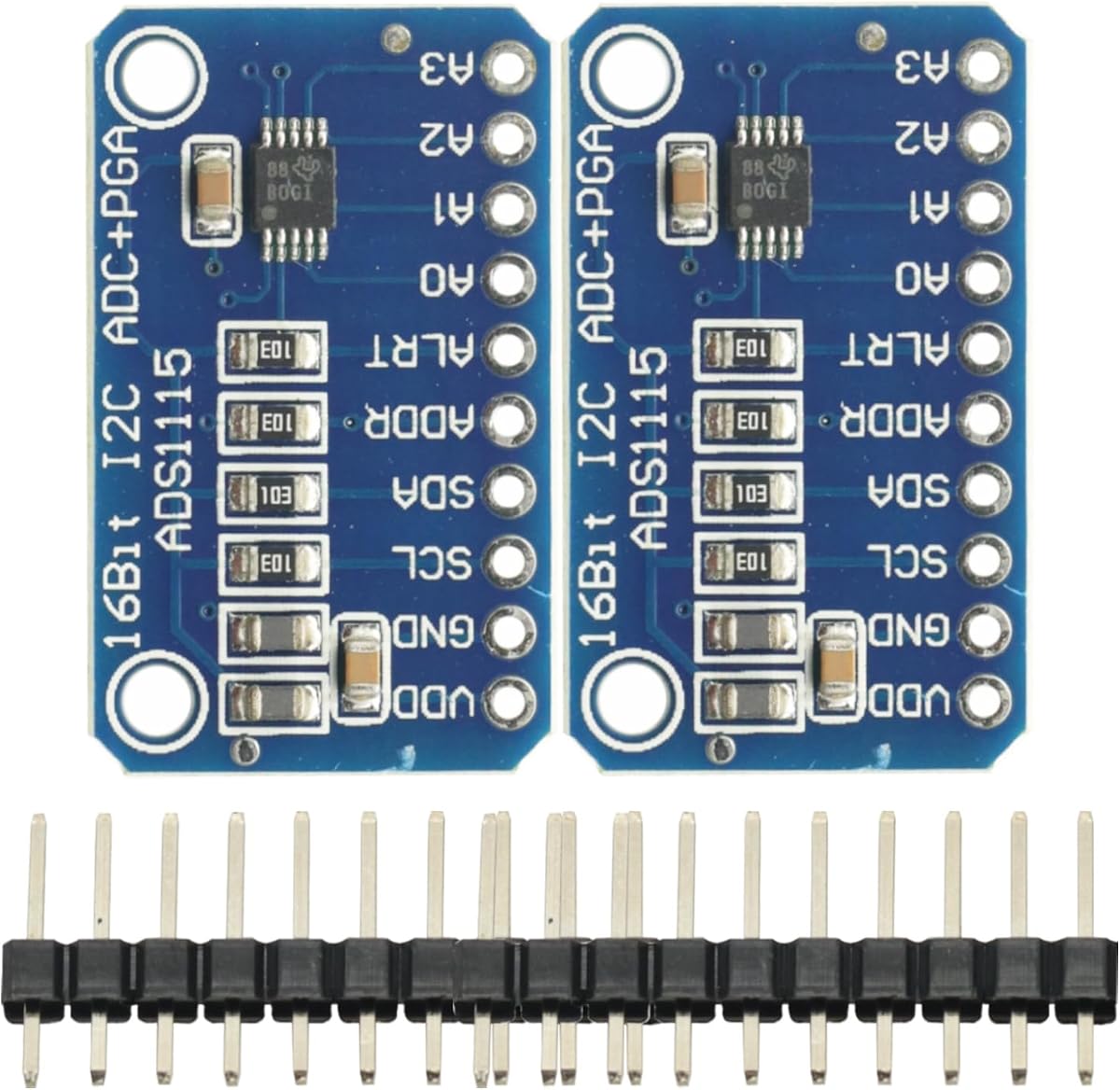
This two-pack of ADS1115 modules offers a straightforward way to add high-resolution analog measurement to Arduino, Raspberry Pi, and other compatible systems. It carries a supplied rating of 5.0, making it one of the strongest feedback scores in this list. The 16-bit converter, four single-ended channels, two differential options, and programmable gain cover the core needs of many educational and maker projects.
We may earn a commission when you buy through this link, at no additional cost to you.
Seven selectable input ranges provide useful flexibility for signals of different amplitudes. The stated ranges extend from ±0.256V through ±6.144V, allowing a builder to zoom in on small variations or accommodate larger signals. A programmable data rate from 8 to 860 samples per second offers another control point: slower rates can suit routine monitoring, while faster settings can follow more responsive sensors.
The board works from 2.0V to 5.5V and communicates over I2C. Its listed seven-bit address range allows multiple modules to coexist when addresses are assigned correctly. The tradeoff is that both boards in the pack still share the capabilities of the ADS1115 architecture, including a relatively modest top sampling rate compared with dedicated high-speed acquisition modules.
Pick this option for a first analog expansion, a classroom exercise, or a two-node monitoring system. It delivers the key ADS1115 functions without introducing a more complex interface. Projects that require rapid waveform capture, eight simultaneous channels, or readings above the stated input limits should move to a board designed for those needs.
Choosing the correct range helps place the useful signal across the converter's available codes. This can improve resolution for low-output sensors without forcing one fixed input window on every channel.
I2C keeps the physical connection compact, requiring SDA and SCL alongside power and ground. The address range also allows carefully configured boards to share a bus without using every available connection.
We may earn a commission when you buy through this link, at no additional cost to you.
The HiLetgo 3-Pack ADS1115 is designed for Arduino and Raspberry Pi users who want several precision analog channels without relying on a controller's limited analog pins. The supplied rating is 4.3. Its 16-bit conversion, four channels, programmable gain amplifier, and I2C interface provide a familiar route to reading potentiometers, resistive sensors, and other voltage-based outputs.
We may earn a commission when you buy through this link, at no additional cost to you.
The broad 2.0V to 5.5V operating supply allows integration with common 3.3V and 5V systems, subject to correct wiring and compatible logic levels. Its single-shot mode automatically shuts the converter down after a conversion, while the programmable data rate spans 8 to 860 samples per second. These are useful features for projects that alternate between occasional readings and more continuous monitoring.
Three modules make the package attractive for multi-sensor installations, classroom groups, or keeping spare boards close at hand. A potential disadvantage is that the listing does not provide the same detailed range and address information as some of the more specification-focused ADS1115 options. Buyers should still verify their library and wiring expectations against the current product documentation.
This pack suits projects that need several independent analog-to-digital converters but do not require high-speed sampling. It is a practical choice for environmental logging, classroom experiments, and basic control systems. Those needing detailed differential ranges or more extensive integration guidance may prefer one of the better-documented alternatives.
The single-shot mode is convenient for projects that do not need continuous conversion. Automatic shutdown can reduce activity between readings, although the overall energy benefit still depends on the complete system.
The three-board format helps learners keep individual experiments separate or assemble a multi-sensor demonstration. It also provides spare units if a module is damaged during prototyping.
We may earn a commission when you buy through this link, at no additional cost to you.
The four-pack ADS1115 4-Channel ADC Converter Board is aimed at projects that need several converter modules, such as distributed monitoring, classroom kits, or multi-sensor installations. Its supplied rating is 4.1, placing it behind several higher-rated products, but the underlying 16-bit ADS1115 feature set remains appropriate for common analog measurement tasks.
We may earn a commission when you buy through this link, at no additional cost to you.
Its important distinction is channel flexibility. The board supports single-ended and differential signals, while the internal PGA helps users adapt conversion sensitivity to the input. A 2.0V to 5.5V supply range covers widely used microcontroller systems, and single-shot mode provides automatic shutdown between readings when appropriate.
The four-board quantity is both the main attraction and the main caveat. A project that only measures one or two voltages may not use every module, and multiple converters on one I2C bus require unique addresses. Users must also plan power and grounding carefully so several active modules do not create noise or communication instability.
Choose this product for a coordinated build involving several analog channels spread across multiple boards. Its flexible inputs and adequate resolution serve most educational and maker applications. For a compact single-board design, use a smaller pack; for precise high-rate acquisition, choose a module with a different converter architecture.
The ability to use single-ended or differential inputs lets one architecture support different sensor arrangements. Plan each channel's common ground or reference arrangement before connecting external circuitry.
Four modules let several students or subassemblies work independently. When placed on separate I2C buses, they can operate without address conflicts and still follow a consistent conversion approach.
We may earn a commission when you buy through this link, at no additional cost to you.
This ADS1115 two-module set combines 16-bit resolution with a detailed set of programmable input ranges, making it a strong all-purpose choice for Arduino and Raspberry Pi projects. The supplied rating is 5.0. It supports four single-ended channels or two differential inputs, and its two included modules provide enough hardware for a compact multi-sensor arrangement.
We may earn a commission when you buy through this link, at no additional cost to you.
The seven selectable ranges run from ±0.256V to ±6.144V. This flexibility lets a builder match the conversion window to a small thermocouple-style output, a potentiometer, or a larger sensor signal. The data rate can be programmed from 8 to 860 samples per second, while the 2.0V to 5.5V supply range supports common embedded systems.
I2C remains the central limitation. Although the converter is capable of 16-bit readings, bus speed and the selected data rate govern how rapidly complete samples reach the microcontroller. If the application is oversampling or follows signals with meaningful high-frequency content, a faster interface and acquisition architecture may be more appropriate.
This two-pack is well suited to a beginner building a first ADC project, a teacher preparing a small sensor station, or a maker adding two precise measurement nodes. It balances detailed specifications with a compact quantity and broad input flexibility, making it one of the most approachable choices in the guide.
Seven input ranges let users select a measurement window appropriate to each signal. Matching that window to the sensor can make small changes easier to distinguish than a single fixed range would.
The two modules can serve separate sensor groups on a shared bus when their addresses are configured correctly. This makes the set useful for compact monitoring nodes without requiring a large converter board.
We may earn a commission when you buy through this link, at no additional cost to you.
The Lonely Binary Gold Edition ADS1115 3-Pack adds polished construction and broad platform guidance to the familiar 16-bit converter architecture. Its supplied rating is 4.4. Each board offers four single-ended or two differential analog channels, six software-selectable input ranges, and 3.3V and 5V logic compatibility.
We may earn a commission when you buy through this link, at no additional cost to you.
The ENIG, lead-free finish is designed to improve solderability and resist oxidation, making the boards more attractive for permanent installations than a throwaway breadboard experiment. Pre-soldered headers allow immediate use with a breadboard or jumper wires, removing one assembly task and reducing the chance of uneven pin connections.
Its standout expansion feature is address selection from 0x48 through 0x4B, allowing as many as four modules on one I2C bus and up to 16 analog channels. The listing also names UNO, Mega, Nano, ESP32, ESP32-S3, ESP8266, Raspberry Pi, Pico, STM32, and BBC micro:bit as compatible platforms, with C++, MicroPython, and CircuitPython library support.
This is the premium pick for builders who value construction, documentation breadth, and a ready-to-wire multi-module set. It works particularly well for IoT monitoring nodes, multi-sensor loggers, and educational projects that may move from a breadboard to a permanent build. A single-channel prototype may not require all three modules, but this remains the most thoughtfully specified option here.
The ENIG finish supports easier soldering and helps protect the board from oxidation over time. Combined with installed headers, it reduces the preparation required before deploying a project.
Four selectable I2C addresses allow up to four converters to share SDA and SCL. That architecture can create a 16-channel system without requiring four separate communication buses.
We may earn a commission when you buy through this link, at no additional cost to you.
The Teyleten Robot AD7606 Module targets a very different use case from the ADS1115 boards: high-speed, multichannel data acquisition. It provides 16-bit resolution across eight independent channels and a stated 200 KSPS sampling rate. The supplied rating is 3.0, the lowest in this guide, so prospective buyers should weigh the specialized capabilities carefully.
We may earn a commission when you buy through this link, at no additional cost to you.
Its input range can be set to ±5V or ±10V, with 1-megohm input impedance and a 2.5V internal reference. The board accepts eight channels through 3.81–8-pin connectors and can provide eight-channel data in serial or parallel form. That combination makes it potentially relevant to waveform monitoring, vibration studies, synchronized sensing, and other applications that need faster capture.
Integration is more involved than using I2C. The module uses SPI for control communication, has 3.3V control signal levels, and offers parallel data output for faster transfer. The Arduino must therefore have appropriate logic compatibility, available pins, and code capable of handling the module's data format. Supplying 5V does not mean every connection can be treated as a 5V logic input.
Choose this board when synchronized high-speed acquisition is central to the project and you are prepared for more involved wiring and firmware. It is not the easiest first ADC board, and its lower marketplace rating deserves attention. For routine sensor logging, an ADS1115 or ADS1256 is generally more convenient.
Eight independent channels sampled together can reveal relationships between simultaneous signals. This is valuable when phase, timing, or event alignment matters in the measurements.
The module can output channel data through serial or parallel paths. Parallel output may move more information quickly, while serial control simplifies some board layouts and firmware routines.
We may earn a commission when you buy through this link, at no additional cost to you.
The four-pack ADS1115 4-Channel I2C A/D Converter is a general-purpose module set for sensor reading, voltage measurement, robotics, monitoring, and educational experiments. It carries a supplied rating of 4.6. Each converter provides 16-bit resolution, four input channels, and a programmable gain amplifier for handling low-voltage sensor outputs.
We may earn a commission when you buy through this link, at no additional cost to you.
The standard I2C interface uses SDA and SCL, which simplifies integration with existing microcontroller systems. The product information identifies Arduino, Raspberry Pi, ESP32, STM32, and other controllers as compatible platforms. This broad support is useful for makers who move between embedded projects or want one ADC architecture across several types of hardware.
Compared with listings that enumerate exact voltage ranges and address options, this description is less technical. The four included modules are nevertheless attractive for parallel sensor stations, classroom sets, and projects requiring spare hardware. As with any multiple-board setup, unique I2C addresses and careful power distribution must be managed.
This pack is a good general recommendation for a maker who wants several standard precision ADC boards without paying for the most specialized acquisition hardware. It suits typical temperature, pressure, light, and analog signal projects. Buyers who need exact input windows or very high sample rates should consult the board documentation and compare them with the more technically detailed ADS1115 alternatives.
Using a standard I2C ADC allows many existing Arduino ADS1115 libraries and examples to serve as a starting point. Confirm that the selected library supports the board's addressing and pin configuration.
The gain amplifier improves the usefulness of low-level sensor outputs. The module is appropriate for common temperature, pressure, light, and resistive sensing tasks where moderate-speed readings are sufficient.
We may earn a commission when you buy through this link, at no additional cost to you.
The HiLetgo single ADS1115 module is a compact way to add high-resolution analog measurement to an Arduino, Raspberry Pi, or another compatible controller. The supplied rating is 4.3. Its 16-bit resolution, four channels, programmable gain amplifier, and two-wire interface cover the fundamental requirements of most analog sensor projects.
We may earn a commission when you buy through this link, at no additional cost to you.
The 2.0V to 5.5V supply range makes the board adaptable to common embedded systems, while its single-shot mode automatically shuts down after conversion. This is useful for battery-operated or intermittently sampled projects. A programmable data rate of 8 to 860 samples per second provides enough flexibility for routine monitoring without pretending to be a high-speed acquisition system.
As a single module, it has a limited expansion footprint compared with the two-, three-, and four-board packs. Adding converters later requires available I2C addresses and careful bus management. Its main advantage is simplicity: a builder can use it for a focused project without carrying unused boards or designing a larger multi-node arrangement.
This is a sensible pick for a first Arduino ADC upgrade, a single sensor node, or a breadboard demonstration. It provides the core ADS1115 experience in a compact form. Projects requiring several independent channels should consider a multi-module bundle, while high-rate synchronized capture belongs in a more specialized board category.
The module adds four precise measurement inputs without requiring a large breakout board. It is a practical way to move potentiometers and analog sensors away from limited controller pins.
Single-shot operation can suit projects that check a sensor periodically rather than continuously. The automatic shutdown function ensures the converter is not left active between conversions.
We may earn a commission when you buy through this link, at no additional cost to you.
Choose an Arduino ADC Board by matching converter resolution, channel count, input range, interface, and sampling speed to the signals your project must measure.
Choose 16 bits for most Arduino sensor projects and 24 bits when the signal range and noise conditions justify greater precision.
Count analog sources first, then reserve capacity for differential pairs and future expansion.
Never connect a sensor solely because the module accepts 5V power; confirm its allowable input range first.
Use moderate ADS1115 rates for routine sensors and choose a high-speed design only for signals that truly require rapid sampling.
Choose I2C for simple, shared-bus projects and SPI or parallel transfer for specialized high-speed acquisition.
Confirm supply voltage, logic voltage, ground connection, and library support before powering the module.
Choose construction quality and included accessories based on whether the board is a classroom experiment or a finished installation.
Prioritize a well-documented library because configuration errors can resemble inaccurate sensor readings.
Begin by identifying the sensor output voltage, ground reference, and required update rate. Connect the board's power and ground to the controller, then wire SDA and SCL to the matching I2C pins for an ADS1115 module. Ensure the logic levels are compatible, and configure the converter's gain and data rate before interpreting the digital readings. For SPI-based boards, follow the module's control and data-pin documentation rather than an I2C wiring pattern.
Read the ADC several times and compare the results with a known voltage or a multimeter before connecting sensitive equipment. Keep analog input wires short where possible, route them away from noisy switching circuits, and use a common ground between the sensor and converter. If a signal is too large, too small, noisy, or outside the supported range, add appropriate conditioning rather than increasing gain blindly.
For care, power the board down before changing wiring and avoid touching the sensor terminals or connector pins. Store modules in a dry, static-safe environment and keep the board away from conductive debris. Periodic checks of connections, calibration results, and temperature behavior are especially useful in data-logging installations. Because a clean digital reading can still represent an inaccurate physical measurement, compare periodically measured results with a trusted reference.
An external ADC board can provide more channels, greater resolution, selectable gain, or faster acquisition than many Arduino models offer. It does not automatically improve every sensor project, because wiring, noise, grounding, and sensor quality still determine accuracy. Use an external board when the required input range, channel count, or measurement speed is not available from the controller.
The ADS1115 provides 16-bit resolution, four single-ended or two differential channels, and I2C communication. The ADS1256 board provides 24-bit resolution, eight single-ended or four differential channels, higher maximum output rates, and a measurement range described as 0–3V. The ADS1115 is usually easier for routine Arduino sensor projects, while the ADS1256 suits more specialized precision acquisition.
Yes, provided the modules have different I2C addresses and the bus can support the combined load. ADS1115 boards commonly expose addresses from 0x48 through 0x4B, allowing up to four modules and 16 single-ended channels on one bus. Correct address selection, common grounds, suitable wiring, and sufficient power are still required.
The difference may come from input range, gain, sensor output impedance, grounding, noise, reference variation, or the meter's own accuracy. A digital reading is not automatically a calibrated measurement. Compare both devices at the same point, verify the conversion settings, and test a known voltage source before assuming the converter is defective.
Yes, when the board is configured for a differential input and a suitable range. The stated bipolar ranges extend from ±0.256V to ±6.144V, but each signal pair must remain within the selected limits and respect the module's input and supply constraints. Do not connect a negative voltage beyond the selected range or any channel input above VDD.
It can be used when its SPI control, 3.3V logic, connector, and data-output arrangement are handled correctly. Its 200 KSPS rate and eight synchronized channels are valuable for high-speed acquisition but make it more complex than a standard ADS1115 module. Routine temperature or potentiometer readings are usually easier with an I2C ADS1115.
Choose a range that includes the expected signal with useful headroom, and avoid a range so broad that the signal occupies only a tiny portion of the available codes. For small variations, a tighter range can improve apparent sensitivity, but it also increases the risk of clipping if the signal exceeds the limit. Confirm readings across the full expected operating range.
No. More resolution can reveal smaller numerical changes, but noise, poor grounding, unconditioned sensor outputs, inaccurate references, and unsuitable analog ranges can still degrade results. Match resolution to the signal, use the appropriate gain, keep wiring short, and validate readings against a known reference for dependable measurements.
The Teyleten Robot ADS1115 3-Pack stands out as the balanced overall choice because it combines 16-bit resolution, four channels, programmable gain, a useful sampling range, and three modules. The ADS1115 two-pack options are excellent for accessible projects, while the Lonely Binary Gold Edition set is the most polished option for permanent multi-sensor builds.
Prioritize the specification that directly affects your measurements: input range for signal safety, resolution for small changes, channel count for sensor quantity, and interface or sampling rate for data throughput. Specialized acquisition needs point toward the ADS1256 or AD7606, whereas everyday sensor monitoring is best served by an ADS1115.
Before purchasing, verify the current product listing, documentation, library compatibility, and included accessories. Specifications and marketplace conditions can change over time, so compare the live listing with the requirements of your project rather than relying only on a general recommendation.