
Garpsen Clip-On Grow Light
4.7Editor score
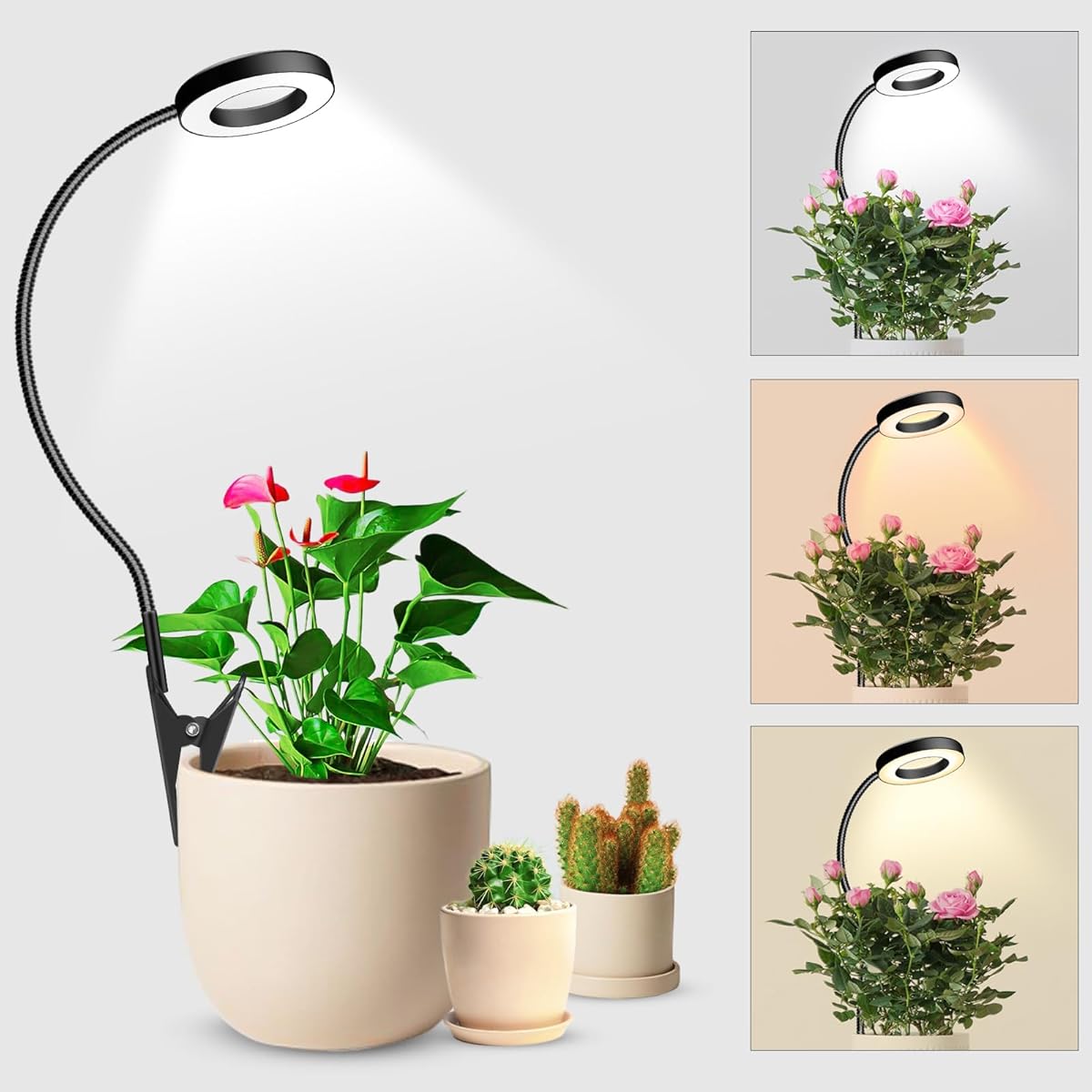
52 full-spectrum LEDs
Six brightness levels
Three lighting modes
360-degree gooseneck
Our clip on LED grow lights guide compares ten indoor plant lights for brightness, timers, adjustability, spectrum, heat control, and ease of use.
Clip on LED grow lights provide a convenient way to supplement daylight for indoor plants, seedlings, herbs, and compact growing setups. The best models combine useful light output, adjustable positioning, straightforward controls, effective heat management, and a secure clamp that can attach to a pot, shelf, or other suitable support.
This guide compares ten clip on LED grow lights using the supplied product information, focusing on LED arrangement, spectrum options, timer settings, dimming controls, gooseneck flexibility, power requirements, heat dissipation, and intended applications. It covers single-head, dual-head, and multi-head designs for everything from small succulents to larger indoor plants.
Each review explains the product's most useful features, practical limitations, and ideal buyer, helping you match a fixture to your space and routine. Ratings reflect the supplied customer feedback, while product availability, configurations, and prices can change, so verify the latest listing before purchasing.
4.7Editor score

4.6Editor score

4.3Editor score
The comparison below highlights the key differences among all ten clip on LED grow lights, including light configuration, controls, flexibility, and power design.


The Eqqiuped 168-LED four-head system earns the Editor's Choice position because it combines unusually broad coverage with precise control over spectrum and intensity. Its supplied rating is 4.5, and the two-pack includes two light bars, each containing five red LEDs and 37 sunlight-white LEDs. That four-head format is the defining feature: it can spread light across a wider plant area than a single clip-on head without requiring several unrelated fixtures.
We may earn a commission when you buy through this link, at no additional cost to you.
The controls are among the most granular in this list. Users can select full-spectrum white-plus-red light, red-only illumination, or white-only illumination, then choose from ten brightness levels. The 3-, 9-, and 12-hour cycle memory repeats the selected schedule each day as long as power remains connected. Red is presented as useful for flowering, fruit, and leaf development, while white supports vegetative and structural growth.
Each bar has a flexible 360-degree gooseneck and sturdy clip, allowing the heads to be aimed toward separate parts of a plant or across a shelf. The trade-off is physical bulk. Four heads in a two-pack can take up more room than a single-head lamp, and the listed design appears to require a wired power connection. Its full-spectrum claims should also be understood as a combination of white and red LEDs rather than a fully customizable multi-band system.
This is a strong choice for home growers who want abundant adjustability and broad coverage from a two-pack. It is particularly appealing for mixed plant shelves, compact vegetable arrangements, and anyone willing to reposition the heads as plants develop. Buyers seeking the simplest clamp design may prefer one of the smaller SANSI models, but the Eqqiuped system is the most feature-rich configuration here.
The four-head layout distributes light over a larger area and can be aimed at multiple pots. This is useful when a single narrow beam would leave the edges of a plant canopy underlit.
Three spectral modes and ten dimming levels allow the output to be adjusted for seedlings, leafy growth, flowering, and fruiting. The automatic timer reduces the need for daily manual switching.
We may earn a commission when you buy through this link, at no additional cost to you.
The Upgrade 96-LED Halo stands out for its unusual dual-circular lamp head and a supplied rating of 4.6. Rather than relying on one conventional bar, it uses a halo arrangement intended to focus illumination over a plant while remaining visually tidy. The light contains 90 white LEDs and six red LEDs, balancing a strong white component with a smaller red supplement.
We may earn a commission when you buy through this link, at no additional cost to you.
Its 360-degree adjustable gooseneck and anti-slip clamp make placement straightforward, while the 78.74-inch cord adds flexibility when the power outlet is not close to the plant. The aluminum circular lampshade is designed to improve heat dissipation, a valuable feature for a light that may operate for many hours near foliage. The modern appearance also allows it to blend more naturally into a living room or office than a utilitarian strip.
Controls include three lighting modes and five brightness levels spanning 20% to 100%. Its timer offers 6-, 12-, and 16-hour cycles, which differs from the more common 3-, 9-, and 12-hour schedule. That longer maximum cycle is useful for plants receiving substantial supplemental light, although users should still consider the plant's needs and avoid leaving the fixture in a position that encourages excessive heat. The halo shape may also be less effective for a wide shelf of many small pots.
Choose this model when one attractive lamp per plant or small grouping is the goal. It is a good match for seedlings, herbs, indoor flowers, succulents, and balcony or greenhouse use where a focused but generous pool of light is useful. Its long cord, solid clip, and understated design make it especially practical for home growers who value flexibility and appearance.
The dual-ring design spreads light around the target plant while maintaining a compact profile. It offers a middle ground between a narrow spotlight and a broad multi-head bar.
A 78.74-inch power cable makes it easier to reach a plant positioned away from the nearest outlet. The aluminum housing adds practical heat management for extended daily use.
We may earn a commission when you buy through this link, at no additional cost to you.
The SANSI 20W Gooseneck is the premium technical choice in this group, with a 4.4 supplied rating and a design centered on optical efficiency, ceramic thermal management, and replaceability. Its secondary optical design is stated to provide 402 μmol/s/㎡ at one foot. It covers 400nm to 780nm with 4000K daylight and a color-rendering index close to 100, targeting plants throughout their growth cycle.
We may earn a commission when you buy through this link, at no additional cost to you.
The 360-degree gooseneck allows the light to surround a plant rather than approach from only one fixed direction. This is useful for compact indoor gardens where uniform exposure around the canopy is important. SANSI's Chip on Ceramic technology places the LED chip directly on a non-conductive ceramic heat sink, reducing thermal resistance and supporting a stated 25,000-hour lifespan for the grow bulb.
The most distinctive practical benefit is bulb replaceability. Instead of discarding the entire fixture when an LED source fails, the user can replace the grow bulb. That improves long-term usability and reduces waste. The trade-off is that the product data gives detailed electrical and optical specifications but does not describe programmable dimming, selectable spectral modes, or a built-in cycle timer. Buyers who require automated schedules may need to manage those separately.
This SANSI model is best for a serious indoor grower who prioritizes output quality, replaceable components, and full-spectrum coverage over compactness or simple integrated controls. It is well suited to plants requiring stronger or more uniform supplemental light, while the maximum safety rating of 10 watts per head is an important installation consideration. It is the top pick for shoppers seeking a more technical, serviceable fixture.
A replaceable grow bulb means a failed light source does not require replacing the complete clamp assembly. This design can reduce waste and make long-term maintenance more practical.
The ceramic heat-sink technology is intended to move heat away from the LED junction more effectively. Its claimed 25,000-hour bulb lifespan makes it attractive for regular, long-term indoor use.
We may earn a commission when you buy through this link, at no additional cost to you.
The bseah Clip-On Desk Light combines a 4.5 rating with a familiar set of controls that will appeal to first-time grow-light users. It is designed for indoor garden plants and positions the light through a clamp, flexible gooseneck, and compact head. The product is particularly relevant to desks, plant stands, and small home setups where a dedicated hanging fixture would be inconvenient.
We may earn a commission when you buy through this link, at no additional cost to you.
Its main attraction is control. Ten dimming levels provide finer adjustment than most competing models, while three lighting modes can be matched to plant stage and season. A cycle-memory timer provides 3-, 9-, or 12-hour operating periods and repeats the selected schedule each day when power remains connected. The 360-degree gooseneck makes it simple to reposition the lamp after new leaves or stems change the plant's shape.
The specification set is less quantitative than that of some competitors. It does not list an LED count, PPFD, power draw, cord length, or heat-sink construction, so buyers cannot directly compare its output with more technical fixtures. The supplied information does state that the company provides up to 24 months of warranty service, though availability may depend on the purchase location and seller. Its uncluttered design remains a positive for buyers who prioritize simplicity.
This bseah light is a sensible pick for desk plants, small flowering houseplants, and growers who want automatic scheduling with a high degree of brightness control. It may be less compelling for technical users comparing light output at a precise distance, but for everyday supplemental lighting it offers the most important functions in an approachable package.
Fine brightness steps make it easier to start with lower illumination and increase it as a plant develops. This is particularly useful for seedlings and plants adjusting to supplemental light.
Once configured, the 3-, 9-, or 12-hour schedule repeats automatically each day. That reduces the need to remember daily switching, provided the light stays connected to power.
We may earn a commission when you buy through this link, at no additional cost to you.
The SANSI 5W Pot Light two-pack is designed for small indoor plants and compact spaces, earning a 4.5 supplied rating. Each light delivers 5 watts and is rated at 35.78 μmol/s/㎡ when positioned six inches from the plant. The focus is not maximum output, but efficient, low-voltage illumination that can be attached neatly to a pot without taking over the surrounding area.
We may earn a commission when you buy through this link, at no additional cost to you.
The 4000K natural-light color is designed to remain comfortable for indoor use, and SANSI's ceramic technology is incorporated into the light source. A 360-degree gooseneck and spring clip make the fixture easy to install on a pot and direct toward the foliage. The claimed applications include succulents, aloe vera, devil's ivy, calibrachoa, African violets, and other compact houseplants.
A built-in timer offers 3-, 6-, or 12-hour cycles, paired with four brightness levels of 25%, 50%, 75%, and 100%. The 5-volt input can be powered through a suitable power bank, laptop, or computer, which is convenient but means the light is not a standard plug-in fixture. Compared with higher-output models, the 5-watt version is better suited to smaller plants positioned close to the source and less appropriate for a dense, large canopy.
This product is a good match for apartment dwellers, office desks, and anyone lighting multiple small pots. The two-pack lets the user place a light in each location rather than stretching one fixture across a large room. For stronger output over mature foliage, choose the 10-watt SANSI option; for compact decor and convenient USB-powered placement, this model is the more balanced choice.
The 5-volt system can draw power from common USB-compatible sources. That makes the fixture easy to incorporate where a conventional outlet is inconvenient.
At five watts, the fixture is designed for compact houseplants and close positioning. It offers a practical alternative to large grow bars when only a small canopy needs supplemental light.
We may earn a commission when you buy through this link, at no additional cost to you.
The SANSI 5W Two-Pack shares the compact architecture of the preceding model but earns a higher supplied rating of 4.6. It includes two 5-watt pot clip lights, each producing 35.78 μmol/s/㎡ at six inches. The two-light format is especially useful for balancing plants in separate locations, such as pots on opposite sides of a desk or two shelving units that cannot share a single lamp.
We may earn a commission when you buy through this link, at no additional cost to you.
Each fixture includes a 360-degree gooseneck, an easy-install clamp, a 3-, 6-, or 12-hour timer, and four brightness levels. Its 4000K color temperature is presented as natural and comfortable for an indoor environment. Low-voltage 5V power makes it possible to use compatible computers, laptops, or power banks, while the ETL listing provides a stated layer of quality and safety verification.
The core limitation is output. This model is scaled toward succulents, aloe vera, African violets, calibrachoa, devil's ivy, and similarly compact plants. It is not intended to replace a high-output fixture for a large, dense canopy. The four brightness steps are also fewer than the ten offered by the Eqqiuped and bseah models, although the lower starting level of 25% provides cautious control for sensitive growth stages.
This two-pack is one of the strongest choices for small-space plant collections, particularly for people who want two separate fixtures without moving a single light between locations. Its 4.6 rating, low-voltage convenience, and two-year service make it a reassuring option for routine indoor use. Choose a higher-output model when the plants are large, deeply rooted, or located farther from the fixture.
Using two separate lights lets growers illuminate different pots without repeatedly repositioning one unit. This is helpful for balanced plant rooms or compact indoor collections.
SANSI states that it offers a two-year service and online support. Buyers should use the seller's messaging channel for setup questions or service requests.
We may earn a commission when you buy through this link, at no additional cost to you.
The wolezek Two-in-One Light is the most installation-flexible model in the list, with a supplied rating of 4.5. Its defining feature is the ability to clamp the fixture to a pot or insert it into potting soil using the provided configuration. That gives the user more freedom when a rim is too narrow, the plant is in an unconventional container, or a traditional desk clip cannot reach the intended position.
We may earn a commission when you buy through this link, at no additional cost to you.
Three lighting options cover a broad stated range from 660nm to 6500K. The flexible 360-degree gooseneck positions the source at different angles, while five brightness levels allow output to be adapted to growth stage and viewing preferences. Timers can be set for 6, 12, or 16 hours, providing a long maximum cycle for plants that benefit from a substantial daily light period.
Heat management comes from an aluminum-alloy housing intended to dissipate heat efficiently. The 80.7-inch cord adds freedom in positioning, and the product listing mentions comprehensive 12-month warranty support and lifetime assistance. As with several other clip lights, no LED count, PPFD, or power figure is provided, making it harder to compare output quantitatively with models that publish those measurements.
This wolezek light is best for growers who value mounting options or need to place a lamp inside a densely planted pot. It works for seedlings, flowers, herbs, and compact vegetables in homes, balconies, greenhouses, or offices. Those who need a documented PPFD value may prefer a SANSI or Barrina model, but the two-in-one mounting design remains genuinely useful in awkward spaces.
The ability to clamp or insert the light allows it to fit a wider variety of pots and growing arrangements. This is particularly helpful for unusual containers and densely planted soil.
The three selectable color temperatures allow the user to shift the appearance and emphasis of the light. They can be matched to seedlings, vegetative growth, flowering, and fruiting needs.
We may earn a commission when you buy through this link, at no additional cost to you.
The Barrina Orbgrow OG11A2 is the most output-focused clip light here and carries a supplied rating of 4.3. Its 22-watt lamp produces 1,550 lumens, and the stated PPFD reaches 1,980.5 μmol/m²/s at a height of 3.94 inches. Thirty-six high-efficiency chips provide the intense light needed for indoor plants across multiple growth stages.
We may earn a commission when you buy through this link, at no additional cost to you.
A major differentiator is stepless dimming. Instead of jumping among a small set of preset levels, the integrated control permits smooth brightness adjustment. Three timer settings of 4, 8, and 12 hours are available, and each bulb can be configured independently. The E26 socket also accepts replaceable grow bulbs, improving long-term flexibility and potentially allowing compatible bulbs to be swapped in.
The fixture provides full-spectrum light with a CRI of 98 and a 5000K color temperature. A plastic-and-aluminum cooling system manages heat, but the specified minimum canopy clearance of 7.87 inches is important. Although the quoted PPFD is measured at only 3.94 inches, the product guidance calls for at least 7.87 inches above the canopy, so buyers should understand the distinction and follow the recommended distance. Its high output also makes careful positioning essential.
Choose the OG11A2 for experienced indoor growers, compact high-light setups, or a plant collection that needs powerful supplemental illumination with precise dimming. It is less suitable for beginners who want a forgiving fixture with minimal heat and distance considerations. Even with the lowest rating in this group, its output metrics, replaceable socket, and stepless control justify a place on the shortlist.
Continuous brightness adjustment gives the user finer control than four- or five-level fixtures. This is helpful when moving between seedlings, mature foliage, and flowering plants.
The E26 base makes bulb replacement straightforward and allows compatibility with other compatible grow bulbs. This can extend useful service and simplify future upgrades.
We may earn a commission when you buy through this link, at no additional cost to you.
The SANSI 10W Two-Pack combines a 4.6 rating with one of the strongest published output figures among the clip-on products in this guide. Each 10-watt light provides 169.7 μmol/s/㎡ at six inches, and the set includes two fixtures. This makes it a more capable option than the 5-watt SANSI models while retaining a straightforward clamp-and-gooseneck format.
We may earn a commission when you buy through this link, at no additional cost to you.
SANSI emphasizes uniform light distribution, noting that even coverage can help avoid stretched growth caused by uneven illumination. The 360-degree gooseneck allows each lamp to be aimed around a plant, while the clamp installs directly on a pot without an additional piece that might damage the container. Each light offers four brightness settings at 25%, 50%, 75%, and 100%, along with 3-, 6-, and 12-hour cycle timers.
The two-pack increases placement flexibility because the lights can serve separate plants instead of illuminating one canopy from different angles. That can be a major benefit in a multi-pot setup. The trade-off is that 10-watt heads are larger and more powerful than the 5-watt version, so they need more deliberate positioning and adequate separation from foliage. The supplied information also does not mention a power source, so buyers should verify compatibility with the complete package.
This set is an excellent choice for indoor plant enthusiasts who want a meaningful increase in light without moving to a large freestanding bar. It is well suited to multiple medium-sized potted plants, compact vegetable arrangements, and growers prioritizing uniformity. It deserves a place near the top of the list for its published output and two-light flexibility, even if its dimming interface is not as granular as some alternatives.
A 10-watt output provides a useful middle ground between compact 5-watt lights and high-intensity fixtures. It is suitable for potted plants that need more support than a small desk lamp can provide.
Even distribution helps ensure that light reaches multiple sides of the canopy. Adjusting each gooseneck allows the two lights to be aimed without moving the pots themselves.
We may earn a commission when you buy through this link, at no additional cost to you.
The Garpsen 52-LED Light is a strong entry-level pick, carrying the highest supplied rating in the group at 4.7. It provides 6000K full-spectrum illumination through 52 LEDs, designed for flowers, herbs, mint, succulents, seed germination, bonsai, and other small indoor plants. The rectangular head is intended to create a broad lighting area over a compact canopy.
We may earn a commission when you buy through this link, at no additional cost to you.
Installation is flexible. Stable clips allow attachment to a flowerpot or table, while additional accessories permit insertion into potting soil. A smart controller supplies five brightness levels, three color modes, and automatic 6-, 12-, or 16-hour timing. The 360-degree gooseneck is 21 inches long, and the 10-foot power cable provides ample reach from many outlet positions.
The product is also described as useful as a work or reading light, with a color-rendering index of up to 95%. That makes it more versatile than a fixture intended only for narrow plant use. On the other hand, it does not provide PPFD, power consumption, or a detailed heat-sink specification. As a result, it is difficult to compare its intensity quantitatively with the SANSI or Barrina products, and its 52-LED array is likely aimed more at small plants than dense canopies.
This Garpsen model is ideal for beginners, renters, and owners of small plant collections who want adjustable light without a complex installation. It is particularly good for a desk, hanging planter, or small pot where broad coverage matters. Choose a higher-output model for mature, dense plants or larger growing spaces, but for everyday indoor supplemental lighting, this is a capable and approachable choice.
Pot clipping and soil insertion provide alternatives for different containers and plant sizes. This makes the light easy to adapt as a plant is transferred or rearranged.
The 21-inch gooseneck and 10-foot cord offer plenty of positioning flexibility. The light can be directed at a plant without requiring the pot to sit directly beside an outlet.
We may earn a commission when you buy through this link, at no additional cost to you.
A useful clip on LED grow light should fit your plant, placement, and lighting routine rather than simply provide the largest listed LED count. Consider output, coverage, spectrum, controls, heat management, power, and mounting flexibility before making a selection.
Begin by matching light output to the size and type of plant. Small succulents, seedlings, herbs, and compact houseplants may be well served by a 5-watt pot light, while medium-sized plants benefit from a 10-watt fixture or a multi-head bar. High-output models can support more demanding indoor growth, but they require careful distance and heat management. A larger LED count alone does not provide a complete comparison because diode quality, lens design, wattage, and measurement distance also affect usable light.
Choose a lower-output compact light for small pots, or a higher-output model for larger canopies and multiple plants.
PPFD is a more informative specification for plant-facing products than a bare wattage or LED count, provided the distance is clear. The SANSI products publish PPFD at six inches, the 20-watt SANSI at one foot, and the Barrina at 3.94 inches. These figures cannot be compared directly without noting the measurement distance. Even distribution and adjustable goosenecks also matter because a bright center beam does not guarantee full-canopy coverage.
Prioritize documented PPFD, canopy coverage, and adjustable positioning rather than comparing isolated wattage figures.
Full-spectrum light combines wavelengths used during different plant growth stages. Most of the listed fixtures combine white and red LEDs, while the wolezek model offers color options stated to range from 660nm to 6500K. Red light is associated with flowering, fruiting, and leaf development, whereas white light supports vegetative and structural growth. A selectable full-spectrum mode is usually the most convenient general option, with single-color modes available when targeted adjustment is desired.
Select full-spectrum mode for routine use, then use red or white modes selectively when the plant's stage or setup benefits from a narrower emphasis.
Automatic timers make a grow light much easier to maintain. Cycle-memory functions repeat the same schedule each day, but options range from short 3-hour cycles to 16-hour cycles. Dimming is equally important because seedlings and tender foliage may need less light than mature plants. Preset levels are convenient, while Barrina's stepless control provides finer adjustment. When comparing products, check whether the timer repeats automatically, how many brightness levels are offered, and whether the controls are accessible on the fixture.
Look for a daily cycle timer and enough dimming range to lower output during sensitive growth stages.
The mounting system determines whether a light can be positioned effectively. A secure clamp with a 360-degree gooseneck is useful for pots, shelves, and plant stands, while soil insertion may suit containers with narrow rims. Long cords provide additional freedom when the nearest outlet is inconvenient. Buyers should also consider the neck length and head size: a bulky multi-head system can cover more plants but may crowd a compact desk or shelf.
Choose a stable clamp, flexible neck, and adequate cord length for the exact spot where the plant will remain.
LEDs produce less heat than many older lighting technologies, but close, continuous operation can still generate warmth. Products in this list use aluminum housings, circular aluminum shades, or plastic-and-aluminum cooling systems. The Barrina's high-output design specifically calls for a minimum distance of 7.87 inches above the canopy, demonstrating why clearance should be checked. Always follow the manufacturer's positioning guidance and avoid placing a hot light where it could damage foliage or create an electrical hazard.
Verify the recommended canopy distance and favor a fixture with a documented cooling system for long daily schedules.
Power requirements affect where the light can be installed. Some products use standard cords, while SANSI's 5-watt models use a 5-volt input compatible with power banks, laptops, and computers. Replaceable bulbs can extend useful life, as offered by the SANSI 20W and Barrina E26 designs. Certifications and warranty terms provide additional reassurance, but buyers should verify the details on the current listing, especially for multipacks and region-specific service.
Check connector type, replaceable components, safety certifications, and warranty coverage before installing a permanent setup.
Begin by evaluating the plant's existing light exposure, growth stage, and the area where the fixture will be installed. Set the lamp on its lowest brightness, attach the clamp securely without damaging the pot, and position the gooseneck so the head faces the foliage evenly. For soil-insertion models, use the support carefully and avoid disturbing roots. Before selecting a timer duration, consider the plant's species, season, and how much natural light it already receives.
After positioning the light, choose the most appropriate spectral mode and increase brightness gradually while observing the plant. Full-spectrum mode is a practical starting point for many indoor plants. Red or white emphasis modes can be used when the product instructions support them and the plant's stage warrants adjustment. Keep the manufacturer's distance guidance in mind, especially with high-output models, and move the lamp if the leaves become warm or show signs of stress.
For maintenance, switch off and unplug the fixture before repositioning it, wiping the lamp head, or adjusting the clamp. Clean dust from the housing and LEDs so that airflow and light distribution are not obstructed. Inspect the cord and connection for damage, and never leave water where it can contact electrical components. Replaceable bulbs should be installed according to the product instructions, and recurring schedules should be reset after any major power interruption.
The ideal distance depends on the fixture's output and the manufacturer's guidance. Compact 5-watt lights are often positioned around six inches from small foliage, while the Barrina 22-watt model calls for at least 7.87 inches above the canopy. Start with a conservative distance, watch the leaves for heat stress, and adjust brightness when close placement is required.
A plant's need for supplemental light depends on its species, growth stage, season, and available daylight. Many listed fixtures support 12- or 16-hour schedules, but a longer timer does not automatically mean longer exposure is better. Start with a shorter period and increase it only when the plant's response and local conditions justify more illumination.
No. LED count is only one part of overall light performance. Wavelengths, power consumption, lens design, PPFD, heat dissipation, and light distribution also influence how effectively a fixture supports plants. A 52-LED model may be appropriate for a small pot, while a lower-count high-output fixture may deliver more usable light at the correct distance.
Full-spectrum lighting combines white and red output for a broader range of plant growth needs. Red-only modes concentrate the fixture on the wavelengths commonly associated with flowering, fruit development, and certain leaf responses, while white-only modes emphasize vegetative and structural growth. The best general-purpose setting is usually full spectrum, with targeted modes used according to the plant and product guidance.
Replaceable bulbs can extend the fixture's useful life because only the light source needs replacement if it fails. They may also make future upgrades easier. Integrated panels can offer a cleaner design and fewer replaceable parts, so the best choice depends on your priorities for longevity, appearance, and long-term maintenance.
Modern LED fixtures generally produce less heat than older incandescent or halogen grow lamps, but heat can still accumulate when a lamp is very close to foliage or enclosed. Models with aluminum housings or other cooling systems are designed to dissipate heat. Keep the fixture at the specified distance and adjust its angle or brightness if leaves become warm, discolored, or stressed.
Use separate lights when each plant needs its own close, evenly distributed source or when pots are too far apart for one fixture. A two-pack can also balance illumination across a shelf. If several small plants sit close together beneath a broad multi-head bar, one larger system may be more space-efficient than several individual clips.
That depends on the fixture's power design and the smart plug's requirements. Standard plug-in models may work with a compatible smart plug, provided it supports the lamp's load and can switch the power safely. Low-voltage USB lights require a compatible smart plug, power adapter, or other controllable power source. Always follow electrical instructions and avoid using a smart plug beyond its rated capacity.
The Eqqiuped 168-LED system is the most versatile pick, combining four adjustable heads, ten brightness levels, three spectral modes, and a daily timer. The Garpsen 52-LED light offers an approachable starting point with flexible mounting and a high supplied rating, while the SANSI 10W Two-Pack delivers a stronger balance of output, uniformity, and separate placement for serious indoor growers.
Your priority should reflect the plants and space. Choose a compact 5-watt fixture for small pots, a documented higher-output model for a larger canopy, and a multi-head or two-pack arrangement when several plants need light. Timers, dimming, gooseneck adjustment, and thermal design are just as important as the headline LED count because they determine how consistently the light can be delivered.
Before purchasing, confirm the current product configuration, power requirements, included accessories, dimensions, and placement guidance on the latest listing. Customer ratings and prices can change over time, and marketplace inventory may vary. Comparing those current details will help you select the clip on LED grow light that best fits your plants, room, and daily routine.