
Garage Door Opener Surge Protector
4.7Editor score
900-joule surge protection
Single standard grounded outlet
UL Listed safety listing
Compare surge protector for garage door opener options in this guide, which reviews 10 point-of-use and whole-home devices for protection, compatibility, and
A garage door opener contains a motor, circuit board, sensors, and remote-control components that can be vulnerable to power spikes. A suitable surge protector adds a layer of defense, but installation method, electrical ratings, grounding, and outlet compatibility matter more than brand names alone.
This guide compares ten point-of-use and whole-home surge protective devices, including products purpose-built for garage door openers and multipurpose models that support them. The evaluation considers surge capacity, voltage handling, safety listings, installation requirements, outlet availability, and suitability for residential use.
Each review explains the product's most useful features, practical limitations, and ideal buyer. The list also shows where a compact outlet protector differs from a panel-mounted device, while current pricing, availability, electrical codes, and installation requirements should always be confirmed before purchase.
4.7Editor score

4.8Editor score

4.6Editor score
The table below compares all ten products by protection rating, electrical capacity, installation style, and the features most relevant to garage door opener owners. Point-of-use models offer focused protection, while panel-mounted devices are broader electrical-system investments.




The Garage Door Opener Surge Protector is a purpose-built option for owners who want focused protection without installing a panel-mounted system. Its 4.7 rating reflects a favorable customer history, while the straightforward design makes it particularly easy to understand. The device plugs into a standard grounded outlet and is designed for a single garage door opener.
We may earn a commission when you buy through this link, at no additional cost to you.
Its principal strength is clarity. The product provides 900 joules of surge protection, uses a 15A/125VAC/1,875-watt rating, and includes an LED indicator that shows when protection is active. The manufacturer also states that it works with standard garage door openers regardless of brand, which simplifies the buying decision when the exact opener model is known to be conventional.
The main limitation is scope. This is a single-outlet protector, so it does not create additional receptacle space or protect unrelated equipment. Its 900-joule rating is also below several multipurpose alternatives in the comparison. It also cannot address every electrical issue, such as persistent undervoltage, damaged wiring, or an improperly grounded outlet.
This is a sensible choice for a straightforward garage with a dedicated grounded receptacle and one opener. Buy it when the goal is affordable, recognizable protection at the point where the opener plugs in. For broader household coverage, a higher-capacity multipurpose strip or a panel-mounted SPD may be the better investment.
Because this model is designed specifically for one garage door opener, it avoids the ambiguity of a general-purpose power strip. Its single-outlet layout also helps prevent accidental overloading.
The built-in LED offers a quick way to check whether the protector remains active. Periodic visual inspection is sensible, especially after a severe electrical event.
We may earn a commission when you buy through this link, at no additional cost to you.
The Fosmon Refrigerator Surge Protector is the most feature-rich point-of-use product in this guide. It carries a 4.8 rating and combines surge suppression with high-voltage, low-voltage, delay, and normal-operation indicators. That combination makes it useful for a garage door opener as well as the other appliances named by the manufacturer.
We may earn a commission when you buy through this link, at no additional cost to you.
The protector is rated for 120VAC and 15A appliances, with a maximum motor load of 1/3 horsepower and a 1,875-watt capacity. Its 140-joule energy rating and 1,200V clamping voltage provide a defined response to voltage spikes, while the four LEDs make unusual power conditions easier to recognize than a single operating light would.
Its most distinctive feature is the three-minute restart delay after an out-of-range voltage event. The manufacturer designed this feature to avoid rapid power cycling that could stress refrigerator compressors. It may temporarily interrupt power to a garage opener, but that delay can also give connected electronics a controlled restart rather than an immediate return after a disruption.
This is a strong pick for an owner who values diagnostics and broad appliance compatibility. It is less compelling for someone seeking the highest available point-of-use surge capacity, since its 140-joule rating is comparatively low. Even so, the combination of voltage monitoring, clear indicators, and controlled restart behavior makes it the most versatile model here.
Four separate indicators distinguish normal operation, high voltage, low voltage, and delay mode. This gives users more diagnostic information than a basic protected or unprotected light.
The three-minute delay prevents immediate power restoration after an out-of-range event. That behavior supports controlled restarts, although owners should be prepared for a temporary interruption.
We may earn a commission when you buy through this link, at no additional cost to you.
The SURAIELEC Single Outlet Surge Protector offers one of the strongest surge-energy ratings among the compact point-of-use products considered. Its 4.8 rating reflects strong customer satisfaction, and the 1,470-joule capacity separates it from lower-rated appliance protectors. It plugs directly into a wall outlet rather than requiring a separate power cord.
We may earn a commission when you buy through this link, at no additional cost to you.
The device uses 900V clamping voltage and is rated for 15A/1,875W. Its flame-retardant casing and ETL Listing add a clear safety focus, while the LED indicates whether surge suppression remains active. The compact form is also useful behind appliances or in locations where a long strip would be inconvenient.
Compared with the feature-rich Fosmon model, this protector lacks explicit high-voltage, low-voltage, and restart-delay indicators. It is therefore better suited to a buyer who prioritizes joule capacity, compact construction, and straightforward surge protection rather than detailed voltage monitoring. The single-outlet format also means it does not add usable receptacles.
Choose this model when space is limited, the outlet is already conveniently located, and you want more surge capacity than a basic dedicated opener protector. Confirm that the garage opener's plug and current draw fit the product's rated outlet and that the wall connection is properly grounded.
The 1,470-joule rating provides a substantial capacity buffer for a garage door opener. It is one of the strongest specifications offered by the compact products in this roundup.
Its compact wall-plug design can be easier to accommodate than a corded strip. The single outlet also keeps the installation visually uncluttered.
We may earn a commission when you buy through this link, at no additional cost to you.
The Fosmon Three Outlet Protector is a multi-outlet wall adapter designed for appliances and electronics, including garage door openers. Its 4.7 rating indicates a positive customer reception, and the package includes two protectors. That configuration can be useful across separate areas of a garage, workshop, laundry room, or home.
We may earn a commission when you buy through this link, at no additional cost to you.
Each adapter provides three grounded outlet positions and 1,200 joules of surge protection. The three-prong plug is rated for 15A and 1,875W on a 125V circuit, and protected LED indicators communicate operating status. The product conforms to UL 498A and UL 1449 standards, adding useful context for buyers who pay attention to independent safety testing.
The tradeoff is that all three outlets share the adapter's overall electrical capacity. It should not be treated as an unlimited source for several high-draw appliances. Its wall-adapter form may also block the original receptacle more completely than a low-profile single protector.
This is a practical choice for a garage with limited wall-outlet space or for owners who want to protect several appropriately rated devices in one location. The two-pack adds flexibility, but a garage door opener remains the device that should be connected to the most heavily loaded or critical circuit.
The three-outlet configuration turns one wall receptacle into a compact protected power center. That can simplify setups where several low-draw devices share a workbench.
Two adapters allow protection in separate rooms or work areas. The product's stated compliance with UL 498A and UL 1449 also supports informed safety comparisons.
We may earn a commission when you buy through this link, at no additional cost to you.
The Eaton Tripp Lite IBAR2-6D is a premium point-of-use protector built for demanding garage, workshop, industrial, and electronics applications. Its 4.6 rating is slightly lower than several compact models, but the product distinguishes itself with a rugged all-metal housing, two outlets, and a 1,410-joule surge rating.
We may earn a commission when you buy through this link, at no additional cost to you.
Its patented isolated filter bank is designed to limit noise interaction between connected devices, while the manufacturer states that it blocks EMI/RFI line noise up to 80 dB. A 12A circuit breaker provides automatic shutoff if the protection circuit is incapacitated, adding another layer of safety management.
Installation flexibility comes from a six-foot AC cord, keyhole mounting slots, and a right-angle plug. These details make it easier to place the unit in a workshop or near a garage door track without wasting receptacle space. The trade-offs are physical bulk and only two outlets compared with the Fosmon three-outlet adapter.
This is the strongest premium point-of-use recommendation for owners who value metal construction, noise filtering, mounting flexibility, and a long cord. It is less suitable when the priority is a compact wall-plug form or three powered connections. Installation remains straightforward, but the outlet and circuit must support the opener correctly.
The all-metal housing gives the protector a more substantial feel than plastic wall adapters. That construction is particularly relevant in garages and workshops.
The isolated filter bank and stated EMI/RFI filtering add value beyond basic surge suppression. Those features are useful when sensitive electronics share an electrically noisy environment.
We may earn a commission when you buy through this link, at no additional cost to you.
The Generac 7409 is a whole-house surge protective device for owners seeking broad protection rather than a single-outlet accessory. Its 4.9 rating is among the strongest in the roundup, and the unit is designed for 120/240V residential panels. It can support protection for appliances, HVAC equipment, and sensitive electronics throughout a property.
We may earn a commission when you buy through this link, at no additional cost to you.
Its 50KA per-phase capacity and 200KA short-circuit current rating distinguish it sharply from compact point-of-use devices. The same unit can be configured as either a Type 1 or Type 2 SPD, giving an installer flexibility for line-side or load-side placement. A NEMA 4X enclosure permits indoor or outdoor installation.
This is not a simple plug-in product. It requires a licensed electrician to mount it to a panel knockout and connect the 24-inch, 12-gauge pre-wired leads through a 20A two-pole breaker, which is not included. The device also works only at the electrical-panel level, so separate point-of-use protection may still be appropriate for telephone, coax, or Ethernet lines.
For a homeowner seeking one high-capacity system across multiple appliances, this is the most ambitious option here. It is especially relevant to homes with generator transfer switches, given the stated NEC 2023 requirement for an SPD in that installation context. The installation complexity and professional labor make it less suitable as a simple garage-only purchase.
Unlike a wall-plug protector, this SPD is installed at the service panel. It is intended to intercept surge energy before it reaches multiple household circuits.
The NEMA 4X enclosure and wide temperature range support indoor or outdoor placement. A licensed electrician should determine the correct Type 1 or Type 2 configuration.
We may earn a commission when you buy through this link, at no additional cost to you.
The ABB THQLSURGE2 is a Type 1 whole-home surge protective device aimed at owners with compatible residential or light-commercial load centers. Its 4.8 rating reflects a favorable customer record, while the 25kA per-phase rating provides a clear technical benchmark for comparing it with other panel devices.
We may earn a commission when you buy through this link, at no additional cost to you.
Its plug-on format simplifies the physical installation compared with a hardwired panel-mounted model. The manufacturer says it can be used at service entrances, subpanels, or inside load centers and specifically identifies compatibility with PowerMark load-center models. LED indicators show whether the unit is operational.
Compatibility is the decisive issue. A panel device cannot simply be moved to an arbitrary outlet or installed without confirming that the enclosure has the correct spaces, bus arrangement, and voltage configuration. Electrical work within a load center also calls for appropriate expertise and adherence to local requirements.
This is an excellent option for a compatible PowerMark system and a household that wants broad surge coverage rather than one protected receptacle. Homeowners with other panel brands should verify fit before purchasing. It is a panel-level upgrade, not a substitute for checking the grounding and condition of the garage circuit.
Type 1 placement is intended to provide a first layer of defense against externally originating surges. That makes the device relevant at service entrances and other suitable upstream locations.
The stated PowerMark compatibility is helpful but not universal. Buyers should confirm their exact load-center model and available mounting positions before ordering.
We may earn a commission when you buy through this link, at no additional cost to you.
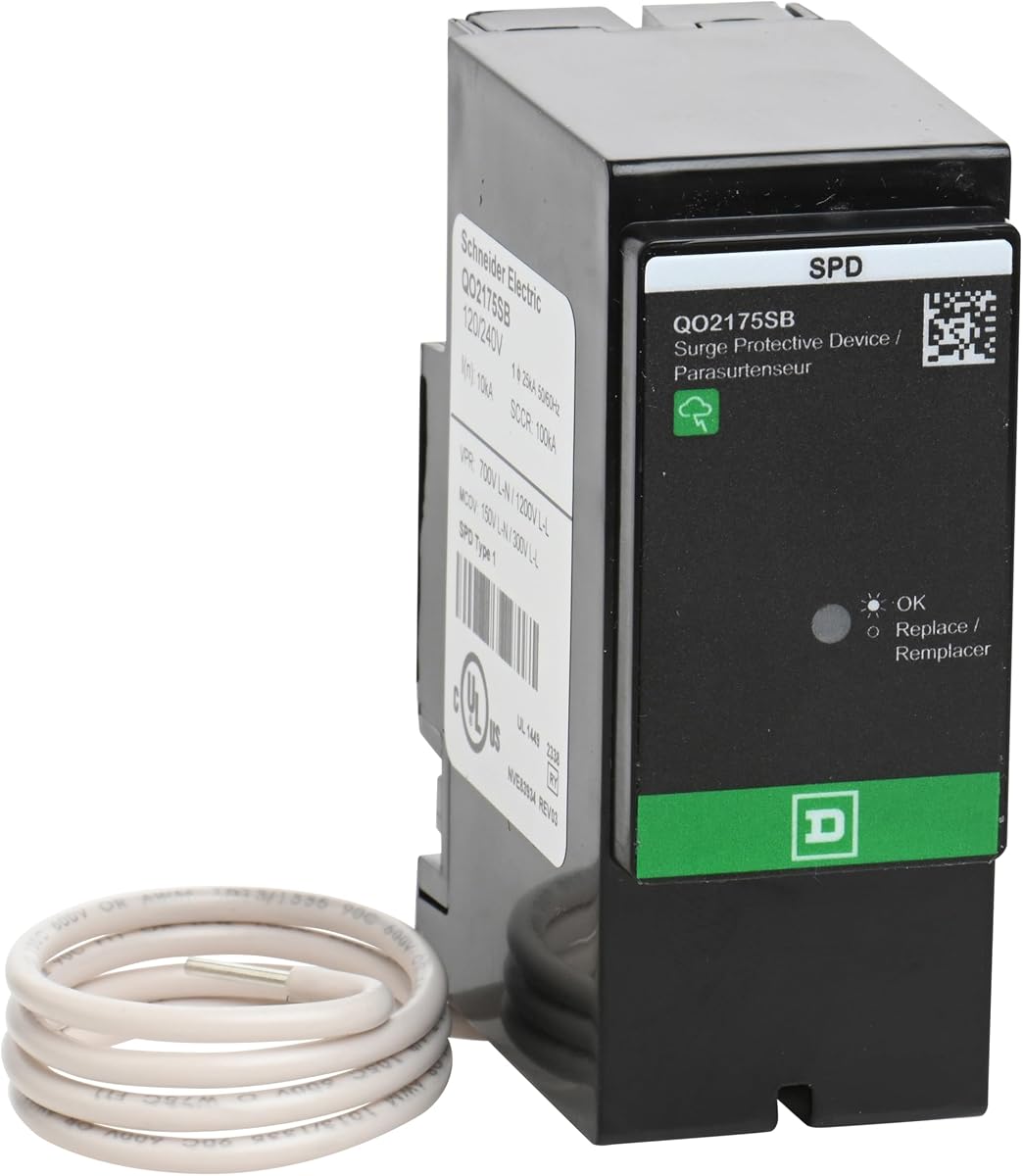
The Square D QO2175SB is a secondary surge arrestor designed specifically for Square D QO load centers. It has a 5.0 customer rating, the highest among the ten products, and its plug-on design makes it a logical choice for homeowners with the appropriate QO electrical panel.
We may earn a commission when you buy through this link, at no additional cost to you.
The unit is rated for 120/240VAC, single-phase, three-wire configurations and has a 5kA surge rating with a 22.5kW SCCR. Each metal-oxide varistor is individually fused, and an LED displays operating status. The product is designed for residential and small-business applications, including solar, temperature control, uninterruptible power systems, and electric vehicle charging.
Its limitations are equally specific. It requires two adjacent spaces in a QO load center, and the NEMA 1 rating identifies it as an indoor device. It also must be installed by someone qualified to work inside the panel. The 5kA rating is lower than the per-phase capacities listed for several whole-home competitors in this guide.
Choose this model when your electrical system already uses a compatible QO load center and you want integrated secondary protection without running a separate plug-in cord. It is less useful for a garage-only goal, but it can contribute to broader protection for an opener and other connected equipment when properly selected and installed.
Rather than relying on a universal plug-in format, the device is designed for a QO load center. That specificity can make installation more orderly for compatible panels.
The individually fused MOV design provides defined protection for the internal surge components. The LED provides a visible status check after installation.
We may earn a commission when you buy through this link, at no additional cost to you.
The Square D HOM2175SB is a 25kA surge protective device designed for Square D Homeline load centers. Its 4.7 rating indicates a well-received product, while its compatibility with service entrances, CSEDs, and Homeline load centers gives owners several potential installation contexts.
We may earn a commission when you buy through this link, at no additional cost to you.
The device uses a plug-on installation and requires two spaces in the panel. An LED indicator confirms operating status, and the product is UL 1449 Third Edition Listed. Its 120/240V, single-phase, three-wire configuration makes it a broad household option when the existing panel matches.
The tradeoff is installation complexity. A surge device inside a load center should be handled with care and installed according to electrical requirements. It also cannot be moved to a garage wall outlet, and buyers should confirm that their panel provides the correct space and configuration.
This model makes sense for a home with a compatible Homeline system and a goal of protecting several circuits. It provides a larger protection layer than a point-of-use strip, but it does not make the garage opener immune to electrical problems. Grounding, wiring, and the condition of the dedicated circuit still require attention.
The manufacturer lists service entrances, CSEDs, and Homeline load centers as possible locations. The correct location depends on the panel and an electrician's assessment.
An integrated LED lets users check whether the device is still operational. It is especially useful after a severe storm or unexpected power disruption.
We may earn a commission when you buy through this link, at no additional cost to you.
The Siemens QSPD2A035B is an indoor surge protective device intended for installation in compatible Siemens load centers. Its 4.4 rating is the lowest in the comparison, but the device offers a substantial 35kA of surge current protection per phase, making it relevant for owners focused on high-energy panel protection.
We may earn a commission when you buy through this link, at no additional cost to you.
The unit plugs directly into the load-center bus, which the manufacturer describes as a quick installation process. Green and red mechanical indicators show protection status, providing feedback without relying on a continuously powered LED. Its design is centered on integration with an existing Siemens system rather than portability or outlet flexibility.
Compatibility, indoor placement, and professional installation are the main constraints. A buyer should verify the exact Siemens load-center model, available bus positions, and applicable installation requirements. Because it is installed upstream of individual receptacles, it is a whole-system option rather than a garage-specific accessory.
For a compatible Siemens load center, this product is a strong technical option with 35kA per-phase handling. It can complement the protection around a garage door opener and other appliances. It is not the right choice for a renter, an incompatible panel, or anyone seeking a simple outlet-based installation.
The 35kA rating is among the highest listed in the roundup. It gives compatible panel owners a high-capacity option for broad surge suppression.
The green and red mechanical indicators report status without a continuously powered LED. This is a simple, durable approach for a panel-mounted device.
We may earn a commission when you buy through this link, at no additional cost to you.
The right choice depends on whether you want focused outlet protection, a multipurpose power strip, or protection installed at the electrical panel. Evaluate the opener circuit, grounding, available space, and installation skill before comparing technical ratings.
A point-of-use protector plugs into the same receptacle as the garage door opener and is the simplest option for one garage. It can also serve a nearby workbench or appliance without changing the service panel. A panel-mounted surge protective device is installed inside the electrical panel and is intended to protect a wider portion of the property. These two approaches solve different scopes, so the correct decision begins with the breadth of protection you actually need.
Choose point-of-use protection for a focused opener upgrade. Choose panel protection when you want broader household coverage and have a compatible panel.
The joule rating indicates how much surge energy the device is designed to absorb. The products in this guide range from 140 joules for the feature-rich Fosmon model to substantially higher ratings for heavier point-of-use and whole-house devices. A higher rating is generally desirable when several appliances share a circuit or when the location is exposed to repeated switching transients. Ratings still do not guarantee that a device will withstand every event, so they should be compared alongside clamping voltage, safety listings, and intended use.
For a single opener, a reputable 900-joule model can provide focused defense. For broader protection, compare higher-capacity models and professional-grade panel devices.
A garage door opener is a motor-driven appliance, so voltage range, current, horsepower, and wattage all matter. Several products here are rated for 15A and 1,875W, while the feature-rich Fosmon model also states a maximum 1/3-horsepower motor load. The opener's nameplate information and the device's electrical ratings should be checked before installation. A protector should not be used outside its listed load or motor range.
Confirm the opener's voltage, amperage, wattage, and plug type. Keep the connected load within the protector's published limits.
Surge protection depends on a low-resistance path to ground. A protector cannot correct a loose, damaged, or improperly grounded receptacle, and a three-to-two-prong adapter should not be used to bypass grounding requirements. Garage receptacles can also be affected by moisture, dust, pests, and repeated plugging. Inspect the outlet, receptacle cover, and circuit for damage before installing any protector, and consult an electrician if the plug fits loosely or the outlet shows discoloration.
Use a properly grounded, intact receptacle. Do not treat a surge protector as a substitute for correct wiring.
Look for a relevant safety listing rather than relying on generic surge-protection language. Products in this list include UL, ETL, or CSA certifications, and the Eaton model also states conformance with UL 1449. A listing indicates that the product has been evaluated against defined safety requirements. It does not mean the device is appropriate for every installation, particularly when a panel-mounted model must match the load center, voltage, conductor configuration, and local electrical requirements.
Prioritize recognized safety listings and exact electrical ratings. Panel products also need complete installation compatibility.
The most compact products use one outlet and leave the wall receptacle unobstructed. A three-outlet adapter creates more powered positions in a garage or workshop but may block the original receptacle more fully. A corded metal protector can be mounted in a convenient location with its six-foot cord, although it takes up more room. Consider the opener plug shape, nearby storage, vehicle clearance, moisture exposure, and whether a power strip could be overloaded before choosing the physical format.
Choose the format that fits the space without encouraging overloaded daisy-chaining. More outlets are useful only when the shared circuit can support them.
A basic LED confirms that a protector is active, while a multi-LED model can distinguish normal operation, high voltage, low voltage, and delay mode. Mechanical indicators suit panel devices that should not depend on a continuously illuminated light. Restart delay is another important behavior: the feature-rich Fosmon model waits three minutes after an out-of-range event, which may be inconvenient but supports controlled re-energization of connected equipment.
Decide whether simple status feedback is enough. Diagnostic lights and restart delays can help, but they also make protection behavior less immediate.
Plug-in protectors require little technical skill, while panel-mounted devices usually call for a licensed electrician. Some panel products need adjacent spaces, a specific bus position, a compatible load center, or a breaker that is not included. Before installation, confirm the product's dimensions, required mounting space, voltage, wire configuration, and applicable local code. After installation, inspect the status indicator and the receptacle periodically, and replace a protector whose indicator shows that its protection has sacrificed itself.
Match installation complexity to your electrical experience. A high-end rating cannot compensate for incorrect placement or unsafe installation.
Begin by confirming that the garage receptacle is grounded, intact, and connected to an appropriate circuit. Check the opener's electrical label and the surge protector's voltage, amperage, wattage, horsepower, and outlet rating. Unplug the opener before installing the protector, then connect the opener to the protected outlet without using extension cords or additional power strips.
After connection, verify the status indicator and test the opener's normal open, close, light, and safety-response functions. If the protector offers high-voltage, low-voltage, or delay indicators, learn what each light means before relying on the device. For a panel-mounted system, have the installation completed by a qualified electrician and confirm that the permitted status indicator shows normal protection.
Inspect the unit, plug, outlet, and wiring periodically for heat, discoloration, loose connections, moisture intrusion, or physical damage. Never reset or bypass a protector that indicates failed protection. Unplug the opener during extended power outages or before electrical work, and arrange service if the receptacle or circuit shows damage.
Not every protector is appropriate for every opener. Compare the opener's voltage, amperage, wattage, and motor load with the protector's published limits, and use a grounded receptacle. A device that exceeds the load or is not designed for motor appliances may fail to protect the equipment properly.
A surge protector reduces the chance that transient voltage reaches connected equipment, but no product can guarantee protection from every lightning event or extreme electrical condition. A properly selected and installed device is one layer of a broader electrical safety plan that also includes grounding, sound wiring, and appropriate panel protection.
A dedicated point-of-use protector can be worthwhile when the opener uses a grounded receptacle and its wiring is sound. It is especially useful if the garage also experiences power fluctuations. A panel-mounted system may provide broader protection, but it does not automatically replace careful inspection of the opener's outlet and circuit.
A Type 1 surge protective device is designed for line-side installation, such as near the service entrance, and can handle external surge sources. A Type 2 device is installed on the load side of the main breaker. The Generac 7409 can be configured for either arrangement, while a qualified electrician should determine the correct installation.
A higher rating indicates greater energy-handling capacity, which can be beneficial, but it is only one part of a complete comparison. Clamping voltage, safety listing, electrical load rating, grounding, installation quality, and the scope of protection also matter. The most capable model is not necessarily the easiest or most appropriate for one outlet.
A three-outlet adapter can be used if the opener and every other connected device remain within the adapter's total 15A and 1,875W capacity. Do not treat the three outlets as three independent protected circuits, and avoid daisy-chaining power strips or extension cords.
Some protectors stop supplying power when they detect an out-of-range condition or when their internal protection has been exhausted. The feature-rich Fosmon model also uses a three-minute delay before restoring power. If the indicator remains off or indicates a fault, unplug the equipment and replace or inspect the protector rather than repeatedly resetting it.
Working inside an electrical panel involves exposed energized components and should be handled by a qualified, licensed electrician. The electrician must also confirm panel compatibility, available space, voltage, conductor configuration, breaker requirements, and local electrical codes before installation.
The Garage Door Opener Surge Protector is the most focused budget option, offering 900 joules, a standard grounded connection, and a straightforward installation. The Fosmon Refrigerator Surge Protector stands out for diagnostic indicators and controlled restart behavior, while the Eaton Tripp Lite IBAR2-6D offers the strongest premium point-of-use combination of metal housing, filtering, mounting flexibility, and 1,410-joule capacity.
Prioritize electrical compatibility, proper grounding, recognized safety listing, and the scale of protection needed. A dedicated outlet protector is usually the easiest choice for one opener, whereas a panel-mounted device is better for broader household coverage and requires compatible equipment. In either case, the protector works best alongside sound wiring, a grounded receptacle, and regular inspection.
Current prices, product availability, and electrical requirements can change, so confirm the latest listing and local code conditions before purchasing. For panel products, verify the exact model of the load center and have installation handled by a qualified electrician. For point-of-use models, check the opener's nameplate ratings and the condition of the garage outlet before plugging anything in.