
Gorilla Super Glue Gel XL
4.6Editor score
Controlled no-run gel formula
Impact-resistant cyanoacrylate
Anti-clog metal-pin bottle cap
Best Super Glue for 3D Prints: compare 10 top-rated options for PLA, ABS, PETG, models, miniatures, repairs, and precision work safely.
Super glue can turn a cracked model, loose miniature, or separated multi-part print into a successful repair, but the wrong applicator or formula may be difficult to control. The best choices balance fast curing, strong adhesion, low-stringiness, and enough control for small printed features.
We compared ten super glue and cyanoacrylate options by examining their stated compatibility with PLA, PETG, ABS, resin, and other materials, along with applicator design, viscosity, curing speed, gap filling, and resistance to impact. The guide covers general-purpose adhesives, precision gels, thin liquids, and brush-applicator formulas.
Each pick highlights the materials and jobs it is best suited for, while also noting practical trade-offs such as visible residue, black finishes, fumes, or a need for careful positioning. Ratings and product details reflect the supplied listings, and prices can change, so check the current listing before buying.
4.6Editor score

4.7Editor score

4.5Editor score
The following comparison covers ten cyanoacrylate adhesives formulated for general repairs, printed models, and precision work. Key differences include viscosity, applicator type, setting time, material compatibility, finish, and suitability for impact-prone or gap-filling joints.




This CA-based adhesive is purpose-built for 3D printing rather than adapted from a general household glue. It carries a 4.7 rating and stands out for explicit compatibility with PLA, PETG, ABS, resin, and other common printed materials. That broad material focus makes it a sensible first choice for makers who do not want to keep several specialized adhesives on hand.
We may earn a commission when you buy through this link, at no additional cost to you.
Its 40g squeeze bottle and precision tip address one of the most common problems with cyanoacrylate: applying too much to a small part. A controlled application is particularly useful around thin walls, miniature accessories, and multi-part assemblies where excess adhesive could spread beyond the joint. The industrial-strength formulation is also presented as suitable for functional prototypes, reinforcing printed parts, repairs, and completed models.
The main compromise is inherent to fast-curing CA glue. Users need to prepare both surfaces and align the parts before applying the adhesive, because the formula is intended to set quickly. As with any cyanoacrylate product, ventilation, gloves, and careful handling are sensible precautions. Even with precise application, cleanup around the work area is important if appearance matters.
This is the most broadly useful option for a 3D-printing enthusiast who wants one adhesive for several filament types. It suits general repairs, hobby assemblies, miniatures, and functional prototypes, provided the user takes basic precautions around fast-setting glue. For someone whose work is primarily PLA or PETG and who values straightforward nozzle application, it offers the strongest balance of focus and versatility.
The stated compatibility with PLA, PETG, ABS, and resin reduces the need to identify a separate adhesive for every project. That makes this bottle especially convenient for mixed-material workshops and prototypes that combine printed components with other surfaces.
The pointed squeeze-bottle nozzle gives the user more control than a broad applicator, helping keep adhesive close to the joint. It is still important to use only a small amount because cyanoacrylate can wick along printed layer lines and seam lines.
We may earn a commission when you buy through this link, at no additional cost to you.
Gorilla Super Glue Gel XL is a premium general-purpose option for users who need dependable control rather than a very thin liquid. Its 4.6 rating reflects a well-positioned balance of fast setting, no-run behavior, and broad material compatibility. The gel format is especially useful when a printed part must be held vertically or when the joint is too small for the user to tolerate a runny application.
We may earn a commission when you buy through this link, at no additional cost to you.
Impact Tough technology is a notable differentiator for functional repairs. The listing states that the adhesive dries in 10 to 45 seconds, does not require clamping, and reaches a full cure in 24 hours. It bonds plastic, wood, metal, ceramic, glass, rubber, leather, and paper, allowing printed models to be joined to mixed components without changing adhesives mid-project.
The bottle includes a metal pin in its anti-clog cap, which helps maintain an airtight seal and keeps the nozzle from becoming blocked between uses. The gel dries completely clear without the foaming or residue described in the listing. As a gel, however, it may not penetrate a tight mechanical fit as readily as a thin liquid, so parts should have clean, direct contact.
This adhesive is ideal for detailed plastic models, durable household assemblies, and printed mechanisms that may encounter impact or handling. Choose it when run control and a discreet finish matter more than maximum flow into a minute gap. It also works well as a general workshop adhesive beyond 3D printing, making it a versatile addition to a maker's tool collection.
The no-run gel is designed to remain where it is placed instead of traveling down a vertical joint. This can simplify assembly of standing figures, wall-mounted prints, and multi-part prototypes where a liquid adhesive would be harder to manage.
The distinction between setting and full cure is important for load-bearing repairs. Although the product sets within seconds, allowing the complete 24-hour curing period gives the joint the best opportunity to reach its final strength.
We may earn a commission when you buy through this link, at no additional cost to you.
This thin plastic glue is aimed at small assemblies such as miniatures, construction toys, toy cars, and other detailed plastic models. Its 4.4 rating reflects a specialized formula rather than a general-purpose household adhesive. The listing specifically identifies ABS and PVC, making it a practical choice for printed or molded parts made from those plastics.
We may earn a commission when you buy through this link, at no additional cost to you.
A low-viscosity adhesive can enter small interfaces and bond close-fitting surfaces without adding much bulk around visible features. The stated 10- to 30-second adhesion window supports quick assembly, which is useful when several miniature components must be held in position during a build. Once complete adhesion is reached, the product is described as waterproof and 30% stronger than super glue according to the listing.
The transparent result is a major benefit for painted or colored miniatures, since a visible white or cloudy joint can disrupt the finish. The included anti-clogging cap helps reduce waste and makes repeat access more convenient. The tradeoff is that a thin formula gives less margin for error than a gel: overapplication can wick into seams, and users should test the flow on a scrap surface first.
This is a strong choice for precision model work involving ABS, PVC, toys, and miniatures. It may not be the first option for a heavily loaded functional prototype where gap filling or impact resistance is the main concern. For delicate, visually clean assemblies, however, its thin flow and transparent cure make it especially useful.
The low-viscosity formula is well suited to close-fitting model parts where a gel may leave too much material around the joint. Dispensing a tiny amount through a controlled tip is still essential.
A transparent cure helps preserve the appearance of painted, colored, or multi-material miniatures. It is particularly useful for projects in which the adhesive line should not distract from the finished model.
We may earn a commission when you buy through this link, at no additional cost to you.
This 30g super glue is one of the most directly relevant choices for 3D-printing repairs, with explicit mentions of PLA, ABS, PVC, toys, models, and miniatures. Its 4.5 rating places it among the stronger-rated products in this group. The formula is positioned for people who primarily need to bond plastic components and want a straightforward squeeze bottle rather than a specialized applicator.
We may earn a commission when you buy through this link, at no additional cost to you.
A fine-tip nozzle is the product's most useful feature for small printed pieces. It allows the user to place a controlled amount near a crack, broken limb, or detachable joint without flooding the surrounding area. The glue dries clear and colorless, helping repaired action figures, construction toys, and other finished models retain a clean appearance.
Its quick-setting nature is helpful for fast repairs, but it is also the product's main practical limitation. The parts should be clean, dry, correctly aligned, and ready before the bottle is opened. A cap helps prevent the nozzle from drying out between uses, although the tip should still be checked regularly. The listing does not position this formula as a gap filler or emphasize high-temperature performance.
This adhesive is a budget-conscious pick for hobbyists who mainly print with PLA, ABS, or PVC and work on small models. It is less compelling for prototypes that need a long-term engineering data sheet or repairs involving rubber and metal. For routine plastic fixing, though, the combination of fine control, clear curing, and a dedicated 3D-printing focus is hard to overlook.
The narrow nozzle reduces the amount of glue needed for tiny model details. It is particularly helpful when repairing faces, arms, accessories, and other parts where excess adhesive would be difficult to hide.
The formula explicitly addresses common printed and model plastics, including PLA, ABS, and PVC. That targeted positioning makes it easier to choose for a plastic-only project than a more general adhesive with a less clearly stated material range.
We may earn a commission when you buy through this link, at no additional cost to you.
This medium-viscosity cyanoacrylate package combines a 28.3g bottle with a 3g aluminum tube of gel, giving the user two application styles. It holds a 4.7 rating and stands out for a stated 750 CPS viscosity that offers a balance between flow and control. The set is explicitly mentioned for PLA, ABS, and PETG, as well as wood, metal, ceramics, pottery, and leather.
We may earn a commission when you buy through this link, at no additional cost to you.
The liquid component is described as providing 2,610 PSI of strength with a 15- to 20-second bond time, while the gel is stated to reach 2,900 PSI and set in 10 to 45 seconds. The medium liquid consistency can be useful for close-fitting hobby parts and longer joints, whereas the gel offers more localized placement. An anti-clogging cap with a built-in steel pin helps keep the main bottle usable.
The key drawback is that the included products are not interchangeable for every application. A user who needs consistent no-run behavior should reach for the gel, while someone seeking a balance of penetration and control may prefer the liquid. The aluminum gel tube is portable, but both components must be closed and stored properly to prevent premature curing.
This is an excellent choice for a mixed workshop where printed parts may be combined with wood, metal, or ceramic components. The two-formula package reduces the need to buy a separate gel, and the medium viscosity is versatile for models and repairs. It is particularly attractive for users who appreciate having both rapid positioning time and stronger gel control available in one purchase.
The medium liquid is useful when the joint needs some flow, while the gel is better for vertical surfaces and localized repairs. Having both allows a user to match the adhesive to the geometry of the assembly.
The stated strength figures make the set appealing for hobby models and practical repairs, although the best bond still depends on surface preparation, joint design, and complete curing. The range of compatible materials also makes it broader than a plastic-only adhesive.
We may earn a commission when you buy through this link, at no additional cost to you.
This transparent gel is designed around common plastic-repair challenges, including PLA, ABS, PVC, acrylic models, toys, and car parts. Its 4.5 rating and emphasis on low stringiness make it attractive for users who find ordinary liquid super glue difficult to apply cleanly. It can also bond plastic to fabric, wood, and metal for mixed-material projects.
We may earn a commission when you buy through this link, at no additional cost to you.
The most attractive feature is its gap-filling ability on uneven, rough, or vertical surfaces. A printed component may not meet another part perfectly because of warping, tolerances, or layer-line irregularities, and this adhesive is positioned to bridge those imperfect interfaces. Its elastic, impact-resistant film is also intended to help prevent a repaired joint from becoming brittle and failing again.
The glue achieves an initial fix after five to 10 seconds of pressure, sets within 60 seconds, and is described as fully hardening in 5 to 10 minutes. That distinction matters: a joint may be stable enough to position early without yet having reached its final state. The sealed packaging and precision tip help with storage and placement, while the transparent formula supports discreet repairs.
This gel is a strong candidate for models with small gaps, rough interfaces, or parts that need more elasticity than a rigid glue can provide. It is less suitable for a user who needs the joint to reach full strength within seconds, and cyanoacrylate safety precautions still apply. For a versatile 3D-printing repair bottle, it offers one of the most useful combinations of gap filling, flexibility, and controlled application.
Layer lines, slight warping, and loose-fit printed parts can leave a visible void between two components. The gel format is intended to occupy gaps that a very thin adhesive may not adequately fill.
The stated tough, elastic film is useful for joints that may flex, vibrate, or experience impact. It helps the repaired area resist becoming brittle, although joint design still determines long-term performance.
We may earn a commission when you buy through this link, at no additional cost to you.
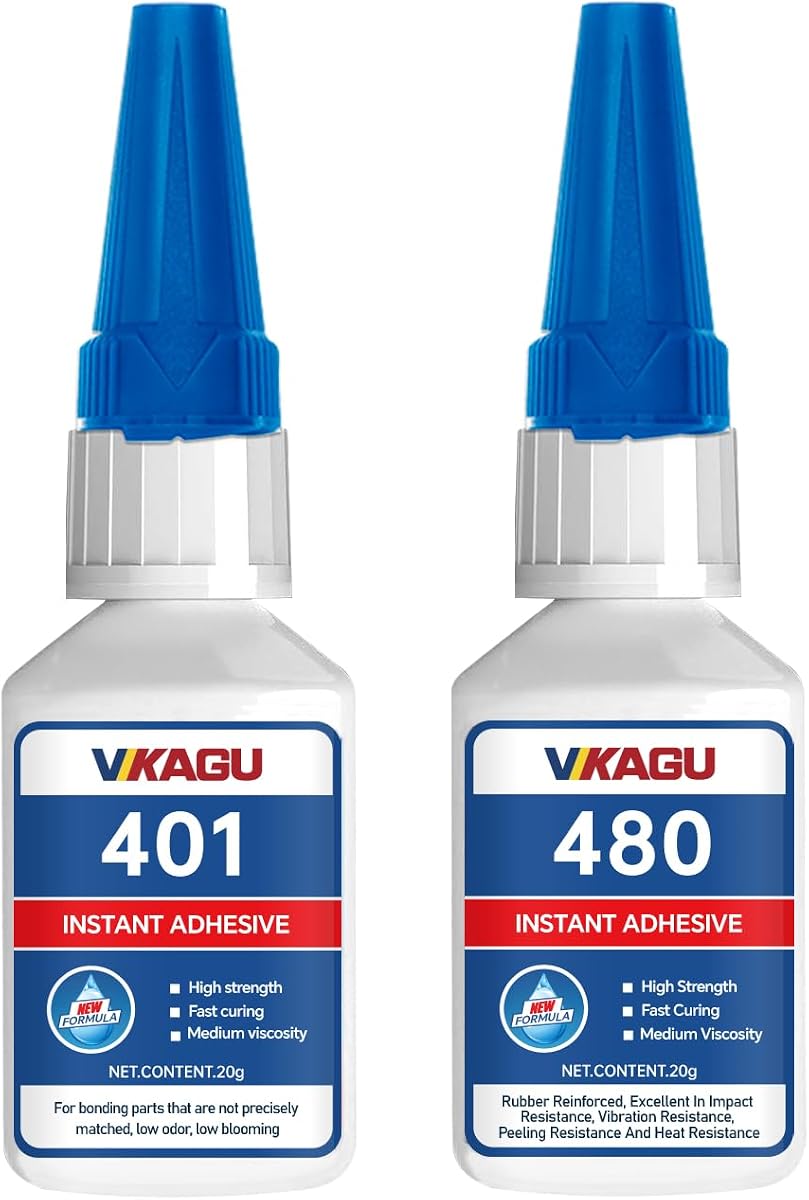
This two-formula set combines clear 401 adhesive with black, rubber-toughened 480 adhesive. The 4.6-rated package is appealing to advanced hobbyists because it provides distinct solutions for rigid and flexible joints rather than asking one glue to handle every repair. The 401 formula is specifically mentioned for stiff plastics and PLA or PETG 3D prints, while 480 is intended for high-stress and vibration-prone parts.
We may earn a commission when you buy through this link, at no additional cost to you.
The 401 medium-viscosity glue cures in 3 to 10 seconds and is described as surface-insensitive, clear, and suitable for ceramics, wood, plastics, and O-ring splicing. The 480 formula has a 10- to 30-second set time, which provides more positioning time, and is reinforced with rubber particles for shock absorption and resistance to peeling and thermal cycling. It dries black, making it better suited to rubber and dark components than visually hidden repairs.
Both bottles use a precision tip and an anti-clog cap with a stainless-steel pin. These details are particularly helpful in a small workshop where dried adhesive inside a narrow nozzle can make a product unusable. The set also gives users a clear choice between a fast rigid bond and a tougher flexible bond, rather than forcing a compromise on one formula.
This is a compelling pick for makers who repair both printed mechanisms and rubber components, or who want a black adhesive for visible functional parts. The black finish rules it out as the default choice for clear model presentation, and the two bottles require careful storage. Nevertheless, the formula-specific approach is unusually versatile for a compact workshop kit.
Clear 401 is designed for rapid, rigid fixation, while black 480 is formulated to absorb impact and tolerate movement. Matching the adhesive to the expected stress on the joint is more informative than choosing by setting time alone.
The 401 formula's 3- to 10-second set is useful for immediate assembly, whereas 480's 10- to 30-second window gives users more time to align parts. This difference can be valuable when a printed component does not snap into place perfectly.
We may earn a commission when you buy through this link, at no additional cost to you.
This 1500 CPS super glue gel uses two applicators: a fine brush for delicate work and a nozzle for larger surfaces. Its 4.4 rating makes it a practical choice for builders who want more placement options than a conventional squeeze bottle provides. The brush can be particularly helpful when coating the inside of a recess, joining a tiny miniature part, or spreading adhesive evenly across a limited contact area.
We may earn a commission when you buy through this link, at no additional cost to you.
The product sets in 15 to 45 seconds and fully cures within 24 hours, according to the listing. It is described as clear, permanent, and resistant to moisture, heat, and wear after curing. The gel can bond plastic, rubber, pottery, ceramics, toys, jewelry, glass, metal, wood, and leather, making it relevant to printed models as well as broader home repair work.
The dual cap is designed to seal between uses so the brush and nozzle remain ready to dispense. This reduces the likelihood of a hardened applicator interrupting a repair. The trade-off is that the brush and gel consistency demand more care than a thin, fast-flowing liquid, and brush bristles can retain adhesive after use. Users should not force a clogged brush or puncture the applicator carelessly.
This adhesive suits model makers who value control over raw dispensing speed. The brush makes it easier to place a measured film, while the nozzle handles a larger repair without changing products. It is also a good general-purpose option for a household craft shelf, although printed parts should be cleaned and dried first to support the best bond.
A fine brush can reach areas that a narrow nozzle may not coat evenly, such as the inside of a hollow print or a recessed mounting area. The user can apply a controlled film instead of flooding the surface.
The nozzle is convenient for quick repairs and larger contact areas, while the brush offers more deliberate placement. Switching between them makes the formula useful across different scales of model work.
We may earn a commission when you buy through this link, at no additional cost to you.
This two-pack of clear Gorilla super glue combines a brush applicator with a precision tip in each format. Its 4.5 rating and general-purpose compatibility make it a strong all-around choice for printed models, household repairs, and craft work. Each 12g bottle is relatively compact, which is helpful for a crowded tool drawer or portable repair kit.
We may earn a commission when you buy through this link, at no additional cost to you.
The brush gives the user more deliberate control on small parts, while the precision tip supports quick, localized drops. The adhesive dries in 10 to 45 seconds, does not require clamping, and is formulated for impact resistance and strength. The listing states that it bonds glass, plastic, wood, metal, ceramic, rubber, leather, paper, and other materials.
A special anti-clog cap helps prevent the bottle from drying out and blocking the applicator. The clear finish is useful for repairs where visual distraction should be minimized. The two-pack format also provides redundancy, so a small workshop does not have to depend on a single bottle for every task. The smaller bottle size, however, means that heavy users may need to refill more often.
This set is a sensible general recommendation for someone who wants a trusted super glue format with flexible dispensing. It works especially well for small models, delicate parts, and mixed-material repairs. Users should still treat the cyanoacrylate as an instant adhesive, clean the surfaces first, and avoid disturbing the joint during the initial set.
Having two bottles means one can remain available if the other is being used or if a nozzle becomes difficult to clear. It also allows a user to keep separate bottles for different project categories.
The stated impact-resistant formula is useful for printed parts that will be handled, carried, or exposed to ordinary mechanical stress. As with all cyanoacrylates, the joint performs best when the surfaces fit closely and the bond is left undisturbed while curing.
We may earn a commission when you buy through this link, at no additional cost to you.
Loctite 454 Surface Adhesive Gel is a small-tube option for individual repairs rather than high-volume assembly. Its 4.6 rating and clear gel format make it attractive for users who want a discreet adhesive close at hand. The tube contains 3g, which is enough for targeted fixes but not intended to supply a busy production line.
We may earn a commission when you buy through this link, at no additional cost to you.
The gel is designed to create strong bonds between rubber, leather, plastic, and metal. That makes it relevant to 3D-printing projects in which a printed component needs to be attached to a rubber foot, metal fitting, leather detail, or another plastic piece. The clear formula helps the repaired area blend into the finished model, and the tube format is convenient for a desk, toolbox, or travel repair kit.
Its main limitation is curing time. The stated full cure is 24 hours, so a joint may be handled sooner but should not be subjected to significant stress during that period. The small tube also needs careful closure and storage because cyanoacrylate products can deteriorate if exposed to air. Users should avoid squeezing the tube excessively if residue would be difficult to remove from the workspace.
This product is best for small, visually sensitive repairs and users who value a compact, clear adhesive. It is less suitable for repeated assembly work, large surface areas, or anyone seeking a high-volume container. For a carefully prepared joint involving plastic, rubber, leather, or metal, however, it offers a convenient and discreet option with a strong general-purpose profile.
The 3g aluminum-style tube is easy to store and reduces the amount of adhesive committed to the workspace. It is particularly helpful for a single broken model part or a small mixed-material assembly.
The clear gel is suitable where appearance matters and the printed component may meet rubber, leather, plastic, or metal. Close-fitting, clean surfaces will help the adhesive perform as intended.
We may earn a commission when you buy through this link, at no additional cost to you.
The best super glue for a 3D-printing project depends on the filament, joint geometry, visible quality requirements, and how much positioning time the assembly allows. Review material compatibility, viscosity, applicator control, and full cure behavior before choosing a bottle.
Start by checking whether the adhesive explicitly mentions the materials in the project. PLA, PETG, ABS, PVC, and resin do not all behave identically, and a general household glue may be marketed for plastic without clarifying how it performs on printed layer lines. The leading options in this guide provide at least some stated compatibility with common 3D-printing materials, while the 401 and 480 set specifically identifies PLA and PETG. The Loctite tube also covers plastic alongside rubber, leather, and metal, making it relevant when a printed component is only one part of an assembly.
Viscosity determines how the adhesive behaves after it leaves the bottle. A thin liquid can reach close-fitting interfaces and small gaps but may run along printed seams. A gel remains more localized, making it easier to control on vertical parts or visually sensitive models. Medium-viscosity products attempt to balance penetration and control. Consider how the parts are shaped: smooth mating surfaces reward low flow, while recessed joints and larger gaps benefit from a thicker formula that will not immediately disappear from the application area.
The applicator can matter as much as the chemical formula. Precision tips are useful for a broken finger on a miniature or a thin seam around a printed housing. Brushes give more deliberate coverage in recesses and can place a thin film over a limited area. Thick gel may be easier to control on vertical assemblies. The 3D Printing Glue bottle, the fine-tip model glue, and the multi-applicator options are particularly useful for detailed work, while a conventional nozzle is adequate for larger, less visible joints.
Fast setting is convenient for quick repairs, but it can make accurate assembly more difficult. A printed part may require a few seconds to rotate into position or for adhesive to wick into a seam. Products with slightly longer set times can provide a more forgiving workflow. Pay attention to the difference between the initial fix, the stated set time, and the full cure. The 480 formula offers a longer positioning window than the 401 formula, while the 3D Printing Glue and model-focused products are explicitly positioned for rapid results.
Consider what happens after the joint is repaired. A display miniature mainly needs a clean, rigid connection, while a tool handle, phone mount, or functional mechanism may encounter impact, vibration, flexing, or temperature changes. The Gorilla Gel XL emphasizes impact toughness, the plastic repair gel describes an elastic and impact-resistant film, and the 480 formula uses rubber particles to absorb stress. Rigid, gap-filling designs are still valuable where parts should not move relative to one another, but they may be less tolerant of repeated flexing.
Printed parts can have small gaps caused by dimensional variation, shrinkage, warping, or the natural channels between supports and models. A gap-filling adhesive can bridge those spaces and create a broader contact area than a thin adhesive. The multi-purpose plastic repair gel specifically mentions uneven, rough, and vertical surfaces. A thicker formula is often more useful in this situation, but a gap-filling bond should not be treated as a substitute for designing a proper mechanical fit. Whenever possible, a joint should still have sufficient surface contact and appropriate structural reinforcement.
A clear adhesive is usually preferable for painted models, miniatures, transparent prints, and household items. Several options in this guide cure clear and colorless, including Gorilla Gel XL, the thin miniature glue, the plastic model glue, the brush-applicator gel, and Loctite 454. The black 480 formula intentionally does the opposite and is best reserved for dark or rubber components. Even clear glue can leave a visible bead if too much is applied, so use the smallest practical amount and remove excess before it cures.
Cyanoacrylate glue is useful partly because it cures quickly, but that same chemistry makes bottle care important. Anti-clog caps and built-in metal or steel pins appear on several recommended products because they help maintain an airtight seal and preserve an open nozzle. Tubes and small bottles should be closed immediately after use, while larger bottles should be stored upright in a cool, dry location away from direct light. A protective cap does not eliminate the need for regular tip inspection, particularly with thin liquids that can dry inside narrow openings.
Prepare the parts before opening the bottle. Remove loose plastic, dust, oil, and printing residue, then lightly dry the mating surfaces. Printed parts should fit as closely as possible, and any area intended for glue should be free of uncured resin or oily finishes. Arrange tools, tape, and supports before application so the user can join the parts immediately without searching for an item with adhesive already exposed.
Dispense a small amount onto one joining surface. The amount should be enough to wet the intended contact area without creating a large bead. Follow the formula's applicator guidance, use only the nozzle or brush that suits the joint, and bring the parts together in the intended orientation. Hold the assembly steady during the initial set, then avoid loading the repaired area while the adhesive reaches its full cure.
Ventilate the work area, wear protective gloves, and keep cyanoacrylate away from eyes and skin. Do not use a fingernail or a sharp object to clear a fine nozzle, because that can create a splash hazard. Store each bottle or tube tightly closed in a cool, dry location away from children and pets, and wipe uncured adhesive from the workspace with an appropriate method. Avoid casually handling bonded skin; seek appropriate safety guidance if accidental contact occurs.
Several products in this guide explicitly state compatibility with PLA, but a compatible adhesive is not automatically the best choice for every print. The user should confirm that the joint is clean, dry, and made from compatible materials. For load-bearing parts, test a small coupon and allow the stated full cure period before applying stress.
Super glue is generally favored for quick assembly, clean finishes, and precise small repairs, while epoxy can offer a longer working time and a strong permanent joint. The best choice depends on the geometry, required strength, and user's comfort with handling the adhesive. The plastic repair gel among these options also provides a longer full-hardening period than several instant formulas.
A thin, clear adhesive with precise dispensing is usually easiest to control on tiny models. The thin miniature glue and fine-tip plastic model adhesive are both designed for detailed work, while a brush applicator can be useful in recessed areas. Apply only a minimal amount because excess glue can spread over painted surfaces and be difficult to remove.
A thicker gel with gap-filling properties is more suitable than a thin liquid for imperfect interfaces. The multi-purpose plastic repair gel in this guide is designed for uneven, rough, and vertical surfaces. Gap filling can improve contact, but a structurally weak print may still need redesigning, support, or mechanical reinforcement.
Handling time depends on the formula, joint design, and temperature. Many of the listed products set in seconds, but several specify a full cure of 24 hours or a 5- to 10-minute hardening period. Treat the stated set time as a positioning guideline rather than proof that the joint has reached full strength, and avoid heavy loads until curing is complete.
Use products with anti-clog caps and built-in pins when possible, and close the bottle immediately after dispensing. Store the adhesive in a cool, dry place and check the tip before each use. Do not poke a hardened nozzle with a sharp tool, because the stored pressure can cause cyanoacrylate to spray unexpectedly.
The finish depends on the formula and how much adhesive is applied. The products described as clear or transparent should minimize visible cloudiness, but excessive glue, surface moisture, and trapped bubbles can still leave a noticeable mark. Apply a thin amount, align the parts promptly, and allow the joint to cure undisturbed.
Gorilla Super Glue Gel XL is a general-purpose adhesive listed for plastic and several other materials, making it plausible for compatible printed parts. The two-pack version similarly identifies plastic among its supported surfaces. Users should still verify the specific filament, avoid unsupported or wet surfaces, and test the joint when appearance or structural performance is critical.
The 3D Printing Glue CA-Based Adhesive is the strongest overall choice because it explicitly combines common printed-material compatibility with a precision applicator. Gorilla Super Glue Gel XL is the most versatile premium option, while the budget-focused Super Glue for Plastic Models delivers fine control and a clear finish for routine repairs.
For highly specific work, the medium-viscosity liquid and gel set offers greater application flexibility, the multi-purpose plastic gel is well suited to imperfect joints, and the 401 and 480 combination separates rigid and impact-resistant applications. The thin miniature glue, dual-applicator formulas, and compact Loctite tube serve users who value specific dispensing methods or discreet repairs.
Regardless of the chosen adhesive, prioritize clean surfaces, careful alignment, and adequate cure time. Compare the stated material compatibility and applicator with the geometry of the actual project, and check the latest listing details and current price before purchasing, since availability and pricing can change over time.