
Electro-Voice Pxm 12MP 12 700W Powered Coaxial Monitor
4.8Editor score
Wide 90-degree coverage
55-degree monitoring angle
Advanced onboard DSP
Three-input integrated mixer
Stage monitor speakers help performers hear the full mix without turning toward the main speakers, making them essential for clear vocals, confident timing, and better communication onstage. A useful monitor must deliver accurate sound at a comfortable listening level while avoiding excessive bass, feedback, and physical strain. The right choice also depends on venue size, monitor angle, amplification, and control requirements.
This guide compares ten stage monitor and closely related powered loudspeaker options based on the supplied specifications, including driver configuration, output, coverage, connectivity, built-in processing, portability, and intended applications. It includes passive wedges, powered floor monitors, compact multi-purpose speakers, and touring-oriented systems, so readers can compare options for rehearsal rooms, clubs, houses of worship, and larger stages.
Each numbered review explains the product's strongest qualities, practical trade-offs, and most suitable users. The top selections are highlighted separately to make the shortlist easier to navigate, while the buying guide explains how to evaluate wedge geometry, coverage patterns, headroom, feedback control, and connectivity. Product prices and availability can change, so confirm current listings and specifications before purchasing.
4.8Editor score

4.4Editor score

4.5Editor score
As an Amazon Associate we earn from qualifying purchases.
The comparison below highlights each model's configuration, output, coverage or monitoring geometry, and key control features. Because the list combines dedicated wedges with powered loudspeakers designed for both monitoring and main-system use, buyers should also consider placement, included amplification, and how each model fits into a complete live-sound setup.



The Behringer EUROLIVE F1220D is a substantial active stage monitor built around a bi-amped 12-inch woofer and 3-inch tweeter. Its 4.5 rating reflects a generally favorable buyer response, while its most important feature is the combination of large low-frequency output, separate high-frequency driver, and onboard monitoring controls. It is especially relevant to performers who want more low-end presence than a small nearfield monitor can provide.
We may earn a commission when you buy through this link, at no additional cost to you.
The separate amplification for the woofer and tweeter allows each section of the system to be managed independently, and the supplied information specifically highlights Class-D amplifier technology, wide frequency bandwidth, strong dynamic range, and a lightweight design for its output class. An adjustable feedback filter is particularly useful when a monitor sits close to a microphone or when a stage environment makes feedback control challenging. The integrated limiter adds another layer of system protection during demanding rehearsal or performance sessions.
Its main trade-off is physical size. A 12-inch monitor can deliver impressive impact and volume, but it requires more floor space and may be less convenient for small stages, tight rehearsal rooms, and rapid load-in situations. The separate tweeter also makes this a more substantial design than compact all-in-one speakers. Users who need the lowest possible footprint or frequently move between venues may prefer a smaller powered monitor, while those with adequate space gain a fuller low-frequency foundation.
Overall, the F1220D is a compelling choice for bands that want a traditional, full-size wedge with dedicated high- and low-frequency amplification. It suits performers who need enough low-end impact to judge bass guitar, drums, or electronic effects while retaining a separate tweeter for vocal detail. For a small stage, measure the available floor area first; for a larger band or outdoor setting, its larger drivers and feedback controls offer a practical advantage.
The adjustable feedback filter and integrated limiter make the F1220D more adaptable to close-monitor placement. These controls can help a user manage the balance between stage volume and microphone pickup, although correct positioning and a disciplined mix remain the first line of defense.
The 12-inch bi-amped woofer gives the monitor more physical scale than compact models. That can help performers hear low-frequency instruments and impacts without relying entirely on the main PA, provided the wedge has enough room and is aimed correctly.
We may earn a commission when you buy through this link, at no additional cost to you.
The Gemini AS-2108P is a portable powered floor monitor with an 8-inch woofer, a 1-inch high-temperature voice-coil piezo compression driver, and a 300-watt output rating. Its 3.7 rating is lower than that of several premium alternatives, but the specification sheet shows a versatile and road-friendly package. It can function as a stage monitor or main PA speaker for vocals, rehearsals, DJ work, and modest live events.
We may earn a commission when you buy through this link, at no additional cost to you.
Connectivity is a major strength. The speaker provides two channels with switchable XLR and 1/4-inch microphone and line inputs, RCA, auxiliary input, and an XLR mix output. These options allow performers to connect microphones, instruments, phones, mixers, and playback equipment without depending on Bluetooth. A top handle, impact-resistant molded ABS cabinet, and standard 35mm pole mount improve transport and deployment options, while clip-LED protection provides a visible indication of overheating during extended use.
The main compromise is that an 8-inch woofer will not reproduce the same deep low-frequency impact as a 10-inch or 12-inch wedge. It also lacks wireless streaming, which some casual users may expect from a modern speaker, although the deliberate wired-only design is advantageous where interference and latency are concerns. The 3.7 rating also suggests mixed experiences, so prospective buyers should pay close attention to system compatibility and setup rather than assuming it will match a larger monitor in every application.
The AS-2108P is best for singers, small ensembles, churches, DJs, and rehearsal groups that value compact size, extensive wired connections, and simple onboard tone control. Its dual-channel gain and bass/treble EQ can make it practical for users who want a self-contained box without a separate mixer. It is a sensible budget-oriented option when low-end authority is less important than portability, connection flexibility, and immediate operation.
At 11 pounds, the Gemini monitor is designed to move more easily than full-size 10-inch and 12-inch wedges. The molded enclosure, top handle, and pole socket make it useful for performers who carry their own equipment between compact rehearsal spaces, church rooms, and small venues.
The combination of XLR, 1/4-inch, RCA, auxiliary, and mix-output connections gives the AS-2108P more routing flexibility than many entry-level monitors. It is a good fit for live systems where dependable wired connections are preferred over wireless playback.
We may earn a commission when you buy through this link, at no additional cost to you.
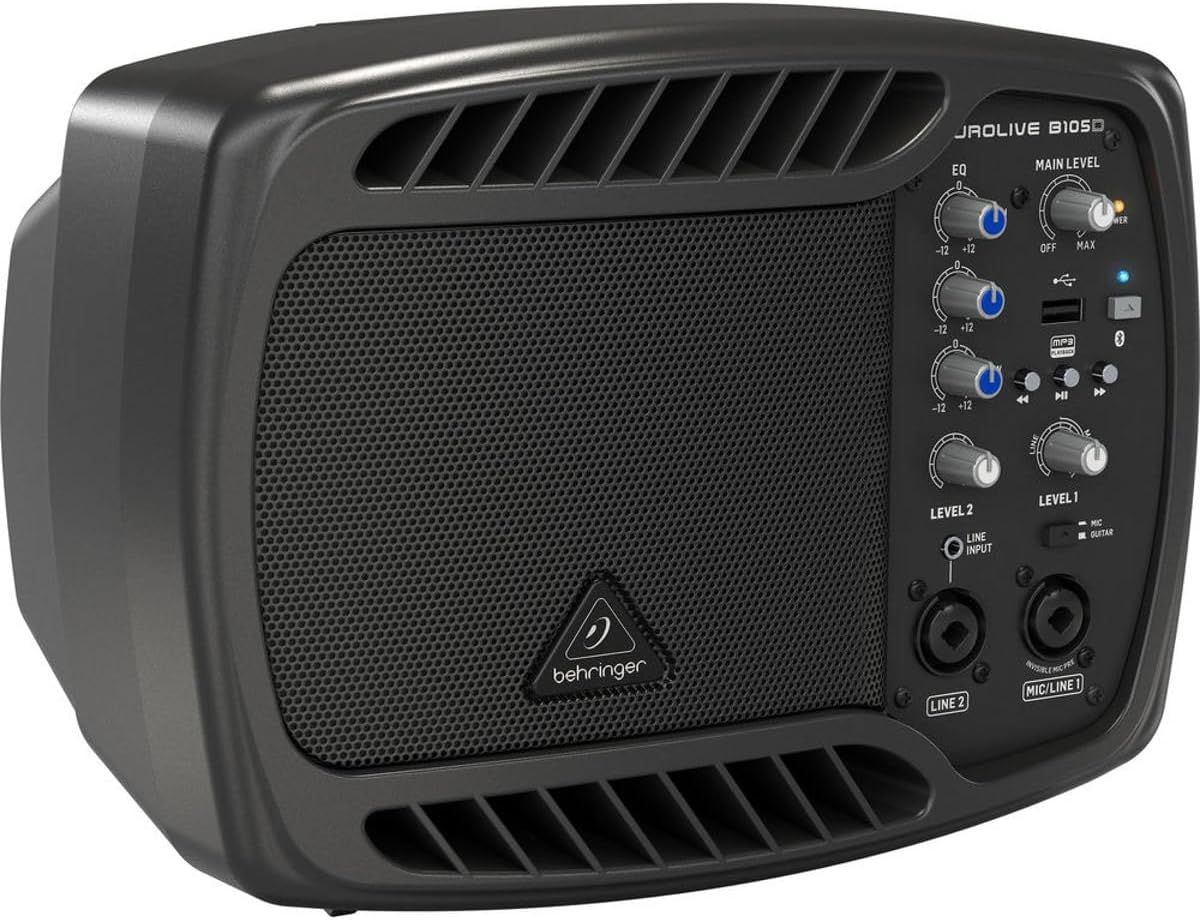
The Behringer EUROLIVE B105D is an ultra-compact 50-watt active speaker intended for vocal and keyboard monitoring, multimedia use, press conferences, and home recording studios. Its 3.8 rating places it behind the highest-rated models, but its versatility makes it more than a simple wedge. The built-in three-channel mixer, three-band EQ, MP3 player, and Bluetooth streaming broaden the ways it can be used.
We may earn a commission when you buy through this link, at no additional cost to you.
Its strongest appeal is flexibility in small spaces. A singer can use it as a monitor, a keyboardist can use it for reference, and presenters can benefit from the built-in media playback. The included MP3 player accepts files through USB sticks, while Bluetooth allows compatible phones, tablets, and computers to stream audio. The low-noise three-channel mixer and Class-D amplifier architecture make it a self-contained option for rehearsals, lessons, small rooms, and informal events.
The limitations are equally clear. Fifty watts provides less output and lower-frequency authority than the 250-watt, 300-watt, 700-watt, and 1,400-watt models in this guide, so it is not intended to compete with large systems in an outdoor stage or demanding full-range PA application. Bluetooth also introduces wireless considerations that wired-only stage monitors avoid. Most importantly, the B105D's compact enclosure and integrated 5-inch-style multipurpose format do not offer the same dedicated floor-monitor geometry as a deep wedge with a horn.
This model is a strong recommendation for small-space users who want one speaker to cover several roles rather than a specialized high-output monitor. It is particularly useful for vocalists, keyboard players, teachers, presenters, and home studio users. Buyers should choose it for convenience and compactness; if a band needs greater maximum volume, stronger bass, and a true stage-facing wedge, they should move up to a larger powered or passive monitor.
The B105D combines stage monitoring, PA use, multimedia playback, and a small mixer in one enclosure. That versatility is especially valuable in classrooms, rehearsal rooms, home studios, and presentations where equipment space is limited.
Bluetooth streaming and the built-in USB MP3 player make background and reference playback convenient. A three-channel mixer with three-band EQ allows basic level and tone adjustments without requiring a separate desk mixer.
We may earn a commission when you buy through this link, at no additional cost to you.
The Seismic Audio SA-10MTSingle is a passive, two-way 10-inch floor monitor with a dedicated 4-by-10-inch titanium horn. Its 4.5 rating and straightforward professional specification make it an interesting option for users who already understand passive speaker systems. The monitor is specified at 150 watts RMS and 300 watts peak, with a woofer using a 40-ounce magnet and 2-inch voice coil.
We may earn a commission when you buy through this link, at no additional cost to you.
A dedicated horn and 10-inch woofer provide a more specialized monitor architecture than a compact full-range PA box. The horn is intended to shape and project high frequencies toward the performer, while the larger woofer offers more low-frequency presence than the 8-inch Gemini. The passive design also gives the user freedom to match the monitor to an amplifier that suits the venue and desired headroom.
The central trade-off is that no onboard amplification is included. Users must have a suitable power amplifier, signal routing, and speaker cables already available or budget for them separately. Because the supplied data does not list minimum amplifier requirements, the manufacturer or seller's current documentation should be checked before matching this monitor to an amplifier. A single unit also may not cover every position if a stage requires a matched stereo pair.
The SA-10MTSingle is best for experienced performers and sound systems that value a purpose-built wedge, external amplification, and a conventional 10-inch format. It suits musicians who want to select their own amplifier and control the entire signal chain. For first-time buyers or those seeking a plug-and-play monitor, a powered model with onboard EQ and protection will generally be easier to deploy.
The wedge enclosure directs sound upward toward a performer rather than relying on a conventional upright cabinet. This is useful when the monitor needs to sit at the front edge of a stage and deliver a focused, practical listening angle.
Because this monitor is passive, its performance depends on the external amplifier and signal source. Matching the amplifier correctly, providing clean signal, and using appropriate speaker cabling are essential parts of achieving consistent low output and controlled monitoring.
We may earn a commission when you buy through this link, at no additional cost to you.
The Seismic Audio SA-10MT-PW-Pair bundles two powered, active 10-inch floor and stage monitors with titanium horns. Its 4.4 rating suggests a strong buyer reception, and the pair format addresses one of the most common practical needs in live performance: providing consistent monitoring on both sides of a stage. The product is listed for floor-monitor, live-sound, stage, and studio applications.
We may earn a commission when you buy through this link, at no additional cost to you.
Compared with buying a single passive wedge and arranging amplification, this package simplifies deployment. Both monitors are powered and use a two-way 10-inch configuration, giving users a consistent approach across two stage positions. The dedicated wedge format is more specialized than an upright main PA speaker, while the included power makes the system more approachable for a band that wants to bring its own monitor solution.
There is still a tradeoff between convenience and transport. Two floor monitors occupy more stage space and must both be carried, positioned, powered, and cabled. The supplied specifications do not detail the exact onboard controls, input types, protection circuitry, or amplifier power, so buyers should inspect the current product listing for those details. The pair should also be checked against available stage power and cable routing before the event.
This pair is an excellent fit for a full band that wants a consistent two-monitor stage footprint without sourcing separate wedges and external amplifiers. It is especially practical for rehearsals and small-to-medium stages where both sides of the stage need coverage. A solo performer with a compact rig may find one monitor sufficient, while a touring or larger band may eventually require higher output or more advanced processing than this package offers.
A matched pair helps performers on opposite sides of the stage hear similar monitor information. This is particularly useful for bands in which different musicians may otherwise rely on inconsistent main-PA spill or one shared floor monitor.
Powered monitors remove the need to match passive cabinets to external amplifiers. Users still need suitable signal connections and reliable power, but the basic deployment is more direct for many rehearsal and performance environments.
We may earn a commission when you buy through this link, at no additional cost to you.
The Behringer EUROLIVE F1320D is an active 300-watt, two-way monitor system featuring a 12-inch woofer, 1-inch compression driver, adjustable feedback filter, integrated limiter, and sound processor. Its 4.5 rating is strong, and the combination of output and driver size makes it a natural choice for louder stages, rehearsal rooms, and applications where musicians want substantial low-frequency monitoring.
We may earn a commission when you buy through this link, at no additional cost to you.
The compression driver provides a dedicated high-frequency path, while the large woofer handles low and mid frequencies with greater physical capability than smaller monitor systems. Class-D amplification technology contributes to efficient, relatively lightweight operation. The adjustable feedback filter, integrated limiter, and sound processor give the system useful controls for system management and speaker protection, especially when the monitor is operated close to a vocal microphone.
The obvious drawback is size and potential overkill. A 12-inch floor monitor can be difficult to place on a compact stage and may produce more low-frequency energy than a small room needs. Its 300-watt rating should be understood as part of a larger powered monitor category rather than a guarantee that every room requires that much output. Users should control the monitor from the mix rather than turning it up automatically to solve a weak front-of-house mix.
The F1320D is best for bands that need a powerful, full-size wedge and can accommodate its physical footprint. It is well suited to louder rehearsals, small clubs, and outdoor events where the combination of 12-inch low-end capability and a compression driver is useful. In a tiny room or for a solo act with minimal stage space, a more compact model may be easier to manage and may provide a more practical balance.
The adjustable feedback filter is a valuable feature for wedge monitors placed close to singers and microphones. It provides an additional tool for balancing stage volume, although it does not replace correct monitor placement, gain staging, or feedback control in the mix.
With a 300-watt active system and a 12-inch woofer, the F1320D is aimed at situations that need more impact and headroom than compact monitors can offer. A dedicated compression driver handles high-frequency reproduction as part of the two-way design.
We may earn a commission when you buy through this link, at no additional cost to you.
The YAMAHA DBR10 is a 700-watt bi-amped powered speaker with a 10-inch driver, a stated maximum output of 129 dB, and FIR-X tuning across a frequency range of 55 hertz to 20 kilohertz. Its 4.4 rating reflects solid buyer approval. Although it is marketed as a high-performance main or monitor speaker rather than exclusively as a wedge, that flexibility makes it relevant to performers who want one system for multiple front-of-house and stage-monitor positions.
We may earn a commission when you buy through this link, at no additional cost to you.
The most important specification is the combination of high digital power and substantial maximum output. FIR-X tuning is intended to optimize the speaker's response and behavior, while the bi-amped arrangement gives the low- and high-frequency sections separate amplification. The seven-year warranty also distinguishes it from many budget-oriented powered speakers and may appeal to buyers who prioritize long-term ownership support.
As a monitoring solution, the DBR10 is not automatically the best wedge for every stage. Its 10-inch driver provides a good balance of low-frequency authority and manageable size, but it still requires careful placement, an appropriate monitor angle, and adequate output distribution. The impressive 129 dB maximum figure represents a substantial capability, yet users should match that capability to the room rather than operating continuously at the limit. A high-output speaker can still be a poor monitor if the mix or placement is wrong.
The DBR10 is a strong option for bands that need a powerful, versatile powered loudspeaker, particularly when the same type of system is used for the main PA and monitor duties. It is also appropriate for larger rehearsals and stages where high headroom matters. Musicians seeking a dedicated, low-profile wedge with numerous monitor-specific inputs may prefer the Electro-Voice PXM 12MP, while users prioritizing a smaller footprint should look to the Gemini or B105D.
A 700-watt bi-amped design and 129 dB maximum output give the DBR10 considerable capability. This allows it to serve demanding applications, provided sound levels are managed responsibly and the speaker is positioned to deliver useful coverage to the performer.
FIR-X tuning is a key part of the DBR10's digital approach to loudspeaker control. Combined with a seven-year warranty, it makes the model an appealing option for users who value managed performance and long-term manufacturer support.
We may earn a commission when you buy through this link, at no additional cost to you.
The Electro-Voice Pxm 12MP is a 700-watt powered coaxial monitor with a 12-inch, 1.75-inch coaxial driver, a consistent 90-by-90-degree coverage pattern, and a 55-degree monitoring angle. Its 4.8 rating is the highest among the products supplied. It is designed specifically around portable monitoring and playback, making it a leading choice for musicians, DJs, and audio engineers who need more control than a basic powered wedge provides.
We may earn a commission when you buy through this link, at no additional cost to you.
The coaxial driver and broad coverage pattern are especially important for stage monitoring. The 55-degree angle is designed to preserve intelligibility whether the performer stands close to or farther from the system, reducing the need to move the cabinet for every position. The integrated mixer accepts two XLR and 1/4-inch combination inputs plus stereo RCA, allowing several sources to be combined without a separate analog mixer. The DSP goes further with four EQ presets, high and low shelving, parametric midrange EQ, adjustable low-cut filters, a tunable feedback notch, and recallable user settings.
The trade-off is complexity and cost relative to simpler monitors. A rich DSP can provide precise control, but it also takes time to configure and can encourage excessive adjustment during a show. The 700-watt Class-D amplifier and system protection support consistent playback near the limits of the specification, yet users still need suitable signal flow and disciplined gain staging. The coaxial architecture may also require more front-stage space than a compact wedge.
The PXM 12MP is our premium recommendation for serious performers who need intelligible, wide-coverage monitoring, flexible input handling, and recallable sound settings. It works particularly well for touring-style floor monitoring, rehearsal spaces, DJ booths, and compact three-way system expansion when paired with a dedicated subwoofer and the system's adjustable subwoofer matching low-pass filters. It is the most technically sophisticated option in this guide and the one most likely to reward a user willing to configure it properly.
The 90-by-90-degree coverage pattern gives the PXM 12MP a broad, consistent field of sound. Its 55-degree monitoring angle is designed to keep the mix clear as a performer shifts position, helping reduce repeated cabinet adjustments during a set.
Four EQ presets, high and low shelving, parametric mids, adjustable low-cut filters, and a tunable feedback notch give the operator a deeper control palette. Recallable user settings make it easier to preserve a known-good sound between rehearsals and performances.
The system can be combined with a dedicated subwoofer and the PXM 12MP's adjustable subwoofer matching low-pass filters. That creates a compact full-range main PA option for users who need more low-frequency weight without carrying separate powered full-range mains.
We may earn a commission when you buy through this link, at no additional cost to you.
The Mackie Thump12v4 is a 12-inch powered loudspeaker listed at 1,400 watts peak, with Bluetooth streaming, app control, linking for a second speaker, and SoundCheck DSP voicing modes. Its 4.9 rating is the highest numerical rating in this roundup. The product is positioned as a portable main loudspeaker, but its high output, DSP, and app-based control can also make it useful in selected monitor applications.
We may earn a commission when you buy through this link, at no additional cost to you.
The strongest element is the combination of portability and capability. The cabinet is described as light enough for one hand, while the 1,400-watt peak figure provides substantial headroom for a compact powered system. SoundCheck DSP automatically selects voicing for different applications, and Bluetooth allows convenient streaming without a cable. Linking a second Thump speaker expands the system for larger spaces or broader coverage.
It is important to distinguish peak output from sustained output, and the product is a general-purpose powered loudspeaker rather than a dedicated floor wedge. A performer wanting a precise upward-facing stage monitor may prefer a coaxial monitor or a traditional wedge with a defined horn. Bluetooth is useful for playback and control, but a wired signal is generally the predictable choice for a live monitor feed. The 4.9 rating is encouraging, although it should not replace checking whether the cabinet's shape and coverage suit the intended stage position.
The Thump12v4 is a good choice for mobile entertainers, DJs, bands that also need compact mains, and users who want wireless playback and app control in a high-output portable package. It is less specialized for a traditional stage-monitor application, but it can work where a user wants a flexible powered loudspeaker with automated voicing. Compare its physical size and coverage with a dedicated monitor before placing it at a performer's feet.
The 12-inch cabinet and stated one-hand portability make the Thump12v4 attractive for mobile performers who move frequently. Its 1,400-watt peak capability gives it considerable output potential for compact rooms, rehearsals, and small events.
SoundCheck DSP provides application-oriented voicing modes, while Bluetooth supports streaming and linking. These features suit casual playback and mobile sound, though wired live-signal connections remain preferable when consistency is critical.
We may earn a commission when you buy through this link, at no additional cost to you.
The Mackie Thump215 is a 15-inch powered loudspeaker with a 1,400-watt ultra-efficient Class-D amplifier, heavy-duty drivers, a 40 hertz to 23 kilohertz frequency response, and a maximum output of 129 dB. Its 4.6 rating is among the strongest in the group. The large driver and generous power make it most relevant to performers who need substantial bass impact and high output from a portable powered cabinet.
We may earn a commission when you buy through this link, at no additional cost to you.
The 15-inch driver sets this model apart from conventional compact stage wedges. It can reproduce more physical low-frequency energy, making it useful for monitoring bass-driven performances, DJ work, or a portable main-system role. The Class-D amplifier provides a substantial power figure without requiring a large separate amplifier. Built-in feedback elimination and a music-ducking mode add useful management tools for live or mixed-content applications.
The largest trade-off is that substantial capability may be unnecessary for a small room. A 15-inch cabinet takes up more space, requires more effort to load, and can overwhelm close-monitor positions if its output is not managed carefully. The monitor angle and coverage should be tested in the intended room, and the speaker should never be treated as an automatic cure for a poorly balanced front-of-house mix. Because the product is a general powered loudspeaker, dedicated monitor users should also verify whether its enclosure geometry provides the upward coverage they require.
The Thump215 is best for mobile DJs, high-energy bands, outdoor events, and users who need a powerful 15-inch full-range system. It can complement a small subwoofer and provide substantial midrange and high output for larger rooms. For a conventional stage wedge, a smaller 10-inch or 12-inch monitor is usually easier to position. This model shines when maximum portable full-range impact matters more than a low-profile dedicated floor-monitor footprint.
A 15-inch driver gives the Thump215 greater physical scale than the 8-inch, 10-inch, and 12-inch alternatives. That can help performers hear bass weight and impacts, though the cabinet requires more floor space and careful placement.
The built-in feedback eliminator can help a user manage a challenging acoustic environment, particularly when a microphone is placed near the speaker. It should be used as part of a broader feedback-control strategy rather than as a substitute for correct gain and placement.
We may earn a commission when you buy through this link, at no additional cost to you.
The best stage monitor is the one that provides a clear, controlled mix at the performer's position without overwhelming the stage or interfering with other speakers. Compare driver size, monitor geometry, output, inputs, processing, and portability against the needs of your venue and performers.
A stage monitor is designed to direct sound upward from the floor toward the performer. Traditional wedge cabinets use a sloped enclosure, while coaxial monitors may use a defined monitoring angle to preserve intelligibility as a performer moves. The Electro-Voice PXM 12MP makes this consideration explicit with its 55-degree monitoring angle and broad 90-by-90-degree coverage. A dedicated wedge such as the Seismic Audio SA-10MTSingle may be better when exact upward placement is the priority.
Choose a geometry that matches how the monitor will be placed and how much the performer moves. Confirm the cabinet footprint, position it away from microphones, and test the listening angle during soundcheck.
Driver size strongly affects the monitor's physical low-frequency output, cabinet size, and portability. The 8-inch Gemini is easy to transport, the 10-inch Seismic and Yamaha models offer a middle ground, and the 12-inch Behringer, Electro-Voice, and Mackie options provide greater scale. The 15-inch Mackie Thump215 is the most physically substantial choice in this guide. Larger drivers can help performers feel bass and impacts, but they also use more stage space and may be excessive in a small room.
Match driver size to the room and the instruments that need to be heard clearly. For a compact stage, a smaller monitor may be more practical than maximum low-frequency output.
Power determines how much system headroom is available before the amplifier reaches its limits. Listed figures differ by terminology, so buyers should distinguish peak output from continuous power and RMS ratings. The Mackie models list 1,400 watts, the Yamaha and Electro-Voice list 700 watts, the Behringer F1320D lists 300 watts, and the Seismic passive monitor lists 150 watts RMS. These numbers are not directly interchangeable, but they reveal the general power classes represented here.
Choose enough headroom for the venue without assuming a higher headline figure guarantees better sound. Proper gain staging, signal quality, and system tuning matter as much as the amplifier number.
A powered monitor includes amplification and is usually simpler to deploy, while a passive monitor gives the user control over amplifier selection. The Seismic Audio SA-10MTSingle is passive and therefore requires a suitable external amplifier. Powered and active products in the rest of the guide offer a more direct path from signal source to stage. If portability and quick setup matter most, powered is generally the convenient choice; if system matching and signal-chain control are priorities, passive may be preferable.
Confirm that a passive monitor matches your amplifier and cabling, or choose an active model that includes protection and onboard controls. Do not assume the included electronics provide the exact features you need.
Connection flexibility determines whether a monitor can accept a microphone, instrument, mixer output, phone, or playback source. The Gemini AS-2108P includes XLR, 1/4-inch, RCA, auxiliary, and mix-output options, while the Electro-Voice PXM 12MP combines two XLR and 1/4-inch inputs with stereo RCA. The B105D adds Bluetooth and USB MP3 playback. These options make the speakers more adaptable, but the most important live connection should still be a reliable wired path with clean signal and appropriate gain.
List every source you expect to connect before purchasing. Confirm connector types, channel count, output capability, and whether your mixer sends a usable monitor signal.
Onboard DSP can simplify setup and make a system more consistent. The Behringer F1220D and F1320D include adjustable feedback filters, the Electro-Voice PXM 12MP offers extensive EQ and filtering, and the Mackie Thump12v4 includes SoundCheck voicing modes. These features can help manage feedback and tune a monitor to a room. However, DSP is not a substitute for sensible placement, disciplined gain control, and a well-balanced source mix.
Choose a model with controls that match your level of experience. Simple EQ may be preferable for a new performer, while deep presets and filters can benefit a touring or technically advanced user.
A monitor must be carried into the venue, positioned onstage, powered, and cabled, so size and weight affect every rehearsal and performance. The Gemini weighs 11 pounds and offers a top handle, while the B105D is designed as an ultra-compact system. The Mackie Thump12v4 emphasizes one-hand portability, whereas 12-inch, 15-inch, and two-speaker packages require more loading effort. The correct choice balances physical impact with the space available onstage.
Measure the stage, test the load route, and consider whether one monitor or a matched pair is needed. Portability is especially important for mobile performers who move between venues regularly.
A monitor should cover the performer's listening area without spilling excessive sound into neighboring microphones. Broad patterns can reduce the need to reposition the cabinet, while narrower or strongly directional designs can help with stage separation. The Electro-Voice PXM 12MP explicitly provides a 90-by-90-degree pattern, and the 10-inch and 12-inch traditional wedges use horns to project high frequencies toward the performer. The Yamaha DBR10 and Mackie models can also serve main or monitor roles, offering greater placement flexibility.
Consider stage size, mic placement, performer movement, and whether the same speaker must also serve the audience. Test the complete system in the room whenever possible.
Begin with placement, not maximum output. Set the monitor at the performer's feet or near the front of the stage, angle it toward the ears, and keep it away from microphones to reduce direct sound pickup. Raise the monitor level only until the performer can hear the mix clearly, then make finer adjustments through the source mixer and onboard EQ. If the performer asks for more level, check for feedback, acoustic buildup, and poor source balance before simply adding power.
Connect the system with appropriate cables and maintain a clean gain structure. Turn down source and amplifier levels before powering the speaker, then bring levels up gradually. Use the speaker's protection, feedback filtering, limiter, and other DSP features as part of a controlled setup, but do not rely on them to compensate for excessive gain or incorrect placement. Save approved settings where the manufacturer supports recall, and write down the signal routing so it can be reproduced at the next show.
Inspect handles, enclosures, drivers, connectors, and stands before every transport or deployment. Keep the monitor dry, clean dust and debris from vents, and avoid blocking airflow. Do not push the amplifier into sustained clipping or expose the equipment to excessive heat, moisture, or impact. For powered units, use appropriate power connections and safe cable routing; for passive wedges, verify that the amplifier remains correctly matched and that speaker cables are not pinched or damaged.
A stage monitor is positioned near a performer and points sound upward so the musician can hear the mix without facing the audience. A main PA speaker is designed to project sound toward the audience. Some powered products can serve both roles, but a dedicated monitor usually prioritizes floor placement, upward coverage, and near-field clarity.
One monitor can work for a solo act or a small stage where performers share a listening position. A pair provides more consistent coverage across the stage and can reduce dependence on main-speaker spill. The Seismic Audio SA-10MT-PW-Pair is the only matched two-speaker bundle in this guide, while several other models can be purchased in quantities suited to a complete system.
No. A 12-inch model generally has more physical low-frequency capability, but it also occupies more space and may be excessive in a small room. An 8-inch model is easier to transport and position, while a 10-inch model often provides a practical middle ground. The best choice depends on stage size, output requirements, and how much low-end feedback performers need.
Some models are explicitly designed for both functions. The Yamaha DBR10 is described as a high-performance main or monitor speaker, and the Gemini AS-2108P can work as a powered monitor or main PA. This flexibility is useful, although a dedicated monitor may provide a more focused wedge shape and upward projection for stage use.
A powered monitor is convenient because it includes its own amplification and often adds EQ, protection, and feedback controls. A passive monitor can offer more control over the amplifier and overall signal chain, but it requires matching equipment. First-time users and mobile performers generally benefit from the simpler setup of an active or powered model.
A feedback filter helps reduce unwanted high-frequency buildup that can turn into a howling loop. It can be especially useful when a monitor is positioned close to a vocal microphone. It cannot replace correct speaker placement, clean gain staging, or a properly balanced mix, so operators should always address the physical cause of feedback as well as the filter.
Bluetooth is convenient for practice rooms, background playback, and some mobile performance setups, but a wired connection is generally more consistent for live monitor feeds. The B105D and Mackie Thump12v4 support Bluetooth, while the Gemini emphasizes wired-only operation for predictable stage signal routing.
The correct level depends on room size, stage acoustics, main PA output, and the instruments that need to be heard. Rather than selecting a specific headline power figure, begin with a monitor that fits the stage, set the mix properly, and provide enough clean headroom for the intended level. Larger 10-inch, 12-inch, or 15-inch models are most useful when the venue and monitoring demands justify their size.
The top selections represent three distinct approaches. The Electro-Voice PXM 12MP offers the most sophisticated monitoring package with a coaxial driver, wide coverage, adjustable monitoring angle, extensive DSP, and integrated mixing. The Yamaha DBR10 provides exceptional output and digital tuning in a versatile 10-inch powered format, while the Behringer EUROLIVE F1220D delivers a large-wedge configuration with a dedicated tweeter, feedback filter, and useful low-frequency scale at a more modest tier.
Most performers should prioritize a correct fit for the stage, clean signal, and a monitor angle that keeps the mix intelligible. Compact systems such as the Gemini AS-2108P suit mobile and smaller stages, while the Behringer and Mackie options suit users who need greater impact. Powered models simplify deployment, and DSP can improve repeatability, but none of these features replaces careful placement, disciplined gain control, and a properly mixed source.
Before ordering, verify the current product specifications, connector requirements, dimensions, included accessories, and compatibility with your existing mixer and power. Product prices and availability can change, so compare current listings and read the latest manufacturer guidance. The right stage monitor is ultimately the one that helps the performer work confidently without dominating the stage or creating a feedback problem.