
40W 12-Inch Solar Attic Fan
4.5Editor score
Up to 2000 CFM airflow
Twelve-inch metal fan blades
Controller-free solar operation
Weather-resistant copper motor
A solar vent fan can remove trapped heat, moisture, dust, and stale odors from a shed without requiring a nearby electrical outlet. The right model depends on shed size, available sunlight, fan diameter, airflow needs, noise concerns, and whether nighttime or cloudy-day ventilation is essential.
This guide compares ten solar-powered ventilation options for sheds and related spaces such as chicken coops, greenhouses, pet houses, attics, and workshops. We evaluated the stated airflow, power systems, weather ratings, controls, mounting requirements, battery support, and practical space recommendations for each model.
The picks range from compact solar fans for small structures to high-output systems suited to larger sheds and attics. Some operate only in sunlight, while others include household-power backup, a battery, temperature controls, or a timer. Product prices and availability can change, so compare the current listing details before buying.
4.5Editor score

4.8Editor score

3.9Editor score
As an Amazon Associate we earn from qualifying purchases.
The table below compares all ten fans by their power source, fan size, airflow or operating approach, and standout installation feature, making it easier to identify the right model for a particular shed.

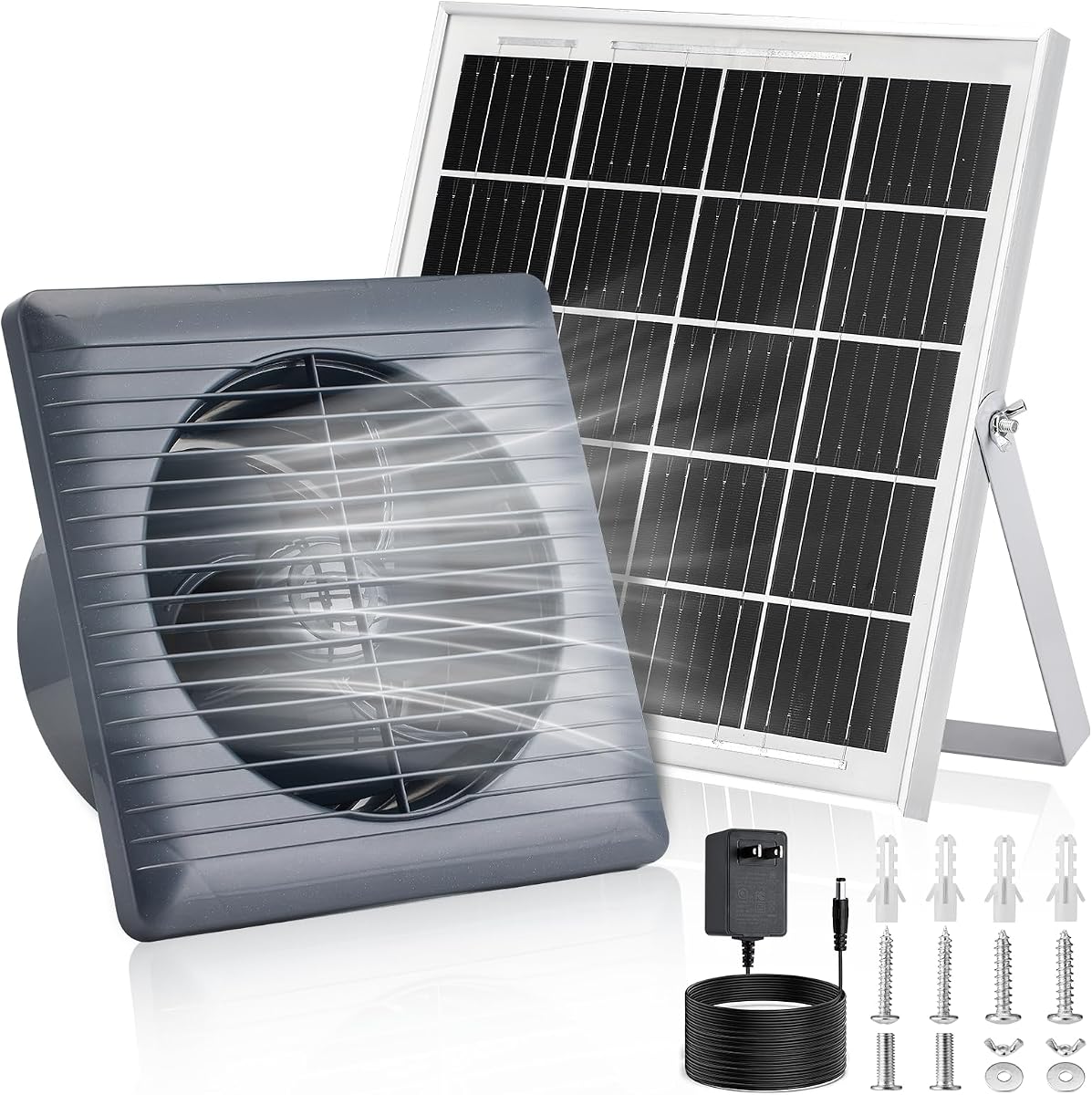




This 8-inch solar exhaust fan is a flexible middle-ground option for sheds, chicken coops, greenhouses, pet houses, and other compact ventilated spaces. Its 4.1 rating reflects a solid feature set rather than class-leading refinement. The combination of a 25W monocrystalline solar panel, 430 CFM claimed airflow, 2300 RPM speed, and household-power backup makes it unusually versatile for buyers who do not want a fan to stop whenever the sunlight fades.
We may earn a commission when you buy through this link, at no additional cost to you.
The panel is described as having photovoltaic conversion efficiency of up to 21.5 percent and an IP67 waterproof rating, while the adjustable bracket helps place it where it receives the strongest available light. A 16.4-foot solar-panel cord provides installation flexibility, and the included 4.66-foot household adapter offers an alternative when continuous ventilation is more important than a fully solar installation. The separate ON/OFF switch provides direct manual control rather than leaving every operating decision to automatic daylight behavior.
Its anti-backflow valve is another useful feature. The product information says the valve remains closed when the fan stops, helping keep insects, debris, and outside animals from entering through the vent. That makes this model more appropriate for exposed shed openings than a bare fan without a closure. The stated 36-decibel operating noise also fits well in a residential setting, although actual sound will depend on the shed structure, mounting quality, and surrounding surfaces.
This is a strong choice for a medium-sized shed needing substantial daytime ventilation with optional household power at night. It may be less attractive for a remote structure with no reliable electrical connection, because it does not store energy in a battery. It is also more capable than the smallest models but less powerful than the 12-inch systems. For a balanced 8-inch setup, however, the airflow, placement flexibility, and backflow protection form a compelling package.
The dual-power design separates the fan from any single energy source. Solar power handles normal daytime operation, while the included adapter can maintain ventilation at night or during poor weather. This is especially useful where a shed is occupied by animals or used for heat-sensitive storage.
The stated 430 CFM output gives the fan enough capacity for many small and medium enclosed spaces without the footprint of a 12-inch unit. A listed noise level of 36 decibels also makes it a sensible candidate for coops, home workshops, and sheds near frequently used outdoor areas.
We may earn a commission when you buy through this link, at no additional cost to you.
This 8-inch solar powered exhaust fan earns a 4.0 rating and is positioned for medium-sized enclosed spaces that need more ventilation than a compact fan can provide. Its stated 430 CFM airflow and 2600 RPM motor speed are particularly notable because they preserve the airflow figures associated with larger 8-inch kits while adding a brushless motor. The manufacturer recommends approximately 100 to 250 square feet, depending on enclosure height, sunlight, and airflow resistance.
We may earn a commission when you buy through this link, at no additional cost to you.
That recommendation is more useful than an undefined capacity claim because it helps prevent buyers from installing an oversized system in a tiny coop or expecting a small shed to receive unlimited circulation. The 25W monocrystalline panel is described as offering 21.5 percent conversion efficiency, while the 16.4-foot panel cable and 4.9-foot AC adapter cord provide placement flexibility. The housing has an IP44 rating, and the panel is protected by toughened glass with an IP67 rating.
A quiet motor is another meaningful advantage in spaces occupied by chickens, pets, or people. The listed operating level is no more than 36 decibels, which should be less disruptive than a conventional high-speed motor. The kit also includes an adjustable mounting bracket, screws, and an anti-backflow valve intended to limit insect and debris entry when the fan is not operating. Installation involves drilling a seven-inch hole and mounting the components.
Choose this model when the shed falls within its recommended area and daytime solar performance is the main priority, with household electricity available as a backup. It is less appropriate for a small enclosure where a 6-inch fan would be easier to fit, or a large shed that needs the output of a 12-inch system. Its quiet motor, defined space guidance, and dual-power option make it a practical all-around choice.
The 100-to-250-square-foot recommendation gives owners a useful starting point. Before purchasing, consider the shed's height and how restricted the airflow path is, because both influence how effectively the fan moves air through the enclosure.
The brushless motor is intended to reduce noise and vibration while supporting smooth operation. That makes the fan easier to live with in a chicken coop, pet house, greenhouse, or workshop close to the main house.
We may earn a commission when you buy through this link, at no additional cost to you.
The HG Power 12-inch model is the most feature-rich smart ventilation system in this group, earning a 4.8 rating. It combines a 40W bifacial solar panel, 764 CFM of stated airflow, a 12-inch shutter fan, a thermostat, speed controls, and dual power operation. For a larger shed, workshop, barn, basement, greenhouse, or attached sunroom, that combination offers a more comprehensive solution than a simple daylight-activated fan.
We may earn a commission when you buy through this link, at no additional cost to you.
Two operating modes distinguish the system. Energy Saving mode varies fan speed with available sunlight and can rely on the AC adapter for steadier output. Performance mode offers four speed levels, but the specification notes that the adapter is required for that control. Users can also select a target temperature from 68 to 113 degrees Fahrenheit, allowing the fan to start only when the space reaches the chosen threshold.
The ten-minute delay is a particularly thoughtful feature. Once the temperature falls below the set point, the fan continues running for ten minutes before shutting down, reducing rapid on-and-off cycling and helping protect the motor. The product description identifies this as a normal protective behavior. Since the system has no battery, however, it depends on either sunlight or its included AC adapter for continuous operation.
This is the strongest recommendation for a buyer who wants automatic climate-aware ventilation rather than a fan that simply follows daylight. The 12-inch shutter design and 764 CFM output are more appropriate for a larger enclosed area than the compact kits in the list. Buyers should plan the opening, panel position, and cable routes carefully, but the complete package, intelligent controls, and backup power justify the extra complexity for larger installations.
Instead of running at full output whenever the sun appears, the fan can respond to the actual temperature inside the shed. The adjustable threshold and operating modes give owners more control over comfort, airflow, and energy use.
The 12-inch shutter fan and stated 764 CFM airflow suit larger spaces where an 8-inch model may feel undersized. A bifacial panel that captures light from both sides adds useful output potential where the panel receives sunlight on more than one face.
We may earn a commission when you buy through this link, at no additional cost to you.
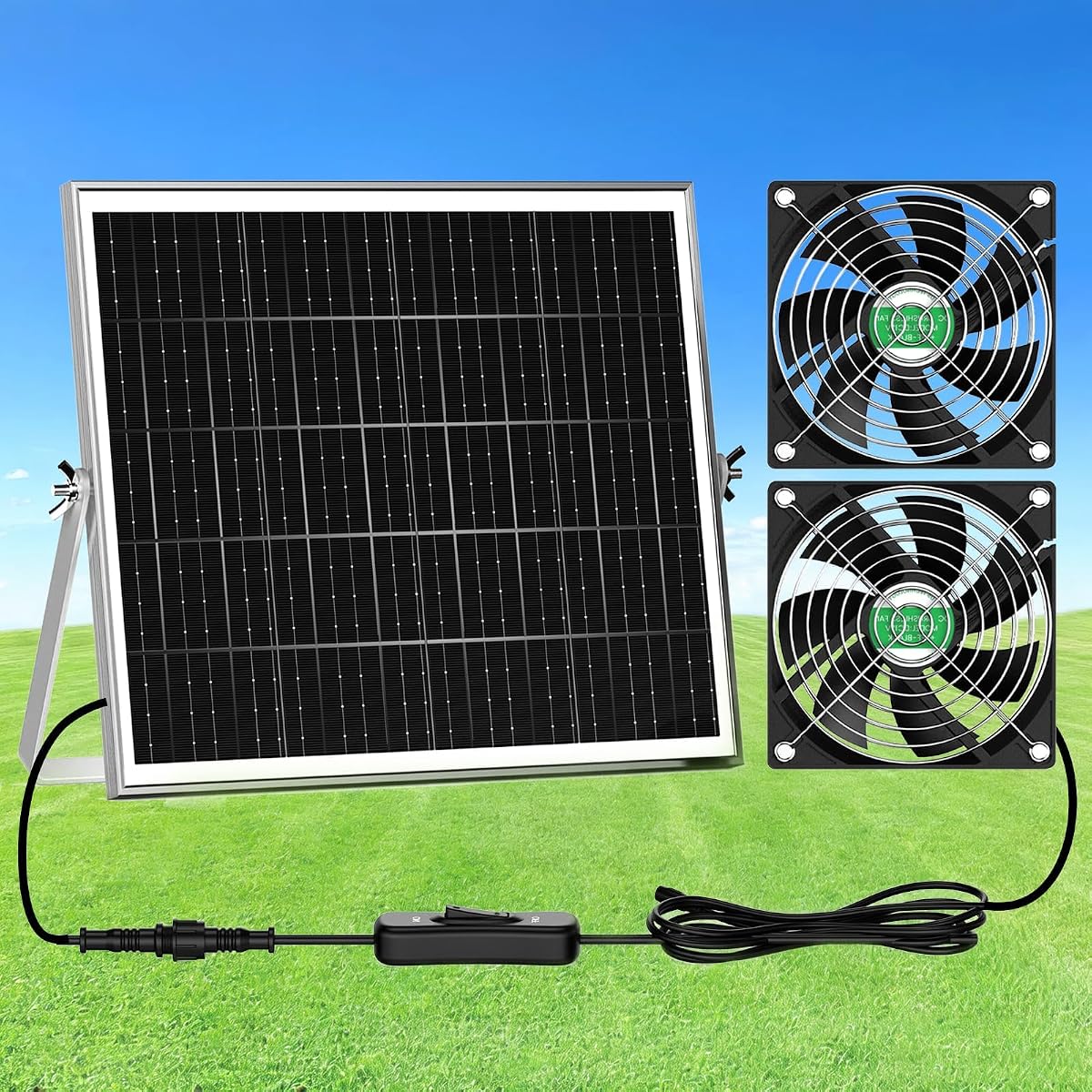
This 30W dual-fan solar kit is a straightforward ventilation solution for a small greenhouse, chicken coop, shed, pet house, attic, or window opening. It carries a 3.9 rating and distinguishes itself from many competitors with two fans rather than one. The pair can support more even circulation in a confined structure, and the product information identifies exhaust and fresh-air introduction as central functions.
We may earn a commission when you buy through this link, at no additional cost to you.
The solar-only design is refreshingly uncomplicated. There is no battery, no on/off switch, and no speed selection. The fan operates automatically in bright sunlight, with stronger output under stronger illumination, and the 8.2-foot extension cable provides some freedom in placing the panel relative to the fans. Pre-drilled mounting holes and waterproof plug-and-play connectors mean most installations require basic tools rather than electrical wiring.
Safety and durability are handled through a double-layer metal protective mesh and an IPX7-rated solar panel. The grille helps protect people, pets, and small animals from accidental contact with the blades while also guarding the fan itself. Buyers must still account for the fact that this product is intended for bright-light operation and cannot provide air movement after dark.
For a small shed where a basic, affordable, solar-only system is enough, this kit is a sensible choice. It offers no household-power fallback or battery storage, so it is best for daytime cooling and odor control rather than continuous overnight ventilation. Its dual-fan configuration makes it particularly interesting for compact structures that benefit from air entering and leaving in a coordinated flow.
The dual-fan arrangement is useful in small enclosures where one airflow path may leave stagnant corners. Owners can position the units to promote circulation between an intake point and an exhaust opening.
There are no controls to learn and no battery to maintain. The tradeoff is equally clear: the system depends on bright sunlight, so its output varies with the weather and it stops when the available light is insufficient.
We may earn a commission when you buy through this link, at no additional cost to you.
This compact 6-inch solar exhaust fan is designed for sheds and enclosures under 30 square feet. Its 4.1 rating reflects a well-defined use case: buyers who need strong ventilation in a very small structure but do not want the installation footprint of an 8- or 12-inch fan. The product information also includes households with chickens, rabbits, and other small animals, making gentle and quiet operation important.
We may earn a commission when you buy through this link, at no additional cost to you.
A brushless motor operating at no more than 28 decibels is the standout specification. The stated 2300 RPM speed is supported by airflow of up to 380 CFM, which is meaningful in a compact area but not intended to overwhelm a small enclosure. A 25W monocrystalline panel, adjustable bracket, 16.4-foot solar cable, and 4.66-foot AC adapter allow the fan to run in the sun or on household power.
The anti-backflow valve closes when the fan is off, helping maintain the intended direction of airflow and limit entry through the vent. The panel uses tempered glass and an aluminum frame with an IP67 rating for outdoor resistance. Installation is based around drilling a 5.6-inch hole, connecting the panel, and positioning the bracket where it receives strong sunlight. A separate ON/OFF switch provides manual control.
This is the right pick for a mini shed, rabbit hutch, compact chicken coop, or small greenhouse where quietness and a manageable cutout matter most. It is less suitable for a workshop or medium shed that needs a larger volume of moving air. For its intended space, however, the combination of compact sizing, 380 CFM output, low noise, and dual-power flexibility is well matched to the job.
The 5.6-inch installation opening and six-inch fan are easier to incorporate into a mini shed or animal hutch than an 8-inch system. That dimensional advantage can be more valuable than maximum airflow in a tightly scaled space.
The stated 28-decibel operating level is especially appropriate around animals sensitive to sound. The motor also supports smooth, durable operation according to the listed product information.
We may earn a commission when you buy through this link, at no additional cost to you.
The 25W Metal Solar Powered Fan earns a 4.4 rating by combining a rugged metal frame with a substantial 18,000mAh built-in battery. It is listed for chicken coops, greenhouses, sheds, pet houses, barns, RVs, and attics, so it suits buyers who want a durable outdoor unit with stored solar energy rather than a fan that stops as soon as sunlight fades.
We may earn a commission when you buy through this link, at no additional cost to you.
The battery is the defining feature. The listing states that it supports continued operation on cloudy days or at night, although the amount of stored power available at any moment will depend on sunlight and prior charging. The panel can be placed in a well-lit area, and a 16.4-foot waterproof cable connects it to the fan. This makes the system more practical for a shed where nighttime cooling is beneficial but a household outlet is unavailable.
Durability is addressed through the metal frame, corrosion resistance, and an IP65 waterproof rating. A steel mesh guard protects the blades, and the stated operating-temperature range is 5 to 140 degrees Fahrenheit. The product information also says the fan can be mounted on walls, roofs, or windows, and that installation can be completed in about 15 minutes using the pre-drilled holes, screws, and instructions.
This model is attractive for outdoor coops and sheds that cannot depend on grid power. Its main uncertainty is that the supplied information does not state a CFM figure, so buyers cannot compare its raw airflow with the 380, 430, 764, or 2000 CFM alternatives. Still, the battery, metal construction, animal-safe guard, and long cable form a practical package for off-grid ventilation.
The 18,000mAh battery distinguishes this model from solar-only kits and household-adapter systems. It provides a path toward continued ventilation after sunset or during periods when the panel cannot generate enough energy.
A metal frame, corrosion resistance, waterproofing, and a protective steel mesh make the fan well suited to coops and sheds exposed to rain, wind, temperature changes, and animal activity. A five-minute installation claim also keeps setup approachable.
We may earn a commission when you buy through this link, at no additional cost to you.
This 5.5-inch solar fan two-pack is built for small greenhouses, chicken coops, sheds, pet houses, attics, windows, and camping areas. Its 4.2 rating reflects a versatile pair design, and the listed maximum of 3200 RPM gives it an appealing high-speed specification. The product information recommends a space of approximately 130 square feet, which provides a useful starting point for sizing the installation.
We may earn a commission when you buy through this link, at no additional cost to you.
Its detachable fan and solar panel allow the panel to sit outside while the fans are positioned as intake or exhaust units. Buyers can configure both fans according to the structure's openings, and an arrow and physical orientation help indicate the intended airflow direction. The fan housing is made from heavy-duty aluminum, while dual metal protective nets add impact and safety protection. The solar panel is listed with an IP67 waterproof rating.
Installation hardware is unusually comprehensive. The package includes a bracket for upright, wall, or roof placement, mounting plates and screws, nylon ties for pole hanging, and a plug-and-play cord. A manual on/off switch is placed on the fan cord, providing more direct control than the fully automatic solar-only products. A stated lifespan of up to five years is also included in the product information.
This kit works best for owners who understand solar limits and want two small ventilation points. It runs during daylight hours, with greater speed under stronger sun and reduced output on cloudy days or near dusk. For a compact shed where an intake-and-exhaust arrangement would improve circulation, the two detachable fans are a strong argument. For overnight ventilation, a battery-equipped or grid-powered model would be more appropriate.
Pairing intake and exhaust fans can establish a clearer directional path through a shed than a single isolated vent. Detached wiring lets each fan be positioned where the enclosure's layout requires it.
The supplied bracket, plates, screws, and nylon ties support wall, roof, upright, and pole installations. That range of included hardware makes it easier to adapt the kit to an existing shed without designing a separate mounting system.
We may earn a commission when you buy through this link, at no additional cost to you.
The 40W Solar Attic Fan is the high-output choice in this guide, carrying a 4.5 rating and a stated maximum airflow of 2000 CFM. Its 12-inch metal blades and pure copper motor are built for larger sheds, garages, attics, greenhouses, barns, and other spaces where the smaller 6-, 7.1-, and 8-inch units would be undersized. The stated operating range is 1800 to 2000 CFM.
We may earn a commission when you buy through this link, at no additional cost to you.
The design emphasizes minimal complexity. There is no thermostat, controller, battery, or complicated wiring. The fan and panel arrive preconnected, and the unit is described as activating at sunrise and powering down at dusk. That set-and-forget approach is appealing for a large shed or attic where a continuous exhaust path is wanted but a full control system is unnecessary.
Construction details support its premium positioning. A hail-resistant metal housing, heavy-duty copper motor, and IP65 weather-resistant design are intended to withstand demanding outdoor conditions. The product information also says the managed sound level is comparable to a quiet conversation, avoiding the excessive hum it attributes to lower-quality solar ventilation fans. A 40W panel supplies the energy needed for the larger fan.
This is the best option for a large shed or attic with substantial heat buildup and enough roof or wall area for a 12-inch installation. It is not the sensible choice for a mini shed, and it cannot continue running after dark without another power source. Even with those limits, its exceptional stated airflow and robust construction make it the strongest premium ventilation platform for buyers who prioritize raw capacity.
The 1800-to-2000-CFM range is several times the stated output of the 8-inch competitors. It gives a larger shed the circulation needed to expel substantial heat and moisture more decisively.
The absence of a controller, battery, or thermostat simplifies ownership. Once installed and exposed to direct sun, the fan is intended to follow daylight automatically, making it suitable for seasonal exhaust in attics and large outbuildings.
We may earn a commission when you buy through this link, at no additional cost to you.
The Solar Fan with Battery and Timer combines a 25W panel, a 15,000mAh battery, and a dedicated nighttime timer. It carries a 3.9 rating and targets small greenhouses, chicken coops, sheds, pet houses, attics, barns, RVs, window vents, and other enclosed spaces. Maximum speed is listed at 3500 RPM, making it attractive for buyers who want a relatively vigorous small-space exhaust.
We may earn a commission when you buy through this link, at no additional cost to you.
The battery is designed to provide 12 to 15 hours of operation after a full charge, with the product information stating that six to seven hours of sunlight are required. At night, the timer can be set for three or six hours. This is a different control arrangement from a temperature thermostat: it establishes a timed overnight run rather than adjusting output according to a measured target.
Its dual airflow design allows installation for either air intake or exhaust, helping owners create a more consistent ventilation path through a shed or coop. A metal protective grill safeguards the blades, and the body is described as corrosion resistant, waterproof, and rustproof. The 16.4-foot extension cable allows the panel to be placed separately from the fan for a better solar exposure.
This product is a good match for an off-grid shed or coop that needs scheduled ventilation after dark. The trade-off is charging time: the battery should receive several hours of strong sunlight to be ready for a full night. The nighttime-only timer also means it does not provide the same temperature-responsive control as the HG Power model. For predictable overnight operation without a household outlet, though, it remains a practical option.
The three- and six-hour settings make it possible to extend ventilation beyond sunset without adding a grid connection. The timer restriction to nighttime gives owners predictable control when the goal is cooling after the hottest part of the day.
Because the unit supports both intake and exhaust positioning, it can fit into a planned circulation system. Pairing it with another opening or fan can help move air through the structure rather than simply creating turbulence near the vent.
We may earn a commission when you buy through this link, at no additional cost to you.
The 7.1-inch Solar Greenhouse Fan is a direct-power option aimed at small greenhouses, chicken coops, sheds, pet houses, attics, campsites, and window installations. It has a 3.7 rating, the lowest of the ten products, but its specifications are still notable: a stated 3800 RPM maximum speed, a 25W monocrystalline panel, and compatibility with enclosed areas of approximately 80 to 120 square feet.
We may earn a commission when you buy through this link, at no additional cost to you.
The panel and fan are physically separate, allowing the panel to be mounted outside in direct sun while the fan is positioned inside or in another suitable location. It can be set up as an exhaust or intake unit by flipping the fan to the opposite side. It cannot perform both functions simultaneously, so proper orientation and a complementary opening remain important to the overall result.
Durability comes from an IP65 waterproof rating, a heavy-duty aluminum frame, and double-layer metal mesh guards. The 16.5-foot cord provides enough separation between the fan and panel for many shed layouts. An adjustable bracket helps orient the panel toward the sun, and an arrow identifies the intended airflow direction. Installation is otherwise simple, with the supplied kit providing the principal mounting component.
This fan is best for a buyer who values high speed, simple solar-only operation, and the ability to change between intake and exhaust. Because it has no battery, it slows under reduced light and shuts off after sunset. It also cannot provide continuous air movement through cloudy periods. For a small or medium shed that mainly needs daytime cooling, that limitation is manageable; for overnight climate control, one of the dual-power or battery-equipped models is a better fit.
The stated 3800 RPM speed gives the fan a performance-focused profile. Output remains dependent on available sunlight, but it can create a pronounced air movement in a small or medium enclosure when the panel receives strong direct light.
Reversing the fan changes it from an exhaust to an intake device. This flexibility lets the owner adapt the unit to the shed's openings and prevailing airflow, although the two modes cannot operate at the same time.
We may earn a commission when you buy through this link, at no additional cost to you.
The right solar vent fan for a shed depends on more than panel wattage. Match the fan's airflow and opening size to the enclosure, then decide how it should operate when sunlight is limited.
Begin with the shed's floor area, height, and degree of enclosure. The products in this guide vary widely, from a compact 6-inch model recommended for spaces under 30 square feet to a 12-inch system capable of stated 1800-to-2000-CFM output. Other listed guidance includes 80 to 120 square feet for the 7.1-inch fan, roughly 100 to 250 square feet for one 8-inch model, and 764 CFM for the thermostatically controlled 12-inch unit. These figures provide useful starting points, but actual performance also depends on solar exposure, vent restriction, enclosure height, and the path air must follow through the structure.
Solar power is not always the same as uninterrupted ventilation. Direct solar-only models run when light is available and may slow under clouds or stop at sunset. Household-adapter models remain useful after dark but require access to grid power. Battery-equipped fans charge during sunlight and can continue after sunset, although runtime depends on charging conditions and battery capacity. The HG Power model also supports both solar and AC operation, giving it greater flexibility for buyers who want automatic temperature control without depending entirely on stored energy.
A strong solar panel cannot compensate for a fan that is inappropriate for the space, and a powerful fan may still perform weakly if the panel lacks sufficient sunlight. Compare panel wattage, stated fan speed, airflow, and the recommended area together. The 40W bifacial panel in the HG Power system and the 40W panel in the high-output attic fan are intended to support larger fans, while 20W to 30W kits are presented for smaller structures. Weather ratings are also important: examples in the selection include an IP67 panel with an IP44 fan housing, an IP65 fan, and an IP67 solar panel paired with an IP44 housing.
The fan diameter does not always match the required cutout. The 8-inch products call for a seven-inch hole, while the compact 6-inch model calls for a 5.6-inch opening. The 7.1-inch and 5.5-inch products are intended to work with their respective unit sizes and mounting arrangements. Before buying, measure the wall, window, gable, or roof location and check for framing, wiring, trim, and exterior obstructions. A smaller opening may simplify installation in a prebuilt shed, while a larger opening can improve airflow if the structure allows it.
Noise matters most when a fan operates beside people, chickens, pets, or bedrooms. The compact 6-inch model lists a brushless motor operating at no more than 28 decibels, while two 8-inch models list levels of 36 decibels or less. The high-output 12-inch attic fan is described as operating at a managed level comparable to a quiet conversation, although larger moving parts can still transmit vibration through a shed wall. Secure mounting, unobstructed airflow, and sensible speed settings help reduce rattling and sound transmission.
A shed fan should be installed away from exposed blades, wiring, and loose fasteners. Several products include metal protective meshes or steel guards, while some use anti-backflow valves that close when the fan stops. Installation methods range from plug-and-play waterproof connectors to a 16.4-foot cable with a separate panel. The 5.5-inch two-pack includes wall, roof, upright, and pole-hanging hardware, while the 40W attic fan arrives with the panel and fan preconnected. Choose the arrangement that lets the panel face strong sunlight without leaving the fan or cable exposed to avoidable strain.
The simplest products operate automatically in bright sunlight, while some include a manual ON/OFF switch. The 30W dual-fan kit has no switch and varies automatically with light. The battery model adds a three- or six-hour timer effective at night, and the HG Power model offers a thermostat, energy-saving and performance modes, and four speed levels in performance mode. For straightforward seasonal cooling, automatic operation may be enough. For animal housing, temperature-sensitive storage, or spaces occupied at night, more precise controls can prevent unnecessary full-speed operation.
A shed generally ventilates most effectively when air enters through one opening and exits through another. The 7.1-inch and 5.5-inch products can be reversed or positioned for either intake or exhaust. Fans with anti-backflow valves are intended to stop reverse movement when they shut down. Even when a single fan is used, adding a passive lower vent may provide a clearer circulation path than expecting one fan to ventilate a sealed enclosure. In a greenhouse, pay particular attention to the direction of the airflow so warm air is consistently directed out rather than trapped above the plants.
Begin by choosing a sunny exterior location for the solar panel and a high or unobstructed location for the fan. Install the panel where it can receive direct light without being shaded by trees, roof overhangs, or nearby structures. Connect the fan using the supplied waterproof connector or power cable, then secure both components with the included bracket, plates, or screws. If the model calls for a wall opening, cut the specified hole carefully, avoid concealed electrical lines or structural supports, and seal exposed edges as appropriate for the shed's construction.
For the first use, test the fan in the intended orientation and confirm that it draws air from the desired side and expels it through the opening. Models with an ON/OFF switch can be checked directly, while direct solar models begin operating when the panel receives sufficient light. If the product includes household power, test that connection before relying on it. Thermostat-equipped models should be allowed to read the room temperature, and timer-equipped models should be programmed during daylight hours because the timer is specified for nighttime use.
Maintenance is mostly limited to keeping the panel unobstructed and the fan clean. Wipe away leaves, dust, bird debris, and other buildup that could reduce solar output or restrict airflow. Check that the housing, grille, mounting screws, and cable connections remain secure, particularly after storms or seasonal weather changes. Do not allow water to enter electrical connections, and avoid operating the fan if its guard is damaged or loose. Battery-equipped and hybrid systems should be allowed to charge in strong sunlight, while direct solar systems should be evaluated for their reduced output on cloudy days.
It depends on the model. Direct solar-only fans stop or become very slow after sunset because they have no stored-energy system. Battery-equipped models can continue operating after charging in sunlight, while models with an included AC adapter can draw household power at night. Check whether the product has a battery, household-power compatibility, or both before choosing a fan for overnight ventilation.
Start with the shed's floor area and height, then allow for the restricted airflow path created by vents, screens, filters, or insulation. The products here range from a 6-inch model for spaces under 30 square feet to a 12-inch model with up to 2000 CFM of stated output. Manufacturer area guidance is a useful starting point, but a small, well-ventilated structure may need less output than a similarly sized closed shed.
Direct sunlight provides the best results for any solar-powered fan. Under weak or cloudy light, direct models generally run more slowly because they have no battery to draw from. Positioning the panel in an unobstructed sunny location can therefore make a meaningful difference in airflow performance, especially for compact fans with limited panel capacity.
Some models can be installed in either role, but most can perform only one at a time. The 7.1-inch fan is reversed to change direction, while the two 5.5-inch units can be positioned separately as an intake-and-exhaust pair. For a well-balanced shed, plan the direction of airflow and provide suitable openings so fresh air can enter as warm or stale air leaves.
Several products in this guide include metal protective mesh, double-layer guards, or steel blade guards to reduce accidental contact. An anti-backflow valve can also help limit insect and debris entry when the fan is off. Even with these features, install the unit securely, keep the opening inaccessible to small children where possible, and check that no guard or housing component has become loose.
First identify the required opening size and choose a location with good airflow. Mount the solar panel in direct sun, position the fan in the vent opening, connect the supplied cable or waterproof plug, and secure the bracket and housing with the included hardware. Test the airflow direction and, on powered models, verify the switch, adapter, timer, or thermostat before finalizing the installation.
Solar exhaust fans are intended to move moist, warm air out of enclosed spaces, which can help reduce humidity when the shed has a way for drier outside air to enter. Their effectiveness depends on solar exposure, the size of the openings, airflow resistance, and how much moisture is present. Continuous or battery-supported operation can be more helpful during periods when humidity remains high after sunset.
Solar output is generally weaker in low-light winter conditions, and a fan with no battery or grid backup may run slowly or stop. One product in this guide states an operating range of 5 to 140 degrees Fahrenheit, but its output can still vary with available sunlight. Choose a model with stored energy or household-power backup if dependable winter ventilation is a priority.
The HG Power 12-inch solar exhaust fan is the most complete recommendation for a larger shed, combining 764 CFM of stated airflow with thermostat control, two operating modes, dual power, and a protective shutdown delay. The 40W 12-inch attic fan leads in raw capacity with up to 2000 CFM and a robust construction, while the 30W dual-fan kit serves as a practical budget choice for a small structure that only needs straightforward daytime ventilation.
For most buyers, the right priority is the operating schedule. Choose a compact 6-inch model for a very small shed, an 8-inch model for a medium enclosure, and a 12-inch system when heat and space demand higher output. Add household-power or battery support if ventilation must continue after dark. Also plan the intake, exhaust opening, solar-panel angle, and safe mounting before purchasing so the system works as intended from the beginning.
Finally, check the current product listing, included components, dimensions, ratings, and availability before ordering. Product prices, seller details, and included accessories can change, and installation requirements may vary with the model. The links provided in this guide lead to the relevant product pages, where buyers can confirm the latest information and choose the solar vent fan that best matches their shed.