
100W Foldable XT60 Solar Panel
4.8Editor score
Compact 100W bifold design
23.7% monocrystalline efficiency
XT60 power station output
Expandable series-parallel setup
ETFE weather-resistant construction
Discover the best solar panels for buses, comparing efficiency, portability, weather resistance, power output, mounting options, and compatibility.
Solar panels for buses can transform a long-distance coach, converted van, school shuttle, or touring vehicle into a more independent energy platform. The right panel must balance useful output, manageable weight, durable construction, safe electrical compatibility, and resistance to vibration, wind, dust, rain, and the changing angles encountered on the road.
This guide compares portable folding panels, fixed monocrystalline kits, a drill-free mounting system, and a wiring accessory based on the supplied specifications. We examine power ratings, cell efficiency, connector coverage, waterproofing, portability, direct-charging features, expandability, and practical considerations for installing solar equipment aboard a bus.
Each review shows what a product is best suited for, from lightweight mobile charging to higher-output power-station support and permanent installations. Ratings and specifications reflect the available product data, while product availability and prices can change. Always verify dimensions, voltage, and connector requirements before buying.
4.8Editor score

4.5Editor score
4.7Editor score
The comparison below covers ten different approaches to bus solar power, including portable power-station chargers, fixed vehicle kits, drill-free mounting hardware, and DIY wiring supplies. Power output, efficiency, portability, weather resistance, and installation demands are the primary differentiators.


This 100W folding panel earns a place in the guide because it combines meaningful output with unusually broad connection support. It carries a 4.6 rating and uses Grade A+ monocrystalline cells rated at 23.5% efficiency. For a bus traveler, the combination of portability, IP67 protection, and adaptable connectors makes it more practical than assuming every power station accepts the same plug.
We may earn a commission when you buy through this link, at no additional cost to you.
Its strongest feature is the upgraded five-in-one solar cable, which includes DC8020, XT60, Anderson, DC7909 or 8mm, and DC5521 connections. The built-in controller also offers one USB-C port with 15V and 3A output and two USB-A ports, including a QC3.0 connection. That lets phones, tablets, GPS devices, and cameras draw power directly when a power station is not part of the setup.
The panel weighs 9.48 pounds and folds to 24.13 by 21.06 by 1.77 inches, making it much easier to move than a rigid bus installation. Two adjustable kickstands can improve solar alignment, while the zippered compartment protects the controller and cables. There is an important limitation: a power station's maximum solar input governs the actual charging rate, so this panel cannot overcome a lower generator input limit.
This is a sensible choice for smaller bus electrical systems, mobile use during stops, and owners who want one panel to serve several power-station brands. Fixed installers may eventually want a larger array, but for flexible, affordable, and broadly compatible solar equipment, it delivers an unusually useful combination of features.
Rather than requiring a collection of brand-specific adapters, the five-in-one cable covers several common portable power station families. Confirm the exact connector shape and input specification for the intended battery before purchase, particularly when the bus uses a less common connection.
The USB-C and USB-A outputs are useful when the bus does not have a large power station installed. A phone or navigation device can charge directly from the panel's controller, reducing dependence on vehicle outlets for smaller electronics.
We may earn a commission when you buy through this link, at no additional cost to you.
This 400W folding panel provides a major step up in charging capacity while retaining a format that can be deployed outside the bus. It has a 4.5 rating, premium monocrystalline cells, and a stated conversion efficiency of 23.4%. Its 36V architecture is intended for compatible portable power stations rather than direct connection to every 12V or 24V battery.
We may earn a commission when you buy through this link, at no additional cost to you.
MC4 connectors allow the panel to work with most portable power stations that accept the appropriate voltage and input range. The included cable also supports DC, XT60, and Anderson connections, while the product description highlights QC3.0 USB output. This gives installers several ways to reach supported power stations without treating the bus battery as a generic solar-controller input.
ETFE lamination improves light capture and helps the surface resist dust and high temperatures. Adjustable kickstands make deployment more practical on grass, gravel, or a parking surface. Although rated IP65, exposed electrical connections should still be protected from standing water, and the panel should be secured so wind cannot catch its folding sections.
Buyers seeking a larger mobile array for a power station, especially during extended travel away from shore power, will find this model compelling. The trade-off is greater size and weight than a 100W or 200W panel. The lower 4.5 rating also means the choice is based on specifications and versatility rather than an exceptionally high customer score.
A 400W panel can reduce the time needed to replenish a substantial power station compared with a small charging panel. Actual generation still depends on sunlight, angle, temperature, shading, and the power station's permitted input, so realistic daily energy estimates are more useful than the headline wattage alone.
The folding body and kickstands make this suitable for travelers who need strong charging capability at campsites or parking areas. A bus owner can carry the panel separately and deploy it where light is unobstructed rather than mounting a large surface permanently on the vehicle.
We may earn a commission when you buy through this link, at no additional cost to you.
The Renogy 200W panel combines high cell efficiency, a manageable folded size, and direct device charging. It has a 4.5 rating and uses 16-busbar N-Type cells with a stated efficiency of 25%. The panel weighs 13.89 pounds and closes magnetically at 23.72 by 22.99 by 1.97 inches, a useful balance for buses where every stored pound matters.
We may earn a commission when you buy through this link, at no additional cost to you.
Its integrated charging options are particularly useful for a working vehicle. A 45W USB-C port and two USB-A ports can support phones, tablets, laptops, GPS units, and cameras. When connected to a compatible power station through MC4 output, the same panel can support a larger battery bank. The four-in-one adapter is not included, so owners with other connection types must purchase that accessory separately.
Four kickstands offer 40-, 50-, and 60-degree positioning, which helps maximize exposure on uneven campsite ground and on the roof or rear of a bus. The product data also lists UL 61730 testing and CE, RoHS, FCC, CA65, PSE, and ISO 9001 claims. Reinforced grommets and an accessory pouch add useful installation detail for mobile use.
This is the most balanced choice for many bus travelers because it produces substantial charging power without reaching the size of a 400W or 480W folding panel. It is best for people who value direct charging, compact storage, and strong efficiency but do not want to carry a full-size rigid panel.
Buses offer limited usable roof area once vents, luggage, vents, and access paths are considered. A 25% N-Type panel can deliver meaningful output from a relatively compact surface, although actual performance varies with heat, angle, and partial shading.
The 45W USB-C output and dual USB-A connections make the panel more than a basic power-station input. Travelers can keep essential electronics running with fewer adapters, provided the devices' charging requirements are compatible with the available ports.
We may earn a commission when you buy through this link, at no additional cost to you.
This compact 100W panel has the highest numerical rating in the group, at 4.8, and stands out for straightforward XT60 output. It produces a stated 19.8V and 100W using monocrystalline cells with 23.7% efficiency. That makes it a natural fit for many 12V portable systems when the connected power station accepts the appropriate XT60 solar input.
We may earn a commission when you buy through this link, at no additional cost to you.
A smart charging chip provides reverse-charge, overcharge, and overload protection. The bifold format includes adjustable kickstands and reinforced loops, allowing the panel to sit on the ground or hang near a tent or RV. It can also be connected with another matching 100W panel in series or parallel, which gives owners a path toward greater output without replacing the original panel.
ETFE lamination, dust resistance, and a listed operating range of minus 10 to 70 degrees support outdoor use. The description also calls the panel waterproof, but exposed connectors should be shielded from immersion. The 12A maximum battery-current statement provides a clear boundary for system design and should be checked against the connected device.
For compact buses, frequent travelers, or backup charging needs, this panel is easy to justify. It is especially attractive when a matching second unit can later be added. Its modest output means it will not replace a large power station, but it can maintain smaller systems and essential electronics with minimal storage or deployment burden.
Two compatible 100W panels can be combined in series or parallel, allowing a bus owner to increase charging capability gradually. Expansion still requires correct electrical configuration, matching components, and attention to the maximum input of the connected power station or charge controller.
The briefcase-style bifold design is easier to store and deploy than a large rigid panel. It is particularly suitable for small converted buses, shuttle vans, and travelers who need a portable panel rather than permanent roof hardware.
We may earn a commission when you buy through this link, at no additional cost to you.
This four-piece mount is the only dedicated bus-focused installation product in the group. It has a 4.2 rating and is designed to hold virtually any aluminum-framed solar panel without drilling into the vehicle surface. That makes it appealing for bus owners who want removable equipment, rented vehicles, or bodywork they do not want to puncture.
We may earn a commission when you buy through this link, at no additional cost to you.
The set uses high-quality ABS plastic described as non-corrosive, long-lasting, and recyclable. Self-tapping screws attach the mount to the panel, while the surface side relies on adhesion. The product listing mentions that the manufacturer can recommend adhesive tapes or glues, but those adhesive options are not described as part of this particular set, so buyers should confirm what is included.
The mount is explicitly listed for RVs, vans, truck campers, trailers, motorhomes, buses, boats, and yachts. Its usefulness therefore extends beyond large coaches to many types of mobile living. Correct surface cleaning, adhesion, load distribution, and protection from road debris remain essential because a mounting method that avoids drilling does not eliminate environmental stresses.
This is not a solar panel by itself, so it cannot be compared directly on output or efficiency. Its value is installation flexibility. A bus owner who already has a suitable aluminum-framed panel can use this hardware to create a removable mounting arrangement, provided the chosen adhesive or fastening method is compatible with the bus's exterior material.
For coaches and converted vehicles, avoiding permanent holes can preserve resale value and reduce the risk of water intrusion. The mounting approach is most appropriate when the panel can be removed before travel or when the selected surface and adhesive are properly prepared.
The mount is designed for virtually any aluminum-framed solar panel, making it reusable across a bus, boat, trailer, or camper. Confirm the frame dimensions and available attachment points before ordering so the panel sits securely without interfering with folding sections or connectors.
We may earn a commission when you buy through this link, at no additional cost to you.
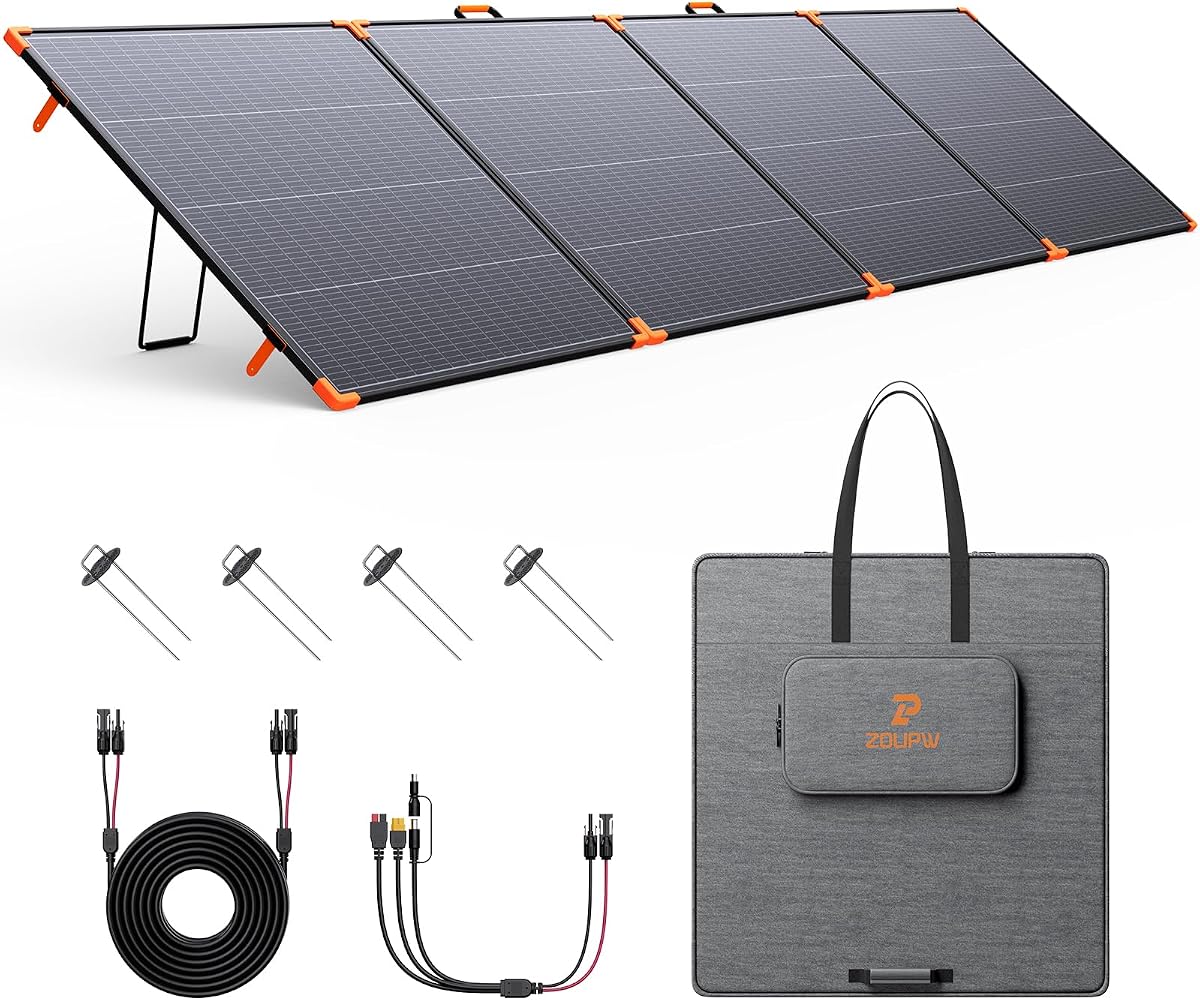
The ZOUPW 480W is the premium option in this comparison because it combines the highest nominal output with N-Type bifacial construction. It has a 4.7 rating, a 25% conversion rate, and a design intended to capture reflected light as well as direct sunlight. That makes it a strong candidate for a well-planned bus energy system using a large compatible power station.
We may earn a commission when you buy through this link, at no additional cost to you.
The bifacial construction can provide up to 30% additional output on high-albedo surfaces such as snow or sand. The product description also discusses early morning and hazy conditions, although real output still depends on weather and orientation. Integrated bypass diodes help maintain performance when partial shade affects the panel, but the instructions still advise against long-term fixed series or parallel connections and operation in shaded conditions.
At 22.5 pounds, the composite construction is considerably lighter than a glass panel of comparable class. The 42.5V architecture is designed for large power stations, and the package includes a storage bag, two-foot 12AWG four-in-one connector cable, a 13-foot extension, and four ground stakes. IP68 protection and a scratch-resistant coating support demanding outdoor use, although connectors should not be soaked.
This panel suits bus operators or serious off-grid travelers who need faster replenishment of a large battery bank. It demands more space, a higher-capacity power station, and careful placement than the smaller choices. The gain is a compact high-output array that can reduce setup complexity by replacing several smaller portable panels.
The second active side can collect light reflected from the deployment surface, increasing usable output under favorable conditions. The potential advantage is greatest over bright snow or sand, so operators should position the panel where the lower face receives an unobstructed reflected-light path.
Replacing traditional glass with composite materials reduces the panel's overall weight and makes deployment manageable by one person. This is helpful for a bus where the panel may need to be removed, transported, and positioned for maximum sunlight rather than permanently fixed.
We may earn a commission when you buy through this link, at no additional cost to you.
This ECO-WORTHY package is a strong choice for a fixed or semi-fixed bus installation. It has a 4.6 rating and includes two 100W monocrystalline panels, Z-mount brackets, a 30A PWM charge controller, solar cables, connectors, and a tray cable. The complete bundle simplifies sourcing several separately sold components for an RV- or vehicle-based system.
We may earn a commission when you buy through this link, at no additional cost to you.
Each panel measures 35.2 by 23.1 by 1.37 inches. The kit can be connected in series for a 24V arrangement or in parallel for a 12V arrangement, subject to correct wiring and controller settings. The stated daily output is 800Wh under four hours of full sunshine, a scenario that demonstrates why real-world conditions and system losses matter.
The aluminum alloy frames are described as corrosion resistant, with a 2400Pa wind rating and 5400Pa snow load rating. An IP65 junction box protects the cable entry. Pre-drilled holes and plug-and-play cables simplify installation, although a bus owner still needs to plan cable routing, fusing, grounding, battery compatibility, and weatherproof connections.
A PWM controller is simpler and generally less expensive than an MPPT controller, but it can reduce charging performance when battery voltage and panel voltage differ. This package is best for owners who prioritize a complete conventional system and flexible panel count. It may be less compelling for travelers who need a lightweight panel that can be redeployed at different stops.
The included panels, brackets, controller, and wiring create a more unified starting point than buying individual components. Buyers should still verify whether their existing bus battery, inverter, and wiring are appropriate for the supplied controller and series or parallel arrangement.
Documented wind and snow load ratings are relevant to panels exposed above a moving vehicle. Installation still requires secure supports and appropriate wind shielding, because mounting hardware and the vehicle's movement affect loads that the panel specification alone cannot address.
We may earn a commission when you buy through this link, at no additional cost to you.
This 50W Renogy panel is a compact fixed-panel option for buses that need a modest charging contribution rather than a large power station array. It has a 4.7 rating, uses 25% high-efficiency N-Type cells, and is built around a corrosion-resistant aluminum frame and anti-reflective, low-iron tempered glass.
We may earn a commission when you buy through this link, at no additional cost to you.
The panel includes multilayer encapsulation and EL testing. Bypass diodes minimize power loss caused by partial shade and support low-light performance, though a panel mounted near bus roof equipment may still suffer from obstructions. The junction box has an IP65 rating, while the stated mechanical figures include 2400Pa wind resistance and 5400Pa snow load capability.
Pre-drilled grounding holes make the panel compatible with Renogy Z-brackets, pole mounts, and tilt mounts. Unlike folding portable models, it is intended to remain deployed, making it more appropriate for a permanent bus roof or side installation where an appropriate charge controller and battery system are already in place.
Its lower output means it works best as a maintenance charger or supplement for a modest battery bank. It is not a strong choice for quickly replenishing a large power station. For a bus owner seeking a small, durable panel that can coexist with other charging equipment, however, its 25% efficiency and established range of mounting options are compelling.
A 50W panel can be useful where roof space is limited or where the electrical system is designed for slow background charging. It can also serve as a dedicated source for a smaller battery circuit when paired with an appropriate controller.
Compatibility with Z-brackets, pole mounts, and tilt mounts allows the installer to choose a layout that suits the bus. Keeping the panel clear of vents and allowing a suitable tilt can help avoid avoidable shading and improve energy collection.
We may earn a commission when you buy through this link, at no additional cost to you.
This product is a wiring accessory rather than a finished solar panel. It includes 20 meters of tab wire, 2 meters of DIY solar bus bar wire ribbon, and a 10ml flux pen for connecting solar cell panels to circuit boards. Its value is therefore specialized: it supports custom panel construction and repair work that cannot be handled with a standard plug-in panel.
We may earn a commission when you buy through this link, at no additional cost to you.
The generous lengths make it possible to create multiple connections or work on panels of different sizes. Bus bar ribbon can simplify the repetitive wiring of individual cells, while tab wire and flux assist in making soldered electrical paths. The included flux pen helps prepare connections, although it does not replace a soldering iron, suitable solder, insulation, and safe handling practices.
Because no customer rating is provided, there is no numerical satisfaction signal to weigh. More importantly, the package should not be judged as a power-producing product. It has no stated wattage, efficiency rating, junction box, frame, or weather resistance, so it cannot substitute for a panel in a completed bus installation.
This kit suits a builder creating a custom panel from individual solar cells or repairing a purpose-built assembly. For most bus operators, a ready-made certified panel is safer and simpler. The accessory is best reserved for installers comfortable designing electrical layouts, managing polarity, preventing shorts, and encapsulating or otherwise protecting the completed wiring.
Factory-folded panels offer convenient connectors, but custom projects may need individual cell interconnections. This kit provides the wire and ribbon needed to make those connections, allowing a builder to determine dimensions and layout rather than accepting a standard module.
Working with bare cells and soldered bus bars requires care to avoid polarity errors, damaged cells, and exposed conductors. A completed bus installation also needs suitable insulation, environmental sealing, junction protection, and integration with a correctly specified charge controller.
We may earn a commission when you buy through this link, at no additional cost to you.
The ZOUPW 450W panel delivers high output in a portable package and holds a 4.6 rating. Its N-Type monocrystalline cells use a 16-busbar design, providing a stated 25% efficiency and better performance in low-light conditions than conventional P-Type cells. The fiberglass composite construction keeps the weight at 29.5 pounds while retaining a rigid folding structure.
We may earn a commission when you buy through this link, at no additional cost to you.
Its most important specification is the 45.9V open-circuit voltage. The panel is intended for large power stations accepting 40V to 60V input and is explicitly not compatible with low-voltage units below 30V, including several Jackery and Bluetti models named in the product information. This voltage restriction is critical: physical connector compatibility alone does not make the panel electrically safe to connect.
The included four-in-one adapter supports XT60, Anderson, DC7909, and DC8020 connections. ETFE coating and sealed lamination provide an IP68 rating, while smart bypass diodes help when portions of the panel are shaded. The package includes a 13.12-foot 12AWG extension cable, four ground stakes, a storage bag, and a manual. Four kickstands adjust to 45 degrees for positioning.
This is a strong option for travelers using a high-voltage, 2kWh-class power station, but it is not a universal panel. The warnings against long-term fixed connections, shaded operation, and combining panels with different service lives should be respected. Those restrictions make it better as a carefully deployed portable array than as an unrestricted permanent bus installation.
A 45.9V open-circuit voltage is appropriate for compatible high-capacity systems, where the panel can operate closer to the power station's conversion range. Before purchase, compare the power station's solar input voltage, current, connector, and maximum wattage with the panel specifications.
The four-in-one cable covers several connector formats used by larger power stations. It does not override electrical compatibility, so owners should still verify the power station manufacturer's input requirements and use only the connector intended for the selected input.
We may earn a commission when you buy through this link, at no additional cost to you.
Choosing solar panels for a bus requires matching electrical output to the battery system while accounting for vehicle weight, roof area, storage, weather exposure, and the need to deploy or remove the equipment. The right panel is one that fits the bus's energy architecture and operating pattern, not simply the option with the largest stated wattage.
Choose a panel whose operating range is explicitly supported by the connected equipment. Connector shape is only one part of compatibility.
Base the purchase on measured or conservatively estimated daily demand, not only the largest available wattage.
Include the entire energy system in the weight and storage calculation, not just the module.
Favor efficient cells when space is tight, but prioritize an unobstructed location and realistic energy calculations.
Water-resistance ratings do not make connectors submersible, and secure mounting remains essential in moving vehicles.
Match expansion plans to the controller's electrical limits and the manufacturer's series or parallel guidance.
Select a mounting method that protects the bus body, holds the panel securely, and leaves every connection serviceable.
Verify protections and certifications for the complete electrical system, not merely for the solar module.
Before deployment, identify the bus power system, confirm the panel's voltage and connector requirements, and inspect the module, cables, controller, and mounting points. Place the panel in direct sunlight with no shade from roof equipment, mirrors, trees, or nearby vehicles. For folding models, open the panels fully, secure all kickstands, and orient the surface toward the available sun. If a portable power station is being charged, use the specified solar input and observe its maximum input wattage and voltage.
For a permanently installed system, isolate the correct electrical circuit before making connections, follow the controller and battery instructions, and ensure the cable runs are protected from sharp edges and moving parts. Use appropriate strain relief and weatherproof connectors, prevent positive and negative conductors from contacting the bus body, and check that every panel is operating within its allowed configuration. Never place heavy objects on a folding panel, step on it, or interrupt operation by touching exposed electrical parts.
Maintenance should include brushing away dust, leaves, mud, and bird residue with a soft nonabrasive tool, then inspecting the laminate for cracks and the cables for damaged insulation or hot connectors. Keep the panel surface clear of standing water and avoid immersing exposed plugs. Tighten compatible mounting hardware at appropriate intervals, check the adhesive or brackets after rough roads, and clean the junction-box seals. If output falls unexpectedly, test in direct sunlight, inspect for shading and debris, verify the charge controller state, and confirm that the battery or power station is not limiting input.
Only when its voltage, current, connector, and charge requirements are compatible with the battery and controller system. Many portable panels are designed primarily for power-station inputs, and connecting them directly to a battery can prevent charging or cause damage. Use the manufacturer-supported connection method, especially for high-voltage models with open-circuit ratings above 30V.
No. A larger panel can shorten charging time, but it also requires more space, may be heavier, and may exceed the connected power station's input limit. Choose the wattage around the bus's realistic daily energy demand, then confirm compatibility with the battery, controller, connector, and deployment location.
Choose an unobstructed, structurally sound area that avoids vents, roof accessories, antennas, and areas where the panel could shade passengers or other equipment. The location should permit safe cable routing, maintenance access, and secure mounting. A removable portable panel may be preferable when frequent travel makes roof mounting impractical.
Some models include direct USB outputs, including the ZOUPW 100W and Renogy 200W panels. The Renogy model provides a 45W USB-C connection, while the ZOUPW 100W includes USB-C and USB-A ports. Device charging still depends on sunlight, the panel's output, cable quality, and whether the connected equipment supports the offered charging standard.
The answer depends on daily consumption, battery capacity, sunlight, and how quickly the battery needs to recharge. A 100W or 200W portable panel may support essential devices and a smaller battery, while a 200W fixed kit or 400W to 480W portable array may suit more demanding systems. Calculate expected solar energy under realistic conditions rather than relying on peak wattage.
A high IP rating indicates strong protection for the applicable enclosed components, but exposed connectors and edges may still require additional protection. Do not soak plugs, close a connector while wet unless the manufacturer explicitly permits it, or assume the rating covers every accessory. Position the panel to minimize pooling and inspect the seals regularly.
Only when the panels, charge controller, and battery arrangement support the manufacturer's specified series or parallel configuration. Matching voltage ranges, current limits, connector types, and operating conditions are essential. The 100W XT60 model and two-panel ECO-WORTHY kit support expansion, but the 450W and 480W listings specifically caution against long-term fixed series or parallel use and shaded operation.
Not necessarily. A drill-free system depends on the selected adhesive or bonding method and the condition and material of the exterior surface. Some surfaces may require cleaning, priming, mechanical support, or a different fastening approach. Confirm compatibility with the bus manufacturer and test the bond before trusting it with a full-size panel in motion.
The strongest overall choice for many bus travelers is the Renogy 200W portable panel because it balances 25% N-Type efficiency, direct 45W USB-C charging, a compact magnetic body, and useful positioning options. The compact 100W foldable XT60 model is the value-oriented pick for smaller systems, while the ZOUPW 480W bifacial panel serves owners who need the highest output and have a compatible high-voltage power station.
Prioritize electrical compatibility before comparing wattage. Confirm the power station or battery voltage, charge-controller limits, connector, physical space, and the amount of daily energy the bus actually requires. Portable folding panels offer flexibility, fixed monocrystalline kits provide a more established installation path, and the Spartan Power mount helps owners avoid drilling when its adhesive and surface requirements are properly met.
Finally, review current prices, availability, warranty terms, and any updated manufacturer instructions before purchasing. Product costs and technical details can change, and a panel that is well suited to one bus may be inappropriate for another. The safest choice is the one that fits the complete electrical system, can be secured safely, and matches the travel pattern of the people using the bus.