
25W Metal Solar Powered Fan
4.4Editor score
Metal outdoor construction
25W solar panel
18,000mAh battery backup
A solar exhaust fan can keep a shed cooler by moving heat, moisture, odors, and stale air outdoors without requiring a nearby electrical outlet. The best unit depends on shed size, available sunlight, local weather, and whether you need daytime-only ventilation or battery-supported nighttime operation.
We compared ten solar-powered fans using their published specifications, including airflow, solar-panel capacity, battery storage, controls, construction, installation requirements, and suitable applications. The list covers compact wall fans, high-output shutter fans, dual-panel systems, thermostat controls, and battery-backed solutions for coops and greenhouses.
Each pick highlights a different practical strength, from a straightforward 25W fan to remote-controlled systems with larger batteries and more flexible speed settings. Product availability, ratings, configurations, and prices can change, so verify the current listing and installation requirements before making a purchase.
4.4Editor score

4.8Editor score

4.1Editor score
As an Amazon Associate we earn from qualifying purchases.
The comparison below organizes all ten options by fan type, power source, airflow, controls, and outdoor durability, making it easier to identify the model that fits your shed and operating conditions.


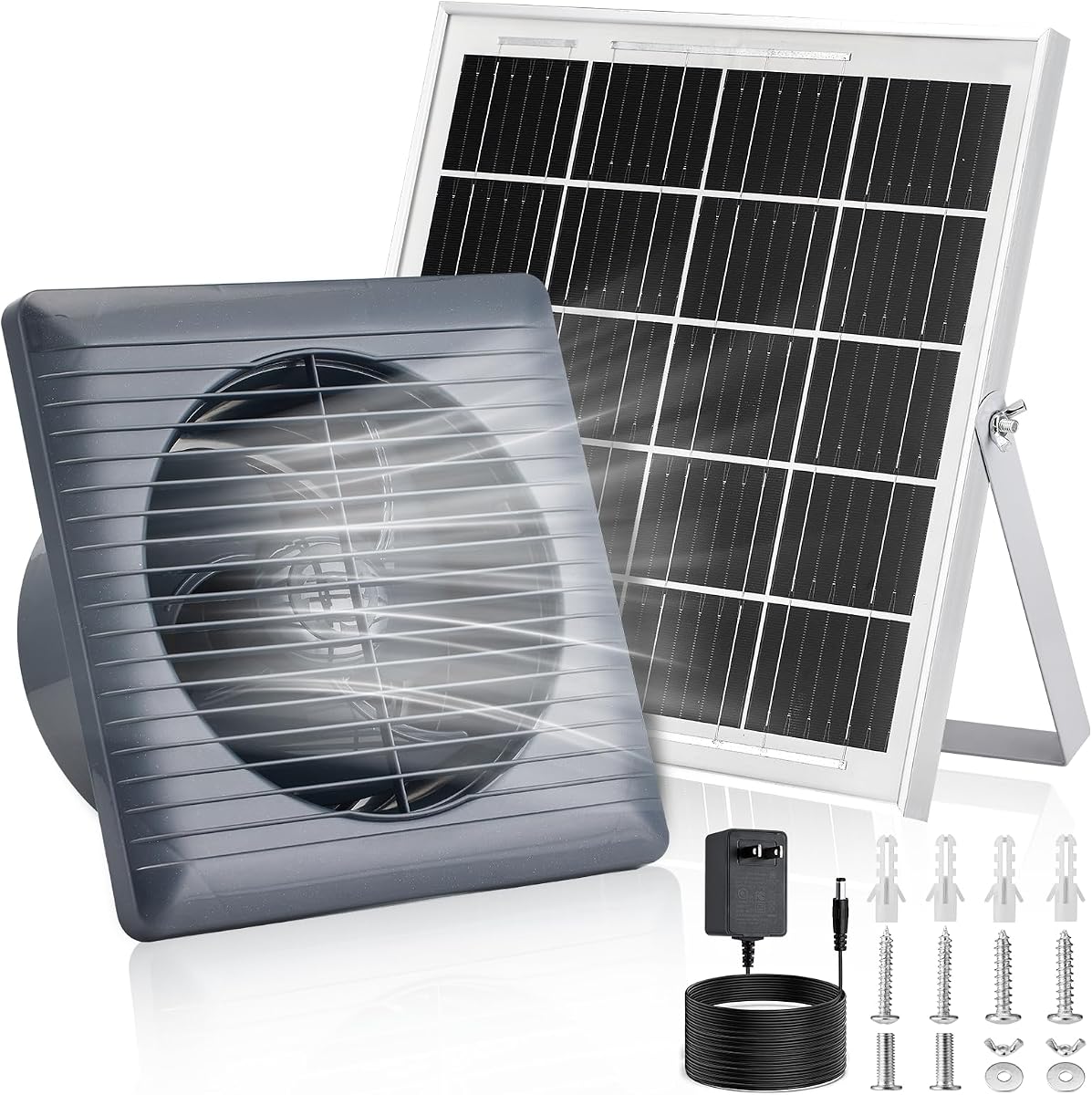


The 25W Metal Solar Powered Fan is a straightforward, well-rounded exhaust solution for sheds, chicken coops, greenhouses, and similar outdoor structures. Its 4.4 rating reflects a favorable balance of metal construction, battery capacity, weather resistance, and uncomplicated installation. It is particularly attractive for buyers who want useful night operation without moving into a more complex control system.
We may earn a commission when you buy through this link, at no additional cost to you.
A 25W solar panel charges an integrated 18,000mAh battery, allowing the fan to continue operating after sunset or during cloudier periods. The metal frame is designed to resist corrosion and outdoor heat, while the IP65-rated fan and steel mesh guard add protection in spaces occupied by birds or other animals. A 16.4-foot waterproof cable gives the installer flexibility to place the panel in direct sunlight and mount the fan separately on a wall, roof, or window.
The main compromise is the lack of programmable settings, a thermostat, a timer, or remote operation. That means the owner has less direct control over when the fan runs and must adapt the setup to prevailing conditions. Its listed temperature tolerance of 5°F to 140°F is broad, although actual performance still depends on proper installation, panel placement, battery condition, and the shed's construction.
This is a strong recommendation for a typical small shed or animal enclosure that needs dependable airflow with minimal controls. Check the intended cutout and mounting area before buying, position the panel where it receives unobstructed sunlight, and confirm that wall or roof material can accept the included fasteners. For a larger commercial shed or a user who wants automated temperature control, one of the premium models may be a better fit.
The 18,000mAh battery is the feature that separates this model from basic solar-only fans. It can maintain ventilation when sunlight is unavailable, which is helpful for sheds that accumulate nighttime heat or need odor and moisture control after sunset.
The metal frame, corrosion-resistant construction, IP65 fan rating, protected mesh, and stated temperature range suit demanding outdoor placements. These characteristics are especially relevant in chicken coops, pet houses, and sheds exposed to rain, insects, and changing temperatures.
We may earn a commission when you buy through this link, at no additional cost to you.
The Metal Solar Dual Fan is designed for buyers who want more airflow configuration than a single wall unit provides. It has a 4.2 rating and uses two solar-powered fans to create an intake-and-exhaust arrangement or place both fans where additional circulation is needed. The metal construction and 18,000mAh battery also make it suitable for outdoor animal shelters, greenhouses, and sheds.
We may earn a commission when you buy through this link, at no additional cost to you.
Its 25W panel can be positioned separately from the fan assembly using the included long cable, which is valuable when the best sunlight is on a roof, gable, or nearby wall. An ON/OFF switch provides basic manual control, while the IP65-rated blades and waterproof plug help protect the electrical connection. The two-fan arrangement can improve circulation by moving fresh air into one side of a structure and expelling warmer air through the other.
One notable ownership detail is the bracket notice. The listing states that a fan purchased without a mounting bracket should prompt the buyer to contact the seller, which can create uncertainty during setup if the package is not inspected immediately. The system also lacks the timer, remote, thermostat, and multiple speed settings found in the higher-end models, so users seeking automated operation will need to manage it manually.
Choose this model when airflow direction and intake-and-exhaust flexibility matter more than advanced controls. Confirm that both fan components and the panel bracket are present before installation, inspect the package on arrival, and ensure the panel receives direct sunlight. It is a practical two-fan option for a small shed, coop, greenhouse, pet house, attic, garage, or RV.
Two fans give the installer a useful degree of freedom. Positioning one near an intake opening and the other near an exhaust point can establish directional airflow, while both can be used to improve circulation in a confined structure.
The long panel cable allows the solar unit to sit where sunlight is strongest rather than being forced directly above the fan. This can be especially helpful on sheds with shaded walls, roof overhangs, trees, or nearby obstructions.
We may earn a commission when you buy through this link, at no additional cost to you.
The 8-Inch Solar Exhaust Fan combines a compact 25W panel with a high-speed 8-inch ventilation fan. It has a 4.1 rating and is positioned as a capable exhaust unit for sheds, chicken coops, greenhouses, dog houses, garages, attics, and other compact spaces. Its stated 430 CFM airflow and 2,600 RPM motor speed make it appealing where quick heat removal is important.
We may earn a commission when you buy through this link, at no additional cost to you.
A major advantage is the included AC adapter. The fan can run from solar power during suitable conditions or connect to household electricity through the adapter when cloud cover or nighttime prevents adequate charging. The IP67-rated monocrystalline panel has a toughened glass surface and aluminum frame protection, while the anti-backflow valve is intended to remain closed when the fan stops, reducing the entry of insects and outside debris.
The absence of a battery means this is primarily a daytime ventilation product unless it is connected to household power. That limitation may not matter in a climate where solar exposure is dependable, but it makes the system less self-contained than battery-equipped competitors. It also requires a seven-inch opening, so it is not a drop-in solution for every pre-cut vent.
This fan is a good fit for a shed that receives strong sunlight during the day and has a suitable wall or gable opening. Its high output and low stated operating noise make it useful for coops and greenhouses where animals should not be exposed to excessive sound. For overnight operation, verify that the adapter arrangement is acceptable or choose a battery-backed alternative.
The included power adapter separates this model from strictly solar-only kits. Buyers can extend ventilation into cloudy periods or at night when wiring to household power is practical, while retaining solar operation as the primary source.
The 8-inch format combines a stated 430 CFM airflow with a 36 dB operating level. That balance can make the fan easier to integrate into smaller structures than a large shutter-fan assembly.
We may earn a commission when you buy through this link, at no additional cost to you.
The Dual-Panel Battery Exhaust Fan is a premium, feature-rich option for larger sheds, greenhouses, workshops, attics, garages, and coops. Its 4.1 rating may not be the highest in the group, but the product provides an unusually extensive control and energy-storage package. It is designed for buyers who value fine-grained airflow management over a simple on-or-off installation.
We may earn a commission when you buy through this link, at no additional cost to you.
Two 20W monocrystalline panels provide more collection area than a basic single-panel design. They may be aimed in the same direction for efficient charging or positioned separately to capture sunlight at different times of day. The built-in 60Wh rechargeable battery stores daytime energy and is stated to support more than 10 hours of operation at the default speed, allowing ventilation to continue through cloudy periods, evenings, and overnight.
The remote control provides 12 speed levels, timer settings, and control from up to 26 feet away. Level 8 is identified as the recommended default. The fan can deliver up to 1,020 CFM, while the full-metal housing, copper brushless motor, aluminum blades, and waterproof construction are intended to provide durable outdoor operation. The stated noise range of 40–60 dB is suitable for many workshops, greenhouses, and animal buildings.
This is the best choice for a larger structure that benefits from scheduled or adjustable airflow and has room for two panels, a battery-equipped fan, and remote control. Buyers should consider the installation footprint, panel orientation, and the need to keep the solar area unobstructed. It is less appropriate for a tiny shed where a compact panel and one simple fan would be easier to place.
The two panels can face the same direction to improve charging or occupy separate positions to extend collection across the day. That flexibility is valuable on buildings with roof angles, partial shading, or changing sun exposure.
Twelve speeds and timer functions make it possible to tailor airflow to different periods, including quieter nighttime operation or stronger daytime cooling. Remote access also reduces the need to climb a ladder for routine adjustments.
We may earn a commission when you buy through this link, at no additional cost to you.
The 10-Inch Dual-Panel Exhaust Fan is the highest-output model in this roundup, with a stated maximum airflow of 1,450 CFM. Its 4.1 rating is supported by a strong technical package that includes two 30W monocrystalline panels, a 90Wh rechargeable battery, 12 speed levels, and timer controls. It is aimed at larger greenhouses, sheds, workshops, attics, garages, and chicken coops.
We may earn a commission when you buy through this link, at no additional cost to you.
The dual-panel arrangement offers flexibility for collecting energy throughout the day. The 90Wh battery is stated to provide more than 10 hours of airflow at the default setting, giving the system a substantial energy reserve for evenings and cloudy weather. A remote control allows the user to change speed and timer settings without accessing the fan, while Level 10 is presented as the recommended default.
Durability features include a full-metal housing, pure copper brushless motor, lightweight aluminum blades, and waterproof construction. The stated operating range of 40–60 dB remains relatively restrained for a fan capable of this output. Nevertheless, high airflow usually requires a larger opening, adequate space around the fan, and attention to structural mounting.
This is most appropriate for a large shed or greenhouse where maximum ventilation is the priority and there is adequate room for the panels and fan assembly. A small, tightly enclosed shed may not benefit enough from the extra capacity to justify the larger installation. Confirm the required cutout, maintain clearance around the airflow path, and position the panels where they receive direct sun.
The 1,450 CFM maximum makes this model relevant to larger greenhouses, workshops, coops, and commercial-style sheds. It offers considerably more published capacity than the 8-inch and 7.1-inch options in the guide.
The 90Wh battery is the largest storage capacity listed among these picks. Paired with two 30W panels, it is intended to support extended operation when direct sunlight is unavailable.
We may earn a commission when you buy through this link, at no additional cost to you.
The HG Power 12-Inch Fan is the standout all-around choice in this guide, combining the highest customer rating with thermostat-based automation and flexible power options. It is designed for workshops, barns, basements, sunrooms, greenhouses, chicken coops, attics, garages, and walls. The 4.8 rating reflects a particularly strong combination of features, construction, and user appeal.
We may earn a commission when you buy through this link, at no additional cost to you.
A 40W bifacial solar panel can collect energy from both sides, while the included AC adapter provides a seamless alternative when sunlight is limited. There is no battery, so uninterrupted operation away from household electricity depends on available solar energy. Two control modes balance energy conservation and stronger performance, and the thermostat can be set from 68°F to 113°F for automatic starting and stopping.
The smart ten-minute delay is especially thoughtful: after the temperature falls below the selected threshold, the fan continues for ten minutes before shutting down. This reduces rapid on-and-off cycling and supports longer motor life. The 12-inch shutter fan has a stated 764 CFM airflow, and the package includes a controller with temperature probe, panel and mounting hardware, cables, and the fan.
This is the most adaptable pick for a shed that needs temperature-based control rather than continuous ventilation. It is particularly suitable when the fan can be connected to household power for backup, since that enables steady airflow even when the panel is shaded. Its lack of battery storage is a meaningful limitation for remote off-grid sites, but the thermostat and dual-power design make it the most complete choice for accessible installations.
The adjustable thermostat lets the owner define when ventilation begins and stops. This is more efficient and convenient than leaving a basic fan running continuously during changing daytime temperatures.
The 40W bifacial panel provides flexible solar collection, and the included AC adapter can maintain operation when sunlight is weak. Household backup also unlocks the performance mode, which supports manual speed adjustment from one to four.
We may earn a commission when you buy through this link, at no additional cost to you.
The 25W Dual-Fan Controller System is a control-focused solution for small sheds, coops, greenhouses, pet houses, and other compact spaces. It has a 4.0 rating and stands out because it combines two independent fans with three operating modes, including an activity-sensing mode designed to stop airflow when a coop is empty.
We may earn a commission when you buy through this link, at no additional cost to you.
The continuous mode provides ongoing ventilation, while the timing mode alternates between running and paused periods. The sensing mode starts the fan when poultry activity is detected and shuts it off after ten minutes of inactivity. Two-speed control lets the user choose high or low output. This makes the system more versatile than a basic one-speed fan, especially for animal enclosures where occupancy changes during the day.
The included 2500mAh battery stores solar energy and is stated to charge in approximately four hours under suitable conditions. The 25W panel measures 15.7 by 13.8 inches and can be mounted on a wall or roof. The fans can operate as intake, exhaust, or both, although the listing specifically recommends this setup for spaces around six by six feet, with additional fans suggested for larger areas.
Choose this model for a small shed or coop that benefits from occupancy-based control and directional airflow. The relatively small battery means it should not be treated as a long-duration nighttime power source, particularly in cloudy seasons. Confirm that the sensing function suits the animals and enclosure, inspect the included hardware, and verify the space guidance before expanding the system.
The activity-sensing mode can reduce unnecessary ventilation when birds are not moving or present. The stated ten-minute delay avoids rapid shutdowns during brief periods of inactivity and may conserve stored energy.
The two small fans can be positioned as intake, exhaust, or paired for circulation. Their compact format is advantageous in confined coops and sheds, although larger structures would require additional capacity.
We may earn a commission when you buy through this link, at no additional cost to you.
The 8-Inch Brushless Exhaust Kit is a compact, quiet ventilation system for garden sheds, coops, pet houses, greenhouses, RVs, and other small enclosures. Its 4.0 rating is supported by a stated 430 CFM airflow, a brushless motor operating at no more than 36 dB, an anti-backflow valve, and both solar and AC power options.
We may earn a commission when you buy through this link, at no additional cost to you.
The 25W monocrystalline panel has a stated 21.5% conversion efficiency and comes with an adjustable bracket. Its 16.4-foot cable permits remote placement, while the included AC adapter offers another means of keeping the fan operating when solar conditions are poor. The brushless motor is designed to reduce vibration and sound, making the kit suitable for coops and pet houses where noise can stress animals.
The manufacturer recommends the 8-inch fan for enclosed spaces of approximately 100–250 square feet, with results varying according to ceiling height, sunlight, and airflow resistance. The anti-backflow valve helps prevent insects and debris from entering when the fan is stopped. A seven-inch cutout is required, and the fan housing is rated IP44 while the panel carries an IP67 rating.
This model is a good choice for a small shed that needs more power than a compact battery fan but does not require remote controls or an integrated battery. Its explicit area guidance is useful for avoiding an undersized or oversized installation. For overnight off-grid ventilation, choose one of the battery-backed systems; for larger buildings, consider the 10-inch or 12-inch options.
A stated maximum operating level of 36 dB makes this one of the quieter selections in the guide. The brushless design also supports smoother operation, lower vibration, and improved durability.
The recommended 100–250 square foot range gives buyers a practical starting point. Adjustments may still be necessary because enclosure height, openings, and airflow resistance materially affect performance.
We may earn a commission when you buy through this link, at no additional cost to you.
The 7.1-Inch Battery Exhaust Fan is an attractive middle ground between a compact wall fan and a large premium shutter system. It carries a 4.5 rating and distinguishes itself with a 24,000mAh battery, a 25W solar panel, and a stated 8–12 hours of continuous operation after sunset when the battery is fully charged.
We may earn a commission when you buy through this link, at no additional cost to you.
The battery specification makes the product particularly useful for sheds, coops, greenhouses, RVs, and pet houses that need ventilation after dark or during extended cloudy periods. The 14.7-foot panel cable allows the panel to be mounted on a roof or positioned near a stronger light source, and the adjustable panel angle helps optimize exposure. A separate ON/OFF switch provides simple manual control.
The fan uses IP65-rated blades and a waterproof plug for outdoor resilience. Installation involves drilling an opening of approximately 7.28–7.48 inches, connecting the panel cable, and securing the unit. Unlike several alternatives, it does not offer an AC adapter, remote, timer, thermostat, or multiple speed levels, so owners must choose a single operating approach and manage it manually.
This is a strong recommendation for buyers who prioritize long battery runtime and simple placement. It is less suitable for users who need household-power fallback, automated temperature control, or detailed speed adjustment. Confirm the cutout dimensions, keep the panel clear of shade, and allow the battery to charge fully before relying on its published overnight duration.
A fully charged battery is stated to run the fan for 8–12 hours after sunset. That duration makes the unit better suited to nighttime ventilation than smaller-battery alternatives, although real runtime depends on sunlight and operating conditions.
The adjustable panel, long cable, and ON/OFF switch keep operation uncomplicated. Once mounted, the system needs little routine attention beyond keeping the solar surface clean and unobstructed.
We may earn a commission when you buy through this link, at no additional cost to you.
The 12V Monocrystalline Exhaust Fan is a battery-free, low-maintenance choice for daytime ventilation. It has a 4.2 rating and combines a 25W monocrystalline solar panel with a fan rated to move up to 430 CFM at 2,500 RPM. It is suitable for sheds, greenhouses, attics, garages, RVs, chicken coops, dog houses, and remote outdoor workshops.
We may earn a commission when you buy through this link, at no additional cost to you.
Because the fan starts automatically when sunlight reaches the panel, it is well suited to structures that become hottest during the day. The battery-free design eliminates battery replacement, acid leakage, and related maintenance concerns. A 13-by-13-inch footprint makes the assembly comparatively compact, while a dual-layer safety mesh helps prevent birds and small animals from contacting the moving blades.
The UV-stabilized ABS housing and corrosion-resistant protective grille are designed for outdoor exposure, with an IP65 rating. The listing also states that the system can reduce indoor temperature by as much as 15°F under suitable conditions. Actual results depend on shed construction, solar exposure, opening size, and airflow path, so this should be treated as a potential rather than a guaranteed outcome.
Choose this model when ventilation is needed mainly during sunny hours and simplicity is more important than overnight operation or programmable control. It is a particularly clean solution for remote sheds without battery servicing. Since the fan does not store energy, it will stop when sunlight becomes insufficient, which should be considered for locations with frequent long overcast periods.
The absence of a battery simplifies ownership and avoids replacement-related maintenance. This makes the model attractive for remote installations where checking or servicing a stored-energy system would be inconvenient.
The 13-by-13-inch footprint and dual-layer mesh support straightforward installation around animals. It is easier to accommodate in many sheds than a larger dual-panel installation.
We may earn a commission when you buy through this link, at no additional cost to you.
The right solar exhaust fan depends on shed size, local sunlight, desired operating hours, available opening space, and the level of automation needed. Review airflow, battery or backup power, controls, and installation requirements together rather than focusing on a single specification.
Airflow is a useful starting point because it indicates how much air the fan can move under its stated test conditions. The options in this guide range from 430 CFM compact units to a high-output model listed at up to 1,450 CFM. The 8-Inch Brushless Exhaust Kit provides a manufacturer recommendation of roughly 100–250 square feet, while the 25W Dual-Fan Controller System is suggested for spaces around six by six feet. Larger sheds, workshops, greenhouses, and coops benefit from higher output, but adding a high-capacity fan to a tiny enclosure can make airflow unnecessarily strong and difficult to control.
Solar-only fans are simple and maintainable, but they generally operate only while the panel receives useful sunlight. Battery-backed models store daytime energy for cloudy periods, evenings, and overnight use. Capacities range from 2,500mAh in the dual-fan controller system to 24,000mAh in the 7.1-inch model, while premium systems use 60Wh and 90Wh batteries and claim extended operation at their default speeds. The HG Power model uses household AC power instead of a battery, while two 8-inch kits pair solar operation with an included adapter. The right choice depends on whether uninterrupted ventilation matters more than a battery-free design.
Panel capacity affects charging speed and how well the system can recover after cloudy weather. Most compact products use a 25W panel, while the dual-panel premium systems use two 20W or two 30W panels. The HG Power fan uses a 40W bifacial panel designed to collect energy from both sides. Placement matters as much as the wattage: a smaller panel in full sun may outperform a larger panel under heavy shade. Look for an adjustable bracket and enough cable length to move the panel away from obstructions such as trees, roof overhangs, or walls.
Basic switches are easy to understand, but automated controls can make a fan more efficient and convenient. The HG Power 12-Inch Fan includes a thermostat, two operating modes, four speed settings, and a ten-minute shutdown delay. The 25W Dual-Fan Controller System offers continuous, timing, and poultry-activity-sensing modes. The premium dual-panel systems provide 12 speed levels, timers, and remotes. If you want to reduce heat without constantly monitoring the fan, these controls are worth considering. For an uncomplicated weekend shed, a simple ON/OFF switch may be entirely sufficient.
Ventilation fans are not all the same size, and a shed wall or gable may need to be cut before installation. The 8-inch products generally call for an opening around seven inches, while the 7.1-inch model calls for approximately 7.28–7.48 inches. Larger 10-inch and 12-inch assemblies require more space and may need a more substantial mounting area. Measure the existing opening, identify the wall material, and confirm whether it can accept screws and a fan or shutter assembly. Also leave the required airflow clearance and avoid placing the fan where a closed door or equipment would block the intake or exhaust path.
A shed fan is exposed to rain, sun, dust, insects, and temperature changes. Listed protections include IP65 fan ratings, IP67 solar panels, metal housings, corrosion-resistant frames, and waterproof cable connections. Waterproofing does not eliminate the need for sensible placement: avoid directing a roof runoff stream toward the fan, and make sure the panel connection is not exposed to standing water. Metal components can add durability but may also require attention to prevent surface corrosion, while ABS and aluminum combinations can reduce weight and maintenance.
Noise matters in chicken coops, pet houses, greenhouses, and workshops. Several models state low operating levels of approximately 36 dB, while the larger premium fans are listed at 40–60 dB. Low vibration and a brushless motor can improve both comfort and equipment life. For animal spaces, also examine the grille or safety mesh, the gap between fixed and moving components, and whether the fan is drawing air through a protected area. A quiet fan is not automatically animal-safe, so both acoustic and physical protections should be considered.
Every outdoor solar fan benefits from periodic panel cleaning, but the energy-storage design affects the rest of the maintenance burden. Battery-free systems avoid battery replacement and leakage concerns. Rechargeable systems require less servicing but still need the panel kept clean so charging remains effective. Check that cables do not become pinched, brackets remain tight, and the fan opening stays clear of cobwebs, leaves, and nesting material. Wall-mounted units are usually easier to inspect than roof-mounted systems, while a separate panel and long cable can make cleaning and repositioning more convenient.
Begin by locating the shed's hottest, most stagnant area and identifying a suitable wall, gable, or roof opening. Confirm the required cutout, check for studs or structural supports, and install the fan where airflow can enter or leave the space without being blocked by shelves, equipment, or vegetation. Mount the solar panel in the brightest available position, using the adjustable bracket and long cable when the ideal sun exposure is separate from the fan.
Connect the system exactly as described in its manual, secure the plug and any exposed connection, and test the fan before closing the wall or attic opening. Models with switches, remotes, timers, sensors, or thermostats should be configured after confirming that airflow direction is correct. If the installation includes an AC adapter, route its cable away from standing water and use it as backup when sunlight or stored battery power is insufficient.
For routine care, clean dust, leaves, and bird debris from the panel at regular intervals, especially during seasons with frequent dust, pollen, or construction nearby. Inspect the grille, mounting screws, cable connections, and fan opening for damage or obstruction. Battery-equipped systems do not require routine battery replacement in the way lead-acid systems do, but they should still be monitored for unusually short runtime, and all fans should be disconnected from their power source before physical inspection.
Runtime depends on battery capacity, sunlight, fan speed, and the model's power consumption. The 7.1-inch fan is stated to run for 8–12 hours after sunset with a 24,000mAh battery, while premium systems claim more than 10 hours at their default settings with 60Wh or 90Wh batteries. Actual performance may be shorter following cloudy weather or a period of heavy use.
Solar panels still generate some energy under cloud cover, but output normally falls compared with direct sunlight. Battery-backed fans can use stored energy when conditions are poor, whereas solar-only models may slow or stop. The HG Power system can also use its included AC adapter, giving it another source of support when sunlight is insufficient.
The correct size depends on the shed's volume, ceiling height, climate, opening, and amount of heat buildup. A 430 CFM unit may suit a smaller garden shed or animal enclosure, while larger greenhouses and workshops benefit from higher-output models. A manufacturer-recommended area figure is a useful starting point, but actual airflow also depends on the complete intake and exhaust path.
No. Solar operation is designed to operate without a household outlet, provided the panel receives sufficient sunlight. Several models add an AC adapter for backup, while battery-equipped systems store energy for later use. Fully off-grid installations should check the panel, battery, and cable specifications before purchase.
Yes, and they are among the most common applications for these products. Look for a protective grille or mesh, reliable outdoor construction, low noise, and enough airflow for the enclosure. A thermostat, activity sensor, or timer can improve efficiency in coops where continuous daytime operation is not always necessary.
Yes, provided the selected model is designed for the installation location and the attic has suitable intake and exhaust openings. A remote solar panel can be placed in strong sunlight while the fan sits at a high vent. Roof-mounted equipment requires secure fastening and safe access during installation and maintenance.
An exhaust fan pulls air out of the structure, while an intake fan draws outside air in. Effective ventilation usually benefits from both, because one component without replacement air can reduce airflow. Products with two independent fans are especially flexible, while single-fan kits should be oriented according to the shed's openings and prevailing breeze.
Inspect the panel regularly and clean it whenever dust, leaves, pollen, or bird debris begin to reduce sunlight collection. Frequency depends on the location, but shaded or dusty environments require more frequent attention. Keep the fan grille clear as well so the motor is not working harder than necessary.
The 25W Metal Solar Powered Fan is a sensible budget-oriented choice for buyers who want a metal frame, 18,000mAh battery, and flexible panel placement without complicated controls. The HG Power 12-Inch Fan is the most versatile overall option thanks to its thermostat, AC fallback, adjustable speed modes, and strong 764 CFM rating. The Dual-Panel Battery Exhaust Fan stands out for premium remote control, a 60Wh battery, and up to 1,020 CFM of published capacity.
Prioritize airflow that suits the enclosure, direct access to sunlight, and the operating period you need. A thermostat, timer, remote, or activity sensor is valuable when energy efficiency and convenience matter. A battery or AC adapter is important if ventilation must continue overnight, while a battery-free model is easier to maintain and best suited to reliable daytime conditions.
Before ordering, measure the intended opening, verify the panel and fan dimensions, check the installation instructions, and consider the direction of airflow through the entire shed. Also review the current product listing, warranty, included accessories, ratings, and price, since specifications and availability can change after this guide was published.