
Wiszodet Kids Smart Game Watch
4.4Editor score
Thirty-nine built-in puzzle games
Touchscreen camera and video
Standalone operation without apps
Choosing a smartwatch for an 11-year-old is more complicated than choosing a colorful watch with a few games. At this age, children may want a device for creativity, fitness, communication, and independence, while parents need a clear understanding of contacts, tracking, controls, and limitations.
This guide compares ten watches across entertainment, photography, activity tracking, communication, location features, water resistance, and ease of use. It includes camera-focused models for play, fitness watches for movement, and connected models for calls, texts, and GPS monitoring, with special attention to the product information supplied.
Each review explains who the watch is likely to suit and where trade-offs appear. The top picks represent the strongest options for different priorities, including a budget game watch, a well-rounded child-focused model, and a safety-focused phone watch. Product features and availability can change, so check the current listing and terms before buying.
4.4Editor score

4.6Editor score

3.7Editor score
As an Amazon Associate we earn from qualifying purchases.
The table below places the ten watches side by side, emphasizing the differences between standalone entertainment devices, fitness trackers, and connected phone watches. It is designed to clarify the most important buying tradeoff: playful independence versus direct communication and parental oversight.
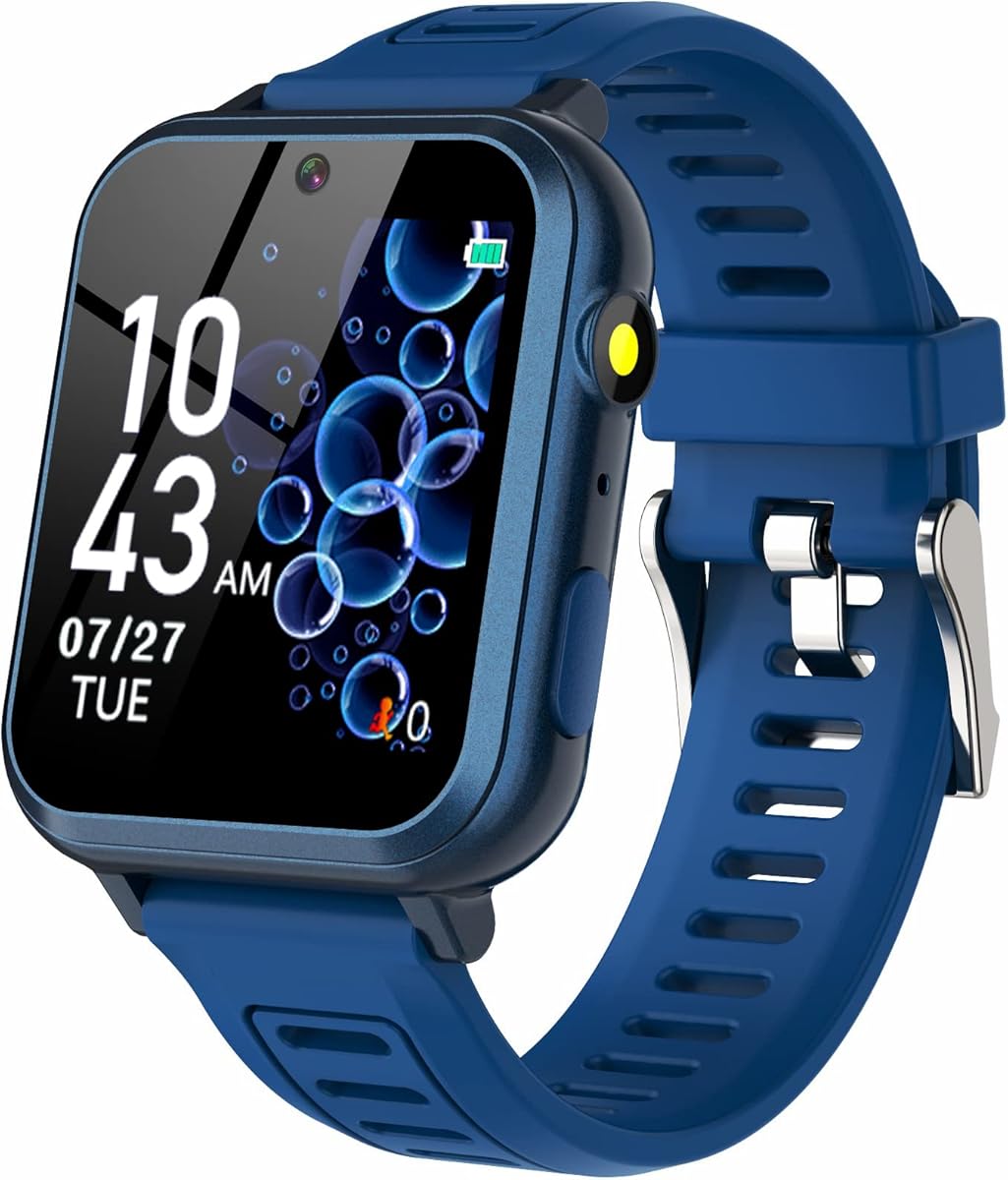


The Smart Watch for Kids with 39 Games Alarm Clock, Touchscreen Calendar Camera has a 4.3 rating and stands out as a broad all-in-one option for an 11-year-old who wants entertainment without cellular service. Its feature set extends well beyond games, including a selfie camera, video, a music player, voice recorder, pedometer, alarm, stopwatch, calculator, themes, a screensaver, an audiobook function, a learn card, habit tracking, and a silent profile. The touchscreen also supports a calendar, making the device useful for both play and everyday organization.
We may earn a commission when you buy through this link, at no additional cost to you.
The strongest part of this model is its variety. Children can solve puzzles, record short clips, listen to music, set reminders, or use the flashlight without downloading an app or entering a phone number. A built-in memory card is included according to the product information, and it can be used for children's songs, pictures, and videos. The stated capacity of more than 10,000 HD photos or more than six hours of video gives the camera and video functions unusual prominence for a standalone watch.
There are important limitations, however. This is not a phone watch: it has no SIM card and no call function. Parents also need to account for variable battery performance, with the listed working time ranging from three to seven days depending on use. The included USB cable takes about two hours to charge the watch fully. These constraints are understandable for a device centered on independent entertainment, but they make it less appropriate for a child who needs to contact a parent while away from home.
This is a strong recommendation for families seeking a single screen that combines games, photography, music, reminders, and basic activity tracking. An 11-year-old who does not need phone calls will find a broad set of useful activities, while a parent can appreciate the lack of app setup and cellular complexity. For communication-heavy needs, one of the GPS phone watches would be the better direction; otherwise, this remains a versatile, approachable standalone choice.
The camera, video, stickers, music, games, and downloadable content are all managed from the watch itself. That simplicity makes the device easier for an 11-year-old to use independently, without a parent account or paired smartphone as a prerequisite.
Alarms, a calendar, a stopwatch, a pedometer, a learn card, and a habit tracker give the watch utility beyond entertainment. These functions can support routines, homework reminders, movement goals, and independent time management.
We may earn a commission when you buy through this link, at no additional cost to you.
The Wiszodet Kids Smart Game Watch carries a 4.4 rating and presents a capable package for an 11-year-old who values games, photography, and uncomplicated operation. Its 1.54-inch color touchscreen gives children access to 39 puzzle games, a selfie camera, video recording, music, a torch, a voice recorder, a pedometer, an alarm, a stopwatch, a calculator, themes, volume controls, and screensaver options. The product is explicitly positioned for ages 5 through 12, placing an 11-year-old comfortably within its intended range.
We may earn a commission when you buy through this link, at no additional cost to you.
Its educational and play features are well balanced. The puzzle games are described as helping logical thinking, reaction speed, and hand-eye coordination, while a time-teaching function can help children practice reading a clock. The pedometer tracks steps and estimated calories, and alarms support time reminders. This makes the watch more than a collection of mini games, although the emphasis remains on entertainment and basic activity awareness rather than genuine communication.
The camera and video functions support the same large stated media capacity seen in many standalone child watches: more than 10,000 HD photos or over six hours of video. Children can also choose a photo as the wallpaper. Parents should note that the watch does not make calls, does not require an app, and does not need a SIM card. It is therefore easier to set up than a connected watch, but it cannot answer the safety and contact needs of a child who travels independently.
This is a compelling choice for budget-conscious families seeking the conventional child smartwatch formula with a good rating, many games, and a child-friendly interface. It is especially suitable for an 11-year-old who wants a personal entertainment device but does not yet need direct voice contact with parents. If a smartwatch is intended to replace a phone, choose a GPS-enabled alternative instead; if the goal is a fun, self-contained gadget, this model fits the brief well.
The 39 puzzle games and built-in time teaching add more variety than a single arcade-style title. They also make the watch useful for practicing coordination, logical reasoning, and clock reading without requiring a phone or app.
Because all core features are built in, an 11-year-old can begin using the watch without a complicated setup process. Parents avoid cellular accounts and app permissions while children retain access to music, video, games, and reminders.
We may earn a commission when you buy through this link, at no additional cost to you.
The VTech KidiZoom Smartwatch DX4 has the highest rating in this group at 4.6, and it offers a particularly polished mix of creativity, movement, and child-friendly learning. It is intended for ages four and older, so it remains suitable for an 11-year-old. Rather than concentrating on phone-style communication, the watch emphasizes two cameras, a large display, games, reactions, customization, and time-telling practice.
We may earn a commission when you buy through this link, at no additional cost to you.
Dual cameras are the signature feature. Children can take photographs and videos, apply creative effects, make use of photo and video customization, and explore a composer app for creating music. The watch also includes 50 built-in clock faces, additional downloadable faces, and a shake-to-hear-the-time function. English, Spanish, and French are supported, adding a useful language dimension to a device that looks and functions more like a creative camera than a conventional fitness tracker.
The watch is not passive entertainment. Its activity challenges and reaction games are designed to get children moving, and the splash-proof construction makes it more suitable for everyday play than a device that must be kept completely dry. The rechargeable lithium-ion battery is charged with the included micro-USB cable, and the manufacturer specifically advises against third-party adapters. This is a minor ownership consideration, but it is worth noting before purchase.
For an 11-year-old who wants a distinctive watch for photography, creativity, and active games, the KidiZoom DX4 is an excellent top choice. It provides a polished and varied experience without a SIM card, app, or calling function. It is less suitable for a child who needs to speak with a parent independently, but for school-age creativity and screen-free movement prompts, it is hard to overlook.
The dual-camera arrangement supports more creative possibilities than a basic single-camera setup. Photo effects, video tools, wallpapers, and the composer app encourage experimentation, which can be especially appealing to an 11-year-old developing an interest in content creation.
Reaction games, activity challenges, and the splash-proof design turn the watch into a device that can encourage physical engagement. That makes it a useful alternative to passive scrolling, particularly for younger children or family trips.
We may earn a commission when you buy through this link, at no additional cost to you.
The Cubitt Teens Smartwatch has a 4.4 rating and is explicitly designed for ages 11 through 14, making it one of the most age-appropriate choices in this roundup. It adopts a more mature smartwatch format than the colorful entertainment models, with a 1.85-inch AMOLED touchscreen, a 390-by-450 resolution, a modern interface, interchangeable straps, and more than 100 available watch faces through the Cubitt app.
We may earn a commission when you buy through this link, at no additional cost to you.
Its standout feature is Bluetooth calling, which allows a teen to make and receive calls directly from the watch without carrying a phone. The watch can also deliver notifications from calls, texts, WhatsApp, Instagram, and Facebook. Bluetooth connectivity depends on the paired phone, so it is not a fully independent phone watch, but it offers a useful middle ground for school, errands, and situations where carrying a smartphone is inconvenient.
Fitness is a major strength. The watch automatically tracks steps, calories, distance, heart rate, and sleep, with more than 20 dedicated sport modes for activities such as running and cycling. It also includes more than 20 games, customizable alarms, reminders, a parental password lock, and an IP68 water-resistant design. The combination of a large vivid screen, mature styling, and broad daily tracking makes it particularly appealing as an 11-year-old moves toward teen-oriented features.
This is a strong recommendation for a child who is ready for a wearable that feels less like a toy and more like a personal smartwatch. Bluetooth calling is the decisive advantage over standalone game watches, while the fitness and notification tools make it useful every day. Parents should confirm that their child has access to a paired smartphone for the features they care about, and they should review which notifications the watch is intended to display.
Bluetooth calling is particularly useful for an 11-year-old who is old enough to move around independently but not yet ready for a full cellular watch. A paired phone remains necessary, yet the child can handle calls directly from the wrist.
Automatic tracking for steps, calories, distance, heart rate, and sleep gives the watch more daily relevance than a game-focused device. More than 20 sport modes also make it easier to maintain an active routine as interests expand.
We may earn a commission when you buy through this link, at no additional cost to you.
The JrTrack 5 SE Kids Smart Watch by Cosmo is built for ages six and older and focuses on communication, location, and parental management. Its 3.7 rating is the lowest listed here, but the specifications identify it as the most safety-oriented model. It functions as a standalone phone watch with real calls, SMS and MMS messaging, photos, voice notes, video messages, and family group conversations rather than relying on a nearby smartphone.
We may earn a commission when you buy through this link, at no additional cost to you.
Location is the main attraction. A dedicated location chip, real-time Active Tracking, customizable safe-zone alerts, and location history are managed through the Cosmo parent app. SafeCORE adds SOS alerts, optional 911 calling, safe-zone notifications, and unknown-caller blocking. Only parent-approved contacts can reach the watch, which directly addresses a common concern when a child is carrying a communication device away from adults.
School-Fi is a notable feature for an 11-year-old. When enabled, it recognizes arrival at school and limits distractions while preserving essential safety and communication functions. Parents can also manage apps, set time limits, review text history, and choose from a kid-safe app library. The trade-off is that this is a service-based device requiring a compatible eSIM and Cosmo Mobile Family-Safe service; the watch is not compatible with other carriers, and service plan options are separate from the hardware.
For families whose top priority is knowing where a child is and enabling safe contact, the JrTrack 5 SE is the most capable pick in the guide. It is more consequential and more involved than a standalone game watch, so the lower rating and cellular requirements deserve careful consideration. If parents need direct communication, location history, controlled contacts, and school controls, those features justify the additional complexity.
Real-time tracking, location history, safe zones, approved contacts, and unknown-caller blocking create a layered safety setup. These tools are especially useful for independent travel, after-school routines, and times when a child needs to reach a guardian quickly.
School-Fi automatically reduces distractions when the child arrives at school while keeping essential communication available. This reduces the need to manually manage the watch around a changing academic schedule.
We may earn a commission when you buy through this link, at no additional cost to you.
The Smart Watch Fitness Tracker has a 4.1 rating and is designed for ages six through 14, giving it another strong age fit for an 11-year-old. Its 1.5-inch color touchscreen combines a customizable dial with 19 indoor and outdoor sport modes, automatic step, distance, and calorie tracking, sleep monitoring, heart-rate tracking, a pedometer, reminders, and a vibrating alarm clock.
We may earn a commission when you buy through this link, at no additional cost to you.
Sleep and activity monitoring provide a useful reason to wear the watch beyond games. The sleep function displays deep sleep, light sleep, and the number of awakenings, while the vibrating alarm can wake a child without creating noise that disturbs others. Reminders for sitting and drinking water add further routine support. Parents can view detailed data through the app, and the watch supports wallpaper selection or uploading a favorite photo.
This is not a standalone phone watch. It does not support SIM cards, cannot make or answer calls or messages independently, and has no separate Wi-Fi connection. Bluetooth does allow smart alerts for incoming calls, SMS, and WhatsApp messages from a paired phone. The product information also states that the app is used for detailed activity data, despite the title's broad no-phone or no-app wording, so buyers should interpret the title in light of the full feature description.
The magnetic charging cable and stated battery life of up to five to seven days make maintenance convenient, although actual duration varies with use. IP68 water resistance and a durable TPU back strap suit an active child. This is a good recommendation when movement, sleep, and habit formation matter more than independent phone service or a large game library.
Steps, distance, calories, heart rate, and sleep patterns create a more complete picture of daily activity. The vibrating alarm, hydration reminder, and sitting reminders make the watch useful for building age-appropriate routines.
The IP68 rating, durable TPU strap, adjustable design, and magnetic charging setup suit frequent wear. Nineteen sport modes give children familiar choices for running, jumping rope, basketball, and other activities.
We may earn a commission when you buy through this link, at no additional cost to you.
The 4G Kids Smart Watch Boys with GPS Tracker & Call Phone has a 4.3 rating and is aimed at children ages five through 12. It combines real-time GPS tracking with phone and video calling, text messaging, voice chat, a camera, an alarm, a step counter, a calculator, a stopwatch, route history, school mode, safety-zone alerts, a watch finder, and five educational games. The parent-facing JuniCare app controls the key settings.
We may earn a commission when you buy through this link, at no additional cost to you.
Communication is more flexible than on many competing child watches. The device supports up to 15 contact numbers, which is useful for a child with multiple relatives or caregivers. It also includes an emergency SOS function that, when held for more than five seconds, cycles through up to three preset guardian numbers while sending parent alerts. Parents can block unknown callers, creating a controlled communication environment for an 11-year-old.
Location tools include real-time tracking, customizable SafeZone boundaries, and route history. School mode provides a separate way to limit distractions, while the 1.85-inch screen supports video calling at 240 by 280 resolution. The stated 700mAh battery and child-safe materials make the hardware seem suitably designed for regular wear, although the product information does not provide a precise working duration under different use conditions.
The main setup requirement is a T-Mobile Nano SIM card, which is not included. The family must insert the card, restart the watch, confirm the 4G signal, download JuniCare, and bind the device. APN configuration may be necessary if the signal does not appear. For a child who needs a dependable way to call several guardians, this is a strong pick, but families must be comfortable with carrier and app setup.
Fifteen permitted contacts offer more flexibility than a very small approved list, while unknown-caller blocking and parent-managed controls add structure. The multi-contact SOS cycle provides a useful emergency fallback.
Real-time GPS, SafeZone alerts, and route history help parents follow daily movement. School mode creates a distraction-free period without removing the underlying communication and location functions.
We may earn a commission when you buy through this link, at no additional cost to you.
The 4G Kids Smart Watch Phone GPS has a 4.2 rating and is designed for children ages four through 12. It combines 4G voice calls, text chat, two-way video calls, GPS location, a camera, games, an alarm, a parent app, class mode, and SOS features. The included Speedtalk SIM card distinguishes it from models that require buyers to source cellular hardware separately.
We may earn a commission when you buy through this link, at no additional cost to you.
The watch uses dual GPS and LBS positioning, allows parents to create electronic geofences around locations such as home and school, and provides 24-hour route playback. Out-of-zone alerts are sent to the parent's phone. A front-facing camera enables two-way HD video chat, and a one-touch SOS control offers a quick route to emergency contact. The parent app can also manage approved contacts and block unknown incoming calls.
Class mode is especially relevant to an 11-year-old. A parent can activate it remotely and set usable time limits, disabling games, the calculator, pedometer, and stopwatch while leaving positioning and emergency calling available. This creates a more focused school option than simply asking a child to ignore distractions. The watch's 1.7-inch curved IPS screen, breathable silicone strap, and woven alternative strap are designed for comfortable all-day use.
The included SIM is complimentary but must be activated on the official Speedtalk site, and a data plan must be selected. It is usable only within the United States, so this model is less suitable for families living elsewhere. The watch should also be powered off before inserting the SIM. For families in the United States that want a ready-to-activate connected watch, it offers a straightforward path to calls, video communication, and geofenced location.
Including the Speedtalk SIM removes the first step of sourcing compatible service hardware. Pairing uses a QR code in the Junicare app, while plan activation and data selection still need to be completed separately.
Customizable safe areas can be centered on home, school, and other familiar locations. Route playback provides additional context, helping parents review where a child has traveled throughout the day.
We may earn a commission when you buy through this link, at no additional cost to you.
The Tixpc Kids Smart Watch has a 4.4 rating and offers another polished standalone experience for children ages four through 12. Its long feature list includes a selfie camera, video, a music player, 39 games, a pedometer, an alarm, a calculator, a torch, a touch screen, a calendar, a timer, a stopwatch, an album, a voice recorder, themes, wallpapers, and volume adjustment.
We may earn a commission when you buy through this link, at no additional cost to you.
The watch's biggest strengths are creativity and accessibility. A big-head sticker shooting mode is designed for playful family and friend photos, and children can set a captured image as wallpaper. The stated storage capacity is more than 10,000 HD photos or over six hours of video. The puzzle games are presented as supporting reaction time, logical thinking, and hand-eye coordination, while the music player accepts files transferred to a My Music folder through a computer connection.
Time management is handled with up to three reminders and a pedometer that tracks steps and calories. The 12-hour and 24-hour display formats are useful for children learning to read different kinds of clocks. As with the other game-focused models, there is no need to connect a phone or download an app, but that also means there are no calls, texts, or live location tools. A parent choosing this product is buying entertainment and activity functions rather than a first phone.
This is a good fit for an 11-year-old who enjoys taking pictures, making videos, listening to personal music, and solving short puzzles. The computer-based music transfer is more involved than simply downloading a track, but it gives the child control over a personal library. For straightforward entertainment without cellular service, the Tixpc model is competitive with other standalone picks and particularly appealing to creative users.
USB computer access makes it possible to add selected music to the watch, while large stated photo and video storage supports a large personal media collection. The two features make the watch feel more like a dedicated entertainment device.
Three reminders, a pedometer, a timer, and selectable time formats support everyday organization. Because there are no incoming calls or messages, the watch offers a deliberately distraction-free alternative to a smartphone.
We may earn a commission when you buy through this link, at no additional cost to you.
The Kids Smart Watch Gift for Girls has a 4.4 rating and is marketed across ages five through 12, with additional wording highlighting ages seven through 10. It combines familiar child-watch features with a stronger emphasis on routines: habit tracking, parental control, a silent profile, alarms, reminders, and selectable time formats. That makes it a practical pick for an 11-year-old who is ready for a little more organization.
We may earn a commission when you buy through this link, at no additional cost to you.
The main entertainment consists of 39 games chosen to suit children of multiple ages, with the stated intention of developing logical thinking, reaction ability, and hand-eye coordination. The 1.54-inch IPS HD touchscreen is straightforward for a child to navigate, and the aluminum frame gives the watch a more durable appearance. A music player, voice recorder, pedometer, flashlight, stopwatch, calculator, themes, screensaver options, and volume controls round out the feature list.
The camera and video tools are suitable for recording everyday events, and the big-head sticker shooting mode adds a humorous effect for pictures with friends and family. The listing describes a rechargeable battery that can last more than seven days on a full charge, with the battery upgraded to 500mA. Actual duration can vary, so a family that relies on the watch throughout the week should still establish a regular charging routine rather than treating the stated maximum as guaranteed.
This watch is well suited to a child who wants games and photography but needs help building daily habits. Habit tracking and silent-profile controls can make it useful around school, bedtime, or focused activities, while parental control provides another layer. It does not offer phone calls, texting, or GPS, so it is not a substitute for a phone. Within the standalone category, however, it provides one of the strongest combinations of entertainment, routine support, and child-friendly controls.
Habit tracking adds a purpose beyond games and media. An 11-year-old can use the feature alongside alarms, a pedometer, and reminders to make progress on personal routines visible.
Parental controls and a silent profile help the watch fit into quiet or structured periods. They are especially useful for children who are learning to manage notifications and distractions before carrying a full smartphone.
We may earn a commission when you buy through this link, at no additional cost to you.
The best smartwatch for an 11-year-old is the one that matches the child's independence, interests, and family communication needs. Start with the level of connectivity, then examine age suitability, activities, controls, comfort, and ongoing setup requirements.
A standalone watch keeps the experience focused on games, photos, music, alarms, and activity tracking. It is simpler for a child to operate and does not require cellular service, but it cannot provide direct calls, texts, or live location updates. Connected models are more appropriate when a child regularly travels alone, needs to contact a parent, or spends time in locations where immediate communication matters.
Choose standalone features for entertainment, or connected features for safety and coordination.
An 11-year-old falls within the intended range of most watches in this guide, but the type of experience still matters. Game-heavy models emphasize puzzles, cameras, and playful customization, while teen-focused watches add mature styling, notifications, calling, and detailed fitness tracking. Look for functions that reward the child's current interests rather than simply choosing the model with the longest specification list.
Prioritize age-appropriate independence, challenge, and usability.
GPS is essential when the child needs independent travel. Strong options provide real-time location, route history, safe-zone alerts, and parent visibility through an app. The JrTrack 5 SE offers Active Tracking and School-Fi, the 4G Kids GPS Tracker Watch provides SafeZone alerts and route history, and the included-SIM model supports geofences and 24-hour route playback. These tools help parents monitor movement without relying solely on a child's reports.
Verify tracking accuracy, alert options, and app reliability before relying on location features.
Communication security deserves careful attention. Look for parent-approved contacts, unknown-caller blocking, SOS controls, and group messaging where appropriate. The JrTrack limits communication to approved contacts, the 4G Kids GPS Tracker Watch supports up to 15 contact numbers, and the included-SIM 4G model provides an SOS button and app-based contact management. Bluetooth calling on the Cubitt model depends on a paired phone rather than cellular service on the wrist.
Compare who can reach the child and how emergency contacts are configured.
Games can provide problem-solving, reaction, and hand-eye coordination practice, but variety and parent controls matter. Five models list 39 games, while the Cubitt includes more than 20. Creative tools such as dual cameras, photo effects, stickers, video recording, and the KidiZoom composer app offer alternatives to repetitive play. School mode or class mode can disable entertainment automatically when a child needs to focus.
Favor varied, age-appropriate activities with clear distraction controls.
An 11-year-old may benefit from a watch that supports movement and healthy routines. The Cubitt tracks steps, calories, distance, heart rate, and sleep across more than 20 sport modes. The budget fitness tracker adds 19 sport modes, sleep-stage information, hydration reminders, and a vibrating alarm. The game-oriented watches include basic pedometers but are not as comprehensive in health-oriented tracking.
Check the health metrics and sport choices that matter to your family.
Battery claims vary considerably and are affected by use. The standalone kids watch lists a three-to-seven-day working time, the fitness tracker lists up to five to seven days, and the Tixpc and other game watches do not guarantee a similar operating range in the supplied data. Charging methods also differ: some use USB, some use a magnetic cable, and the VTech KidiZoom uses a supplied micro-USB cable with a warning against third-party adapters.
Use the supplied charging method and plan for regular charging regardless of maximum claims.
Children run, play, sweat, and encounter splashes, so construction matters. The VTech KidiZoom DX4 is splash-proof, while the Cubitt and budget fitness tracker have IP68 water resistance. Strap material can also affect comfort: silicone is used on the standalone and 4G models, while the Cubitt has interchangeable straps. A 1.85-inch or 1.7-inch screen may feel more substantial, while a 1.5-inch display offers a more compact profile.
Choose a comfortable fit and water-resistance level suited to daily activity.
Start by fully charging a new watch with the supplied cable and reviewing its intended age range, operating instructions, and safety guidance. For connected models, install the named parent app, complete the pairing or QR-code process, set the correct time and date, and establish the approved contact list before handing the watch over. SIM-based devices also require the specified compatible card, activation, and any necessary APN settings.
Set clear expectations for use. A child should know which features are available at school, when games can be used, how to make an emergency contact, and what to do if the watch is lost. Parents can use class mode, school mode, alarms, silent profiles, and app controls where available, but the child should also understand why those limits exist. Avoid making the watch solely a punishment device, because positive routines and negotiated boundaries encourage consistent use.
For care, keep charging contacts clean and use only the included or specified charging equipment. Check the strap fit often, especially during sports, and remove the watch if it causes irritation. Follow the stated water-resistance guidance, do not charge a wet watch, and avoid exposing it to extreme heat. Review contacts, location permissions, and notification settings periodically, particularly as routines change.
The best type depends on whether the child needs communication or entertainment. Standalone watches are simple and focus on games, cameras, music, and activity tracking, while GPS phone watches provide safer independent travel through calling, approved contacts, and location alerts. A teen-style Bluetooth watch is a middle option when the child carries a paired smartphone.
A GPS smartwatch is most useful when the child travels independently, attends activities away from home, or needs to reach a parent directly. Look for real-time location, safe-zone alerts, route history, approved contacts, and SOS functions. It is less essential when the watch is mainly for games and entertainment at home.
Standalone watches reduce complexity because they have no cellular service, calls, or incoming messages. However, they do not help a child contact a guardian or report a location. Phone watches introduce more connection features but also require careful controls for contacts, notifications, app use, and school distraction.
Most game-focused models work without a paired phone because their functions are built in. GPS phone watches require compatible cellular service, and Bluetooth calling or notification features require a paired smartphone. The fitness tracker can send Bluetooth alerts from a phone, although some detailed activity information is viewed through its app.
Alarms, timers, stopwatches, reminders, time-teaching tools, and selectable clock formats all support time awareness. Watches with school mode or class mode can disable distracting entertainment automatically. Parents can also use reminder features for homework, bedtime, hydration, and getting ready for activities.
A camera watch can support creative play, family activities, and casual videos, but parents should establish privacy rules about photographing people and sharing images. The VTech KidiZoom and several standalone models include photo effects or stickers. Connected camera functions also make careful contact and location settings more important.
Charge it according to the manufacturer's instructions and the child's usage pattern. Listed battery durations range from several days to more than a week depending on the model and use, but gaming, video, calls, GPS, and screen time can shorten that duration. Establish a regular charging time so the watch is available when needed.
Check carrier compatibility, activation requirements, service costs, included SIM restrictions, app availability, and whether the watch works independently or needs a nearby phone. Also review the approved-contact process, emergency calling behavior, location features, school controls, and waterproofing guidance before making the final choice.
The VTech KidiZoom Smartwatch DX4 is the strongest all-around creative choice, combining a 4.6 rating, dual cameras, active games, clock-face variety, and splash-proof construction. The Wiszodet model is the leading budget game watch, offering 39 puzzles, camera features, and simple standalone operation, while the JrTrack 5 SE is the premium safety pick for families that need calling, texting, GPS tracking, and school-focused controls.
Prioritize the function that solves the real need. Choose a standalone watch for games and creativity, a fitness model for activity and sleep routines, a Bluetooth smartwatch for notifications and calls from a paired phone, or a 4G GPS watch for independent communication and location management. A more advanced device is worthwhile only when the family will configure and use those features consistently.
Finally, review the current listing, service requirements, included accessories, compatibility details, and warranty information before ordering. Features, software, ratings, promotions, and availability can change over time, and ongoing cellular costs matter for connected models. Checking those details at purchase helps ensure the selected smartwatch is practical for the child rather than simply the most feature-packed model on the list.