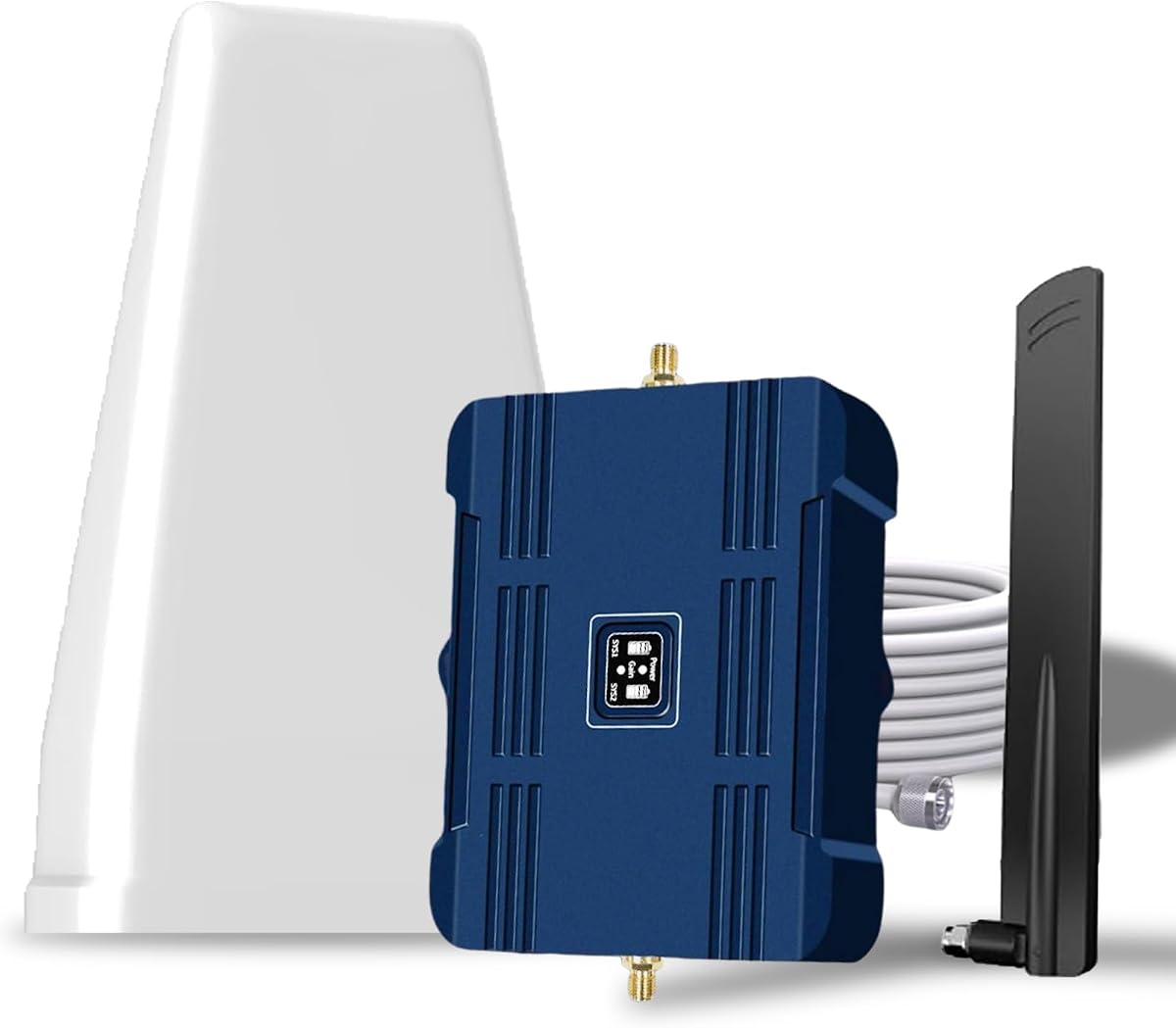
Cell Phone Booster for All U.S. Carriers
5.0Editor score
Up to 6,500 square feet
Two indoor antennas
Touch screen display
FCC and IC certified
Our Smartphone reception booster guide compares 10 top models for home, office, multi-room, and vehicle use, including coverage, gain, carrier support, and
A smartphone reception booster can improve weak cellular service inside homes, offices, basements, rural properties, and vehicles. The best systems combine useful gain, broad carrier compatibility, intelligent gain control, and antennas positioned to capture the strongest available outdoor signal.
This guide compares 10 boosters across home, multi-room, and automotive use. We evaluated stated coverage, maximum gain, supported network bands, carrier compatibility, installation features, monitoring displays, app support, and the practical details that determine whether a kit fits a particular space.
Each review explains the strongest reason to choose a model, along with installation or coverage limitations worth considering. Product designs and seller offers can change, so check the current listing, compatibility, and installation requirements before purchasing, as prices and configurations vary.
5.0Editor score

4.8Editor score

3.6Editor score
The comparison below highlights each booster's intended setting, maximum stated coverage, gain, and key installation feature, making it easier to identify the right system for weak indoor or in-vehicle reception.


This is the most well-rounded home booster in the group, combining a stated 70dB gain, coverage for spaces up to 7,000 square feet, and two indoor antennas. Its 4.8 rating reflects a strong customer reception, while the included indoor antennas are especially useful for distributing service through several rooms rather than concentrating it near the booster.
We may earn a commission when you buy through this link, at no additional cost to you.
Automatic gain control and self-oscillation elimination help the system adjust to incoming signal and maintain a stable result without constant manual tuning. The high-quality LED display provides a convenient way to monitor operation, while the system supports voice, text, data, 4G LTE, and compatible 5G services across major U.S. and Canadian carriers.
The most important qualification is that this booster requires usable signal at the outdoor antenna location. Its stated 7,000-square-foot figure represents the upper potential coverage level rather than a guaranteed result in every building. Dense walls, metal construction, a low outdoor signal, and poor antenna placement can all reduce practical coverage.
This is the best overall choice for a home or office that needs stronger service across multiple rooms. It offers a strong feature set, flexible indoor distribution, and broad carrier support without shifting to a vehicle-specific design. Buyers should plan the antenna layout carefully and verify carrier compatibility before installation.
Two indoor antennas make this kit better suited to larger layouts or properties with separate signal-deprived areas. Positioning one near each difficult room can improve consistency compared with relying on a single antenna beside the main unit.
Automatic gain control adjusts performance as outdoor conditions change, while the LED display gives users a clear way to check status. These features reduce the likelihood of manual adjustment during normal operation.
We may earn a commission when you buy through this link, at no additional cost to you.
The HiBoost Home Office Booster is a practical choice for smaller properties where setup assistance matters as much as raw reach. It carries a 4.3 rating, supports up to 2,500 square feet, and offers a maximum gain of 62dB. Its main unit includes an HD display, while the SignalSupervisor app adds installation guidance and outdoor signal detection.
We may earn a commission when you buy through this link, at no additional cost to you.
Automatic gain control is a useful foundation for maintaining stable performance, and the app helps users check signal strength and identify a stronger location for the outdoor antenna. It can serve several users simultaneously, a useful feature for households, home offices, and small workspaces where phones, tablets, hotspots, and laptops share the same cellular connection.
Its coverage target is smaller than that of many competing home kits, so this model is less appropriate for sprawling properties or a building with many problematic rooms. The listed band support is also narrower than some alternatives: 700–750MHz bands 12, 13, and 17, 800–850MHz band 5, 1900MHz bands 2 and 25, and 1700–2100MHz band 4.
This booster is best for a compact home or office where users value a clear display, app-based setup, and multi-device support. It also comes with a three-year manufacturer warranty and lifetime technical support. Buyers should check their local network frequencies and ensure that a usable outdoor signal can be captured.
The SignalSupervisor app includes outdoor signal-strength detection, installation videos, and online support. This can make the first setup more systematic, particularly for users who are unfamiliar with directional antennas and cable placement.
With support for simultaneous users and a maximum gain of 62dB, this system is suitably scaled to a smaller office or residence. It prioritizes manageable coverage and easy monitoring over very large-area distribution.
We may earn a commission when you buy through this link, at no additional cost to you.
The HiBoost Multi-Room Booster is designed for large homes, offices, metal buildings, cabins, rural cottages, and basements. It has a 4.5 rating and claims coverage for as many as five or six rooms, with a maximum stated area of 8,000 square feet. Two indoor antennas help distribute cellular service across a larger property.
We may earn a commission when you buy through this link, at no additional cost to you.
Its 70dB gain supports stronger reception, while the HiBoost app and built-in LCD display provide information about signal strength, gain settings, and installation progress. Automatic gain control adjusts performance without requiring continuous manual intervention. The booster also supports multiple users and devices at once, which makes it relevant to shared homes and busy workplaces.
Carrier support extends across Verizon, AT&T, T-Mobile, Sprint, US Cellular, and 5G, 4G, 3G, and 2G networks. Nevertheless, actual performance depends on the outdoor signal, antenna placement, building materials, and the distance between indoor and outdoor antennas. The largest coverage figure should therefore be treated as a best-case potential rather than a guarantee.
This is a strong option for buyers who need more distribution than a compact home kit can provide. It combines useful monitoring, two indoor antennas, and broad network support. The included three-year warranty, three-month return policy, and lifetime technical support add confidence, but careful outdoor antenna positioning remains essential.
The combination of two indoor antennas and 70dB gain is well suited to properties with several weak-signal rooms. It can also serve demanding building materials when the outdoor antenna captures a strong enough signal.
The LCD display and HiBoost app let users monitor real-time strength and gain settings. This visibility is particularly useful when comparing antenna positions during installation rather than relying on guesswork.
We may earn a commission when you buy through this link, at no additional cost to you.
This home booster offers a balanced package with a 4.8 rating and a stated indoor coverage target of 5,000 square feet. It is intended to improve calls, messaging, streaming, and data in rooms where the cellular signal is weak, while supporting 2G, 3G, 4G LTE, and 5G devices.
We may earn a commission when you buy through this link, at no additional cost to you.
Smart features include LED indicator lights, automatic gain control, automatic standby mode, and oscillation elimination technology. These functions are designed to adapt the system to different environments without repeated manual adjustments. The booster can support numerous smartphones, hotspots, tablets, and laptops used across major U.S. and Canadian providers.
The listing does not state a maximum gain figure or the number of included indoor antennas, which makes it less straightforward to compare with highly specified kits. Users should verify the package contents before ordering, particularly if the goal is to distribute signal to distant rooms rather than improve reception around a single installation point.
This is a good general-purpose home option for people dealing with dropped calls, buffering, undelivered messages, or slow mobile data. It has an attractive rating, broad network-generation support, and intelligent controls. A two-year manufacturer warranty, 30-day refund, three-month replacement policy, and lifelong technical support provide additional reassurance.
Automatic gain control and oscillation elimination allow the unit to respond to changing signal conditions. Automatic standby further supports efficient operation when the system is not needed.
The ability to serve phones, hotspots, tablets, and laptops simultaneously makes this system attractive to households with varied cellular needs. It focuses on consistent service rather than one specific device category.
We may earn a commission when you buy through this link, at no additional cost to you.
This automotive booster is the only model in the group designed specifically for cars, vans, and SUVs. It carries a 4.8 rating and supports 5G, 4G LTE, and major U.S. carriers, including Verizon, AT&T, T-Mobile, Sprint, and Straight Talk. Its purpose is to improve calls and data during travel through rural areas and remote highways.
We may earn a commission when you buy through this link, at no additional cost to you.
The magnetic outdoor antenna is omnidirectional, so users do not have to aim it toward a particular cell tower. An indoor patch antenna serves passengers, and automatic gain control adjusts signal strength and power in real time. These features are especially helpful in a moving environment, where the vehicle may pass through rapidly changing signal conditions.
The system supports band 12/17, band 13, band 5, band 2/25, and band 4. The seller specifically advises testing the local frequency band before purchase, making this a more compatibility-sensitive choice than a general home booster. It also requires an outside signal that can be received by the vehicle-mounted antenna.
This is the best pick for drivers, families traveling together, and people who regularly enter low-signal areas. Installation requires no drilling, and the listed process can typically be completed by one person in less than 30 minutes. Its FCC certification and simple magnetic hardware make it especially practical for temporary or travel-oriented use.
The magnetic outdoor antenna avoids permanent modification to the vehicle, while the patch antenna can be positioned inside for passenger use. This makes the kit appropriate for frequent installation changes.
Omnidirectional reception reduces the need to realign the antenna as a vehicle changes direction. Automatic gain control helps the system respond to variations as the route passes through different coverage zones.
We may earn a commission when you buy through this link, at no additional cost to you.
This booster stands out with a perfect 5.0 rating and unusually clear coverage guidance. Its listing breaks down potential indoor area by outdoor signal strength: approximately 800 square feet with one or two bars, 3,000 square feet with three or four bars, and 7,000 square feet with five bars.
We may earn a commission when you buy through this link, at no additional cost to you.
Maximum gain is listed at 70dB, with maximum output at 17dBm. The system boosts 5G, 4G LTE, 3G, voice, text, and data for North American carriers, and it supports band 5, band 12, band 13, and band 17. The 5G explanation also notes that compatibility depends on 5G service being available through existing 4G bands.
The kit requires an outdoor log-periodic antenna and a booster unit, with roughly 32 feet of separation recommended between the outdoor and indoor antennas. This separation helps reduce interference and feedback. The product is FCC and IC certified, but the listing does not mention an app or display, so buyers seeking visual monitoring may prefer another model.
This is a strong option for buyers who want an honest view of how outdoor signal affects indoor results. It suits homes and offices that can receive at least a modest signal outside. The detailed installation guidance and stated performance limits make it easier to set realistic expectations before purchasing.
The area estimates show why outdoor signal quality is the decisive factor. A stronger signal outside can support substantially more usable coverage inside, while a very weak outdoor reading sharply limits the result.
Stating both 70dB maximum gain and 17dBm maximum output gives buyers useful technical information. It also makes the system easier to compare with other kits that provide only a broad coverage claim.
We may earn a commission when you buy through this link, at no additional cost to you.
This is the strongest budget-oriented home booster in the group, combining a 5.0 rating with a stated coverage area of up to 6,500 square feet. It is designed for homes and offices with weak reception and includes two indoor antennas, allowing users to distribute service through three to five rooms or across separate problem areas.
We may earn a commission when you buy through this link, at no additional cost to you.
A touch screen display is a notable feature because it provides an accessible way to check status without an app. The system supports 5G, 4G LTE, and 3G for major North American cellular networks. It is FCC and IC certified, giving buyers confidence that the system is designed to operate within applicable regulatory requirements.
The listing provides realistic coverage estimates based on outdoor signal: about 800 square feet with one or two bars, 3,000 square feet with three or four bars, and 6,500 square feet with five bars. The booster cannot create service where no usable signal exists outside, so the outdoor antenna location remains the most important installation decision.
This is a compelling choice for buyers who want multiple antennas and a display without paying for a more specialized installation. It is well suited to a medium or large home and can support calls, texts, streaming, and faster data. Installation guidance calls for keeping power off while positioning the antennas and maintaining about 32 feet of separation.
The inclusion of two indoor antennas gives this model better distribution potential than a single-antenna kit. It can serve separate rooms or improve coverage in a building with a less convenient central location.
The integrated touch screen offers a convenient status check without requiring a compatible phone or app. It is a straightforward choice for users who value visible feedback without extra software.
We may earn a commission when you buy through this link, at no additional cost to you.
This home and office system has a 4.9 rating and carries the largest stated area in the selection: up to 8,100 square feet. It includes two indoor antennas and offers 70dB maximum gain with 17dBm maximum output, making it one of the most generously specified systems in the group.
We may earn a commission when you buy through this link, at no additional cost to you.
The booster supports 5G and 4G LTE for major North American carriers, including Verizon's 5G Nationwide data signals. It can improve voice, text, and data performance in homes, offices, basements, and other locations where the indoor signal is weak. Two indoor antennas provide more placement flexibility than a single indoor antenna.
The listing contains somewhat different coverage estimates, including an 8,000-square-foot headline figure and another passage describing up to 6,500 square feet. Its more detailed estimates are 600 square feet with one or two outdoor bars, 2,500 square feet with three or four bars, and 6,000 square feet with five bars. These variations reinforce the importance of relying on realistic outdoor signal expectations.
This is a good option for a large property or commercial workspace that can place the outdoor antenna where it receives a strong signal. It combines high stated gain, broad area potential, and two indoor antennas. As with other kits, the result depends on antenna placement, separation, building materials, and the cellular network's signal outside.
A stated maximum of 8,100 square feet makes the system relevant to larger homes and offices. Real-world coverage will depend heavily on the outdoor bars available and how many obstacles stand between the antennas.
Two indoor antennas can be positioned to reach separate rooms or placed on opposite sides of a broad floor plan. This improves the chance that every device has a nearby usable signal source.
We may earn a commission when you buy through this link, at no additional cost to you.
The SureCall Flare 3.0 is a focused option for small homes, offices, and individual rooms. Its 3.6 rating is the lowest in the group, but the product information is notably clear about realistic coverage. Depending on outdoor signal, it can cover approximately 500 square feet with one or two bars, 1,500 square feet with three or four bars, and 3,500 square feet with five bars.
We may earn a commission when you buy through this link, at no additional cost to you.
A Yagi outdoor antenna is included to capture cellular signal, while the free SureCall app for iOS and Android helps users aim the antenna, optimize the setup, and complete installation. The system supports multiple users and improves voice, text, and data for phones, tablets, and hotspots across major U.S. carriers.
Its 5G and 4G LTE focus and 3,500-square-foot ceiling make it better aligned with compact properties than expansive buildings. It also cannot overcome a complete lack of outdoor cellular signal. The lower rating may reflect customer satisfaction rather than a lack of core features, but prospective buyers should evaluate the current listing carefully.
This is a sensible choice for a small home office, apartment, bedroom, or workshop that needs reliable service. It is designed, assembled, and tested in the USA, is FCC approved, and includes a three-year warranty with lifetime U.S.-based customer support.
The SureCall app provides installation assistance and can help users optimize the Yagi antenna's direction. Proper aiming is especially important because the antenna concentrates reception toward the available tower signal.
The product clearly links each coverage estimate to the number of bars available outside. This is a useful framework for comparing realistic potential rather than relying on one maximum area figure.
We may earn a commission when you buy through this link, at no additional cost to you.
The SureCall Fusion Professional is the premium option for large homes and commercial buildings up to 8,000 square feet. It uses a pair of Yagi panel antennas and is built around 2XP technology, which doubles uplink power to improve performance in challenging signal environments.
We may earn a commission when you buy through this link, at no additional cost to you.
The system supports voice, text, and data for North American carriers, including Verizon, AT&T, Sprint, and T-Mobile. It is compatible with 4G and 5G devices, including MiFi hotspots and cellular data hubs, and can improve coverage for multiple cellular devices throughout a large building.
Its 3.6 rating is tied for the lowest in the selection, so the premium feature set should not be confused with universally strong customer feedback. A professional installation demands attention to outdoor antenna direction, indoor panel placement, cable runs, and separation. The product is FCC approved and was designed, assembled, and tested in the USA.
This booster is best for buyers with a genuinely large building, a demanding multi-user cellular requirement, or a difficult environment where stronger uplink performance is valuable. It is less likely to be necessary for a small residence where a more compact kit would provide adequate service.
The patented 2XP approach doubles uplink power to help the system communicate effectively with the carrier network. This is especially relevant where calls, uploads, or data sessions depend on a stronger signal from the building to the tower.
Yagi panel antennas and an 8,000-square-foot target distinguish this system from compact home boosters. It is better suited to broad floors, commercial spaces, and installations where antenna placement can be professionally planned.
We may earn a commission when you buy through this link, at no additional cost to you.
The right booster depends mainly on the available outdoor signal, building size, number of users, and intended environment. These factors determine whether a compact kit, multi-antenna system, or automotive model is the most practical choice.
A booster can amplify a usable signal, but it cannot manufacture cellular service where no signal reaches the outdoor antenna. Before buying, check the phone's signal strength outside in the intended antenna location rather than relying on readings taken indoors. Even one usable bar can support some improvement, while a strong outdoor reading allows a system to deliver much broader indoor coverage.
The relationship is especially clear in the coverage estimates offered by several products. At one or two outdoor bars, realistic coverage may be only a few hundred square feet; at three to four bars, it can expand into the low thousands; and at five bars, some systems can approach their maximum stated area. Always prioritize a location with the strongest stable signal.
Square-foot figures are useful only as rough comparisons because walls, floors, metal, and antenna placement affect the result. A compact home office may need only a small system, while a property with a basement, several exterior rooms, or metal construction may require two indoor antennas and greater potential reach.
Check both the headline area and the more detailed outdoor-signal estimates. Also consider where devices actually operate. A booster covering 2,500 square feet can work well if those square feet are used regularly, while a larger system may be wasted in a small but heavily obstructed building.
Maximum gain describes how much the unit can amplify a received signal, while maximum output describes the strength it can provide downstream. Higher figures are useful in difficult buildings, but they are not substitutes for adequate outdoor signal or correct antenna separation. Automatic gain control generally helps the unit operate without excessive amplification.
Compare specifications only when they are clearly defined. A listed 70dB maximum gain is meaningful, while a marketing claim without a technical figure provides less basis for comparison. Output and gain should be considered together with the supported bands, coverage area, and quality of the included antennas.
A booster marketed for all major U.S. carriers is more flexible than one tied to a single network, but buyers should still confirm the local carrier and frequencies used in their area. Supported band lists are especially important for users in rural areas or locations served by regional and smaller providers.
5G compatibility also requires nuance. Several products explain that the relevant 5G service is delivered through Dynamic Spectrum Sharing on existing 4G bands, and the FCC has not allowed certain new cellular enhancers discussed in the listings. Confirm that the device and local network operate on compatible bands before purchase.
The outdoor antenna captures available cellular service, while indoor antennas distribute the amplified signal throughout the building. Multi-antenna kits offer better flexibility for larger homes, offices, basements, and separate wings. They also require careful placement to avoid feedback and maintain appropriate separation.
Directional antennas such as Yagi and log-periodic models generally need to be aimed toward a usable signal source. Omnidirectional models are more forgiving and particularly convenient in vehicles, but they may concentrate less energy in one direction. Plan cable routes and antenna locations before drilling or mounting equipment.
Home systems are designed for continuous indoor coverage and usually include an outdoor directional or log-periodic antenna. Vehicle systems prioritize quick installation, magnetic mounting, and an omnidirectional antenna that can receive signal while the car moves. Installing a home kit in a car would add unnecessary complexity and leave performance on the table.
Large commercial buildings may justify a premium system with multiple directional panels and more substantial installation planning. Small apartments and home offices can often be served by a simpler kit. Matching the hardware to the environment prevents unnecessary expense and improves the likelihood of a clean installation.
Automatic gain control is common among the better systems because it adjusts amplification as outdoor conditions change. Oscillation elimination helps prevent feedback between antennas, while standby mode can reduce unnecessary power use. These features improve convenience and stability without requiring constant user intervention.
A built-in LCD or touch screen provides quick feedback without extra software, while an app can add installation videos, signal-strength checks, and troubleshooting. Decide which interface suits your preferences. Buyers who install on their own may value app guidance, while those wanting a simple status check may prefer a physical display.
Look for FCC approval or FCC and IC certification, as applicable, because compliant products are designed to operate without interfering with carrier traffic. Warranty and support terms can also be informative. The selection includes options with two- and three-year warranties, return periods, replacement policies, and lifetime technical support.
Installation support matters because even a capable booster can underperform when the outdoor antenna faces the wrong direction. A manufacturer that provides app guidance, installation videos, or accessible customer service can make troubleshooting much easier. Compare support options alongside coverage, gain, and antenna configuration.
Begin by identifying the weakest areas that need service and then finding the outdoor location with the strongest stable cellular signal. Install the outdoor antenna in that location, aim it according to its design, and connect the relevant cable to the booster. Keep the power off while positioning or adjusting the antennas to reduce the risk of feedback.
Place the booster and indoor antennas where they can serve the intended users while maintaining the separation recommended in the product instructions. Several listings advise approximately 32 feet between outdoor and indoor antennas. Once the physical setup is complete, power the system on, allow it to adjust, and use the display or app to check signal strength and gain behavior.
For care, keep the unit and connections away from moisture, excessive heat, and obstructed airflow. Inspect cables and mounting points periodically, particularly on vehicles where vibration and weather are constant. If performance declines, first move the outdoor antenna to a stronger signal location, check connections, and confirm that local carrier and band compatibility has not changed.
No. A booster strengthens an existing cellular signal captured by its outdoor or vehicle-mounted antenna. If the outside location has no usable signal, indoor amplification cannot produce a reliable cellular connection. Even a modest outdoor signal can sometimes be improved, but stronger outside readings generally lead to broader and more consistent indoor coverage.
Coverage depends more on outdoor signal strength than the advertised maximum square footage. In the reviewed products, weak outdoor readings may support only a few hundred square feet, while strong readings can approach maximum claims of several thousand square feet. Building materials, antenna placement, and indoor antenna locations also determine actual performance.
Most of the reviewed systems support 5G and 4G LTE, and several also cover 3G or 2G. The type of 5G available locally is important because many current carrier 5G services operate through Dynamic Spectrum Sharing on existing 4G bands. Confirm both the booster's supported bands and the bands used by your local carrier before purchasing.
Products described as compatible with all U.S. carriers generally support the major nationwide networks, but compatibility still depends on frequency bands. Smaller, regional, or prepaid providers may use frequencies that are not included in a particular booster. Check the supported band list and confirm your provider before completing the order.
Two indoor antennas can be better when a large building has several weak-signal areas or separate floors. They allow the indoor signal to be distributed from more than one location, reducing dead zones that a single antenna may leave behind. They also demand more careful placement, and both antennas should be positioned according to the installation instructions.
Most home boosters are intended to improve indoor reception by capturing outdoor signal and distributing it inside. An omnidirectional vehicle booster is better suited to travel because it can receive signal from different directions while the vehicle moves. Using a stationary directional home antenna outdoors is unlikely to provide the convenience of a purpose-built mobile kit.
The reviewed SureCall Flare 3.0 specifically describes an all-in-one kit with no monthly fees, and home boosters generally operate through the user's existing cellular service. A user still needs an active plan and adequate outside signal. Confirm the seller's current package details if you are comparing a specific listing.
Choose the location with the strongest stable signal, then aim the antenna toward the source of that signal. Yagi and log-periodic antennas are directional, so small adjustments can make a meaningful difference. Use the display or app to compare readings, keep the required separation from indoor antennas, and turn the unit off while making major adjustments.
The Cell Phone Booster for Home & Multi-Room with two indoor antennas is the best overall choice for most homes because it combines 70dB gain, a generous coverage target, automatic controls, and broad carrier support. The budget-oriented All U.S. Carriers model also stands out with a perfect rating, touch screen display, and two indoor antennas, while the SureCall Fusion Professional is the premium option for large buildings.
Prioritize usable outdoor signal, correct band support, and the number of indoor antennas over headline coverage alone. A small office may need only a compact system, whereas a basement or large home usually benefits from multiple indoor antennas and a carefully chosen outdoor location. Vehicle travelers should choose the dedicated magnetic, omnidirectional car booster instead of a home installation.
Before ordering, verify the current listing, package contents, carrier compatibility, and local frequencies. Product configurations and prices can change, so compare the latest offer rather than relying on an earlier promotional figure. The right booster combined with a strong outdoor signal and sound antenna placement offers the best chance of improving calls, texts, streaming, and mobile data.