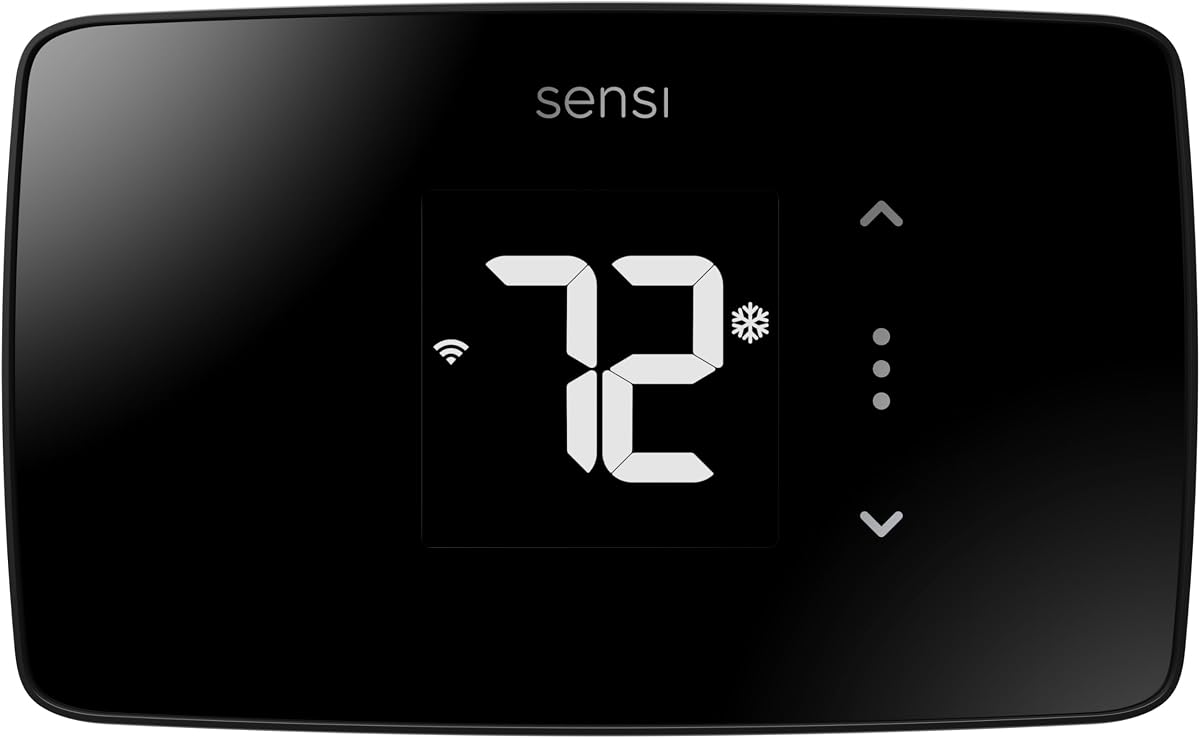
Sensi Lite Smart Thermostat ST25
4.0Editor score
No C wire in most homes
Seven-day app scheduling
Energy usage reporting
Our guide compares the best smart thermostats without C wire, including installation needs, scheduling, sensors, app controls, and smart-home features.
Smart thermostats without C wire offer remote control, programmable schedules, and energy-use insights without requiring a traditional common wire in many homes. A good model should fit your HVAC system, provide dependable power, and make everyday temperature changes easy through its app, display, and connected features.
We compared the 10 products based on their stated C-wire requirements, supported HVAC equipment, installation process, scheduling tools, app functionality, energy features, voice-control options, sensors, and available customer ratings. The list includes models that work directly without a common wire in most homes and others that require a compatible power accessory in certain installations.
Each review explains who should consider the thermostat, which features set it apart, and where compatibility caveats matter. Ratings and product details reflect the supplied information, while current prices and promotions can change, so readers should verify the latest listing and equipment requirements before buying.
4.0Editor score

4.4Editor score

4.3Editor score
This side-by-side comparison highlights C-wire compatibility, installation requirements, app-based control, energy features, and the most notable smart-home functions. It also distinguishes thermostats that work without a common wire in most homes from models that may need a C-wire or compatible power adapter.


The Sensi Smart Thermostat ST55 combines an approachable installation process with the features most homeowners want from a connected thermostat. It carries a 4.4 customer rating, and its most important advantage for this roundup is that a common C wire is generally not required in most applications. That makes it a practical starting point for older homes that lack the extra power wire commonly associated with modern smart thermostats.
We may earn a commission when you buy through this link, at no additional cost to you.
Installation guidance is a major strength. A built-in level helps position the thermostat correctly, while step-by-step app instructions guide users through setup. The familiar button-based design fits the space occupied by many conventional thermostats, reducing the need to patch walls or repaint after installation. Once connected, users gain flexible scheduling, remote access, usage reports, HVAC alerts, and filter-change reminders through the Sensi app.
The thermostat is also designed to avoid unnecessary complexity. It does not carry a large display, room sensor, or built-in speaker, but that restraint makes the core experience approachable for people who primarily want scheduling and remote temperature control. Alexa compatibility extends the connected-home appeal, while the stated policy that Sensi will not sell personal information to third parties offers reassurance for privacy-conscious buyers.
The important trade-off is that no C wire does not automatically mean every installation is identical. A homeowner should confirm that the existing equipment and wiring arrangement are compatible before purchase. For a conventional system that fits the supported applications, the ST55 is the strongest all-around recommendation in this guide because it combines broad everyday features with one of the clearest DIY installation experiences.
The built-in level and app-led instructions remove much of the guesswork from mounting and setup. Its familiar form factor also makes it easier to replace a traditional thermostat without changing the appearance of the surrounding wall.
Flexible schedules, remote access, usage reports, HVAC alerts, and filter reminders make the thermostat useful beyond basic temperature adjustment. These features help households understand when and how their equipment is operating.
We may earn a commission when you buy through this link, at no additional cost to you.
The Sensi Lite ST25 is a value-focused connected thermostat for households that want scheduling and remote control without moving to a more complex display. Its 4.0 customer rating reflects a broadly positive reception, while its most attractive feature for this category is its ability to operate without a C wire in most homes. As with the Sensi ST55, certain heating-only, cooling-only, and heat-pump arrangements may require a common wire or another compatible power accessory.
We may earn a commission when you buy through this link, at no additional cost to you.
The installation experience is designed to be approachable. A built-in level helps with physical placement, and simple app instructions guide users through configuration. Once operating, the thermostat supports flexible scheduling, geofencing, remote access, and usage reports. It also works with Alexa and is ENERGY STAR certified, providing a useful set of connected and efficiency-oriented features for a simpler thermostat.
Its interface is intentionally streamlined rather than feature-heavy. That makes it a sensible option for someone who wants a modern schedule, smartphone control, and useful reports without paying for a large screen, integrated sensor, or voice assistant. Sensi also states that it does not sell personal information to third parties or use thermostat activity data for advertising and targeting purposes.
The ST25 is best for renters, older homes, and straightforward heating-and-cooling systems where the seller or installer can confirm compatibility. Buyers should not interpret the no-C-wire statement as universal: heat pumps and single-stage equipment can have different power requirements. When compatibility is suitable, it delivers the essential smart-home functions in a comparatively restrained package.
Scheduling, geofencing, remote control, and reporting cover the core needs of an energy-conscious household. The lack of advanced sensors and a large display also keeps setup and daily use relatively direct.
A C wire is unnecessary in most applications but may be needed for heating-only, cooling-only, or heat-pump systems. Reviewing the wiring and HVAC configuration before purchase avoids a frustrating installation delay.
We may earn a commission when you buy through this link, at no additional cost to you.
This generic smart thermostat is positioned as an accessible option for homes, offices, and hotel-style spaces where a color display and flexible heating control are priorities. Its listing explicitly states that no C wire is required, and it supports Wi-Fi, mobile app management, programmable scheduling, and a color LCD screen. However, no customer rating is available, so there is no supplied rating to support a long-term reliability assessment.
We may earn a commission when you buy through this link, at no additional cost to you.
Its standout visual feature is the vibrant LCD display, which offers an easier-to-read temperature interface than a minimal monochrome screen. Remote management allows users to adjust temperatures without physically visiting the room, while programmable schedules add an automatic layer of control. The stated stable Wi-Fi connectivity is especially relevant for offices, hotel rooms, and other secondary spaces where intermittent access may be inconvenient.
The product information is more limited than that of the established brands in the list. It does not provide details about voice-assistant ecosystems, HVAC monitoring, sensor support, energy reports, or compatibility with a broad range of heating and cooling equipment. The precise-temperature claim is also described in terms of floor heating, so buyers should verify whether the model is appropriate for their full system and intended room type.
This thermostat makes most sense for a buyer who values a color interface, straightforward remote control, and no stated C-wire requirement more than deep ecosystem integration or advanced home monitoring. Because compatibility and long-term customer feedback are less documented, careful review of the listing and existing HVAC equipment is especially important before purchase.
Remote management and programmable heating make the model potentially useful in a home office, hotel room, or other supplementary space. The display gives occupants a clear local control option when they are present.
The supplied information focuses on heating and floor-heating use and does not provide a broad compatibility list. Confirm equipment type, wiring, voltage, and installation requirements before selecting it for a primary whole-home system.
We may earn a commission when you buy through this link, at no additional cost to you.
The Google Nest Thermostat in Snow is a familiar choice for households already invested in Google Home, with a 4.1 customer rating and broad smart-home integration. It is designed to work without a C wire in most homes, although heating-only, cooling-only, zone-controlled, and heat-pump systems may need a C wire or another compatible power accessory. The availability of an online compatibility checker helps reduce uncertainty before installation.
We may earn a commission when you buy through this link, at no additional cost to you.
Its app-based scheduling is easy to appreciate, particularly for users who want their thermostat to lower itself when everyone leaves. Remote control works from a phone, laptop, or tablet, and the Savings Finder looks for schedule changes that may improve energy use. Voice control is available through Google Assistant, Alexa, and Matter-certified voice assistants when the required compatible smart device is present.
HVAC monitoring adds practical value. The thermostat can send an alert when something appears wrong with the heating or cooling system and can provide maintenance reminders. Nest Renew also supports a cleaner-energy focus by using thermostat activity to favor times when the available energy is cleaner or less costly, subject to the program and local energy context.
This is a strong choice for Google-centered homes, especially those that value a minimal thermostat and automated away behavior more than a large local display. The main limitation is that power requirements vary. Buyers with heat pumps, zone controls, or single-stage systems should use the compatibility checker and determine whether a C wire or power accessory will be needed.
The thermostat lowers itself when the home is empty and offers schedule suggestions through Savings Finder. These features can make energy-conscious automation easier without requiring constant manual changes.
Google Assistant is the natural fit, but the model also supports Alexa and Matter-certified assistants. Voice control requires a compatible smart device, so existing ecosystem hardware should be considered.
We may earn a commission when you buy through this link, at no additional cost to you.
The Sensi Lite ST25W provides the same core smart-home proposition as the earlier Sensi Lite model: straightforward scheduling, remote access, and energy-use information for a 4.0 customer rating. It is designed to work without a C wire in most homes, making it relevant for conventional installations that lack a common wire. Heating-only, cooling-only, and heat-pump systems may still need a C wire or compatible power accessory.
We may earn a commission when you buy through this link, at no additional cost to you.
A built-in level and simple step-by-step app instructions are included to assist with installation. The thermostat's energy tools include flexible scheduling, geofencing, remote access, and usage reports, while ENERGY STAR certification provides a useful efficiency credential. Alexa support and smartphone control make it practical for users who want to adjust a home's temperature without walking to the thermostat.
Compared with feature-heavy premium models, the ST25W keeps the proposition focused. There is no stated room sensor, built-in speaker, large color display, or air-quality monitoring. That makes it potentially easier for first-time smart-thermostat owners to understand, while the most important functions remain available through the app and the thermostat's basic controls.
For a conventional system in a home without a C wire, this is a balanced and practical selection. Compatibility should be confirmed in advance, particularly when the equipment is a heat pump or operates on only heating or cooling. Buyers who prioritize scheduling, remote control, and clear energy reports will find the core experience more useful than the additional hardware found in premium alternatives.
The built-in level and guided app setup make the physical and digital installation approachable. Its restrained feature set reduces the number of settings users need to learn.
Flexible schedules and geofencing work together to reduce unnecessary heating or cooling when the home is empty. Remote access adds a final layer of convenience for arrivals, departures, and schedule adjustments.
We may earn a commission when you buy through this link, at no additional cost to you.
The Honeywell Home RTH9585WF1004 is a polished smart thermostat for users who want a larger color screen and a broad set of energy-management features. Its 4.3 customer rating places it among the stronger-reviewed products in this roundup. It is not a C-wire-free model in the strictest sense because a C wire or a compatible power adapter is required, making advance compatibility checking essential.
We may earn a commission when you buy through this link, at no additional cost to you.
The bright touchscreen is the model's most visible advantage. It provides intuitive local control and displays information in a colorful format that can be easier to read than a minimal screen. Flexible programming supports a household schedule or utility peak-rate pricing, while fan controls include On, Automatic, and Circulate modes. The latter runs the fan randomly about 35 percent of the time according to the supplied description.
ENERGY STAR certification, monthly energy reports, and personalized efficiency tips extend the thermostat's role beyond scheduling. Eligible customers may also be able to join a local utility demand-response program that permits slight temperature adjustments during periods of high energy demand. The thermostat works with Amazon Alexa, Google Home, and the Honeywell mobile app.
Compatibility is the deciding factor. It supports forced-air gas, oil, or electric systems, hot-water and steam heating, and heat pumps with electric backup. It does not work with 120-240V electric baseboard heat, and heating-only oil furnaces require a C wire. For a compatible conventional system, this is an attractive option for buyers who prioritize the screen and utility-oriented features.
The full-color touchscreen creates a more modern thermostat experience and makes temperature and mode changes convenient. Local controls are particularly useful when the phone is out of reach or Wi-Fi access is temporarily unavailable.
Monthly reports and personalized tips provide visibility into household energy use. Demand-response enrollment may also be available, although eligibility and participation depend on the local utility.
We may earn a commission when you buy through this link, at no additional cost to you.
The ecobee Smart Thermostat Premium is the most feature-rich choice in the list and earns the Best Premium distinction. It has a 4.3 customer rating, an included SmartSensor, and a Power Extender Kit for homes without a C wire. The PEK, trim kit, and installation components are included, which makes it more complete for a straightforward upgrade than models whose power accessories must be purchased separately.
We may earn a commission when you buy through this link, at no additional cost to you.
The included sensor helps address uneven temperatures by measuring the room occupants actually use rather than relying only on a hallway reading. A built-in radar occupancy sensor can also learn a household routine and preheat or precool the home before arrival. The thermostat is ENERGY STAR certified, and the product information states that it can save up to 26 percent compared with holding a home at 72°F.
Additional features set it apart from the other choices. The built-in air-quality monitor can issue alerts, provide improvement suggestions, and remind users to change a furnace filter. A built-in speaker supports Alexa or, with the required Apple home hub, Siri, and it can play Spotify content. It can also work with an ecobee Smart Doorbell Camera for a live view and two-way visitor communication.
Those advanced features deserve a caveat: Siri requires an Apple home hub, and the doorbell and security-related functions require an ecobee Smart Security subscription. Even with those dependencies, the Premium is the strongest option for buyers who value whole-home comfort intelligence, sensor-based zoning, voice control, and integrated monitoring. The included PEK directly addresses the central challenge of installing a smart thermostat in a home without a C wire.
The included SmartSensor measures conditions in the room people use most, helping reduce hot and cold spots. Its movement data can also support more informed temperature adjustments and energy savings.
The included Power Extender Kit is designed for homes without a C wire. Bundling it with the trim kit reduces the need for a separate accessory purchase and makes the installation package more complete.
A built-in Alexa or Siri speaker adds voice control without requiring a separate smart speaker. Air-quality alerts and filter reminders add value, while the smart-security and doorbell capabilities involve additional compatibility and subscription requirements.
We may earn a commission when you buy through this link, at no additional cost to you.
The Honeywell Home T5 is a straightforward Wi-Fi thermostat for homes that want a flexible schedule and automatic away behavior. It has a 4.2 customer rating and provides seven-day programming, geofencing, home and away modes, and monthly energy reports. Its notable limitation is that a C-wire power adapter is required, so it belongs in this roundup as an option for buyers willing to add the appropriate power accessory.
We may earn a commission when you buy through this link, at no additional cost to you.
Location-based temperature control is its standout connected feature. Geofencing uses a smartphone's location to recognize when the household leaves and returns, allowing the thermostat to reduce unnecessary heating or cooling while no one is home. Users can also program a standard seven-day schedule, giving them both predictable routines and automatic adjustment when plans change.
ENERGY STAR certification, monthly usage reports, and personalized energy tips help users understand consumption. Eligible homeowners may also find rebates through their energy provider or qualify for a local utility demand-response program. The thermostat works with most heat-and-cool oil furnace systems, but heating-only oil furnaces require a C wire.
The T5 is best for a household that values scheduling, location awareness, and straightforward reporting without a large touchscreen or built-in speaker. Compatibility deserves careful attention because a C-wire adapter is required and oil-heating configurations have specific limitations. Once the existing system is confirmed as suitable, the core feature set is effective and unobtrusive.
Location awareness helps the thermostat recognize when the home is empty and adjust accordingly. This reduces the need to make the same change manually every time the household leaves.
Buyers need to determine whether the home has a usable C wire or requires a compatible adapter. Heating-only oil furnace systems are specifically limited unless a C wire is present.
We may earn a commission when you buy through this link, at no additional cost to you.
The ecobee Smart Thermostat Essential brings a polished color touchscreen and expandable comfort monitoring to a simpler ecobee model. It carries a 4.2 customer rating and is compatible with 85 percent of systems according to the supplied information. The online ecobee Compatibility Checker is the best starting point for determining whether it will work with a particular HVAC setup.
We may earn a commission when you buy through this link, at no additional cost to you.
The thermostat can operate without a C wire by using the ecobee Power Extender Kit, but the PEK and trim kit are sold separately. That distinction matters when comparing it with the ecobee Premium, whose power extender is included. Optional SmartSensor additions are also sold separately and let users measure temperature and movement in rooms that matter most.
Beyond temperature control, the Essential includes indoor humidity detection, a schedule assistant, and time-of-use functionality that can preheat or precool the home when energy is less expensive. The color touchscreen and ecobee app provide two ways to change settings, while free software upgrades are intended to keep the device current over time.
It works with Apple HomeKit, Google Assistant, and Alexa, and with most 24 VAC equipment, including gas, oil, electric, dual-fuel, forced-air, conventional heating-and-cooling, heat-pump, and boiler systems. This is a good middle option for buyers who want ecobee features and possible sensor expansion but do not need the Premium model's built-in speaker, radar sensor, air-quality monitor, or included SmartSensor.
The Essential supports optional SmartSensor accessories that measure temperature and movement in occupied rooms. This creates a path to more precise comfort control without requiring the Premium package.
Homes without a C wire can use the ecobee PEK, although it must be purchased separately. Account for that accessory and the optional trim kit when planning the complete installation.
The schedule assistant and time-of-use functions can prepare the home when energy is less expensive. These tools make the thermostat more relevant for households with variable energy rates.
We may earn a commission when you buy through this link, at no additional cost to you.
The Honeywell Home 7 Day Programmable Touchscreen is the simplest option in this guide because it focuses on local scheduling rather than internet-connected control. Its 4.4 customer rating is the highest numeric rating among the supplied products. It can operate on batteries or a hardwired power source, allowing it to work in homes that do not have a C wire when battery power is suitable for the installation.
We may earn a commission when you buy through this link, at no additional cost to you.
The thermostat offers day-to-day, weekend, and full-week programming. A crystal-clear, blue-backlit display shows indoor temperature and humidity, while on-screen filter reminders add useful maintenance guidance. Smart Response Learning observes the heating and cooling cycle and can adapt operation to deliver the desired temperature at the scheduled time.
Its compatibility list is broad. It supports single-stage and multistage heating and cooling, heating-only and cooling-only systems, forced air, central air, heat pumps with or without auxiliary heat, hot-water and steam or gravity systems, 750 millivolt equipment, and gas fireplaces. A permanent day and time backup preserves settings if power is interrupted.
This is the right choice for someone who wants a dependable programmable thermostat without creating a Wi-Fi account or managing a mobile app. It does not offer the remote access, automatic geofencing, usage reports, or voice-control features of the smart models, so it is better suited to a secondary zone, an older property, or a household that prefers local-only operation.
Users can configure separate routines for individual days, the weekend, or the entire week. This provides enough control for many households without requiring a connected app.
Battery or hardwired power allows installation without a network connection. The local interface and saved settings also reduce dependence on cloud services and smartphone access.
Smart Response Learning adapts to the home's heating and cooling cycle, helping the thermostat reach the requested temperature when the schedule calls for it.
We may earn a commission when you buy through this link, at no additional cost to you.
The right model depends less on the thermostat's headline features and more on your HVAC equipment, wiring, available accessories, and preferred smart-home ecosystem. Use the following factors to narrow the field before purchasing.
A C wire provides continuous electrical power to the thermostat, allowing features such as Wi-Fi, a color display, and occupancy sensing to operate reliably. Some smart thermostats can work without it by using batteries, stealing power from the heating system, or connecting to a power extender. The phrase without C wire can therefore mean direct compatibility in most homes, support through an accessory, or a universal requirement that the installer must solve.
Choose the thermostat only after checking the existing wiring, equipment type, and thermostat location. The Sensi ST55 and Sensi Lite models generally avoid the wire in most applications, while ecobee models can use a Power Extender Kit. Honeywell models in this list expressly require a C wire or compatible adapter.
A thermostat must support the heating and cooling stages, voltage, and control functions used by the home. Heating-only, cooling-only, zone-controlled, heat-pump, oil, steam, and high-voltage electric systems can behave differently. A thermostat advertised for most homes may still exclude particular equipment combinations, so compatibility checkers and model-specific installation guides should be consulted before ordering.
Look for a product that clearly states its supported equipment and any exceptions. The ecobee Essential supports most 24 VAC systems, while the Honeywell T5 Touchscreen lists a particularly broad range of conventional HVAC arrangements. Confirming compatibility reduces the chance of an unsuitable replacement.
Basic smart functionality usually means Wi-Fi, remote app access, and a programmable schedule. More advanced models add geofencing, automatic away behavior, usage reports, room sensors, occupancy detection, air-quality monitoring, voice assistants, and utility demand-response participation. Selecting only the features that will actually be used prevents an unnecessarily complex installation and keeps the interface manageable.
Homeowners seeking simple automation should prioritize reliable scheduling and remote access. Families with uneven temperatures may benefit more from a room sensor, while large households may value occupancy detection. Voice control and built-in speakers are useful additions only when the household already uses a compatible smart-home platform.
A thermostat's app is the main interface for most connected functions, so it should make schedules easy to understand and adjust. Geofencing can automatically lower the temperature when everyone leaves, while remote access allows changes from a phone, tablet, or computer. Schedule-assistance tools may suggest changes based on occupancy, and energy reports can show how the system performs over time.
Favor an app with clear schedule editing, useful notifications, and the controls you use most. Sensi models emphasize flexible schedules and reports, Nest offers automatic away behavior and Savings Finder suggestions, and ecobee adds schedule assistance and time-of-use preparation.
A thermostat measures the conditions near its wall location, which may not represent the rooms people use most. A remote sensor can improve comfort in occupied spaces, while a built-in radar sensor can detect presence and learn household routines. These features are most valuable in homes with multiple floors, uneven heating, or frequently changing occupancy.
The ecobee Premium includes a SmartSensor and uses radar-based occupancy detection. The Essential supports optional SmartSensor accessories, while most conventional models do not offer remote room sensing. Decide whether precise room-level control justifies the extra hardware before choosing a more advanced model.
Voice control and automation should fit the platform already used at home. Google Nest is naturally suited to Google Home and Google Assistant, while Sensi models support Alexa. ecobee thermostats work with Apple HomeKit, Google Assistant, and Alexa, and the Premium can place Alexa or Siri directly inside the thermostat. A model that connects to an existing hub usually creates a smoother setup than one requiring a new ecosystem.
Also check what voice control requires. Nest voice commands need a compatible smart device, and Siri on the ecobee Premium requires an Apple home hub. The Honeywell color model supports both Amazon Alexa and Google Home, offering flexibility if the household is not committed to a single platform.
ENERGY STAR certification identifies models designed to meet energy-efficiency standards, while monthly reports and personalized tips can reveal wasteful patterns. Some thermostats also support demand-response programs, allowing a utility to make slight temperature adjustments during periods of high energy demand. Time-of-use features can preheat or precool the home when electricity is less expensive, and cleaner-energy programs may favor certain usage periods.
Do not treat advertised savings as a guaranteed result. Actual outcomes depend on the home, equipment, schedule, climate, and habits. The best approach is to choose a model with transparent scheduling, reporting, and automation, then use those tools consistently and review the data over time.
A no-C-wire label does not remove the need to understand installation requirements. A built-in level can help with physical placement, while guided app instructions can simplify setup. Power extenders, adapters, trim kits, and sensors may need separate purchases, and complex wiring can still call for a professional installer. The installation environment also matters because a thermostat mounted near a draft, direct sunlight, or a heat source may read the room inaccurately.
Check the box contents and product documentation before ordering. The ecobee Premium includes a PEK and trim kit, while the ecobee Essential lists them as separate accessories. The Honeywell T5 Touchscreen can use battery power, and the Sensi models emphasize built-in levels and step-by-step guidance. Confirm every included component before the project begins.
Begin by identifying the wires and equipment type, disconnecting power where appropriate, and following the manufacturer's installation guide and app instructions. The built-in levels found in the Sensi models can assist with placement, but visual confirmation is still important. Install the thermostat away from direct sunlight, drafts, and nearby heat sources, and verify that the display reads the room temperature correctly before finalizing the setup.
After installation, connect the thermostat to the home's Wi-Fi network and create an account if the model requires one. Program a schedule that reflects real occupancy, enable geofencing or away behavior if appropriate, and adjust comfort settings gradually rather than making extreme changes. Review remote-access permissions, connected voice assistants, demand-response enrollment, and any paid security features before granting access to household information.
Care for the thermostat by keeping its vents and display free of dust, checking battery or power status, and following filter-change reminders for the HVAC system. Review monthly energy reports to identify unusual consumption, confirm that schedules still match the household's routine, and update the app and thermostat software when prompted. For persistent connectivity, temperature-reading, or equipment-alert issues, check the manufacturer's support resources and the HVAC system before resetting the device.
Yes, many smart thermostats can work without a C wire by using batteries or a compatible power-extending accessory. The exact method depends on the model and HVAC equipment. Some products work without the wire in most homes but need it for heating-only, cooling-only, heat-pump, or zone-controlled systems, so compatibility should be confirmed before purchase.
The C wire is a common wire that supplies continuous power to a thermostat in many conventional HVAC systems. Continuous power helps support Wi-Fi radios, illuminated color screens, sensors, and other electronics. Thermostats that cannot draw enough power from the heating system need a C wire or a listed adapter.
A power extender is a device that helps power certain smart thermostats without adding a traditional common wire. It is not physically the same as a C wire and may only be approved for specific thermostat and HVAC combinations. Check compatibility instructions carefully and never assume an adapter works with every model.
A conventional thermostat that operates locally will continue to control heating and cooling even if the home loses internet access, although remote and cloud-based features may be unavailable. A smart thermostat generally retains its schedule and basic settings, but buyers should review the manufacturer's offline behavior and avoid depending on remote access for critical temperature changes.
Many compatible systems are designed for DIY installation, especially when the wiring matches the instructions and a C wire or approved power accessory is available. Heating-only systems, heat pumps, unusual voltages, extensive zone controls, or uncertainty about the wiring can call for a qualified HVAC professional.
It is possible to use multiple thermostats in some zoned HVAC systems, but each room generally needs the equipment and control signals required for independent temperature adjustment. A single central thermostat with a remote room sensor may be easier and less expensive than installing a separate connected thermostat in every room.
Actual savings vary according to the home, climate, system efficiency, schedule, and user habits. Some products make stated savings claims, but those figures are not guarantees. Consistent schedules, automatic away settings, sensible temperature adjustments, and regular filter maintenance usually provide a more realistic path to improving efficiency.
A built-in voice assistant is useful when the household already uses that ecosystem and wants hands-free control without a separate speaker. It adds complexity, may require another hub or service, and is unnecessary for users who are satisfied with an app and thermostat display.
The Sensi Smart Thermostat ST55 is the strongest overall selection because it combines no-C-wire compatibility in most applications with guided installation, scheduling, remote access, usage reports, and a 4.4 customer rating. The Sensi Lite ST25 is the best budget option for buyers who want the essential connected features without a more elaborate thermostat, while the ecobee Smart Thermostat Premium stands out for its included Power Extender Kit, room sensor, occupancy sensing, air-quality features, and built-in voice assistant.
Compatibility should remain the top priority. Review the thermostat's supported equipment, inspect the existing wiring, and determine whether a common wire, power adapter, or Power Extender Kit is needed. From there, choose the model that fits the household's actual routine: geofencing and away modes for frequently changing schedules, room sensors for uneven comfort, and utility-program support for households interested in demand response or time-of-use control.
Current prices, promotions, package contents, and availability can change over time, so verify the latest Amazon listing before purchasing. Also review the manufacturer's current compatibility guidance and installation instructions, especially when the home has a heat pump, oil furnace, zone controls, or unusual wiring. A careful compatibility check is the surest way to find a thermostat that provides the desired smart features without turning a straightforward upgrade into an installation headache.


