
OREI 8K@60Hz HDMI 2.1 Signal Generator
4.5Editor score
HDMI 2.1 test pattern support
Total bandwidth up to 40Gbps
Thirteen built-in test patterns
Signal generators are essential tools for electronics engineers, technicians, educators, installers, and serious hobbyists. A useful unit must provide the required frequency range, waveform types, output stability, interfaces, and measurement functions without overlooking how the instrument will be used in practice.
The products in this guide cover general-purpose laboratory generators, multifunction arbitrary waveform instruments, portable RF analyzers with signal-generation modes, audio diagnostic tools, an HDMI test-pattern generator, and a specialized low-frequency resonance unit. We compared documented specifications, functions, portability, and intended applications.
Each review explains where the product is strongest, where compromises may appear, and which type of buyer benefits most. Ratings reflect the supplied customer feedback, while feature summaries are based on listed specifications. Product prices and availability can change, so check the current listing before buying.
4.5Editor score

4.8Editor score

4.1Editor score
As an Amazon Associate we earn from qualifying purchases.
The table below compares all ten products by category, frequency capability, principal output functions, and portability, making it easier to identify the instrument that matches a particular test workflow.


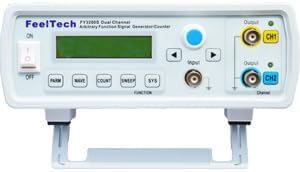

The FY6900 20M is a general-purpose bench signal generator built around direct digital synthesis. Its supplied rating is 3.5, so it does not lead the guide on customer feedback, but the documented feature set remains attractive for electronics experimentation, circuit development, amplifier testing, and education.
We may earn a commission when you buy through this link, at no additional cost to you.
Two output channels expand the possibilities beyond simple single-tone work. The generator reaches up to 20MHz for sine waves, samples at 250MSa/s, provides 14-bit vertical resolution, and stores up to 98 sets of functions or arbitrary waveforms. A 2.4-inch color display makes the desktop unit comparatively approachable for direct panel control.
The principal drawback is that this listing represents the 20MHz version, even though the product family is marketed across several maximum frequencies. It is therefore less appropriate for RF work than the RF-focused choices in this guide. Its 3.5 rating also suggests that some buyers may have found aspects of the overall ownership experience less compelling.
Choose the FY6900 20M when you want a capable two-channel bench generator for signal shaping and general electronics without moving into dedicated RF instrumentation. Confirm the exact model variant before purchase, use appropriate loads, and treat the color screen and waveform storage as the principal workflow advantages.
Independent dual outputs let one channel act as a reference while the other supplies the test signal. That arrangement is useful for phase, offset, and differential-response experiments, although the product data does not specify a numeric phase-control range.
With up to 98 functions and arbitrary waveform sets, users can move beyond basic sine output into more elaborate waveforms. The 250MSa/s sampling rate and 14-bit vertical resolution are the key documented specifications for arbitrary-waveform work.
We may earn a commission when you buy through this link, at no additional cost to you.
The RF Explorer RFE6GEN is a dedicated RF source for continuous-wave, swept, and tracking-generator work from 24MHz through 6GHz. Its 4.1 rating reflects generally positive customer feedback, while the feature set distinguishes it as a specialized instrument for wireless testing rather than a conventional low-frequency bench generator.
We may earn a commission when you buy through this link, at no additional cost to you.
Its most valuable feature is the ability to pair with an RF Explorer spectrum analyzer through PC software. In that arrangement, it can support return-loss and filter analysis through S11 measurements. Dedicated sweep controls also allow a user to define start and stop frequencies, step size, and sweep speed for component and circuit validation.
The lower limit of 24MHz means this device cannot substitute for a general-purpose waveform generator, and its usefulness increases when an RF Explorer analyzer is already owned. The requirement for PC software in advanced measurement workflows is another consideration, although the unit itself is designed for portable use.
This is our premium pick for buyers who need genuine RF signal output and already use, or plan to acquire, the RF Explorer platform. It is a strong choice for Wi-Fi, Bluetooth, LTE, sub-6GHz 5G, IoT, and filter testing within its supported frequency range.
Tracking-generator operation changes the instrument from a simple source into a component of a broader measurement system. Paired with a compatible spectrum analyzer, it can support S11 return-loss and filter analysis for more informative RF diagnostics.
Continuous-wave output supports a stable carrier, while sweep mode provides a controlled range for finding responses. The stated 1kHz resolution and adjustable sweep parameters make the source practical for targeted wireless-component testing.
We may earn a commission when you buy through this link, at no additional cost to you.
The OREI HDMI 2.1 Signal Generator is a compact test-pattern tool for display, cable, converter, and installation troubleshooting. It carries a 4.5 rating and is one of the most approachable options in the guide for technicians who need a repeatable visual signal rather than an analog waveform source.
We may earn a commission when you buy through this link, at no additional cost to you.
The generator supports HDMI 2.1 and HDCP 2.3, produces signals up to 8K at 30Hz, and handles up to 40Gbps total bandwidth with a maximum of 10Gbps per lane. Thirteen built-in patterns include color bars, checkerboards, and gradients, giving installers several ways to identify distortion, color issues, synchronization faults, or dropped signals.
This is not a general-purpose electrical signal generator, and it does not replace a function generator for circuit analysis. The documented 8K maximum also uses a 30Hz refresh rate, so buyers seeking 8K at 60Hz should verify compatibility and the precise capabilities of the current listing.
Choose this device for AV installation, field service, display calibration, and HDMI fault isolation. Its compact metal enclosure makes it more portable than a bench instrument, while the pattern library removes the need to source separate test media for common troubleshooting tasks.
Color bars, checkerboards, and gradients reveal issues that can be hard to isolate with ordinary content. They are useful for checking color rendering, continuity, stability, and the presence of synchronization errors across an HDMI chain.
HDMI 2.1 and HDCP 2.3 support make the unit relevant to contemporary displays and protected-content workflows. The 40Gbps aggregate bandwidth specification gives installers a straightforward way to match the source to modern high-bandwidth installations.
We may earn a commission when you buy through this link, at no additional cost to you.
The FY8300S-20M is the most expansive conventional bench generator in this guide. Its 4.0 rating is solid, and its three-channel architecture, arbitrary-waveform editing, pulse generation, frequency measurement, sweeping, VCO functions, and four TTL outputs make it a versatile all-in-one instrument.
We may earn a commission when you buy through this link, at no additional cost to you.
All three channels can operate independently or synchronously, with precisely adjustable phase differences. The host software can control instrument functions and edit waveforms before saving them to the generator. The open communication protocol and shortcut-key design also support both regular operation and secondary development.
The instrument is not a simple beginner appliance, and its many menus and functions can overwhelm someone who only needs a sine source. The product data also notes that signal outputs can tolerate a short circuit for 60 seconds, but that does not make deliberate repeated shorting a good practice.
This generator is best for educators, product developers, and technicians who value channel count and integrated measurement more than compactness. Select it when three synchronized outputs, four TTL levels, and host-based waveform management can replace several separate pieces of test equipment.
Independent channels can represent clock, data, and control signals or generate phase-shifted relationships. Synchronized updates allow the operator to configure a complete multi-signal scenario more efficiently than with separate manual instruments.
The 100MHz frequency-meter function covers frequency, period, positive and negative pulse width, and duty-cycle measurements. Having these functions in the generator reduces the need to reach for a separate meter during routine setup and validation.
We may earn a commission when you buy through this link, at no additional cost to you.
The AURSINC TinySA Ultra+ ZS407 combines a handheld spectrum analyzer with an RF signal generator, earning a 4.4 rating. Its 100kHz to 7.3GHz analysis range is the widest in the guide, making it especially attractive for field troubleshooting across MF, HF, VHF, and UHF bands.
We may earn a commission when you buy through this link, at no additional cost to you.
The 4-inch 480-by-320 IPS display presents up to 450 scan points per sweep, while an integrated LNA offers up to 20dB gain through 7.3GHz. The generator section produces sine waves from 0.1MHz to 900MHz, square waves, and RF test signals extending to 7.3GHz.
Its generator functions are less comprehensive than those of a dedicated arbitrary waveform generator, so the dual nature is an advantage rather than a replacement for full laboratory equipment. The compact screen also requires careful navigation when investigating crowded spectra.
Choose the ZS407 for mobile RF surveys, antenna and signal checks, wireless troubleshooting, and locations where carrying a full spectrum analyzer is impractical. It is particularly useful for users who want strong frequency coverage, data storage, and battery-powered field work in one enclosure.
A 7.3GHz ceiling allows the analyzer to reach into higher UHF territory without changing hardware. That makes the device suitable for examining a broad collection of transmitters, wireless systems, and interference sources during field visits.
The internal generator can create 0.1MHz to 900MHz sine waves, square waves, and higher-frequency test signals. This supports signal verification and receiver testing when a known local source is needed to trace a fault through a system.
We may earn a commission when you buy through this link, at no additional cost to you.
The Xvive AT-2 Audio Tester Pro combines a 1kHz tone and pink-noise generator with an XLR cable tester, phantom-power checker, input meter, and audio monitor. Its 4.8 rating is the highest among the products reviewed, reflecting a tool that directly addresses common live-production and installation problems.
We may earn a commission when you buy through this link, at no additional cost to you.
The signal generator can feed mixers, DI boxes, wireless systems, pedals, active PA speakers, and in-ear monitor rigs. Three output pad levels of -10, -20, and -40dB help match common inputs, while the XLR meter identifies signal presence and flags very hot levels.
Cable diagnostics are equally useful because the tester checks all three XLR pins automatically or manually. A solid phantom-power indication appears for 44 to 52V, with flashing for 24 to 44V, helping identify incorrectly powered or degraded connections without relying only on subjective behavior.
Choose the AT-2 for live sound engineers, audio technicians, stage crews, and musicians who service XLR-based systems. It is not a broad waveform generator, but for compact audio troubleshooting it combines several tools that would otherwise require separate meters, cables, and signal sources.
A known tone or pink-noise source makes it easier to follow a signal through a mixer, DI box, active speaker, or effects unit. The multiple pad levels help control level matching so the test source does not unintentionally overload a downstream input.
Pin-by-pin testing locates opens or faults that a simple continuity light might miss. Phantom-power measurement and input metering add two more checks to the same workflow, reducing the need to carry a separate collection of diagnostic tools.
We may earn a commission when you buy through this link, at no additional cost to you.
The AURSINC TinySA Ultra+ ZS406 is a portable 2-in-1 spectrum analyzer and signal generator with a 4.5 rating. It covers 100kHz to 5.4GHz, with Ultra mode extending the range to 6GHz, making it a capable field instrument for wireless troubleshooting and RF inspection.
We may earn a commission when you buy through this link, at no additional cost to you.
Its 4-inch 480-by-320 touchscreen supports intuitive navigation, while switchable resolution bandwidth from 200Hz to 850kHz allows a tradeoff between scan speed and signal separation. The stated phase-noise figures of -108dB/Hz at 100kHz offset and -115dB/Hz at 1MHz offset are useful for sensitive spectral work.
As a generator, it provides 100kHz to 900MHz sine waves, 800MHz to 4.4GHz square waves, and mixed signals from 4.4GHz to 5.4GHz. A calibration generator supports self-test and low-input calibration, but the output is less flexible than a laboratory arbitrary waveform generator.
The ZS406 is a strong option for portable spectrum analysis, intermodulation testing, and controlled signal injection. Choose it over the larger ZS407 when the touchscreen, phase-noise data, and PC control matter more than the maximum 7.3GHz analysis ceiling.
The 200Hz minimum resolution bandwidth helps separate nearby carriers that may appear merged at broader settings. This is valuable for adjacent-channel behavior, SSB two-tone intermodulation checks, and other tests requiring a closer view of spectral structure.
The documented phase-noise performance and integrated 20dB LNA help with weak-signal reception and stability analysis. The LNA benefit is stated as effective only below 3.5GHz, so users should account for that limitation when planning high-frequency measurements.
We may earn a commission when you buy through this link, at no additional cost to you.
This FY6900 20M listing shares the principal specifications of the first FY6900 entry but has a 5.0 customer rating, making it the most positively rated conventional generator here. It is a dual-channel DDS function and arbitrary waveform source designed for accurate, stable, low-distortion output.
We may earn a commission when you buy through this link, at no additional cost to you.
It supports sine waves up to 20MHz, 250MSa/s sampling, 14-bit vertical resolution, and up to 98 functions or arbitrary waveform sets. The 2.4-inch 320-by-240 color display and two-channel design make it convenient for routine bench use, while the wide 100-to-240V AC supply simplifies use in different locations.
Its limitations mirror those of the other FY6900 20M listing: it is a desktop unit and is not aimed at RF frequencies. The distinction between the two listings may involve seller, stock, or bundle differences rather than major changes in the core hardware, so buyers should compare the complete current offer rather than assume the model names imply different capabilities.
Choose this listing when the 5.0 rating and current offer are compelling and you need dual-channel arbitrary-waveform generation for electronics work. It is particularly suitable for amplifier, filter, timing, and general circuit experiments within the 20MHz model limit.
A perfect 5.0 supplied rating distinguishes this listing from the otherwise similar FY6900 20M entry. Customer ratings do not replace technical evaluation, but they can provide useful context when multiple versions of the same instrument are available.
DDS technology, dual outputs, a color display, and a broad waveform library cover the core needs of most general-purpose signal-generation tasks. The 20MHz ceiling still makes it a low-to-moderate-frequency instrument rather than an RF solution.
We may earn a commission when you buy through this link, at no additional cost to you.
The FY3200S 6M is a compact dual-channel DDS function and arbitrary waveform generator with a perfect 5.0 supplied rating. It is designed for users who need sine, arbitrary, and pulse-related output in a straightforward bench instrument without paying for high-frequency capability.
We may earn a commission when you buy through this link, at no additional cost to you.
Each of the two channels can be configured independently, allowing different frequencies, waveforms, or amplitudes to be produced at the same time. The arbitrary waveform memory is 2048 by 12 bits, the sampling rate is 250MSa/s, and the output amplitude ranges from 10mVpp as a minimum to 20Vpp as a maximum.
Its main limitation is the 6MHz maximum in this particular model. That ceiling is adequate for audio, control circuits, sensors, low-speed communications, and many educational exercises, but it excludes the higher-frequency demands of RF and video waveform work. The waveform memory is also much shallower than in a sophisticated high-end generator.
Choose the FY3200S 6M for a cost-conscious electronics bench, teaching lab, or first general-purpose signal generator. It offers an unusually clear feature-to-capability balance for low-frequency work, especially for users who value two independent channels and strong listed customer feedback.
Independent parameter settings make it possible to compare two signal conditions or supply reference and stimulus outputs at once. This capability is useful in amplifier, logic, and basic communications experiments even though the maximum frequency is relatively low.
The documented 10mVpp-to-20Vpp range provides flexibility for low-level circuits and higher-amplitude applications. Users should still confirm the exact output behavior at each frequency and load before relying on a specific amplitude in a critical test.
We may earn a commission when you buy through this link, at no additional cost to you.
The Schumann Resonance Generator is a specialized adjustable sine-wave source designed around very low frequencies, including the 7.83Hz Schumann resonance frequency. It carries a 4.2 rating and differs fundamentally from the lab, RF, audio, and video instruments elsewhere in the guide.
We may earn a commission when you buy through this link, at no additional cost to you.
Its documented adjustment range extends from 0.01Hz to 299999Hz, with stable output intended for experiments, sound therapy, and personal resonance exploration. The acrylic enclosure measures 4.3 by 6.3 by 0.8 inches and operates from a standard 5V USB connection, making it easy to carry between home, office, and travel locations.
The product listing associates the device with relaxation, stress relief, and improved sleep, but those are wellness outcomes rather than guaranteed medical effects. Technical users should focus on the stated frequency range, stability, and output, while health-related claims should be treated cautiously and not as a substitute for medical care.
Choose this device if your interest lies in low-frequency resonance, meditation, or exploratory sound-therapy setups. It is not suitable for RF testing, accurate bench measurement, or professional audio diagnostics, despite sharing the broad signal-generator label with the more specialized products in this guide.
The unusually low 0.01Hz lower limit enables exploration beneath the range of ordinary audible and audio-test tones. The included 7.83Hz setting provides a direct starting point for users interested in the product's named resonance concept.
Its slim USB-powered form is easy to carry and leaves no separate power supply to manage. Normal operation is silent; headphones are described as a test method for confirming output rather than equipment required for routine use.
We may earn a commission when you buy through this link, at no additional cost to you.
The right signal generator depends less on the broadest headline specification and more on the signal type, frequency, waveform control, measurement workflow, and portability required by your project. Use the following factors to narrow the field before comparing listings.
Choose a generator whose primary modes match your workload instead of paying for unrelated capabilities.
Confirm both endpoints and account for attenuation, bandwidth limits, and practical output constraints at the extremes.
Prioritize stable editing and repeatable waveform recall when custom shapes are central to the task.
Buy additional channels only when simultaneous, independently configurable outputs will improve the test process.
Integrated functions reduce tool count, but verify software, hardware, and accessory requirements before assuming a complete workflow.
Compare battery life, included accessories, charging method, screen size, and physical weight against the environments where you will work.
Check operating-system support, data formats, update procedures, and whether advanced features work without a paid subscription.
Make sure the complete signal path supports the frequency, connector, impedance, and output level required by the device under test.
Begin by identifying the exact output, frequency range, waveform type, and expected load. Read the current manual, inspect connectors, and confirm that the downstream device is safe for the selected amplitude before connecting anything. For RF products, use appropriate coaxial cables and terminations; for audio products, verify XLR pinout and input level; for HDMI testing, confirm source, cable, and display compatibility.
Configure the instrument conservatively. Begin with output disabled or amplitude at its lowest appropriate setting, select the waveform and frequency, then enable the output and increase level gradually. When using arbitrary waveforms, save a known configuration and avoid changing parameters during a critical measurement unless the changing parameter is the subject of the test. Use sweep, tracking, or multi-channel modes according to a documented sequence rather than improvising unfamiliar combinations.
Protect the device by avoiding reverse voltage, excessive amplitude, sustained short circuits, and connection to incompatible equipment. Keep ventilation openings clear, use the specified power source, and keep liquids away from bench instruments. Clean connectors gently, protect displays from abrasive surfaces, update software when appropriate, and store portable units in a dry protective case with batteries at a suitable charge level.
A signal generator creates a controlled electrical or electronic test signal so a device, circuit, or system can be evaluated under repeatable conditions. Depending on the model, the output may be a sine wave, square wave, arbitrary waveform, RF carrier, audio tone, or HDMI test pattern. Technicians use these signals to check gain, timing, frequency response, audio paths, video links, filters, receivers, and many other systems.
No. A signal generator produces a known output, while an oscilloscope measures and displays signals present in a circuit. They are often used together: the generator supplies a controlled input, and the oscilloscope checks the resulting response. Some products in this guide combine generation with additional analysis, such as the TinySA units, but they do not replace every function of a dedicated oscilloscope.
Choose a range that comfortably contains the intended test frequency rather than barely reaching it. A 6MHz generator is suitable for many audio, control, and electronics tasks, while a 20MHz unit covers more demanding timing and communications experiments. RF work may require hundreds of megahertz or several gigahertz, and the RF Explorer reaches 6GHz. The key is to match the output mode and bandwidth to the actual application.
Arbitrary waveform capability is valuable when a standard sine, square, or pulse shape cannot represent the signal you need. It is especially useful for sensor simulation, waveform replication, communications testing, and teaching. For fixed tones, simple audio checks, or HDMI troubleshooting, specialized outputs are more relevant and may provide a simpler workflow than a full arbitrary waveform generator.
Portable analyzers prioritize convenience, coverage, battery life, and useful integrated features rather than matching every specification of a full laboratory setup. The TinySA products provide detailed RBW, phase-noise, LNA, and calibration information, but precision work still depends on calibration, accessories, operating technique, and the measurement bandwidth selected. Bench tools remain preferable when traceable accuracy or laboratory-level interfaces are the priority.
Usually not well. HDMI test-pattern generators operate in the video domain, audio testers produce tone or pink-noise signals and analyze XLR connections, and RF sources emit high-frequency carriers. A broad arbitrary waveform generator can simulate some electrical waveforms, but it generally cannot perform the domain-specific testing and diagnostics offered by the dedicated HDMI and audio products in this guide.
Confirm the exact model and frequency variant, inspect the display and buttons, test every output, and check connectors for damage. Verify the listed waveform modes, calibration status, included accessories, software access, and whether the seller provides functional testing. A completed self-test or generator-to-scope measurement can provide evidence that the output remains accurate.
Keep the unit within its specified operating environment, use the correct power supply, and avoid stressing outputs beyond their documented limits. Allow warm-up time where required, use suitable cables and terminations, and complete calibration or self-test procedures when specified. Store the instrument away from moisture, impact, and extreme temperatures, especially if it contains a rechargeable battery.
The Xvive AT-2 stands out for live and installed audio work, combining signal generation with XLR testing, phantom-power checking, input metering, and monitoring. The RF Explorer RFE6GEN is the premium selection for dedicated RF work, while the OREI HDMI 2.1 generator offers the most approachable way to troubleshoot modern video installations with built-in test patterns.
For general electronics, prioritize the frequency limit, channel count, waveform memory, output control, and software integration. The FY8300S provides the broadest conventional bench feature set, the FY6900 offerings balance dual-channel capability with an extensive waveform library, and the FY3200S 6M fits lower-frequency requirements. Portable RF users should evaluate the TinySA ZS406 and ZS407 based on required frequency ceiling, interface preference, and battery workflow.
Finally, verify the exact model variant and complete current listing before ordering. Specifications, bundles, seller offers, and prices can change, and the availability of each product may differ over time. Checking the current details helps ensure that the selected signal generator still matches your required frequencies, outputs, accessories, and operating environment.
