
BAZO 1920P Endoscope Camera
4.4Editor score
1920P HD imaging
Eight adjustable LEDs
18.04-foot semi-rigid cable
No Wi-Fi required
A sewer camera for iPhone turns your phone into a practical inspection tool for drains, pipes, engines, walls, ducts, and other confined spaces. The best options balance image clarity, probe maneuverability, waterproofing, lighting, cable reach, and dependable phone connectivity while remaining simple enough for homeowners and DIY users.
This guide compares ten cameras across two distinct categories: lightweight phone-connected borescopes and self-contained sewer inspection systems. We considered probe diameter, dual- or single-lens configurations, cable length, water resistance, LED illumination, app requirements, recording functions, and compatibility with iPhone connectors before ranking each option.
The list begins with flexible phone-connected cameras suited to accessible pipes and household projects, then includes dedicated systems for deeper drain and sewer work. Each review explains the product's strongest use case, practical limitations, and ideal buyer. Availability and pricing can change, so confirm the current listing and iPhone compatibility before purchasing.
4.4Editor score

4.1Editor score
4.5Editor score
As an Amazon Associate we earn from qualifying purchases.
The table below compares each camera by lens design, image resolution, cable reach, waterproof rating, and display or phone compatibility, making it easier to distinguish quick household borescopes from dedicated sewer inspection systems.


This dual-lens borescope is a flexible phone-connected option for inspecting pipes, vehicle interiors, engine areas, walls, mold locations, and wiring. Its supplied information does not include a customer rating, so this recommendation is based on the documented 1920 by 1440 imaging, two-lens design, 7.9mm probe, and 16.4-foot semi-rigid cable rather than an established rating.
We may earn a commission when you buy through this link, at no additional cost to you.
The strongest feature is the combination of front and side cameras. A forward-facing view helps the probe follow a route, while the side lens is valuable when a blockage, crack, joint, or hidden object sits against a pipe wall. The probe produces close-range still images and video at 1920 by 1440 resolution, while adjustable lighting helps reveal details in dark pipes, wall cavities, and engine compartments. Its semi-rigid cable offers a useful compromise between a floppy line and a rigid professional rod.
There are practical limitations to consider. The probe is designed for accessible or moderately confined spaces rather than long municipal sewer runs, and the supplied data does not list cable depth markings. It also relies on the SUP-ANESOK app, so a compatible phone, correct interface adapter, and functioning app are necessary. The camera is not made from heat-resistant materials, and the probe's protective layer can be scratched by sharp edges if the cable is forced or pulled aggressively.
This is a compelling pick for homeowners who want more viewing angles without moving to a dedicated reel system. It is particularly suitable for checking household drains, P-traps, under-sink plumbing, engine cavities, wall voids, and other areas accessible through a small opening. Buy it when dual-lens flexibility, a slim probe, and direct phone viewing matter more than maximum reach or standalone recording.
The front and side lenses reduce blind spots when the target rests along a pipe wall. Switching perspectives can also help when the forward view is blocked by debris or a tight bend.
At 16.4 feet, the semi-rigid cable reaches many household plumbing and inspection points without the bulk of a dedicated reel. The stated IP67 rating supports use in damp environments and underwater to 3.28 feet for up to one hour.
We may earn a commission when you buy through this link, at no additional cost to you.
This single-lens endoscope is a straightforward inspection camera for users who want to connect a probe to an iPhone or compatible Android device and begin viewing hard-to-reach areas. With a 4.3 customer rating, a 7.9mm camera head, 1920 by 1440 close-range images, and a 16.4-foot semi-rigid cable, it covers many common plumbing, automotive, and household tasks.
We may earn a commission when you buy through this link, at no additional cost to you.
Its semi-rigid cable can bend around obstacles while retaining enough shape to remain directed along a drain or into a narrow opening. The adjustable light helps illuminate dark pipe interiors, while the camera records both still images and close-range video. It supports iOS 9.0 and later and Android 7 and later through the supplied interface options, including a Lightning connector for compatible iPhones. A magnet, hook, mirror, protective cap, and manual are included to help with retrieval and general inspection tasks.
The primary trade-off is the single lens. It can provide a clear forward view, but it lacks the ability to pivot toward an object located directly beside the probe. The 16.4-foot cable is also shorter than the 50-foot and 100-foot options in this guide. As with other app-based phonescope systems, the user must download the SUP-ANESOK app and use the correct connection, so compatibility should be verified before buying.
This camera is well suited to owners, renters, mechanics, and DIY users who need a dependable way to look into sinks, pipes, engine areas, wall spaces, and vehicle interiors. It is a balanced general-purpose borescope for anyone who does not require a side lens or professional-length cable.
The semi-rigid design allows the line to be shaped around obstacles without becoming excessively floppy. This makes the camera easier to direct through household bends compared with a completely flexible cable.
The supplied attachments support several common tasks. The magnet can retrieve metal objects, the hook can snag accessible debris, and the mirror can help view around limited obstructions.
We may earn a commission when you buy through this link, at no additional cost to you.
The Teslong 50FT USB C Borescope is aimed at users with a USB-C iPhone who need substantially more cable reach than a typical phone-connected borescope. Its 4.2 rating reflects a generally positive reception, while the documented 50-foot semi-rigid cable, eight high-brightness LEDs, and IP67 waterproof probe make it useful for longer drain routes, outdoor plumbing, vehicle work, and larger inspection spaces.
We may earn a commission when you buy through this link, at no additional cost to you.
The extended cable is the defining feature. At 50 feet, it can reach deeper into straight or gently curving lines than the 16-foot-class cameras, and it can be paired with a drain snake or plastic Wiffle Ball to improve navigation, although those aids are not included. Eight LEDs illuminate dark areas, and the semi-rigid cable can be molded to hold a desired shape. The USB-C interface is convenient for current iPhone 15, 16, and 17-series devices, as well as compatible USB-C iPads and Android hardware.
Compatibility is the most important caveat. This camera does not support older iPhones with Lightning connectors, including the models explicitly listed in the supplied information. Its cable also bends but is not as rigid as a professional sewer camera, which may limit its ability to push through tight elbows or push past heavy obstructions. Users should therefore treat it as a long-reaching inspection scope rather than a guaranteed solution for every deep blockage.
The Teslong is best for a USB-C iPhone owner who routinely needs to inspect long drain runs, exterior pipes, large cavities, or spaces beyond the reach of shorter borescopes. It is less appropriate for Lightning-equipped phones or users who need a rigid, self-powered sewer camera with a large screen and depth markings.
The 50-foot line gives inspection access to deeper sections of a pipe or exterior line. It is most effective in relatively straight routes where the semi-rigid cable can be guided without losing its shape.
Native USB-C support avoids needing a Lightning adapter on recent iPhones. Confirm your exact model and connector before ordering because the stated compatibility excludes a long list of older Lightning-based devices.
We may earn a commission when you buy through this link, at no additional cost to you.
The BAZO 1920P HD Borescope is an economical, broadly compatible inspection camera that pairs an 18.04-foot semi-rigid probe with a phone or tablet. Its 4.4 customer rating is among the stronger results in this list, and the product offers a slim 6.9mm probe, eight adjustable LEDs, IP67 waterproofing, and a UseePlus app that works without Wi-Fi, Bluetooth, separate charging, or user registration.
We may earn a commission when you buy through this link, at no additional cost to you.
Its most user-friendly feature is the straightforward connection process. Included adapters cover iPhone and Micro-USB connections, while the camera does not require a wireless network or internal battery. The 1920P sensor records clear images and video in confined areas, and the adjustable lighting can be adapted for dark pipes, engine compartments, wall cavities, HVAC passages, and automotive interiors. The semi-rigid 18.04-foot cable is slightly longer than many competing phone scopes and retains shape well enough for controlled routing.
The tradeoff is that it uses a single camera lens, so it cannot switch to a side view when a target sits against a wall. It also depends entirely on the UseePlus app, and the manufacturer recommends updating the app if connection problems occur. While the stated IP67 rating makes the probe suitable for damp and underwater use, the scope remains a light-duty inspection tool rather than a rigid pipe crawler.
This is the best budget choice for most buyers who want a capable borescope for household drains, automotive checks, plumbing, engine work, wall inspection, and HVAC maintenance. It is especially attractive to users who want offline operation and simple adapters rather than a standalone display or a professional reel. For the money-conscious shopper, the combination of reach, accessories, lighting, and solid customer feedback is difficult to overlook.
The camera communicates through its connector and UseePlus app without requiring Wi-Fi or Bluetooth. This reduces setup friction and makes the scope suitable for locations where a network connection may be weak or unavailable.
The long probe, adjustable LEDs, and included magnet, hook, mirror, and mounts cover a broad range of inspection tasks. The single-lens format is most effective when the camera can be pointed directly toward the subject.
We may earn a commission when you buy through this link, at no additional cost to you.
The Acoath dual-lens endoscope combines a 7.9mm probe, 1920 by 1440 close-range imaging, and two camera perspectives in a phone-connected design. Its 4.3 rating and broad set of documented uses position it as a capable general inspection scope for vehicle care, home repairs, pipeline work, electrical checks, wall cavities, chimneys, air-conditioning systems, and sewer or drain inspection.
We may earn a commission when you buy through this link, at no additional cost to you.
The dual-lens arrangement gives it an advantage over conventional single-lens borescopes. Users can inspect the path ahead and the area beside the probe, which helps locate cracks, leaks, blockages, or disconnected fittings that are not centered in the pipe. A 16.4-foot semi-rigid cable gives the camera enough shape to navigate bends while remaining flexible enough to coil for storage. The IP67 probe can operate underwater to 3.28 feet for up to one hour, and eight adjustable LEDs make dark areas easier to examine.
Maintenance matters because the camera head is not made from heat-resistant materials. The engine must cool to a normal temperature before inspection, and the probe should not be struck, pulled forcefully, or dragged around sharp protrusions. Doing so could damage the waterproof protective layer and compromise the camera. The product also requires the SUP-ANESOK app and the appropriate connector for iOS 9.0 or later or Android 7 and later.
The Acoath is a good fit for users who want the flexibility of two viewing angles in a slim, accessible probe. It is less suitable for hot engine compartments, rough industrial environments, or long sewer lines where a thicker camera head and greater structural protection are required.
The forward lens follows the route of the pipe, while the side lens reveals objects along the wall. That second angle can shorten diagnosis when a suspected problem is not directly in the camera's forward path.
Treat the camera head carefully around sharp edges and never use it in a hot engine. A soft cleaning cloth and gentle handling help preserve the lens and the protective waterproof layer.
We may earn a commission when you buy through this link, at no additional cost to you.
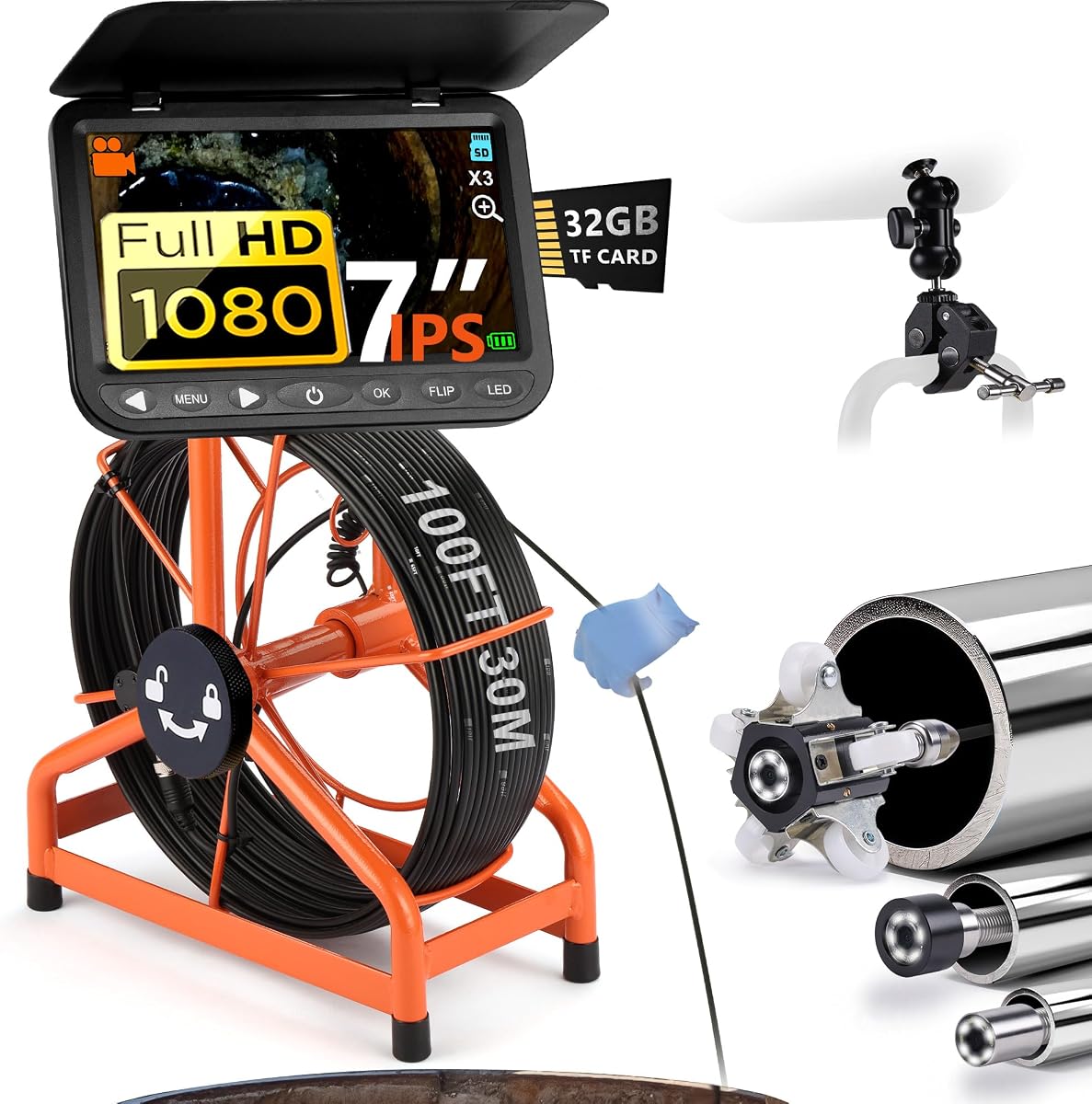
The ChoosePRO HD1080P is a dedicated drain and sewer inspection camera rather than a small phone-connected borescope. It combines a seven-inch IPS display, a 100-foot marked cable, a 32GB DVR card, an IP68 camera head, and a 5000mAh battery. Its 4.5 rating and extensive feature set make it the most complete option for plumbers, contractors, inspectors, and homeowners undertaking serious pipe work.
We may earn a commission when you buy through this link, at no additional cost to you.
The seven-inch display provides a much larger viewing area than a phone screen, while the 16-times zoom and six adjustable LEDs help expose cracks, corrosion, clogs, and other pipe conditions. The cable reel uses a twist-lock system designed to lock or release the line quickly, and its thicker iron tubing is intended to improve stability and durability. Depth markings help users estimate how far the camera head has traveled, which is especially useful when documenting a blockage's location.
This is a self-contained system with important advantages over phone scopes. Footage can be recorded and played back directly, transferred by SD card or USB-C, and saved for later analysis or sharing with a client. The built-in battery provides more than eight hours of use and can be powered through USB-C during operation. A stainless-steel spring tip assists with bends, while 25mm and 84mm sleeves accommodate different pipe sizes. The aluminum clamps and 360-degree mount provide more stable positioning than improvised phone supports.
The trade-off is size, weight, and complexity compared with a 16-foot phone borescope. This is not the tool for squeezing into a tiny wall cavity, and it remains a single-lens system. It is best for users who need longer reach, larger viewing screens, dependable recording, and depth awareness. Despite its sophistication, the plug-and-play design makes it approachable for motivated homeowners as well as professionals.
The marked cable allows an inspector to estimate the camera head's distance from the entry point. This is useful for locating a problem and documenting how far into a line it sits.
The 32GB DVR supports direct recording and instant playback, while SD-card and USB-C transfer make saved footage easy to review. The dedicated display also reduces the need to position a phone in a wet or confined workspace.
We may earn a commission when you buy through this link, at no additional cost to you.
The DEPSTECH NTC55 stands out for its 2560 by 1440 imaging and dual 7.9mm cameras, making it the editor's choice for users who prioritize detail and perspective. Its 4.1 rating is solid, and the documented feature set includes a 16.5-foot semi-rigid cable, an 80-degree viewing angle, 8+1 adjustable LEDs, photo and video capture, zoom, rotation, and local app operation.
We may earn a commission when you buy through this link, at no additional cost to you.
Resolution is the main differentiator. The supplied data describes the 2K sensor as 80 percent sharper than standard 1920 by 1080P and specifies 3.69 million pixels, which can make fine details easier to distinguish. Front and side cameras eliminate the blind spots associated with a single forward view, and the app makes it easy to switch perspectives, capture stills, record video, zoom, rotate the image, and review items directly in the gallery.
Connectivity and app requirements deserve attention. The package includes a Type-C connector and Lightning adapter, supporting iOS 11 or later and Android 9 or later. iPhone users must use the included Lightning adapter, while Android users need OTG support and must enable it before using the DEPSTECHCAM app. The app functions locally without internet access or registration, which supports privacy and use in remote locations, but only the official app can control the camera.
This model is ideal for mechanics, HVAC technicians, home inspectors, and serious DIY users who want more detail than a standard phone scope provides. It is especially useful when inspecting small engine components, wiring, drain pipes, walls, or other structures where a side view can reveal what a forward-facing lens misses. Its 16.5-foot reach and compact dual-lens head offer a balanced combination of portability and diagnostic capability.
The 2560 by 1440 sensor is well suited to close-range inspection where hairline cracks, corrosion, joint gaps, and small obstructions may otherwise be difficult to distinguish. Actual clarity still depends on focus, lighting, and keeping the lens clean.
Photo capture, video recording, 2-times zoom, 90-degree rotation, and gallery review make the DEPSTECHCAM app more versatile than a basic live-view application. The local operation model also avoids a mandatory account or continuous internet connection.
We may earn a commission when you buy through this link, at no additional cost to you.
This dual-lens endoscope is a practical general-purpose inspection camera for automotive DIY and home maintenance. It carries a 4.4 customer rating and offers 1920 by 1440 close-range imaging, a 16.5-foot semi-rigid cable, IP67 waterproofing, and a phone-based display for iOS and Android. It is designed to locate engine problems, lost objects, wall issues, and pipe clogs before larger areas are dismantled.
We may earn a commission when you buy through this link, at no additional cost to you.
Its dual cameras offer forward and side perspectives, helping users see both the route ahead and details along the probe's side. The 16.5-foot semi-rigid cable holds its shape well enough for navigation through narrow spaces, while its flexibility allows the user to bend and roll it for storage. The phone receives power directly through the connection, so the scope does not need separate charging, Bluetooth, or a Wi-Fi network. One-tap capture and long-press lens switching are convenient for documenting findings.
The specification says the camera can inspect underwater areas to 16.5 feet deep, although the probe is still IP67 rated, so users should interpret the stated depth claim carefully and observe the manufacturer's operating limits. There is no physical screen, and the phone becomes the display, which is convenient but means the cable, phone, and connector must all remain properly supported. The kit includes a magnet, hook, and mirror for retrieval or viewing around limited obstructions.
This camera fits homeowners, mechanics, plumbers, and DIY users who want a dual-lens tool with a comfortable balance of reach and portability. It is less suitable for long municipal lines or deep professional sewer surveys, where a 100-foot reel camera has a clear advantage. For routine household and automotive inspection, however, it offers a convincing mix of reach, detail, and convenience.
A phone-connected scope can narrow down where a leak, clog, damaged wire, or hidden object is located. This supports more targeted repairs and reduces unnecessary dismantling.
The dual-lens head improves coverage without requiring a larger cable or bulky reel. That makes the camera easier to carry between plumbing, automotive, and household inspection tasks.
We may earn a commission when you buy through this link, at no additional cost to you.
The 1920P HD single-lens endoscope is a straightforward diagnostic camera for inspecting drains, plumbing, automotive spaces, and other hard-to-reach locations. It has a 3.8 customer rating, which is the lowest among the rated products in this guide, but it includes useful core features: a 7.9mm camera, a 70-degree viewing angle, eight adjustable LEDs, a 16.4-foot semi-rigid cable, and IP67 waterproof protection.
We may earn a commission when you buy through this link, at no additional cost to you.
The slim probe is designed to enter spark plug holes, pipe elbows, wall voids, P-traps, and S-shaped lines. Its semi-rigid cable bends through curves but remains positioned once shaped, making it easier to hold a view near a crack, blockage, or corrosion point. Adjustable lighting helps reduce dark areas without forcing users to work in an unsafe, poorly illuminated space. Photos and videos save directly to the phone gallery through the app, and no separate memory card is required.
The lower rating suggests that some users may have found aspects of image quality, app performance, or general experience less consistent than the higher-rated options. The single 70-degree lens also limits the ability to look directly sideways, which can be a significant disadvantage in curved pipes. Users should check the current app and connector behavior on their exact iPhone model before committing to a demanding diagnostic workflow.
Despite these limitations, the camera is a viable choice for users who need a simple, waterproof phone scope with adjustable lighting and direct photo saving. It works well for accessible household drains, engine bays, and wall spaces where the target can be viewed from the front. Buyers seeking more diagnostic flexibility should favor a dual-lens model.
Eight adjustable LEDs allow the user to tune illumination for a dark pipe or a close reflective surface. Reducing brightness where glare is excessive can make shape and texture easier to judge.
The stated wide-angle lens captures more of the surrounding area than a very narrow forward view. It remains less comprehensive than a dual-lens arrangement because the camera cannot pivot toward a side target.
We may earn a commission when you buy through this link, at no additional cost to you.
The EIXAUP 100-Foot Sewer Camera is a dedicated, portable pipe-inspection system with a 4.3-inch HD color screen, a 100-foot marked cable, a 23mm camera head, and an 8500mAh rechargeable battery. Its perfect 5.0 customer rating is notable, although the small number of reviews that may produce such a result should be considered alongside the documented capabilities.
We may earn a commission when you buy through this link, at no additional cost to you.
The camera head is fitted with 12 adjustable LEDs and a 145-degree viewing angle, giving users broad coverage and controllable illumination in dark drains and sewer pipes. Its 23mm diameter is larger than a typical phone-borescope head, making it better suited to substantial drain lines than narrow wall voids or spark plug holes. The cable includes one Arabic-numeral marker per meter, allowing operators to estimate distance without relying on electronic counting. A sun visor improves screen visibility during outdoor work.
The main limitation is the absence of a built-in DVR, as stated in the product title. It is a live-view inspection system with a physical screen rather than a dedicated recording package, so users who need saved video should consider the ChoosePRO alternative. The large camera head also requires an appropriately sized pipe or access point, and the camera is not intended to navigate the same tight spaces as a 7.9mm phone scope.
This EIXAUP model is designed for plumbers, contractors, inspectors, engineers, municipal workers, and homeowners who need to examine wastewater, stormwater, pipelines, drains, and ducts. The 100-foot reach, broad viewing angle, distance markings, and long battery life make it a strong portable option for medium and large pipe systems where phone-connected scopes cannot go far enough.
Meter markings make it easier to estimate how far the camera head has moved from the access point. This helps operators document the location of a blockage, crack, or other visible defect.
The 23mm camera head and 145-degree view suit drains and sewer lines that require more substantial hardware. Its larger size also means it will not access the same narrow openings as a phone borescope.
We may earn a commission when you buy through this link, at no additional cost to you.
The right camera depends on where you need to look, how far the probe must travel, and whether you want phone-based flexibility or a dedicated inspection system. The following factors help narrow the field before you commit to a model.
In short, select a phone scope for portable inspection and a dedicated system for greater reach, recording, and field operation.
In short, choose dual lenses for broader diagnostic coverage and single lenses when straightforward forward viewing is sufficient.
In short, match cable reach to the likely depth of the pipe and prioritize a semi-rigid or rigid design when precise steering matters.
In short, favor higher resolution for fine diagnostics, but prioritize good lighting and a clean lens for the clearest real-world images.
In short, choose adjustable lighting and an appropriate waterproof rating, then follow all stated depth, temperature, and handling limits.
In short, confirm both the physical connector and app requirements before ordering to avoid an unusable purchase.
In short, choose built-in recording for client documentation, a phone app for portable snapshots, or a larger display for easier field viewing.
In short, choose the smallest practical head for tight access or a larger head for robust pipe inspection and broader viewing.
Begin by checking the phone connector, installing the correct official app, and confirming that the live image appears before inserting the probe. Clean and dry the lens, check the cable for damage, and test the lights in an open area. If the camera includes different sleeves or accessories, fit the appropriate sleeve before entering the pipe and keep the camera head centered whenever possible.
Guide the probe slowly. Feed only a few feet at a time, pause to look around, and use the side lens or adjustable light where available. Avoid forcing the cable through sharp elbows, and never pull hard if the camera head catches. For a blocked drain, stop before pushing the camera into the obstruction; an inspection camera is a diagnostic tool, not a substitute for a drain snake or a professional cleaning method when the blockage is substantial.
After use, disconnect the camera from the phone, wipe the lens with a clean microfiber cloth, and rinse or dry the probe according to the manufacturer's instructions. Let hot equipment cool before inspection, and never expose the phone to dirty water when the camera connector is attached. Coil the semi-rigid cable without sharp bends, store attachments together, and inspect the protective probe layer for scratches after every demanding job.
For household drains, traps, wall voids, engine spaces, and other accessible locations, a phone borescope can provide a useful diagnostic view. It is not equivalent to a long, rigid, dedicated sewer camera equipped with a large display, depth markings, and specialized navigation. Persistent or deep sewer problems are best handled with professional inspection equipment.
A dual-lens model is helpful when the target may sit beside the probe rather than directly ahead. It can reveal cracks, joints, leaks, sidewall debris, and objects more effectively than a forward-only camera. A single-lens scope remains sufficient when the pipe runs straight and the camera can be pointed directly at the problem.
No. Older iPhones use Lightning, while iPhone 15, 16, and 17-series models use USB-C. The Teslong 50FT model is USB-C only, while most other options in this guide include a Lightning adapter. Also confirm the minimum iOS version and install the manufacturer's official app before making a purchase.
Most phone borescopes reviewed here use a 16.4- to 18.04-foot cable, making them suitable for many household pipes and bends. The Teslong extends to 50 feet for newer USB-C iPhones. Cable length is only part of the equation, because tight elbows, debris, and the semi-rigid design can reduce the practical depth reached.
Not for basic diagnosis. Phone-based scopes commonly save photos and videos through their apps, which is enough for many household projects. The ChoosePRO includes a 32GB card and built-in recording for more formal documentation, while the EIXAUP system has a display but no built-in DVR.
The phone scopes feature IP67 waterproof probes, and the dedicated camera heads use IP68 ratings, making them suitable for damp or submerged conditions within stated limits. Always observe the specified depth and duration, inspect the probe for damage, and disconnect it from the phone before cleaning or storage.
Begin by cleaning both lenses with a soft microfiber cloth and removing dust, droplets, or debris from the protective cap. Then adjust the LED brightness, keep the camera head within its intended close-focus range, and confirm that the app is using the correct input. System differences can affect image quality, so updating the app and testing the camera in a bright open area can help isolate the issue.
No. A longer cable is valuable only if the head can navigate the route and your inspection environment requires the extra distance. A 16-foot semi-rigid scope may work better through a tight household trap than a 100-foot reel camera with a much larger head. Consider access, bend radius, pipe diameter, camera-head size, and recording needs together.
The BAZO 1920P Endoscope is the strongest budget-oriented choice for routine household and automotive inspection, combining a good customer rating, offline app operation, adjustable LEDs, and a useful 18.04-foot semi-rigid cable. The DEPSTECH 2K model is the editor's choice when image detail and dual-angle viewing matter, while the ChoosePRO is the premium option for serious drain and sewer work with a large display, 100-foot reach, and built-in recording.
Most buyers should begin with the type of problem they need to diagnose rather than choosing solely by cable length. Phone borescopes excel at accessible plumbing, automotive cavities, and wall spaces, while dedicated reel systems are better for deeper lines, professional documentation, and repeated field use. Within either group, dual lenses, adequate lighting, slim probes, and reliable iPhone connectivity make routine inspections much easier.
Before ordering, verify your iPhone model, connector, operating-system version, and required app. Review the stated waterproof depth, probe dimensions, and heat limitations, and make sure the camera can physically pass through the access point. Product listings, availability, and pricing can change, so checking the current listing and accessory contents at the time of purchase helps ensure the selected camera matches the job.
