
48 PCS Wet Dry Sandpaper
4.7Editor score
Sixteen-grit assortment
Flexible wet-dry sheets
Ideal for print smoothing
Our guide compares the best sandpaper for 3D prints, covering grit ranges, sheet sizes, wet or dry use, precision tools, durability, and print finishes.
Sanding a 3D print can remove visible layer lines, soften sharp edges, improve surface consistency, and prepare a part for painting or other coatings. The most effective sandpaper depends on material, layer height, desired finish, and whether you prefer flexible sheets, compact blocks, or narrow sanding sticks for detailed areas.
This guide compares ten sandpaper and sanding-tool options based on their documented grit ranges, dimensions, abrasive materials, backing designs, wet-and-dry capability, and suitability for detailed or small surfaces. It covers multipurpose sheet assortments, sponge blocks, finger sanders, matchstick-style tools, and water-drop sanding sticks.
Each selection highlights a different practical advantage, from broad grit coverage to access into corners and grooves. Ratings reflect the supplied customer feedback, while product characteristics come from the listed descriptions. Availability and pricing can change, so confirm the current listing and product details before purchasing.
4.7Editor score

4.6Editor score

4.7Editor score
The comparison below evaluates all ten options by grit coverage, format, material handling, and practical 3D-printing applications, from broad sheet kits to tools designed for tight corners and intricate surfaces.



This broad wet-and-dry sheet assortment earns the top position because it combines 16 grit levels with enough material for a complete print-finishing sequence. Its 4.7 rating reflects strong customer satisfaction, while the progression from 120 through 5000 grit supports everything from removing prominent layer lines to polishing a surface after filler or primer has been applied.
We may earn a commission when you buy through this link, at no additional cost to you.
The silicon carbide abrasive is electrostatically coated for consistent grit distribution. The reinforced waterproof backing is particularly useful when moving between dry sanding and controlled wet sanding, while the flexible material can follow flat walls, curved surfaces, and irregular print geometry. Each 9-by-3.6-inch sheet can be cut down for a small block, folded around an edge, or shaped to reach a recessed feature.
The main limitation is that this is a collection of loose sheets rather than a rigid finger sander or sanding block. Fine dust control therefore depends on technique, and very small internal corners may be awkward to reach with a broad rectangle. Nevertheless, the generous grit selection, flexible construction, and clear back markings make the assortment unusually versatile for the money.
This is the most sensible general-purpose choice for most 3D-print owners. It can handle a PLA or ABS figurine, a functional enclosure, and a part being prepared for paint without requiring several different abrasive formats. Choose it when versatility and a complete progression matter more than having a dedicated ergonomic handle or an integrated sanding block.
Having 120, 150, 180, 220, 240, 320, 400, 600, 800, 1000, 1200, 1500, 2000, 2500, 3000, and 5000 grit available makes it easier to work gradually. That range supports initial layer-line correction, intermediate smoothing, and very fine finishing without repeatedly buying separate sheet sizes.
The flexible backing conforms to curved and irregular shapes, allowing a narrow strip to wrap around a cylindrical section or fit along a sharp edge. Its wet-and-dry design also makes it useful for smoothing filled areas or preparing a surface before paint and other coatings.
We may earn a commission when you buy through this link, at no additional cost to you.
These water-drop-shaped sanding sticks specialize in the areas where ordinary sheets struggle: inside cavities, between closely spaced features, along narrow grooves, and around the fine details of a model. With a 4.6 rating and 20 different grits, the set offers unusually fine control for 3D-print finishing, especially on miniatures, figurines, and articulated parts.
We may earn a commission when you buy through this link, at no additional cost to you.
Each stick is individually labeled with its grit rating, reducing the chance of accidentally using an aggressive grade during a finishing step. The double-sided construction also improves efficiency by exposing two abrasive surfaces. Because the tools are narrow, they can be held like a pencil and moved with localized strokes rather than broad sweeps that could round a delicate shape.
The abrasive is mounted on an EVA-based body, giving the user something firmer to grip than a floppy strip of paper. That support is valuable for applying even pressure, but it also means the tips are less forgiving than a completely flexible sheet. Users should avoid forcing the narrow edge into a tight area because the relatively firm point can mark a soft or thin wall.
This kit is an excellent match for detailed prints and anyone who wants one tool for numerous finishing stages. It is less efficient for smoothing a large flat panel, where a full sheet or sponge block would cover more area. For figurines, tabletop terrain, sci-fi models, and printed parts with recessed detail, though, the controlled access and extensive grit progression make it especially useful.
The slim profile reaches areas that a rectangular sheet or block can only approach indirectly. It is well suited to inside corners, gaps between supports, narrow recesses, and the edges of small printed features where a flat abrasive would bridge rather than contact the surface.
Individual grit labels and 20 available levels help users follow a controlled sequence. The progression runs from 80 grit for early correction to 12000 grit for an exceptionally fine polish, making the set useful across both substantial corrections and delicate final work.
We may earn a commission when you buy through this link, at no additional cost to you.
This kit stands out for its dedicated mini sanding block, a tool that is often overlooked when shoppers compare only grit numbers. The compact PU foam block measures 3.5 by 1.1 inches, making it easy to hold and maneuver around corners, trim, grooves, and the vertical faces of a printed object. Its 4.7 rating supports its position as a polished, well-received kit.
We may earn a commission when you buy through this link, at no additional cost to you.
The included 180 sheets span nine grits from 80 to 1000, organized into red, yellow, and gray groups for coarse, medium, and fine work. A hook-and-loop attachment system permits quick changes without tools, which is particularly helpful when comparing successive grits on the same small surface. Durable aluminum oxide abrasive is designed to resist tearing, clogging, and crumbling.
The grit range ends at 1000, so this is not the strongest choice for polishing all the way to a mirror-like finish. The small pad also covers less area per stroke than a standard sheet or larger sponge. On the other hand, those limitations become advantages when working on miniature props, articulated figures, model components, and other prints where a small, controlled footprint reduces the chance of damaging adjacent details.
Choose this kit when ergonomics, organized grit selection, and fast tool-free changes matter most. It offers a particularly satisfying workflow for prolonged hand-sanding sessions because the foam block provides support while the compact shape reaches areas that a broad sheet bridges. For general and ultra-fine finishing, it can be paired with a separate high-grit sheet, but for detailed stock removal and smoothing, the kit is especially capable.
The hook-and-loop backing allows the current sheet to be removed and replaced quickly. This makes it easy to move from 80 grit to 120, 180, and subsequent grades without repeatedly searching for loose paper, and it helps keep the working area organized.
At only 3.5 by 1.1 inches, the foam block can enter narrow grooves and tight corners while still giving fingers a secure purchase. Its lightweight ergonomic construction is designed to reduce fatigue and distribute pressure more consistently than sanding directly with fingertips.
We may earn a commission when you buy through this link, at no additional cost to you.
This 21-sheet assortment offers a balanced seven-grit progression, with three sheets at each of 120, 220, 400, 600, 800, 1000, and 2000 grit. Its 4.6 rating indicates solid customer approval, while silicon carbide construction, a reinforced backing, and wet-or-dry capability make it a practical choice for prints requiring several finishing stages.
We may earn a commission when you buy through this link, at no additional cost to you.
The abrasive is electrostatically coated to distribute grit evenly, which supports consistent material removal and longer-lasting sheets. Its listed anti-clogging properties are especially relevant for plastic prints, where softened resin debris can otherwise interfere with the abrasive. The flexible sheets can be cut to size and used with sanding blocks, palm sanders, or sheet sanders, giving buyers more options than a fixed-shape tool.
Unlike a larger 16-grit kit, this assortment does not cover every intermediate grade. Users may need to repeat a stage or slow their progression if they skip too many numbers, particularly on a prominent layer line. It also lacks a built-in finger block, so comfortable handling depends on the user's own support method. These are minor compromises given the concentration on practical mid-range and fine grits.
This option suits 3D-print owners who want flexible sheets for curved surfaces, large panels, and parts that will later be filled or painted. It is also a good companion to a compact block or set of detail sticks. Buyers who mainly need a full multi-grit workflow may prefer a larger assortment, but this one covers the essential stages with durable, identifiable sheets.
Silicon carbide grit is suited to producing a clean finish on plastic and other craft surfaces. The listed anti-clogging treatment helps preserve a sharp cutting edge, although users should still clear debris regularly and avoid forcing the abrasive.
Because the sheets can be trimmed, they can be fitted to a finger block, wrapped around a curved section, or used with a powered sanding device. This versatility makes the assortment useful for prints of different sizes and shapes.
We may earn a commission when you buy through this link, at no additional cost to you.
This set provides 24 contoured sanding sponges across 12 listed grit options, beginning at 80 and reaching 3000. With a 4.6 rating, it offers a strong combination of broad grit coverage and comfortable handling. The sponge body measures 3.93 by 2.75 by 0.19 inches, making it larger than the mini finger sander but still compact enough for detailed work.
We may earn a commission when you buy through this link, at no additional cost to you.
The soft foam layer gives the fingers a secure grip, absorbs vibration, and adapts to flat or irregular surfaces. That combination is useful on printed walls, rounded housings, and textured areas because the block can maintain contact without requiring the same level of concentrated fingertip pressure. It can also be used for wet or dry work, depending on the print material and the stage of the finishing process.
Only two pieces are included for each listed grit. A long project that produces heavy residue could use replacements sooner than a kit with several sheets at every level. The broad sponge shape is also less effective in narrow internal corners, where a sanding stick or compact mini block performs better. Those are geometry limitations rather than quality problems.
Choose these sponge blocks for general hand-sanding where comfort and consistent pressure are priorities. They are particularly effective on larger, gently curved prints and parts with broad surfaces. For the most intricate recesses, pair them with a narrow sanding stick, but for everyday smoothing, edge softening, and surface preparation, this set is a straightforward and versatile option.
The cushioned body gives the hand a larger, more stable contact area than bare fingers. It absorbs vibration and helps maintain even pressure, which is helpful during longer smoothing sessions and on prints with uneven walls or surface texture.
The flexible sponge follows contours better than a rigid block, allowing more abrasive contact across cylindrical and rounded sections. It can still enter moderately tight spaces, although dedicated detail tools remain preferable for very narrow cavities.
We may earn a commission when you buy through this link, at no additional cost to you.
This 45-sheet set provides one of the broadest documented grit progressions in the group, covering 15 levels from 80 through 5000. Its 4.6 rating demonstrates generally positive reception, and the combination of silicon carbide, a waterproof backing, and both wet and dry use makes it suitable for a broad range of print-finishing tasks.
We may earn a commission when you buy through this link, at no additional cost to you.
The sheets are described as electro-coated for uniform grit distribution and tear-resistant for working on irregular surfaces. Each can be trimmed to any size, while printed grit numbers speed up selection during a multi-stage workflow. Although the pack contains 45 sheets overall, the quantities are not perfectly even across the range, so users doing extensive work at one particular grit may need to account for replacement sooner.
Like the other loose-sheet options, it does not provide an ergonomic handle or built-in corner access. A small block, folded strip, or sanding stick may be necessary for recessed details. It is also important not to confuse wet capability with a reason to use moisture on every print; material compatibility and the intended coating should guide the method.
This assortment is a strong all-round choice for makers who want broad finishing options without needing several brands. It supports early correction, intermediate smoothing, and final polishing, and the waterproof construction adds flexibility when moving between dry and wet stages. It is especially well suited to users who prefer to cut sheets into custom shapes for different print geometries.
Fifteen listed grits allow a user to move from coarse correction to fine polishing while keeping the sheets together and easy to identify. This is helpful for prints that need substantial smoothing as well as a later high-grit finishing pass.
The waterproof backing supports wet and dry workflows, which can reduce dust and help manage residue in appropriate applications. The sheet can be cut to fit a custom block or a small section of a print without requiring a full-size replacement.
We may earn a commission when you buy through this link, at no additional cost to you.
These matchstick-style tools are built for precision rather than broad-surface finishing. Each 5.4-by-0.2-inch stick has tapered ends that can enter gaps and reach along edges, making them useful for 3D-print features that a wider sheet or sponge would bridge. The 4.4 rating is the lowest among these selections, but it still reflects generally favorable customer feedback.
We may earn a commission when you buy through this link, at no additional cost to you.
The set includes 50 tools, split between 120-grit black ends for more aggressive sanding and 280-grit gray ends for finer polishing. Flipping the stick changes the working level without requiring a separate tool. The smooth wooden grip provides a natural hold and can reduce direct pressure on the abrasive, which is advantageous when refining small plastic-model details.
Only two grits are represented, so the set cannot handle a long, graduated smoothing sequence by itself. The narrow contact area also means it would be inefficient on a large flat surface. The claim that it saves 50% time compared with traditional sandpaper should be understood as a product-specific marketing assertion rather than a guaranteed outcome, since results depend on the part, technique, and comparison method.
This pack is best for detailed models, plastic prints, jewelry-scale pieces, corners, and localized repairs. Its large count also makes it convenient for shared hobby use or for replacing a tool that becomes saturated quickly. For complete surface finishing, pair it with a broader multi-grit sheet kit, but as a dedicated detail accessory, the set is simple, portable, and easy to control.
The pointed profile reaches into seams, recesses, and tight gaps where a rectangular sheet loses contact. It also allows the abrasive to follow a single edge or narrow ridge without disturbing the surrounding surface.
A 120-grit end and 280-grit end provide a quick transition from shaping to polishing. Users can flip the same stick instead of searching for a separate replacement, while the abundant pack makes frequent substitution easy.
We may earn a commission when you buy through this link, at no additional cost to you.
Fandeli’s 36-sheet assortment offers 11 grits from 120 to 2500 and carries a 4.7 rating. Its water-resistant paper backing, silicon carbide composition, and flexible structure make it a dependable option for general 3D-print smoothing, particularly when the workflow includes both dry correction and wet finishing.
We may earn a commission when you buy through this link, at no additional cost to you.
The closed abrasive structure is designed for fast cutting and a long working life, while the flexible backing adapts to the contours of curved prints. Grit thickness is printed on the back for quick identification, and the sheets can be cut to smaller shapes. The documented use of fiber inputs from FSC-certified suppliers is an added consideration for buyers who value responsible sourcing in craft materials.
Its 22.86-by-9.14-centimeter format is slightly less wide than a common 9-inch sheet, so it may require cutting for some sanding blocks. The range also stops at 2500 grit rather than extending to 5000. Neither issue prevents effective finishing, but shoppers seeking ultra-fine polishing or large standard sheets may find other options more convenient.
Choose Fandeli when consistent construction, water resistance, flexible handling, and a broad conventional grit range are priorities. The assortment can cover the majority of a typical 3D-print finishing workflow, and its sheet format allows it to be adapted to blocks, sticks, or custom holders. It is a balanced choice for both beginners and experienced hobbyists who want a dependable general-purpose stock of abrasive paper.
The water-resistant backing allows the sheets to be used dry or wet in suitable applications. That flexibility can reduce dust during some stages and support controlled wet smoothing before a final dry polish.
Fandeli states that its paper raw-material suppliers are FSC certified. This provenance note is particularly relevant for buyers comparing general-purpose sandpaper on manufacturing practices as well as grit performance and durability.
We may earn a commission when you buy through this link, at no additional cost to you.
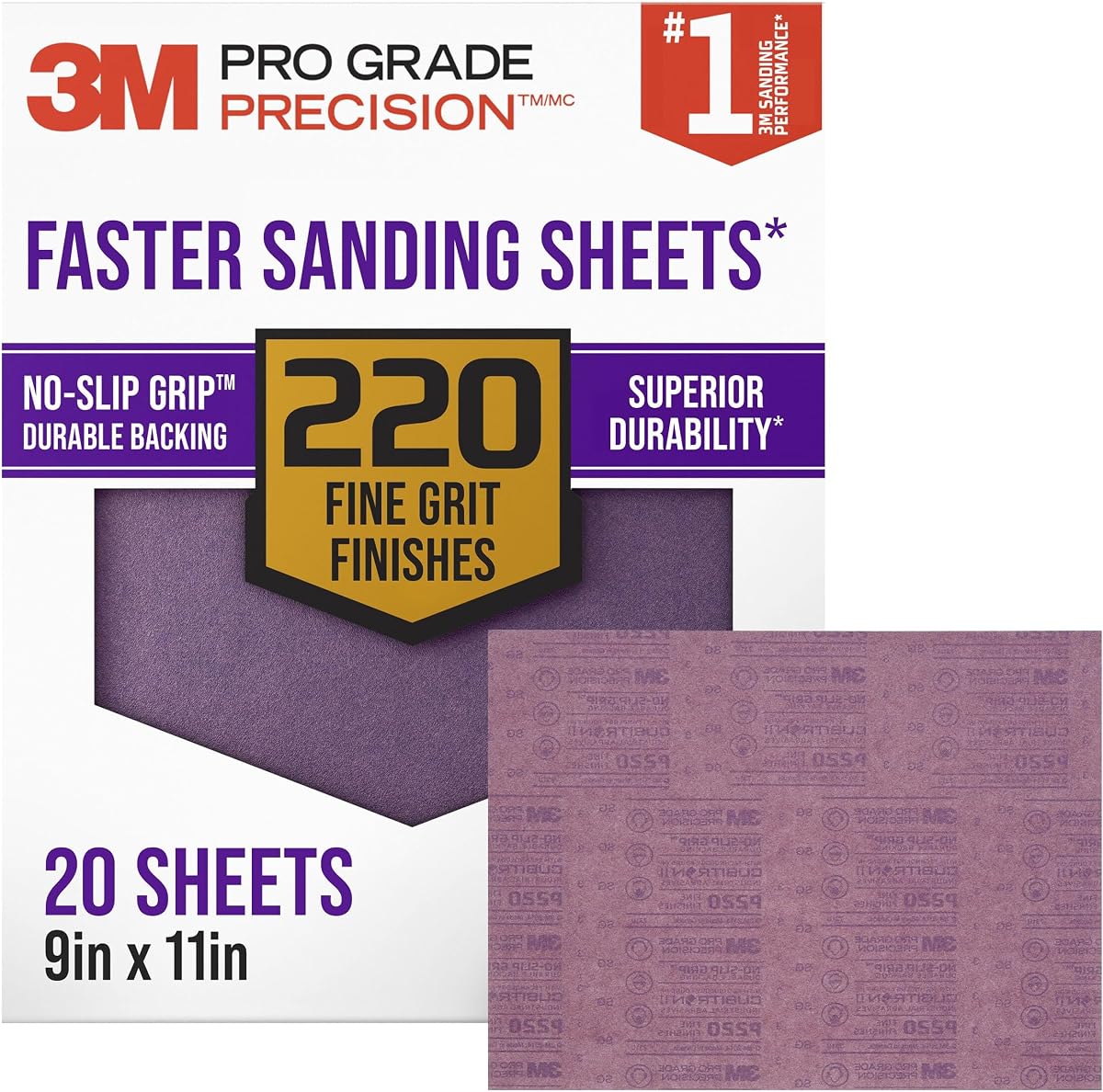
This 220-grit pack earns the highest listed customer rating in the group at 4.8, making it a strong choice for users who already know the exact grit they need. The 20 sheets are a standard 11 by 9 inches, providing more surface area than the compact sheets and sticks for flattening, smoothing, and preparing larger printed parts.
We may earn a commission when you buy through this link, at no additional cost to you.
The abrasive uses premium mineral grits made with technology associated with Cubitron II industrial abrasives. A durable no-slip backing is intended to reduce hand fatigue and tearing, while the conforming sheet follows the shape of the workpiece. It can be used wet or dry, and its color is designed not to discolor the surface being sanded.
Because the pack contains only 220 grit, it does not provide a complete smoothing progression. Users may need to acquire finer or coarser sheets separately, depending on the print and layer height. The 11-by-9-inch format is also less convenient for very narrow recesses, although it can be trimmed into strips or smaller sections for detail work.
This is an excellent single-grit option for 3D-print owners who want reliable, uniform sheets for a defined stage. The 220 grit is useful for reducing visible layer lines after the print has cooled and for leveling modest surface imperfections. It is particularly attractive for larger models and parts where broad coverage matters more than a dedicated compact holder.
Twenty sheets at 11 by 9 inches provide ample material for broad panels and larger models. Users can hold the paper directly, fold it around edges, or cut it to fit a preferred sanding block.
The stated non-discoloring paper color is useful when preserving the appearance of light-colored prints. A conforming, no-slip backing also supports controlled strokes and reduces the likelihood of bunching or tearing.
We may earn a commission when you buy through this link, at no additional cost to you.
The 3M 180-grit sheets are well suited to the early smoothing stage of a 3D-print finishing process. Their 4.7 rating and 20-sheet quantity make them a practical focused option for removing prominent layer lines, knocking down high spots, and establishing a flatter surface before moving to finer abrasives.
We may earn a commission when you buy through this link, at no additional cost to you.
These sheets use premium mineral grit and a durable, no-slip backing designed to limit hand fatigue and tearing. The material conforms to the workpiece, so it can follow curved walls and irregular forms, and it supports either wet or dry use. As with the 220-grit version, the paper color is intended not to discolor the surface being worked.
The single-grit format is the main trade-off. A complete professional workflow generally moves through a sequence, and 180 grit is an early correction grade rather than the final polishing stage. The broad 11-by-9-inch dimensions also make the sheets less ideal for narrow internal details, though trimming a portion produces a practical detail strip.
Buy this pack when a print has significant layer texture and you want a dependable coarse-to-medium correction sheet before progressing to finer grit. It is a good complement to a multi-grit assortment because the full-size format can cover large surfaces quickly. Once the 180-grit stage is complete, move to 220 grit and then progressively finer grades for the finish.
The 180-grit grade is suited to reducing visible ridges and unevenness before the surface becomes more delicate. On prints with prominent layer texture, it provides more purposeful material removal than a fine finishing sheet without the risk of simply polishing the peaks.
At 11 by 9 inches, each sheet covers a broad area and can be cut, folded, or attached to a compatible block. The flexible construction helps it maintain contact with curved or uneven print surfaces during controlled passes.
We may earn a commission when you buy through this link, at no additional cost to you.
The right sandpaper depends on the print material, geometry, layer height, condition, and intended finish. Grit range, abrasive design, sheet flexibility, tool ergonomics, and access to recessed areas should be evaluated together rather than treating grit number as the only deciding feature.
Grit describes the relative coarseness of the abrasive. Lower numbers remove material more aggressively, while higher numbers refine the surface. A 120-grit sheet can knock down prominent layer lines or correct minor dimensional errors, whereas 180 and 220 grit are useful for initial smoothing. Fine grades such as 600, 1000, 2000, and 3000 help reduce visible scratches after coarser work. Multi-grit assortments are convenient because they support a controlled sequence, but single-grit packs make sense when you already know which stage you need. Skipping too many grades can leave deep scratches that are difficult to remove, so a gradual progression generally produces a more consistent result.
Silicon carbide is commonly used for its sharp cutting behavior and suitability for fine finishing, while aluminum oxide is a durable general-purpose abrasive used in the mini detail kit. The supplied product information lists silicon carbide for several sheet sets and aluminum oxide for the 180-piece detail assortment. Abrasive hardness should complement the material rather than encourage excessive pressure. Softer plastics and filled prints can be gouged by heavy-handed sanding, while rigid resin prints tolerate more aggressive correction. Always test in a hidden area and use consistent, light strokes. Wet use can help manage dust in appropriate applications, but moisture may not suit every plastic or coating.
Full-size sheets cover broad panels efficiently and can be trimmed for smaller applications. Compact 9-by-3.6-inch sheets are easy to cut and maneuver, while 11-by-9-inch sheets offer more coverage for larger models. Rectangular sheets can bridge recessed areas, so geometry matters: a narrow strip or shaped piece may contact the actual surface more effectively. Rounded corners can also reduce snagging when working around a printed edge. A sheet that is easy to customize is especially useful in a mixed collection containing flat panels, cylinders, figurines, and enclosures.
A sanding block gives the fingers support, reduces fatigue, and helps distribute pressure. The compact PU foam block is especially useful in corners, while the contoured sponge block provides a larger cushioned grip for general finishing. Loose paper can still work well when folded around a fingertip, cut into a narrow strip, or used with an external holder. For long sessions, a stable grip is often more valuable than a large abrasive area. The best ergonomic option should still fit the task: a broad sponge may feel secure but cannot reach a deep narrow channel as effectively as a slim sanding stick.
Sanding sticks and tapered tools are designed to reach between details, inside recesses, and along narrow edges. The Honoson set provides 20 grits and a double-sided design, allowing a progression without changing tools. The 50-piece matchstick set offers two grit levels in a portable format. These tools complement rather than replace sheet sanding: use sticks for isolated details and sheets or blocks for broad surfaces. Forceful pressure is rarely necessary, and a narrow abrasive should be moved along the feature with support from the surrounding structure to avoid gouging thin walls.
Wet-capable sandpaper can help reduce airborne dust and may be used to smooth water-based fillers or coatings, depending on the product and print material. It can also keep an abrasive from becoming loaded as quickly during certain finishing steps. Dry sanding remains useful for initial stock removal and for many plastic prints. A waterproof or water-resistant backing should not be confused with permission to soak any print. Test a small area, confirm that the plastic is compatible, and allow the part to dry fully before painting, priming, or assembling.
A tear-resistant backing, uniform grit distribution, and resistance to clogging can reduce wasted sheets. Flexible reinforcement is valuable around edges and curved forms, while electrostatic coating can help maintain consistent abrasive coverage. Clearly printed grit numbers on the back speed up selection and reduce the chance of using a coarse sheet by mistake. The Honoson sticks go further by labeling every tool individually, and the mini kit uses color coding for broad grit groups. These details do not guarantee a longer life, but they make the kit easier to organize and use correctly.
A large assortment sounds useful, but the most valuable pieces are the sheets that match your actual workflow. Broad kits offer many grades and ample replacements, while specialized tools concentrate effort on corners and details. A balanced setup can combine one multi-grit sheet assortment, one ergonomic block, and a narrow sanding stick for recesses. This avoids carrying redundant tools while ensuring each part of the print receives an appropriate abrasive. Consider how often you print, the range of materials you use, and whether you usually sand by hand or with powered equipment before deciding how extensive a kit should be.
Start with a clean, fully cooled print and inspect the surface before sanding. Remove loose plastic debris with a soft brush or low-pressure air, but avoid pushing fragments into gaps. If the part has supports, remove them carefully and trim any burrs before abrasion begins. A light first pass with an appropriate grit reveals whether the surface needs shaping, filler, or only cosmetic smoothing. Sand with the part supported on a stable work surface, use even strokes, and keep the abrasive moving to avoid concentrating wear in one spot.
Work through grit levels gradually rather than jumping from a coarse grade directly to a fine one. Use the coarse stage to reduce obvious ridges, then move to progressively finer grits to erase scratches. For curved surfaces, use light, circular or cross-grain motions as appropriate, while checking the shape regularly. Narrow sanding sticks should follow the natural angle of a groove or edge instead of being forced straight into a cavity. When wet sanding is appropriate, wet the area evenly, use a compatible abrasive, and allow the print to dry before continuing.
Keep used sheets organized, dry, and away from edges that could curl or tear. Remove plastic dust from reusable sticks and blocks, and replace a sheet once it becomes smooth, rounded, torn, or clogged. Do not use a sheet that has been contaminated with paint or filler on a different finish unless contamination is acceptable. Store the kit in a dry container away from excessive heat, and check the printed grit labels before each stage so a coarse sheet is not accidentally used for the final polish.
There is no single ideal grit because the correct choice depends on the layer height and desired result. Start around 120 to 220 grit for prominent layer lines, then progress through finer grades such as 320, 600, and 1000. Move gradually to avoid leaving deep scratches that become difficult to remove.
Yes, many general-purpose sandpapers can be used on 3D-printed parts, especially when the sheets are flexible enough to follow the surface. Choose an abrasive and grit appropriate for the material, begin with light pressure, and check a hidden area first. Purpose-built detail tools can make recessed areas easier to reach.
Dry sanding is suitable for most initial layer-line correction and is often simpler for plastic prints. Wet sanding can reduce dust and may help with some fillers or coatings, but the print material and finish must be water compatible. Always test a small area and allow the part to dry completely afterward.
Narrow sanding sticks are often best for deep recesses, small gaps, and fine features because they make direct contact with the surface. A compact finger sander is more comfortable for longer sessions and quick grit changes. For a detailed model, combining a broad sheet or sponge with a narrow stick usually provides the most complete workflow.
Using several levels generally gives the smoothest and most consistent result. Coarse grit removes ridges, intermediate grit corrects the scratches it creates, and fine grit refines the surface. If you jump too far, the final grit may not erase the earlier scratches, so patience during the progression matters.
Sanding can substantially reduce the appearance of layer lines, particularly on smooth, well-tuned prints, but it removes material. Very deep ridges or a poor layer finish may require repeated passes, filler, or another manufacturing method. Preserve important dimensions and thin features by checking the part frequently.
Begin with coarser sanding to clean up the print and establish a sound surface. Then fill minor holes or imperfections, allow the filler to dry, and sand the repaired area with progressively finer grits. A wet-compatible system can be useful for water-based fillers, provided the printed material can tolerate moisture.
Use light, consistent pressure and make sure the part is fully supported. Start with a less aggressive grit than you think you need, clear debris regularly, and avoid forcing narrow tools into tight corners. Inspect the work often, since a single deep scratch can be harder to repair than a slightly uneven surface.
The 48-piece wet-and-dry assortment is the strongest general pick because it combines a wide grit progression, flexible silicon carbide sheets, and enough material for multiple stages. The Honoson sanding sticks take the lead for intricate details, while the 180-piece mini kit offers the most polished workflow with a comfortable block, organized grits, and quick sheet changes.
Prioritize the surface you actually need to finish. Use broad sheets and sponge blocks for panels, cylinders, and larger walls; use tapered sticks for narrow recesses and delicate features; and build a gradual grit sequence for the most uniform result. A mixed toolkit can be more effective than one oversized assortment, because ergonomics and access are just as important as abrasive grit.
Before buying, verify the current listing, sheet dimensions, included accessories, and product details, since availability and pricing can change. Also consider the print material, your planned finish, and whether you need wet-use capability. With the right grit progression and a tool that fits the geometry, sanding can produce a much smoother and more professional-looking 3D print.
