
Hand Rehabilitation Robot Gloves
4.4Editor score
Cordless rechargeable design
Four training options
Nine strength and speed levels
Compare 10 leading robotic rehabilitation gloves for stroke recovery, evaluating training modes, controls, comfort, portability, mirror functions, and overall
Robotic rehabilitation gloves use powered movement to guide the fingers through gripping, stretching, and flexion exercises. They can support repetitive home-based hand therapy for people recovering from stroke, hemiplegia, cerebral palsy, nerve injury, arthritis, or other conditions that limit hand function. The best device is one that feels comfortable, offers adaptable training, and is simple enough to use consistently.
We compared the 10 products in this guide by examining their movement mechanisms, training modes, adjustment controls, mirror-training functions, power systems, glove materials, and suitability for home rehabilitation. The list includes single-glove models, a left-and-right-hand set, plug-in trainers, cordless rechargeable gloves, and devices designed for targeted finger exercise as well as full-hand movement.
Each pick highlights a different balance of features, from the highly rated home-rehabilitation model with four training modes to compact options with three-mode controls and dedicated finger selection. Ratings reflect feedback available in the supplied product data, while specifications and feature descriptions come from manufacturer listings. Product availability and prices can change, so confirm the latest listing details before purchasing.
4.4Editor score

4.8Editor score

3.8Editor score
The comparison below places all 10 robotic rehabilitation gloves side by side, focusing on the training options, motion control, power design, finger selection, mirror-training support, and intended use that distinguish them.


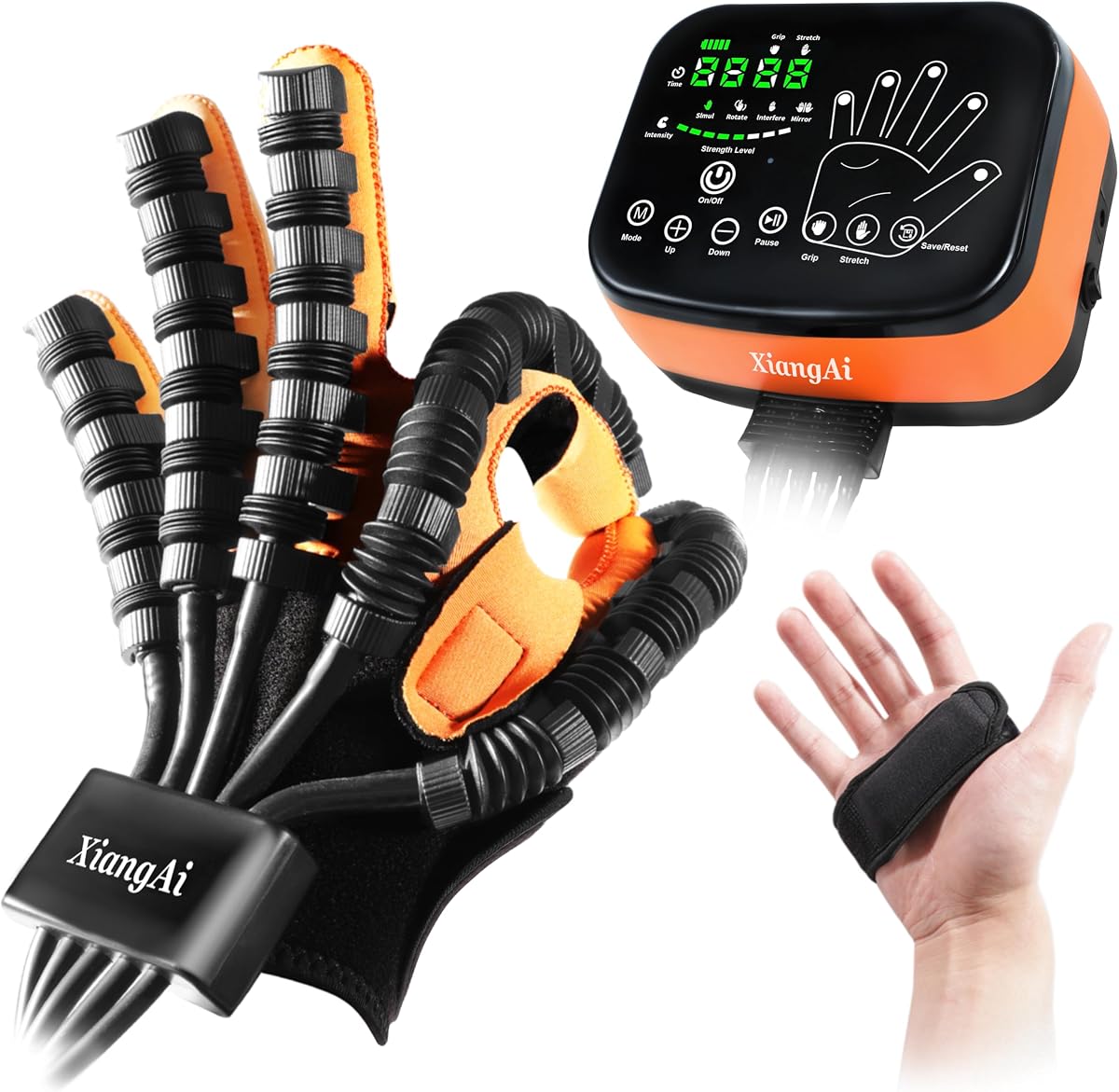


The Rehabilitation Robot Gloves for Home combine a 4.8 rating with a feature set clearly oriented toward convenient, repeatable home rehabilitation. This model supports natural finger movement from 0 to 180 degrees, combines four training modes with adjustable gripping and stretching, and allows the user to select the finger being trained directly from the control panel. Its strongest qualities are flexibility, straightforward operation, and suitability for use while resting in bed.
We may earn a commission when you buy through this link, at no additional cost to you.
The movement repertoire includes five-finger rotation, sequential finger traction, mirror training through a hand strap, and an anti-interference mode intended to provide fuller exercise. Because the glove can be programmed for combined or individual fingers, it adapts to a user's changing needs without requiring a complicated setup. The LED display, saved training mode, and factory-reset function are particularly helpful for people who want repeatable sessions without navigating a complicated menu every day.
One important limitation is that this listing specifies the right hand in medium. Buyers needing a left glove or another size should verify fit before ordering, especially because improper sizing can affect comfort and finger alignment. The supplied information also does not state the battery capacity, so long session planning may require checking the manual or the current product packaging. These drawbacks are modest when weighed against the model’s 4.8 rating and unusually broad training options.
This is our top overall choice for users who value a high rating, direct finger control, and a device designed for the realities of home recovery. It is also a strong option for caregivers supporting a patient who may be bedridden or spending much of the day at home. Anyone choosing a glove should still coordinate its use with a qualified healthcare professional and begin with gentle settings appropriate to the patient’s condition.
Four modes, five-finger rotation, and sequential traction allow the training pattern to change without replacing the device. Direct panel selection is a practical advantage when a clinician wants to concentrate on a particular finger or progressively add more movement to a session.
The glove is designed for rehabilitation at home, including while lying in bed, reducing the need to rearrange daily routines around travel to a clinic. Its saved-mode and factory-reset functions also make repeated sessions more predictable for caregivers and users.
We may earn a commission when you buy through this link, at no additional cost to you.
This XiangAi Rehabilitation Robotic Glove has a 4.1 rating and stands out for its unusually detailed control system. It guides the fingers through movement from 0 to 180 degrees and offers four clearly defined rehabilitation modes, nine grip-and-stretch duration settings, and eight speed levels. Rather than offering only a basic open-and-close exercise, it allows users and caregivers to tune the rhythm and pattern of movement.
We may earn a commission when you buy through this link, at no additional cost to you.
Its four modes cover simultaneous gripping and stretching, alternating finger rotation, thumb interference with the other fingers, and remote-controlled mirror training. The glove uses an 11.1V, 2600mAh rechargeable battery, while the full-screen LED panel displays battery status, remaining exercise time, and the selected mode. A wide hook-and-loop cuff and two additional straps help keep the glove from slipping during repetitive movement.
The supplied listing does not identify a specific hand orientation or size, so fit must be confirmed. It also shares most of its written features and rating with the second product in this roundup, which can make the two listings difficult to distinguish. Nevertheless, the three-year warranty, multiple certifications, and broad adjustment ranges give this model a well-supported feature profile.
This glove is best for users who want detailed control over speed, duration, and movement type in a rechargeable home device. It may be particularly attractive when mirror training with a healthy hand is part of the rehabilitation plan. Confirm hand compatibility, charging details, and the included accessories with the seller before buying.
Nine duration settings and eight speed levels make it possible to vary the pace of assisted movement. This is useful when a user needs shorter, gentler repetitions or when a care plan calls for a more active session as tolerance improves.
The inner medical-grade nylon and spandex blend is intended to reduce irritation, while the polyester outer layer adds durability and grip. Wide finger sleeves, a broad cuff, and two securing straps create a more stable fit during repeated exercise.
We may earn a commission when you buy through this link, at no additional cost to you.
The Upgraded 6th Generation Rehabilitation Robot Gloves have a 4.2 rating and emphasize flexible training functions. The device offers five-finger rotation, sequential traction training, mirror-hand support, and an anti-interference mode. Its direct finger-selection panel removes the need to operate a rotary valve, which can make targeted exercises more intuitive and reduce setup time before each session.
We may earn a commission when you buy through this link, at no additional cost to you.
The manufacturer describes an upgrade to the main power accessories, an upgraded rechargeable battery, and an expected service life of up to five years. An intuitive LED display allows settings to be adjusted, while the ability to save the last training mode and restore factory settings supports consistent use. The glove is also presented as practical for home or bedridden rehabilitation, where a patient may need convenient access to therapy without frequent clinic visits.
The product information is extensive but awkwardly formatted, and it describes both a three-year quality assurance period and an expected service life of up to five years. Those are different assurances, so buyers should read the warranty terms carefully rather than treating them as interchangeable. The listing also lacks a clearly stated hand orientation, which is an important point to verify before ordering.
This model is a compelling option for people who want several training styles in one device and appreciate a panel-based approach to finger selection. It is particularly relevant to users who may work on sequential movement as part of their rehabilitation plan. As with any powered exercise aid, it should be introduced gradually and used according to the instructions of a qualified clinician.
Selecting fingers from the control panel avoids the mechanical selection process associated with rotary-valve models. This can simplify daily setup and make it easier to alternate between individual-finger work and multi-finger routines.
Saving the most recent training mode helps users resume a familiar routine, while the factory-reset option provides a clean starting point when settings need to be reconfigured. These quality-of-life features are useful for caregivers managing regular sessions.
We may earn a commission when you buy through this link, at no additional cost to you.
The 2PCS Rehabilitation Robot Gloves are the most comprehensive package in the roundup, supplying separate gloves for left and right hands along with two hosts, mirror hand straps, training balls, gift boxes, manuals, host charging cables, and USB cables for the straps. With a 3.8 rating, this is not the highest-rated model, but it offers the clearest solution for users who want bilateral training or need equipment for both hands.
We may earn a commission when you buy through this link, at no additional cost to you.
Each glove supports the same four-mode system: simultaneous movement, rotation, thumb interference, and remote-controlled mirror training. Grip and stretch duration has nine settings, and speed has eight levels. Separate 11.1V, 2600mAh hosts give the two sides independent control, which is useful when one hand is more affected than the other or when the user wants to alternate exercise rather than move both hands identically.
The lower rating means buyers should examine customer feedback carefully for fit, noise, and reliability concerns. The package also takes up more room and duplicates components that a single-hand user may never need. Finally, the two gloves share a listed size context rather than offering an explicit range, so checking both hand dimensions is important. The accessories create value for bilateral users but do not make the set necessary for every patient.
This is our premium pick for households that need dedicated left- and right-hand equipment, particularly when mirror practice and independently controlled sessions are desired. It may suit a user recovering from stroke who benefits from alternating active and affected-hand training. Confirm hand sizing, battery charging, and the intended role of each included component before purchasing.
Separate hosts allow each glove to be configured independently, which is helpful when the affected and unaffected hands require different movement patterns. The system also provides dedicated mirror straps for guided bilateral practice.
Two hosts, charging cables, mirror straps, training balls, manuals, and portable boxes create a more complete setup than a single-glove listing. It reduces the need to source matching accessories separately when planning two-sided home therapy.
We may earn a commission when you buy through this link, at no additional cost to you.
This Rehabilitation Robot Gloves for Home listing carries the highest supplied rating in the group at 4.8. It is designed for home-based hand rehabilitation and offers four training modes, adjustable grip and stretch timing, five-finger rotation, sequential traction, mirror training, and anti-interference exercise. The result is a flexible device intended to support different stages of recovery rather than a single repetitive movement.
We may earn a commission when you buy through this link, at no additional cost to you.
One of its most useful design details is the removal of the rotary valve used to choose fingers. Instead, users select the desired finger through an intuitive panel, making individual and combined exercise easier to arrange. A mirror strap supports synchronized bilateral work, and the LED display provides visible feedback. The device also includes mode memory and factory-reset functionality, which helps keep home routines consistent.
The listing specifies a right-hand, medium configuration, so it is not a universal fit. Users with a different hand or size need to check the seller’s sizing information before buying. The supplied details do not state the battery specification, and any claims about longer battery life are comparative rather than quantified. Those limitations matter less for buyers who plan shorter daily sessions, but longer routines may warrant closer investigation.
This is the best-rated model we found and an excellent choice for users who want a versatile, home-oriented glove with direct finger controls. It is also suitable for caregivers supporting someone who spends significant time in bed. Users should still begin with conservative settings, check fit before each session, and follow professional guidance on frequency and intensity.
The 4.8 rating is the strongest in the roundup, while four modes and direct finger selection provide meaningful control over daily routines. Together, these features make the glove appealing for users who want variety without a complicated control process.
Mode memory allows a user to return to a familiar setup, and the factory-reset function helps recover from accidental configuration changes. These details support repeatable use, especially when a caregiver sets up each session.
We may earn a commission when you buy through this link, at no additional cost to you.
The JBMBHC Rechargeable Robot Gloves offer a 4.2 rating and the broadest numeric adjustment range among the reviewed models. They provide 15 flexion and extension speeds and 15 support levels, along with timed sessions intended to help minimize discomfort. This granular control is the defining feature of the product and gives users more room to scale a routine as tolerance changes.
We may earn a commission when you buy through this link, at no additional cost to you.
The glove supports individual and combined finger movements as well as sequential training through all five fingers. Its upgraded mirror function is designed to simplify guided practice with the unaffected hand, while the HD display provides access to the multifunction menu. A revised power pump is described as three times more powerful, and the glove is made from lightweight, soft materials for extended wear.
The listed configuration is right hand, medium, which limits immediate suitability for other users. The description also does not state a specific warranty period, despite discussing manufacturer support and product upgrades. Because a 4.2 rating does not tell us which feature concerns affected individual buyers, reviewing recent customer comments remains important. The many settings may also feel excessive to someone who only wants a basic open-and-close routine.
This model is a strong choice for users who want fine-grained control over speed, support, and session duration. It may be particularly useful during progressive rehabilitation when movement requirements change over time. Confirm sizing, charging method, and comfort before purchasing, and have a therapist help establish an appropriate starting level.
Fifteen speed levels and 15 support levels create a wide adjustment spectrum. A user can begin with a gentler setting and refine the routine later, provided the changes are made gradually and align with professional guidance.
The ability to cycle through the five fingers adds another movement pattern, while the upgraded mirror function makes the unaffected hand easier to use as a guide. These functions make the glove relevant to bilateral and task-oriented rehabilitation.
We may earn a commission when you buy through this link, at no additional cost to you.
The Finger Training Rehabilitation Gloves have a 4.6 rating and focus on a compact, straightforward approach to hand exercise. They support stroke, hemiplegia, arthritis, and cerebral palsy rehabilitation, with a mirror function that simulates movement from the healthy hand to help retrain coordination. The supplied description suggests daily training sessions of 15 to 20 minutes as a starting routine, though individual needs should guide actual use.
We may earn a commission when you buy through this link, at no additional cost to you.
A valve on the glove controls whether one finger or multiple fingers operate. This makes it possible to concentrate on designated digits rather than moving the entire hand every time. The device uses a plug-in design that the manufacturer describes as three times more powerful and more stable than earlier approaches. Its compact format also makes it easier to store and move between rooms than a multi-component system.
A wired power requirement is the principal trade-off. Users without convenient access to an outlet may find the setup less flexible than a rechargeable glove, and a charging lead introduces another item to manage. The valve-based control may also be less intuitive than direct panel selection. Finally, the abbreviated product title does not clearly state hand orientation or size, so compatibility must be verified before purchase.
This is a good pick for someone who values a compact format, high rating, and targeted finger exercise over cordless convenience. The mirror function adds value for stroke recovery, while the plug-in system may appeal to users who prefer stable continuous power. Verify the included components, fit, and operating instructions before beginning a routine.
The valve can switch the glove between single-finger and multi-finger operation. This lets a user isolate a digit for focused practice or open the exercise to more of the hand when appropriate.
The small format and plug-in operation make the trainer relatively portable around the home. Stable continuous power may also appeal to users who prefer not to monitor a rechargeable battery between sessions.
We may earn a commission when you buy through this link, at no additional cost to you.
The Cordless Hand Rehabilitation Gloves have a 4.4 rating and center on a gear-driven, rechargeable design. They can withstand a stated load of 240 grams, provide stronger traction than lighter pneumatic systems, and automatically switch between fingers for training. Four modes—grasping, finger extension, single-finger movement, and full-hand movement—cover common rehabilitation patterns.
We may earn a commission when you buy through this link, at no additional cost to you.
A 2600mAh battery and fully wireless configuration allow training away from a wall outlet, which is useful for home users who move between rooms or want to practice while positioned comfortably. Nine adjustable force and speed levels provide a useful degree of control. Mirror training lets one hand guide the other, while clearly labeled onboard buttons simplify operation for older users and first-time users.
The listing does not state the glove’s hand orientation or size, making fit confirmation essential. It also does not clearly establish whether a USB charging cable is included. As with all powered rehabilitation tools, the stated gear capacity and traction are manufacturer specifications rather than independent test results. Users should also avoid interpreting a cordless design as permission to train without supervision if a care plan calls for assistance.
This is our best budget pick because it combines a cordless rechargeable format with the broadest mode-and-level selection in the roundup. It is a strong option for people who want portable equipment, uncomplicated controls, and both targeted and full-hand exercise. Verify the size, charging accessories, and fit before committing to a routine.
The rechargeable 2600mAh battery allows the glove to operate without a cable during training. Users can position themselves in a comfortable chair or bed and move the device when their routine changes.
The gear-driven mechanism is advertised as handling 240 grams of gravity and producing stronger traction. This may help the glove guide finger extension consistently, although the user should still begin with lower settings and proper alignment.
We may earn a commission when you buy through this link, at no additional cost to you.
The Upgraded C10 Rehabilitation Robot Gloves have a 3.9 rating and distinguish themselves through a pneumatic movement system designed to produce soft, controlled flexion and extension. The glove is rechargeable, portable, and designed so the fingers fit closely to the mechanism, which is intended to improve alignment and make training easier to perform.
We may earn a commission when you buy through this link, at no additional cost to you.
A sensor on the back of the glove supports mirror training by detecting movement signals from the fingers. This is intended to help users with substantial muscle tension train the affected hand using motion from the unaffected hand. Independent air valves allow each finger to be trained separately, and nine intensity levels can be adjusted during a session. Flexion and extension timing can also vary according to the user’s muscle tension.
The pneumatic valves have a specific operating direction: turning the white knob horizontal closes the relevant air inlet, while a vertical position opens it. That directional system may require practice compared with panel-based selection. The 3.9 rating is also the second-lowest in the group, so buyers should review current customer feedback and confirm comfort, hand size, and noise tolerance. The supplied data does not specify a warranty period.
This model is best for users who value precise individual-finger selection, sensor-assisted mirror practice, and softly controlled pneumatic movement. It may suit a rehabilitation plan that emphasizes gradual intensity changes and adaptable timing. Because pneumatic products can feel different from geared models, test the fit carefully and increase settings only with professional input.
The pneumatic system uses soft power output to drive controlled flexion and extension. A closer glove-to-finger fit can help maintain alignment while reducing the effort required to keep each digit positioned.
The back-of-glove sensor is designed to capture finger movement signals and support training of an affected hand through an unaffected hand. It is especially relevant to users with high muscle tension who may benefit from externally guided movement.
We may earn a commission when you buy through this link, at no additional cost to you.
The Three-Mode Rehabilitation Robot Gloves have a 4.3 rating and offer a more compact approach to assisted hand exercise. The device imitates grasping and stretching movements, uses an ergonomic glove design, and is intended to support finger exercise for stroke patients experiencing stiffness or spasms. Its control screen and tactile buttons allow straightforward activation, including for older users who may prefer physical controls.
We may earn a commission when you buy through this link, at no additional cost to you.
Strength adjustment provides a way to tailor the movement, while independent air-valve switches make targeted practice possible. The air inlet for each finger is closed or opened by rotating the corresponding switch to a tilted position, allowing a user to select which digits move. A built-in smart chip is described as supporting gentle training, and the small, light construction makes the device easy to carry between locations.
With three modes, it offers less movement variety than many competing models that provide four modes, sequential patterns, or numerous speed levels. The listing also does not provide a battery capacity, hand orientation, or exact size, so buyers need to confirm those details. The generic 4.3 rating suggests general satisfaction, but it does not establish performance for every hand shape or clinical condition.
This is a good choice for users who prioritize a compact device, easy activation, and independent finger control over an extensive menu. It may suit a straightforward home routine that centers on gripping, stretching, and selected digit movement. Check the fit carefully, confirm how the valves operate, and begin with the lowest suitable strength.
The control screen presents operating information clearly, while tactile adjustment buttons allow one-touch activation. This design is helpful for older adults and users who want to begin a session without navigating a complex menu.
Independent valves let the user include or exclude individual fingers, while adjustable strength supports a progressive routine. Its compact size makes it easier to move, store, and use in different parts of the home.
We may earn a commission when you buy through this link, at no additional cost to you.
The right robotic rehabilitation glove depends on hand size, preferred movement pattern, power access, supervision needs, and the tolerance of assisted exercise. Use the following factors to compare models before making a purchase.
A rehabilitation glove must align with the user’s fingers without compressing joints or restricting natural movement. Some listings specify a particular hand and size, while others leave orientation unclear. Check the seller’s sizing diagram, measure the affected hand, and compare the finger sleeve lengths, palm width, and cuff circumference before ordering. A close fit is especially important for pneumatic and geared systems because alignment affects traction, comfort, and the quality of assisted movement.
In short, confirm hand, size, and finger alignment before buying.
A useful glove should offer more than a single automatic open-and-close cycle. Simultaneous movement, individual-finger exercise, alternating movement, sequential training, and mirror practice can support different rehabilitation goals. The number of modes is not the only consideration, however. Clear labeling, easy finger selection, and the ability to save a routine may matter more in daily use than having the longest feature list.
Prioritize clear, varied modes that match the patient’s therapy plan.
Assisted movement should be progressively adjustable, but the appropriate level depends on muscle tone, joint stability, pain, and medical guidance. The strongest models offer separate force, support, speed, duration, and timing controls. More levels can make gradual progression easier, although a simple display with a few safe settings may be more practical for a user who cannot manage a complicated interface.
Choose enough adjustment range for gradual progression without unnecessary complexity.
Rechargeable gloves provide freedom from power cords, making them convenient for bedside or room-to-room use. Plug-in trainers can be stable and suitable for fixed locations, while compact designs are easier to transport. Consider battery charging frequency, the availability of a suitable outlet, cable storage, and whether the device must remain connected during a session. Check whether charging cables and adapters are included.
Match the power system to your space, mobility, and charging routine.
Mirror training uses movement of the unaffected hand to guide the affected hand through a similar pattern. It can be useful in stroke recovery because the user receives a natural visual and motor reference rather than relying only on mechanical movement. Some models include mirror straps and sensors, while others use a wireless connection or a dedicated control. Verify whether a strap, matching glove, or remote control is required.
Check the included accessories before choosing a mirror-training function.
Long rehabilitation sessions are more likely to be completed when the glove feels comfortable and remains in position. Look for soft inner layers, flexible finger sleeves, breathable or nonirritating fabrics, and a cuff that does not dig into the wrist. Extra straps can improve stability, but they should not restrict circulation. Wide openings are useful for people with limited hand dexterity or sensitive skin.
Prioritize a soft interior, secure cuff, and sleeves that do not pinch.
A clear LED display, large buttons, and an intuitive control panel are important when the device will be used without a caregiver present. Direct finger selection can reduce setup time, while mode memory lets users return to a familiar routine. The best interface is not necessarily the one with the most options; it is the one a patient can understand and reliably start with minimal assistance.
Choose controls that the intended user can identify and operate confidently.
A warranty can provide protection against manufacturing defects, while a stated expected service life helps indicate the manufacturer’s design target. These are separate points and should not be treated as the same promise. Look for relevant safety certifications and confirm what the warranty covers, how service is accessed, and whether shipping or consumable parts are included. The supplied listings mention three-year warranties on several models and certifications on others.
Review warranty coverage and safety credentials before making a final choice.
Begin by reading the included instructions, checking the hand orientation, and trying the glove on without activating the mechanism. Confirm that every finger sits in the correct sleeve and that the cuff or straps feel secure without being too tight. If a glove is used for mirror training, fit the guide or strap to the unaffected hand before starting the powered movement.
Start with the lowest suitable intensity, speed, and duration, then increase one setting at a time. Keep the supported hand supported, maintain a relaxed wrist, and stop if pain, numbness, marked swelling, or unusual resistance occurs. A qualified therapist should advise on frequency, duration, and whether assisted movement is appropriate for the user’s particular condition. Do not use the device on an open wound, recently injured joint, or visibly inflamed area unless the manufacturer and treating professional specifically approve it.
After each session, switch off the device, disconnect the power if required, and gently remove the glove without pulling on the finger sleeves. Wipe the fabric with a slightly damp cloth according to the manufacturer’s care guidance, and allow the glove and any valve or control housing to dry completely before storage. Do not immerse the electronics, use harsh cleaning chemicals, or wash removable covers unless the instructions expressly permit laundering. Store the device in a dry place with the fingers relaxed and the charging equipment untangled.
They can support repetitive, assisted hand exercise at home, particularly after a healthcare professional has established an appropriate rehabilitation plan. They are designed to guide grasping, stretching, flexion, and extension when voluntary control is limited. Home use does not replace professional assessment, and users should begin gently, stop if symptoms worsen, and follow the device instructions.
Automatic glove movement uses the device’s motor and programmed pattern to guide the fingers independently. Mirror training uses movement of the unaffected hand to guide or influence movement on the affected side, often through a sensor, strap, or paired system. Some gloves support both, allowing a user to compare guided and device-driven exercise.
Rechargeable models offer more freedom because the glove can operate without a nearby outlet, which is useful for bedside use or changing locations. Plug-in models may be simpler for a fixed home setup and can provide stable continuous power. Consider charging frequency, cable management, and whether the required power accessories are included.
Single-finger modes are useful when a rehabilitation plan calls for focused practice or when one digit has different mobility and muscle tone. Full-hand modes provide symmetrical movement for general range-of-motion work. A glove that supports both is often more versatile, allowing the user to alternate the pattern as needs change.
The listed products are commonly marketed for people with arthritis, cerebral palsy, hemiplegia, nerve injury, and other hand-function limitations. Suitability depends on individual joint condition, muscle tone, pain, and the guidance of a clinician. A user should not assume that every condition is treated identically by the same movement pattern.
Stop the session and check whether each finger is centered in its sleeve, whether the cuff is too tight, and whether the glove has shifted during movement. Persistent pain, numbness, discoloration, or swelling should be assessed by a healthcare professional. Do not continue exercising through discomfort merely to complete a timer.
The appropriate frequency depends on the user’s condition, tolerance, fatigue, and the recommendations of their therapist or doctor. The gloves are designed to make repeated practice more convenient, but more frequent is not automatically better. Start with a gentle, short session and follow a schedule created or approved by a qualified professional.
Requirements vary by model. Some listings include mirror hand straps, training balls, sensors, or a second glove and host, while others may require a separate mirror accessory or paired control. Review the package contents and setup instructions before purchasing so the advertised mirror function can be used as intended.
The Rehabilitation Robot Gloves for Home lead the guide with a 4.8 rating, four training modes, direct finger selection, and a home-focused design. The Cordless Hand Rehabilitation Gloves stand out for portable rechargeable operation, geared traction, and four modes with nine adjustment levels. For users who need equipment for both hands, the 2PCS Rehabilitation Robot Gloves provide separate hosts, mirror straps, and a complete two-sided accessory package.
The most important priorities are fit, safe movement, and the training patterns that match the user’s clinical goals. A glove with more modes is not automatically better if its controls are confusing or its sizing is unsuitable. Compare finger selection, mirror-training support, adjustment range, power design, and included accessories while keeping the intended user’s dexterity and caregiver involvement in mind.
Ratings, product availability, and prices can change, so check the current listing and manufacturer instructions before ordering. Confirm the included components, charging method, warranty coverage, hand orientation, and size first. Most importantly, use robotic rehabilitation gloves as part of a professionally guided recovery plan rather than as a substitute for individualized medical advice.