
CPR V5000 Call Blocker for Landline Phones
4.2Editor score
5,000 preloaded nuisance numbers
Stores 1,500 additional numbers
Large tactile blocking button
No app or power supply
Requires analog Caller ID service
Robocall blocker for landlines can be tricky, so this expert guide compares ten models for blocking power, setup, compatibility, storage, and everyday ease of
A robocall blocker for landlines can transform a noisy home phone into a calmer, more private line. The best devices combine preloaded nuisance-number lists, one-touch rejection controls, flexible blocking rules, and straightforward installation. Because telephone systems vary widely, compatibility with your carrier, Caller ID service, and existing equipment matters as much as the advertised blocking capacity.
This guide compares ten landline call blockers according to their supplied specifications, ratings, blocking methods, list capacities, setup requirements, and service compatibility. It covers traditional analog devices, network-assisted systems, dual-mode blockers, and a two-line installation for homes and small offices. The goal is to identify the most practical option for each type of household or caller-control need.
Each review explains what the product does well, where its limitations matter, and who is most likely to benefit from it. Ratings and product details reflect the supplied information, while features are considered alongside compatibility, storage, and day-to-day usability. Product availability, promotions, and pricing can change, so readers should confirm the current listing and telephone requirements before purchasing.
4.2Editor score

3.5Editor score
4.1Editor score
The comparison below organizes the ten options by blocking method, preloaded coverage, custom storage, and installation requirements, making it easier to identify a model that fits your landline and calling habits.


The CPR V100K is a traditional analog landline call blocker built around a large preloaded database of known nuisance numbers. Its supplied rating is 3.5, and its defining strength is scale: the product is advertised with 100,000 preloaded numbers plus space for 10,000 additional entries. It also provides a large display, a tactile red BLOCK NOW button, and support that continues beyond the included three-year warranty.
We may earn a commission when you buy through this link, at no additional cost to you.
Its first major benefit is immediate database-based filtering. Calls from numbers already identified as nuisance sources are blocked automatically, which can be useful for callers who repeatedly receive unwanted solicitations without wanting to handle every interruption manually. When a scammer uses a new or spoofed number, the physical button provides a quick way to add that number to the personal block list without navigating through a phone menu or app.
The device is intentionally uncomplicated. It connects to a compatible traditional analog landline, requires no app, Wi-Fi connection, monthly subscription, or external power supply, and uses a large button and display intended to make the system approachable. That makes it particularly relevant to older users or anyone who prefers a self-contained unit with visible controls rather than a cloud-managed service.
The trade-off is compatibility. Active Caller ID service is mandatory, and the V100K is not designed for many internet-based or digital VoIP telephone services. Its huge preloaded list also does not guarantee that every unwanted call will be stopped, since fraudulent callers frequently change or spoof their numbers. For a household with a compatible analog line, however, it is the most compelling option here for broad automatic coverage combined with simple one-touch control.
The preloaded database handles recognized nuisance numbers, while the BLOCK NOW button creates a personal record of numbers that get through. Together, the two approaches provide both immediate filtering and a practical response to newly spoofed callers.
The large display and tactile button reduce the learning curve. With no app, account, Wi-Fi setup, or monthly subscription, users can concentrate on answering familiar calls and rejecting unfamiliar ones.
We may earn a commission when you buy through this link, at no additional cost to you.
The CPR V5000 combines a 5,000-number preloaded nuisance database with a prominent BLOCK NOW button, giving users a simple defense against recurring unwanted calls. Its supplied rating of 4.2 is the highest among the rated products in this guide. It is designed for traditional analog landlines with Caller ID, yet it needs no separate power supply, app, or subscription.
We may earn a commission when you buy through this link, at no additional cost to you.
The core workflow is easy to understand. Known nuisance numbers are filtered from the beginning, while a call from an unfamiliar or newly spoofed number can be rejected with the large red button. The unit can hold 1,500 additional numbers, providing enough room to build a personal blacklist over time. A clear screen and audible button click also help users understand when a command has registered.
The V5000 is specifically framed for users who may not want a complicated setup. It supports traditional analog services associated with providers such as AT&T, Verizon, Frontier Communications, CenturyLink, and Brightspeed. Internet-based and digital VoIP services, including Vonage, Ooma, Xfinity Voice, and Quantum Fiber, are not supported.
That restriction prevents it from being a universal solution, and no physical blocker can guarantee that every fraudulent call will be intercepted. Even so, its 4.2 rating, preloaded coverage, generous personal capacity for its category, and exceptionally simple controls make it an attractive choice for compatible analog households seeking a balanced and uncomplicated blocker.
The oversized BLOCK NOW button turns a nuisance number into a stored exclusion with one press. The click provides physical confirmation, which is useful when the goal is to answer only legitimate calls without navigating complicated settings.
The V5000 operates directly through the telephone line without an app, Wi-Fi connection, or external power supply. That keeps setup limited to verifying that the line is analog and has Caller ID.
We may earn a commission when you buy through this link, at no additional cost to you.
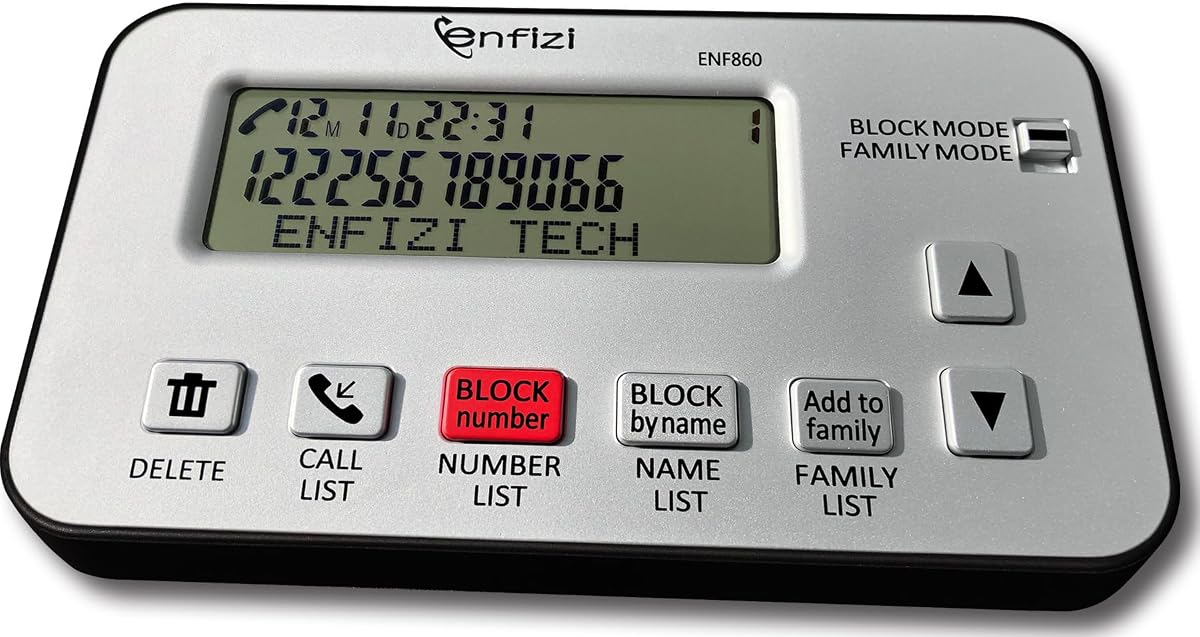
The Enf860 is the most flexible traditional device in the guide, with separate BLOCK and FAMILY modes that can be changed as circumstances change. Its supplied rating is 4.1. In BLOCK mode, it can reject calls by number and name, while FAMILY mode allows only numbers placed on a designated list to ring through. Switching modes does not erase the stored data.
We may earn a commission when you buy through this link, at no additional cost to you.
Its personal database is substantial, holding more than 4,000 numbers and up to 256 names. It can also filter international, private or withheld, and out-of-area numbers by default. More advanced rules can target an entire area code or numbers beginning with selected prefixes, giving users several ways to address common source patterns without adding each individual number.
The no-power, analog design keeps installation simple, but Caller ID remains essential. The manufacturer also makes clear that a database cannot catch every new variant number. In BLOCK mode, some unfamiliar numbers may still ring, making manual additions or a deliberate switch to FAMILY mode necessary for stricter control.
This model is best suited to someone who wants more than a simple database and physical reject button. It offers a meaningful choice between a broad filtering approach and a strict allowlist approach. The tradeoff is complexity: FAMILY mode can prevent legitimate calls if the list is not maintained carefully, and the product remains limited to analog telephone lines.
BLOCK mode permits a database-led approach to nuisance calls, while FAMILY mode acts as a strict allowlist. That makes the Enf860 useful for households that want ordinary filtering at times and near-total call privacy at other times.
The ability to store names alongside numbers helps when a caller presents a recurring identity without a stable number. Prefix and area-code rules add another layer for patterns that would otherwise require extensive manual entry.
We may earn a commission when you buy through this link, at no additional cost to you.
The 4000-Number Call Blocker focuses on user-controlled filtering rather than a large advertised nuisance database. Its supplied rating is 4.0, and it can store up to 4,000 individual numbers, along with prefixes and area codes. The device displays Caller ID information, supports one-touch blocking, and retains the blacklist even when power is removed or the telephone line is unplugged.
We may earn a commission when you buy through this link, at no additional cost to you.
The defining benefit is permanence. Users can build a custom blacklist over time without worrying that a power interruption will erase their settings. Because it is line-powered, it needs no batteries, and it is described as compatible with almost all single-line telephones. It also offers flexible installation, with series connection presented as the better arrangement for some systems.
This flexibility is also its main complication. Parallel installation may not work with every phone system, so users should follow the guidance for their own equipment. Entries that block an area code or prefix can affect more calls than intended, making it important to check and delete unwanted blacklist items when legitimate calls fail to connect.
For people who prefer to curate their own list, this is a practical device. It does not promise the largest preloaded database, but it combines substantial storage, Caller ID visibility, one-touch rejection, and persistent settings without a recurring service. It is particularly well suited to users who receive the same unwanted callers repeatedly and want permanent control over each number and pattern.
Permanent storage means the caller's custom rules remain available even if the line is disconnected or power is interrupted. This makes the device dependable for a household that steadily adds recurring nuisance numbers.
Area codes and prefixes can be blocked alongside individual numbers. These broader rules reduce repetitive entry, although they also require careful review to avoid rejecting legitimate callers.
We may earn a commission when you buy through this link, at no additional cost to you.
The Ultimate Call Blocker WiFi is a network-assisted alternative to traditional database blockers. Its supplied rating is 3.1, but it offers an unusually broad set of filtering tools: a cloud-maintained global blacklist of more than 450,000 linked numbers, unlimited personal entries, name blocking, and an optional whitelist mode. The product is designed to work with a wide range of US service providers.
We may earn a commission when you buy through this link, at no additional cost to you.
Unlike a basic one-touch unit, this model sends calls to a web-based interface where users can review recent calls, manage blocked and allowed numbers, and create rules based on numbers, names, area codes, or prefixes. The global list is maintained by HQTelecom and is included for 12 months following purchase. One connected device can protect all extensions associated with a particular line or number.
Compatibility is one of its strongest selling points. The supplied information lists traditional PSTN, POTS, cable or coax, and VoIP services, along with the need for active Caller ID. The Wi-Fi and web-management design also permits remote list changes from a computer, tablet, or smartphone.
Its main drawback is the lower supplied rating and the dependence on activation and ongoing service for the advertised global-list period. The 12-month inclusion should be checked carefully when purchasing. Even with those considerations, this is the best option here for users who prioritize comprehensive carrier compatibility, unlimited personal storage, and remote list management over a fully self-contained appliance.
The web interface gives users access to blocked, allowed, and recent numbers without returning to the device. This is convenient when a new nuisance caller appears or a legitimate contact needs to be restored.
When enabled, whitelist mode blocks every caller except those specifically stored as allowed. It offers a stringent approach for people who would rather receive very few calls than manage each nuisance number individually.
We may earn a commission when you buy through this link, at no additional cost to you.
The Enf510 is a straightforward analog call blocker with a 4,000-plus preloaded list and capacity for more than 3,000 custom numbers. Its supplied rating is 3.8. It can be operated with the physical BLOCK button or by pressing the hash key followed by six on the connected phone, giving it more than one way to reject a caller.
We may earn a commission when you buy through this link, at no additional cost to you.
Users can block individual numbers, entire area codes, or numbers beginning with specified prefixes. International, private or withheld, VoIP, and out-of-area calls can also be filtered. A family list provides exceptions for trusted numbers, while the device displays the caller's number rather than the caller's name.
The product does not have a strict FAMILY mode comparable with the Enf860. Instead, it is described as block mode only for calls outside the family list, and users must manually add new variant numbers when they bypass the preloaded database. This makes it less convenient for someone who wants a true allowlist-only operating mode.
Compatibility is the main concern. Caller ID is required, and the Enf510 supports analog phones but not digital or internet phones. For a household with a traditional line, the combination of preloaded coverage, custom capacity, broad prefix controls, and phone-based operation makes it a versatile and understandable option, particularly for users who may not want to interact with a small device display.
The physical button provides a direct response when a call is active, while the phone keypad sequence offers an alternative for users who prefer to operate the system from their handset. Both routes support quick rejection of unwanted numbers.
The family list lets trusted contacts remain reachable even when broad nuisance filtering is active. This makes the Enf510 practical for homes where several people answer the same landline.
We may earn a commission when you buy through this link, at no additional cost to you.
The TB208 takes a different approach from database-first blockers by combining robocall verification with a whitelist system for real callers. It supports two incoming lines, eight extension jacks, up to 500 groups of whitelisted numbers, and 1,000 groups of blocked numbers, area codes, or prefixes. The supplied rating is listed as N/A.
We may earn a commission when you buy through this link, at no additional cost to you.
When a caller is not on the whitelist, the device can automatically answer and play a request for a verification code. Robocall systems are expected to be unable to recognize the request, while a legitimate person can enter the correct code and be connected. Whitelisted callers bypass the prompt and ring their corresponding extension directly.
This setup is aimed at homes and small offices that need a structured call-routing system. It can connect corded phones, cordless phones, answering machines, fax machines, POTS lines, and a VoIP adapter. A metal case, wall-mounted or desktop placement, and separate line and extension jacks also distinguish it from simple inline blockers.
There are meaningful compromises. The TB208 has no display, so users cannot see which numbers it blocks. It has no dedicated block or allow button, requires operation on an associated extension, and cannot dial star or hash codes from that extension, which prevents normal voicemail access. It is most appropriate for users willing to configure a multi-extension system in exchange for automated robocall screening and precise whitelist routing.
A robocall may possess a number that appears legitimate, but it is unlikely to respond to a spoken verification request. The TB208 uses that difference to filter automated calls before they ring an extension.
Two line jacks and eight extension jacks provide a structured setup for households or small offices with multiple endpoints. Trusted contacts can be routed to the appropriate extension according to the whitelist configuration.
We may earn a commission when you buy through this link, at no additional cost to you.
The Ultimate Call Blocker LAN Version uses dual blacklists: a global list maintained around the clock and a user-managed list with unlimited storage. Its supplied rating is 3.4. Personal blocking can cover US and international numbers, caller names, area codes, and prefixes, while optional whitelist mode allows only approved contacts through.
We may earn a commission when you buy through this link, at no additional cost to you.
This product appeals to people who do not want to manage fixed storage limits. The global blacklist receives ongoing additions, and users can update their own rules online after activation. Name blocking is particularly useful for identifying categories such as unknown, private, or out-of-area callers as they appear in Caller ID.
The service structure is important. The supplied information states that 12 months of global-list service are included starting when the device is activated online. The product therefore has a connection to an online service even though it is identified as the LAN version. Users who expect an entirely offline, permanently preloaded device should account for that distinction.
Within its connected-service format, the LAN Version offers a broad combination of automation and control. It is a sensible option for someone who wants unlimited personal entries, multiple filtering dimensions, and a strict whitelist option. The lower supplied rating and time-limited global service make careful review of the current package terms advisable.
The user blacklist can expand as new nuisance numbers appear, without relying on a finite local memory. That suits callers who accumulate many one-time and repeat sources over time.
Numbers, names, area codes, and prefixes can all contribute to a rule. Combining identifiers makes it easier to reject a recurring pattern without manually recording every variant.
We may earn a commission when you buy through this link, at no additional cost to you.
The 2000-Number Caller ID Blocker is a compact manual filtering device designed to keep a landline from ringing for unwanted callers. It has a supplied rating of 3.5, a 2,000-number capacity, a one-touch blacklist function, and an LCD display. The product is positioned as an approachable choice for older users and anyone who prefers physical controls.
We may earn a commission when you buy through this link, at no additional cost to you.
Its strongest feature is quick list building. A user can locate a caller's number and add it to the blacklist with a simple press, creating a personal record of repeat offenders. The device can also block international area codes, which helps address overseas callers attempting to appear local through deceptive numbering.
The six-button layout and clear display reduce complexity. Rather than requiring a web account or ongoing subscription, the device presents a focused set of controls for viewing and blocking numbers. Its supplied information also describes it as a way to reduce unwanted voicemail interruptions by preventing the originating calls from reaching the line.
Compared with the CPR and Enf models, its 2,000-number capacity is more modest, and the supplied product information is less detailed about prefix controls or compatibility. Even so, the device fills a clear niche for someone who wants a readable screen, a physical blacklist button, and enough storage to maintain a substantial personal list without advanced network features.
The 2,000-entry capacity gives users room to build a blacklist gradually. Each unwanted caller can be added immediately, reducing the need to rely exclusively on a preloaded database.
A clear LCD and six-button layout keep essential functions visible. The design avoids the learning curve associated with apps, accounts, and remote management systems.
We may earn a commission when you buy through this link, at no additional cost to you.
The 2000-Number Nuisance Call Blocker offers a simple physical approach to stopping unwanted robocalls and nuisance calls. Its supplied rating is 3.4, and it stores up to 2,000 numbers, adds callers through a one-touch blacklist control, and uses a clear LCD display with six buttons. The physical interface is specifically framed as friendly to seniors and less technical users.
We may earn a commission when you buy through this link, at no additional cost to you.
The device addresses both familiar and pattern-based problems. Users can block individual repeat callers as they arrive, while international area-code filtering offers a broader response to overseas calls using deceptive local-looking numbers. Its 2,000-number storage provides a substantial personal list without requiring a recurring cloud-management subscription.
Simplicity is the defining advantage. There is no need to learn an app, create a user profile, or manage lists through a website. A user can view the incoming number, decide whether it is unwanted, and use the one-touch control to prevent that number from calling again.
The available product information is less detailed than for several competing models, particularly regarding preloaded database coverage, connection methods, and advanced filtering rules. Its manual approach may also be less effective against callers who continually change numbers. For people who value clear controls and personal list control, however, it remains a straightforward and approachable landline accessory.
The one-touch blacklist button and LCD keep the blocking process on the device. This is a practical advantage for users who want immediate results without creating an online account.
International area-code rules can stop callers who use misleading numbering to resemble a local contact. Combined with individual number blocking, this provides two levels of control.
We may earn a commission when you buy through this link, at no additional cost to you.
The right landline call blocker depends on telephone compatibility, Caller ID availability, preferred control method, and the number of lists you need. These factors separate simple inline devices from network-assisted systems and multi-extension installations.
Start by identifying whether your telephone service is a traditional analog line or an internet-based or digital VoIP service. Several products in this guide work only with analog lines, while the Ultimate Call Blocker WiFi is described as compatible with a broader range of US providers. Buying before confirming the service type can lead to a device that does not pass Caller ID or control calls correctly.
Check the telephone service with the provider, not merely the telephone handset. A cordless phone can still be connected to an analog line, and an internet phone may be paired with a VoIP adapter. The correct line type is the foundation of every other compatibility decision.
Most of the selected devices require active Caller ID because they identify the incoming number before applying a rule. If your line does not offer Caller ID, a number-based blocker may not have the information it needs to recognize and reject a caller.
Treat Caller ID as a service feature rather than something every telephone displays automatically. Confirm that it is active on the actual line, and consider whether your provider already includes spam filtering that may work alongside the device.
Preloaded databases provide immediate automatic filtering, manual one-touch buttons help with numbers that get through, name blocking catches recognizable caller labels, and verification prompts test whether a live person can respond. The TB208 uses that last method, while the Enf860 and Ultimate devices offer stricter list-based controls.
Choose the method that matches your routine. A preloaded database is convenient for a hands-off approach, manual blocking gives precise control, and verification can help distinguish automated systems from legitimate callers. The strongest practical setup often combines one automatic mechanism with a simple way to add new sources.
Storage ranges from 2,000 entries on the 2000-number devices to 10,000 custom numbers on the CPR V100K and 1,500 on the CPR V5000. The Enf860 supports more than 4,000 custom numbers, while the Ultimate Call Blocker models provide unlimited personal storage through online list management.
More capacity is useful when a household receives many unique spoofed numbers. However, large lists do not guarantee broader coverage unless the entries or preloaded data match the source. Balance storage with usable controls and accurate Caller ID display.
Some devices operate entirely from the telephone line, while the WiFi and LAN Ultimate Call Blocker products use online list management and include a period of global-list service. Network-assisted systems make remote updates and large shared lists convenient, but they introduce activation and service considerations.
If you prefer no accounts or web setup, a line-powered analog model may be more appropriate. If you want to manage calls from a smartphone, browser-based tools, automatic global updates, and unlimited entries can be valuable. Review the current service terms before buying.
A one-line home can usually be served by a simple inline blocker with a display and physical block button. Families sharing a line benefit from a trusted-caller list, while small offices may need multiple line and extension jacks. The TB208 is designed around two incoming lines and eight extension jacks for that more structured environment.
Think about where the device will sit and who will operate it. A wall-mounted, multi-extension system suits a busy shared workspace, whereas a compact desktop unit is easier for a single phone near a chair. Senior-friendly displays and tactile buttons may matter more than remote management in many homes.
Some models simply connect to the phone line and need no external power, while the TB208 requires an AC power supply. The 4000-Number Call Blocker can be installed in series or parallel, although the manufacturer notes that some systems are better suited to series connection. Other units need a phone line, Caller ID, and compatible analog service.
Read the installation notes before ordering and identify the existing jack layout. For anyone unsure how the blocker will interact with their phone, answering machine, fax machine, or multiple extensions, compatibility should be resolved with the manufacturer or telephone provider first.
No blocker can identify every fraudulent caller because scammers frequently change or spoof numbers. Database-based devices may allow new variants through, while strict whitelist systems can unintentionally block legitimate calls. Some products also omit caller-name display, block voicemail access, or lack a way to review blocked numbers locally.
A realistic expectation is better control rather than a guarantee of silence. Review the trade-offs before purchasing, and choose the device that best matches your tolerance for missed calls, manual entry, and setup complexity.
Begin by confirming that the telephone line is compatible, Caller ID is active, and the required jacks or power connections are available. Read the supplied manual before moving any existing equipment. For a simple analog model, follow the stated line connection instructions, then place the unit where its display and controls remain visible and reachable. For a network-assisted product, complete the specified online activation and download or set up the management interface before relying on its lists.
After setup, call the line from a trusted phone and check that the caller's number appears as expected. Test the main blocking method with a number you control but do not want to receive again, and confirm that legitimate calls still ring. Review blocked numbers, area codes, prefixes, family or whitelist entries, and any recently stored calls. Make a small correction rather than entering broad rules until you understand how the device applies them.
For ongoing care, periodically check for missed legitimate calls and remove any overly broad area-code or prefix entries. Keep the device free from moisture, maintain any required batteries if the model uses them, and avoid disconnecting the telephone line unnecessarily because some products save their lists permanently. Update any service-linked list through the official management process, and consult support if a caller continues to ring despite an appropriate rule.
Most of the devices listed require active Caller ID because they read the incoming number before applying a block. A compatible phone may display Caller ID even when the provider does not include it, so service should be confirmed separately. Some internet-based models are described as compatible with VoIP, while many analog-only products explicitly exclude digital and internet telephone services.
No. Fraudsters and telemarketers often change numbers, spoof caller information, or generate new variants that do not match existing rules. A blocker reduces interruptions through preloaded lists, personal entries, name rules, prefixes, and verification prompts, but users should still check unknown calls and maintain their lists when a legitimate number is rejected.
A blacklist is more convenient because familiar numbers generally pass without special action. A whitelist provides stricter control by allowing only approved contacts, but it requires accurate maintenance so important callers are not excluded. The Enf860 and TB208 offer family or whitelist approaches, while the Ultimate Call Blocker products also include optional whitelist mode.
Network-assisted models are better when remote list management, broad service compatibility, and unlimited personal entries matter most. Inline models are better for simplicity, no online account, and fewer setup requirements. The supplied information indicates that the Ultimate Call Blocker global-list service is included for a defined period, so buyers should review current activation and service details.
Several products support area-code, prefix, and broad category rules, including the Enf860, Enf510, 4000-Number Call Blocker, and Ultimate Call Blocker models. Broad rules are convenient for repeated patterns but may block legitimate contacts in the same region. It is wise to begin with an individual-number rule and review the list before expanding it.
Blocking an incoming number at the call-blocking stage can prevent the associated call from reaching voicemail, although the supplied details differ across products. The 2000-Number Nuisance Call Blocker specifically mentions unwanted voicemail protection. The TB208 has another important limitation: its extension phones cannot dial star or hash codes, so standard voicemail access is not available through those extensions.
The TB208 is specifically designed with two incoming line jacks and eight extension jacks. It is intended for North American homes and small offices and includes a whitelist of up to 500 groups and a manual blocking capacity of 1,000 groups. The other products in the guide are presented primarily as single-line landline solutions.
Check the device's blocked-number or blacklist area and look for a broad area-code or prefix entry that may have caught the caller. Remove or modify that rule, and add the legitimate number to the trusted or whitelist list if the product supports one. For a network-managed device, make the correction through its web interface and confirm that the change has been saved.
The CPR V100K is the leading choice for broad automatic coverage, pairing 100,000 preloaded nuisance numbers with 10,000 custom entries and a simple one-touch button. The CPR V5000 offers a more compact traditional setup, a strong supplied rating, and a prominent physical control, while the Enf860 stands out for flexible BLOCK and FAMILY modes plus blocking by number, name, area code, and prefix.
The right alternative depends on the environment rather than on database size alone. The TB208 is the most specialized choice for a two-line home or small office because it combines verification prompts with extension routing. Ultimate Call Blocker models suit users who want online management and broad service compatibility, while the Enf510, 4000-Number Call Blocker, and 2000-number devices provide increasingly focused approaches to manual list control.
Before buying, confirm the telephone service type, ensure Caller ID is active, and decide how much manual involvement you want. Check the current product listing, included accessories, activation requirements, service terms, and compatibility information, since features and promotions can change. With those checks completed, you can select a robocall blocker that fits your line, household, and preferred level of control.