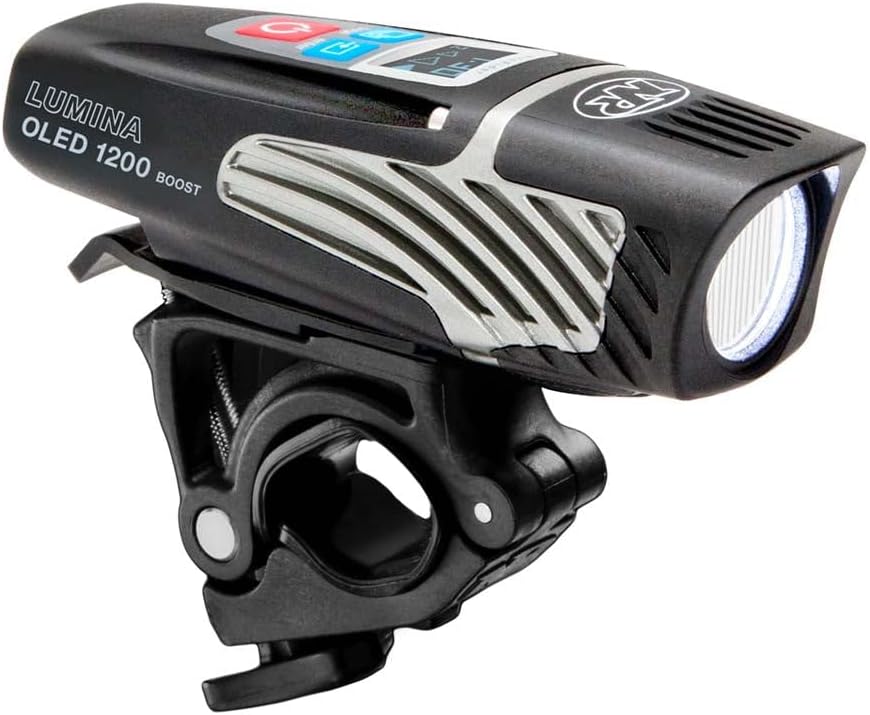
NiteRider Lumina OLED Boost 1200
4.5Editor score
Real-time OLED runtime display
1200-lumen boost mode
FL1 tested light output
Road Bike Lights for Night Riding guide comparing ten rechargeable sets for brightness, beam coverage, runtime, mounting, waterproofing, and overall visibility.
Road Bike Lights for Night Riding must balance a bright, well-shaped beam with long runtime, secure mounting, and dependable weather resistance. The right setup helps riders identify pavement hazards while also making bicycles easier for motorists, pedestrians, and fellow cyclists to detect in darkness.
This guide compares ten front-and-rear lighting systems using their stated brightness, beam reach, mode selection, battery life, charging method, enclosure, and mounting design. It covers options for road commuting, training, trail riding, and emergency use without suggesting that every light suits every rider.
Each review explains the product's strongest benefits and practical limitations. The top selections highlight a versatile high-output set, a feature-rich premium headlight, and an efficient everyday pair, while prices and availability can change, so readers should confirm current details before buying.
4.5Editor score

4.6Editor score
4.6Editor score
The table below compares the ten sets by their most important design differences: stated light output, beam reach, operating modes, battery endurance, charging features, weather rating, and mounting system. These specifications come from the supplied product information and should be considered alongside the detailed reviews.


The Zewdov High Lumen set combines a 1000-lumen front light with a separate rechargeable red taillight, earning a 4.6 rating among the listed products. Its standout feature is the headlight's combination of a focused beam, eight auxiliary floodlights, and a stated visibility range of up to 650 feet. That makes it a versatile choice for riders who want more coverage than a small commuter lamp provides.
We may earn a commission when you buy through this link, at no additional cost to you.
The set offers eight headlight modes and seven taillight modes, covering high, medium, low, and several flashing patterns. The front and rear lights use separate charging leads, and the supplied two-port USB-C cable is said to recharge the headlight in two hours and the taillight in one hour. Runtime is listed at up to four hours on maximum headlight brightness, 19 hours on minimum brightness, and 50 hours for the rear light.
Weather resistance and mounting are also strong points. The headlight has an IP65 rating, an aluminum alloy housing, and shock resistance described as surviving falls of up to five feet. A mounting bracket and elastic strap permit tool-free attachment. The main drawback is that the headlight's single-click, double-click, and long-press control scheme may take a little practice, although the manual explains the sequence.
This is a strong all-around recommendation for road riders, commuters, and cyclists who frequently encounter dark or wet routes. It is especially useful for anyone seeking substantial front brightness, numerous rear patterns, and flexible charging without moving to the premium NiteRider. The Zewdov set is the most balanced choice here, provided riders are willing to learn its controls and carry a charged light on longer trips.
The focused main beam helps riders look farther down the road, while the auxiliary floodlights add light to the sides and nearby obstacles. This combination is more useful for nighttime cycling than relying on a narrow hotspot alone.
Bright steady modes suit open and unlit roads, while flash patterns provide additional visibility in traffic. The rear light's separate controls make it possible to match front and rear illumination to the surrounding environment.
We may earn a commission when you buy through this link, at no additional cost to you.
The Cuvccn set is a 4.6-rated front-and-rear option designed around flexible mode selection and unusually long flash runtime. Each light combines two main LEDs with 19 surrounding auxiliary LEDs, while independent switches let riders operate the front and rear units separately. That control can be useful when a rider wants bright forward illumination and a slower rear flash at the same time.
We may earn a commission when you buy through this link, at no additional cost to you.
Its front light contains a 1100mAh battery, while the taillight uses a 350mAh cell. In slow-flash mode, the stated endurance reaches 58 hours for the headlight and 25 hours for the taillight. A green flashing indicator appears when power falls below 20 percent, reducing the likelihood that a rider begins a journey with an unexpectedly depleted battery.
The IPX6 rating and covered USB port suit wet-weather commuting, while the four-step installation uses a buckle and horizontal or vertical adjustment. The battery can retain its charge for up to nine months, but the manufacturer recommends recharging lights that have remained unused for more than three months. Actual runtime naturally varies with brightness and flash frequency.
Cuvccn is well suited to commuters who value predictable low-power operation and clear battery feedback more than headline brightness. It also works for hiking, camping, and emergency use. Riders should select the appropriate mode before departure and periodically verify the indicator, but the long flash endurance makes this an easy system to keep in a bag between outings.
The 58-hour slow-flash claim gives this front light an advantage for riders who spend several nights per week in traffic. A low-output setting can preserve visibility without requiring a recharge between short urban journeys.
Operating the front and rear lights separately adds flexibility for different traffic conditions. Riders can select a steady road beam ahead while choosing a persistent flash pattern behind.
We may earn a commission when you buy through this link, at no additional cost to you.
This 6800-lumen set receives a 4.3 rating and prioritizes coverage over a compact, minimalist design. Its six high-performance LEDs sit in a horizontal arrangement that the product information says produces up to 270 degrees of illumination and a stated visible distance of 3,600 feet. The result is intended to illuminate both the route ahead and a broad area around the bicycle.
We may earn a commission when you buy through this link, at no additional cost to you.
Five front modes and five rear modes cover steady illumination, flashing, SOS, and red or blue rear patterns. A 360-degree rotating bracket allows the headlight to be aimed after installation, and the package includes two charging cables. The headlight can also charge a phone or another device, making it useful as a large-capacity emergency light when a ride ends unexpectedly.
The large battery is advertised for runtime of up to 72 hours, but that figure depends on the selected mode and should not be treated as an estimate for sustained maximum brightness. The housing is made from anodized aluminum alloy, carries an IPX6 waterproof rating, and resists impacts and corrosion. The taillight can also reflect incoming light when its electrical power is unavailable.
This model is most compelling for trail riders, fast evening riders, and users traveling through wide, dark areas where peripheral illumination is important. The enormous stated output and range may encourage the assumption that brighter always means better, but beam placement and glare remain important. Riders should aim the light carefully and use a lower mode near other people to preserve visibility without dazzling onlookers.
The broad 270-degree pattern is intended to reveal more than a conventional forward cone. It may be particularly helpful on unlit roads, bike paths with vegetation, and trails where hazards can appear just outside the center of travel.
The ability to charge a phone turns the headlight into more than a visibility accessory. Riders can carry it in a vehicle or emergency kit for use during outages, roadside repairs, and activities where a conventional flashlight is unavailable.
We may earn a commission when you buy through this link, at no additional cost to you.
The second Zewdov option in this guide is a 4.6-rated set built around portability. Its front and rear lights are only 1.7 centimeters thick and weigh 27 grams, making them far less conspicuous than the larger high-output sets. Riders who dislike bulky handlebar equipment or want lights that fit easily into a pocket may find this design particularly attractive.
We may earn a commission when you buy through this link, at no additional cost to you.
The included two-in-one cable charges both lights simultaneously in approximately one to one and a half hours. A protected Type-C port helps guard against rainwater ingress, and the battery may retain its charge for up to seven months. The white front light offers four modes, while the red rear light offers six, including a memory function and non-dazzling breathing flash.
Durability comes from a rugged PC housing with an IP65 water-resistant rating. Two pairs of elastic rubber straps allow the lights to be attached at the front and rear without tools. The product information does not provide a lumen figure or a detailed beam-distance claim, so performance should be judged primarily by its stated modes, compact construction, and intended use as a portable road light.
This is a sensible recommendation for urban commuters, travelers, and riders who carry backup lighting. It also works for electric scooters, strollers, backpacks, camping, and fishing. It is not the first choice for riders who require a measured long-distance beam, but its low weight and quick charging make it one of the most convenient systems in the comparison.
A 27-gram total weight and slim profile reduce the chance of handlebar clutter or interference with cables. The lights are also easy to carry when a bicycle is left at a destination and the rider continues on foot.
Charging both units with one included cable reduces the chance of arriving with only one light ready. The short stated charging time is practical for riders who top up their equipment before work or sleep.
We may earn a commission when you buy through this link, at no additional cost to you.
This 6800-lumen set shares the six-LED horizontal concept of the third-ranked product but lists a 5200mAh battery and a stated range of up to 1,860 feet. It carries a 4.3 rating and focuses on long operating time, flexible aiming, and emergency utility for riders who regularly travel through unlit areas.
We may earn a commission when you buy through this link, at no additional cost to you.
The headlight provides high, medium, low, fast-flash, and SOS modes, while the taillight offers red, blue, fast-flash, slow-flash, and alternating red-blue modes. Its 360-degree rotating bracket lets the rider reposition the beam without removing the entire unit. The battery can recharge a phone or other device, and the supplied package includes two charging cables and a manual.
The aluminum alloy housing has an IPX6 waterproof rating and is described as resistant to impact, corrosion, and heat. Green and red indicators communicate remaining power, while the rear unit includes a reflective function that remains useful if its battery is depleted. Maximum runtime is listed at more than 72 hours, although brightness and flash settings will materially change actual use time.
Choose this set when battery capacity and emergency functions matter as much as raw output. It is well suited to off-road excursions, long evening rides, and keeping a light in a vehicle for roadside use. Riders should be prepared for a larger handlebar accessory and should test the controls in daylight before relying on them in full darkness.
The 5200mAh cell gives the set a substantial capacity advantage over many compact bicycle lights. That makes it attractive for riders who do not want to recharge frequently or who use several modes across long outdoor sessions.
The taillight's passive reflective element adds a secondary layer of rear visibility. Although it cannot replace an active flashing light, it remains useful when the electrical system is switched off or the battery has depleted.
We may earn a commission when you buy through this link, at no additional cost to you.
The Banral BHL-001 is a 4.4-rated set that combines a 3000-lumen headlight, a rear light, an LCD percentage display, and a phone-charging function. Its stated 500-foot beam distance is substantial for urban road riding, where the practical challenge is often seeing small debris, lane markings, and early road users rather than lighting an entire landscape.
We may earn a commission when you buy through this link, at no additional cost to you.
Five front modes and five rear modes offer a good range of steady and flashing choices. A three-second long press turns the headlight off from any mode, which is a convenient shortcut. The LCD reports the exact remaining battery percentage, helping riders estimate whether a higher or lower brightness setting is appropriate for the planned ride.
The headlight contains a 5000mAh battery and lasts up to 3.5 hours at maximum brightness or 12 hours at minimum brightness. The 150mAh taillight is listed for up to six hours. Both use Type-C charging, with stated full-charge times of three hours for the front and 0.5 hours for the rear. IPX4 protection and an aluminum housing are suitable for ordinary rain and snow, though the rating is less protective than IPX5 or IPX6 alternatives.
This set is a good fit for commuters who want an exact power readout and can appreciate the headlight's power-bank capability. It is also easy to install, with a front bracket for 0.98–1.26-inch handlebars and an adjustable rear strap for 0.79–1.38-inch seatposts. Riders planning long, high-output rides should begin fully charged and use lower settings when practical.
The LCD percentage is more informative than a simple three-color indicator. Riders can check remaining capacity before a ride and adjust output based on the route and expected journey time.
Charging a phone from the headlight adds useful backup for navigation or emergency calls. The large battery is not a substitute for a dedicated power bank, but it can provide a convenient secondary option on extended rides.
We may earn a commission when you buy through this link, at no additional cost to you.
DARKBEAM's USB-C set is rated 4.3 and combines a stated 4000-lumen headlight with an 18-LED red taillight. Six front modes distinguish broad and spotlight patterns, while the rear unit offers high, low, slow-flash, rapid-flash, and breathing options. This variety makes the package useful for both cycling and general outdoor tasks.
We may earn a commission when you buy through this link, at no additional cost to you.
The headlight uses a built-in rechargeable battery and is listed for approximately four to eight hours depending on the selected mode. Four LEDs provide a clear power indication, and a mobile power bank or other USB device can recharge it through the Type-C connection. The rear light uses its own rechargeable Type-C connector and runs for up to three to ten hours.
An aluminum housing, special heat-dissipation structure, and IPX5 rating support use in rain and fog. The quick-release mount requires no tools. Its versatility extends beyond bicycles: the product information identifies uses for backpacks, helmets, wheelchairs, skateboards, strollers, dog leashes, vehicle storage, basements, and emergency kits.
This is a good option for riders who want one lighting system to cover several activities. Road cyclists will benefit from distinct flood and spotlight modes, while the 18-LED taillight provides strong rear conspicuity. The shorter maximum-output runtime means it requires more deliberate charging than some high-capacity sets, so frequent riders should establish a regular charging habit.
Separate broad and focused modes help riders choose between illuminating nearby hazards and looking farther down the road. This control is useful when a wider field of light would otherwise waste output or create excessive glare.
Both lights can support walking, camping, vehicle maintenance, and emergency preparedness. Carrying the headlight in a vehicle or first-aid kit gives riders a useful backup for situations unrelated to cycling.
We may earn a commission when you buy through this link, at no additional cost to you.
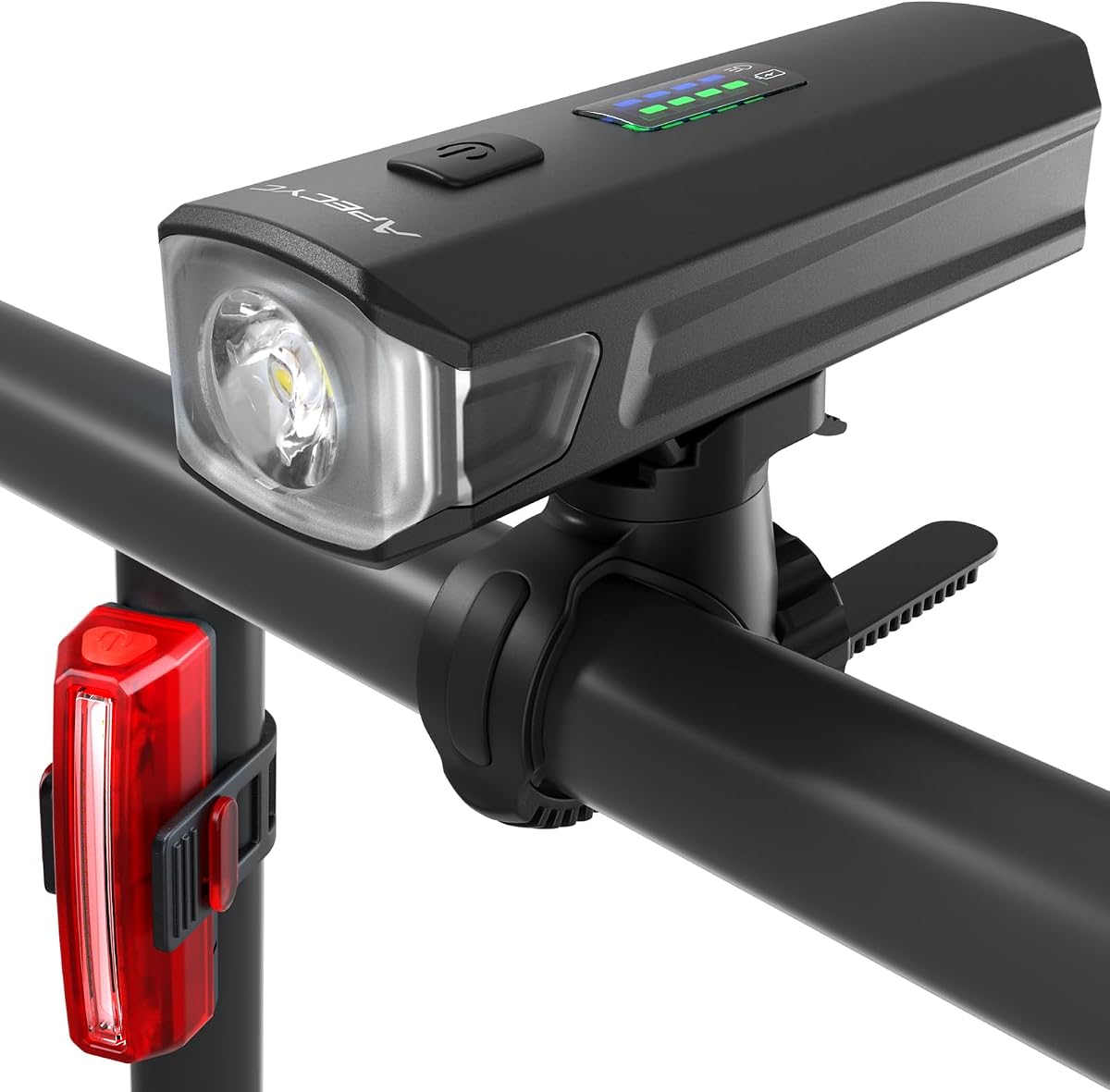
The APECYC set is a 4.6-rated front-and-rear pair created for commuting, road cycling, mountain biking, and low-light recreational rides. Rather than relying on a single headline number, its strongest selling points are a focused front beam, a separate rear light, USB-C charging, an LCD screen, and quick-removal mounting.
We may earn a commission when you buy through this link, at no additional cost to you.
The front light is designed to help riders spot potholes, obstacles, and turns earlier, while the rear unit improves visibility to traffic approaching from behind. Four front modes and five rear modes allow riders to alternate between steady illumination and flashing patterns. The built-in LCD provides a view of remaining power, reducing uncertainty during longer commutes.
The weather-resistant construction is intended for rain, splashes, fog, and wet roads. Tool-free mounts allow installation and removal within seconds, making it convenient to take both lights off when parking, charge them at a desk, or move them to a second bicycle. Although the supplied information does not state exact lumens or runtimes, it clearly positions the set around practical everyday visibility.
APECYC is a strong recommendation for urban riders who want uncomplicated front-and-rear lighting without a large emergency-power setup. It should appeal to commuters, fitness riders, and weekend cyclists who value a clear battery display and rapid tool-free removal. Riders should verify fit and controls on the first daylight ride, then confirm the battery and mounting security before entering heavy traffic.
The forward beam is aimed at helping riders recognize road defects and turns, while the rear light catches the attention of traffic. That combination addresses both halves of nighttime cycling visibility.
Removing the lights in seconds is useful for commuters who store a bicycle at work or share equipment with family members. The quick-release approach also makes scheduled charging more convenient.
We may earn a commission when you buy through this link, at no additional cost to you.
This 4.5-rated set focuses on precise beam and taillight positioning. Its two-LED front headlight has a stated reach of up to 500 feet, while the rear light offers a 150-degree viewing angle for side and rear visibility. That makes it a capable choice for road riders who want to control how their bicycle appears from different directions.
We may earn a commission when you buy through this link, at no additional cost to you.
Six front modes and four rear modes provide a good selection of steady and flashing patterns. One-button operation keeps changes simple, and the headlight rotates through 360 degrees. The rear unit mounts horizontally or vertically and adjusts up to 40 degrees, helping riders optimize visibility on different frames and seating positions.
Both lights use USB-C charging. The front takes three hours to recharge and includes a digital battery display, while the rear takes two hours and is listed for up to ten hours of runtime. IPX4 water resistance and an aluminum alloy housing help protect against rain, splashes, vibration, and drops of up to five feet.
The set is particularly appealing to riders who want more positioning control than a basic fixed commuter light. Silicone straps allow tool-free installation on many road, mountain, and commuter bicycles. The IPX4 rating is sufficient for ordinary wet conditions but not the strongest among these options, so prolonged downpours warrant a sheltered storage plan and regular checks.
A 360-degree rotating headlight lets riders adapt the lighting to handlebar geometry, riding posture, or changing road conditions. It also makes it easier to prevent a mounting angle from directing the beam toward approaching traffic.
The 150-degree rear field and 40-degree adjustment help the light remain noticeable from oblique angles. This is useful on roads where drivers approach from side streets or turn across the cyclist's path.
We may earn a commission when you buy through this link, at no additional cost to you.
The NiteRider Lumina OLED Boost is the premium choice in this comparison, earning a 4.5 rating for its refined controls and verified output. Its 1200-lumen maximum is activated with a double tap, while the integrated OLED display shows the current mode, remaining runtime, and battery level without forcing the rider to estimate performance.
We may earn a commission when you buy through this link, at no additional cost to you.
A purpose-designed collimator lens distributes light widely and evenly, with strong peripheral coverage intended to improve awareness of road hazards. Nine total modes provide detailed control over brightness and runtime. The USB-rechargeable design uses NiteRider's Intellicharge system, which supports faster charging when paired with a suitable higher-amp adapter.
The enclosure combines reinforced fiberglass nylon with an aluminum heat sink for cooling and durability. Its IP64 rating protects against water and dust, making it well suited to road, mountain-bike, and commuter use. FL1 testing adds confidence because the stated lumen output and runtime are based on an established performance protocol rather than an unspecified marketing claim alone.
This premium headlight is ideal for riders who value precise information, dependable output, and straightforward mode management. One limitation is that it is a headlight rather than a bundled front-and-rear set, so riders wanting coordinated rear illumination need a separate taillight. Lockout mode is also valuable for storage and transport, preventing accidental activation while the light sits in a bag.
The OLED display turns battery planning into a direct readout rather than a guess. Riders can select a mode that balances brightness with the time remaining before planning a safer return route or a lower setting.
FL1 testing and a dedicated collimator lens distinguish this option from lights that rely only on a headline lumen count. The wide, even distribution is especially relevant to road riding, where peripheral hazards and smooth illumination matter.
We may earn a commission when you buy through this link, at no additional cost to you.
Choosing bicycle lighting involves balancing road coverage, rear conspicuity, battery endurance, weather protection, and secure mounting. The most useful set is one whose beam can reveal hazards without creating excessive glare and whose rear light remains visible in the traffic environment where the rider actually travels.
A high lumen figure is only one part of useful nighttime illumination. Road riders should look for a beam that is bright enough to expose gravel, cracks, branches, and lane markings while spreading enough light to reveal hazards near the edges of the route. Focused spot patterns can help riders look farther ahead, while flood patterns illuminate nearby surroundings. Some sets combine both through selectable modes, which is valuable when a route alternates between open roads and dark, tree-lined sections.
A front light cannot make a cyclist visible to traffic approaching from behind, so a capable taillight is essential. Riders should consider a wide viewing angle, red illumination, and one or more flash modes. Adjustable mounting is beneficial because seatpost angles and frame positions affect how directly a light points toward following vehicles. A reflective element can provide a secondary safety layer, although it should not replace an electrically powered flashing light.
Runtime is more important than raw brightness for commuters who ride several nights each week. Maximum-output claims often refer to lower settings, so riders should compare at least the stated low-mode and flash-mode runtimes. USB-C is the most convenient common charging format in this group, while dual-light cables simplify preparation. Battery indicators help prevent a surprise shutdown, and a power-bank function adds useful emergency capacity on longer, remote rides.
Night rides frequently involve rain, fog, road spray, or cold conditions. IPX4 offers protection against splashing water, IPX5 adds stronger water-jet protection, and IPX6 is more suitable for heavy rain exposure. No rating makes a light immune to weather, so riders should still keep charging ports covered and dry the lights after severe conditions. Aluminum housings add impact resistance and improve heat dissipation during extended high-output use.
A light that shifts during a ride is both inconvenient and dangerous. Handlebar and seatpost brackets should fit the intended tube diameters, while straps need enough tension to survive rough pavement. Quick-release systems are convenient for commuters who remove lights at work, while adjustable brackets are important for road bikes with different cockpit angles. Riders should check that cables, bags, and computer mounts do not obstruct the beam or switches.
Multiple modes are useful only if they can be changed safely while riding. One-button operation and a long-press shutdown reduce accidental activation and simplify glove use. Bright steady modes suit genuinely dark roads, while flash modes improve conspicuity in urban traffic. Riders should avoid pointing a powerful beam toward approaching people and select a softer or lower setting when traveling in groups.
A compact set is easier to carry, store, and recharge between rides. Lightweight lights with protected ports can also serve as emergency lighting for vehicle repairs, walking, camping, and power outages. Larger high-capacity units may provide more output and phone-charging capability, but they take up more space and may be less convenient for a compact saddle bag. Think about secondary uses when deciding how much size to accept.
Some manufacturers provide independently standardized lumen and runtime information, which makes products easier to compare. Warranty coverage, replacement brackets, and responsive support are also relevant for lights exposed to vibration and weather. Product listings that state charging requirements, waterproof standards, and battery maintenance clearly are generally more helpful than listings that offer only broad claims. Checking the included manual before riding helps prevent incorrect mode or charging operation.
Begin by fully charging both the front and rear lights according to the manufacturer's instructions. Install the headlight on the handlebar and the taillight on the seatpost or another approved rear position, keeping both unobstructed. Check the beam on a familiar dark route, aim it below the horizon, and confirm that the red rear light is visible from directly behind and from both sides.
Choose lighting modes before entering traffic and select a lower beam when another rider, pedestrian, or vehicle is approaching. Use flashing modes to enhance conspicuity, particularly on urban roads, but remember that flashing does not replace a properly aimed beam. At the start of every ride, check the battery indicator, test both switches, and verify that the mounting straps remain tight enough for rough roads.
After use, switch the lights off and inspect the mounts, charging ports, lenses, and straps for dirt or damage. Wipe the lights with a dry or lightly damp cloth, avoid abrasive cleaners, and keep covered charging ports closed while wet. Recharge periodically, particularly before long rides or periods of inactivity, because battery performance can decline when a rechargeable cell is left uncharged for an extended period.
Brightness should be sufficient to reveal pavement hazards, but beam quality and correct positioning matter as much as the lumen figure. A 1000- to 3000-lumen headlight can be effective for paved roads, while unlit trails may benefit from broader coverage and more peripheral light. Always choose a mode that illuminates the route without dazzling other road users.
Yes, a front and rear light serve different visibility purposes. The headlight helps you see obstacles and road users ahead, while the taillight helps approaching drivers and cyclists recognize your bicycle. Using only a front light leaves the rear of the rider largely unseen, especially at night or when surrounded by bright traffic.
No. A very high output can create glare, reduce battery life, and reveal an otherwise poor beam pattern. Riders should consider reach, even illumination, peripheral coverage, mode control, and mounting stability along with the advertised lumens. The best light is the one that provides a controlled, useful beam for the route.
Charge them after every substantial ride or at least whenever the indicator shows a low level. A full charge before a long journey is especially important because maximum-brightness runtime is normally shorter than the advertised low-mode or flash-mode runtime. If a light will sit unused for months, top it up periodically to help preserve battery health.
Products with IPX5 or IPX6 protection are better suited to heavy rain than IPX4 models, but no light should be assumed to be completely waterproof. Keep port covers closed, avoid submerging the unit, and dry it after severe weather. Riders should also use lower brightness in fog because excessive glare can obscure the road.
Steady modes provide a continuous view of the road and are useful on dark routes. Flash modes primarily increase the light's conspicuity to other people and may extend runtime. Commuters often benefit from a bright front beam plus a flashing rear light, while group riders may prefer lower, less glaring settings to avoid dazzling companions.
The headlight belongs securely on the handlebar or another approved forward-facing mount, while the taillight should sit high enough on the seatpost or frame to remain unobstructed. Keep the beam below eye level and check that the light does not point directly at drivers. Straps should be snug, and all mounts should be checked again after a few miles of riding.
Rechargeable lights are generally well suited to commuting because they eliminate disposable batteries and can be topped up at home or work. Look for USB-C charging, a readable battery indicator, secure straps, and enough low-mode runtime for repeated journeys. Carry a backup light when commuting in remote areas or during winter, when battery performance may decline.
The Zewdov High Lumen set stands out as the most versatile overall option because it combines a focused 1000-lumen beam, auxiliary coverage, numerous modes, and an IP65 housing. The NiteRider Lumina OLED Boost is the premium selection for riders who prioritize verified output, an informative OLED display, and refined control, while the APECYC set offers a practical, easy-to-remove commuting solution.
Before buying, prioritize the pattern and control of the beam, realistic runtime in the modes you will use, secure fit, and adequate water protection. A taillight with a wide viewing angle is just as important as a powerful headlight. Riders who travel long distances may also value a battery percentage display, phone-charging capability, or the flexibility to use the lights for walking and emergency tasks.
Product specifications, availability, and prices can change, so confirm the current listing and included accessories before ordering. Charge the system fully, test every control, and mount both lights before the first nighttime ride. With the correct setup, a dependable front-and-rear lighting system can improve confidence, hazard awareness, and visibility throughout the journey.