
X7 RFID Reader Writer
3.6Editor score
Broad multifrequency card support
One-button NFC simulation
Fifteen writable RFID accessories
Explore the best Rfid Key Fob Card Copier options, comparing compatibility, supported frequencies, ease of use, writable media, and portability for users.
An Rfid Key Fob Card Copier can read an existing low-frequency credential and transfer its data to a compatible writable card or key fob. The right device depends heavily on frequency, chip type, security features, and whether you need a simple two-button copier or a computer-connected multifrequency reader.
The products in this guide were compared using their stated compatibility, supported chip types, interfaces, included accessories, display capabilities, portability, and practical limitations. The list covers stand-alone 125kHz copiers, multifrequency systems, and models with app, USB, and NFC simulation support.
Each review identifies what the product is best suited for, from uncomplicated credential management to broader card inspection and access-control work. Product ratings and availability can change over time, and current prices should be checked on each listing before purchase.
3.6Editor score

5.0Editor score

4.3Editor score
The comparison below covers all ten readers and writers, highlighting their supported frequencies, interfaces, displays, bundled media, and principal compatibility restrictions so readers can quickly narrow the field.




This handheld reader-writer combines basic credential-copying functions with a useful bundle of five writable T5577 cards and five matching T5577 key fobs. Its 3.5 rating reflects a functional design with clear limitations, but it remains a convenient starting point for users handling unencrypted 125kHz credentials. The emphasis is on straightforward operation rather than advanced card analysis.
We may earn a commission when you buy through this link, at no additional cost to you.
Two physical controls handle reading and writing, while built-in LEDs and a buzzer provide feedback during each process. The stated compatibility includes T5577, EM4305, CE5200, and other unencrypted 125kHz chips. This makes the device relevant to community access systems, offices, homes, parking controls, and other installations that use compatible low-frequency credentials.
The package is generous for a compact copier because it includes both card-form and key-fob-form targets. Its ABS housing and ergonomic shape are intended to reduce hand fatigue, while the battery-powered design allows on-site use without a computer. The important compromise is that this is not a universal copier: NFC, 13.56MHz, 960MHz, and encrypted cards are outside its stated capabilities.
This is a sensible choice for a homeowner, property manager, or installer who has confirmed that the source credentials are compatible 125kHz cards. Buyers should verify the original card's frequency and chip type before ordering and purchase two AAA batteries separately. For those needs, the included media and simple controls make it a balanced starter kit.
Ten writable targets are included, allowing users to begin with both card and key-fob formats. The blank accessories must be programmed with the appropriate credential data before they can replace an existing access credential.
READ and WRITE buttons reduce setup complexity, while visual and audible prompts help indicate progress. No computer is required, making the unit convenient for temporary or on-site work.
We may earn a commission when you buy through this link, at no additional cost to you.
The ZGAGFZ handheld copier is designed around portability, with a stated weight of 56 grams and a compact housing for on-site credential work. It has a 3.2 rating and includes six T5577 key fobs and cards, giving buyers writable targets in two physical formats. Its core appeal is simple 125kHz copying rather than multifrequency analysis.
We may earn a commission when you buy through this link, at no additional cost to you.
The listed chip support includes EM4100, TK4100, T5577, EM4305, and CE5200, with an important distinction between read-only and writable credentials. EM4100 and TK4100 cards can reportedly be read, but this type of blank media cannot receive a copied credential. T5577, EM4305, and CE5207 media can be both read and written, making them the relevant choices for replication.
The product can be used with parking cards, access cards, switch cards, and small button-shaped credentials. It operates independently once two 1.5-volt AAA batteries are installed. However, the 3.2 rating suggests mixed experiences, and the detailed instructions emphasize confirming the source card's chip type, preferably with a professional reader or a Proxmark3 command-line tool when compatibility is uncertain.
Choose this model when portability matters more than display-based guidance or computer connectivity. It is best suited to technicians or property managers who already know that the credentials are unencrypted 125kHz and need lightweight access to writable T5577, EM4305, or CE5200 media. Confirming compatibility before buying will prevent the most common source of disappointment.
At a stated 56 grams, the copier is easy to carry between locations. Its stand-alone design is useful for technicians who do not want to depend on a laptop, phone, or wall power.
Not every readable 125kHz credential can be reproduced onto a blank target. Prioritize writable T5577, EM4305, or CE5200 media when the goal is to create a replacement fob or card.
We may earn a commission when you buy through this link, at no additional cost to you.
The X100 stands out as a multifrequency access-control reader with a 5.0 rating and substantially broader capabilities than a basic 125kHz copier. It supports 125kHz, 175kHz, 250kHz, 300kHz, 375kHz, 500kHz, and 13.56MHz, giving users a much wider field of compatible credentials to inspect.
We may earn a commission when you buy through this link, at no additional cost to you.
The stated card list includes S50, S70, TK4100, EM4100, EM4200, T5577, TK4100-D, TK4168, HID, and AWID formats. A 2.8-inch TFT color screen presents card information, while Type-C communication and app support allow operation or decoding through a Windows computer or compatible Android phone. An included USB drive contains the manual and installation package.
There are two important qualifications. The software is not compatible with Mac computers, and the listing advises users to exit computer protection software if it identifies the device as malware. Those points make the X100 less convenient for users who rely on macOS or maintain strict endpoint-security policies, despite its broad hardware coverage.
This is the strongest recommendation for a user who needs to identify several kinds of access card rather than simply copy one confirmed 125kHz format. Its screen, app connectivity, and NFC simulation create a more informative workflow. The rating is favorable, but the software requirements should be checked carefully before purchase.
Seven frequency bands make the X100 useful when the credential in hand has not yet been fully identified. Users can inspect more card types without switching to separate hardware for each band.
The color screen gives read and decoded data a more visible presentation than a simple LED copier. App connectivity also makes captured information easier to export when Windows or Android is available.
We may earn a commission when you buy through this link, at no additional cost to you.
This compact 125kHz reader-writer is built around a simple premise: provide a portable copier and enough writable media to handle several access-control tasks. Its 3.2 rating reflects an uncomplicated product, while the package includes six blank white cards and six blue T5577 writable key fobs. It suits users who have already confirmed their credential frequency.
We may earn a commission when you buy through this link, at no additional cost to you.
The device uses separate READ and WRITE buttons and works without a computer, reducing the learning curve for basic copying. T5577 and EM4305 are highlighted as compatible targets, while the listing positions the product for communities, offices, homes, and other access-control environments. Its pocket-friendly design is especially useful for technicians carrying one tool across multiple locations.
The largest restriction is frequency. It cannot read or write 13.56MHz media, so it would be unsuitable for a user who has not yet determined whether the source credential is low-frequency. Its rating is also tied, for this roundup, with the ZGAGFZ model, although this kit includes twice as many blank accessories.
The device is a practical choice for someone who wants a no-computer copier for confirmed 125kHz credentials and values a generous supply of writable targets. Install two AAA batteries before use, verify the card format, and keep spare media available. It offers fewer inspection and connectivity features than the X-series readers, but its core workflow is direct and approachable.
Six cards and six key fobs allow a user to duplicate several credentials or keep a healthy reserve of writable stock. This is one of the most complete bundles among the compact stand-alone models.
The two-button design is easy to understand: one command reads the source credential and the other writes it to a compatible target. It is appropriate for routine work where only known 125kHz formats are involved.
We may earn a commission when you buy through this link, at no additional cost to you.
This handheld RFID writer is a mid-tier 125kHz copier offering a broader set of writable chip types than many simple alternatives. Its 3.7 rating is among the stronger results in the group. The package includes three writable key fobs, three writable cards, and a user manual, with two AAA batteries required separately.
We may earn a commission when you buy through this link, at no additional cost to you.
Compatibility includes T5577, EM4205 and EM4305, and EL8265 or EL8268. The copier can handle parking cards, access cards, switch cards, and small button-type cards. It does not need a computer connection, and its small, lightweight housing supports mobile work. The two-AAA-battery requirement should be considered before ordering because a spare set is necessary for uninterrupted operation.
The included key fobs and cards are blank by default. They must first receive data from the original 125kHz device before they can act as replacements, and the listing explicitly notes that they are not usable directly. The product is designed to read source data and then transfer it to compatible writable media.
This model fits technicians who need flexible support for several low-frequency chip families without moving to a computer-based reader. It is a better choice than an ultra-basic copier when EL8265 or EL8268 media may be present, but a user working only with T5577 may find the larger bundles more useful. Confirm the source format and target protocol before buying.
Support for T5577, EM4205, EM4305, EL8265, and EL8268 adds flexibility when a site has mixed writable media. The correct target must still match the credential protocol and intended system.
The device is small and independent, which favors field use. Since the included cards and fobs arrive blank, users need a compatible source credential and must write the data before testing.
We may earn a commission when you buy through this link, at no additional cost to you.
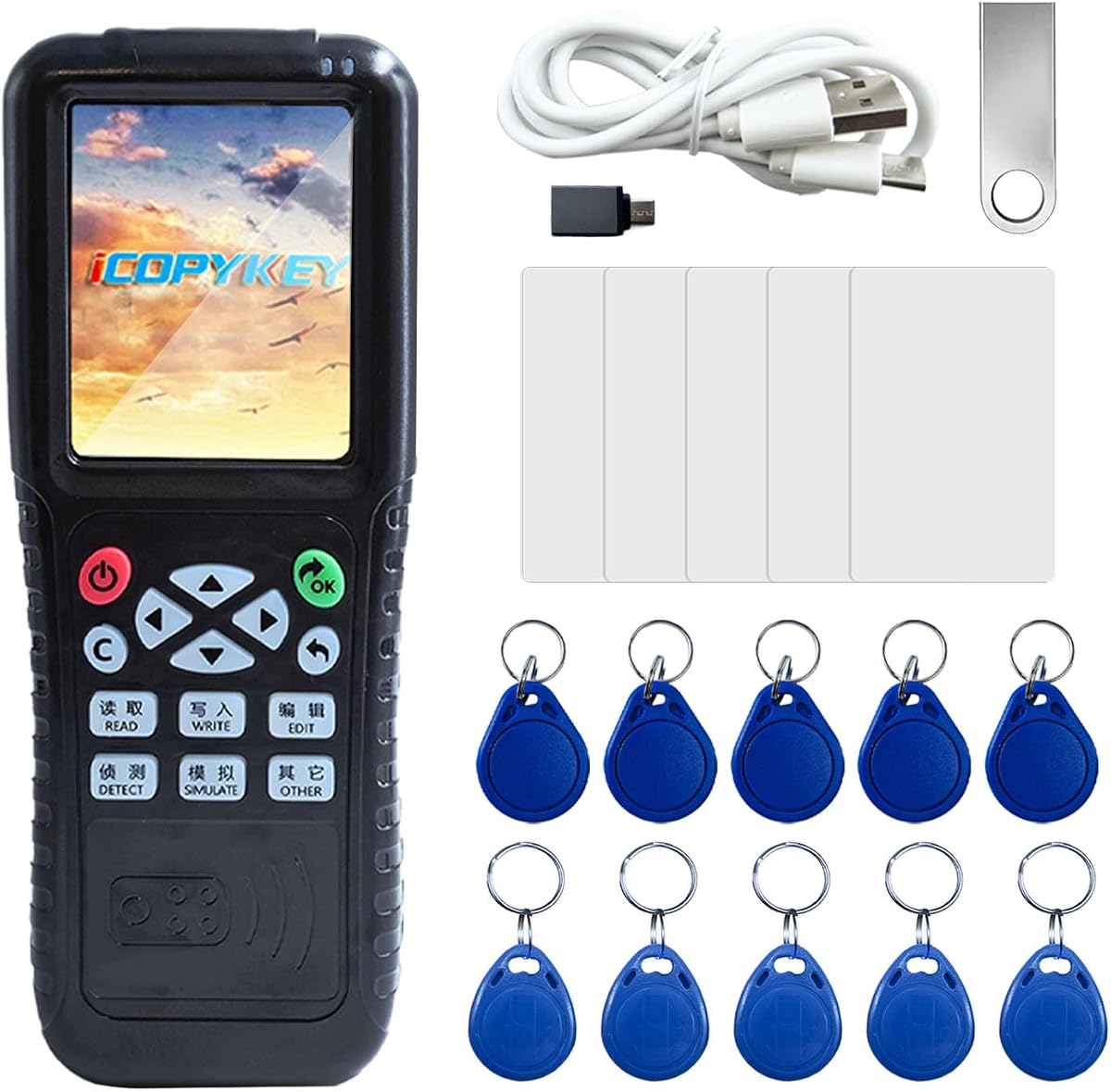
The X7 combines a multifrequency reader-writer, color display, and NFC simulation in a more elaborate access-control package. It supports 125kHz, 175kHz, 250kHz, 300kHz, 375kHz, 500kHz, 13.56MHz, and other frequencies. Its 3.6 rating places it among the more highly rated multifrequency options here.
We may earn a commission when you buy through this link, at no additional cost to you.
The card list is broad, including T5577, S50, S70, TK4100, EM4100, EM4200, TK4100-D, TK4168, HID ProxCard II, AWID, and Paradox. NFC simulation can be activated independently, while the numeric keypad allows a card number to be entered directly. The 2.8-inch TFT screen presents information intuitively, and Type-C provides device communication.
The package includes the reader-writer, a USB cable, five T5577 key chains, five T5577 cards, and five CUID key chains. That media assortment is larger than the bundle offered with the X100 listings. The sensing area is on the back, so card positioning matters; the listing advises users to adjust the placement if a card is not detected.
The X7 is best for an access-control technician or advanced hobbyist who wants several identification methods, a visual interface, and a generous supply of writable targets. It is less attractive for a simple one-format duplication job, and buyers should verify that a particular credential's protocol appears in the supported list. When the stated features match the needed workflow, it is the most feature-rich choice in this roundup.
Identification, number entry, card copying, and NFC simulation are all presented in one interface. This reduces the need for separate tools when managing mixed access-control environments.
Five T5577 key chains, five T5577 cards, and five CUID key chains give users a broad starting inventory. The included USB cable also supports the product's Type-C connection needs.
We may earn a commission when you buy through this link, at no additional cost to you.
The Keysy is a compact 125kHz duplicator built around a remote that can hold and emulate up to four copied credentials. It has a 4.3 rating, making it the highest-rated dedicated copier in the roundup. One rewritable Keysy key fob is included, and additional compatible fobs or cards can be purchased separately.
We may earn a commission when you buy through this link, at no additional cost to you.
The listing identifies support for a broad range of 125kHz environments, including HID Prox, AWID, Indala, ioProx, Rosslare, XceedID, Paradox, and CDVI. Once credentials are read, they can be written to the included branded rewritable media. Placing the remote in front of a compatible reader allows it to act as the stored credential.
A major restriction is that Keysy duplicates only onto its own branded rewritable fobs and cards. It is also important to note that not every door reader supports credential emulation, even if the original card format is otherwise compatible. The product avoids sharing sensitive credential data with a third-party copying service, and customer care is backed by a one-year warranty.
The Keysy is an excellent choice for someone managing a small collection of compatible 125kHz credentials who values a compact, simple remote. It is less versatile for technicians who need blank media in multiple formats or want to inspect several frequencies. Compatibility should be checked with the manufacturer before purchase, especially for unusual reader systems.
The remote's ability to store up to four copied credentials makes it convenient for homes, offices, or shared properties. Users can switch between saved entries without carrying four separate fobs.
The product is backed by a one-year warranty and a stated 30-day return opportunity. Those provisions add reassurance for buyers who need help confirming whether their original fob is compatible.
We may earn a commission when you buy through this link, at no additional cost to you.
This X100 listing is a multifrequency card reader and copier with a 3.9 rating. It covers 125kHz, 175kHz, 250kHz, 300kHz, 375kHz, 500kHz, and 13.56MHz, making it appropriate for users who need to inspect credentials beyond ordinary low-frequency fobs.
We may earn a commission when you buy through this link, at no additional cost to you.
Compatible formats include S50, S70, TK4100, EM4100, EM4200, T5577, TK4100-D, TK4168, HID, and AWID. The included USB drive supplies a manual and installation package for Windows computers and Android phones. Users can operate or decode through the app, while the 2.8-inch color screen presents card information directly on the device.
An independent NFC simulation function can reproduce supported encrypted IC cards with one button. The default system language is Chinese, but English can be selected during startup or changed in settings. As with the other X100 listing, Mac users are excluded, and endpoint protection may need to be temporarily exited if it flags the installation files.
This model is well suited to an installer or technically inclined user who wants broad frequency support, visual data, and app output. Its 3.9 rating is strong for a multifrequency reader. The software limitations make it a less natural choice for Mac-only users, so checking the operating environment before buying is essential.
Support for seven bands and a large list of familiar card formats makes the device more adaptable than a one-frequency copier. It is particularly useful when a site's card technology is uncertain.
The screen supports immediate inspection, while app connectivity provides a route to operation and decoded output. Together they offer more visibility than a simple LED-based reader-writer.
We may earn a commission when you buy through this link, at no additional cost to you.
The ZHAOYU handheld copier emphasizes a ready-to-use bundle, with ten blue T5577 key fobs included alongside the reader-writer. Its 3.6 rating reflects a generally capable 125kHz product, and the stated reading and writing distance of 2.5 to 6 centimeters provides a useful expectation for positioning cards near the sensing area.
We may earn a commission when you buy through this link, at no additional cost to you.
The unit supports T5577, EM4305, and CET5200, along with common 125kHz protocols such as EM4100. It can handle thin cards, thick ID cards, and key-fob credentials, making it applicable to parking and access-control tasks. The key fobs are blank, so users must write the required card number into them before they will work with a reader or lock.
Compatibility is narrower than the product name alone might imply. The listing says many HID and AWID cards use proprietary encodings, longer bit lengths, or encryption such as Corporate 1000. Those advanced formats require specialized equipment and cannot be copied by a generic low-cost writer, even when their frequency is nominally 125kHz.
The ZHAOYU is a good option for users who work regularly with basic 125kHz cards and need a substantial supply of T5577 key fobs. It is not the right tool for proprietary or encrypted corporate credentials. Confirm the source protocol, keep the card close to the reader, and buy two AAA batteries separately before beginning.
The included quantity makes this one of the strongest bundles for a user who routinely replaces key fobs. Each blank fob still needs the correct credential data written before it becomes usable.
A shared 125kHz frequency does not guarantee compatibility. Open-format and common writable protocols are much easier to handle than proprietary, long-bit, or encrypted HID and AWID systems.
We may earn a commission when you buy through this link, at no additional cost to you.
This handheld 125kHz RFID writer is a portable copier with a 3.6 rating and a useful list of compatible formats. Its package includes five writable key fobs and five writable cards. The reader itself works independently, making it appropriate for on-site access, parking, or switch-card tasks where carrying a computer would be inconvenient.
We may earn a commission when you buy through this link, at no additional cost to you.
The listed chip support includes T5577, EM4205 and EM4305, EL8265 and EL8268, and SIC7888. It can copy parking cards, access cards, switch cards, and small button-shaped cards. These capabilities distinguish it from basic readers limited primarily to T5577 and EM4305, although the actual result still depends on the source credential's format and security.
The included targets are blank and cannot be used directly. A user must first read the data from an existing 125kHz device and then write it to a compatible key fob or card. Two 1.5-volt AAA batteries are required but not included, so a spare set should be planned for mobile work.
The product suits a technician who needs broad writable-chip support but does not require a touchscreen, app, or computer connection. It is less suitable for users who have not identified their credential type. As long as the source is an unencrypted 125kHz credential in a supported family, the straightforward stand-alone design can provide a practical duplication workflow.
EL8265, EL8268, and SIC7888 support broadens the range of writable media beyond the T5577 standard. It remains important to match the target chip to the protocol used by the source system.
The small, lightweight housing and lack of a required computer connection simplify field use. Carrying spare AAA batteries is the main additional preparation.
We may earn a commission when you buy through this link, at no additional cost to you.
A useful copier must match the source credential's frequency, protocol, security level, and intended replacement media. The following factors help distinguish simple 125kHz tools from broader multifrequency access-control systems.
Frequency is the first compatibility filter. Most compact copiers in this guide are limited to 125kHz low-frequency cards, while the X100 and X7 models add higher bands and 13.56MHz support. An NFC card, 13.56MHz access card, or 960MHz credential cannot be handled by a 125kHz-only unit. Matching the copier to the source credential prevents an otherwise correct device from failing at the sensing stage.
A chip family name tells more than the frequency alone. T5577, EM4305, CE5200, EM4100, TK4100, EL8265, EL8268, SIC7888, S50, S70, HID, and AWID represent different capabilities. Some can be read but not written, while others are proprietary, encrypted, or tied to longer formats. A replacement can be created only when both the source and target are compatible and the copier supports the required protocol.
Read-only credentials such as some EM4100 and TK4100 cards can be inspected but cannot receive copied data. Writable targets such as T5577, EM4305, and CE5200 are designed to be programmed. Bundled key fobs and cards often arrive blank, and their presence in the package does not mean they are ready for a lock. Always check whether media is described as writable, blank, or preprogrammed.
A stand-alone copier with READ and WRITE buttons is quick to learn, light to carry, and well suited to known 125kHz credentials. Multifrequency devices add screens, app connectivity, NFC simulation, direct number entry, and broader format support. The more capable design is useful for unknown or mixed credentials, while the simpler design is often more convenient for repetitive copying of one known format.
Some readers operate entirely through physical controls, while the X100 listings use an included USB drive with Windows and Android installation files. Mac compatibility is expressly excluded, and protection software may flag those files. The X7 uses Type-C communication but emphasizes its screen and direct controls. Check the required operating system, connection type, and any security warnings before ordering.
Encryption or proprietary encoding can prevent copying even when a device operates at the correct frequency. Corporate 1000, long-bit HID formats, and proprietary AWID credentials are examples of advanced systems that may require specialist equipment. Keysy additionally requires its own branded rewritable media, and not every door reader supports its emulation function. Compatibility support is more reliable than assuming every 125kHz fob is interchangeable.
Bundled writable media can make a copier useful immediately after adding batteries, although programming is still required. The ZHAOYU includes ten T5577 key fobs, the X7 includes five T5577 key chains, five T5577 cards, and five CUID key chains, and the compact kits include several cards and fobs. Compare the quantity, physical format, and chip type against your actual replacement needs rather than choosing on bundle size alone.
Most compact handheld models use two AAA batteries that must be purchased separately. Keysy has the advantage of one included rewritable fob, a one-year warranty, customer care, and a stated return period. Consider how sensitive credential data is, whether the device stores information, how support is provided, and whether the manufacturer's compatibility guidance is available before sharing a fob for copying.
Before copying, identify the source credential's frequency, chip family, security method, and intended access system. Verify that both the copier and the destination media support it, install the required batteries, and ensure the device is in a known READ or IDLE state before placing a credential near the sensing area.
For a basic stand-alone copier, position the source fob or card normally, activate READ, and wait for the LED or buzzer confirmation. Activate WRITE with a compatible blank target in range, then allow the device to complete the transfer. Remove the target only after it signals completion, and test it on the intended reader before relying on it for access.
Keep the device dry, avoid extreme heat, and protect the sensing area from scratches. Store written media away from strong magnets when the credential could be affected, label each target for easy identification, and periodically test backups. For app-based models, use the supplied software, keep the installation package and manual available, and follow the manufacturer's security guidance.
Only if the copier explicitly supports 13.56MHz NFC-compatible credentials. Most compact 125kHz models cannot read or write NFC, 13.56MHz, 960MHz, or encrypted cards. The X100 and X7 listings include 13.56MHz support, but the exact card protocol and security features still matter. Check the source credential's specifications before attempting a copy.
Included key fobs and cards are usually supplied as blank writable media rather than active credentials. They must first receive the appropriate card number or access data through a compatible reader-writer. Even after being written, a target will work only if its chip type, protocol, and intended access reader are compatible with the original system.
EM4100 is commonly encountered as a basic read-oriented 125kHz credential, while T5577 and EM4305 are widely used writable formats. The listing for the ZGAGFZ model specifically says EM4100 and TK4100 media can be read but not used as copied blank targets. T5577, EM4305, and CE5200 media can support both reading and writing.
Not always. Some HID and AWID credentials use proprietary encodings, longer bit lengths, or encryption that generic low-cost writers cannot reproduce. A 125kHz frequency match alone does not overcome those restrictions. The ZHAOYU listing advises users to identify the format first and consult the seller when a card fails to copy.
No. Products such as the Handheld 125kHz RFID Reader Writer, the ZGAGFZ copier, and the compact two-button kits operate through physical READ and WRITE controls. The X100 models add Windows and Android app operation, while the X7 uses Type-C communication and a display. Additional app features do not necessarily mean a computer is required for every task.
A multifrequency model such as the X100 or X7 is the logical starting point because it covers more frequency bands and card families. Its screen, app support, and direct controls can help identify a credential before copying. The user should still verify the protocol and any encryption, because broad frequency coverage does not guarantee that every advanced credential can be reproduced.
The written target may be incompatible, the data transfer may not have completed, or the reader may require a proprietary format. It is also possible that a door reader does not support the emulation function offered by a specific remote-style copier. Test the original and written media separately, confirm the chip type, and consult the equipment supplier before assuming the copier is defective.
Keep a fresh set of the required batteries, the correct writable cards or key fobs, and the user manual or app installation files. A small inventory of different supported chip types can be useful for mixed access-control work. Store the device in a dry, protected case and keep credential data organized so each programmed target can be identified.
The X100 is the most compelling all-around recommendation for users who need broad card inspection, clear visual information, and app connectivity. The X7 expands the multifrequency feature set with NFC simulation, direct number entry, and a larger accessory bundle, while the Keysy provides a compact, focused way to store and emulate up to four 125kHz credentials.
For a confirmed 125kHz workflow, a basic two-button copier can be more direct and portable. Choose based on the source chip, writable target, security format, required screen or app features, and whether you need a large media bundle. Confirm the credential format before ordering, because no generic copier can overcome every proprietary or encrypted protocol.
Ratings, included accessories, software behavior, and availability may change, while current prices also fluctuate. Review the latest listing, compatibility documentation, and return or warranty terms before making a final purchase.