
X100 RFID Reader Writer
5.0Editor score
Supports several RFID frequencies
Includes 2.8-inch color display
Offers NFC simulation
Connects through USB Type-C
This Rfid Key Fob Card Copier 2 guide compares ten devices for supported frequencies, card formats, portability, displays, and ease of use.
An RFID key fob card copier can read credentials from supported access cards and write them onto compatible rewritable tags, making it useful for managing multiple low-frequency credentials. The best unit depends heavily on card frequency, chip format, encryption, intended workflow, and whether you need standalone or computer-connected operation.
We compared all ten products using their supplied specifications, emphasizing supported frequencies, recognized card families, included accessories, power requirements, interface design, portability, and software compatibility. The list includes compact standalone 125kHz copiers, multi-frequency units with color displays, and a programmable Keysy system for compatible proprietary credentials.
Each review explains where the copier is strongest and where its limitations matter. The number-two keyword is treated as part of the search phrase rather than a promise that any device can duplicate every key fob. Product prices and availability can change, so check the current listing and confirm card compatibility before purchasing.
5.0Editor score

4.3Editor score

3.2Editor score
The comparison covers device class, operating method, supported credential types, included media, and important restrictions. Seven entries are handheld 125kHz-focused copiers, two are multi-frequency units with color displays, and the Keysy is a dedicated 125kHz credential system with a different storage and media workflow.




The Handheld 125khz RFID Reader Writer is a straightforward 125kHz copier aimed at users who want a complete basic kit rather than a single reader. Its 3.5 rating reflects the mixed experience typical of an entry-level device, but the supplied package is notably complete: five blank T5577 RFID cards and five writable T5577 key fobs are included. That makes it easier to begin testing without immediately sourcing separate media.
We may earn a commission when you buy through this link, at no additional cost to you.
The strongest feature is the simple operating pattern. A dedicated read button, write button, LED indicators, and buzzer provide the primary feedback, while the handheld ABS body is designed for comfortable one-handed use. Supported chip families include T5577, EM4305, CE5200, and other unencrypted 125kHz types. The stated AWID and HID positioning should not be mistaken for universal support, however, because proprietary encodings and encrypted cards remain outside the device's stated capability.
There are clear trade-offs. Two AAA batteries are required and are not included, which means the copier is not ready to operate immediately from the box. It also cannot read NFC, 13.56MHz, 960MHz, or encrypted credentials. A continuously flashing yellow busy light is described as an incompatibility indication rather than proof of a hardware fault, which is useful context when a card will not be recognized. The package's combination of reader, cards, and key fobs offsets the lack of accessories.
This is a good pick for a technician, property manager, or technically curious user working with clearly identified, unencrypted 125kHz T5577, EM4305, or CE5200 media. It is less appropriate for someone who needs to inspect encrypted corporate cards or mix 125kHz and 13.56MHz credentials. Confirm the frequency and chip type before ordering, obtain the required batteries, and expect a learning curve when testing unfamiliar protocols.
Ten matching pieces of writable media make this package especially convenient for learning the read-and-write workflow. You can test different tags without first finding compatible cards or keychains elsewhere.
Buttons, LEDs, and a buzzer keep the basic process understandable. The absence of computer requirements also makes the copier suitable for on-site work where portability matters more than detailed data analysis.
We may earn a commission when you buy through this link, at no additional cost to you.
The Handheld ID Copier 125khz is a compact, blue-bodied reader-writer designed to copy supported 125kHz credentials. Its 3.2 rating is among the lower scores in this group, so buyers should treat it as a specialized low-frequency tool rather than a universal copier. The package includes six T5577 key fobs and cards, providing enough writable media to handle several test or replacement credentials.
We may earn a commission when you buy through this link, at no additional cost to you.
Portability is a central benefit. At a listed weight of 56 grams, the unit is small and light enough for on-site copying. It supports EM4100, TK4100, T5577, EM4305, CE5200, and other unencrypted 125kHz chips. The product information also explains the important distinction between a readable EM4100 or TK4100 credential and a writable target: cards of those types can often be read, but the supplied blank targets must be writable to receive copied data.
The most significant limitation is the strict 125kHz focus. NFC, 13.56MHz, 960MHz, and encrypted cards are outside its scope. The product guidance recommends identifying the card type with a professional RFID reader or a tool such as Proxmark3, which is a sensible precaution when a failed read could otherwise be blamed on the copier. Two AAA batteries are also needed, and their absence from the package means the buyer must account for that before use.
This copier suits users who need a lightweight standalone unit for unencrypted 125kHz credentials and want a selection of writable T5577 targets. It is less suitable for mixed-frequency estates or proprietary systems. The included media and low weight make it attractive for controlled testing, but verify the original card's protocol and obtain the correct batteries first.
The compact housing and 56-gram listed weight support field use. A technician carrying one copier and several writable blanks can handle a simple backup workflow without a laptop or separate reader.
Being able to read an EM4100 or TK4100 card does not mean a blank card of that type can be rewritten. T5577, EM4305, and CE5207-style writable media are identified as the appropriate targets for duplication.
We may earn a commission when you buy through this link, at no additional cost to you.
The RFID 125KHz Reader Writer is one of the most compact products in the roundup, offering a pocket-friendly approach to copying supported 125kHz cards. It carries a 3.2 rating, which places it near the lower end of the supplied ratings, but the straightforward feature set and generous media package make it worth considering for basic standalone use.
We may earn a commission when you buy through this link, at no additional cost to you.
Its read and write buttons create a clear operating model, while the ergonomic enclosure supports one-handed handling. The kit contains six blank white 125kHz cards and six blue writable T5577 key fobs. It operates independently with two AAA batteries, so there is no application to install and no computer connection to configure. The listed chip support covers T5577, EM4305, and compatible 125kHz tags.
Its primary limitation is incompatibility outside 125kHz. The listing is explicit that the device cannot read or write 13.56MHz cards, which excludes many modern NFC credentials. Batteries are not included, adding a small setup requirement. Another limitation is the lower customer rating: while the specifications indicate a capable basic copier, the feedback suggests that compatibility, instructions, or results may not satisfy every user.
The best candidate for this product is a beginner working with known 125kHz T5577 or EM4305 media, a small business maintaining a limited collection of compatible credentials, or a user who values a pocket-sized copier with no computer connection. It is a sensible budget option when the card type is confirmed, but not a strong choice for offices with mixed technologies. Read the instructions, install fresh batteries, and test with a compatible card before relying on it operationally.
The combination of six cards and six key fobs gives buyers a ready-made testing set. It also allows the same credential to be represented in both common form factors.
A pocket-friendly housing and standalone controls remove the need for a desk setup. This is useful when a credential must be checked or replaced away from a computer.
We may earn a commission when you buy through this link, at no additional cost to you.
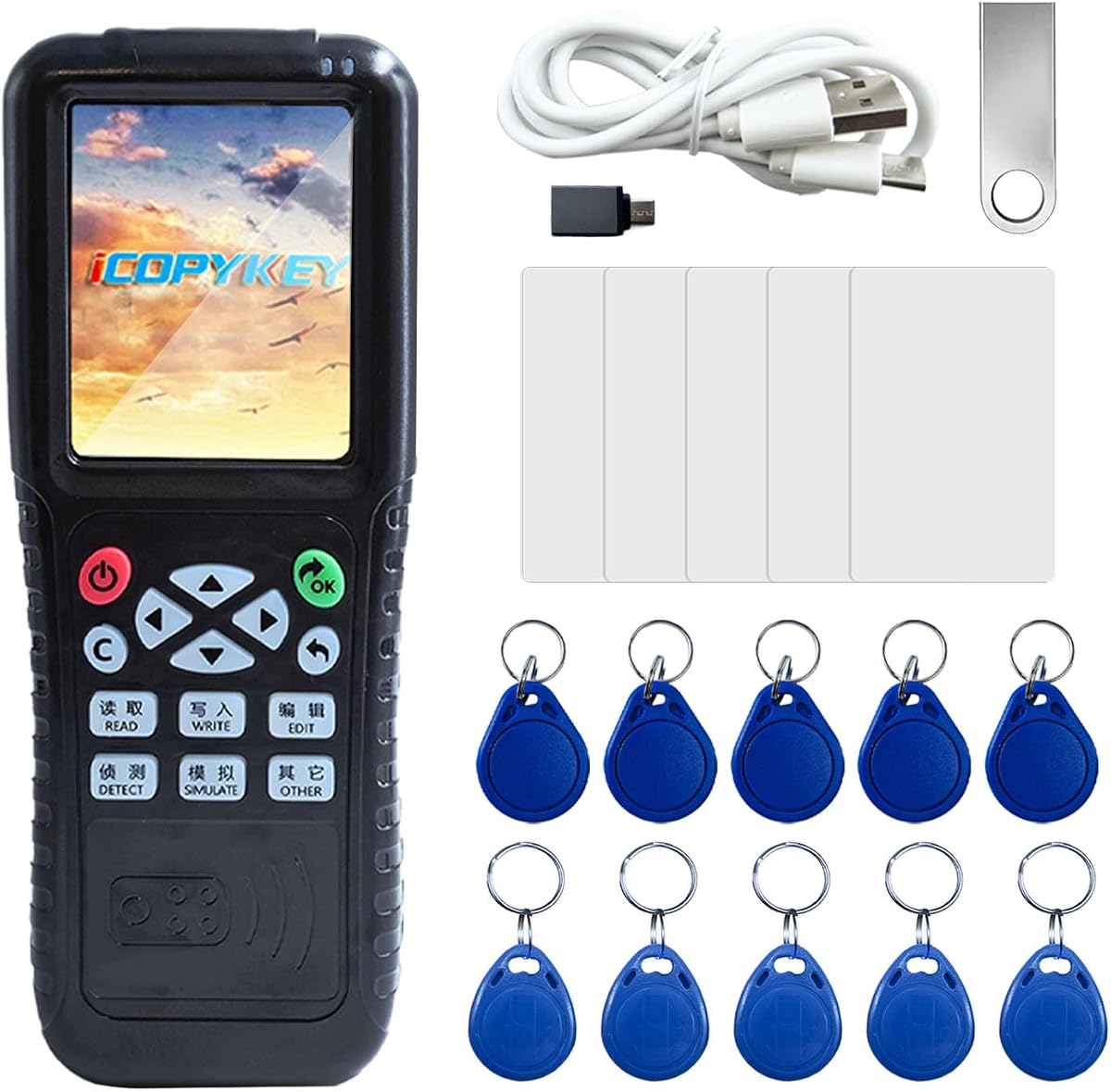
The X100 RFID Reader Writer is the most versatile device in this roundup, with a 5.0 rating and support for multiple low-frequency bands plus 13.56MHz. Unlike the simpler handheld copiers, it combines reader-writer functions with a 2.8-inch TFT color display, app connectivity, USB Type-C communication, and independent NFC simulation. That broader toolkit makes it the premium choice for access-control work involving more than one credential technology.
We may earn a commission when you buy through this link, at no additional cost to you.
The listed compatible frequencies are 125kHz, 175kHz, 250kHz, 300kHz, 375kHz, 500kHz, and 13.56MHz. The card list includes S50, S70, TK4100, EM4100, EM4200, T5577, TK4100-D, TK4168, HID, and AWID. Users can operate or decode through an app connected to a computer or Android phone, and the included USB drive contains installation materials and a manual. NFC simulation can simulate encrypted IC cards using a one-button function.
The trade-offs center on software and platform requirements. The files are supplied for Windows rather than Mac, and the listing says computer security software may identify the installation as malware, advising users to exit protection software in that situation. That is an unusual instruction and should be considered carefully, especially on a work or managed computer. The color display also makes the device more complex than a dedicated READ and WRITE handheld, and the default language is Chinese even though English can be selected.
This X100 is the strongest recommendation for a user who needs to inspect varied access credentials, review decoded information on a screen, or use the NFC simulation feature. It is less attractive for a single, straightforward 125kHz T5577 task because a basic copier is simpler. Confirm Windows or Android support, understand the installation procedure, and verify whether your cards and intended use fall within the listed capabilities.
Multiple frequency bands and a broad listed card family reduce the need to carry separate readers. The color screen provides an intuitive place to inspect recognized card information.
The supplied app and USB drive allow operation or decoding through compatible devices. This is more flexible than a purely button-driven copier, although it also introduces platform and installation considerations.
We may earn a commission when you buy through this link, at no additional cost to you.
The Keysy RFID Duplicator takes a different approach from a conventional copier: it functions as a reusable credential manager rather than simply writing one card at a time. Its 4.3 rating is the strongest among the dedicated 125kHz-focused products, and the listed support for HID Prox, AWID, Indala, ioProx, Rosslare, XceedID, Paradox, CDVI, and other formats distinguishes it from basic open-format devices.
We may earn a commission when you buy through this link, at no additional cost to you.
The Keysy can copy up to four 125kHz key fobs or cards into a single remote and then emulate those credentials in front of compatible readers. A Keysy-branded rewritable key fob is included, while additional media is sold separately. It can also write any previously read credential to that included target. This stored-credential workflow is useful for people who regularly switch among buildings, vehicles, gates, or other access systems and want one device to carry several authorized credentials.
The primary restriction is that Keysy writes only its own branded rewritable media. That closed ecosystem improves predictability but reduces flexibility compared with generic copiers that accept standard writable cards and tags. The product information also notes that not every door reader supports the remote's emulation function. A 1-year warranty, 30-day return window, and customer-care support provide additional reassurance, and the credentials are handled locally rather than sent to a copying service.
This is the best pick for a user managing several legitimate 125kHz credentials who values storage and emulations over a low-cost one-copy-at-a-time tool. Before buying, ask the seller whether the exact original fob is compatible and confirm that the intended reader will accept a Keysy remote. It is less suitable for 13.56MHz NFC credentials or users who need to write ordinary third-party cards.
Storing up to four credentials makes the Keysy useful for frequent transitions between access-controlled locations. The ability to re-emulate saved entries adds convenience beyond ordinary single-use copies.
The product avoids sending sensitive key-fob data to a third-party copying service. That local workflow may appeal to users who want more control over how their credential information is handled.
We may earn a commission when you buy through this link, at no additional cost to you.
The Handheld RFID Writer 125KHz is a compact duplicator with a 3.7 rating, placing it above several other entry-level entries in customer feedback. The package includes the reader-writer, three writable key fobs, three writable cards, and a user manual. It is designed for people who already understand that the blank targets start empty and must receive data copied from an original credential.
We may earn a commission when you buy through this link, at no additional cost to you.
The device supports several 125kHz chip types, including T5577, EM4205, EM4305, EL8265, and EL8268. Its small, lightweight body and lack of a computer connection make it convenient for on-site work. Parking cards, access cards, switch cards, and small button-style or shaped cards are among the listed applications. The writable targets are reusable, which allows the included set to serve repeated replacement or multi-access tasks.
The trade-offs are similar to those of other simple 125kHz devices. Two AAA batteries must be purchased separately, and the original credential must be compatible with both the copier's supported formats and the target's write capability. The listing specifically warns that pre-writing data from the original 125kHz device is required; the included blank chips do not work directly with a reader or lock. It also cannot handle 13.56MHz or encrypted credentials.
The product is a practical choice for a user who repeatedly needs reusable copies of supported low-frequency credentials and prefers a small standalone unit. It is less attractive when the original card is a newer, encrypted, or 13.56MHz system. Use the included manual to follow the read-then-write sequence, confirm the chip family, and install the required batteries before evaluating whether the copy works.
The included key fobs and cards can be rewritten rather than treated as single-use credentials. This is useful when a small number of standardized replacement tags is all you need.
The lightweight, standalone format makes the copier practical for mobile work. A user can move directly to the source credential rather than bringing cards back to a desk-based setup.
We may earn a commission when you buy through this link, at no additional cost to you.
The X7 RFID Reader Writer combines broad credential support with a 2.8-inch TFT color screen, placing it among the more capable access-control devices in this guide. Its 3.6 rating is moderate, but the feature set is substantial: listed frequencies range from 125kHz through 500kHz and include 13.56MHz, while supported card families include T5577, S50, S70, TK4100, EM4100, EM4200, TK4100-D, TK4168, HID ProxCard II, AWID, and Paradox.
We may earn a commission when you buy through this link, at no additional cost to you.
The package is unusually generous for a multi-frequency copier. It includes the main unit, a USB cable, five T5577 key chains, five T5577 cards, and five CUID key chains. The device can simulate encrypted IC cards through an independent NFC simulation function and allows a card number to be entered directly through the keypad, a useful shortcut for selected workflows. Its Type-C connection and low-power standby mode support regular computer-assisted use.
As with any broadly specified reader, compatibility is not universal. The listing invites buyers to contact the seller if a card cannot be read and notes that the sensing area is on the back of the device. Position matters: users may need to move the card around the sensing area to achieve recognition. Software and screen-based operation also make the X7 more complex than a basic two-button 125kHz copier, and not every common card format can be assumed to work.
The X7 is a good option for an access-control technician or technically experienced user who wants to identify multiple frequency families and keep a selection of writable media on hand. It is less suitable for someone needing a simple one-button workflow or a modern phone-only NFC use case. Check the exact card type, arrange the included USB connection as needed, and use direct number entry only where the target system permits it.
The listed frequencies and card families make the X7 more versatile than a 125kHz-only handheld. That breadth helps when credentials in the same building come from different access-control systems.
Fifteen keychains and cards provide a ready supply for testing and replacements. The mix of T5577 and CUID targets also reflects the device's broader card-handling focus.
We may earn a commission when you buy through this link, at no additional cost to you.
The RFID Reader Writer X100 is a screen-based, multi-frequency access-control copier with a 3.9 rating. It shares a close feature profile with the other X100 listing, including support for 125kHz, 175kHz, 250kHz, 300kHz, 375kHz, 500kHz, and 13.56MHz. A 2.8-inch TFT color display makes it suitable for users who want to see card information rather than rely only on a light or buzzer.
We may earn a commission when you buy through this link, at no additional cost to you.
Its supported card list includes S50, S70, TK4100, EM4100, EM4200, T5577, TK4100-D, TK4168, HID, and AWID. App connectivity allows operation or decoding through a computer or Android phone, while the included USB drive provides a manual and installation package. The independent NFC simulation function can simulate encrypted IC cards with a single button, and Type-C communication provides the physical connection.
The primary cautions are software-related. The listing says the included file does not fit Mac computers and instructs users to exit computer protection software if it identifies the file as malware. Installing files from an unfamiliar USB drive or weakening endpoint protection can create security risks, so this instruction deserves careful consideration rather than blind acceptance. English is available at startup or in system settings even though Chinese is the default language. Compared with basic readers, the device is also more complex to operate.
This X100 is best for a user who wants a visual, app-assisted workflow across several card technologies. It is a less natural fit for copying one known T5577 credential or for anyone who needs a Mac-only setup. Confirm the target platform, inspect the supplied installation materials, and ensure the exact source credential appears in the supported list before purchasing.
The TFT display provides a more informative interface than basic LED feedback. It is better suited to users who need to review decoded information before deciding what to write.
Operation and decoding can be performed through a connected computer or Android phone. This broadens the available workflow while making platform compatibility a central buying consideration.
We may earn a commission when you buy through this link, at no additional cost to you.
The ZHAOYU Handheld Copier is a 125kHz-only reader and writer built around a package of ten blue T5577 key fobs. Its 3.6 rating is moderate, but the included quantity and the stated ability to duplicate a compatible card up to 20,000 times make it interesting for users who need a steady supply of rewritable credentials.
We may earn a commission when you buy through this link, at no additional cost to you.
The device supports T5577, EM4305, CE5200, and other compatible 125kHz cards, with a listed reading and writing distance of 2.5 to 6 centimeters. Its mini handheld housing is designed for portability. The product description also gives unusually specific guidance about HID and AWID limitations: basic 26-bit open-format credentials may work, while proprietary encodings, longer 37-bit or 44-bit formats, Corporate 1000, and other advanced systems generally cannot be handled by a generic writer.
The included T5577 key fobs are blank and contain no preprogrammed card numbers, so they cannot simply be added to a lock. They must first be programmed with data read from a compatible source credential. Two AAA batteries are required and are not included. The copier cannot handle NFC, 13.56MHz, 960MHz, encrypted, or CPU-based cards, which sharply narrows the applications for which it is appropriate.
This is a strong choice for a property or service workflow that repeatedly issues key fobs from a known T5577-based system. It is not a good choice for unknown credentials or facilities using modern high-frequency access cards. Identify the protocol, confirm that the original credential is in an open or supported format, and obtain suitable batteries before relying on the ten included key fobs.
Ten writable T5577 key fobs and a stated 20,000-copy capacity suit organizations replacing tags regularly. The tags are reusable once written with the correct credential data.
The listing explains why some HID and AWID cards fail to copy. Recognizing the distinction between an open format and an advanced proprietary system is essential before choosing a generic copier.
We may earn a commission when you buy through this link, at no additional cost to you.
The Handheld ID Copier 125khz is a standalone low-frequency duplicator with a 3.5 rating. Its defining feature is the included set of ten blank T5577 keychains, split between five black and five blue examples, along with a user manual. That makes it a practical starter package for users who want to organize different credentials or recipients by color.
We may earn a commission when you buy through this link, at no additional cost to you.
The copier has simple READ and WRITE buttons and requires no computer. Its listed chip support includes T5577, EM4205, EM4305, EL8265, EL8268, and SIC7888, and compatible cards may be duplicated up to 20,000 times. It can read or clone EM4100 credentials and some basic AWID 125kHz clamshell cards, typically in 26-bit open format. The small, lightweight design supports on-site use, and the included keychains are reusable.
The restrictions are important. The unit operates only at 125kHz, so NFC, 13.56MHz, 960MHz, encrypted, and CPU-based credentials are incompatible. Many HID and AWID systems use proprietary 37-bit, 44-bit, Corporate 1000, or similar formats that a generic copier cannot copy. The supplied T5577 keychains contain no programmed card numbers and must receive data from a compatible original. Two AAA batteries are required and are not included.
This copier is best for a user handling known, unencrypted 125kHz credentials who wants several color-coded writable keychains. It is not suitable for a mixed credential environment or for anyone who needs to copy an advanced corporate card without first confirming its format. Read the included manual, verify the source protocol, and install fresh batteries before beginning your first read-and-write test.
Five black and five blue keychains make it simple to separate credentials by user, room, function, or department. The color choice also helps during testing and inventory management.
A varied list of supported chip families gives the device more flexibility than a copier limited to one target type. Compatibility still depends on the original credential's format and any encryption it uses.
We may earn a commission when you buy through this link, at no additional cost to you.
The right copier is defined by the credential you already own, not by the broadest specification on the box. Begin with frequency, chip type, security, and intended outcome, then consider display, connectivity, power, and the number of writable targets you need.
Frequency is the first filter because a copier cannot read a credential operating outside its supported range. Seven products in this list are designed specifically around 125kHz low-frequency credentials, while the X7 and both X100 listings add 13.56MHz and several other frequency bands. NFC generally refers to 13.56MHz technology, so a 125kHz-only reader is not an NFC reader regardless of how convenient its other features seem.
Match the device to the card you need to copy. Do not assume that a reader labeled RFID can handle every contactless credential. If you own several credentials with unknown specifications, a multi-frequency reader with a color display may be more useful than several separate basic readers.
Within one frequency, chip and protocol differences can determine whether a credential can be read or written. Common examples in these listings include T5577, EM4305, CE5200, EM4100, TK4100, S50, and S70. The listings also distinguish readable credentials from writable targets: an EM4100 or TK4100 card may be read successfully, yet a blank card of that type may not accept copied data.
Look for a list of supported chip families that includes the type physically printed or identified on your credential. Ask the seller for the card's protocol if the information is unavailable. This check is especially important when the package contains several different blanks or keychains.
Many access cards use proprietary encoding or encryption to prevent casual duplication. These listings repeatedly note that 26-bit open-format HID or AWID credentials may be compatible, while 37-bit, 44-bit, Corporate 1000, encrypted, and CPU-based systems may require specialized equipment. A failed copy does not automatically mean a defective device; it may simply mean the source credential is protected.
Choose a product that explicitly states whether it can read the card's security format. The Keysy lists several proprietary families and advises contacting support when compatibility is uncertain. The X100 and X7 list NFC simulation, but that feature should not be treated as permission to defeat credentials you are not authorized to access.
A standalone copier with dedicated read and write buttons is faster to deploy for simple 125kHz jobs. It needs no software and is usually easier to carry between locations. The small handsets in this guide fit that profile, although most require two AAA batteries that must be purchased separately.
Connected multi-frequency devices offer more detailed card handling, app-based operation, color displays, and a broader range of supported formats. They introduce Windows or Android compatibility, installation files, and security considerations. Choose the connected format when the extra visibility and flexibility justify a more involved setup.
Included cards and key fobs can determine how quickly you can begin. Packages range from three keychains and three cards in the Handheld RFID Writer 125KHz to ten keychains in the ZHAOYU and final Handheld ID Copier, six of each in the compact budget model, and fifteen mixed pieces with the X7. The Keysy includes one branded target and sells additional compatible media separately.
Count the number of credentials you realistically need and prefer reusable media over disposable tags. Remember that included blanks generally contain no programmed number. They must be read from an existing compatible source credential and then written before they can operate at a lock or reader.
A 2.8-inch TFT color screen is useful when you need to view decoded card information, confirm a recognized format, or select functions such as NFC simulation and direct number entry. Basic 125kHz copiers rely on LEDs and a buzzer instead, which may be sufficient for straightforward duplicates but provides less detail.
Multi-frequency screen units may depend on an included app, USB drive, or computer connection. The X100 listing says its files fit Windows and Android rather than Mac. It also warns that endpoint protection may flag the software, so use appropriate security judgment and avoid disabling protective software on an unmanaged work device without authorization.
Compact construction and low weight matter when a copier must be carried to doors, parking equipment, or client sites. The basic 125kHz models are explicitly designed for mobile work, with one listing giving a 56-gram weight. The X7 and X100 units are more substantial because they include screens, controls, batteries, and processing hardware.
Most compact models use two 1.5V AAA batteries, and the relevant listings state that batteries are not included. Add that requirement to your setup checklist. A product being sold with cards and keychains may still not be usable immediately until suitable batteries are installed and the blanks have been programmed.
A copier is valuable for replacing an authorized lost credential, managing spare access media, testing a system, or managing multiple authorized entries. The Keysy's ability to store four credentials is particularly suited to that last use case. Basic copiers are more appropriate for creating one-off replacements of known 125kHz tags.
Only duplicate credentials you own or are explicitly authorized to manage, and follow the access policies of the property or organization involved. Door readers may also block copied identifiers for security or system reasons, so a successful write does not guarantee that every lock will accept the replacement.
Start by confirming that the source credential and the destination tag are both supported. Check the frequency, chip family, encoding, and encryption before attempting a copy. For 125kHz devices, use a professional reader or a tool such as Proxmark3 when the card type is uncertain, and consult the seller if you cannot verify compatibility. Install the specified batteries before opening the package's testing workflow, and read the supplied manual because button sequences and supported target types can differ.
For a basic standalone copier, place the original card or fob in the sensing area and use the read function. A successful read is generally confirmed by the stated LED or buzzer feedback, although exact signals depend on the model. Remove the original, place a known writable T5577, EM4305, CE5200, or other compatible target in the same area, and use the write function. For screen-based devices, follow the on-screen prompts instead, adjust the card position if recognition fails, and use direct number entry only when appropriate for the target system.
After writing, test the new credential at a compatible reader before relying on it. Keep the original safe, label each copy with its associated credential or holder, and record which source device produced it. Store unused blanks in a clean, dry place, protect devices from impact and moisture, and remove batteries during long periods of nonuse if the manufacturer permits it. Do not write to encrypted or unsupported access credentials, and never treat a generic copier as a way to bypass access restrictions.
No. A copier must support the card's frequency, chip family, encoding, and security model. Many 125kHz-only units cannot read 13.56MHz NFC cards, encrypted credentials, CPU-based cards, or proprietary HID formats. Check the exact card type and consult the seller before purchasing.
Blank writable tags contain no credential number until they are programmed. You first read a compatible original card and then write that data to the target. After writing, test the new tag with a compatible reader before trying it at a lock.
The product information for the basic handheld models says two 1.5V AAA batteries are required and sold separately. This also applies to the Handheld 125khz Reader Writer, compact RFID 125KHz Reader Writer, Handheld ID Copier 125khz, ZHAOYU Handheld Copier, and the final Handheld ID Copier 125khz. Plan for batteries before delivery.
A 125kHz copier operates in the low-frequency band, while NFC generally uses 13.56MHz. They are not interchangeable. The multi-frequency X7 and X100 models list 13.56MHz support, whereas the other products in this guide are generally limited to 125kHz.
It depends on the format. Some basic 26-bit open-format credentials may work, but proprietary 37-bit, 44-bit, Corporate 1000, and encrypted systems may not. A failed read can indicate an unsupported security format rather than a defective device, so verify the protocol before ordering.
The basic handheld copiers operate without a computer using read and write buttons. The X7 and X100 screen-based devices use USB Type-C connectivity, and the X100 listing provides app operation through compatible Windows computers or Android phones. Computer-free models are generally simpler for routine on-site copying.
Not necessarily. Some EM4100 and TK4100 credentials are readable, but the same card type may not be writable. The product guidance identifies T5577, EM4305, and CE5200 as suitable writable targets. Always confirm the destination's chip type rather than assuming every readable card can be rewritten.
Rules depend on your location and circumstances. Copying credentials you own or are authorized to administer may be permitted, while copying another person's badge or bypassing security controls may violate laws, contracts, or policies. Use these devices only for authorized access management and follow your employer's or property manager's procedures.
The Keysy RFID Duplicator is the strongest all-around choice for managing several authorized 125kHz credentials because it stores up to four entries, supports numerous proprietary formats, and keeps data handling local. The X100 RFID Reader Writer is the premium pick when a color display, app connectivity, NFC simulation, and broader frequency support are important. For a simple and economical 125kHz workflow, the compact RFID 125KHz Reader Writer offers an approachable two-button design and a generous set of cards and keychains.
Prioritize compatibility before every other feature. Identify the source credential's frequency, chip family, bit format, and encryption status, then verify that the copier can both read that card and write the intended replacement. Consider connectivity only after establishing technical support, and remember that standalone devices generally need batteries while connected models also require a suitable operating platform.
Finally, check the current product listing before purchasing because prices, included accessories, ratings, and availability can change. Read the manual, install the required power source, and test a copied credential on a compatible reader before relying on it for an important door. The right copier should make authorized credential management more convenient without creating false expectations about unsupported technologies.