
Wideskall Universal Indoor Rabbit Ear Antenna
3.7Editor score
Extendable 24-inch elements
Dual-loop VHF UHF design
Three-foot coaxial cable
Compare 10 Rabbit Ears TV Antenna options for reception range, adjustability, setup, channel support, and design to find your ideal indoor antenna today.
Rabbit ears antennas remain a practical way to receive local television broadcasts indoors without a monthly cable or satellite subscription. Their adjustable elements can capture both VHF and UHF signals, while compact construction makes them suitable for apartments, bedrooms, dorm rooms, and conventional living spaces.
This guide compares ten indoor rabbit ears antennas based on the supplied specifications, including broadcast compatibility, advertised reception range, tuning options, cable length, installation method, physical design, and customer ratings. The list covers conventional dipole antennas, loop-equipped models, flat-panel alternatives, and a multipack for households needing more than one antenna.
The selections show how practical antenna design varies: some prioritize straightforward dipole adjustment, others emphasize a circular loop or a very small footprint, and one provides an amplified flat-panel approach for urban or suburban environments. Product ratings and availability can change, so check current listings and local broadcast information before purchasing.
3.7Editor score

4.2Editor score

4.0Editor score
The comparison below evaluates every antenna in the roundup for its tuning design, broadcast compatibility, installation needs, and suitability for different indoor environments.



The Philips Rabbit Ears Black Indoor TV Antenna combines traditional adjustable dipoles with a circular loop, giving users two different tuning elements to work with. Its 4.2 customer rating reflects a generally favorable reception of its design. The antenna is positioned as a versatile indoor solution for viewers who want local broadcasts on modern smart TVs, HDTVs, or compatible converter boxes.
We may earn a commission when you buy through this link, at no additional cost to you.
Its strongest feature is the combination of element types. VHF signals are handled by the adjustable dipole section, while the loop provides additional UHF reception and placement flexibility. The antenna supports 1080p broadcasts, is compatible with 4K and 8K televisions, and is listed as compatible with NextGen TV ATSC 3.0 where that standard is available.
Setup is straightforward: place the unit on a table or shelf, connect the included coaxial cable, and scan the television for available channels. Its broad compatibility also makes it reasonable as a secondary antenna for use during cable service interruptions or severe weather. U.S.-based technical support and a limited-lifetime replacement pledge add confidence for buyers seeking a durable household option.
The principal limitation is that no indoor antenna can guarantee a particular channel set regardless of location, terrain, obstructions, or broadcast conditions. This model may also be less visually suited to a television setup that requires the lowest possible profile. Overall, its flexible elements, modern broadcast support, and simple installation make it the strongest general recommendation in this roundup.
Adjustable dipoles and a circular loop give installers two ways to optimize reception. Extending and angling the dipole elements can help with VHF channels, while repositioning the loop can improve UHF reception in challenging indoor locations.
Support for 1080p, 4K, 8K-ready televisions, and ATSC 3.0 broadcasts makes this antenna appropriate for current and next-generation television ecosystems. Actual channel availability still depends on the over-the-air signals accessible at the installation address.
We may earn a commission when you buy through this link, at no additional cost to you.
The Philips Indoor TV Antenna Rabbit Ears for Local Channels combines a modern circular loop with adjustable dipoles and carries a 4.1 rating. It is designed for viewers seeking local news, sports, and entertainment through over-the-air broadcasts while avoiding recurring cable or satellite fees. The antenna is compatible with modern televisions and digital converter boxes.
We may earn a commission when you buy through this link, at no additional cost to you.
This model advertises reception from up to 30 miles away, although the usable result depends on local terrain, tower distance, building materials, and other interference. Its adjustable loop and dipoles allow fine-tuning after installation. Support for 4K and 8K Ultra HD televisions is useful because the antenna passes the received broadcast signal to the display rather than imposing a visible resolution limitation.
The included four-foot coaxial cable makes it easy to place the antenna on a flat surface near the television. After connecting it, viewers can run the television's channel scan. NextGen TV readiness adds compatibility with ATSC 3.0 services in areas where those broadcasts are available.
This is a balanced choice for users who value recognizable Philips branding, a flexible tuning arrangement, and clear indoor installation instructions. It does not offer the particularly thin form of a panel antenna, and buyers should not treat the stated range as a guarantee. For straightforward local-channel reception with modern feature support, it remains a strong contender.
The listed range provides a useful basis for comparing the model with other indoor antennas, but it should not be interpreted as a guarantee. Nearby obstructions, low-rise buildings, hills, and broadcast-tower direction can all influence what the television ultimately receives.
The four-foot coaxial cable provides enough separation for many entertainment stands while keeping the setup uncomplicated. Connecting the antenna, selecting the appropriate television input, and performing a channel scan are the essential installation steps.
We may earn a commission when you buy through this link, at no additional cost to you.
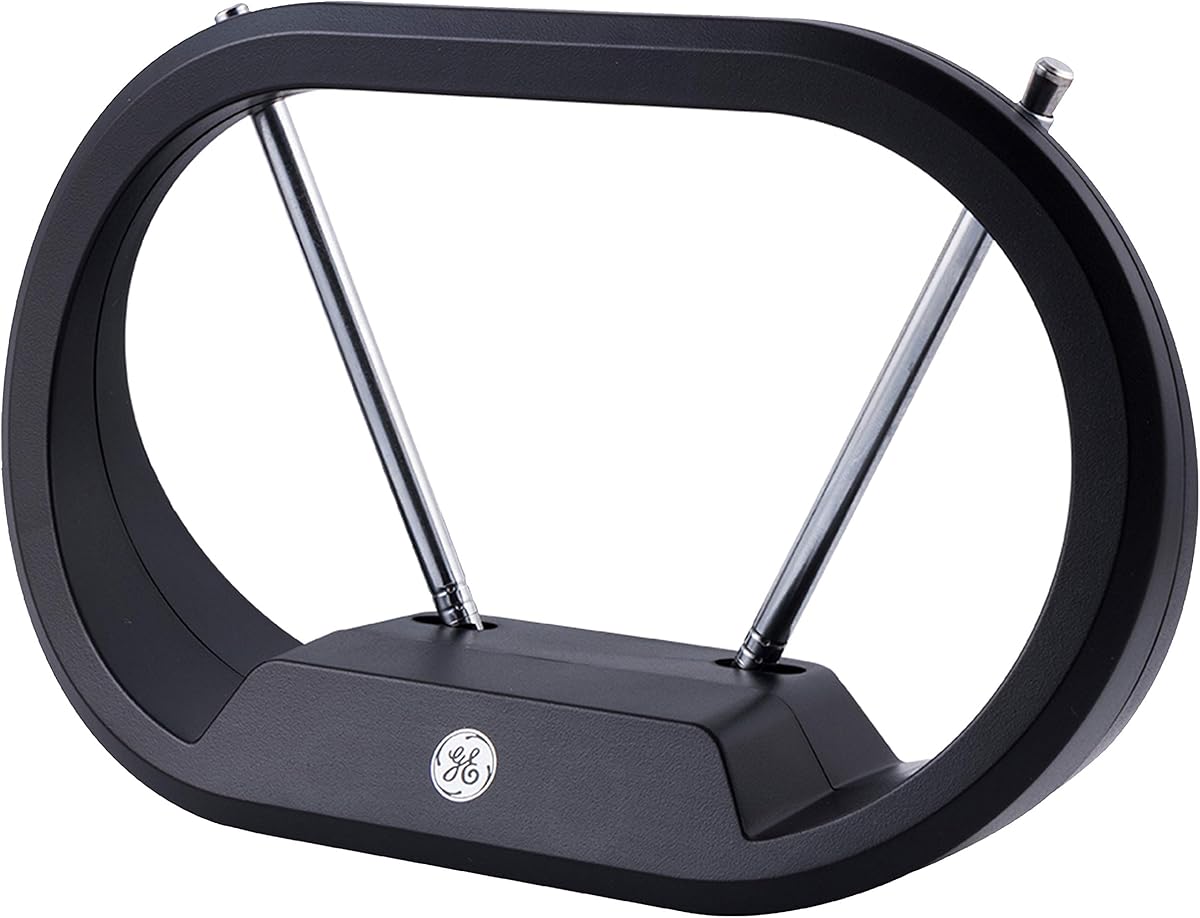
The GE Modern Loop Rabbit Ears Indoor TV Antenna offers a familiar 15-inch dipole design paired with a modern loop and a 4.1 customer rating. It is built for users who want local high-definition television without recurring service charges and who value adjustable reception elements. Its stated features cover both contemporary televisions and NextGen broadcasts where available.
We may earn a commission when you buy through this link, at no additional cost to you.
The extendable dipoles can be adjusted to improve reception and placement flexibility, while the loop adds another element for tuning. The antenna supports VHF and UHF broadcasts and is listed for 1080p content, 4K and 8K Ultra HD televisions, and ATSC 3.0 signals. An advertised range of up to 30 miles gives it a useful comparison point, though terrain and obstructions remain decisive.
Installation requires placing the antenna near the television, attaching the included four-foot coaxial cable, and running a channel scan. GE also provides U.S.-based technical support and a limited-lifetime replacement pledge, which may appeal to buyers who value long-term support as part of the purchase decision.
The most obvious trade-off is visual footprint. Fifteen-inch extendable dipoles require more space than a compact puck-like antenna or a thin flat panel. Even so, the model is a balanced option for receivers who want more manual tuning flexibility than a fixed indoor antenna offers. Its support and replacement commitment further distinguish it from many smaller alternatives.
The long dipoles can be extended to different lengths and repositioned to suit local signal conditions. This manual control is especially useful when a television is located away from the best-facing part of a room.
U.S.-based technical support and a limited-lifetime replacement pledge add value for owners who want assistance with setup and coverage concerns. Support does not change the physical realities of indoor reception, but it can make troubleshooting more accessible.
We may earn a commission when you buy through this link, at no additional cost to you.
The HIDB Compact Rabbit Ears antenna is designed for viewers who want local television in a small footprint. Its 3.8 rating places it behind several higher-rated products in this roundup, but its unusual installation options remain appealing. The base measures 1.25 by 1.25 by 4.75 inches, so it can fit on shelves, desks, windowsills, or other compact surfaces.
We may earn a commission when you buy through this link, at no additional cost to you.
A suction cup and double-sided tape allow the antenna to be mounted in different positions, including near a window or on a metal surface. The listing describes 180-degree directional reception and an advertised range of up to 120 miles. The physical dimensions are considerably smaller than conventional 15-inch dipole antennas, which makes this model easier to conceal.
The antenna supports 1080p and 4K UHD broadcasts where available and works with smart televisions or converter boxes. Setup involves connecting the antenna, selecting the appropriate television input, and scanning for channels. The supplied instructions emphasize rescanning whenever the antenna is moved, because a change in position can alter which stations the receiver finds.
The advertised range is far greater than that of most competitors in the list, but range alone cannot determine reception quality. Building construction, distance, terrain, and orientation remain important. This antenna makes the most sense for buyers who prioritize compact appearance, flexible mounting, and quick access to local channels over a more conventional tabletop design.
The included suction cup and adhesive mounting options distinguish this model from antennas designed only for a tabletop. Those choices allow the antenna to be moved closer to a window or raised above obstructions when the initial signal search is incomplete.
A repositioned antenna may find a different combination of stations because its direction and relationship to walls change. Running a fresh channel scan after each major adjustment helps the television apply the new signal position.
We may earn a commission when you buy through this link, at no additional cost to you.
The Compact Adjustable Rabbit Ears antenna has the highest customer rating among the products supplied, at 5.0. It is designed for both smart televisions and older sets with built-in tuners, as well as digital converter boxes. Its compact format and adjustable VHF and UHF dipoles make it a versatile choice for mixed technology households.
We may earn a commission when you buy through this link, at no additional cost to you.
The antenna can receive available local over-the-air broadcasts from major networks such as ABC, CBS, NBC, FOX, PBS, and CW, depending on location. It is listed as digital 4K and 1080p ready. Because the antenna measures 1.25 by 1.25 by 4.75 inches, it can be used on television stands, shelves, desks, windowsills, and other indoor surfaces.
Installation is direct. Connect the antenna to the television's antenna or RF input, select antenna or air mode, and perform a channel scan. The manufacturer recommends positioning the unit near a window or in a high location and rescanning after substantial changes to placement.
This model's main limitation is that the supplied information does not state a maximum reception range. A high customer rating is positive, but it cannot substitute for technical specifications or local signal availability. The product is best suited to users who need a compact, flexible antenna across several television types and value accessible support for setup and reception questions.
Supporting smart TVs, HDTVs, older televisions with built-in tuners, and converter boxes broadens the model's usefulness. It can serve as a shared household antenna without requiring a dedicated modern display.
The lightweight unit is easy to relocate, which is important because indoor signal results can change with position. Moving it toward a window or a higher shelf can reveal channels missed during the initial scan.
We may earn a commission when you buy through this link, at no additional cost to you.
The Wideskall Universal Indoor Rabbit Ear TV Antenna offers a conventional extendable design with a 3.7 customer rating. Its primary appeal is simplicity: a dual-loop structure, telescoping elements, and a three-foot coaxial cable provide a familiar way to receive VHF and UHF over-the-air broadcasts. It also supports FM radio reception.
We may earn a commission when you buy through this link, at no additional cost to you.
The antenna extends to a maximum of 24 inches, giving users room to change the length and direction of the elements. Its dual-loop configuration is designed for indoor HDTV reception, while the included cable allows placement on a television stand or nearby shelf. No tools are indicated for setup.
This model's listed video capability extends to 1080i HDTV broadcasts. It does not include the explicit 4K, 8K, or ATSC 3.0 compatibility language found on several competing products, so buyers should not infer those capabilities from the physical design alone.
The 3.7 rating indicates that reception experiences are mixed for some customers, which is common when indoor antennas are placed near structural interference. The model remains a sensible budget-oriented option because it provides extendable elements, both VHF and UHF reception, and a simple connection without adding advanced claims. It is best considered for basic local-channel viewing with realistic expectations.
The telescoping elements can be adjusted to different lengths, allowing viewers to experiment when stations are missing or unstable. Fine adjustments are particularly useful in rooms where a fixed direction does not produce consistent reception.
The three-foot coaxial cable is suitable for many nearby television setups, and the antenna can also pick up FM radio broadcasts. Its uncomplicated specification set makes it approachable for first-time over-the-air television users.
We may earn a commission when you buy through this link, at no additional cost to you.
The HIDB TV Antenna for Smart TV Indoor is a compact model built around omnidirectional reception and a 3.8 customer rating. Rather than relying on a narrow directional orientation, its design is intended to capture local signals from multiple directions. That makes it appealing for users who do not want to continually rotate or reshape an antenna to improve the channel list.
We may earn a commission when you buy through this link, at no additional cost to you.
The housing uses dual PC soft material described as flame-retardant, moisture-resistant, and lightning-resistant for indoor use. Its slim, lightweight construction is easy to conceal and move between a television stand, table, bedroom, apartment, or other living area. The product is positioned for local high-definition channels and is listed for 4K viewing.
Recommended setup starts with the television's antenna input and a channel scan. For better reception, the instructions suggest testing vertical and horizontal placements, mounting the antenna high, and positioning it near a window that faces local broadcast towers. A channel scan should be repeated after the antenna is moved.
The product does not provide a maximum advertised range, and its 3.8 rating suggests that results may vary. Nevertheless, omnidirectional reception and compact construction offer a distinct advantage over models that need precise directional placement. It is a practical consideration for renters or viewers whose television is positioned awkwardly relative to local towers.
The omnidirectional design reduces the need for exact tower-facing orientation. While walls and obstructions still affect reception, viewers can reposition the unit vertically or horizontally instead of relying on one narrowly defined angle.
The slim body is easy to hide around a television area, while the stated flame-retardant, moisture-resistant, and lightning-resistant properties make it suitable for normal indoor placement. The lightweight build also makes repeated testing of locations convenient.
We may earn a commission when you buy through this link, at no additional cost to you.
The GE Flat Panel Indoor HD Digital TV Antenna is a modern alternative to extendable rabbit ears. It carries a 4.1 rating and uses a low-profile panel with an adjustable stand, making it visually suitable for entertainment centers where long dipoles would be intrusive. It receives local VHF and UHF signals and supports a listed range of up to 40 miles.
We may earn a commission when you buy through this link, at no additional cost to you.
Compatibility includes 1080p HD, 4K Ultra HD, and NextGen TV ATSC 3.0 broadcasts where available. The supplied information notes that NextGen TV can deliver a stronger signal, premium audio, richer color, and faster refresh rates. Its receiving capability is intended to expand access to local channels rather than restrict the antenna to a particular display type.
Installation is tabletop-based. The adjustable stand supports horizontal or vertical orientation, while the included coaxial cable connects the antenna to a television or converter box. Users then run the television's channel scan. The ability to change orientation preserves some installation flexibility despite the fixed panel form.
This is not a conventional telescoping rabbit ears model, so buyers should recognize the different design category. Its benefit is a cleaner appearance and straightforward stand adjustment rather than hands-on dipole tuning. For users who prefer a discreet indoor antenna with generous advertised range and modern broadcast support, the GE Flat Panel is one of the strongest alternatives in the roundup.
The flat panel occupies less visual space than fully extended dipoles. It blends more easily with televisions, shelves, and other indoor electronics while retaining a stand that can be oriented for better reception.
Support for ATSC 3.0, 1080p, and 4K Ultra HD makes the panel suitable for modern local broadcasting. The listed 40-mile range exceeds that of several rabbit ears competitors in the comparison.
We may earn a commission when you buy through this link, at no additional cost to you.
The Philips Indoor TV Antenna Rabbit Ears three-pack gives households three identical antennas rather than a single tabletop model. Each antenna has a modern loop, 15-inch extendable dipoles, and a 4.1 rating, with a listed reception range of up to 30 miles. The multipack is designed for homes with several televisions or for keeping an extra unit in reserve.
We may earn a commission when you buy through this link, at no additional cost to you.
Every antenna supports local 1080p broadcasts, 4K and 8K Ultra HD televisions, and ATSC 3.0 where available. The included four-foot coaxial cable makes each unit straightforward to position on a flat surface. Viewers connect the antenna, select the appropriate television input, and perform a channel scan.
The main advantage is deployment flexibility. Three antennas can be tested in different rooms because an indoor signal may perform better in one part of a home than another. They can also serve televisions in separate bedrooms, offices, or living areas without requiring a single antenna to cover the entire household.
The trade-off is that most households do not need three units, and the multipack does not increase the advertised range of each antenna. Each placement still needs its own scan, and indoor conditions can differ substantially from room to room. It is best suited to multi-TV homes or buyers who value having spare antennas available for testing and backup.
Three units make it easier to discover which room offers the cleanest television signal. Rather than moving one antenna around and repeating the setup, buyers can place each antenna in a separate location and scan each television.
A household with a living-room television and televisions in bedrooms or offices can use one antenna in each location. The shared feature set and included cable length keep setup consistent across rooms.
We may earn a commission when you buy through this link, at no additional cost to you.
The Winegard FlatWave FL5500A is an amplified, multidirectional indoor antenna designed for urban and suburban environments. Its 4.0 rating and premium panel construction distinguish it from the basic extendable rabbit ears in this list. It advertises VHF and UHF reception from up to 60 miles while maintaining an ultra-thin, low-profile appearance.
We may earn a commission when you buy through this link, at no additional cost to you.
Rather than requiring users to manipulate long dipoles, the FlatWave uses an amplified panel design intended to gather signals from multiple directions. It connects directly to most televisions through a coaxial input and works with smart TVs, streaming devices, and other systems able to display over-the-air channels. NextGen TV compatibility supports use in areas offering ATSC 3.0 broadcasts.
Installation is presented as a no-tool process. After connecting the antenna, users run a channel scan while the Winegard app guides the setup. The dual-color panel is designed to blend into a home interior without complex mounting hardware, making it attractive near a television or in an entertainment area.
Its biggest limitation is that it is the most expensive option in the roundup, and amplification cannot create a broadcast signal where none is available. It also lacks the manual dipole adjustment of traditional rabbit ears. Even so, for buyers in dense urban or suburban areas who value multidirectional reception, a discreet profile, and app-assisted setup, it is the premium selection.
The internal amplification works with a multidirectional panel to strengthen usable over-the-air signals across VHF and UHF bands. This is particularly relevant in urban areas where towers may be distant or buildings may interrupt a direct line of sight.
The Winegard app assists users through the setup process while the television performs its channel scan. This guidance can make a low-profile, fixed-direction-style antenna easier for first-time users to position and configure.
We may earn a commission when you buy through this link, at no additional cost to you.
The right indoor antenna depends on local broadcast availability, room layout, television connections, and how much manual tuning you want to manage. Reviewing these factors before purchasing can prevent frustration after installation.
Antenna range is only one part of reception, and the stations available at an address matter more than a broad mileage figure. Check the DTV.gov Maps listing or another reliable over-the-air channel guide for the local towers, network affiliates, and available digital broadcasts. Compare those channels with the programs you actually watch, then favor an antenna that supports the relevant VHF and UHF frequencies.
Many local stations remain on VHF, while a substantial portion of digital broadcasts use UHF. A product described as VHF and UHF compatible gives you broader coverage than a model focused on only one band. Pay particular attention to loop or panel elements for UHF and adjustable dipoles for VHF, since they respond differently to walls, floors, and household electronics.
Traditional dipoles can be extended, shortened, and angled, giving manual control over reception. Loop and flat-panel antennas often use multidirectional designs that are easier to place but provide less hands-on adjustment. Consider how much tuning you are comfortable doing and whether the room has a clear line toward local towers.
Modern television compatibility includes 1080p, 4K Ultra HD, 8K-ready televisions, and ATSC 3.0 or NextGen TV. These labels indicate that the antenna can pass the corresponding broadcasts to compatible televisions and streaming devices. They do not guarantee that every network will transmit in the highest format or that ATSC 3.0 service is available in your area.
Rabbit ears can extend far beyond their base, while compact antennas and flat panels occupy less visual space. Measure the available television area before buying, especially if a long dipole would crowd surrounding objects. If signals are weak, visual size should not be the deciding factor; a higher or window-side placement may matter more than a slim footprint.
An amplified antenna can help preserve a weak but available signal across its electronics and cable. It cannot create a station that is outside the television's reception range, and excessive amplification may not improve a signal distorted by severe interference. For many indoor locations, a correctly placed multidirectional antenna is enough without added amplification.
Most indoor antennas use a standard coaxial connector and include a cable, but the length varies among the products here. Three feet suits close tabletop placements, while four feet offers more freedom to move the antenna toward a window. Confirm that your television or converter box has an antenna or RF input and that the antenna is compatible with it.
Setup assistance can be valuable because placement and rescanning often resolve more issues than replacing an antenna. Products listing U.S.-based technical support, customer service, or a limited-lifetime replacement pledge may provide greater confidence. Read the terms carefully and retain the receipt and packaging in case support is needed.
Begin by identifying the antenna or RF input on the television or digital converter box. Connect the supplied coaxial cable securely, turn on the television, and select the antenna or air input. If the television asks for a location or network setting during setup, choose the option for over-the-air reception.
Place the antenna near the television for the first scan, then extend and adjust its elements if it has dipoles. Raise it, rotate it, or move it toward a window if stations are missing. Run a complete channel scan after every meaningful change so the television can discover channels under the new orientation.
Keep the antenna away from obvious sources of electrical interference, and do not place it where it can be knocked over or pulled by a cable. Dust it gently, avoid moisture near the electronics, and keep the coaxial connection secure. For best results, rescan whenever broadcast conditions change or the antenna is moved to another room.
No. A rabbit ears antenna can only receive over-the-air signals that reach its location, and the available channels depend on broadcast towers, terrain, building materials, interference, and antenna placement. Check DTV.gov Maps for local coverage, perform a channel scan, and adjust or relocate the antenna if important stations are missing.
Yes. Moving an antenna can change both signal strength and direction, so the channel list discovered during an earlier scan may no longer reflect the best available reception. After extending, rotating, raising, or relocating the antenna, complete another scan on the television or converter box.
A higher position near a window is often a useful starting point, especially when the window faces local broadcast towers. The best indoor position can still differ because of walls, furniture, and neighboring buildings. Try several locations, compare the resulting channel lists, and keep the antenna in the position that produces the most stable reception.
No. Amplification can improve the handling of a weak signal that reaches the antenna, but it cannot create a broadcast that is unavailable at the location. Placement, antenna direction, frequency support, and local interference are usually more decisive than amplification alone.
Only if the television has an analog or digital tuner with a compatible antenna input. Many newer sets are streaming-focused and omit the tuner, while some older sets require a separate digital converter box. The antenna's RF or antenna connector should match the television or converter input.
Several models in this roundup support 4K televisions, 8K-ready televisions, or ATSC 3.0 broadcasts where available. The antenna must pass the signal to compatible equipment, but the television still needs a suitable tuner, and NextGen service must be available in the area. The advertised compatibility does not change the list of receivable stations.
Neither format is universally better. Extendable dipoles offer more manual tuning and can be useful around specific obstructions, while flat-panel antennas often look cleaner and may use amplification or multidirectional reception. The better choice depends on available space, tower direction, room construction, and willingness to adjust the antenna.
The first scan may have been performed in an unfavorable position, or the antenna may not be tuned for all available VHF and UHF signals. Extend and angle the dipoles, move the antenna higher or toward a window, and rescan. If reception remains weak, test a model with stronger multidirectional or amplified reception and verify local tower availability.
The Philips Black Indoor Antenna is the strongest all-around choice because it combines adjustable dipoles, a circular loop, modern broadcast compatibility, and straightforward support. The Wideskall Universal Rabbit Ears is the budget selection for basic local viewing, while the Winegard FlatWave FL5500A is the premium option for a discreet, amplified, multidirectional design.
Prioritize local channel availability, VHF and UHF support, and a tuning style that suits your room. Adjustable elements offer useful control in awkward spaces, compact models suit small entertainment areas, and flat panels minimize visual clutter. Cable length, ATSC 3.0 support, and manufacturer assistance can provide additional differentiation.
Ratings and product availability can change over time, and retailer pricing should be checked before buying. Use the comparison to match antenna design and specifications to your television setup, local towers, and room conditions, then be prepared to fine-tune the placement and run a final channel scan.