
CORSAIR RM850e (2025)
4.6Editor score
ATX 3.1 transient protection
Fully modular cable design
Quiet 120mm fan curve
Our PSU for Rtx 5070 and 5070 Ti guide compares wattage, ATX 3.1 support, efficiency, modularity, connectors, noise, and fit for every build.
Choosing a PSU for an RTX 5070 or RTX 5070 Ti requires more than matching a graphics card with a suitably large wattage number. Modern GPUs also benefit from ATX 3.1 transient-load handling, a native 12V-2×6 connection, efficient power delivery, and enough headroom for the rest of the computer.
This guide compares ten relevant ATX 3.1 power supplies alongside three current RTX 5070 and RTX 5070 Ti graphics cards that reveal important case-fit, connector, and power requirements. We evaluated the supplied efficiency certifications, power ratings, cabling, fan features, dimensions, and manufacturer guidance.
The selections include compact, budget-conscious, mainstream, and high-headroom options, with one review for every product in the supplied list. Each entry explains who the product suits and where it fits best, while current prices and availability can change at any time.
4.6Editor score

4.8Editor score

4.7Editor score
The table below places all ten products side by side, emphasizing the specifications most relevant to RTX 5070 and RTX 5070 Ti builds. It also includes the featured graphics cards so their stated PSU requirements, physical size, and connector needs can be considered together.



The Seasonic Focus GX-750 is a 750W ATX 3.1 and PCIe 5.1-ready power supply with a 4.8 rating, making it one of the strongest all-around choices in this guide. Its standout credentials include 80 PLUS Gold efficiency, Cybenetics Platinum certification, OptiSink thermal design, and explicit compatibility guidance for the NVIDIA RTX 5070 Ti and AMD RX 9000 series.
We may earn a commission when you buy through this link, at no additional cost to you.
The native 12V-2×6 connector removes the need for a transitional multi-adapter arrangement, while ATX 3.1 support is particularly relevant for a new RTX 5070 or RTX 5070 Ti system. A hybrid fan-control setup uses the 135mm fluid dynamic bearing fan intelligently, helping the unit remain quiet during lighter workloads without compromising cooling when demand rises.
Its principal limitation is the fixed 750W ceiling. That is sufficient for the graphics cards discussed here, but it offers less expansion room than an 850W or 1000W model. The hybrid cable arrangement is also less tidy than a fully modular unit, making cable routing less ideal in compact cases.
This is the most balanced recommendation for builders who want modern GPU power, high efficiency, and strong RTX 5070 Ti compatibility without moving to a larger wattage class. It is particularly well suited to a dedicated gaming system that does not require extensive future GPU upgrades.
Gold and Cybenetics Platinum certifications indicate an emphasis on converting AC input into usable DC power efficiently. Lower conversion losses can reduce waste heat and support quieter cooling, particularly during common gaming loads.
The native 12V-2×6 connection and ATX 3.1 platform make this a straightforward match for current RTX 50-series cards. That modern foundation also helps the unit handle the transient power excursions associated with demanding GPU workloads.
We may earn a commission when you buy through this link, at no additional cost to you.
The Seasonic CORE GX-750 delivers 750W in an ATX 3.1 and PCIe 5.1-ready platform and carries a 4.6 rating. Like the Focus GX-750, it combines 80 PLUS Gold with Cybenetics Platinum certification and includes a native 12V-2×6 cable for direct connection to compatible graphics cards.
We may earn a commission when you buy through this link, at no additional cost to you.
Seasonic explicitly identifies the unit as ready for the RTX 5070 Ti and RX 9000 series, which makes its compatibility claim easy to understand. The included 12V-2×6-to-dual-8-pin cable provides a useful option for older GPUs, while OptiSink design helps manage internal temperatures.
Buyers should consider that 750W leaves less margin for a heavily upgraded system or a future high-end graphics card. The included adapter also adds cable bulk, although it is not needed when the GPU accepts the native 12V-2×6 connection.
The CORE GX-750 is a strong midrange choice for a focused RTX 5070 or RTX 5070 Ti build. It suits buyers who prioritize efficiency and a native modern connection without paying for the extra capacity found in 850W and 1000W units.
A native 12V-2×6 cable provides a cleaner connection than a chain of traditional PCIe adapters. It is particularly useful for builds centered on current RTX 50-series graphics hardware.
The supplied 12V-2×6-to-dual-8-pin cable lets the same power supply serve an older compatible graphics card. That flexibility is helpful when upgrading a system one component at a time.
We may earn a commission when you buy through this link, at no additional cost to you.
The CORSAIR RM850x is an 850W, fully modular power supply with a 4.7 rating and a strong feature set for premium RTX 5070 and RTX 5070 Ti systems. It meets the ATX 3.1 standard, supports PCIe 5.1, provides a native 12V-2×6 connector, and carries Cybenetics Gold certification for efficiency up to 91%.
We may earn a commission when you buy through this link, at no additional cost to you.
Fully modular cabling is the RM850x's most user-facing advantage. Only the leads actually needed are installed, which can simplify assembly and keep the interior of a compact PC tidy. Embossed cables and low-profile combs also improve appearance and make otherwise similar-looking leads easier to identify.
Compared with a 750W option, 850W creates more breathing room for an enthusiast processor, a demanding GPU, and additional components. The trade-off is a larger and generally more premium unit than a basic 650W or 750W power supply, so buyers should consider case clearance and their actual component list.
The RM850x is an excellent all-around recommendation for builders who want meaningful headroom without jumping to 1000W. It is particularly attractive when clean cable management, efficiency, and a native modern GPU connector are priorities.
Detachable cables eliminate unused leads inside the chassis and reduce visual clutter around the power supply. This can be especially helpful when working in a compact enclosure with limited cable-routing space.
The 850W rating leaves room beyond the baseline needs of an RTX 5070 or RTX 5070 Ti system. That makes it a sensible middle ground for processors and other components that may add meaningful demand.
We may earn a commission when you buy through this link, at no additional cost to you.
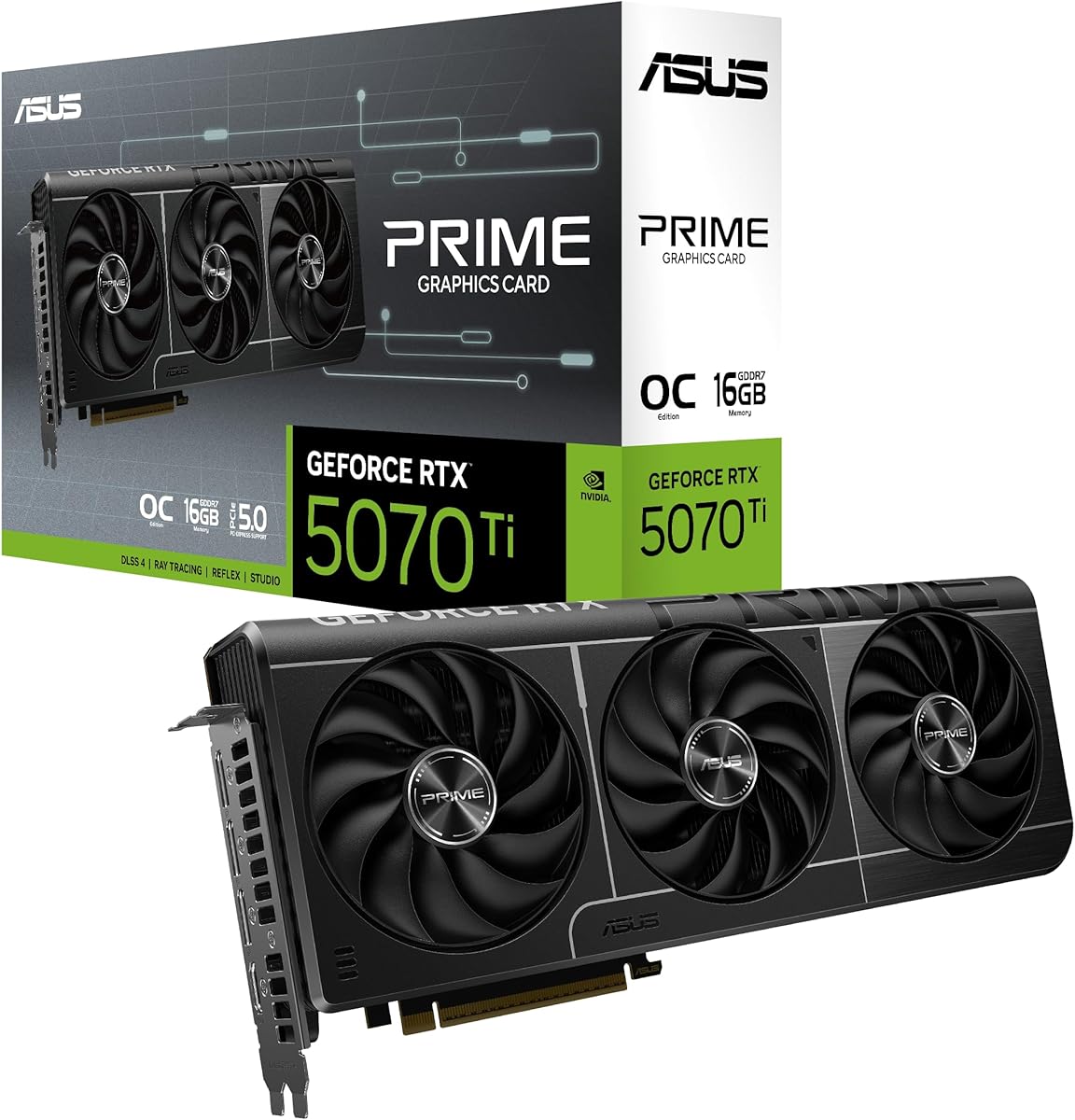
The ASUS SFF-Ready Prime RTX 5070 Ti is a 16GB GDDR7 graphics card with a 4.6 rating. Although it is not a power supply, it is important to this comparison because its published requirements clearly state that a minimum 750W PSU with a 16-pin 12V-2×6 connection is required.
We may earn a commission when you buy through this link, at no additional cost to you.
Its compact 306mm length, 2.5-slot thickness, and SFF-Ready positioning make it useful for evaluating whether a proposed power supply and case can accommodate a high-end GPU. The card also includes dual BIOS profiles, Axial-tech fans, dual-ball fan bearings, 0dB technology, and a phase-change GPU thermal pad.
The requirement for a native 16-pin connection rules out a PSU that lacks the appropriate 12V-2×6 cable or a safe supported adapter. Buyers should also verify case clearance and slot spacing, as compact dimensions do not eliminate the need to check motherboard and cooler arrangements.
This graphics card is best matched with the 750W Seasonic units or a more powerful 850W or 1000W model. Its own specifications give a clear benchmark for choosing a PSU that will support an RTX 5070 Ti without compromising the SFF goal.
The stated minimum of 750W with a 16-pin 12V-2×6 connector gives builders a concrete starting point. Higher-capacity options add useful headroom but should still be evaluated against the complete system.
A 306mm length and 2.5-slot design simplify many compact builds. Power-supply selection still requires checking connector reach, cable bend radius, case dimensions, and the position of adjacent components.
We may earn a commission when you buy through this link, at no additional cost to you.
The CORSAIR RM850e (2025) is a 4.6-rated 850W power supply that combines modern ATX 3.1 support with a fully modular design. It stands out as a value-focused way to obtain more headroom than a 750W unit while retaining clean installation and low-noise characteristics.
We may earn a commission when you buy through this link, at no additional cost to you.
Its ATX 3.1 certification indicates support for PCIe 5.1 platforms and the ability to withstand two transient power excursions from the GPU. A specially calculated fan curve, 120mm rifle-bearing fan, and 105°C-rated capacitors reinforce the emphasis on stable everyday operation.
The supplied product details do not specifically identify a native 12V-2×6 cable, so compatibility with the featured graphics cards should be confirmed in the final cable list and packaging. It also has fewer cosmetic extras than the RM850x, but those omissions do not alter the core electrical platform.
The RM850e is a compelling recommendation for a builder who wants substantial capacity without moving to 1000W. It is well suited to an RTX 5070 Ti system, particularly when a fully modular layout and quiet operation matter more than premium visual detailing.
ATX 3.1 certification is particularly relevant for modern graphics cards that can produce brief power spikes. The stated ability to withstand two GPU transient excursions adds confidence beyond a basic wattage comparison.
The calculated fan curve targets low noise, while full modularity removes unneeded cables. Together, these details make the unit practical for a clean daily-use or gaming system.
We may earn a commission when you buy through this link, at no additional cost to you.
The CORSAIR RM1000x is a 1000W ATX 3.1 and PCIe 5.1 power supply rated 4.5 by customers. It brings the largest capacity in the power-supply portion of this list, giving RTX 5070 and RTX 5070 Ti builders generous headroom for high-end processors, additional hardware, and future expansion.
We may earn a commission when you buy through this link, at no additional cost to you.
Its 91% Cybenetics Gold efficiency, native 12V-2×6 connector, and full modularity closely match the feature priorities of the RM850x. Embossed cables with low-profile combs help with identification and routing, while ATX 3.1 support is designed to resist transient power spikes from the GPU.
A 1000W rating is not necessary for many RTX 5070 systems, and buyers may end up paying for capacity they will not use. It can also be physically less convenient than a smaller unit, making case fit and cable reach important checks before purchase.
The RM1000x is the right option for a high-power, upgrade-oriented workstation-style build or a system intended to retain a large GPU for several years. For a focused gaming PC with an RTX 5070 Ti, an 850W model may offer a better balance.
A 1000W supply creates substantial room for power-hungry CPUs, multiple storage devices, and future graphics hardware. That reserve can reduce the chance of an upgrade requiring another PSU replacement.
The stated efficiency of up to 91% can reduce conversion losses and the amount of heat the unit needs to dissipate. A larger fan and controlled cooling strategy can help maintain lower noise during demanding workloads.
We may earn a commission when you buy through this link, at no additional cost to you.
The CORSAIR CX650M (2025) is a 650W semi-modular power supply with a 4.7 rating, native 12V-2×6 support, and a 120mm low-noise fan. It is the most compact-capacity option here, making it most relevant to an RTX 5070 build rather than a heavily upgraded RTX 5070 Ti system.
We may earn a commission when you buy through this link, at no additional cost to you.
Corsair states that the 650W model can provide up to 450W of GPU power through a single cable and specifically identifies the RTX 5070 and RTX 5070 Ti among supported cards. ATX 3.1 and PCIe 5.1 support, 105°C-rated capacitors, and LLC topology strengthen the technical foundation.
The main limitation is clearly its 650W ceiling. While the manufacturer says it is sufficient for the featured RTX cards, system-wide headroom depends on the processor, cooling solution, and other components. Semi-modular construction also leaves the main power cables attached, making the layout less flexible than a fully modular unit.
The CX650M is a sensible entry-level choice for a straightforward RTX 5070 gaming system where space, noise, and native connector support are priorities. Use Corsair's PSU calculator for the complete build and verify the final configuration before purchase.
The 650W model can cover a typical RTX 5070 configuration without the extra bulk of an 850W or 1000W unit. It is most appropriate when the rest of the system is not designed for unusually high simultaneous load.
The native 12V-2×6 cable supports current RTX 50-series graphics cards and compatible older models. Avoiding an adapter is helpful in tight cases where extra cable bulk and bend restrictions can be inconvenient.
We may earn a commission when you buy through this link, at no additional cost to you.
The ASUS ROG Strix RTX 5070 Ti is a high-clock, three-fan graphics card with a 4.7 rating. Its 2625MHz OC mode and 2602MHz default mode position it as an enthusiast-oriented RTX 5070 Ti option, while 16GB of GDDR7 memory aligns it with modern high-resolution gaming expectations.
We may earn a commission when you buy through this link, at no additional cost to you.
The 3.2-slot design uses a large fin array optimized for airflow from three scaled-up Axial-tech fans. MaxContact design and a phase-change GPU thermal pad are intended to improve heat transfer, while 0dB technology allows the card to remain relatively silent during light activity.
Its substantial size makes physical planning more important than with the ASUS Prime cards. A power supply with adequate wattage and a correctly supported modern GPU connection is essential, and the graphics card should be matched to a case that can accommodate its depth, height, and slot footprint.
The ROG Strix RTX 5070 Ti is best suited to a roomy performance build with an efficient 850W or 1000W power supply. It should be chosen for its cooling design and factory clocks, with the rest of the system designed to avoid restricting its airflow.
A large fin array and three Axial-tech fans provide substantial airflow capacity for a factory-overclocked card. Good case airflow remains essential because a powerful cooler cannot fully compensate for a restricted intake or exhaust path.
Because this is a large, high-performance RTX 5070 Ti, a system builder should avoid treating wattage as an afterthought. An 850W supply offers practical headroom, while 1000W gives additional room for an enthusiast processor and other power-hungry components.
We may earn a commission when you buy through this link, at no additional cost to you.
The ASUS TUF Gaming RTX 5070 Ti OC is a 16GB GDDR7 graphics card with a 4.7 rating and a 2610MHz clock. It combines a 3.125-slot design with an RGB-equipped exterior, making it a distinctive option for builders who want a capable RTX 5070 Ti without moving to the largest ROG-style cooler.
We may earn a commission when you buy through this link, at no additional cost to you.
Durability is a central theme. Military-grade components, a protective PCB coating, and a phase-change GPU thermal pad support long-term reliability, while the vented exoskeleton and Axial-tech fans are designed to improve heat dissipation. The listed fan design claims up to 31% more airflow than standard fans.
As with other three-slot-class cards, clearance remains a concern in smaller cases. The product description calls TUF Gaming Gold 850W or 1000W power supplies a perfect companion, which offers useful guidance for a high-end system. The dual BIOS also gives users a choice between Quiet and Performance modes.
The TUF RTX 5070 Ti OC is a strong fit for a mid-to-high-end gaming build that values durability, cooling, and understated performance. Pairing it with an 850W power supply balances its requirements without the excess capacity of a 1000W model.
Military-grade components, PCB coating, and a phase-change thermal pad reflect a focus on durability and consistent thermal transfer. These details are particularly relevant for a graphics card expected to remain in service through multiple gaming generations.
The manufacturer's reference to 850W and 1000W TUF Gaming Gold power supplies points toward a system with substantial capacity needs. An 850W ATX 3.1 unit is the more balanced starting point, subject to the rest of the build.
We may earn a commission when you buy through this link, at no additional cost to you.
The ASUS SFF-Ready Prime RTX 5070 is a compact 12GB GDDR7 graphics card with a 4.7 rating. It uses the NVIDIA Blackwell architecture and is designed for small-form-factor systems, making it a useful reference point for determining whether an RTX 5070-oriented power and cooling plan will fit into a compact build.
We may earn a commission when you buy through this link, at no additional cost to you.
Its 2.5-slot design preserves more installation space than a triple-slot card. Axial-tech fans, a phase-change GPU thermal pad, and a dual BIOS switch support the combination of cooling, quiet-light-load operation, and selectable performance behavior.
The supplied specifications do not state a specific minimum PSU wattage, so buyers should not infer one from the product title alone. The power supply should be selected from the graphics card's official documentation and the requirements of the complete system, ideally using a modern ATX 3.1 unit with a native 12V-2×6 cable.
This Prime card is a good match for a smaller RTX 5070 build where the 2.5-slot footprint and SFF-Ready designation are priorities. The CX650M may suit a leaner system, while 750W to 850W models provide more flexibility depending on the chosen processor and future upgrades.
The 2.5-slot form factor leaves more room for motherboard components and case airflow than many larger RTX 5070 designs. It is a strong option when a compact graphics card is needed but a power-hungry multi-slot cooler is not.
Because the supplied listing does not provide a minimum PSU rating, the most reliable approach is to check the card manufacturer's official system requirements. A modern 750W or 850W ATX 3.1 supply remains a practical starting point for many complete systems.
We may earn a commission when you buy through this link, at no additional cost to you.
The right power supply depends on the graphics card, processor, case, connector layout, and expected upgrade path. Use the wattage figure as a starting point, then verify efficiency, ATX 3.1 support, transient handling, and physical compatibility before making a final choice.
Start with the combined power demands of the graphics card, processor, motherboard, memory, storage drives, fans, and accessories. The RTX 5070 Ti featured in the ASUS Prime listing calls for a minimum 750W PSU, but the minimum is not the same as an ideal target. A system with a powerful CPU and several high-speed components may benefit from 850W or 1000W, while a more restrained RTX 5070 configuration can use a 650W unit if the manufacturer approves it.
Choose enough continuous capacity for normal operation and comfortable headroom for transient loads. A power supply that operates near its limit may not offer the same acoustic or efficiency profile as one running with more reserve.
ATX 3.1 is especially relevant to RTX 50-series graphics cards because the standard addresses short-duration power excursions associated with modern GPUs. The CORSAIR RM850e is specifically described as capable of withstanding two transient excursions from the GPU, while the other ATX 3.1 products in the list also emphasize current platform support.
Prefer a unit that explicitly states ATX 3.1 or PCIe 5.1 readiness instead of relying on generic references to future compatibility. This gives the power supply and graphics card a clearer shared electrical standard for demanding workloads.
A native 12V-2×6 cable is the cleanest connection for compatible RTX 5070 and RTX 5070 Ti cards. It reduces cable bulk compared with an adapter and avoids routing multiple traditional connectors through a single GPU socket. Seasonic, CORSAIR RM-series, and the CX650M explicitly include or emphasize the native cable.
Before buying, confirm the exact cable included with the selected PSU and GPU. Do not assume that a 12VHPWR or 12V-2×6-looking connection is interchangeable, and leave sufficient room near the socket for a proper cable bend.
Efficiency determines how much input power becomes usable system power and how much becomes heat. The Seasonic Focus GX-750 and CORE GX-750 carry both 80 PLUS Gold and Cybenetics Platinum credentials, while the CORSAIR RM850x and RM1000x are Cybenetics Gold-certified for efficiency up to 91%. The CX650M occupies the lower Cybenetics Bronze tier.
Higher efficiency can support lower temperatures and quieter fan operation, especially during mixed or gaming workloads. Certification labels are useful comparisons, but they should be considered alongside actual noise-control features and the quality of the overall platform.
Fully modular supplies let builders install only the cables they need, improving tidiness and reducing clutter behind the motherboard tray. The RM850x, RM850e, and RM1000x use this approach, while the CX650M uses semi-modular construction with permanent main power cables and the Seasonic models use hybrid fan control rather than a fully modular description.
In a compact chassis, every unused cable removed can make component access easier. Modularity is therefore a practical benefit as well as a cosmetic one, but it should be weighed against the selected case's available cable-routing space and cable-bend requirements.
A power supply does not need to run its fan continuously when load and temperatures are low. The Focus GX-750 uses hybrid fan control with a 135mm fluid dynamic bearing fan, the RM850e uses a calculated fan curve, and the CX650M uses a 120mm fan designed for low and medium loads. These approaches can keep a PC quieter during browsing, media playback, and light games.
For sustained heavy loads, consider the size and quality of the fan alongside the unit's thermal design. A larger fan moving air at a lower speed can be less noticeable than a smaller fan forced to ramp aggressively, although actual noise also depends on the system and loading pattern.
The power supply must physically fit the case, and the graphics card must leave enough room for cables to bend correctly. The ASUS Prime RTX 5070 and RTX 5070 Ti use a 2.5-slot SFF-Ready format, while the ROG Strix and TUF cards are substantially larger. Check motherboard slot spacing, CPU cooler height, GPU length, and PSU bay dimensions before ordering.
Compact cases can also complicate modular cable routing. A slightly larger power supply with better connector access may be easier to work with than a smaller unit that forces tight bends or leaves unusable cable space.
If the system may receive a more demanding processor, additional storage, or a future high-end graphics card, choosing extra capacity can reduce the need for another upgrade. The 850W and 1000W models in this guide provide that reserve, whereas 650W and 750W units are more tightly optimized for a defined configuration.
Do not buy a large wattage rating merely to maximize a number. Prioritize a verified ATX 3.1 platform, appropriate connectors, efficiency, and a case that can support the unit. Reasonable future headroom is useful; unused capacity without practical benefit is not.
Begin by confirming that the power supply's wattage and standards match the complete system. Compare the supplied cables with the motherboard, CPU, storage, and graphics-card requirements, and use the native 12V-2×6 cable whenever the GPU supports it. Arrange cables so they do not run directly beneath hard drives or interfere with moving fans.
Install the unit in accordance with its manual, using the correct orientation and the screws or mounting hardware appropriate for the case. Connect the modular leads only after the system is switched off and disconnected from mains power, then check each connector for a secure fit without forcing it.
Keep the intake and exhaust paths unobstructed, and do not operate the system with the power supply compartment open or exposed to excessive dust. For unusual silence or thermal concerns, use software monitoring to check behavior under load, but avoid opening the power supply because its internal capacitors can retain dangerous charge.
A 650W unit can be appropriate for a straightforward RTX 5070 system when the manufacturer approves the configuration and the processor is not exceptionally power hungry. A 750W ATX 3.1 supply offers a safer margin and is a practical starting point for many complete builds. Always calculate demand using the graphics card and CPU requirements rather than choosing from wattage alone.
The ASUS Prime RTX 5070 Ti listing in this guide specifies a minimum 750W PSU with a 16-pin 12V-2×6 connection. An 850W model provides more useful headroom, especially with a powerful processor, while a 1000W supply is appropriate for extensive future upgrades. A larger unit does not replace the need to check connectors, case fit, and case airflow.
ATX 3.1 is strongly preferable for a new RTX 5070 or RTX 5070 Ti build because it is designed around current GPU power delivery and transient-load behavior. It also supports the latest PCIe connectivity approach. Older high-quality units may work, but ATX 3.1 gives clearer confidence when pairing a modern graphics card with its recommended PSU.
Yes, whenever the graphics card and power supply support it. A native 12V-2×6 connection is simpler than using a multi-adapter and is particularly helpful in compact cases. The cable should be inserted fully and routed with enough space for the required bend, because a sharply folded connector can create unnecessary strain.
A 750W supply can meet the minimum stated for the ASUS Prime RTX 5070 Ti when the rest of the system is suitably restrained. An 850W unit is a better all-around choice when using a high-power CPU, adding storage and accessories, or preserving room for future upgrades. The exact manufacturer requirements for the selected GPU should always take priority.
Fully modular cabling can make small builds easier to assemble because unnecessary leads do not occupy the case. It also improves appearance and can simplify access to components behind the motherboard tray. Semi-modular or hybrid designs remain viable, but permanently attached cables and unused leads may be inconvenient in a particularly compact enclosure.
Efficiency can help by reducing the amount of heat that must be removed, but noise depends on the fan size, bearing type, fan curve, and operating load. A unit with a well-controlled fan and a higher efficiency certification can be especially quiet, though acoustic performance varies by case and system. A good case with restrained airflow paths can also reduce the need for a higher fan speed.
It may be physically possible, but the older PSU should be checked for wattage, connector support, ATX 3.1 readiness, and condition. A 12V-2×6 adapter can help with some older systems, although native connectivity is cleaner and more appropriate for a new build. For maximum confidence in transient handling and expected longevity, a modern ATX 3.1 unit is the stronger choice.
The Seasonic Focus GX-750 is the most balanced overall choice, combining 750W capacity, ATX 3.1 support, native 12V-2×6 connectivity, and dual efficiency certifications. The CORSAIR RM850e delivers useful 850W headroom at a value-focused level, while the CORSAIR RM850x adds polished efficiency, modular cabling, and cable-management details for a more premium build.
Prioritize the complete system's power demand rather than choosing on wattage alone. Confirm ATX 3.1 support, use a native 12V-2×6 cable when available, leave adequate room around the connector, and verify physical fit for both the power supply and graphics card. For a lean RTX 5070 system, the CX650M may be sufficient; a high-power RTX 5070 Ti system is better served by 850W or 1000W.
Current prices, discounts, bundle contents, and availability can change, so check the latest listing before purchasing. Review the final cable specification carefully, especially for units whose supplied descriptions do not explicitly mention a native 12V-2×6 cable, and validate the selected PSU against the manufacturer's requirements for your exact hardware.