
Cigarette Lighter Male Plug Adapter Inverter Cable
4.6Editor score
16 AWG copper wiring
Built-in 15A fuse
Green power indicator
Three-foot cable length
Explore the 10 best Power Inverter Cables for vehicles, solar, marine, and battery setups, comparing wire gauge, cable length, terminals, and built-in safety
Power inverter cables connect a vehicle, battery bank, or solar installation to equipment that needs dependable DC power. A suitable cable must fit the source, carry the intended current, use compatible terminals, and provide adequate protection against shorts and overloads.
We compared ten products spanning cigarette-lighter adapters, battery-clip leads, heavy-gauge lugged cables, and cut-to-length wiring kits. The comparison considers conductor size, cable length, connection style, fuse protection, construction, voltage support, and intended installation environment.
Each pick reveals where it fits best, from compact vehicle projects to demanding inverter installations. Ratings reflect available customer feedback, while specifications are based on the supplied product information. Product prices and availability can change, so confirm current details before buying.
4.6Editor score
4.8Editor score

4.6Editor score
The table below compares all ten options by their most important practical characteristics, including conductor gauge, connection method, cable length, and electrical protection. It makes it easier to distinguish quick vehicle adapters from permanently installed battery and power-distribution wiring.




This three-foot cigarette-lighter adapter is one of the most approachable ways to connect a vehicle-powered inverter or small appliance. It carries a 4.6 rating and uses 16 AWG red-and-black copper wire. Its most useful features are the integrated 15A fuse, green power LED, and plug-and-play construction.
We may earn a commission when you buy through this link, at no additional cost to you.
The phenolic plug shell is described as heat resistant, arc resistant, and more durable than ordinary plastic. Copper spring contacts and a soldered plug connection support dependable repeated use. The package also includes extra 20A and 15A glass fuses, which is helpful because a correctly rated replacement should always be available.
The main limitation is its 16 AWG conductor and relatively short three-foot length. That makes it most appropriate for moderate loads, compact inverter setups, air pumps, and electric cups rather than a high-output stationary system. The stated 12V and 24V support adds flexibility, although the actual appliance load must remain within the cable and fuse limits.
This is a sensible budget choice for users who want a simple vehicle connection without assembling battery lugs or purchasing separate protection. It also works well as a temporary or portable lead. Buyers needing more reach, lower resistance, or a permanently installed connection should move to a heavier cable set.
The built-in 15A glass fuse provides a clear protection point in the circuit, while the green LED confirms when power is present. Spare 15A and 20A fuses make routine maintenance easier and reduce the chance of driving with an unprotected lead.
The standard male plug and pre-soldered connections allow quick use with compatible vehicle sockets. Its compact form is especially convenient for portable equipment, though the short lead limits where the adapter can be placed.
We may earn a commission when you buy through this link, at no additional cost to you.
This two-piece 5 AWG battery cable set offers a more substantial connection for inverters, solar systems, marine equipment, RVs, and other high-current DC applications. Its 4.6 rating reflects broadly favorable customer feedback, while ten-foot leads provide useful installation flexibility.
We may earn a commission when you buy through this link, at no additional cost to you.
Each cable combines 3/8-inch and 5/16-inch lugs, allowing it to fit different studs and battery posts. Copper lugs receive a tinned coating for corrosion resistance, which is especially relevant in marine and outdoor installations. Polyolefin heat-shrink tubing seals the lug attachment points against moisture and wear.
Unlike a cigarette-lighter adapter, this is a permanently oriented battery connection that requires compatible terminals, fasteners, and proper routing. The larger conductor can handle more demanding current than the lighter leads in this list, but installation quality remains essential. Users must confirm that the battery posts and inverter terminals accept the included lug sizes.
This is the strongest premium option for users who value long reach, substantial conductor size, and multiple terminal formats. It is particularly useful for an inverter mounted away from the battery, in a boat, or in an RV. The set is less convenient for temporary use because the lugs are designed for a fixed electrical connection.
Providing both 3/8-inch and 5/16-inch lugs improves compatibility with different battery and equipment hardware. That versatility can reduce the need to modify or replace the cable ends during installation.
Tinned copper lugs and sealed heat-shrink joints add useful protection in humid or outdoor environments. These features make the set more appropriate for marine and solar wiring than a basic accessory lead.
We may earn a commission when you buy through this link, at no additional cost to you.
This 14 AWG adapter is a useful middle ground between a compact lighter cord and a full battery cable set. It has a 4.6 rating, a six-foot length, and an eyelet terminal designed for 5mm or 6mm inverter studs. The 20A fuse and LED status indicator make it suitable for powered car accessories.
We may earn a commission when you buy through this link, at no additional cost to you.
The male cigarette-lighter plug uses a standard design intended to fit most vehicle sockets. Its 6.3mm line nose aperture and 14 AWG wire provide a sturdier connection than a very thin accessory lead. Both 12V and 24V vehicle systems are supported, with output voltage remaining the same as the source.
One tradeoff is that the ring-terminal end must match the inverter stud. Buyers should measure the stud diameter and check the stated 5mm or 6mm compatibility before ordering. As with every lighter-powered lead, the vehicle socket and its internal fuse must also be rated for the intended load.
This adapter is well suited to car inverters, air pumps, electric cups, and DIY mobile equipment that need more reach than a three-foot cord. It offers a good balance of flexibility, visible power indication, and manageable 14 AWG conductor size, but it is not the right choice for a fixed high-current installation.
The six-foot length gives the inverter more positioning flexibility than a short plug adapter. It can reach from a socket into a cabin, cargo area, or nearby equipment without creating a very long cable run.
A 20A fuse helps protect the vehicle and connected device, while the LED indicates that the lead is energized. The additional 25A fuse provides a spare for future replacement.
We may earn a commission when you buy through this link, at no additional cost to you.
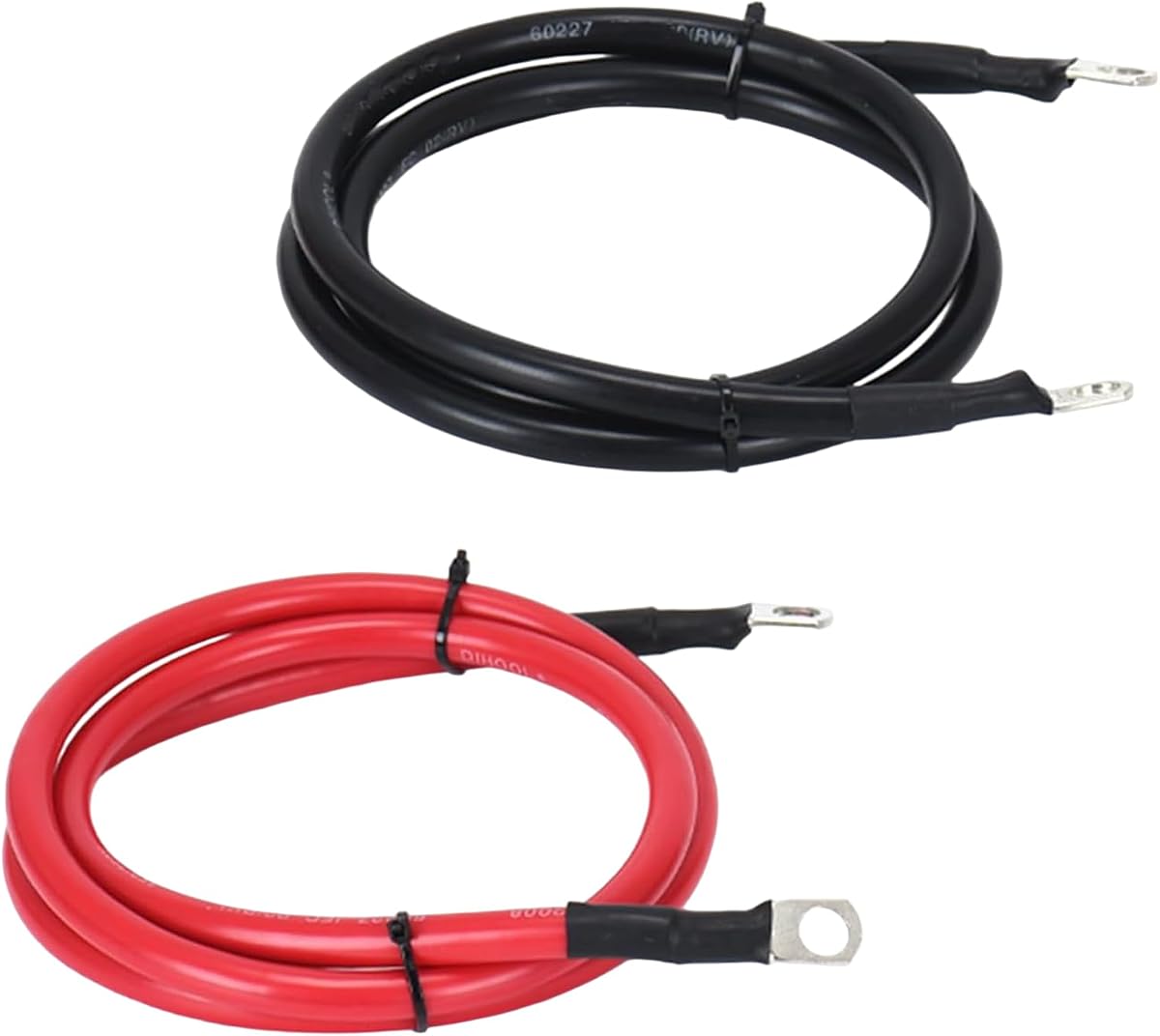
This four-foot 4 AWG pure copper battery cable set stands out with a 4.8 rating, the highest among the ten products. It is designed for power inverters and general DC connections in vehicles, solar systems, marine installations, RVs, motorcycles, and other equipment.
We may earn a commission when you buy through this link, at no additional cost to you.
The set includes one red positive and one black negative cable. Tinned copper ring terminals resist corrosion and oxidation, while the flexible PVC jacket is described as abrasion resistant, waterproof, moisture proof, flame retardant, and thermally insulated. Heat-shrink tubing seals the cable ends.
Four feet is adequate when the inverter and battery are reasonably close, but a longer route may require an extension or the six-foot version of the same series. The fixed 3/8-inch terminals also need to match the hardware on the battery and inverter. As with all high-current leads, secure connections and correct polarity are essential.
This is the best overall choice for a compact, fixed inverter installation that benefits from pure copper and a high customer rating. It balances current capacity, manageable length, and durable terminal construction. Marine, RV, and automotive users are especially likely to appreciate the sealed ends and corrosion-resistant lugs.
Pure copper provides the central advantage of this cable set, especially when conductor size and route length are important. It is a strong choice for a fixed battery-to-inverter connection rather than a lightweight temporary accessory lead.
Tinned ring terminals, a protective jacket, and sealed heat-shrink joints help preserve performance in demanding environments. These details are particularly relevant when the connection is exposed to moisture, vibration, or regular handling.
We may earn a commission when you buy through this link, at no additional cost to you.
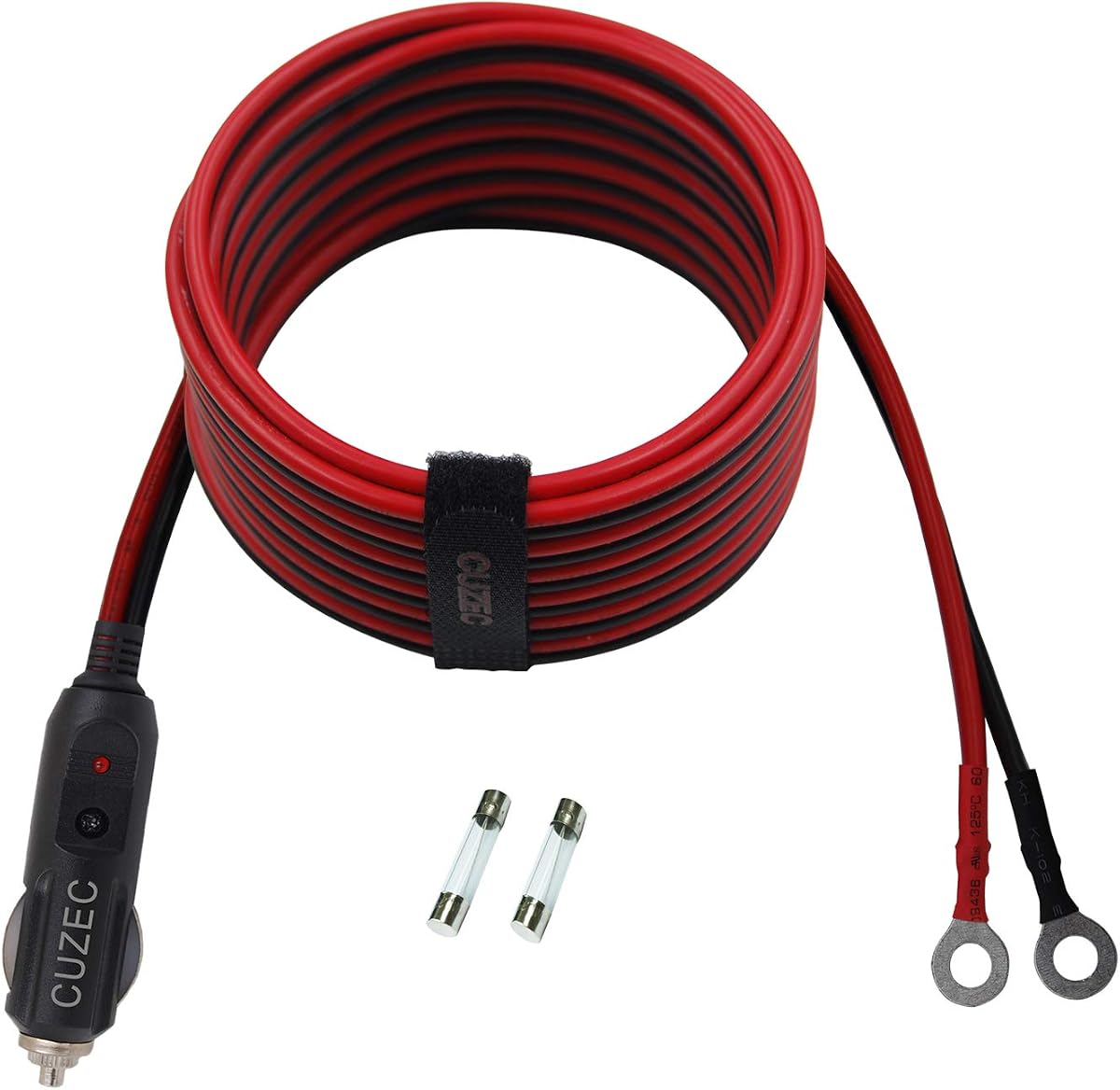
This CUZEC lead provides a direct battery connection with an unusually long 13.1-foot cable. It has a 4.5 rating and is designed for high-power inverters and other 12V or 24V appliances. Battery clamps make it useful when a fixed lug connection would be inconvenient.
We may earn a commission when you buy through this link, at no additional cost to you.
The red and black clamp leads make polarity easy to identify, and an external 15A fuse helps protect against a short circuit and high surge current. The other end uses an eyelet terminal with a stated 6.3mm hole, allowing it to attach to a compatible inverter stud.
Its 16 AWG conductor is lighter than the 4 AWG and 5 AWG options, so it should not be treated as a solution for unrestricted high-current loads. The generous cable length also creates more resistance than a short lead, particularly for a power-sensitive device. Battery clamps require periodic checks because movement and vibration can loosen them.
This product is a practical choice for portable inverters, camping equipment, and temporary diagnostic or workshop projects where the battery is too far away for a standard lead. Buyers should confirm both the terminal hole and the expected load before use, and they should inspect the clamps for a secure connection during use.
The 13.1-foot length is useful when a battery, portable inverter, and appliance are separated by several feet. It also reduces the need to improvise with extension cords in temporary mobile setups.
Clamp terminals make the lead easy to attach and remove without permanent modification to a battery post. This convenience is balanced by the need to check clamp tightness and keep the connectors clean and dry.
We may earn a commission when you buy through this link, at no additional cost to you.
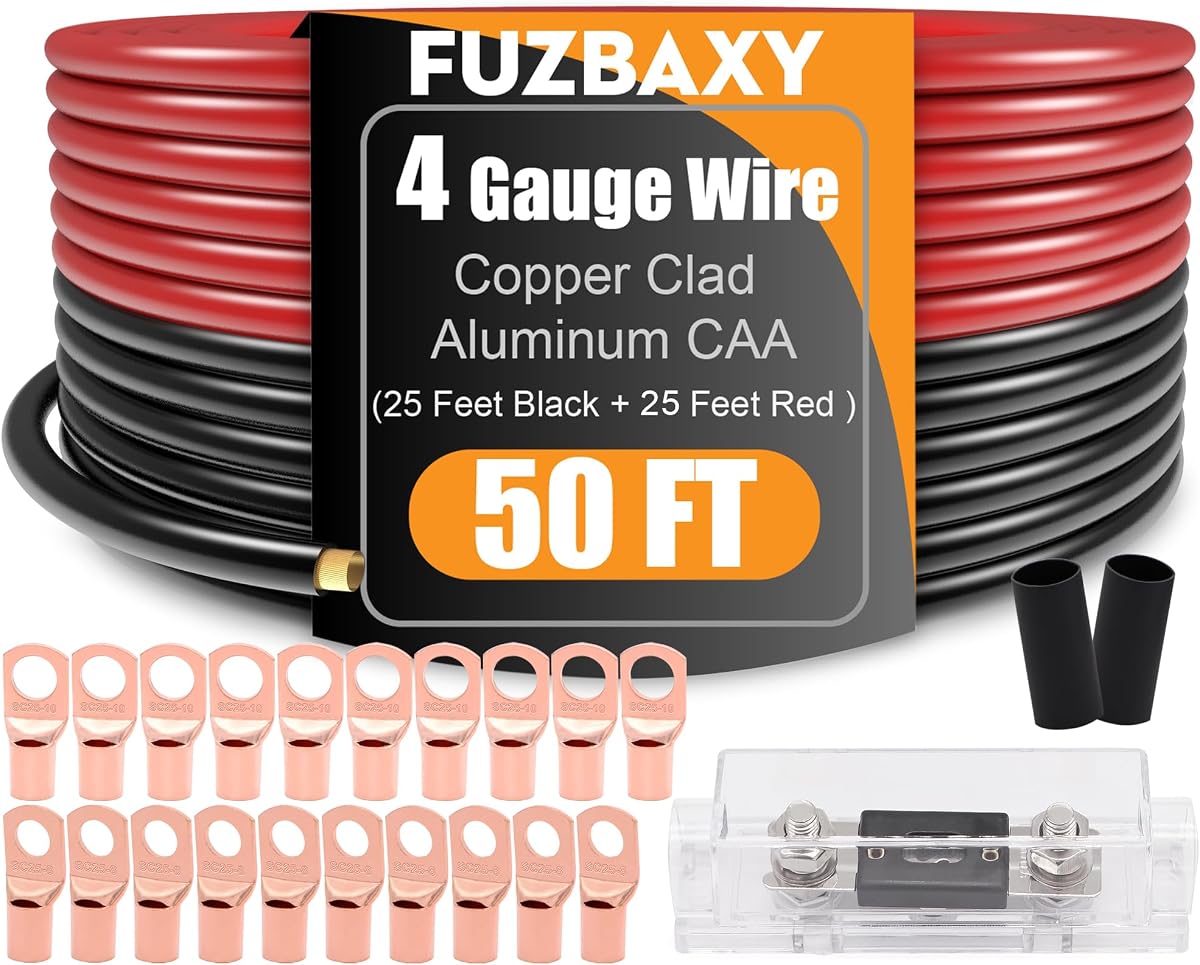
This kit is built for installers who want to create a custom high-current run instead of using a preassembled cable. It has a 4.6 rating and includes 25 feet each of red and black 4 AWG copper-clad aluminum wire, along with ring terminals, heat-shrink tubing, and a 100A ANL fuse holder.
We may earn a commission when you buy through this link, at no additional cost to you.
The extensive accessory set allows the wire to be cut for cars, trucks, boats, RVs, solar systems, winches, or marine inverter connections. CCA offers flexible handling and can resist corrosion better than standard copper in humid conditions. The included fuse holder provides a defined protection point for the completed circuit.
Unlike a ready-made battery cable, this package requires measuring, cutting, crimping, and finishing the connections. CCA has different conductivity characteristics from pure copper, which is important when cable length and load demand are significant. Users should follow good crimping practices and ensure the fuse holder is positioned close to the power source.
This is a strong option for a custom vehicle or renewable-energy installation, especially when one kit can cover several wiring tasks. It is less convenient for a quick plug-in setup. Installers who prioritize maximum conductor purity for a critical long run may prefer the ABIGAIL pure-copper options.
Ring terminals and heat-shrink tubing let an installer finish the cable professionally after determining the correct route. The result is a cleaner fit than using an uncut bulk wire in a confined installation area.
The 100A ANL fuse holder adds a purpose-built protection component to the kit. It should be installed where it can protect the cable and connected equipment if the circuit experiences an overload or short.
We may earn a commission when you buy through this link, at no additional cost to you.
This six-foot 4 AWG cable set extends the same pure-copper concept as the shorter ABIGAIL option while providing more routing room. Its 4.8 rating is the joint-highest listed rating in the group. It targets automotive, solar, marine, RV, motorcycle, and general power-inverter battery connections.
We may earn a commission when you buy through this link, at no additional cost to you.
One red positive and one black negative cable are included, with 3/8-inch ring terminals at each end. Tinned copper terminals improve oxidation and corrosion resistance. The flexible PVC jacket is described as abrasion resistant, waterproof, moisture proof, flame retardant, and heat insulating, with heat-shrink tubing covering the terminal attachments.
The principal difference from the four-foot version is installation reach, but length alone does not make every system better. A shorter lead can experience less voltage drop, while a longer lead is more useful when routing around obstacles. This set does not include a fuse, so appropriate circuit protection must be considered as part of the installation.
This is an excellent choice for an inverter mounted farther from the battery or for a vehicle installation that needs a little extra cable. The combination of pure copper, 4 AWG sizing, and a high rating makes it well suited to users who want a ready-made, durable fixed connection without cutting and terminating bulk wire.
The six-foot length provides useful routing flexibility while retaining factory-finished ring terminals. It is a practical middle ground between a short battery lead and a full custom wiring kit.
Pure copper conductors, tinned terminals, and sealed ends create a durable package for outdoor, marine, and mobile installations. The protective jacket is also designed to withstand abrasion and handling.
We may earn a commission when you buy through this link, at no additional cost to you.
The GEARit set provides 25 feet of red and 25 feet of black 4 AWG copper-clad aluminum wire. It has a 4.6 rating and is intended for custom amplifier, battery, inverter, distribution-panel, and automotive wiring. Unlike a complete battery lead, it gives the installer freedom to select the exact route length.
We may earn a commission when you buy through this link, at no additional cost to you.
Color coding simplifies positive and negative runs, while fine-stranded conductors and flexible jackets make the wires easier to guide through trunks, panels, amplifier racks, and battery compartments. CCA provides a practical balance of handling, corrosion behavior, and material cost where pure copper is not strictly required.
The package is focused on wire rather than a complete termination system. Compatible 4 AWG lugs, connectors, shrink tubing, and any necessary fuse protection must be obtained separately. CCA also warrants consideration of voltage drop over long routes, especially when an installation is close to the output limit of an inverter.
This pair is best for installers who already understand vehicle electrical work and need flexible bulk wire. It works particularly well for routing around structural components and fitting a project to exact dimensions. Beginners wanting a ready-to-install inverter connection should instead choose a preassembled lugged cable set.
Fine-stranded wire and a flexible jacket make routing through tight spaces more manageable. The generous lengths also make it possible to create separate power and ground paths without wasting short pre-cut cables.
The red and black pair can serve many DC projects, including inverter, distribution, and automotive work. Because accessories are not included, the selected terminals and protection components should be planned before installation begins.
We may earn a commission when you buy through this link, at no additional cost to you.
This CUZEC adapter combines a 12-foot cable with 14 AWG heavy-duty wire and a 20A fuse. It carries a 4.7 rating, making it one of the strongest customer-rated lighter adapters in the selection. The extended reach is particularly useful when the vehicle socket and inverter cannot sit next to each other.
We may earn a commission when you buy through this link, at no additional cost to you.
The male cigarette-lighter plug fits standard vehicle sockets and includes a 6.3mm line nose aperture. Red and black conductors identify polarity, while an LED indicates when power is active. The cable is compatible with 12V and 24V systems, and the package includes both a 20A fuse and a 25A spare.
A 20A cable cannot safely overcome a lower-rated vehicle socket fuse or other limitation in the upstream circuit. The 12-foot length may also produce more voltage drop than a shorter lead, which can matter for sensitive electronics. Users should check the socket rating, inverter input requirements, and the load before connecting the cable.
This is a practical option for a long temporary connection in a car, truck, or camper. It provides more reach than most cigarette-lighter leads while maintaining a familiar protected connection. For a permanent installation, however, a lugged battery cable and properly positioned circuit protection are usually more appropriate.
The 12-foot cable makes it easier to place an inverter or accessory away from the socket. It can cross a cabin, reach a rear work area, or serve equipment temporarily without an immediate extension.
The integrated 20A fuse protects the lead, and the LED gives immediate confirmation that the plug is receiving power. A spare 25A fuse is included for replacement needs.
We may earn a commission when you buy through this link, at no additional cost to you.
This product is a complete 300W power inverter rather than a cable-only accessory. It has a 3.9 rating, converts 12V DC into 110V AC, and includes a detachable 3.2-foot XT60 cigarette-lighter cable. That distinction makes it relevant to readers building a compact mobile power setup.
We may earn a commission when you buy through this link, at no additional cost to you.
The inverter provides two 110V AC outlets, two USB-A ports, and a 60W USB-C port with Power 3.0 support. Pure sine wave output is designed to provide more stable AC than modified sine wave alternatives, which can be advantageous for sensitive electronics. The cooling fan remains dormant below 100W and is stated to operate at 28.6dB.
Its 300W ceiling limits the appliances it can support, and the included cable has an XT60 connection intended for this inverter rather than a universal battery connection. The cigarette-lighter approach also depends on a vehicle socket and its upstream fuse. Users should not treat the USB-C wattage as additional inverter capacity beyond the total output.
This option is best for a traveler who wants an all-in-one inverter, AC outlets, and charging ports in a compact unit. For an existing inverter, a dedicated battery cable may be the better purchase. Its lower rating and specialized cable mean it does not lead the cable-focused recommendations, but it remains a complete solution for a straightforward vehicle power kit.
Pure sine wave output is the defining feature for users charging or operating sensitive electronics. The 110V output and 60Hz frequency are designed to resemble standard household AC more closely than a modified wave.
Two AC outlets, two USB-A ports, and a 60W USB-C port provide more connection options than a basic inverter. The detachable XT60 lead makes the unit easier to store when it is not needed.
We may earn a commission when you buy through this link, at no additional cost to you.
The right power inverter cable depends on the source, inverter input, load, route, and installation environment. Gauge, conductor material, length, terminal design, and fuse placement matter more than appearance or a broad compatibility claim.
Wire gauge should be selected according to the inverter's input current, cable length, acceptable voltage drop, and installation conditions. A thinner cable can create more resistance and heat, while a heavier cable provides additional current capacity. The 16 AWG lighter leads in this guide suit lighter or moderate portable loads, whereas 4 AWG and 5 AWG sets are more appropriate for demanding battery connections. Do not choose solely from the connector size: the conductor, terminal, fuse, and source must all be compatible with the load.
Choose a gauge that supports the full load and the complete cable route, not just the inverter label. Heavier is generally better when voltage drop is important.
A cigarette-lighter plug is convenient for temporary vehicle use, while battery clamps offer quick portability without a permanent lug. Fixed battery lugs and ring terminals provide a more stable connection for a permanently installed inverter, especially in an RV, boat, trailer, or off-road vehicle. Check whether the inverter uses threaded studs, bolt posts, or another input arrangement, then measure the required terminal hole or lug size before purchasing.
Select the connection that matches both the source and the planned mobility. Convenience should not come at the expense of a secure, low-resistance connection.
Measure the actual distance between the battery or power source and the inverter, then add enough slack for routing, service loops, and connector clearance. Longer cables are convenient but can increase resistance and voltage drop, especially with lighter wire. A three-foot lead may suit adjacent equipment, while six to twelve feet provides more placement freedom. Thirteen-foot and bulk-wire options help when the source and inverter are in separate compartments or the route crosses obstacles.
Plan the complete path before choosing length, and avoid leaving unnecessary excess cable where it can interfere with moving parts.
Pure copper is a straightforward choice for high-current or long runs because it is a familiar conductive material with strong performance characteristics. Copper-clad aluminum, or CCA, can offer flexible handling and can be useful where its properties meet the application. The tradeoffs include bulk, termination technique, and potentially different voltage-drop behavior. CCA is not the same as solid copper, so it should not be treated as a direct substitute without considering the cable length, load, and installation method.
Pure copper is the conservative option for critical power. CCA is most compelling in custom wiring projects where weight, routing, and cost are considered alongside electrical requirements.
A fuse is intended to interrupt excessive current before a cable overheats or equipment is damaged. Some lighter adapters include a fuse in the plug, while battery clip leads may use an inline fuse and custom wire kits may include a high-current fuse holder. The fuse rating must protect the cable and match the source, load, and conductor. Replacing a fuse with a higher-rated unit can defeat an important safety feature, so use the specified type and consult a qualified installer when uncertain.
Verify fuse placement, rating, and availability of a spare. A fuse holder should sit where it can protect the intended section of cable.
Marine, solar, camping, and automotive installations expose cables to moisture, salt, abrasion, heat, vibration, and UV. Tinned copper lugs, corrosion-resistant plating, and heat-shrink tubing can improve long-term reliability. A flexible PVC jacket helps with routing and wear, while sealed cable ends reduce the chance that moisture reaches a conductor. Even a well-built cable should be routed away from sharp edges, hot exhaust components, moving mechanisms, and standing water.
For exposed installations, prioritize corrosion protection, sealed terminations, and careful routing over cosmetic features.
Some adapters are designed for both 12V and 24V vehicle systems, while others are intended specifically for 12V DC inverter input. Confirm the inverter's acceptable input voltage before connecting any lead. Red usually identifies positive and black identifies negative, but color should never replace a proper positive and negative check. A reversed battery connection can damage an inverter or other equipment, so disconnect power and verify the circuit before use.
Check the inverter manual, the source voltage, and every terminal before energizing the system. Correct polarity is non-negotiable.
Plug-in adapters and battery clips are fast to install and easy to carry, making them useful for mobile or temporary use. Preassembled lugged cables are better suited to fixed installations because they provide a stable connection at both ends. Bulk wire kits offer the most control over length and routing but require termination tools and correct accessories. Decide how often the setup will be moved before paying for a more permanent or more customizable solution.
Choose a portable connection for frequent mobility and a secured cable for long-term installations. The best setup is the one that remains reliable in its intended setting.
Begin by turning off the inverter and disconnecting the power source. Compare the cable's voltage rating, conductor gauge, fuse rating, connector, and terminal dimensions with the inverter and battery. Route the cable away from sharp edges, hot engine parts, moving suspension components, and areas where it could be crushed or snagged.
Connect the black negative lead first when the source is a battery, followed by the red positive lead, unless the inverter manufacturer's instructions specify a different procedure. For cigarette-lighter adapters, insert the plug fully and confirm that the LED illuminates. For lugged leads, clean the battery posts or studs, fit the correct ring terminals, and tighten the hardware securely without damaging the conductor or terminal.
Before energizing the system, inspect the full cable for damaged insulation, exposed copper, loose terminals, corrosion, or improperly seated fuses. Recheck connections after initial use and periodically thereafter, especially for battery clamps and vibration-prone vehicle installations. Keep the cable dry, avoid overloads, replace only appropriately rated fuses, and disconnect it when it will not be used for an extended period.
The appropriate size depends on the inverter's input current, cable length, and acceptable voltage drop. A 16 AWG lead may be adequate for lighter portable loads, while 4 AWG or 5 AWG is generally more appropriate for demanding fixed battery connections. Always verify the inverter requirements and consider the full route before selecting a gauge.
Yes. Lower AWG numbers indicate heavier conductors, so 4 AWG wire is larger than 5 AWG wire. Both are much heavier than 14 AWG or 16 AWG accessory leads. The right choice depends on current, length, terminal compatibility, installation space, and how much voltage drop the installation can tolerate.
A direct battery connection can be appropriate for a fixed or high-current installation when the cable, terminals, fuse, and inverter are correctly matched. A cigarette-lighter adapter is easier for temporary use but depends on the vehicle socket and its fuse. Confirm the inverter's input current and voltage before deciding which method to use.
Yes. Longer cables add resistance, which can reduce the voltage reaching the inverter and generate additional heat. The effect is more noticeable with thin conductors and demanding loads. Choose only the length needed for the route, and use a heavier gauge when a long run or low voltage drop is required.
A cigarette-lighter adapter plugs into a vehicle socket and is intended primarily for portable or temporary use. A battery cable uses clamps or lugs for a more stable connection and is generally better for a permanent inverter installation. The vehicle socket and its internal fuse may also limit the load accepted by an adapter.
Only when the product is explicitly rated for both 12V and 24V operation. Some listed lighter adapters support both systems, while the 300W inverter in this guide is described as a 12V-to-110V device. Always check the inverter's input specification and the cable's voltage rating before connecting it.
Red generally identifies the positive connection, while black identifies negative. The color helps prevent installation errors, but users should still verify polarity independently. Reversing battery leads can damage an inverter or connected equipment, so confirm both connections before turning the circuit on.
Use cables with corrosion-resistant lugs, sealed terminations, and suitably insulated jackets, and protect the circuit with a correctly rated fuse. Route cables away from sharp edges, moving parts, heat sources, and standing water. Periodic inspections are important because vibration and moisture can loosen or corrode connections over time.
The Cigarette Lighter Plug Adapter is the best budget choice for a straightforward, protected vehicle hookup, while the ABIGAIL four-foot 4 AWG set earns the Editor's Choice for a durable, pure-copper fixed connection. The five AWG battery cable set stands out as the best premium option for its ten-foot length, dual lug sizes, and corrosion-resistant construction.
Prioritize the source connection, current requirement, cable length, and protection method before choosing a wire. A longer cable is not automatically better, and a larger gauge is useful only when its terminals and protection match the equipment. For permanent installations, pure copper lugged cables or a properly terminated custom kit generally offer greater flexibility than a lightweight plug adapter.
Finally, check current product specifications, inverter requirements, and availability before ordering. Ratings and product details can change, and prices vary over time. Confirm the cable gauge, length, connector size, fuse rating, and polarity so the selected lead fits the intended system safely and reliably.