
HANYCONY US to Australia Adapter
4.7Editor score
Two AC power outlets
Two USB-C charging ports
One USB-A charging port
Compact 2.4-ounce body
Compare the best power adapter for Australia travel, including plug compatibility, USB charging options, power ratings, portability, and multi-packs.
A power adapter for Australia travel should fit Type I wall outlets while accommodating the plugs and charging needs of your devices. The right model offers a secure connection, useful USB ports, manageable size, and a clear power limit, making it far more useful than a basic shape converter alone.
We compared all ten options by examining destination compatibility, supported plug types, AC outlet quantity, USB-A and USB-C availability, maximum power, voltage requirements, size, weight, extension-cord design, and whether the product was sold alone or as a multi-pack. Every model changes plug compatibility, but none converts voltage.
Each review explains where the adapter is strongest, where its specifications create limitations, and which travelers may benefit most. Ratings reflect the supplied customer feedback, while practical details come from the listed product information. As with all travel gear, prices and availability change frequently, so check the current listing before purchasing.
4.7Editor score

4.7Editor score

4.8Editor score
The comparison highlights destination compatibility, outlet configuration, charging-port mix, maximum rated capacity, portability, and pack size, helping travelers identify the adapter that best matches their devices and itinerary.


The TESSAN Australia Plug Adapter 2 Pack earns a 4.7 customer rating and stands out as the most balanced option in this guide. Each adapter combines a Type I plug for Australia and other compatible destinations with four American-style AC outlets and three USB ports. That combination handles plugged-in electronics, phones, earbuds, and smaller travel accessories without requiring a separate power strip.
We may earn a commission when you buy through this link, at no additional cost to you.
Its most useful feature is the USB-C port with Power Delivery up to 20W, while the two USB-A ports support the charging needs of additional accessories. The four-sided design allows up to seven devices to charge at once, and the stated dimensions and 4.01-ounce weight make it reasonably convenient for luggage, backpacks, and carry-ons. A power indicator helps confirm when the adapter is energized.
The main limitation is that this changes plug shape but does not convert voltage. Hair dryers, straighteners, curling irons, electric toothbrushes, and other high-draw appliances must support 100V to 250V dual voltage. It also has no surge protection or cords, which improves portability but may not suit someone seeking a protected, centralized power hub for a long hotel stay.
The two-pack format is a meaningful advantage for Australia travel. One adapter can remain in carry-on luggage while the other stays in a checked bag, or both can serve separate rooms or travel groups. This is a strong all-around choice for travelers who need multiple outlet positions, modern USB connectivity, and a compact form that works across several Type I regions.
Four AC outlets and three USB ports cover a useful mix of high-draw chargers and USB-powered devices. The design is especially convenient when a hotel room offers only one accessible wall socket.
Keeping one adapter in each bag reduces the risk of leaving a critical plug behind. The duplicate also allows simultaneous use in separate locations.
We may earn a commission when you buy through this link, at no additional cost to you.
The HANYCONY US to Australia New Zealand Plug Adapter provides a straightforward way to use American plugs in Type I destinations. It has a 4.7 rating, a compact 2.2 by 1.1 by 1.5-inch body, and a 2.4-ounce weight. For a traveler who mainly needs to charge a phone and laptop while keeping luggage light, that simplicity is an advantage.
We may earn a commission when you buy through this link, at no additional cost to you.
The adapter includes two standard American outlets plus two USB-C ports and one USB-A port. Its listed maximum AC capacity is 3,250 watts at no more than 250 volts and 13 amps, while the combined USB output is stated as 15.5 watts. The USB-C ports support up to 5V/3A, and the USB-A port supports up to 5V/2.4A, making this a practical choice for many common travel electronics.
This is a plug adapter rather than a voltage converter. Devices must support 110V to 250V, and high-draw appliances such as hair dryers, straighteners, electric toothbrushes, and razors should be checked before use. The supplied information also notes a rated limit of 1,875 watts and 15 amps for some described configurations, so users should follow the product instructions and avoid overloading the adapter.
The lack of surge protection and extension cord is worth considering. Some travelers may prefer a more protected or flexible power strip, but those who want an inexpensive, compact Type I converter with USB-C charging will find this option easy to justify. It is especially well suited to a solo traveler carrying a limited number of devices.
Two USB-C ports make this compact adapter more current-facing than a basic shape converter. They can charge compatible phones, tablets, and other devices at up to 5V/3A.
At only 2.4 ounces and without an attached cord, the adapter is easy to carry and position directly at a wall outlet.
We may earn a commission when you buy through this link, at no additional cost to you.
This two-pack of Australia and New Zealand travel plug adapters has a 4.7 rating and a particularly useful mix of three American AC outlets and four USB charging ports. Each unit can support up to seven devices, making it a solid choice for couples, families, or travelers carrying several phones, tablets, cameras, and battery chargers.
We may earn a commission when you buy through this link, at no additional cost to you.
The USB side includes two USB-A and two USB-C ports. The listed combined USB output is 5V/3.1A, with individual USB-C output up to 3A and USB-A output up to 2.4A. Importantly for device compatibility, the product information notes that USB-C is not Quick Charge 3.0 and does not support charging protocols requiring 9V to 22V. That makes it best viewed as a convenient standard-voltage charging hub rather than a laptop-charging powerhouse.
The adapter is rated for up to 2,500 watts at 250 volts and 10 amps. It does not convert voltage, so connected appliances must support the broad 100V to 250V range. As with many compact travel adapters, it has no surge protection and no extension cord. The blue indicator shows when power is active, while the stated 3.0 by 2.4 by 1.6-inch size remains reasonably compact.
Its strongest selling point is flexibility across two adapters. Travelers can place one in a carry-on and one in checked luggage, or use both in rooms with inconvenient outlet locations. It may not satisfy someone seeking high-wattage USB-C charging, but it is a well-rounded option for numerous lower-power devices and standard American plug accessories.
Three AC outlets and four USB ports reduce adapter clutter in hotels, dorm rooms, and shared accommodation. The multi-port layout is more practical than carrying several separate wall chargers.
The USB-C ports do not support the higher charging voltages used by some laptops and demanding devices. Check a device's charging requirements before relying on them for major power delivery.
We may earn a commission when you buy through this link, at no additional cost to you.
The HANYCONY Australia Plug Adapter 2 Pack combines a Type I destination plug with four American outlets, two USB-C ports, and two USB-A ports. Its 4.7 rating reflects a generally favorable response, while the two-side layout is intended to let several chargers connect without blocking one another.
We may earn a commission when you buy through this link, at no additional cost to you.
The AC outlets are listed at up to 3,250 watts, 250 volts, and 13 amps. The USB-C ports deliver up to 5V/3A, while USB-A supports up to 5V/2.4A. Combined USB output is stated as 15.5 watts. This configuration suits a traveler bringing several standard USB devices alongside one or two laptop chargers, although the USB ports are not designed for high-voltage laptop charging.
As with the single HANYCONY model, it is not a voltage converter. Compatible appliances must support 110V to 250V, and care is needed with hair dryers, straighteners, electric toothbrushes, and razors. The adapter has no surge protection, so travelers concerned about spikes or needing a protected extension point should consider a different design.
This pack is best for people who want more full-size outlets than the smaller three-outlet options. The second unit can serve as a spare or provide simultaneous charging in another area. Its compact dimensions and lack of a cord make it easy to pack, while the indicator provides reassurance that the adapter is receiving power.
Four American outlets accommodate multiple wall chargers without requiring a separate power strip. This is useful in hotel rooms where several travelers need to charge at once.
Two matching adapters make it easy to keep one in each bag or use both simultaneously in separate accommodation.
We may earn a commission when you buy through this link, at no additional cost to you.
The meta-ant Australia Travel Adapter is built for travelers who want more placement flexibility than a plug-only adapter provides. It combines a Type I destination plug, a five-foot extension cord, three American outlets, and four USB ports. That makes it a practical centralized charging point in a hotel room, cruise cabin, dorm, office, or kitchen.
We may earn a commission when you buy through this link, at no additional cost to you.
Its charging arrangement includes two USB-C ports and two USB-A ports. The USB-C outputs are listed up to 5V/3.4A and 17 watts, while the USB-A ports reach up to 5V/2.4A and 15 watts. All USB ports share a maximum output of 4.2 amps and 21 watts. The adapter can detect connected devices and optimize their charging, making it useful for phones, earbuds, and tablets.
Unlike a compact block adapter, the five-foot cord allows the hub to rest on a desk, nightstand, or other reachable surface while remaining plugged into the wall. The trade-off is size and weight: the listed weight is 10.64 ounces, and the unit measures 4.33 by 3.93 by 1.22 inches. It also lacks surge protection.
This adapter does not change voltage. Devices must support 100V to 250V, so high-draw styling tools need special attention. Overall, it is an attractive choice when a traveler values reach and centralized charging more than the smallest possible package. The attached cord distinguishes it clearly from the direct-plug alternatives.
The five-foot extension lets travelers create a reachable charging area even when the wall outlet is behind furniture or in an inconvenient position.
Three AC outlets and four USB ports make this a convenient single point for phones, tablets, cameras, and other travel electronics.
We may earn a commission when you buy through this link, at no additional cost to you.
The TESSAN US to Australia Plug Adapter 2 Pack is a substantial charging solution with a 4.7 rating. Each Type I adapter provides four American AC outlets, two USB-C ports, and two USB-A ports, allowing up to eight devices to be connected at once. The two-pack provides a spare and makes simultaneous use in separate locations convenient.
We may earn a commission when you buy through this link, at no additional cost to you.
The USB-C ports are differentiated by output. One supports up to 20 watts, while the other reaches 15 watts. Each USB-A port is listed at up to 12 watts. This makes the adapter a better fit for travelers who rely on USB-C phone, earbud, and other accessory charging than a simple Type I block. The four AC outlets remain useful for laptop chargers, cameras, and other American-plug accessories.
The listed maximum AC load is 2,500 watts, and the adapter supports 100V to 250V wide-voltage devices. It does not convert voltage, and high-draw appliances should only be used if they explicitly support broad input voltage. The absence of surge protection and cords keeps the design simple, though travelers who need either feature may prefer another model.
At 2.24 by 2.35 by 3.43 inches, the adapter is larger than several compact options but still portable. The two-pack is a good choice for a family or for splitting equipment across luggage. It offers a particularly effective combination of four outlets, two USB-C connections, and two USB-A connections in each unit.
Separate 20W and 15W USB-C outputs let travelers match charging performance to different compatible accessories without carrying multiple wall blocks.
Eight possible connections per adapter make the design useful for travel groups and anyone carrying several battery-powered accessories.
We may earn a commission when you buy through this link, at no additional cost to you.
The Ceptics Australia Plug Adapter 3 Pack focuses on the essential task of adapting American plugs for Type I outlets. It has a 4.7 rating and includes three units, giving travelers ample backups for luggage, hotel rooms, and travel companions. Each adapter accepts standard North American two- or three-prong flat-pin plugs, including polarized plugs.
We may earn a commission when you buy through this link, at no additional cost to you.
The design is notably compact at 1.5 by 1.5 by 1.75 inches. It is listed for a maximum load of 10 amps at 250 volts and is described as fully grounded. Unlike a universal receptacle that may present a crowded or less secure plug face, this product offers a focused input configuration for common American plugs.
There are no integrated USB ports, so travelers must bring separate chargers and cables for phones, tablets, and other USB devices. It also does not convert voltage. The supplied information specifies compatibility with dual-voltage electronics such as phones, laptops, battery chargers, tablets, and certain CPAP machines. It should not be assumed to support single-voltage hair styling appliances.
The three-pack makes this a practical choice for anyone who values simplicity, compactness, and redundancy. A traveler can place one adapter in each suitcase and one in a work bag, or use them across several rooms. Ceptics also includes a limited lifetime warranty according to the product listing, adding reassurance for a frequently used travel accessory.
Accepting common North American flat-pin plugs directly avoids the loose or crowded fit that can occur with broad universal socket designs.
Three matching adapters support multiple destinations, travel companions, and separate luggage without increasing the size of each unit.
We may earn a commission when you buy through this link, at no additional cost to you.
The Australia Power Plug Adapter, 4FT AU Power Strip is a corded Type I adapter designed to create a centralized charging point away from a wall socket. Its 4.6 rating is slightly lower than most products in the list, but the four-foot cord and combined AC and USB layout serve a distinct purpose for extended stays, shared rooms, and workspaces.
We may earn a commission when you buy through this link, at no additional cost to you.
It includes three American outlets and a total of four USB ports, with two USB-C and two USB-A connections. USB-C output is listed up to 5V/2.4A, while all USB ports share a maximum of 5V/4.8A and 24 watts. Smart charging technology is described as detecting connected devices. The product information specifically notes that the Type-C ports do not support MacBook Pro or other laptops requiring 14V to 22V.
The AC portion accepts standard North American two- and three-prong plugs and is rated up to 2,500 watts at 250 volts and 10 amps. The cord provides more freedom than a direct plug, but it takes up more room and is less convenient for moving between outlets. Hong Kong is specifically excluded because it generally uses Type G plugs.
This is not a voltage converter, and the supplied warning calls attention to checking device voltage before use. It works best for dual-voltage electronics and standard chargers. Travelers who want a flexible cord, several outlets, and basic USB charging in one package will find that it offers more function than a simple shape converter.
The four-foot cord helps travelers position a charging hub on a desk or bedside table instead of crowding directly around a wall outlet.
Three AC outlets and four USB ports support both traditional wall chargers and modern cables. USB output is best for lower-power accessories.
We may earn a commission when you buy through this link, at no additional cost to you.
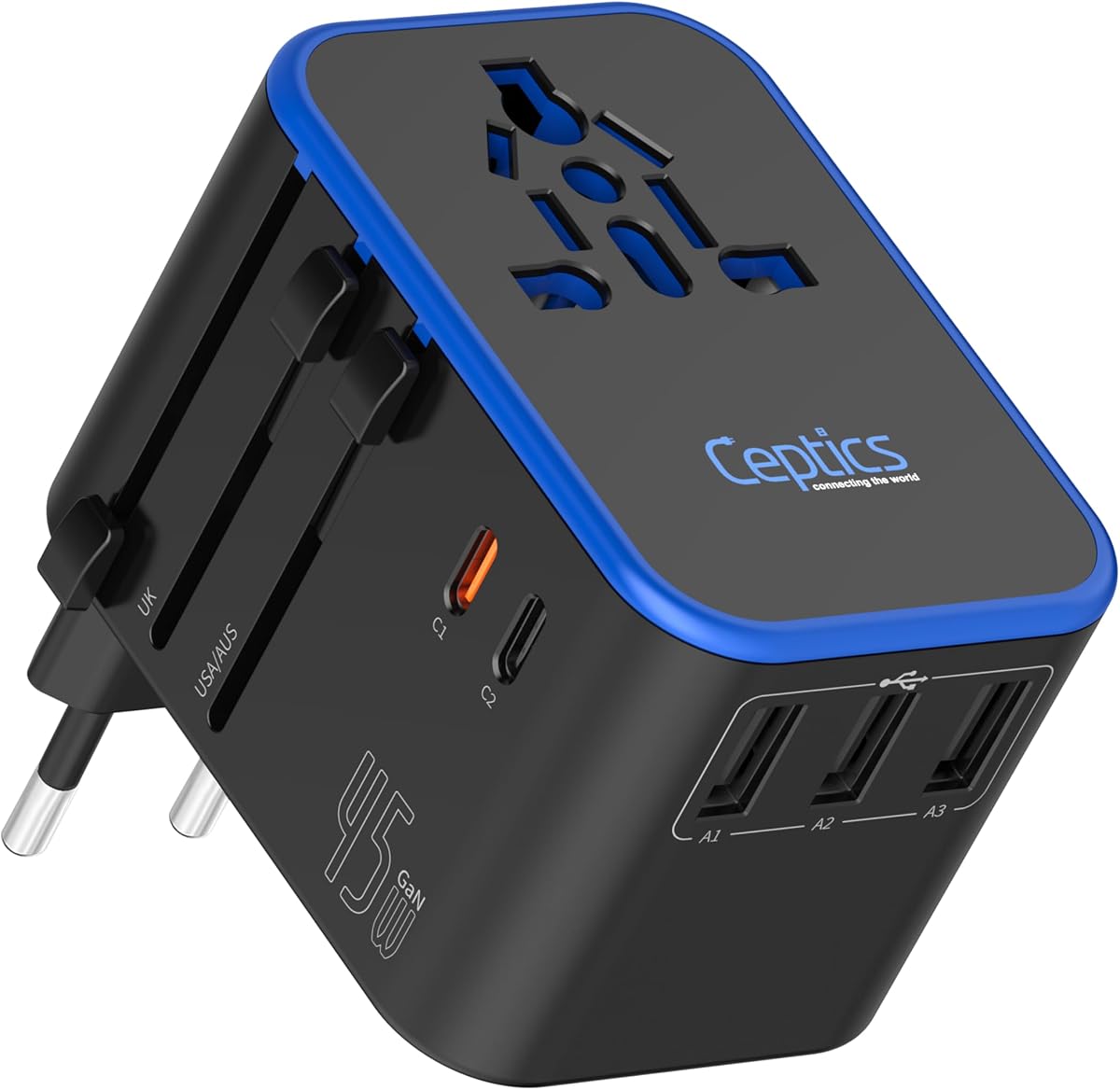
The Ceptics 45W Universal Travel Adapter is the broadest international option in this guide. Rather than using a single Type I destination plug, it combines a universal AC input with interchangeable output plug formats for Type A, Type I, Type C, and Type G destinations. Australia and New Zealand use the Type I configuration.
We may earn a commission when you buy through this link, at no additional cost to you.
The charging side includes three USB-A ports rated at 2.4 amps and two USB-C ports, one featuring Power Delivery and Quick Charge 3.0, with a stated total output of 45 watts. The listed compatible devices include phones, tablets, iPads, laptops, and other electronics, making this a more advanced universal charger than the compact Type I-specific models in the ranking.
Safety features include an eight-amp fuse, an extra replacement fuse, FCC, CE, and RoHS certification, electric-shock protection, a plug lock, and built-in safety shutters. These details are valuable for frequent international travelers, although the product still does not convert voltage. Devices must support worldwide 100V to 240V input, and 110V-only hair dryers, curling irons, and straighteners are expressly excluded.
The trade-off is that a universal receptacle can accept more plug shapes but may not hold a particular plug as securely as a dedicated adapter. For a trip focused on Australia, a Type I-specific product is usually more direct. For a multi-country itinerary, however, this adapter can reduce the number of accessories needed, particularly when paired with capable USB-C cables and chargers.
Type A, Type I, Type C, and Type G outputs make this a practical choice for trips that cross several regions instead of remaining entirely within Australia and New Zealand.
Power Delivery, Quick Charge 3.0, a replaceable fuse, and safety shutters make the adapter more versatile for technically compatible devices.
We may earn a commission when you buy through this link, at no additional cost to you.
The TESSAN Australia Plug Adapter 2 Pack has the highest listed customer rating in the group at 4.8. Each unit combines four American AC outlets, three USB-C ports, and two USB-A ports, allowing up to nine devices to charge simultaneously. It is the most connection-dense Type I adapter in this roundup.
We may earn a commission when you buy through this link, at no additional cost to you.
USB-A output is listed up to 2.4 amps, while the USB-C ports deliver up to 3 amps. Combined USB output is specified as 5V/5.6A and 28 watts maximum. The product is intended for smartphones, tablets, earbuds, and other compatible accessories. Its four AC outlets provide ample room for conventional American wall chargers as well.
The adapter is not a voltage converter. It supports devices designed for a broad 100V to 250V input range, and the instructions specifically advise checking hair dryers, straighteners, and curling irons for dual-voltage support. It has no surge protection, and there is no extension cord. Those omissions may be important for travelers seeking a protected hub or a long-reach power strip.
At 2.21 by 2.64 by 3.43 inches and 4.84 ounces, the design remains portable, while its four outlets are arranged so that several plugs can be used without blocking others. The two-pack adds redundancy and simultaneous-use flexibility. For a family, student dorm, cruise cabin, or group of devices, this is the premium capacity pick in the list.
Four AC outlets and five USB ports create one of the largest charging hubs available without adding an extension cord. It is especially useful for shared travel spaces.
Up to 3 amps per USB-C connection and 28 watts combined output suit many common travel accessories. Higher-voltage charging needs still require compatible chargers and cables.
We may earn a commission when you buy through this link, at no additional cost to you.
Choose by matching the destination plug, your device voltage, charging speeds, outlet quantity, and pack size to the way you travel. A compact converter is ideal for a light carry-on, while a multi-port model or corded power strip is better for groups and extended stays.
Australia and New Zealand generally use Type I wall sockets, which have two angled flat pins and a vertical earth pin. A suitable travel adapter must physically present that plug configuration while accepting the wall plugs you intend to bring. Most models in this guide accept standard North American two- and three-prong flat-pin plugs, including polarized plugs, which is a significant advantage over a generic adapter that may fit awkwardly.
Several listings also describe compatibility with other Type I destinations, including China, Argentina, Fiji, Samoa, and various Pacific island locations. That can be helpful for an itinerary covering more than one country, although travelers should confirm current local outlet requirements rather than relying solely on the product description.
Every product in this roundup changes plug shape; none changes the voltage supplied by the wall. Australian outlets generally provide 220V to 240V, so a device intended only for 110V or 125V should not be connected even if its plug fits. Dual-voltage electronics marked for 100V to 250V or a similarly broad range are the appropriate choice for use with these adapters.
Hair dryers, straighteners, curling irons, some electric toothbrushes, and certain razors are common examples of appliances that may not accept overseas voltage. Check the labeling on the device or its original charger before packing it. If the appliance supports only one voltage, a separate approved voltage converter is required; a shape-changing travel adapter cannot provide that function.
AC outlet count determines how many conventional wall chargers can operate at the same time. Products with two outlets suit a solo traveler carrying a laptop charger and perhaps one other plug. Three- and four-outlet models are more useful for couples, families, dorm rooms, and travel groups. More outlets do not inherently mean a device can draw more power, so the adapter's total wattage and current ratings remain important.
The listed maximum capacities range from 2,500 watts to 3,250 watts, depending on the model. Stay below the stated rating and avoid connecting several high-draw appliances through one adapter. When in doubt, follow the instructions supplied with the product and distribute demanding loads across separate outlets or adapters.
USB-C ports can reduce the number of separate charging blocks a traveler carries, but their usefulness depends on protocol and power support. The TESSAN options include USB-C Power Delivery, with one model offering 20W and another presenting 15W and 20W outputs. The Ceptics universal adapter supports Power Delivery and Quick Charge 3.0 and provides a stated 45W combined output.
Other products provide USB-C charging at standard 5V levels. That is suitable for many phones, earbuds, watches, and small accessories, but it may not fast-charge a modern laptop. A USB-C port does not automatically support every USB-C charger or device, and a cable can also limit performance. Check wattage and voltage requirements before assuming a port can fast-charge a particular product.
USB-A remains useful for older phones, cameras, power banks, earbuds, and numerous travel accessories. Models with one or two USB-A ports let travelers keep a conventional cable option without sacrificing every USB port. Products with both USB-A and USB-C offer better flexibility, especially for mixed travel groups whose devices do not share a charging standard.
Output sharing matters when several devices draw power simultaneously. The listed combined outputs range from 15.5 watts on the smaller HANYCONY unit to 28 watts on the largest TESSAN model. Faster charging of one device may reduce the available rate for others, so check the specifications for both individual ports and aggregate output.
Direct-plug adapters are easy to carry and place at a wall outlet, but they offer less reach and can make multiple bulky chargers look crowded. Corded models include four- or five-foot extensions, allowing a charging hub to sit on a desk, bedside table, or other convenient surface. Their additional length, weight, and bulk may be worthwhile for long stays but less appealing for minimalist packing.
The listed weights range from 2.4 ounces for the compact HANYCONY models to 10.64 ounces for the meta-ant corded unit. Consider not only the adapter but also the chargers and cables it must accommodate. A slightly larger adapter with many ports can still reduce total luggage volume if it replaces several separate wall blocks.
A two- or three-pack offers several practical advantages. You can keep units in different bags, use them in separate rooms, share one with a travel companion, or maintain a backup in case an adapter is lost or damaged. Multi-packs are particularly useful for people moving between hotel rooms or for families with separate charging zones.
The trade-off is bulk if every unit is packed at once. A three-pack of very small basic adapters may still be sensible, while a pair of large multi-port units could consume meaningful luggage space. Select the pack count according to your travel party and the likelihood of carrying everything in one bag.
None of the listed Type I-specific products includes surge protection. That should be considered if you plan to use the adapter with expensive equipment for extended periods, particularly in hotels or shared electrical networks. Cordless, surge-free products are also described as suitable for cruise ships, although travelers should always follow the cruise line's current rules.
Other useful safety details include grounded construction, power indicators, safety shutters, certification, and replaceable fuses. The Ceptics 3 Pack is described as fully grounded, while the Ceptics universal model includes an eight-amp fuse, an extra fuse, and built-in safety shutters. These protections do not replace sound electrical practices, including avoiding overload and keeping connections dry.
Before leaving home, identify the devices you plan to connect and confirm that each one supports 100V to 250V, or an equally appropriate wide input range. Inspect the adapter, plug pins, and cables for damage, and read any instructions included with the product. Keep the adapter accessible during the flight and place it in your personal item if it is essential for charging your phone or computer after arrival.
At the destination, insert the Type I plug fully into the wall socket without forcing it. Connect your devices only after the adapter is secure, and distribute high-wattage loads among separate outlets or adapters when possible. If the adapter includes a cord, position the power strip on a dry, stable surface and avoid creating a trip hazard or placing it near heat sources.
Unplug the adapter when it is not in use, especially if it will remain connected for a long hotel stay. Do not exceed the stated current, voltage, or wattage limits, and never use an adapter with a visibly hot plug, discolored outlet, damaged cable, or intermittent connection. Clean the exterior with a dry cloth, keep moisture away from the electrical contacts, and store the unit unplugged in a dry place.
You need a voltage converter only for an appliance designed exclusively for a voltage that does not match the local supply. Most modern phones, tablets, laptops, cameras, and many chargers support broad input voltage and work with a Type I plug adapter alone. Hair dryers, straighteners, curling irons, and some other high-draw appliances are more likely to require a separate voltage converter. Always check the input label before packing or connecting them.
A suitable US-to-Australia adapter will let a North American flat-pin plug connect to a Type I wall socket. The products in this guide are designed around that common input. They do not change the electrical voltage, so compatibility is only safe for devices whose input specifications cover Australian voltage. A plug that physically fits can still be unsafe if the appliance is single-voltage.
A Type I-specific adapter has one defined destination plug and usually offers a more secure, focused connection for compatible North American plugs. A universal adapter accepts several input plug shapes and can include output fittings for multiple countries, making it convenient for a multi-country trip. It may be bulkier and could fit some plugs less snugly. For Australia-only travel, a Type I adapter is generally more direct; for several regions, a universal model may reduce clutter.
Only if the hair dryer explicitly supports the local voltage and the adapter's rated capacity. Many hair dryers and styling tools are designed for 110V or 125V only and can overheat or be damaged on a 220V-to-240V supply. If the device is not dual voltage, use an appropriate voltage converter and follow its instructions. High-draw tools should also be connected directly or distributed so that the adapter is not overloaded.
The number depends on the adapter's physical outlets, USB ports, and total electrical ratings. The options reviewed range from devices with only AC plug accommodation to one that supports up to nine simultaneous connections. More connections do not guarantee full charging speed for every device because AC and USB power may share a total capacity. Check individual port limits, combined output, and the power requirements of each connected device.
Several listed products are specifically described as cordless, without surge protection, and suitable for cruise ship use. Even so, cruise lines can impose their own rules, and a corded or powered surge protector may be restricted. Confirm the current policy before departure and choose a simple Type I adapter if the line prohibits extension cords or surge protectors. Never use damaged equipment regardless of location.
A direct-plug adapter is sufficient when the wall outlet is easy to reach and your charger can remain attached. An extension cord becomes useful when the outlet is behind furniture, in a cramped room, or inconveniently positioned. Corded products offer that reach, while direct-plug models take less space and are easier to carry. Choose according to the length of your stay and the placement of available outlets.
A Type I adapter is useful in Australia, New Zealand, and other destinations that use Type I sockets, although local requirements should always be confirmed. A universal adapter can support additional regions such as the United States, Europe, the United Kingdom, and parts of Asia through different output fittings. Check the country list and device requirements before each leg of a multi-country trip, and pack a backup if reliable charging is mission-critical.
The TESSAN Australia Plug Adapter 2 Pack is the best overall option because it balances four AC outlets, three USB ports, 20W USB-C Power Delivery, and a useful two-pack format without adding an extension cord. For travelers who want a smaller, simpler purchase, the single HANYCONY Type I adapter offers two AC outlets, two USB-C ports, and a USB-A port in a particularly compact body. The TESSAN nine-port two-pack is the premium choice for groups that need the most simultaneous connections.
Prioritize voltage compatibility before any other feature. A physically correct plug is not enough if the device supports only 110V or 125V. From there, choose enough full-size outlets for laptop chargers, USB-C power appropriate for your phones and accessories, and a size that suits your luggage. A corded design is worthwhile for a stationary hotel-room hub, while a cordless Type I adapter is usually easier to carry between destinations.
Finally, verify the current specifications, compatibility, warranty, and price on the retailer listing before buying. Travel adapters remain available, but product configurations and customer feedback can change. Checking the live listing at the time of purchase helps ensure that the selected model still matches your devices, destination list, and charging needs.