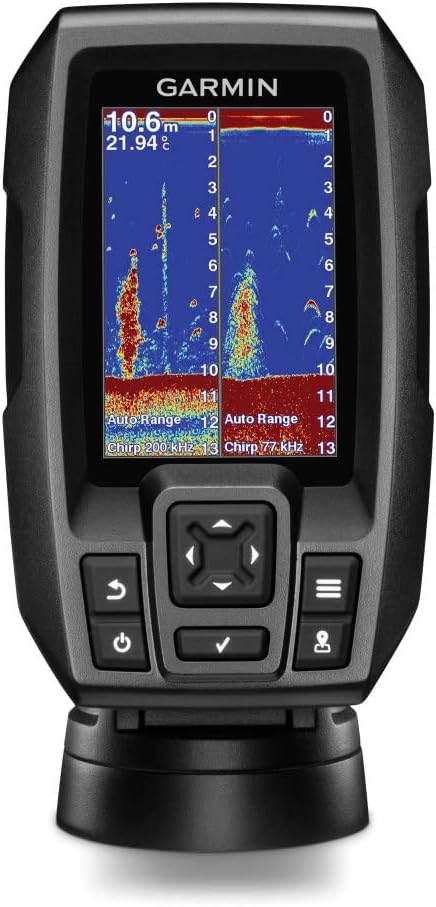
Garmin 010-01550-00 Striker 4 with Transducer
4.6Editor score
Chirp sonar with ClearVu scanning
Three-and-a-half-inch display
GPS waypoint navigation
A portable depth and fish finder for kayak fishing should make it easier to locate fish, understand bottom structure, and monitor changing water conditions without complicating a compact setup. The right unit balances sonar performance, readable displays, reliable power, portability, and the freedom to cast or mount a sensor where it suits your fishing style.
This guide compares ten fish-finding and depth-finding options using their stated specifications, features, and customer ratings. It covers castable wireless systems, wired portable units, and more permanent kayak installations, highlighting range, display options, alerts, mounting solutions, battery behavior, and compatibility with different fishing environments.
Each review explains who the product is best suited for, along with its strongest benefits and practical trade-offs. The three leading selections are highlighted separately, while the full comparison covers every model in the list. Product availability and prices can change, so check the current listing and specifications before making a final purchase.
4.6Editor score

4.3Editor score

4.7Editor score
As an Amazon Associate we earn from qualifying purchases.
The comparison below covers portable wireless, wired, and mounted fish finders, with each entry summarized by its display, sonar capability, depth performance, and kayak-focused convenience.

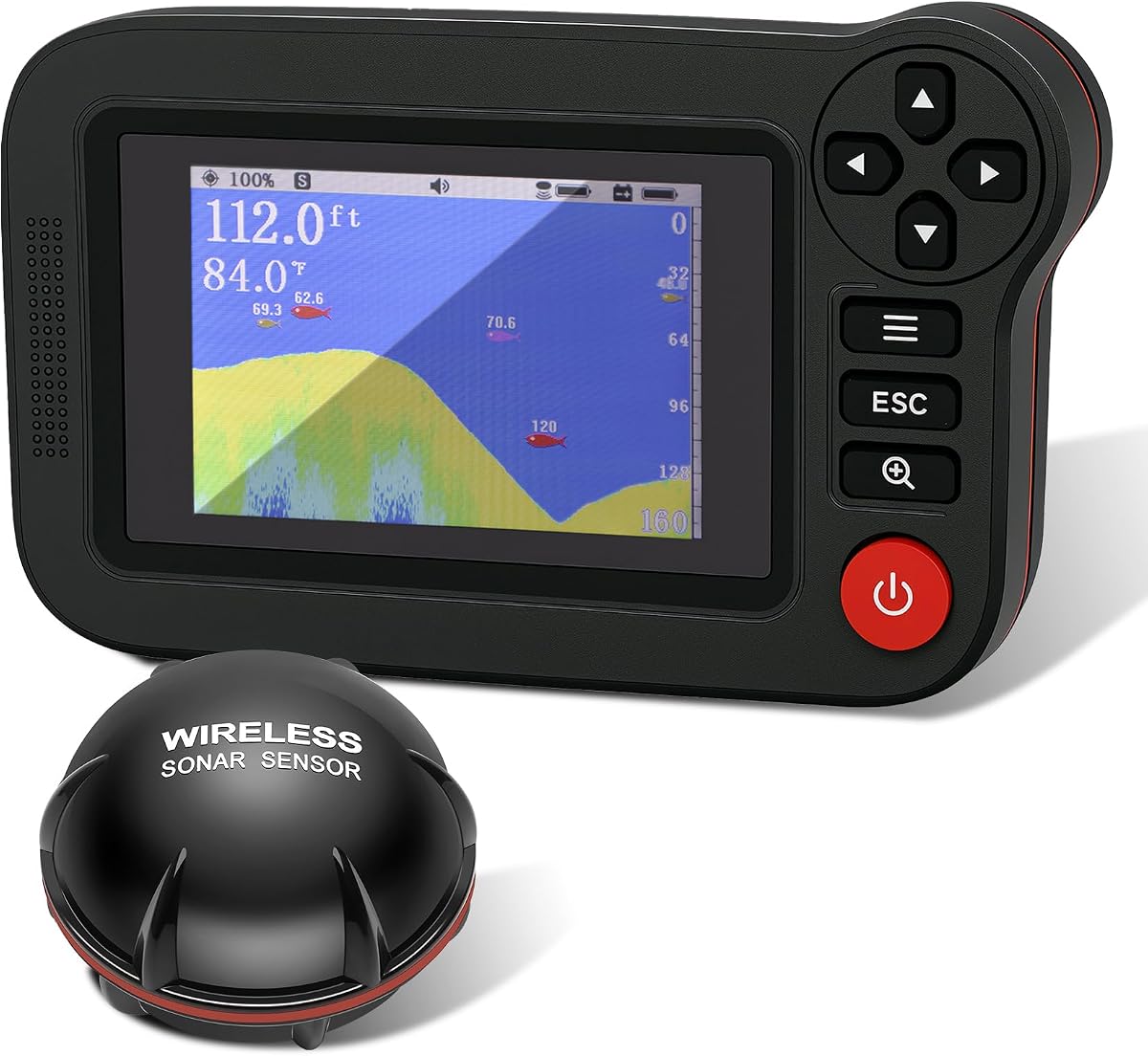


The Venterior Portable Rechargeable Fish Finder combines a castable wireless sensor with a handheld color display, making it one of the most practical options for kayak anglers. Its 4.3 rating reflects a broadly useful feature set, while the absence of a permanent hull installation is especially valuable in compact boats. It provides the type of information anglers need to find productive water without tying down a full dashboard system.
We may earn a commission when you buy through this link, at no additional cost to you.
The sensor reports water depth, temperature, approximate fish size, fish depth, and bottom contour. A 105-degree beam and a depth range of 2.6 to 164 feet provide a useful balance for lakes, rivers, and other fishing environments. Its stated wireless distance of 262 feet gives the kayak operator room to reposition while still retaining a live connection. Work and simulation modes add flexibility, and the display can switch between black and white backgrounds for daylight or nighttime readability.
The main compromise is that portability requires care with the sensor, tethering point, and wireless link. The unit's fish-size categories are less precise than the detailed arches and target separation sought by serious sonar users, and maximum performance may depend on clear water and favorable conditions. The supplied instructions also note that the sensor's battery indicator is only reliable when the sensor is in water and floating. These are manageable limitations for anglers who want an uncomplicated, removable system.
This is the strongest general recommendation for most kayak anglers because it combines wireless casting, rechargeable power, useful environmental readings, and a bright color screen without requiring hull work. Choose it if you fish from varied locations, appreciate portability, and want information about temperature, bottom shape, and fish presence in one package. A permanently mounted high-end unit may be preferable for advanced mapping, but this model delivers the most convincing portable balance.
Tether the compact sensor to a fishing line and cast it ahead of the kayak, allowing you to investigate drop-offs, vegetation, and deeper water without a permanent transducer. The wireless design keeps the display free of trailing cables, which is especially helpful in a confined cockpit.
Temperature, fish depth, approximate size, bottom contour, and alarms provide a broader view of the water column. This makes the unit more useful than a standalone depth sounder, particularly when searching for temperature changes or structure beneath the kayak.
We may earn a commission when you buy through this link, at no additional cost to you.
The Garmin 010-01550-00 Striker 4 with Transducer is a compact fixed-mount fish finder that combines detailed sonar with an easy-to-use interface. Its 4.6 rating makes it one of the strongest-rated products in this guide, and the 3.5-inch screen remains appropriately sized for a kayak console. It is a sensible entry point for anglers who want proven Garmin sonar and GPS features without moving to a larger color display.
We may earn a commission when you buy through this link, at no additional cost to you.
ClearVu scanning sonar provides detailed representations of fish, objects, and structure, while Chirp sonar sends a continuous frequency sweep to create crisper fish arches and better target separation. The waypoint map allows anglers to identify, mark, and navigate to brush piles, stumps, and docks. A keyed interface with dedicated buttons keeps operation straightforward, and the stated IPX7 rating provides reassurance around splash-prone fishing environments.
This is not a fully portable castable system in the same sense as the wireless models. The transducer and display are intended to remain installed, and the maximum depth depends on the system and water environment. The product listing identifies a maximum of 1,600 feet in freshwater and 750 feet in salt water, but actual kayak use is more likely to be limited by draft, mounting position, and local conditions. The fixed arrangement also requires careful cable routing to avoid snagging or pinching lines.
The Striker 4 is best for an angler who can mount a display near the kayak's center console and values sonar detail, GPS waypoints, and recognizable controls. Its relatively modest screen keeps the unit practical in a small craft, and the included transducer avoids the need to assemble a basic system. If the primary priority is true cable-free casting, choose a wireless option; if the priority is detailed structure viewing and navigation, this Garmin is a better fit.
ClearVu scanning sonar and continuous-sweep Chirp technology make the 3.5-inch display more informative than its compact dimensions might suggest. It is particularly useful for locating structure, assessing drop-offs, and separating fish targets from the bottom.
Dedicated buttons reduce the learning curve, while the waypoint map helps anglers save productive brush piles, stumps, and docks. The combination suits a hands-on kayak session in which quick menu changes matter more than a large touch interface.
We may earn a commission when you buy through this link, at no additional cost to you.
The Venterior Portable Wired Fish Finder is a straightforward handheld unit designed for anglers who want depth and fish information without navigating a complex interface. It earns a 4.3 rating and offers a practical alternative to wireless systems. Toss the wired sensor into the water, turn on the display, and it can show water depth, approximate fish location, fish size, vegetation, sand, and rocks.
We may earn a commission when you buy through this link, at no additional cost to you.
Five user-selectable sensitivity levels let the operator account for different conditions, while a battery-saver mode, backlight, fish alarm, and selectable units add useful control. The 45-degree beam reaches a stated depth of 328 feet, exceeding the maximum listed for several compact color units in this guide. A neck strap makes the handheld display easy to wear while the kayak is occupied with paddling, casting, or managing tackle.
The defining trade-off is the cable connecting the display and transducer. Although the system is advertised as portable and compact, the lead can occupy limited cockpit space and must be routed so it does not interfere with pedals, line, or paddling. Four AAA batteries provide approximately four to five hours of continuous use, which may be sufficient for a focused outing but less convenient than a rechargeable system. It also lacks some of the navigation and detailed mapping features found in the Garmin options.
This model is a good fit for a paddling angler who values straightforward operation, a wide depth range, and a readable handheld format. It works well for freshwater, salt water, shore fishing, dock fishing, kayaking, and ice fishing. Choose it when a manageable sensor lead is acceptable and simplicity matters more than wireless casting, GPS navigation, or a larger mounted screen.
The sensor can be lowered from the kayak to identify depth, fish targets, weeds, sand, and rocky bottom. Adjustable sensitivity helps the display remain useful as conditions change, while the wide beam covers a meaningful area beneath the sensor.
The handheld format, neck strap, and tackle-box-friendly dimensions reduce bulk. The trade-off is the tethered sensor, which should be clipped securely and routed away from the paddle, feet, and fishing line.
We may earn a commission when you buy through this link, at no additional cost to you.
The Portable Castable Fish Finder for Kayak with Wireless Sonar Sensor is designed around a generous 656-foot wireless connection, giving it a notable range advantage over many compact alternatives. It has a 4.2 rating and a 3.5-inch TFT LCD with black, blue, and white backlight modes. The information set includes water depth, temperature, fish size, fish depth, bottom contour, and multiple alarms.
We may earn a commission when you buy through this link, at no additional cost to you.
Its 105-degree sonar beam and 2.6 to 164-foot depth range support general freshwater and saltwater use. The sonar sensor is compact, lightweight, and intended to be tied to a fishing line and cast ahead of the kayak. That arrangement allows the angler to scan a wider area than a hull-mounted transducer can reach. A mounting bracket and lanyard are included, so the display can be secured or worn around the neck.
Long wireless range does not guarantee uninterrupted performance in every environment, and the user still needs to manage the probe's line, orientation, and battery. The 3.5-inch display may occupy more console space than a slimmer handheld, although the included bracket helps. The stated eight-hour operating time follows a two-hour charge, which is convenient, but the probe's low-battery condition means it will stop working until recharged. Recharge before leaving for a long trip rather than relying on a mid-session opportunity.
This is a strong choice for an angler who wants to cast a lightweight sensor beyond the kayak and read multiple water-column details. The long stated range and adjustable sensitivity, depth range, and noise filter make it versatile for kayak, shore, sea, and ice fishing. It is particularly attractive for anglers who want more scouting flexibility than a permanently mounted traditional unit can offer.
The 656-foot transducer-to-screen distance gives the operator considerable freedom to cast the probe toward suspected structure. This is useful for checking channels, weed edges, submerged timber, and drop-offs without stopping the kayak.
Black, blue, and white display backgrounds let the angler choose the most readable setting for direct sunlight, shaded water, or low-light conditions. The 3.5-inch TFT screen provides a large viewing area for fish icons, depth, and contour information.
We may earn a commission when you buy through this link, at no additional cost to you.
The DANOPLUS Portable Fish Finder is a compact wireless unit with a 2.4-inch color LCD, a rechargeable sonar sensor, and a fish alert system. Its 4.3 rating reflects a balanced package for kayaking, ice fishing, river and lake fishing, and sea fishing. The display reports fish size with depth, water temperature, water depth, bottom contour, and the water surface.
We may earn a commission when you buy through this link, at no additional cost to you.
The sensor supports 147 feet of underwater detection across a stated 90-degree angle. An illuminated lamp activates when the sensor touches water, and the unit provides both on-screen and audible fish alarms. The display supports 21 operating languages, which is unusual among portable fish finders and may be useful for multilingual households or anglers sharing the device. Its relatively small screen helps preserve limited console space on a kayak.
The stated depth maximum is lower than that of the other sonar-focused products in this list, so it is less suited to anglers regularly searching deep channels, steep drop-offs, or offshore structure. The supplied information does not clearly state the maximum wireless distance between the sensor and display, which makes it harder to compare communication reach with the explicitly ranged models. The lamp and alarm features also depend on the sensor being positioned where fish can encounter it.
Choose this unit if portability, a colorful compact screen, audible alerts, and a rechargeable illuminated sensor matter more than deep-water reach. It is a particularly convenient choice for anglers moving among kayak, shore, and ice-fishing locations. For large lakes with deeper structures, verify your target depth first and consider a unit with a greater maximum range.
The fish alarm appears on the display and emits an audible signal when a fish enters the sensor's coverage area. That lets the angler focus on the line or surroundings instead of watching every screen update continuously.
The sensor's lamp turns on when it contacts water, improving its visibility and adding a distinctive feature for low-light outings. Its rechargeable design removes the need for disposable batteries in the sensor.
We may earn a commission when you buy through this link, at no additional cost to you.
The Garmin Striker 4 with Portable Kit is the premium selection in this guide and carries the highest customer rating listed, at 4.7. Its portable-kit package includes a kayak in-hull transducer mount, addressing one of the hardest parts of installing a conventional fish finder in a small craft. The result is a fixed system with established Garmin sonar and navigation features rather than a temporary castable sensor.
We may earn a commission when you buy through this link, at no additional cost to you.
Chirp sonar sends a continuous sweep of frequencies to provide wider information, crisper fish arches, and better target separation. The waypoint map helps users view, mark, and navigate to brush piles, stumps, and docks. A built-in flasher displays sonar data in a classic format suited to ice fishing and vertical jigging. The stated maximum depth is 1,600 feet in freshwater and 750 feet in salt water, with 200 watts RMS transmit power.
The premium approach also introduces installation demands. The kayak mount must be positioned correctly, and the transducer and cable need a safe route through the hull and deck. A permanently mounted display cannot be moved as freely as a handheld unit, and the in-hull installation may be more involved than simply tethering a wireless probe. Fish-arch interpretation and map navigation also require more familiarity than a basic depth-only readout.
This is the most compelling option for a serious kayak angler who plans regular use, wants detailed sonar, and values GPS waypoint management. It is also attractive for anglers moving between open-water and ice-fishing applications because of the flasher. Choose this model when setup permanence and long-term capability matter more than minimal weight or a completely cable-free experience.
The included in-hull transducer mount demonstrates that this is a kayak-oriented installation rather than a basic boat package. Proper placement and routing can create a stable, integrated system that avoids dangling sensor cables.
The waypoint map lets anglers record and revisit specific underwater features, while Chirp sonar supports better fish and target separation. Together they help transform a fishing trip into a repeatable process of marking productive locations.
We may earn a commission when you buy through this link, at no additional cost to you.
The Garmin STRIKER Vivid 4cv is built around a four-inch color display and modern scanning sonar, making it a strong choice for anglers who want more visual information than a monochrome unit provides. Its 4.6 rating and inclusion of a GT20 transducer create a complete core package. The screen is relatively large for a kayak, yet it offers enough space to distinguish fish, structure, and bottom features effectively.
We may earn a commission when you buy through this link, at no additional cost to you.
The included GT20 transducer supports built-in Garmin CHIRP traditional sonar and CHIRP ClearVu scanning sonar. Vivid color palettes help separate targets and structure, while high-sensitivity GPS allows anglers to mark waypoints, create routes, and view boat speed. Quickdraw Contours mapping adds another layer of utility by connecting recorded depth information with navigation, making it easier to revisit a productive drop-off or underwater feature.
The four-inch footprint and fixed installation are the main concerns for small kayaks. Mounting space, viewing angle, and cable routing need to be planned so the display remains readable without obstructing the angler. As with other permanent systems, it offers less freedom than a castable unit and may be unnecessary for someone who only wants occasional depth checks. Color also helps interpretation, but only when the screen remains visible in direct sunlight and at the intended viewing angle.
Choose the STRIKER Vivid 4cv if your priority is a large, colorful sonar presentation and a broad feature set. It is especially attractive for anglers who want to mark locations, navigate routes, see speed, and build depth contours over repeated outings. If console space is extremely limited, one of the smaller wired or wireless systems may be a better physical fit.
Vivid scanning sonar palettes create clearer visual separation between fish, vegetation, rock, and other structure. The four-inch screen gives those distinctions room to develop, which can make a marked area easier to interpret after a pause or a move to a new position.
GPS waypoints, route creation, speed display, and Quickdraw Contours extend the unit beyond basic fish detection. These features are most useful for anglers who return to marked water and want their sonar observations connected to a navigable map.
We may earn a commission when you buy through this link, at no additional cost to you.
The Venterior Portable Wired Fish Finder is similar in concept to the other handheld wired model in the guide, but it adds a water-resistant storage bag for better protection. Its 4.2 rating and broad feature set suit anglers who want depth, fish, and bottom information in a package that can be carried in a tackle box and protected between trips.
We may earn a commission when you buy through this link, at no additional cost to you.
The display identifies water depth, approximate fish location, fish size, weeds, sand, and rocks. Five sensitivity levels allow adjustments for different water conditions. A fish alarm, backlight, battery-saving mode, and selectable measurement units help tailor the experience, while saved settings reduce repeated configuration. Its 45-degree beam reaches from 3 to 328 feet below the sensor, giving it an impressive stated depth range for a compact portable system.
The included bag protects the display from water splash, accidental bumps, and scratches, but it does not eliminate the main wired-design compromise. The sensor cable must be managed around the kayak, and four AAA batteries provide only four to five hours of continuous operation. A spare set of batteries or a disciplined power plan is necessary for longer sessions. The system also lacks a GPS map and advanced sonar palettes found in mounted Garmin units.
This Venterior model is best for an angler who wants a protective portable package, a long stated depth range, and a simple display. It works for kayaking, dock fishing, shore fishing, and ice fishing across fresh or salt water. Select it when carrying a tethered sensor is acceptable and when secure storage of the handheld unit is a priority.
The water-resistant bag helps protect the display from splash, scratches, and impacts while it is stored with tackle. It is especially helpful in a kayak, where loose equipment can shift while the boat moves.
A stated 328-foot maximum depth and selectable sensitivity make the unit useful for a broad range of shoreline, lake, river, and fishing conditions. The 45-degree beam balances focused coverage beneath the sensor with a manageable handheld setup.
We may earn a commission when you buy through this link, at no additional cost to you.
The Portable Castable Fish Finder for Kayak Wireless Sonar Sensor, Depth Finder delivers a balanced combination of casting range, screen size, and information. It has a 4.2 rating and a stated 500-foot wireless distance, placing it between the shorter-range compact wireless option and the longer-range 656-foot system. A 3.5-inch TFT LCD makes the display easy to inspect in bright sunlight.
We may earn a commission when you buy through this link, at no additional cost to you.
Its sonar reports water depth, temperature, fish size, fish depth, and bottom contour. Fish and depth alarms provide useful notifications, while adjustable sensitivity, depth range, and noise filtering help adapt the signal to different environments. The 105-degree beam and 2.6 to 164-foot depth range are consistent with the needs of lake, shore, saltwater, and ice anglers. The main unit includes a mounting bracket and lanyard for flexible positioning.
The sensor eliminates long heavy cables and can be tied to a fishing line for casting. Its stated two-hour charge and eight-hour operating time are convenient, although the low-battery warning means the probe will stop working when depleted. The main unit and transducer both use power connections, so charging both before a long outing is wise. The display may also occupy more cockpit space than a slim handheld, though the bracket improves stability.
This model is a strong all-around choice for an angler who values wireless freedom, a large readable screen, and adjustable sonar controls. It is especially appealing for kayak and shore fishing where changing position and casting ahead of the boat are central to the strategy. It may be the most balanced choice when wireless reach is important but an extreme maximum range is not essential.
The 500-foot stated distance gives the operator room to cast and reposition without excessive tether length. That makes it useful for investigating weed edges, channels, submerged structure, and changing depth around a kayak.
Adjustable sensitivity, depth range, and noise filtering allow the sonar picture to be adjusted for the lake, river, coast, or ice. Fish and depth alarms complement the visual display without replacing the need to interpret bottom contours.
We may earn a commission when you buy through this link, at no additional cost to you.
The Humminbird PiranhaMAX 4 is a traditional mounted fish finder with a four-inch display, dual-beam sonar, and a tilt-and-swivel bracket. Its 4.6 rating makes it one of the better-rated products in the guide. It is designed to give anglers a choice between detailed coverage and a wider view of fish, structure, and contours in a straightforward console unit.
We may earn a commission when you buy through this link, at no additional cost to you.
The dual-beam design lets the user select a narrow beam for greater detail or a wide beam for broader coverage. That flexibility is useful in a kayak because a narrow setting can help separate close targets, while a wide beam can search more water around the boat. The tilt-and-swivel mount makes it easier to change the viewing angle, and the four-inch screen offers a comfortable display size for depth and sonar information.
The included XNT 9 28 T transducer is described as a transom-mount model, so kayak installation may require adaptation and careful planning. A permanent display and fixed transducer are less portable than the wireless systems, and the package does not highlight the GPS mapping and contour features found in more advanced fish finders. The one-year limited warranty is also shorter than the two-year coverage described for the Venterior products.
Choose the PiranhaMAX 4 for an angler who values simple operation, a sizable screen, and the ability to switch between narrow and wide sonar coverage. It can work well in a small kayak if the display and transducer are securely mounted and the cable is routed safely. It is less compelling for anglers who need GPS waypoints, detailed mapping, or a genuinely castable sensor.
The narrow beam offers a more focused view for detailed target separation, while the wide beam covers a greater area beneath the kayak. Switching between them can be useful as the angler moves from open water to a specific structure.
The tilt-and-swivel mount lets the display be positioned for the angler's preferred viewing angle. Kayak owners should confirm the available mounting surface and plan a safe, snag-free route for the transducer cable.
We may earn a commission when you buy through this link, at no additional cost to you.
The right kayak fish finder depends on whether you prefer a castable wireless probe, a lightweight wired handheld, or a permanently mounted sonar system. Consider cockpit space, target depth, navigation needs, display readability, and power before choosing.
Wireless fish finders use a compact sensor connected to the display without a long cable. You can tether and cast the probe ahead of the kayak, making it easy to inspect structure outside the immediate hull area. Wired handheld systems are simpler in concept and often less expensive, but the sensor lead occupies cockpit space and must be routed around paddles, pedals, feet, and fishing line. Permanent mounting removes much of that clutter but requires installation effort and a fixed display location.
Check the stated depth range against the water you expect to fish. Compact wireless units commonly reach 147 to 164 feet, while some wired and mounted systems list maximum depths of 328 feet in freshwater or substantially greater figures. Maximum depth is only useful if the transducer can operate effectively at that depth, so consider kayak draft, mounting position, water clarity, and the type of structure you are targeting. A wider beam can cover more area but may show less detail than a focused beam.
A kayak display is most useful when its information can be read quickly without occupying too much cockpit space. Color screens make structure and fish arches easier to distinguish, while selectable black, blue, and white backgrounds can improve visibility in sunlight or at night. A 3.5-inch TFT screen offers a generous viewing area, and a 4-inch display may be preferable if the mounting area is sufficient. Smaller handheld screens save space but require a closer viewing angle.
Wireless range determines how far the angler can cast the sensor while maintaining communication with the display. Stated maximum distances range from 262 feet to 656 feet among the wireless products in this guide. Treat those numbers as maximum specifications rather than guaranteed real-world distances, because water, obstacles, battery condition, and orientation may affect the connection. A 500-foot range can be ample for normal lake scouting, while anglers investigating broad channels may favor the longest stated reach.
Rechargeable displays and probes are convenient for repeated outings because they can be topped up at home. Wireless systems often state around eight hours of continuous operation after a two-hour charge, although the display and sensor may have separate power needs. Handheld wired models commonly use four AAA batteries and may last four to five hours. For long trips, carry spare batteries or recharge both components before leaving. Low-battery warnings are useful, but they do not substitute for a sound charging plan.
If you return to productive water, GPS waypoints can save brush piles, stumps, docks, channels, and drop-offs for later visits. The Garmin Striker models include waypoint mapping, while the STRIKER Vivid 4cv adds route creation, speed display, and Quickdraw Contours. Castable and basic handheld units focus more on immediate depth and fish information. Decide whether navigation is central to your method or whether locating and reading nearby water is enough.
Permanent displays require a stable surface and a safe path for the transducer cable. The Garmin Striker 4 Portable Kit includes a kayak in-hull mount, while the PiranhaMAX 4 is supplied with a transom-mount transducer that may require adaptation for a kayak. Wireless displays can often use a bracket or neck lanyard, and handheld systems fit into a tackle box. Consider paddle clearance, seated viewing angle, pedal space, tackle access, and the likelihood of the unit being knocked loose.
A depth finder may display only depth, while a fish finder can add temperature, fish size, fish depth, bottom contour, vegetation, and alarms. Sensor lamps can help in low-light conditions, and simulation modes allow practice away from the water. More data is not automatically better: clear readings and a display you understand are more valuable than a crowded screen. Prioritize the measurements that influence where you cast and how you interpret the bottom.
Before the first outing, read the included instructions, identify the display controls, and learn how to change beam width, sensitivity, depth range, units, backlight, and alerts where those options are provided. Charge the display and wireless probe fully, or install fresh batteries in a wired model. Secure the mounting bracket or neck strap and confirm that the transducer cable or sensor tether will remain clear of the paddle, pedals, line, and tackle.
Tune the sonar for the environment rather than accepting every default. Increase sensitivity when fish targets are difficult to see, reduce it when the display becomes cluttered, and use the available noise filter if surface interference is a problem. For a castable probe, attach it securely to the line, cast it ahead of the kayak, and allow the sensor to settle fully in the water. Keep a clear understanding of which displayed measurements represent actual readings and which are approximate fish-size or fish-location categories.
After the session, switch off the unit, disconnect the sensor, and dry the display and connectors before storage. A water-resistant bag helps, but it should not replace basic moisture protection. Inspect the cable or tether for wear, clean the transducer, and store the device in a stable tackle compartment away from extreme heat. Recharge components before the next trip and replace disposable batteries promptly so an unexpected low-power indication does not end the outing.
A wireless fish finder is usually more convenient for kayak fishing because it removes the long sensor cable and allows the probe to be cast ahead of the boat. A wired handheld can be simpler and may offer a greater stated depth range, but the cable needs careful routing. The best choice depends on cockpit space, whether you want to scout beyond the hull, and how much permanent installation you are willing to manage.
Several products in this guide explicitly support ice fishing, and models with a built-in flasher are especially suited to that activity. A wireless probe can be placed beneath the ice, while a wired sensor can be lowered into a drilled hole. Check local ice-fishing rules, maintain the stated operating conditions, and never compromise safety to fish through questionable ice.
The required range depends on the lake, reservoir, river, or coastal area you fish. A unit reaching 147 to 164 feet covers many typical kayak locations, while deeper lakes may require a system with a greater maximum depth. Maximum ratings do not guarantee equal clarity at every depth, so consider transducer placement, water conditions, and the type of structure you need to identify.
GPS waypoints are valuable if you repeatedly fish the same water and want to return to channels, stumps, brush piles, or drop-offs. They are less essential for an angler who mainly wants immediate depth and fish readings while exploring new areas. Garmin options in this guide provide waypoint mapping, while the most portable castable models focus on real-time sonar information.
Secure the display where it remains visible without obstructing your paddle stroke, and use a lanyard or bracket if appropriate. Route any wired sensor away from your feet and line. A wireless probe can be cast ahead and allowed to settle, while a mounted transducer should be positioned to provide useful coverage beneath or around the kayak. Spend time learning the screen before relying on it to find fish.
Color can make fish, vegetation, rock, and other structure easier to distinguish, particularly on larger screens such as the 4-inch Garmin STRIKER Vivid 4cv. A smaller monochrome or two-background display may be sufficient for anglers who primarily need depth, temperature, and simple fish icons. Choose based on readability in your typical light and the amount of cockpit space available.
The listed wireless models state up to eight hours of operation after roughly two hours of charging, while the wired handheld models specify approximately four to five hours with new AAA batteries. Actual runtime depends on screen brightness, alarms, sonar use, and battery condition. Charge every component before a long trip and carry spare batteries if using a disposable-battery model.
Many products in the guide are explicitly suitable for salt or sea water, including the wireless Venterior models, DANOPLUS unit, and wired handheld fish finders. The Garmin Striker models also list different maximum depths for fresh and salt water. Always follow the manufacturer's stated application guidance and confirm that any mounting hardware is suitable for the intended environment.
The Venterior Portable Rechargeable Fish Finder is the leading general recommendation because it combines a castable wireless sensor, color display, useful temperature and fish information, bottom contour data, and no permanent hull installation. The Garmin Striker 4 with Transducer stands out as the budget-minded choice for detailed ClearVu sonar, Chirp arches, and GPS waypoints, while the Garmin Striker 4 Portable Kit is the premium option for a dedicated kayak installation.
Your priorities should guide the final choice. Favor wireless connectivity and casting freedom if you move around and scout ahead of the kayak. Choose a wired handheld for simple operation and a wide stated depth range. Select a mounted Garmin system when detailed structure viewing, GPS navigation, flasher support, or Quickdraw Contours justify a more permanent setup. In every case, verify the unit's dimensions, mounting requirements, target depth, and power method against your kayak.
Fish-finder specifications and prices can change, and availability may vary among model configurations. Before ordering, confirm the current listing, included transducer or probe, mounting hardware, battery requirements, and warranty terms. The comparison and recommendations in this guide are intended to narrow the field, but the most reliable choice is the model that fits your fishing water, boat layout, and desired level of navigation and sonar detail.