
Professional Microphone Pop Filter Double-Layer
4.1Editor score
Six-layer filtering design
Flexible 360-degree metal arm
Universal stand clamp
This guide compares the 10 best pop filters for vocal recording, covering plosive control, compatibility, mounting, materials, and ease of use.
A pop filter sits between a singer or speaker and a microphone, reducing the force of air blasts that create distracting plosives, breath noise, and unwanted sibilance. The right accessory can make vocals sound cleaner without changing the microphone, while a poorly fitted model may obstruct sound, wobble, or fail to match the mic.
We compared the filters in this guide by their stated materials, mounting systems, microphone compatibility, dimensions, and intended recording applications. The list covers flexible gooseneck shields, compact three-layer screens, model-specific solutions, and larger isolation balls, allowing home creators and studio users to compare design choices rather than simply searching for the most layers.
Each product review explains the filter's standout benefits, practical limitations, and best-fit user. Ratings and specifications reflect the supplied product information, while product availability and prices can change, so readers should confirm current details before making a purchase.
4.1Editor score
4.5Editor score

4.0Editor score
This side-by-side comparison highlights each pop filter's construction, mounting approach, compatibility, and most useful recording scenario, making it easier to identify the option that fits your microphone and setup.


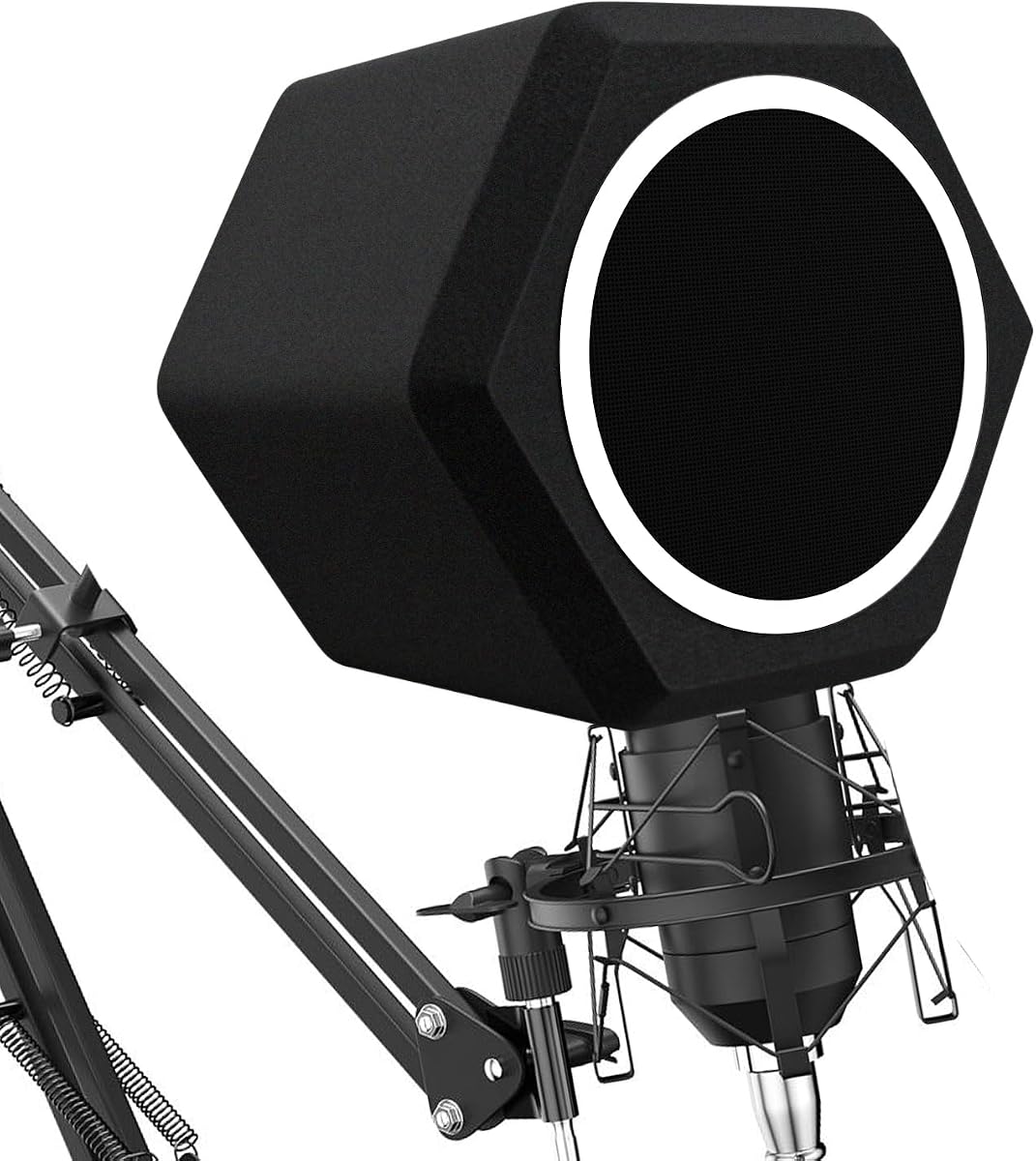
This isolation-ball pop filter has a 4.5 rating and stands out for combining an acoustic foam enclosure with a double-layer screen at the opening. Unlike a conventional flat shield that addresses only the air moving directly toward the microphone, the five-sided design extends coverage around the recording area and is intended to reduce plosives, wind interference, saliva spray, noise, and reflections.
We may earn a commission when you buy through this link, at no additional cost to you.
The removable jacket is designed for condenser and USB microphones with diameters from 50 to 75 millimeters, and an included holder accommodates different microphone sizes. Its front screen provides an additional layer of separation, while the surrounding foam creates a more enclosed recording environment. At 120 grams, it remains portable and can attach to desktop stands, tripods, cantilever arms, or floor stands.
The principal trade-off is its larger physical footprint. A compact flat filter may be easier to position when desk space is tight, and users should measure their microphone before ordering. The enclosure may also feel unnecessary in an already treated studio. Even so, the combination of directional coverage, protective foam, and broad supported microphone sizes gives it clear value for untreated rooms, home studios, live recording, and outdoor performance.
Choose this filter if you want one accessory to handle both burst noise and ambient reflections rather than merely placing a mesh screen in front of the mic. It is especially compelling for vocalists, podcasters, streamers, and radio or studio users who value portability and microphone protection. For users who want a single, adaptable solution, it is the strongest overall choice in this guide.
The five-sided foam body intercepts sound and airflow from several directions, while the front double layer disperses remaining air pressure. This broader design can be useful in rooms that have not received extensive acoustic treatment.
The stated 50–75 millimeter range is central to fit and stability. Measure the removable-jacket diameter before buying, and confirm that the included holder can support the microphone's width and shape.
We may earn a commission when you buy through this link, at no additional cost to you.
The NEEWER Professional Microphone Pop Filter Shield has a 4.4 rating and uses a familiar two-layer screen to separate harsh air blasts from the microphone. The first layer intercepts the initial pressure, while the space between layers and second screen further disperse energy, making this a practical general-purpose shield for singing, acting, podcasting, and streaming.
We may earn a commission when you buy through this link, at no additional cost to you.
Its steel gooseneck supports the filter and lets the user alter the angle and distance between screen and microphone. A swivel mount makes installation and removal straightforward, while the rotating clamp is designed to fit tubular microphone booms and stands. The scratch-proof gripper reduces the chance of damaging a stand while maintaining a secure connection.
This is not a specialized windscreen or microphone-specific shield, and the microphone is not included. Users who need a very compact solution may find its frame and gooseneck less convenient than a simple elastic-band model. The two-layer design also does not offer the same directional enclosure as the larger isolation ball. Even so, its sturdy adjustment system and broad mounting compatibility make it a dependable middle-of-the-road choice.
This is a good pick for a creator who already owns a stand and wants a recognizable pop-filter format with easy positioning. It should appeal equally to first-time podcasters and performers who need to move the shield during voice-over sessions. Verify that the clamp diameter accommodates your stand before purchase, then position the screen a short distance in front of the microphone's active face.
The metal gooseneck and swivel mount let you move the screen away from edges and other reflective surfaces. Keeping the filter centered and stable helps make repeated takes more consistent.
The adjustable rotating clamp is intended for tubular booms and microphone stands. Its scratch-resistant gripper offers a practical balance between secure positioning and equipment protection.
We may earn a commission when you buy through this link, at no additional cost to you.
This PEMOTech pop filter carries a 4.5 rating and combines metal mesh, foam, and etamine in a three-layer design. It is aimed at vocal recording, video production, and streaming, with the layered construction intended to reduce plosives, pops, crackles, wind interference, and breath sounds without requiring a separate stand-mounted assembly.
We may earn a commission when you buy through this link, at no additional cost to you.
Attachment is handled through elastic bands and an inner rubber ring, allowing the screen to be fitted directly to a compatible microphone. The stated range covers 45- to 61-millimeter diameters, including common models such as the Audio-Technica AT2020, AT2035, AT4040, Rode NT1A, several MXL microphones, and other similarly sized devices.
Compatibility is the main limitation. The product information explicitly states that it is not for the Blue Yeti, and users should not assume that a roughly similar body shape will provide the same fit. It also lacks the flexible gooseneck offered by several rivals, so placement is tied directly to the microphone rather than independently adjustable. For users within the stated diameter range, however, the compact and simple installation remains appealing.
This filter makes sense for a home creator seeking more than one screen layer without a bulky arm or clamp. It is particularly useful for compact desktop recording arrangements and compatible condenser or USB microphones. Measure the mic first, select this model only if it falls comfortably within 45–61 millimeters, and confirm that its shape is compatible with the attachment system.
Combining mesh, foam, and etamine gives the filter several surfaces over which airflow can be diffused. The direct attachment design also keeps the overall setup smaller than most stand-mounted options.
Elastic bands and an inner rubber ring avoid the need to adjust a boom or desk stand. The microphone must fit the stated diameter range, however, and the Blue Yeti should be excluded.
We may earn a commission when you buy through this link, at no additional cost to you.
The YOUSHARES Blue Yeti Pop Filter has a 4.5 rating and is designed specifically for the Blue Yeti. Its six-layer construction includes double metal mesh and high-density windproof sponge intended to disperse air pressure, trap saliva, dust, and vapor, and reduce plosives generated by P, B, and similar sounds.
We may earn a commission when you buy through this link, at no additional cost to you.
A carbon steel gooseneck can be bent to change the angle and distance between the pop filter and microphone. The product information says it can withstand more than 10,000 bends, while an L-shaped swivel clip attaches to a microphone stand or the Blue Yeti itself. Unlike adhesive pad approaches, the adjustable clip is intended to resist sliding as the microphone position changes.
The limitation is obvious but important: this is a model-specific accessory. Buyers who use another USB microphone may find a universal filter more useful, and the extra gooseneck may be redundant if the Blue Yeti sits in a permanently fixed location. The included foam windscreen adds another function, but users should not expect the outer windscreen to replace the pop filter for close, direct speech.
This is a strong recommendation for Blue Yeti owners who record vocals, stream, or podcast and want both a layered shield and a separate foam windscreen. It is less compelling for a multi-microphone studio, though the product information does not establish compatibility with other models. Confirm that you own the intended Blue Yeti and that your stand or mounting point will accept the swivel clip.
The dedicated 5.5-inch format and adjustable swivel clip are designed around the Blue Yeti. This can be simpler than experimenting with a generic screen that does not sit evenly in front of the microphone.
The package combines a six-layer pop filter with a foam windscreen. The pop filter addresses direct air bursts, while the windscreen adds another barrier against airborne moisture and particles.
We may earn a commission when you buy through this link, at no additional cost to you.
This professional double-layer pop filter has a 4.1 rating and delivers a useful combination of layered screening, an adjustable arm, and a universal clamp. The product information describes six layers of filtering material, including dual metal mesh and high-density foam, intended to reduce plosives, sibilance, and unwanted noise.
We may earn a commission when you buy through this link, at no additional cost to you.
Its carbon steel arm can be shaped to different angles, with a stated ability to withstand more than 10,000 bends. The L-shaped rotating clamp fits most microphone boom arms and desk stands with tubes up to 1.38 inches, and an EVA pad helps protect the stand from scratches. Dimensions include a 5.91-inch outer diameter, 5.12-inch inner screen, 13.39-inch arm, and 21.06-inch total extended length.
The 4.1 rating is lower than that of most products in this list, and the specifications do not name particular compatible microphones. The relatively long arm may also occupy more desk space than a direct-mount filter. Although the claim of six filtering layers sounds substantial, the important consideration remains whether the screen is correctly positioned and does not obscure the microphone's intended pickup pattern.
This is a practical pick for creators who want a complete, flexible setup without committing to a model-specific accessory. It suits podcasting, karaoke, broadcasting, home recording, and streaming. Check the clamp's stated tube-diameter limit, keep the screen centered several inches from the microphone, and make small distance adjustments while monitoring the resulting sound.
The long flexible arm, rotating clamp, and layered screen cover the basic needs of a new recording setup. It is easier to start with than a simple foam cover when the microphone is mounted on a boom or desk stand.
A correctly centered filter can outperform a larger model placed at the edge of the microphone's pickup area. Use the adjustable arm to find a stable distance and avoid covering vents or acoustic elements.
We may earn a commission when you buy through this link, at no additional cost to you.
The SUNMON Fifine K688 Pop Filter has a 4.1 rating and is built for Fifine K688 and K658 microphones. Its L-shaped clip uses rubber pads to hold the filter in place, while a flexible carbon steel gooseneck allows the user to change the screen's angle and position without repeated sagging or wobbling.
We may earn a commission when you buy through this link, at no additional cost to you.
The product combines metal and sponge material in a six-layer screen. According to the product information, this arrangement breaks up airflow more efficiently than a basic two-layer foam filter, helping reduce B and P plosives and background noise while preserving upper-frequency detail. A 5.5-inch foam windscreen also helps protect the microphone from saliva and water vapor.
Its strongest advantage is also its main constraint: the mounting design is intended for specific Fifine models. It may not suit a studio with many different microphones, and buyers should not assume that a generic round microphone will fit the L-shaped clip. The 4.1 rating also warrants realistic expectations; the product addresses plosives and airflow but cannot remove room echo, electrical noise, or all sibilance.
This filter is a sensible choice for a Fifine K688 or K658 owner who records vocals, podcasts, streams, broadcasts, or karaoke. It provides a more integrated arrangement than a loose foam cover and allows precise positioning through the gooseneck. Confirm the exact microphone model and inspect the connection point before ordering to ensure the dedicated clip engages correctly.
The L-shaped clamp and rubber pads are designed to engage supported Fifine microphones securely. That model-specific fit can be useful when the microphone's shape or mounting points would be awkward with a universal adapter.
Metal and sponge layers work together to break up airflow before it reaches the microphone. The design is especially relevant to close-mic singers who produce frequent consonant bursts during speech and singing.
We may earn a commission when you buy through this link, at no additional cost to you.
This microphone isolation ball has a 4.2 rating and combines a five-sided high-density foam enclosure with a dual pop-filter cover. It is intended to reduce plosives, wind interference, saliva spray, pops, crackles, breath sounds, and echoes, offering a more comprehensive acoustic barrier than a simple mesh disc.
We may earn a commission when you buy through this link, at no additional cost to you.
The detachable jacket supports microphones between 1.96 and 2.75 inches in diameter, including examples such as the Audio-Technica AT2035 and AT2020 and the Blue Yeti. The product information emphasizes smaller pores, a fine texture, good tensile performance, and rapid rebound in the sponge, with the goal of avoiding the deformation associated with lower-density foam.
A ball-style enclosure does take up more room than a flat screen, and users should measure carefully because the product is explicitly not a miniature version. It is also less convenient when frequent microphone repositioning is required. Even with these drawbacks, the enclosure can make a noticeable structural contribution to reducing reflections in a lightly treated space and adds physical protection against saliva or accidental drops.
Choose this option for a portable home studio, radio environment, outdoor performance, or live recording setup where the microphone can remain inside the supported size range. It offers an appealing all-in-one alternative to buying a separate isolation ball and pop filter. Confirm the dimensions and jacket fit before purchase, and place the supported microphone centrally for the most consistent result.
The surrounding foam helps intercept reflections and airborne sound, offering modest acoustic control in a compact package. It cannot duplicate the performance of a professionally treated room, but it is more targeted than a flat screen alone.
The listed high-density material is described as finer-textured, resilient, and quick to rebound. A snug jacket and durable foam are particularly useful for transport and repeated setup changes.
We may earn a commission when you buy through this link, at no additional cost to you.
This gooseneck pop filter has a 4.5 rating and emphasizes a simple, stable setup for recording, streaming, podcasting, and voice-over work. Its dual-layer mesh is designed to block plosives from P and B sounds, reduce sibilance and breath noise, and provide a cleaner vocal signal while also shielding the microphone from saliva and dust.
We may earn a commission when you buy through this link, at no additional cost to you.
A durable metal gooseneck is designed to hold its position without sagging, allowing the creator to adjust both the screen angle and its distance from the microphone. The padded adjustable clip is presented as compatible with standard microphones, including the Blue Yeti, Rode, and Audio-Technica, and it attaches to mic stands and boom arms without a tool.
The specifications do not provide exact screen dimensions, arm length, or maximum clamp diameter, so buyers who need those measurements should confirm them before ordering. Compatibility claims should also be understood as broad categories rather than a guarantee for every model or stand. A universal clip can be less elegant than a model-specific mount, particularly if the microphone has an unusual shape.
This product is a good general recommendation for someone who values straightforward installation and a rigid, stay-put arm. The tool-free swivel mount is useful for creators who move between a desk and a boom arm, while the dual screen provides more protection than a single fabric layer. It is a strong fit for common USB and condenser microphones used in podcasting, streaming, and voice production.
A stay-put gooseneck prevents the screen from drifting after the microphone is positioned. That stability makes it easier to preserve the same relationship between the sound source, filter, and microphone from one recording session to the next.
The tool-free design reduces setup time and makes it convenient to remove the filter for transport. The padded clip is intended to hold a stand securely while limiting the risk of scratching its finish.
We may earn a commission when you buy through this link, at no additional cost to you.
The Stedman PS101 V2 Pop Filter is a purpose-built accessory for the Stedman PS101 V2 microphone. Although no customer rating was supplied for this product, its specification is unusually focused: rather than attempting broad compatibility, it is designed to work seamlessly with one microphone model, which can result in a cleaner and more deliberate fit.
We may earn a commission when you buy through this link, at no additional cost to you.
The filter helps reduce plosive sounds and breath noise, addressing two of the most common problems encountered in close vocal recording. It is suitable for home studios, podcasting, voice-over work, and professional recording environments, making it relevant to users who want a dedicated accessory for a serious or regularly used microphone.
The obvious limitation is exclusivity. It is not a general-purpose choice for a desk full of different microphones, and the product information does not describe an adapter or alternative mounting configuration. No numerical dimensions, filter material, or included hardware are provided, so buyers may wish to confirm the physical setup and contents. There is also no supplied rating to provide the same historical feedback available for most other products here.
This is the premium choice for a Stedman PS101 V2 owner who values model-specific integration and regular studio use. Its quick attachment mechanism and durable construction should support a stable workflow, while the focused plosive and breath control directly address common recording problems. If you own another microphone, select one of the universal or model-specific alternatives instead.
A purpose-built filter can be preferable to a universal accessory when every adjustment has been designed around one microphone. The product is best considered only for owners of the PS101 V2.
The listed durable construction and simple attachment mechanism target regular use. For podcasters and voice-over artists who keep the same microphone in place, setup convenience can be as important as filtration.
We may earn a commission when you buy through this link, at no additional cost to you.
This multi-layer pop filter has a 4.5 rating and offers a flexible carbon steel gooseneck, thick filtering sponge, and rotating stand clamp. Its stated applications include singing, vlogging, voice-over, podcasting, gaming, streaming, and general speaking, making it a broad option for creators who work across several kinds of vocal content.
We may earn a commission when you buy through this link, at no additional cost to you.
The filter material is intended to reduce plosives, wind interference, and saliva spray, while also blocking hisses, pops, and thuds associated with B, P, and S sounds. A 360-degree gooseneck allows the screen to be moved to a preferred height, angle, and distance, while the screw-closing clamp is designed to grip tubular stands without scratching them.
The clamp is stated to fit surfaces up to 1.96 inches, which is broader than many universal options in this list. However, exact screen diameter and arm length are not provided, and the product title does not communicate a model-specific design despite naming several compatible microphones in the description. It should be considered a general stand filter, not a dedicated mount for any one of those models.
This is a good choice for a creator who records vocals for gaming, streaming, podcasts, or voice work and wants a sturdy arm that can be repositioned. It is also useful for home studios with varied microphones, provided the stand's tube dimensions fall within the stated clamp range. Install it with the screen centered in front of the active microphone area and avoid squeezing the foam against a mesh grille.
The 360-degree arm accommodates seated speakers, standing performers, and different microphone heights. Its metal construction is intended to support the filter without continuously sagging.
A stated maximum surface size of 1.96 inches gives the clamp a useful range for many stands. Check the tube diameter carefully and use the screw grip to prevent gradual movement.
We may earn a commission when you buy through this link, at no additional cost to you.
Choosing a pop filter involves balancing airflow control, microphone fit, mounting stability, and the physical space available in your recording area. The most elaborate design is not automatically the best choice; a clean fit, proper placement, and suitable construction usually have a greater effect on everyday results.
Begin by deciding whether you need a universal stand clamp, a direct-fit wrap, or a model-specific screen. Universal clamps are useful for mixed equipment, while dedicated products can be easier to position around a particular microphone body. The YOUSHARES option is designed for the Blue Yeti, the SUNMON filter supports the Fifine K688 and K658, and the Stedman PS101 V2 filter is intended exclusively for that microphone. The PEMOTech model supports microphones from 45 to 61 millimeters but explicitly excludes the Blue Yeti.
Choose based on the equipment you actually own now and may own later. Measure microphone diameter and inspect the shape, vents, controls, and mounting points before ordering. Compatibility language is not a substitute for checking the physical fit.
Metal mesh offers a firm, open surface for dispersing direct air bursts, while foam and fabric-style layers provide additional resistance to wind, breath, and moisture. Multi-layer products combine these materials to balance open sound transmission with more complete airflow control. The YOUSHARES and SUNMON filters use six layers, while the budget professional filter also describes six layers of mesh and high-density foam.
More layers are not automatically better. A dense or poorly positioned filter can affect high frequencies, so listen to your microphone in context and keep the screen clear of its acoustic openings. Choose enough layering to handle your speaking or singing distance, then adjust the gap for the cleanest result.
A rigid gooseneck, rotating clamp, or direct elastic attachment keeps the filter from shifting between takes. The gooseneck models allow more precise positioning, which is useful when the microphone is mounted on a boom, floor stand, or movable desk arm. Direct-attachment filters reduce the number of components and can be easier to transport. Isolation balls add weight and bulk even though the listed models are portable.
Prioritize a mount that fits your stand securely and lets you place the screen where it does not block the microphone. Test the connection before recording and tighten any screw or swivel mechanism. A stable filter is especially important during live performance and long podcast sessions.
A flat pop filter primarily addresses the strongest blast of air moving directly toward the microphone. An isolation ball or five-sided enclosure adds acoustic material around several directions, which may help with reflections, stray noise, and moisture in a lightly treated environment. It can also protect the microphone from saliva and minor physical contact. The trade-off is a larger footprint and less convenient repositioning.
Choose a flat filter for close desk recording, limited space, and frequent mic changes. Choose an enclosure for portable all-in-one protection, outdoor use, or a room where the microphone receives sound from more than one direction. Neither design replaces proper room treatment.
The screen should cover the part of the microphone that receives the strongest airflow without blocking the intended pickup area. Flat circular designs are common because they position easily in front of a side-address microphone. Model-specific screens can be shaped for the body and orientation of their intended microphone. The isolation-ball options use a jacket that surrounds the mic more fully.
Compare the listed outer and inner diameters with the physical space around your microphone. Consider the gooseneck length too, since a large screen connected by a long arm may be awkward near a desk edge. Aim for enough coverage to intercept bursts without touching the microphone or obstructing controls.
Home creators may move equipment between rooms, while a fixed studio benefits from a more permanent arrangement. Direct-fit filters generally assemble quickly and have fewer loose parts. Clamp-and-arm systems take slightly longer to position but can suit different microphones. Isolation balls enclose the microphone and therefore take longer to fit around the body or remove for transport.
Consider how often you will pack and unpack the accessory, as well as the amount of desk space it occupies. A simple, fast setup is often more valuable than additional features that are rarely used. Keep all parts organized so foam, mesh, clips, and adapters are not separated.
Foam, etamine, and mesh can collect saliva, dust, fibers, and skin oils. A removable or washable layer is easier to maintain than a fixed construction, but the supplied information does not describe cleaning instructions for every model. The metal mesh also requires attention because trapped moisture can leave visible marks or affect performance over time.
Clean removable foam gently according to the manufacturer's guidance, avoid saturating material that is not designed to be washed, and let every part dry fully before reassembly. Keep the screen away from unnecessarily dusty locations and inspect the elastic bands, rubber rings, clamp pads, and gooseneck for looseness during routine setup.
Begin by mounting the microphone securely and positioning it in the direction in which you will speak or sing. Attach the pop filter according to its design: connect the clamp to the stand, slide the direct-fit jacket or elastic bands around a compatible microphone, or engage a model-specific clip. Keep the screen centered in front of the microphone's active side and leave a visible gap rather than pressing foam against the grille.
Then adjust the distance while speaking or singing at your normal vocal intensity. Plosives are most likely when the filter is too close, too far to the side, or not aligned with the airflow. Listen for a clean consonant transient without excessive muffling, and check the recording rather than relying only on how the setup feels in the room. For an isolation ball, center the supported microphone inside the jacket and secure the opening in a stable position.
For care, remove accumulated dust and residue gently and follow the product's cleaning guidance. Do not use harsh chemicals on foam, etamine, or plastic components, and allow washed parts to dry completely. Periodically tighten clamp screws, inspect elastic attachments, and check the gooseneck for looseness. Always confirm the filter does not touch the microphone, cover a port, or interfere with controls.
A pop filter is useful whenever a microphone is positioned close to a speaker or singer, because consonant bursts can still reach sensitive microphones at short distances. It is especially helpful for dynamic and condenser USB microphones used for podcasting, streaming, voice-over, and vocals. Headset microphones, studio speakers, and distant room recordings may need less protection depending on the recording method.
It can make vocals cleaner by reducing plosives, breath noise, and some unwanted airflow. It does not inherently improve the microphone's frequency response, remove room echo, or solve electrical interference. Correct placement and an appropriate filter design are essential because a poorly positioned or overly restrictive screen may also affect the sound.
A pop filter is usually positioned between the microphone and vocalist to control concentrated bursts of air, often using mesh, foam, or layered fabric. A windscreen is a cover placed over the microphone to reduce steady airflow, moisture, and dust. Some products combine both functions, as seen with the YOUSHARES filter and its included foam windscreen.
There is no single distance that works for every microphone and filter, but beginning around a few inches from the active grille is a reasonable starting point. The screen should not touch the microphone or cover a breathing hole. Speak or sing at your normal intensity, then adjust the distance and angle until plosives are controlled without making the voice sound dull.
Many universal filters can be clamped to a stand and placed in front of a Blue Yeti, provided the screen does not obstruct the microphone's controls or acoustic openings. A dedicated Blue Yeti filter may offer easier positioning and a more predictable fit. The PEMOTech three-layer model specifically states that it is not for the Blue Yeti, so its compatibility claim should not be generalized to the other products.
No. Layer count is only one part of the design, and openness, density, mesh quality, and placement can all influence the result. A well-positioned filter with a balanced construction may work better than an oversized multi-layer screen that muffles the voice. Always judge the choice through the microphone and in the context of the finished recording.
A pop filter mainly controls airflow-related problems, not room echo. The larger isolation-ball designs add surrounding acoustic material and may reduce some reflections or nearby noise, but they cannot provide the consistent control of a treated studio. Use room treatment, microphone technique, and appropriate isolation for serious echo and background-noise problems.
Follow the manufacturer's care instructions when available, because fixed metal, plastic, foam, and etamine components may require different methods. Remove loose dust carefully, avoid harsh chemicals, and never saturate materials that are not washable. Let the filter dry fully before reinstalling it, and replace stretched elastic bands or damaged foam when these no longer hold the screen securely.
The Microphone Wind Shield Isolation Ball is the most versatile overall option because it combines a five-sided acoustic enclosure with a double-layer front screen and broad support for common XLR and USB microphones. The Professional Double-Layer Pop Filter stands out as the budget choice with a flexible arm, universal clamp, and layered construction, while the Stedman PS101 V2 filter is the premium recommendation for owners who want purpose-built compatibility.
Your microphone and recording space should determine the rest of the choice. Select the YOUSHARES or SUNMON filter for the specifically named microphone models, consider the PEMOTech direct-fit design for a compatible 45–61 millimeter microphone, and use a gooseneck filter when precise positioning is important. A flat screen is convenient and compact, while an isolation ball provides broader directional coverage and greater microphone protection.
Before buying, verify the connection method, diameter limits, and available desk space, then test the setup while speaking or singing at normal volume. Product prices and availability can change, so check the current listing and included components before ordering. With the correct fit and position, a pop filter can remove distracting vocal bursts and help every recording sound more controlled.