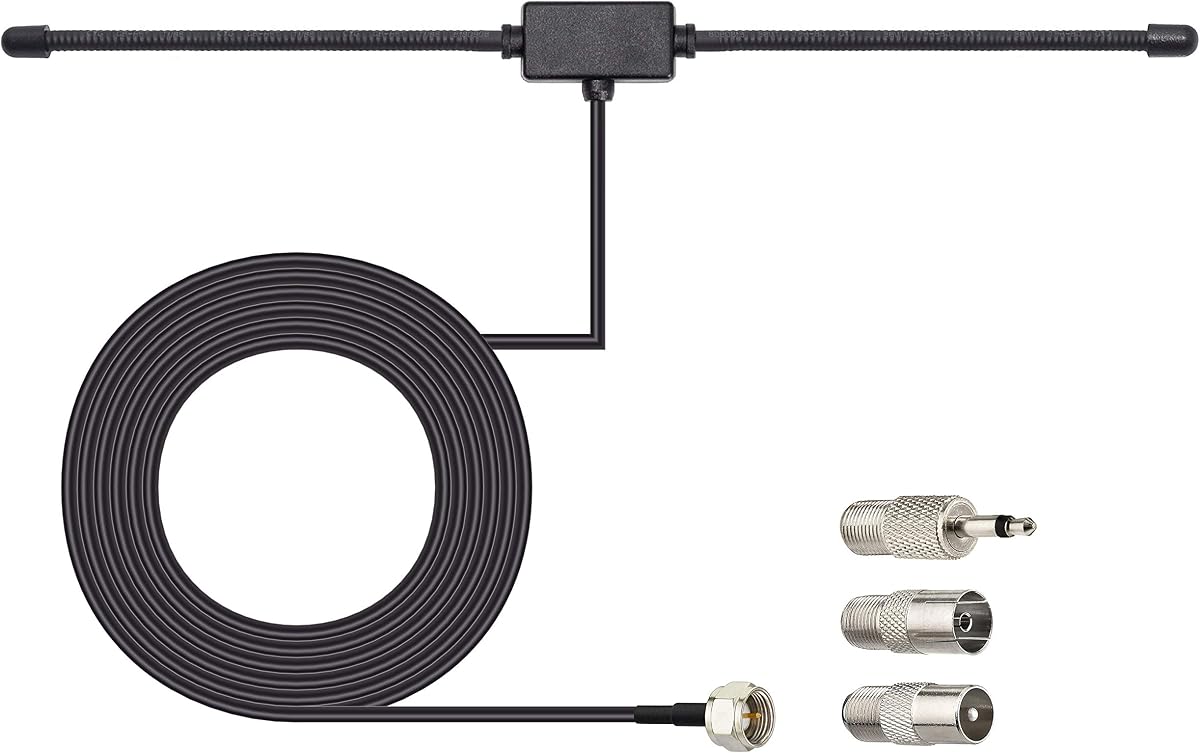
Bingfu FM Dipole
4.1Editor score
75-ohm indoor FM design
Ten-foot coaxial extension
Multiple connector adapters
Compare the 10 best Ocf Dipole Antenna options for ham radio, FM reception, portable spectrum analysis, wideband monitoring, and easier installation today.
An Ocf Dipole Antenna can take several practical forms, from a compact 10-meter half-wave design to a wideband log-periodic array, a loaded multifunction dipole kit, and a long-wire antenna for portable HF operation. A useful model balances frequency coverage, impedance, mounting flexibility, environmental resistance, and compatibility with the receiver or radio you already own.
This guide compares all ten available options by examining their stated frequency ranges, antenna construction, connector arrangements, mounting options, power handling, and intended applications. It includes dedicated amateur-radio antennas, indoor FM reception aids, a spectrum-analysis antenna, and a kit of interchangeable dipole elements rather than treating every similarly named product as interchangeable.
Each numbered review explains who the product is best suited for, where its specifications stand out, and where its limitations make it a less natural fit. The top selections represent the strongest balanced options for general spectrum work, budget-conscious FM reception, and specialized amateur-radio use. Product availability and prices can change, so confirm current details before buying.
4.1Editor score

4.5Editor score

5.0Editor score
The table below places all ten antennas side by side, highlighting their primary application, frequency coverage, construction, and key practical advantage. It is a quick way to narrow the field before reading the detailed reviews and buying guide.


The RTL-SDR Blog Multipurpose Dipole Antenna Kit has a 4.4 rating and is designed for portable radio-frequency reception rather than one fixed operating band. Its most notable feature is the range of included elements: one 23cm-to-1m telescopic antenna, one 5cm-to-13cm telescopic antenna, a 60cm RG174 lead, a 3m RG173 extension, and both a flexible tripod and a suction-cup mount.
We may earn a commission when you buy through this link, at no additional cost to you.
That assortment makes the kit especially useful for an SDR operator who changes location, compares nearby frequency bands, or wants a quick way to improve an existing receiver setup. The telescoping sections allow the effective element length to be adjusted rather than forcing the user to carry several fixed antennas. Including a tripod also permits temporary elevation without finding a permanent mast, while the suction mount offers another way to position the antenna on a smooth surface.
The principal limitation is that the package is a kit rather than a single antenna with one clearly specified operating range. Users must understand which element and cable combination suits the target frequency and ensure the connections remain secure. Its supplied details also do not include a broad formal impedance figure, so it is less straightforward for applications requiring guaranteed 50-ohm operation across an entire range.
This is the most flexible pick for portable experimentation, especially for users who want one package to cover several practical setups. It is less compelling for a high-power amateur-radio station, where power handling, matching, and fixed installation details deserve more attention. For travel, testing, and signal comparison, however, the included mounts and telescoping sections create an unusually useful combination.
Two telescoping antennas cover different length ranges, allowing the user to match the radiating element more closely to a target band. That flexibility is valuable when carrying one kit into several different reception scenarios.
The flexible tripod and suction cup remove the need for a dedicated mast or permanent mounting point. These options make it easier to experiment with antenna position and compare signal strength.
We may earn a commission when you buy through this link, at no additional cost to you.
The AURSINC ZA048 LDPA carries a 4.5 rating and is the most broadly capable antenna in this guide for RF testing and signal monitoring. It covers 400MHz to 8GHz with a rated 50-ohm input impedance, allowing it to interface directly with compatible RF equipment, including the tinySA ULTRA spectrum analyzer.
We may earn a commission when you buy through this link, at no additional cost to you.
Its printed log-periodic dipole array architecture is intended to balance broad frequency coverage with directional characteristics. According to the supplied specifications, most bands above 1GHz achieve approximately 10dB or lower return loss and a VSWR near 2. In the 400MHz–1GHz region, return loss is about 4.5dB or less and VSWR is around 4, so the antenna is strongest on the upper portion of its stated range.
It is not a perfect every-band match. Performance at the lower end involves a more pronounced VSWR, and the package does not include the tinySA Ultra or SMA cables shown in the demonstration material. The adjustable mounting bracket is included and supports listed 2.8-inch and 4-inch tinySA models, which is a significant convenience for mobile measurements.
This is the top overall choice for users who want one antenna to explore a very wide range of frequencies, identify signal direction, and work with a portable spectrum analyzer. It is less suitable for conventional FM stereo reception or high-power HF transmission. For spectrum analysis, however, its coverage, matching, directionality, and compact form factor form a particularly coherent package.
The 400MHz–8GHz range allows an operator to move between cellular-adjacent frequencies, Wi-Fi, industrial RF, and other higher-frequency services without replacing the antenna. That makes the LDPA useful for surveys and comparative signal tests.
The array's directional sensitivity can help reveal which direction a stronger source occupies. Rotating the antenna and watching the analyzer response creates a practical way to locate and compare nearby transmitters.
We may earn a commission when you buy through this link, at no additional cost to you.
The Bingfu FM Radio Dipole Antenna has a 4.1 rating and provides a straightforward way to improve reception for indoor stereo receivers, home theater equipment, and other compatible FM tuners. It uses a 75-ohm unbalanced dipole with an adhesive wall mount and a ten-foot, or three-meter, coaxial extension cable.
We may earn a commission when you buy through this link, at no additional cost to you.
The included adapters cover F-type, 3.5mm, and TV-style male or female connections, allowing the antenna to fit several receiver arrangements. The long extension is important because moving the antenna away from a receiver or entertainment system can reduce interference from nearby electronics. Its adhesive base also makes repositioning straightforward without tools or permanent hardware.
The product does not solve every reception problem. Indoor FM reception depends on building materials, local interference, terrain, weather, and the receiver's own tuner. A dipole may not outperform a well-positioned outdoor antenna in a difficult location, and the correct adapter must be selected and securely tightened to avoid signal leakage.
This is the best budget choice for someone with a home FM receiver that struggles with indoor reception. It is particularly useful as a low-commitment upgrade requiring no permanent installation. The combination of a wall-mountable dipole, extended lead, and multiple adapters is more versatile than a basic wire antenna, although it remains firmly oriented toward FM rather than wideband RF analysis.
The extended lead allows the antenna to be moved away from a receiver, television, or other electronics that may create noise. Placing it near a window or higher on a wall can also provide a clearer line of sight toward broadcast transmitters.
The supplied connector set accommodates common receiver terminals. Users should compare the receiver socket with the included options before installation and tighten every connection to minimize signal loss.
We may earn a commission when you buy through this link, at no additional cost to you.
The AH710 ICOM Folded Dipole Antenna has a 5.0 rating and is a specialized amateur-radio option covering 1.9 to 30MHz. Rather than trying to serve FM reception, spectrum analysis, and portable operation simultaneously, it focuses on the conventional high-frequency bands used by shortwave and ham-radio operators.
We may earn a commission when you buy through this link, at no additional cost to you.
A folded dipole can provide a practical balance between radiation efficiency, feed-line behavior, and installation convenience. The supplied information does not specify power rating, exact impedance, mounting hardware, or the connector arrangement, so those details should be verified with the manufacturer or seller before committing to a permanent high-power installation.
The product's strongest advantage is specialization. Buyers already using compatible ICOM equipment and seeking a predictable HF-oriented antenna may prefer a purpose-named model over a multipurpose kit. The trade-off is reduced flexibility: it does not offer the wide 400MHz–8GHz span of the AURSINC model, the telescoping sections of the RTL-SDR kit, or the field portability of the JYR8010.
This is the premium selection for an amateur-radio buyer whose principal requirement is dedicated HF operation within the stated 1.9–30MHz range. It is not the right general-purpose antenna for an FM listener or spectrum-analysis enthusiast. Its 5.0 rating is encouraging, but informed installation and compatibility verification remain more important than the rating alone.
A dedicated HF antenna can be easier to integrate into an amateur-radio station than a general-purpose wideband model. Users should match the antenna to the radio, feed line, and bands they intend to operate.
The available product information is concise, so confirming connector type, power handling, impedance, and mounting requirements is important. Those details matter particularly for a fixed or high-power station.
We may earn a commission when you buy through this link, at no additional cost to you.
The JYR8010-150W End Fed Half Wave Antenna has a 4.5 rating and combines an eight-band HF design with a 40-meter radiating element and a 1:64 impedance transformer. It supports 80, 40, 30, 20, 17, 15, 12, and 10 meters, making it a strong candidate for amateur-radio operators who want broad coverage without constant retuning.
We may earn a commission when you buy through this link, at no additional cost to you.
Its stated operating limits are 150W for SSB, 120W for CW, and 80W for FT8. The integrated transformer is intended to provide usable multi-band operation without an external antenna tuner in most setups. A durable ABS housing, heavy-gauge wire, reinforced end insulator, and secure clamping system add to its suitability for outdoor use.
The 1:49 and 1:64 transformer arrangement, 40-meter element, and broad band coverage mean it is not the same thing as a conventional half-wave dipole. Results still depend on installation, surrounding objects, and feed-line setup. The stated guidance recommends keeping the antenna three meters from obstacles and five meters from metal surfaces, and the natural-cooling enclosure and waterproof M-J connector are useful features for sustained outdoor operation.
This antenna is well suited to POTA, SOTA, camping, emergency communication, and flexible home or portable stations. It is less attractive for a user with very limited real estate because clearance around the element can influence performance. It is also not intended to run every listed power level in every mode, so operators must respect the stated limits.
The integrated impedance transformer is central to the antenna's convenience. It lets the operator move among the listed HF bands while avoiding the repeated adjustment that can burden a simple end-fed wire.
The single-wire format can be strung between trees, poles, rooftops, or masts with relatively little hardware. The stated clearance guidance remains important because nearby structures can alter radiation and impedance.
We may earn a commission when you buy through this link, at no additional cost to you.
The Falcon 10 Meter Dipole Base Station Antenna has a 4.5 rating and is a simple, dedicated half-wave antenna for the 10-meter amateur-radio band. Its defining feature is restraint: rather than covering a wide spectrum, it focuses on a single popular HF band and presents itself as a base-station installation.
We may earn a commission when you buy through this link, at no additional cost to you.
A half-wave dipole is a familiar antenna architecture because it can provide effective radiation without requiring the complexity of a multi-band matching network. The Falcon model is described as weather-tight and suitable for indoor or outdoor use, which gives it some flexibility in home stations, attics, porches, and other locations where a compact permanent installation is needed.
The supplied information does not state the feed-point impedance, maximum power, connector, mounting dimensions, or exact conductor arrangement. Those omissions limit the certainty with which it can be compared with the more technically detailed models in the list. It is also important not to assume that every device advertised for the 10-meter band will be tuned identically at its exact operating frequency.
The Falcon 10 Meter model is best for a ham-radio operator who specifically wants a simple 10-meter dipole and does not need broad-band versatility. It is less appropriate for spectrum analysis, indoor FM, or multi-band HF operation. Its 4.5 rating and clear purpose make it a credible focused choice, provided the buyer confirms the missing installation specifications.
A single-band dipole can be a sensible option when the operator regularly uses one band and wants a straightforward base antenna. It avoids the tuning network and control system required by many multiband alternatives.
The stated indoor-and-outdoor design allows placement beyond a protected radio room. Installation should still account for access, orientation, nearby structures, and safe cable routing.
We may earn a commission when you buy through this link, at no additional cost to you.
The Falcon 11 Meter Dipole Base Station Antenna has a 3.9 rating and is intended for amateur-radio operation on the 11-meter band. Like the Falcon 10 Meter model, it is described as a half-wave base-station antenna with a weather-tight design intended for indoor or outdoor use.
We may earn a commission when you buy through this link, at no additional cost to you.
The dedicated 11-meter format is relevant to operators who already know that band is central to their activity. A fixed dipole avoids the need to change elements when the operator moves between different tasks, and the weather-tight enclosure adds confidence for installations that are not permanently sheltered.
Its lower rating and limited published specifications deserve attention. The available data does not identify the feed impedance, power limit, connector type, overall dimensions, or exact mounting method. It would therefore be imprudent to treat it as an interchangeable substitute for the Falcon 10 Meter version; element length, feed arrangement, and intended operating conditions may differ.
The product is a practical choice for a buyer who specifically wants an 11-meter base-station dipole. It is a less flexible recommendation for anyone seeking one antenna for multiple HF bands, FM reception, or wideband analysis. The 3.9 rating does not automatically disqualify it, but it makes careful product-page verification and realistic installation planning especially important.
The dedicated length makes this model more relevant to operators centered on the 11-meter band. A user who changes bands frequently may prefer a transformer-based or wideband solution instead.
Because the supplied information omits several installation and electrical specifications, buyers should confirm compatibility with their radio and feed line. Checking those details avoids selecting on the band label alone.
We may earn a commission when you buy through this link, at no additional cost to you.
The Ancable 300 Ohm FM Antenna has a 4.5 rating and offers a simple T-shaped dipole for FM stereo receivers. It is intended for receivers that accept a clip or terminal-style FM connection and is positioned as a plug-and-play improvement over relying on a receiver's built-in antenna.
We may earn a commission when you buy through this link, at no additional cost to you.
The antenna uses a 300-ohm design and includes a 5.9-foot coaxial cable. Its T-shaped element can be placed away from the receiver, while the supplied lead offers more separation than a very short stub antenna. The product is marketed for tabletop radios and for home, office, garage, or basement receivers where broadcast reception may be limited by the internal antenna.
Compatibility is the most important consideration. Buyers should confirm that the receiver's FM socket matches the provided connection format before ordering. The shorter lead may also provide less placement freedom than the Bingfu model's three-meter extension, and the 300-ohm arrangement is intended for a different connection environment than a conventional 75-ohm coaxial FM input.
This antenna is best for a basic FM setup where simplicity matters more than sophisticated broadband performance. It is a credible low-cost upgrade for a compatible receiver and a 4.5 rating indicates generally favorable user response. It is not suitable for wideband spectrum analysis, high-power transmission, or receivers requiring a standard 75-ohm coax connector.
Moving the external element away from the receiver can reduce the effect of local electronic noise and provide a clearer orientation toward transmitters. Placement near a window is often more useful than keeping the antenna beside the equipment.
The clip or terminal connection is less universal than a standard coaxial input. Comparing the receiver socket with the product's pictured connection prevents avoidable incompatibility.
We may earn a commission when you buy through this link, at no additional cost to you.
The SS17 Stainless Steel 1000W 17ft Collapsible Multi-Band Dipole Antenna has a 4.9 rating and combines a high stated power rating with a portable stainless-steel structure. It is designed for 6 through 20 meters and 30 through 160 meters, with a loading coil supporting those multiple HF ranges.
We may earn a commission when you buy through this link, at no additional cost to you.
The antenna extends to approximately 17 feet and collapses to about 25 inches. That combination makes it much easier to store and transport than a permanently installed full-size dipole. Stainless steel adds a rugged material choice, while the listed 1000W power handling makes the antenna relevant to more demanding amateur-radio stations than a typical lightweight wire model.
The collapsed form still needs a large clear area when extended, and the 0.63-inch diameter creates a substantial physical profile. The stated band coverage is broad in terms of included frequencies, but it is not the same as continuous 1.9–30MHz coverage. Users should also determine whether their radio and operating setup are compatible with a coil-loaded, collapsible construction.
This is an excellent option for an operator who wants a durable, high-power multiband dipole that can be removed or transported. It is particularly compelling for temporary installations, field organizations, and home stations with less permanent antenna infrastructure. It is less suitable for someone needing the AURSINC model's hundreds-of-megahertz-wide coverage.
A 1000W rating and stainless-steel construction suit users who need more capability than a lightweight portable dipole offers. The collapsible body still permits compact storage between operating sessions.
The seventeen-foot operating length needs adequate space and secure support. A collapsible design is easier to transport, but it does not eliminate the clearance required by the deployed antenna.
We may earn a commission when you buy through this link, at no additional cost to you.
The Harvest W8010 HF Dipole Antenna is built for an amateur-radio base station and covers 3.5 to 28MHz. The specified operating bands are 80, 40, 20, 15, and 10 meters, with a stated maximum power of 1.2kW peak and a 50-ohm impedance.
We may earn a commission when you buy through this link, at no additional cost to you.
Its high power rating and conventional system impedance make it a serious option for fixed HF stations. The 50-ohm feed point is familiar in amateur-radio installations, while support for the listed bands covers a useful range of common longwave-through-10-meter activity. The product is therefore best considered a permanent or semi-permanent station antenna rather than a lightweight indoor accessory.
The product data does not provide a customer rating, so it is difficult to compare user satisfaction with the other options. It also omits information about the physical layout, mounting hardware, feed connector, and detailed matching behavior across the full 3.5–28MHz span. Buyers should confirm how the listed bands are selected and whether a tuner or matching arrangement is required.
This antenna is a compelling candidate for a high-power home station that primarily operates the named HF bands. Its 1.2kW peak figure and 50-ohm impedance distinguish it from compact receiving antennas and lightweight portable kits. It is less appropriate for FM listening, spectrum analysis, or operators who need a collapsible field setup.
The 1.2kW peak specification indicates a station-oriented product intended to support substantially more power than a basic receiving dipole. Appropriate feed line, grounding, and station protection remain the installer's responsibility.
A 50-ohm impedance aligns well with common amateur-radio equipment and feed-line systems. Confirming connector details and band-specific matching before erecting the antenna helps prevent avoidable installation issues.
We may earn a commission when you buy through this link, at no additional cost to you.
The right antenna depends less on a universal winner and more on the frequencies, equipment, power level, and operating environment involved. These factors help separate a receiving accessory, a portable SDR tool, and a fixed amateur-radio antenna before you compare products.
Start with the exact frequencies your radio or analyzer will receive. The products in this guide occupy very different parts of the spectrum: the AURSINC LDPA spans 400MHz to 8GHz, the two indoor FM antennas focus on broadcast reception, and most of the remaining models serve conventional HF amateur-radio bands. A wide numerical range does not guarantee equal performance everywhere, so compare the stated operating bands and the user's intended use rather than relying on the broadest headline specification.
Choose the antenna that directly covers your most important frequencies. For a single-band station, a dedicated 10- or 11-meter model may be simpler. For multiple HF bands, review transformer-based or coil-loaded options, and for wideband spectrum work, prioritize a design explicitly rated for that task.
Impedance should be compatible with the receiver, spectrum analyzer, radio, and feed line. The AURSINC antenna is rated for 50-ohm equipment, the Bingfu model uses a 75-ohm unbalanced FM arrangement, the Ancable model uses 300 ohms, and the Harvest W8010 is specified at 50 ohms. Connectors also vary: some products use standard coaxial fittings, while the Ancable antenna uses a spade-terminal arrangement and the Bingfu kit supplies several adapters.
Verify both electrical impedance and physical connection before buying. An adapter can solve many fitting problems, but it does not erase an impedance mismatch or guarantee that a product is safe for a high-power transmitter. When details are absent, request them from the seller or manufacturer rather than assuming compatibility.
Receiving-only antennas and transmitting antennas have very different requirements. The SS17 lists 1000W of power handling, the Harvest W8010 states 1.2kW peak, and the JYR8010 supports up to 150W SSB, 120W CW, and 80W FT8. These figures are not interchangeable, and the lower mode-specific limit should be respected. Higher capability can be valuable in a fixed station, but it may also require sturdier wire, a suitable feed line, sound grounding, and more careful installation.
For reception-only SDR or FM work, transmit power is usually irrelevant. For amateur-radio transmission, compare the listed limit with your radio's output, allow for feed-line losses, and choose conservatively. Never assume a receive antenna can safely handle transmitter energy.
Portable antennas are easier to carry, reposition, and remove, but they still need adequate space when deployed. The RTL-SDR Blog kit includes telescoping elements and temporary mounts, the JYR8010 can be strung between trees or poles, and the SS17 collapses to approximately 25 inches before extending to 17 feet. Fixed antennas such as the Falcon base-station models and the Harvest W8010 are better suited to an established operating position with repeatable clearance and mounting support.
Think about how often you will move and where the antenna can be safely supported. A portable model is valuable for field activity, emergency communications, and experimentation, while a fixed model can be easier for regular base-station use. Neither portable labeling nor collapsible construction eliminates the need for safe clearance.
Indoor FM reception is affected by building materials, electronics, windows, and local interference. The Bingfu antenna includes a long extension and adhesive wall mount, while the Ancable product uses a shorter lead and a terminal-style connection. Outdoor HF installations face different issues, including nearby buildings, metal surfaces, supporting trees or masts, and changing weather. The JYR8010 specifically recommends three meters of clearance from obstacles and five meters from metal surfaces.
Choose mounting methods that suit the site rather than expecting the antenna to overcome poor placement. Give indoor antennas room from electronics and a clear view toward transmitters. Secure outdoor supports, manage cables safely, and inspect installations after severe weather.
A conventional half-wave dipole, folded dipole, end-fed wire, loaded dipole, log-periodic dipole array, and indoor T-shaped antenna behave differently. The log-periodic design favors wideband directional measurements, while an end-fed wire uses an impedance transformer to support several bands. A folded dipole can simplify feed-line behavior, and an indoor FM dipole aims to improve a receiver's local broadcast signal. The architecture should match the task rather than merely carry the word dipole.
Understand whether you need broad coverage, directional sensitivity, a simple receiving element, or a high-power radiating system. Reviewing the design also helps explain why some antennas include baluns, loading coils, multiple elements, or long coaxial extensions.
Useful installation information includes mounting hardware, feed connector, antenna dimensions, required clearance, and whether the product is intended for indoor, outdoor, portable, or permanent use. The RTL-SDR Blog kit provides both a tripod and suction cup, the AURSINC includes an adjustable bracket for listed tinySA models, and the Bingfu antenna uses adhesive mounting. Other products provide fewer mechanical details, making seller verification more important.
Choose an antenna you can support safely and orient correctly. Cable strain, corrosion, water ingress, accessible connectors, and the ability to relocate the antenna can be as important as the headline electrical specification.
Begin by identifying the antenna's intended frequency range, impedance, and connector arrangement, then confirm that both are compatible with your radio, receiver, analyzer, and feed line. Install the antenna in a clear location, orient the element as intended, and allow the full recommended distance from buildings, metal objects, and other antennas. For indoor FM units, place the antenna near a window and away from electronics; for portable HF setups, secure both the antenna and its support before transmitting.
After connection, inspect every coaxial joint and make sure it is fully tightened. Loose fittings can introduce leakage, intermittent reception, or unreliable measurements. Turn on the receiver and compare signal strength or noise floor with and without the external antenna. For direction finding with the AURSINC LDPA, rotate the antenna while watching the spectrum analyzer, then repeat from another position to reduce the chance of mistaking a local reflection for the true source.
Outdoor antennas require ongoing care despite weather-resistant construction. Check the wire, connectors, balun or transformer housing, clamps, and mounting points periodically, especially after strong winds, ice, or storms. Do not transmit with a damaged feed line or visible element damage. When the JYR8010 is used outdoors, its supplied guidance recommends inspecting the installation and guy rope every six months and replacing a deteriorated assembly rather than relying on aging components.
The term is commonly used in online shopping for dipole-style radio antennas, but the available products use several different structures. They include conventional half-wave and folded dipoles, an end-fed wire with a transformer, a collapsible loaded dipole, an indoor FM T-shaped antenna, a multipurpose telescoping kit, and a wideband log-periodic dipole array. The most useful definition is therefore the application and frequency range rather than a single physical design.
Only if the antenna is explicitly designed for broad coverage and your equipment can tolerate its matching behavior across the desired range. The AURSINC ZA048 covers 400MHz to 8GHz, while the HF products cover selected amateur-radio bands. Even a wideband antenna may have higher VSWR at its lower frequencies, so check both frequency coverage and stated impedance before making assumptions.
It often can, especially when the built-in receiver antenna is short, poorly positioned, or surrounded by electronics. The Bingfu and Ancable models can provide a better external element and more placement flexibility. Actual results depend on building construction, local interference, transmitter distance, and how far the antenna is placed from the receiver, so a window location is usually preferable to a position directly beside the equipment.
The impedance difference is relatively modest, and FM receivers commonly use 75-ohm connections, but a proper match is still preferable. More importantly, confirm that the physical connector and antenna design are appropriate for the receiver. The Bingfu antenna includes several adapters, whereas the 300-ohm Ancable model is intended for a compatible clip or terminal-style FM input.
Voltage standing wave ratio indicates how well the antenna and feed system are matched to the equipment. A ratio near 1:1 is ideal, while a higher value reflects more reflected power and can affect efficiency, usable power, and measurement accuracy. The AURSINC ZA048 is described as operating near a VSWR of 2 in most bands above 1GHz and around 4 from 400MHz to 1GHz, so its strongest results occur in the upper range.
Do not transmit through an antenna unless its specifications explicitly confirm suitable power handling and matching for your radio and mode. The RTL-SDR Blog kit, Bingfu FM antenna, and AURSINC LDPA are presented primarily for reception, monitoring, or measurement. For transmission, use a model with a stated power rating, such as the SS17, Harvest W8010, or the mode-specific limits of the JYR8010, and follow all installation requirements.
Clearance depends on the design, but the JYR8010 specifically recommends keeping the antenna three meters from obstacles and five meters from metal surfaces. A general rule is to provide as much open space as practical, avoid parallel runs with metal roofing or wiring, and use a secure support. The AURSINC LDPA and indoor FM antennas have entirely different mounting needs and should not be installed using the same placement assumptions.
Compare the antenna's output fitting with the socket on the receiver, radio, or analyzer. The Bingfu package includes F-type and 3.5mm-related options, while the AURSINC uses a 50-ohm connection for compatible equipment. The Ancable product requires a matching clip or terminal arrangement. If the socket is not clearly identified, check the receiver manual or ask the seller before ordering.
The AURSINC ZA048 stands out as the strongest all-around choice for portable spectrum analysis and wideband direction finding, while the Bingfu FM Dipole offers a focused and economical solution for indoor broadcast reception. The ICOM AH710 is the premium selection for operators seeking a dedicated HF antenna for compatible amateur-radio equipment. Each serves a distinct purpose rather than representing one universal dipole design.
Prioritize the factors that will determine real performance: the exact frequencies you use, the impedance of your equipment, whether you need transmission capability, and how much installation space is available. A receiving antenna placed poorly will not match a well-positioned but simpler design, while a high-power model is unnecessary for a basic SDR or FM listener. Match the antenna architecture to the job before comparing aesthetics or convenience.
Finally, check the current product page, included components, specifications, and price before purchasing. Availability and pricing can change, and demonstration cables or compatible radios shown in product imagery are not always included. Confirming the connector, power limit, mounting requirements, and current package contents ensures that the selected Ocf Dipole Antenna fits the intended setup.