BNnYY OBD2 USB-C Dash Cam Adapter
4.4Editor score
Dual-mode physical switch
11.6V and 23.4V cutoff
Stable 5V/3A output
Our OBD2 to USB C Power Adapter for Dash CAM guide compares parking modes, voltage protection, vehicle fit, stable output, and easy installation for drivers.
An OBD2 to USB C power adapter gives a compatible dash cam a cleaner, more discreet power connection than a loose cigarette-lighter plug. The best options combine stable output, parking-mode controls, low-voltage protection, and straightforward OBD-II installation, but vehicle behavior and dash cam pin requirements still need careful verification.
We compared all ten adapters using the information supplied for each product, focusing on operating modes, cutoff behavior, supported electrical systems, cable length, connector design, installation method, and device compatibility. The list also distinguishes basic constant-power cables from models with automatic ACC detection, voltage displays, adjustable protection, and parking-mode support.
Each review explains the strongest features, practical trade-offs, and ideal use for its adapter. The selection shows how simpler daily-use designs differ from comprehensive parking-monitoring kits, while product details and availability can change, so shoppers should confirm current specifications and vehicle compatibility before buying.
4.4Editor score

4.3Editor score

4.4Editor score
The comparison below places every adapter's operating modes, electrical limits, parking features, and installation approach side by side, making it easier to identify a model that matches your vehicle and dash cam.


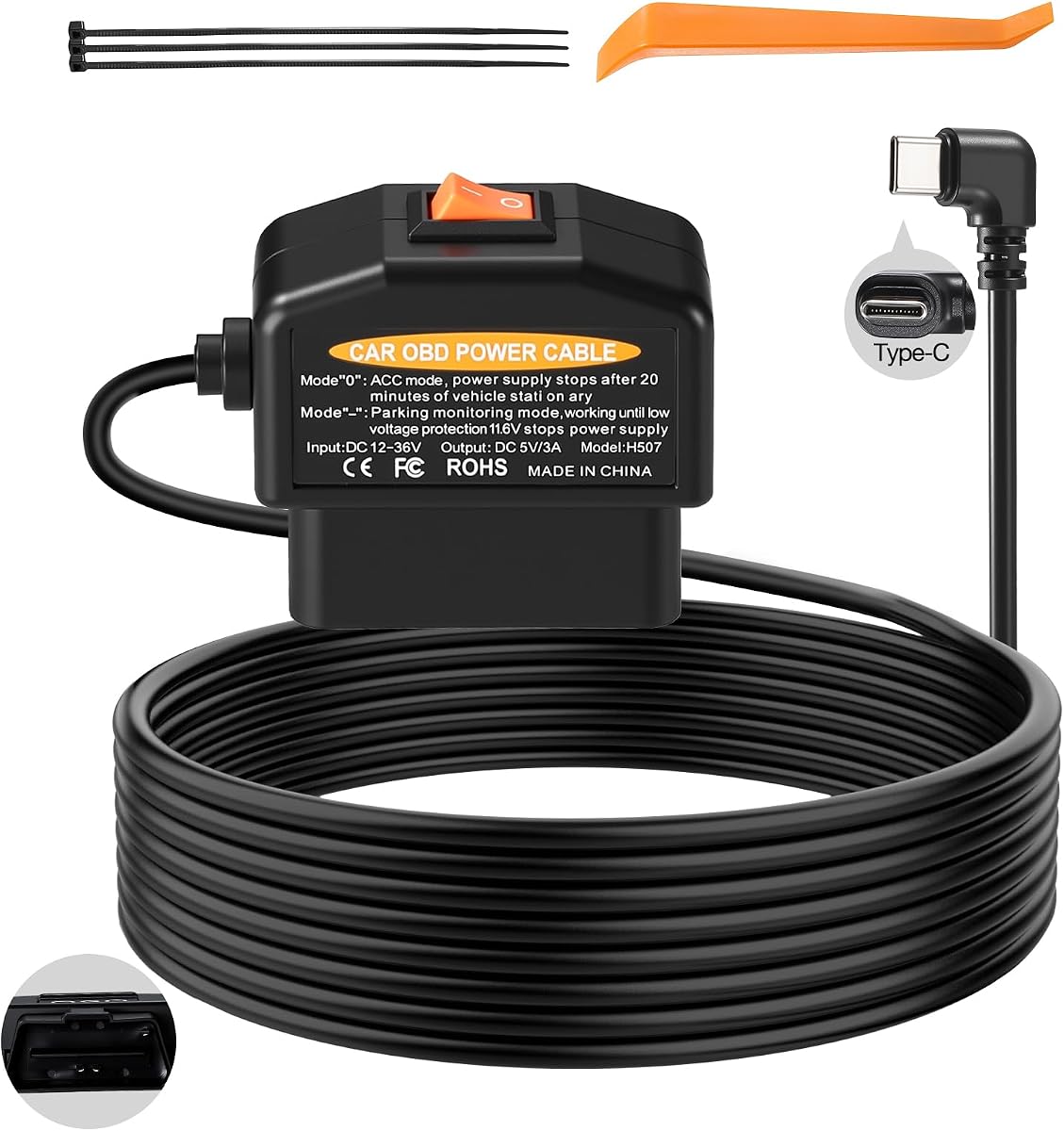


The BNnYY OBD2 to USB C Power Adapter for Dash Cam has a 4.4 rating and combines a straightforward installation with features usually associated with more elaborate hardwire kits. Its most notable qualities are the physical daily and surveillance mode switch, regulated 5V/3A output, and automatic cutoff at 11.6V or 23.4V.
We may earn a commission when you buy through this link, at no additional cost to you.
Daily mode is designed to stop supplying power roughly 20 minutes after the engine shuts off, while parking mode continues drawing power for monitoring. The intelligent voltage chip checks the vehicle battery and disconnects the dash cam when the selected threshold is reached. Protection against over-current and short circuits adds another layer of operational safety.
The 3.5-meter cable reaches the cabin from most OBD-II port locations without requiring fuse-box wiring or dashboard modifications. That makes this adapter attractive for drivers who want a cleaner cabin and a free 12V socket. The trade-off is its strict A5-B5 USB-C pin requirement, and the connector will not power a dash cam designed for A8-B8 pins or direct 12V input.
This is a sensible choice for a compatible dash cam and a vehicle whose OBD port remains energized after shutdown. Buyers should also remember that a vehicle that disconnects its OBD port when off may need to be driven to approximately 20 km/h to wake the adapter. For those conditions, the BNnYY offers a balanced and easy-to-understand solution.
The selector switch makes it easy to move between an energy-conscious daily mode and continuous parking surveillance. A visible control is particularly useful when the cable is routed out of sight and the mode otherwise would be difficult to change.
Separate thresholds for 12V and 24V vehicles make the adapter more versatile than a basic cable. Automatic cutoff helps limit battery drain, although owners should still monitor battery condition and avoid assuming that any cutoff guarantees the vehicle will start after a long parked period.
We may earn a commission when you buy through this link, at no additional cost to you.
This Intelligent Dual-Mode OBD Cable holds a 4.5 rating, the highest among the ten products, and presents a useful combination of parking-mode support, low-voltage protection, and simple installation. It is built for USB-C dash cams that use A5-B5 signal pins and converts vehicle power into a stable 5V/3A output.
We may earn a commission when you buy through this link, at no additional cost to you.
Its switch provides two distinct operating approaches. Daily mode is described as shutting off about 20 minutes after the engine stops, while parking monitoring mode can support vibration wake-up and automatic low-power time-lapse recording after a transition period. Built-in protection is listed at 11.8V for 12V vehicles and 23.4V for 24V vehicles.
The 3.5-meter extension gives installers enough length to conceal the wiring along the console or under interior trim. The included installation tool is useful for routing the cable without leaving a conspicuous loose connector. Over-current and short-circuit protection improve confidence in daily use, while the power-only design leaves the vehicle's OBD data channel separate.
The product is well suited to owners who want more than basic ACC shutdown behavior but do not need an LED voltage display. Its main limitation is the same pin-definition issue that affects several other A5-B5 cables. It also lacks the adjustable cutoff settings offered by the four-level kits, so users wanting precise control should compare those alternatives.
Parking mode can maintain power for a compatible camera's vibration-triggered or time-lapse recording features. This makes the cable more useful than a standard ACC adapter when evidence capture while parked is a priority.
The supplied clamp or routing accessory helps keep the three-and-a-half-meter lead tucked away. A concealed installation preserves the cabin's appearance and removes the need to modify the vehicle's factory wiring.
We may earn a commission when you buy through this link, at no additional cost to you.
The Four-Level LED Voltmeter Kit earns a 4.3 rating and stands out as the most feature-rich option in this group. It combines automatic ACC detection, four selectable low-voltage cutoffs, a real-time LED battery display, parking support, and a broad collection of electrical protections in a plug-and-play OBD-II design.
We may earn a commission when you buy through this link, at no additional cost to you.
Users can choose different 12V thresholds, including 11.6V, 11.9V, and 12.5V, along with a 20-minute timer setting. Comparable choices are provided for 24V systems. The LED display makes it easier to understand the vehicle's electrical state without connecting a separate meter, while the regulated 5V/3A output is suitable for compatible USB-C dash cams and other supported devices.
ACC detection is intended to switch between driving and parked operation automatically. The included A8-B8 adapter improves compatibility with devices that do not use the more common A5-B5 arrangement. Over-current, short-circuit, overheat, and thermal-recovery safeguards add confidence, though the stated note that the cable has not been tested with every dash cam brand means careful checking remains important.
This is the most versatile pick for a driver who wants visible battery information and adjustable protection rather than a single fixed threshold. It is less attractive for someone seeking the simplest possible adapter, but its parking support, electrical safeguards, and pin-definition options justify the additional complexity.
The integrated LED voltmeter provides immediate feedback about the vehicle battery, helping owners choose a sensible cutoff level and recognize a weak or aging battery. That visibility is more useful than relying entirely on an invisible automatic cutoff.
Multiple thresholds allow drivers to balance parking duration against starting confidence. Newer users can begin with a higher threshold, while owners familiar with their battery condition can select a more aggressive setting.
We may earn a commission when you buy through this link, at no additional cost to you.
This LED Display 11.5-Foot Kit has a 4.3 rating and focuses on transparent battery monitoring, automatic parking behavior, and compatibility with a wide range of popular dash cam brands. Its 11.5-foot lead provides ample routing room for concealed installations across many vehicle layouts.
We may earn a commission when you buy through this link, at no additional cost to you.
The built-in display shows real-time battery voltage, while four cutoff choices include 11.6V, 11.9V, 12.5V, and a 20-minute timer. First-time users are advised to start at 12.5V, particularly with older batteries or cold weather, because a higher threshold can reduce the likelihood of a low-voltage starting issue.
The ACC smart chip is designed to maintain recording while driving and enter parking surveillance after shutdown. The product description names VIOFO, 70mai, Wolfbox, Rove, and RedTiger among compatible brands, although buyers should still verify their exact model and its parking-mode support.
A significant vehicle-side caveat is that the OBD port must continue supplying power with the engine off. Some European vehicles, including certain Mercedes-Benz, BMW, and Volkswagen models, may continue presenting ACC signals, preventing the 20-minute timer from operating as expected. This is a strong feature-rich option when the vehicle wiring behaves as required.
Seeing the live battery reading helps owners distinguish normal resting voltage from a declining battery. It also makes the adjustable protection settings easier to use intelligently rather than selecting a cutoff blindly.
The listed brand support is encouraging, but the connector arrangement and parking-mode requirements can vary by model. Checking the dash cam and vehicle manuals before installation prevents avoidable troubleshooting.
We may earn a commission when you buy through this link, at no additional cost to you.
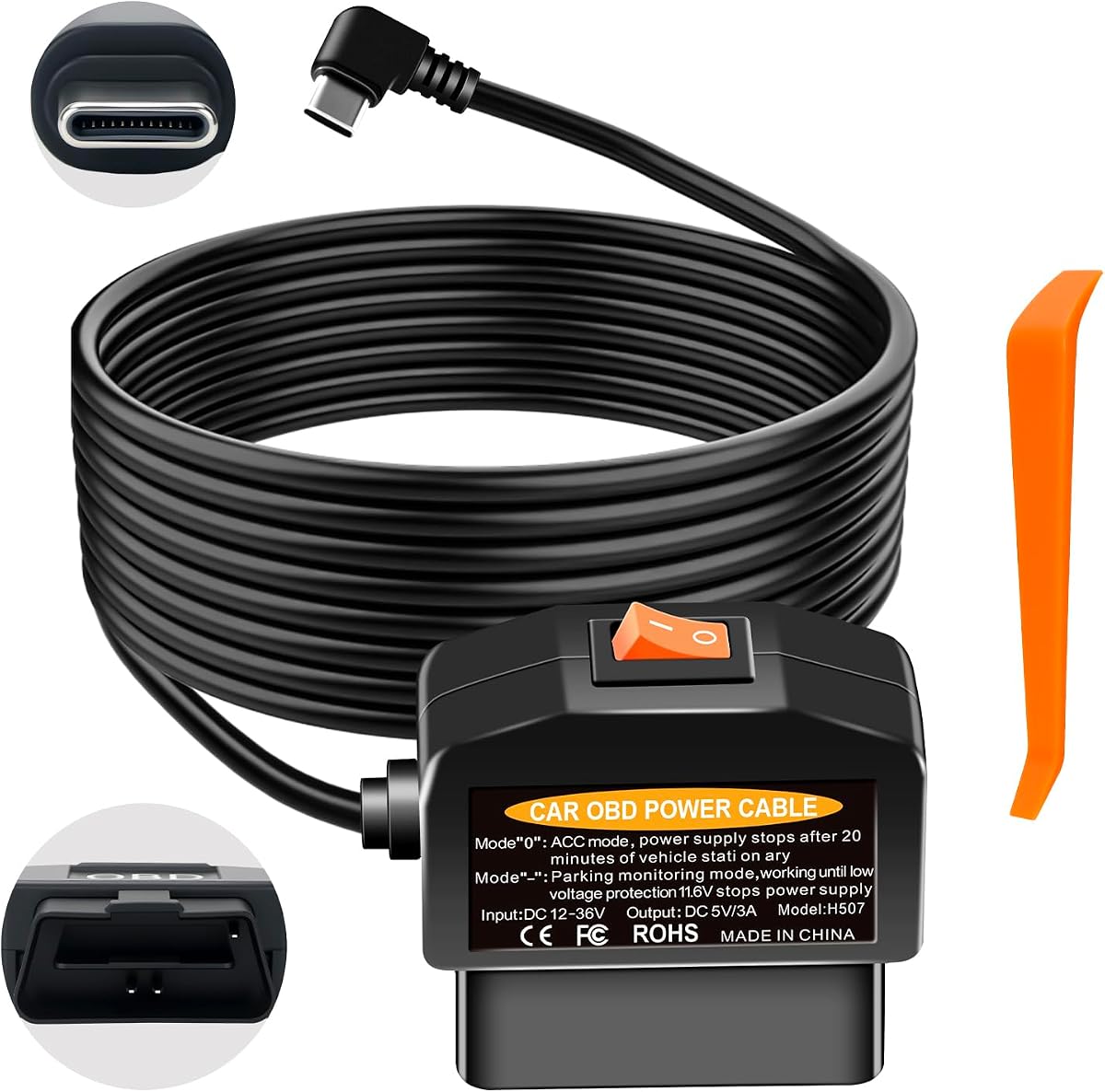
The CERRXIAN Right-Angle OBD Cable has a 4.3 rating and offers a broad 13V–40V input range, a right-angle USB-C connector, and two clearly described operating modes. It can also power suitable Type-C devices beyond dash cams, including GPS units, mobile phones, and tablets, according to the supplied information.
We may earn a commission when you buy through this link, at no additional cost to you.
Mode O provides ACC behavior, with power shutting off between 10 and 200 seconds after the engine stops depending on the vehicle's factory settings. Mode dash-mark activates parking monitoring and keeps supplying power until the voltage falls below 11.6V. The 5V/3A output is regulated for compatible electronics.
The right-angle connector is useful in tight dashboard spaces and can reduce strain where the dash cam cable enters the port. The 3.5-meter length and included trim tool support a concealed installation. Unlike diagnostic adapters, this cable extracts power only and does not communicate with the vehicle's ECU data network.
The product itself appropriately warns that its 11.6V cutoff is a last-resort protection level and cannot guarantee that the battery will retain enough charge to start the vehicle. It is best for owners who understand the risks of long parking operation and want broad input compatibility in a compact right-angle format.
The angled plug can sit more neatly beside a mounted dash cam than a straight connector. This may improve cable routing and reduce unwanted movement around the camera's power port.
The 13V–40V specification allows use across a wider collection of electrical systems than a conventional 12V-only cable. Parking runtime still depends on battery health, vehicle behavior, and the power draw of the connected device.
We may earn a commission when you buy through this link, at no additional cost to you.
The Six-Protection USB-C Hardwire Kit carries a 4.4 rating and emphasizes a comprehensive safety system around a familiar OBD2 installation. Its two-mode switch, stable 5V/3A output, and automatic voltage cutoff make it a strong all-around option for compatible USB-C dash cams.
We may earn a commission when you buy through this link, at no additional cost to you.
The electrical safeguards include low-voltage cutoff, anti-drain protection, over-current protection, short-circuit protection, reverse-polarity protection, and overheat protection. Daily mode normally stops output about 20 minutes after shutdown, although the actual interval can be longer depending on the vehicle's OBD logic. Parking mode continues supplying power until a low-battery condition is detected.
A stated five-minute delay before output stops in parking mode may reduce abrupt shutdown behavior. The cable works with 12V and 24V systems, including cars, SUVs, trucks, and larger vehicles, and its 3.5-meter length is sufficient for concealed routing. The design draws power only and is described as isolated from ECU data.
Its limitations are relatively minor for informed buyers. The A5-B5 pin arrangement excludes A8-B8 and 12V-input cameras, and there is no visible voltage display or user-adjustable cutoff. It is well suited to buyers who value layered protection over detailed battery monitoring and customization.
Protection against reverse polarity, over-current, short circuits, and overheating addresses several installation and electrical risks. Low-voltage and anti-drain functions provide additional support for vehicles that remain parked for extended periods.
The regulated 5V/3A output is intended to reduce resets and recording interruptions caused by inconsistent power. A dependable connection is essential when a dash cam needs to remain active through ignition changes and parked operation.
We may earn a commission when you buy through this link, at no additional cost to you.
The Switchable ACC OBD Power Cable earns a 4.4 rating and provides a detailed operating model without adding a display or adjustable menu. It is aimed at fuel vehicles with OBD or OBD-II ports and USB-C dash cams that use A5-B5 signal pins.
We may earn a commission when you buy through this link, at no additional cost to you.
The one-button interface offers ACC and surveillance modes. ACC mode is described as powering down after five minutes when the vehicle is off, while surveillance mode continues until the 11.6V cutoff activates. The supplied details also explain the higher voltage behavior used in one setting, where a delay occurs once the battery reaches a defined level.
Its intelligent control chip checks battery voltage and stops output below the low-voltage threshold, which is especially useful for aging batteries or vehicles with inconsistent voltage readings. The product obtains power without interfering with OBD communications and fits directly into the vehicle's existing port, avoiding fuse-box and battery modifications.
This is a good option for a conventional fuel-powered vehicle and a compatible dash cam. It is not the appropriate choice for hybrid or pure-electric vehicles, for which the manufacturer directs buyers toward a different vibration-detection model. The lack of an LED display also means users cannot check voltage as easily as they can with several competing kits.
The voltage-detection design is explicitly positioned for fuel vehicles, offering a straightforward power solution for the broad group of cars using standard OBD ports. Electric and hybrid owners should follow the product guidance and consider a different model.
A single control simplifies the choice between regular ACC behavior and continuous surveillance. It also keeps the cable and housing uncomplicated for drivers who do not want to manage a digital display or complex settings.
We may earn a commission when you buy through this link, at no additional cost to you.
The 12V OBD2 USB-C Parking Kit has a 4.2 rating and distinguishes itself with an included A5-to-A8 signal adapter, automatic ACC detection, and protection against overload, short circuits, and high temperatures. It is specifically designed for conventional 12V vehicles with constant OBD power.
We may earn a commission when you buy through this link, at no additional cost to you.
The adapter supports a dash cam with a USB-C power input and includes a 3.5-meter cable for concealed installation. Its A5-to-A8 adapter is intended to resolve parking-mode compatibility issues for certain Wolfbox and Thinkware models, reducing the need to purchase a second cable if the camera uses that signal arrangement.
Automatic ACC behavior powers the camera with the ignition and supports parking-mode recording after shutdown. An 11.6V cutoff is included to reduce battery depletion, while the housing is described as resistant to temperatures up to 185°F. A surge-protection feature is also listed as helping maintain consistent recording quality.
Vehicle requirements are the decisive limitation. The OBD port must remain powered after the engine is shut off, or the cable will not deliver output for parking use. It is also limited to 12V vehicles and does not support electric vehicles made before 2005. For a conventional car with constant OBD power, however, the included signal adapter is a useful convenience.
Including an A5-to-A8 adapter can make the kit usable with more dash cam models than a fixed-pin cable. It is particularly relevant to owners of the identified Wolfbox and Thinkware units who also need a single purchase for parking operation.
If the vehicle's diagnostic port switches off with the ignition, parking mode cannot function. Checking the owner manual or measuring the port with a multimeter before installation prevents disappointment.
We may earn a commission when you buy through this link, at no additional cost to you.
The L-Shaped LED Voltage Kit has a 4.0 rating and offers a compact 90-degree USB-C connector, real-time voltage display, and four selectable operating levels. It converts a 12V–24V vehicle supply into a regulated 5V/3A output for compatible dash cams and other supported USB-C devices.
We may earn a commission when you buy through this link, at no additional cost to you.
The protection choices are 11.6V, 11.9V, 12.5V, and a 20-minute timer. In parking operation, constant power can support continuous or time-lapse recording, subject to the camera's own capabilities. The angled connector is particularly useful with bulky cameras, side-mounted ports, or confined dashboard spaces.
The package includes the cable, a pry tool, and four wire ties for routing. Its safety features include a built-in fuse, over-current protection, short-circuit protection, overheating protection, and reverse-connection protection. These are useful additions for a cable that remains connected to both the vehicle and a recording device.
The principal drawback is the lowest listed customer rating in the group, although that does not by itself establish a specific defect. The connector uses A5-B5 pins and may not work with cameras using A8-B8. The 20-minute timer also requires a stationary vehicle and no occupant, and it may not trigger as expected if the dash cam lacks time-lapse parking support.
The L-shaped plug can sit closer to the dash cam body and reduce cable protrusion. That is useful when the port faces a windshield mount, dashboard edge, or another tight obstruction.
The LED display and selectable cutoffs give users more control than a basic fixed-threshold cable. The included pry tool and ties help create a tidy installation after the connection has been tested.
We may earn a commission when you buy through this link, at no additional cost to you.
The Wide-Range OBD2 USB-C Cable has a 4.4 rating and earns the premium pick for its especially broad 12V–36V input range, clear two-mode control, and 5V/3A regulated output. It is designed for compatible Type-C dash cams and can also serve supported GPS units and radar detectors.
We may earn a commission when you buy through this link, at no additional cost to you.
Mode O is the energy-conscious ACC setting, normally stopping output 20 minutes after the car is turned off and left stationary. Mode dash-mark provides continuous power for monitoring until the 11.7V low-voltage threshold activates. A five-minute delay is specified before the automatic cutoff completes, reducing the chance of an abrupt end to parked recording.
Installation requires only plugging the OBD connector into the vehicle and the USB-C end into the device. The extra cable can then be tucked into the interior, preserving a clean appearance and leaving the cigarette-lighter socket available. The power-only design is described as not interfering with OBD data communication.
The adapter is not compatible with every dash cam, because it uses A5-B5 USB-C signal pins rather than A8-B8. It also may not charge every phone even when the connector shape fits. Some vehicles need to move to approximately 20 km/h before supplying power to the OBD adapter. Subject to those conditions, its wide input range and clear safety behavior make it a strong premium choice.
A 12V–36V range covers conventional cars, larger commercial vehicles, and electrical systems outside the limits of many 12V-only adapters. It is particularly valuable for users with trucks, SUVs, or specialized in-car equipment.
The button-controlled ACC and monitoring modes are easy to distinguish. The specified delay before low-voltage cutoff also makes the parking behavior more predictable when the camera must finish writing footage.
We may earn a commission when you buy through this link, at no additional cost to you.
A useful OBD2 to USB C adapter must match both the vehicle's electrical behavior and the dash cam's connector definition. The following factors help narrow the field before installation and reduce the likelihood of lost parking footage or a drained battery.
Choose the pin definition used by your camera, and look for an included signal adapter when available. Do not assume every USB-C dash cam can use any USB-C OBD power cable.
Verify constant or delayed OBD power before installation. A vehicle that powers down its diagnostic port cannot support continuous parking operation through this connection.
Prefer a visible switch when you want manual control. Choose automatic ACC detection when a one-time setup and seamless mode changes are more important.
Use an adjustable model for greater control, or a fixed cutoff for simplicity. Inspect the vehicle battery regularly if it is old or frequently parked for long periods.
Choose a display when you want immediate battery feedback. It is especially useful during installation and for vehicles that show inconsistent resting voltage.
Match both the vehicle input and camera input. A 5V USB-C connector does not make a direct-12V dash cam compatible.
A roughly 11.5-foot lead is useful for hidden routing. An angled connector is advantageous beside bulky or side-mounted cameras.
Prioritize layered circuit protection and a non-destructive installation. Test the connection and both power modes before hiding the wiring.
Begin by confirming that the dash cam uses a compatible USB-C pin definition and supports the parking or time-lapse functions you intend to use. Check the vehicle manual for OBD port behavior, then test the port with a multimeter if constant power is required. Connect the adapter to the OBD-II port and the USB-C end to the camera before selecting an operating mode.
Select the daily or ACC setting for routine driving and switch to parking surveillance only when the vehicle's OBD port can remain powered after shutdown. If parking output is delayed, allow for the vehicle's programmed transition period and avoid unnecessary movement. Review the voltage display when one is available, choosing a cutoff that reflects the battery's age, condition, and typical parking duration.
Route the cable only after both driving and parked functions work correctly. Tuck the lead beneath interior trim, use the included tool cautiously, and avoid sharp edges, pinch points, and areas with continuous heavy vibration. Periodically inspect the plug, connector, and routing, and address corrosion, looseness, unusual heat, or intermittent power. If the vehicle battery becomes weak, test it promptly and reconsider extended parking-mode use.
No. The physical USB-C plug may fit while the internal signal pins do not match the camera's requirements. Many adapters specify A5-B5, while some dash cams require A8-B8. Confirm the pin definition with the camera seller before purchase, and also verify that the camera accepts regulated 5V power rather than direct 12V input.
The most common cause is an OBD port that switches off when the engine is shut down. Some vehicles also use a delayed activation cycle or require the car to reach a certain speed before the adapter receives power. Check the owner's manual, test the port with a multimeter, and allow the stated delay before assuming the cable is defective.
It can, especially in continuous parking mode or with an old, weak, or poorly charged battery. Low-voltage cutoff reduces the risk, but it is a last line of defense rather than a promise that the vehicle will start. Use a suitable cutoff level, avoid extended parking when the battery is already low, and maintain the battery regularly.
ACC mode is intended for normal driving and usually stops supplying power a set time after the engine shuts down. Parking mode continues powering the dash cam so it can detect incidents, record continuously, or create time-lapse footage. The exact transition behavior depends on the adapter, vehicle wiring, and the recording functions supported by the camera.
The products described here are power-only adapters, so they take power from the OBD port without accessing or transmitting vehicle data. That differs from diagnostic scanners and other OBD devices that communicate with the vehicle's control systems. The diagnostic port may still be needed by a garage or roadside service, so the adapter can be unplugged when required.
For most vehicles, a 3.5-meter or 11.5-foot lead is sufficient to connect an OBD-II port in the center console to a windshield-mounted camera and route the wire beneath the trim. Measurements vary by vehicle and camera placement, so measure the intended route before finalizing the installation and avoid creating a long unsecured loop.
These are the approximate vehicle battery voltages at which the adapter is intended to stop drawing power. A threshold around 11.6V applies to typical 12V systems, while 23.4V corresponds to a 24V system. Reaching the threshold does not guarantee the battery can still start the vehicle, particularly if it is old or has already been deeply discharged.
A fixed cutoff is easier to manage and works well for most vehicle batteries in good condition. Adjustable levels are preferable when you want to balance parking runtime against starting reliability, have an older battery, or want a higher threshold during cold weather. New users should begin conservatively and monitor the battery's resting voltage.
The BNnYY Dual-Mode USB-C Adapter is a balanced budget-oriented choice with clear physical controls and dependable voltage protection. The Four-Level LED Voltmeter Kit is the most complete option because it combines adjustable cutoffs, visible voltage information, automatic ACC detection, and broad device support, while the Wide-Range OBD2 USB-C Cable stands out for its 12V–36V input and premium flexibility.
Before choosing, prioritize compatibility rather than feature count. Confirm the dash cam's USB-C signal pins, verify that the vehicle's OBD port remains powered after shutdown if parking operation is required, and match the adapter's input range to the electrical system. Low-voltage protection is essential, but cable quality, routing, battery condition, and proper mode selection also determine real-world reliability.
Product specifications and availability can change, so buyers should review the current listing before ordering. Comparing the latest connector details, cutoff levels, included accessories, and vehicle requirements will help ensure that the selected adapter works as intended and provides a clean, discreet power connection for compatible dash cam hardware.