
GQ GMC-300S
4.6Editor score
Rechargeable internal memory logging
PC data viewer included
Three operating modes
Our nuclear radiation detector guide compares ten meters for sensors, accuracy, alarms, logging, portability, and use across homes, labs, and workplaces.
A nuclear radiation detector can make unfamiliar radiation environments more understandable by identifying ionizing radiation and showing changes in dose rate. The right instrument depends on the source, the required precision, alarm behavior, data logging needs, and whether you need to carry it into confined or remote locations.
We compared ten available instruments using the supplied specifications, focusing on detector technology, measurable radiation types, measurement ranges, displays, alarms, power, recording functions, and intended applications. The guide includes Geiger counters, scintillator-based monitors, a pocket detector, a professional data recorder, and one electromagnetic-field meter whose function is clearly distinguished.
Each review explains the product's strongest features, limitations, and best-fit user so you can narrow the field efficiently. Ratings reflect the supplied marketplace feedback, while current availability and prices change, so readers should verify the latest listing details before buying or relying on any device for safety-critical work.
4.6Editor score

4.6Editor score

4.5Editor score
The comparison below covers sensor technology, radiation coverage, measurement capabilities, alerts, recording options, and practical portability. It also separates true ionizing-radiation instruments from the ERICKHILL EMF meter, which measures electric and magnetic fields rather than gamma, beta, or X-ray radiation.




The GQ GMC-300S is a digital nuclear radiation detector, monitor, meter, Geiger counter, and dosimeter with a supplied rating of 4.6. Its standout quality is the combination of real-time logging and practical display modes, allowing it to serve both quick spot checks and longer monitoring sessions without requiring a separate recorder.
We may earn a commission when you buy through this link, at no additional cost to you.
Readings are logged into internal memory every second, and historical data can be downloaded to a computer using the supplied free data viewer software. Dosimeter mode, CPM count mode, and graph mode give users different ways to interpret the same activity, while the rechargeable battery is designed to support repeated use without a disposable battery habit.
The supplied information does not identify the exact sensor material, gamma energy response, alpha capability, or calibration certification. That makes it difficult to compare its low-level performance confidently with scintillator devices or a detector that explicitly provides an LND7311 sensor. Safety-critical users should also verify the full technical specification and calibration status with the manufacturer.
This is a strong general recommendation for homeowners, educators, hobbyists, and travelers who want documented measurements in addition to a live reading. It is especially attractive for users who need trend data and PC review but do not need the premium Radar-9989 feature set. For professional industrial work, confirm suitability before deploying it.
One-second internal logging turns the GMC-300S from a momentary meter into a basic monitoring tool. The included PC viewer makes it possible to download a session, review it later, and identify changes that a quick visual inspection might miss.
Dosimeter, CPM, and graph modes support different levels of user experience. Beginners can work with displayed results, while more technically inclined users can examine count activity and trends when interpreting a location over time.
We may earn a commission when you buy through this link, at no additional cost to you.
The FNIRSI GC-01 is a compact Geiger counter with a built-in GM sensor, a curve display, and a supplied rating of 4.2. It is aimed at users who want a portable meter with adjustable warnings and a visual history of changing readings rather than a basic on-and-off measurement.
We may earn a commission when you buy through this link, at no additional cost to you.
The listed radiation coverage includes gamma rays, beta particles, and X-rays. Its cumulative dose equivalent spans 0.00 μSv to 500.0 mSv, while the stated energy range is 48 keV to 1.5 MeV with an indicated tolerance of ±30% for Cs-137 gamma radiation. Three alarm styles—light, vibration, and sound—can be selected, and thresholds apply to both current and cumulative dose.
One unusual feature is the description of the working principle, which mentions using a trachea or small room as a probe. That wording is ambiguous and should be clarified with the manufacturer before use. The supplied data also does not explain whether a specific external probe is included, how the curve display is retained, or how the unit is calibrated.
The GC-01 is best for a portable general-purpose check where gamma, beta, and X-ray detection, selectable alerts, and curve-based feedback matter. It can suit home renovation checks, geological surveying, radiology, industrial inspection, and laboratory awareness work. Users who need assured response characteristics or professional documentation should request calibration and probe details before purchase.
Light, vibration, and sound alarms make the detector usable in environments where one type of notification is more practical than another. Vibration is helpful around machinery or in a shared space, while sound and visual alerts remain easier to notice during active monitoring.
The stated ability to detect gamma, beta, and X-ray radiation is more useful for general ionizing-radiation screening than an EMF-only instrument. Its curve display also helps reveal whether a reading is relatively stable or changing while the meter remains in position.
We may earn a commission when you buy through this link, at no additional cost to you.
The HFS-50-CsI is a personal dosimeter and portable radiation monitor with a supplied rating of 4.6. Its CsI scintillator sensor, broad stated measurement range, waveform display, and three types of alarm make it the most balanced option in this guide for users who want more sophistication than a simple count meter.
We may earn a commission when you buy through this link, at no additional cost to you.
The stated dose-rate range extends from 0.01 μSv/h to 20 mSv/h, with a measurement error of ±10%. It can display dose rate, total dose, staged dose, average dose rate, and maximum dose rate. A dynamic waveform updates over 200 seconds, while the colorful indicator bar offers a quick visual indication of the current level.
Data is refreshed every second and the device can retain up to 100 of the latest records. Total dose and cumulative time remain after shutdown, and a timed-measurement function supports more structured sessions. Its alarm system combines sound, flashing lights, and on-screen numerical alerts, with a response time stated below three seconds and adjustable thresholds.
This monitor is a strong recommendation for home, laboratory, environmental, and personal-monitoring work, including checking exposure near hospital X-ray and CT equipment. The included telescopic rod can help maintain distance from a source, while the case supports storage. It is less suitable for applications that specifically require alpha-particle detection, because the supplied data emphasizes gamma and X-ray measurement.
The 200-second dynamic curve and multicolor dose bar make normal fluctuations easier to interpret than a bare number. This is valuable when moving between background areas and a suspected source because the display reveals both the current level and the recent pattern.
The 2000mAh battery can provide up to 1,700 hours in screen sleep mode and recharges through USB Type-C in about three hours. The stored records and persistent cumulative information make the device useful for monitoring sessions that extend beyond a quick visual check.
We may earn a commission when you buy through this link, at no additional cost to you.
The ND01 is a portable Geiger counter built around a Geiger-Muller tube, with a supplied rating of 3.7. Its defining feature is a three-color status system that turns numerical radiation readings into SAFE, REMIND, and DANGER categories for quick interpretation.
We may earn a commission when you buy through this link, at no additional cost to you.
The listed dose-rate range is 0.00 to 50,000 μSv/h, while cumulative dose equivalent reaches 5,000 mSv. The stated energy range is 48 keV to 1.5 MeV with a ±30% tolerance for Cs-137. The detector offers average-value filtering alongside real-time and instantaneous readings, and a three-level alarm responds when the display enters a higher status.
The listed status ranges are 0.00–0.52 μSv/h for green SAFE, 0.52–2.28 μSv/h for yellow REMIND, and above 2.28 μSv/h for red DANGER. Another unusual claim states that natural background radiation is removed from readings. Because the method is not explained, users should determine whether this is a calibration feature, display offset, or automatic background subtraction before interpreting a result.
ND01 is appealing to users who value immediate color feedback and simple pocketability. It is suitable for broad awareness checks in homes, laboratories, radiology areas, industrial settings, and around items such as antiques, jewelry, stone, or seafood. Its lower supplied rating and ambiguous background-processing claim make it less persuasive for regulated or high-stakes professional work.
Green, yellow, and red categories let a user understand the displayed level without mentally comparing every number with a threshold. This is particularly helpful for quick inspections, although the numerical value should still be consulted when documenting a result.
The ND01 can show instantaneous, average, and real-time values, allowing the user to balance quick response against a filtered result. The supplied operating guidance also recommends positioning the sensor with its back toward the source for a 15-second measurement.
We may earn a commission when you buy through this link, at no additional cost to you.
The Radar-9989 is a professional-style radiation detector built around a U.S.-made LND7311 mica-window sensor, with a supplied rating of 4.5. It stands out for broad radiation-type coverage, dedicated surface-contamination measurements, multiple unit formats, and a large color screen.
We may earn a commission when you buy through this link, at no additional cost to you.
The detector is described as measuring alpha, beta, gamma, and X-ray radiation. Six units are available: μSv/h, μR/h, CPS, CPM, μSv, and Bq/cm². A 270-second dose-rate waveform helps reveal trends, while an energy-compensation sliding cap is intended to improve measurement accuracy across different radiation conditions.
Visual and audible alerts operate even when the screen is asleep, and the alarm threshold can be customized. The 3.5-inch color LCD supports an interface suited to detailed field use. The package includes the detector, storage box, telescopic rod, Type-C charging cable, lanyard, and manual, creating a more complete kit than many general-purpose meters.
This is the top choice for users who want one sophisticated instrument for industrial safety, laboratory work, professional monitoring, and personal screening. Its claimed alpha, beta, gamma, and X-ray coverage is particularly useful when contamination screening matters. Users should still follow correct probe technique and consult the manual regarding mica-window care, source-specific response, and calibration.
Supporting six units lets the Radar-9989 present dose rate, accumulated dose, count rate, and surface contamination in familiar formats. That flexibility is valuable for both professional workflows and users comparing readings with information from different instruments.
The telescopic rod supports safer distance while the case, lanyard, and charging cable support transport and routine use. The large color display is also easier to read in the field than a minimal monochrome screen.
We may earn a commission when you buy through this link, at no additional cost to you.
The Generic Geiger Counter is a portable nuclear radiation detector designed for gamma rays, beta particles, and X-rays, with a supplied rating of 4.0. It prioritizes simple operation, clear real-time readings, rechargeable power, and flexible alarm behavior for general users and group inspections.
We may earn a commission when you buy through this link, at no additional cost to you.
The display presents readings immediately after startup and is designed to remain readable in direct sunlight. Light, vibration, and sound alarms are available, and the user can set separate thresholds for instantaneous and cumulative dose. The slim housing is described as lightweight and drop-resistant, with a replaceable rechargeable battery.
Measurement options include instantaneous flux readings at a chosen point, real-time and timed measurements, a dosimeter function for personal exposure tracking, and long-term monitoring at a designated location. A Type-C cable handles both charging and data transfer, while logging functions preserve measurement information for later review.
The product is a practical option for home renovations, geological exploration, steel inspection, vehicle inspection, industrial production, radiology departments, and radiation laboratories. The main limitation is its generic naming and the absence of a detailed sensor type, energy response, calibration statement, or numerical range in the supplied information, all of which warrant verification.
Separate instantaneous and cumulative thresholds let the device warn differently depending on whether the concern is a sudden rise or accumulated exposure. The three notification styles also make it practical to use the meter in both quiet and noisy environments.
Point, timed, real-time, dosimeter, and long-term monitoring modes cover different questions. This makes the meter adaptable to a quick location check or a more structured period of observation without requiring multiple devices.
We may earn a commission when you buy through this link, at no additional cost to you.
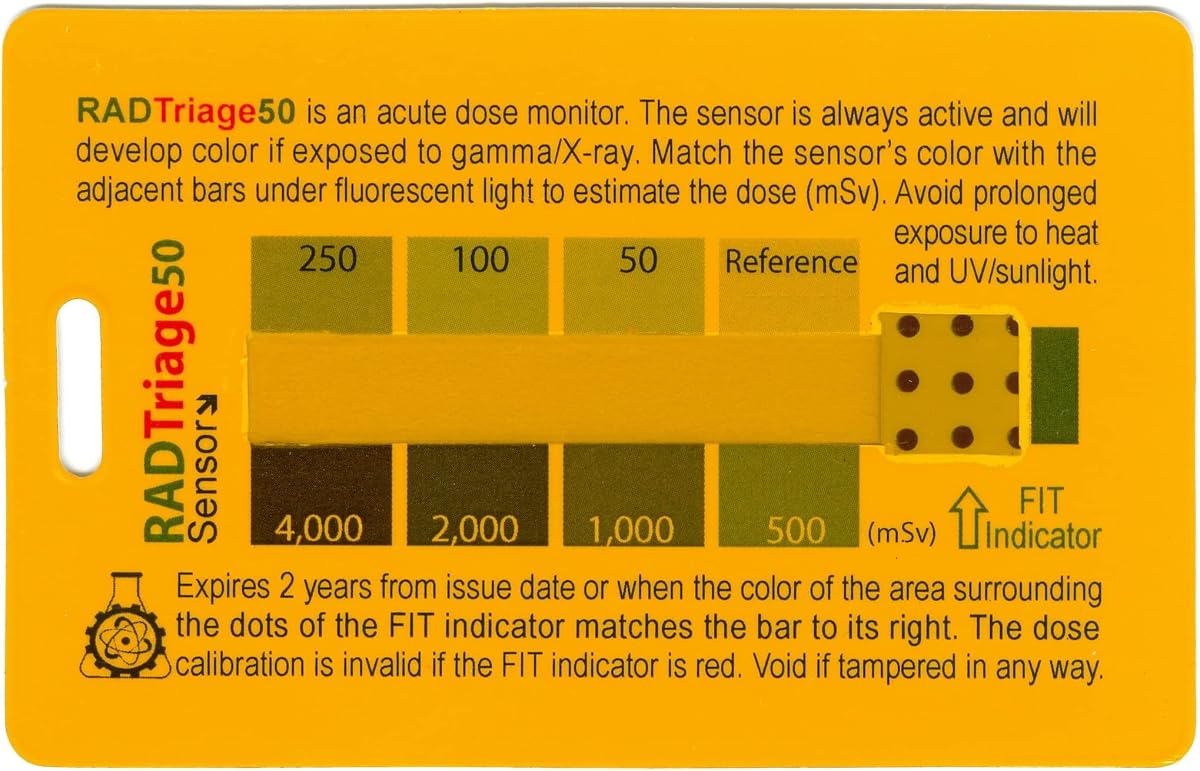
The Rad Triage 50 is a compact personal radiation detector designed to fit in a wallet or badge holder, with a supplied rating of 4.4. Unlike handheld electronic meters, it needs no batteries or routine calibration and is presented as a field-tested, military-grade tool intended for rapid triage.
We may earn a commission when you buy through this link, at no additional cost to you.
The supplied information says it detects beta, gamma, and X-ray radiation and can identify radiation associated with nuclear reactors, nuclear-weapons fallout, and dirty bombs. It is made in the United States and described as U.S. military-grade, field tested, and approved by the U.S. Department of Homeland Security. It is also described as impervious to an electromagnetic pulse bomb.
Its shelf life may be extended by as much as 10 years when stored in a freezer, after which the usable life is at least two years. The lack of batteries is a major convenience for emergency kits, travel, and long-term storage. However, the supplied data does not explain the display, sensitivity, operating response, measurement units, alarm method, or whether the passive card requires user action to register a reading.
Rad Triage 50 is best for people wanting a durable, pocketable awareness tool rather than a logging dosimeter. It can complement a digital meter in an emergency kit, travel bag, or household preparedness box. It should not replace a calibrated meter when numerical dose-rate readings, trend data, or occupational documentation are required.
The absence of batteries and calibration removes two common sources of long-term device failure. That makes the card especially appealing for emergency supplies, outdoor kits, and users who want something small enough to carry every day.
The product's role is best understood as an initial alert tool. It can help identify a potentially concerning source, but it does not replace an instrument that reports dose rate, accumulated exposure, and a time series for professional interpretation.
We may earn a commission when you buy through this link, at no additional cost to you.
The GQ GMC-320 Plus is a digital Geiger counter and radiation data recorder with a supplied rating of 4.6. It is aimed at users who need more than spot readings, particularly those creating continuous records, reviewing radiation history on a computer, or integrating measurements into a wider monitoring network.
We may earn a commission when you buy through this link, at no additional cost to you.
Automatic recording removes the need to watch a display continuously, and recorded sessions can be played back later on a PC. The open communication protocol is intended to make support for broad radiation-monitoring networks easier, which is a meaningful distinction from a simple standalone meter with no documented integration path.
The product listing also points to a technical-support forum through GQ Electronics. A 30-day money-back warranty and one-year factory warranty add service reassurance, although buyers should confirm current terms directly with the seller. The supplied data does not describe the display, alarm system, sensor specifications, measurement range, power system, or physical controls in detail.
The GMC-320 Plus is the strongest recommendation for a dedicated recorder that may serve professional or institutional monitoring. It suits users who value automatic records, playback, and network communication more than a pocketable format or multifunction display. Prospective buyers should request the full manual and verify the current accessory bundle, software compatibility, and technical specifications.
A radiation environment can change while a person is attending to another task. Automatic recording keeps a continuous history, reducing dependence on manually noting every observation and making later review more reliable.
The open communication protocol can make it easier to incorporate readings into a network instead of treating each meter as an isolated instrument. This is a key advantage for organizations comparing data from multiple locations.
We may earn a commission when you buy through this link, at no additional cost to you.
The GQ 320S is a digital nuclear radiation detector, monitor, meter, Geiger counter, and dosimeter with a supplied rating of 4.5. It combines real-time one-second logging with downloadable history and several display modes, making it a capable option for users who want records as well as immediate readings.
We may earn a commission when you buy through this link, at no additional cost to you.
Historical data can be downloaded to a computer, and free data viewer PC software is included. The meter offers dosimeter mode, CPM count mode, and graph mode, giving users both interpreted exposure information and more direct count activity. A swivel display option can improve positioning during desk use, handheld monitoring, or close-range checks.
The rechargeable battery is designed for long-lasting operation, reducing the inconvenience of carrying spare cells. The supplied data does not identify the sensor technology, alpha capability, energy range, alarm behavior, exact measurement range, or calibration details, so it should not be assumed to match the HFS-50-CsI or Radar-9989 based on the shared GQ branding alone.
GQ 320S is a good fit for education, monitoring projects, hobby research, and periodic checks where a permanent record adds value. It is particularly attractive when a user wants more software support than a basic counter. For professional deployment, request current calibration, detector specifications, and certification details before purchase.
Downloadable history and included viewer software allow a user to compare readings over time rather than relying on a single snapshot. This is helpful for documenting how a location changes during different activities or environmental conditions.
The swivel display makes it easier to view results without repeatedly bending over or awkwardly rotating the instrument. That practical design detail can improve comfort during longer monitoring sessions.
We may earn a commission when you buy through this link, at no additional cost to you.
The ERICKHILL EMF Meter is a handheld electric- and magnetic-field detector with a supplied rating of 4.4. It is useful for home and office screening, testing whether shielding changes a reading, and locating low-frequency electromagnetic fields around household appliances, but it is not a nuclear radiation detector.
We may earn a commission when you buy through this link, at no additional cost to you.
The electric-field range is 1 to 1,999 V/m, while the magnetic-field range is 0.01 to 99.99 μT or 0.1 to 999.99 mG. A sound and flashing light alarm activates above the listed thresholds of 40 V/m and 0.4 μT, or 4 mG. The clear LCD supports magnetic readings in μT or mG and electric readings in V/m.
The device can compare readings before and after positioning shielding material, identify likely sources near electronics and appliances, and support broader environment checks. A data-hold function freezes the display for recording, and automatic shutdown after five minutes of inactivity conserves the rechargeable battery. A mute mode supports quiet environments.
ERICKHILL is best for homeowners, office workers, and appliance shoppers who want to investigate low-frequency EMF. It must not be confused with a Geiger counter, scintillation dosimeter, or radiation survey instrument. None of the listed features establish gamma, beta, alpha, or X-ray detection, so use a true ionizing-radiation detector for nuclear screening.
A before-and-after comparison can reveal whether a particular shielding product changes the field reading in a specific location. This is a practical way to evaluate products rather than relying on a general claim that shielding works equally well in every environment.
For meaningful magnetic readings, the appliance should be switched on and operating, with the top sensor close to the source. The device may display zero when the source is off or below its detection range, which is an important limitation when interpreting results.
We may earn a commission when you buy through this link, at no additional cost to you.
The right nuclear radiation detector depends on what you need to measure, the radiation types involved, the required precision, and whether you need alarms, records, portability, or specialized functions. Review the technical specifications carefully and avoid treating every radiation meter as interchangeable.
Geiger-Muller counters use a gas-filled sensor that produces electrical pulses when ionizing radiation interacts with the gas. They are familiar, portable, and often appropriate for general screening, although sensitivity and energy response can vary. Scintillator detectors use a crystal such as CsI to produce light when struck by ionizing radiation, allowing detailed energy-related measurement and potentially steadier results in demanding applications.
A detector advertised for gamma, beta, and X-ray radiation cannot necessarily measure alpha particles. Alpha particles have limited penetration, while beta, gamma, and X-ray behavior differs substantially. The Radar-9989 explicitly lists alpha, beta, gamma, and X-ray coverage; the FNIRSI GC-01 and several Geiger counters list gamma, beta, and X-ray; the Rad Triage 50 also identifies beta, gamma, and X-ray detection.
A wide range is useful when background levels and elevated readings may occur in the same session. Look at both maximum dose rate and cumulative-dose capability, along with the stated measurement error. The ND01 lists 0.00–50,000 μSv/h, the FNIRSI GC-01 lists cumulative equivalent dose from 0.00 μSv to 500.0 mSv, and the HFS-50-CsI lists 0.01 μSv/h to 20 mSv/h with ±10% error.
Alarms should be noticed in the environment where the detector will be used. Light-only alerts suit silent locations, sound alerts work in many work settings, and vibration can help users notice a threshold without disrupting others. Adjustable thresholds are valuable, but users should understand whether alarms respond to instantaneous readings, cumulative dose, or both.
Logging turns a spot measurement into a record that can reveal trends or support later analysis. The GQ GMC-300S and GQ 320S record every second and include PC viewer software, while the HFS-50-CsI stores up to 100 recent records and maintains total-dose information after shutdown. The GQ GMC-320 Plus focuses on automatic recording, playback, and network communication.
A clear display is important, but the way results are presented also matters. The ND01 uses green, yellow, and red safety categories; the FNIRSI GC-01 provides a curve display; the HFS-50-CsI uses a dynamic waveform and dose bar; and the Radar-9989 uses a 3.5-inch color screen with a 270-second graph. Numeric and visual presentations can serve different levels of experience.
Rechargeable power is convenient for frequent use, while disposable batteries can be useful where charging is impossible. The HFS-50-CsI includes a 2000mAh battery, the GMC-300S has a rechargeable battery, and the ND01 uses two AAA batteries. Consider size, carrying method, screen visibility, and whether a telescopic rod is needed to keep a safe distance from a source.
Consumer radiation meters are not automatically equivalent to certified occupational or regulatory instruments. The supplied data includes response ranges, energy tolerances, and error claims for several models, but not complete calibration certificates. A Geiger counter, scintillator, and EMF meter also measure fundamentally different phenomena. For workplace compliance or safety decisions, consult the manual, manufacturer, and a qualified radiation-safety professional.
Before first use, read the complete manual, identify the sensor and radiation types covered, install or charge the battery as directed, and confirm that the unit starts normally. Learn the current units, alarm thresholds, operating modes, and any background-subtraction behavior. Take a short reading in a normal environment so you understand the baseline and display response before approaching a suspected source.
Position the detector according to its instructions. Some products specify a general orientation, while others include a telescopic rod for maintaining distance. Keep the sensor in the recommended relationship to the source, allow the displayed value to stabilize, and record the duration, location, mode, and units. For comparative work, use the same position, orientation, and measurement time so the results are meaningful.
Care for the instrument as a measurement tool rather than a general-purpose electronic gadget. Keep the sensor window and housing away from dust, moisture, impact, and excessive heat; use the supplied case during transport; and avoid leaving the device powered on when it is not needed. Recharge or replace the battery as directed, download stored records before resetting or disposing of the unit, and have calibration or technical support considered when readings become unstable or questionable.
A general-purpose Geiger counter that detects the radiation types relevant to your concern is usually the simplest choice. The GQ GMC-300S is a practical general option, while the ND01 adds especially intuitive color-coded status ranges. For screening near X-ray equipment or where scintillator performance is preferred, the HFS-50-CsI offers a more specialized sensor and detailed display.
Some devices are designed to cover all four, but many only list gamma, beta, and X-ray response. The Radar-9989 explicitly advertises alpha, beta, gamma, and X-ray detection through its mica-window sensor. Always check the manufacturer's radiation-response chart because the presence of a window or a general Geiger-counter label does not prove equal sensitivity to every type.
No. A Geiger counter responds to ionizing radiation such as alpha, beta, gamma, and X-rays, while the ERICKHILL EMF Meter measures low-frequency electric and magnetic fields around electronics, wiring, and appliances. The ERICKHILL is useful for home EMF screening, but it cannot determine a nuclear radiation dose and should never replace a true radiation detector.
Dose rate describes the radiation level at a given moment, often in μSv/h, while total dose accumulates exposure over time. A device can show a low instantaneous rate but a meaningful cumulative total if the measurement continues. Products such as the HFS-50-CsI, GQ 320S, and FNIRSI GC-01 display dose-related information, making it important to monitor both when appropriate.
Usually not. Consumer instruments are valuable for general awareness, screening, education, and records, but workplace or regulatory decisions may require calibrated equipment, controlled procedures, and documentation from a qualified safety professional. Verify the device's certification, calibration status, energy response, and approved application before relying on it for compliance.
Follow the manual's instructions because sensor orientation and distance can affect the reading. The ND01 guidance recommends keeping the screen toward the user, placing the sensor's back toward the source, holding the device parallel to the measurement source, and reading for about 15 seconds. For elevated readings, increase distance and use a telescopic rod or another remote method rather than exposing yourself unnecessarily.
Readings can vary because of nearby electronic equipment, building materials, geological conditions, medical imaging systems, industrial sources, and the detector's orientation. A brief reading is not always the best comparison. Record background conditions, wait for stabilization, repeat the measurement, and use the same placement when comparing locations or testing whether shielding has changed a field.
The GQ GMC-300S and GQ 320S are strong choices for frequent one-second logging and PC review, while the HFS-50-CsI stores up to 100 recent records and retains total-dose information. The GQ GMC-320 Plus is designed specifically around automatic recording, playback, and network communication for users who need a more dedicated data-recording setup.
The GQ GMC-300S is the best-balanced budget pick because it combines a 4.6 rating, one-second logging, PC downloads, and several measurement modes. The HFS-50-CsI earns the Editor's Choice position with its CsI scintillator, detailed waveform, triple alarms, persistent records, and long battery life, while the Radar-9989 is the premium option for broad radiation coverage, six units, surface-contamination measurement, and a large color display.
Prioritize the detector technology and radiation types relevant to your environment before considering convenience features. General users may prioritize logging and clear displays, professionals may need documented response and contamination features, and travelers may value compactness. Whatever the category, verify the manual, calibration details, radiation coverage, and intended application rather than choosing solely by a rating or alarm appearance.
Marketplace ratings and prices change over time, so check the current listing, package contents, seller information, and warranty terms before purchasing. Once selected, learn the controls, establish a normal background reading, use the recommended measurement technique, and maintain the sensor and battery as directed.