
Bose TV Speaker
4.3Editor score
Compact angled full-range drivers
Dialogue-focused remote controls
HDMI optical and AUX connections
A soundbar can make television dialogue easier to hear, music more engaging, and gaming more immersive without requiring a complicated home theater setup. However, the phrase non powered soundbar often creates confusion because many compact soundbars still require power for their amplifiers, active drivers, wireless features, and connection controls.
The models in this guide were compared by examining their stated audio architecture, speaker and subwoofer configurations, supported connections, dimensions, room-calibration tools, remote controls, and mounting options. The list covers slim all-in-one designs, detachable systems, and larger packages with wireless or wired subwoofers and surround speakers.
Each review explains the product's strongest benefits, practical limitations, and ideal buyer. Product configurations and availability can change, so readers should verify the current specifications, room requirements, included accessories, and connection compatibility before purchasing, and remember that prices and promotions fluctuate over time.
4.3Editor score

4.4Editor score

4.4Editor score
As an Amazon Associate we earn from qualifying purchases.
The comparison highlights channel count, bass support, virtual surround processing, connection options, and special features so buyers can distinguish simple compact models from full home theater systems.


The Bose TV Speaker is a straightforward all-in-one model built around a relatively small footprint and a clear priority: making television speech more intelligible. Its 4.3 rating reflects a broadly favorable reception, while the two angled full-range drivers are intended to create a wider and more natural presentation than a typical pair of built-in television speakers. The product is especially relevant for viewers who spend much of their time watching news, interviews, scripted series, and other dialogue-heavy programming.
We may earn a commission when you buy through this link, at no additional cost to you.
Connection flexibility is one of the strongest aspects of this design. It supports HDMI, optical audio, AUX, and Bluetooth, allowing it to work with televisions, streaming devices, game consoles, computers, phones, and other sources that can feed the appropriate connection. A remote control adds a dedicated dialogue mode and bass boost, giving users useful adjustments without navigating a complicated menu. The optical cable is included, while an HDMI cable and wall brackets are sold separately.
The main compromise is that this is not a full surround-sound package. There is no included subwoofer, and the product's emphasis is on vocal clarity and a credible stereo image rather than room-filling cinematic effects. It can work with the Bose Bass Module 500 or 700 through the proper connection cable, but those accessories are separate. The phrase non powered soundbar is therefore somewhat misleading for this model because its internal amplification and connection electronics require power.
This is a strong recommendation for anyone who wants a small, uncomplicated upgrade and has limited shelf or console space. It is less suitable for buyers who expect immediate deep bass, rear-channel effects, or a complete theater package. Those shoppers should consider one of the included-subwoofer systems in the comparison. For straightforward dialogue improvement and flexible source connections, however, the Bose TV Speaker remains an especially approachable choice.
The dedicated dialogue mode is particularly useful when voices compete with music or background effects. Combined with the angled drivers, it gives the compact enclosure a broader presentation while keeping the controls straightforward for everyday viewing.
HDMI, optical, AUX, and Bluetooth cover most source needs, while the included optical cable reduces the immediate setup burden. The bar's slim body also makes it easier to position in front of a television without overwhelming the viewing area.
We may earn a commission when you buy through this link, at no additional cost to you.
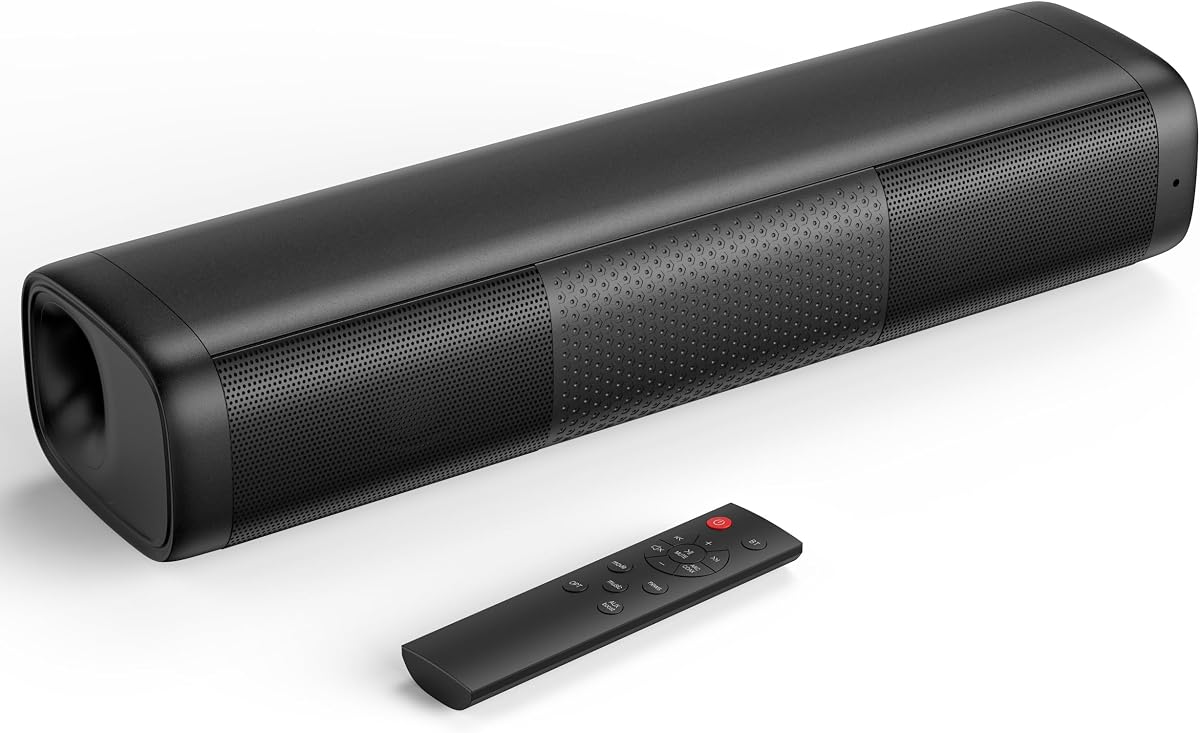
The Saiyin 11.7-inch Sound Bar combines a small enclosure with a stated peak output of 48 watts, making it a practical option for apartments, bedrooms, secondary televisions, and compact entertainment centers. Its 4.2 rating indicates generally positive reception, and the design places emphasis on balanced audio rather than a large physical footprint. The 11.7-by-3.5-by-2.5-inch dimensions should fit more readily than many full-width bars.
We may earn a commission when you buy through this link, at no additional cost to you.
It offers Bluetooth, optical, and 3.5mm AUX connections, plus a dedicated subwoofer output for a powered unit. That expansion option is valuable for buyers who want to begin with a slim bar and add bass later. A remote, AC adapter, AUX cable, optical cable, wall-mounting hardware, and setup documentation are included. The product also supports several popular streaming-device remote types, although the specific compatibility notes are important when comparing it with a television ecosystem.
The most significant technical consideration is source configuration. The product works with standard audio outputs and should be set to PCM, stereo, or another non-surround signal. Optical sources require the television's audio output to be changed accordingly. Incorrect settings can result in cracking noise or no sound, so this is a model better suited to buyers who are comfortable making a quick menu adjustment. It also lacks a wireless subwoofer or surround speakers in the standard package.
Choose the Saiyin model when shelf space is the main concern and you want flexible connections at an entry-oriented level. It is a good fit for a smaller room, a gaming monitor, or a TV whose built-in speakers struggle with dialogue. Buyers who want richer cinema effects from the first setup may prefer a complete system with a wireless subwoofer. Within the compact category, however, this soundbar offers a useful feature set and a generous bundle of accessories.
The compact enclosure is the headline advantage, while the subwoofer output gives buyers a practical upgrade path. A compatible powered subwoofer can add low-frequency weight without requiring a larger soundbar or a complete surround system.
Bluetooth handles convenient wireless streaming, while optical and AUX provide wired options for televisions, computers, and game devices. The included cables and remote make the basic setup more approachable.
We may earn a commission when you buy through this link, at no additional cost to you.
This detachable soundbar is differentiated by its two-piece construction and stated 80W output from four high-performance drivers. The 4.1 rating reflects a solid but not universally exceptional reception, while the product's versatility gives it appeal for renters, gamers, and people who cannot permanently mount a conventional soundbar. It is designed for televisions, PCs, projectors, and other compatible audio sources.
We may earn a commission when you buy through this link, at no additional cost to you.
The most unusual feature is the range of placement choices. The system can be positioned horizontally, vertically, on a tabletop, or mounted to a wall, with each orientation intended to produce a different distribution of sound. Automatic volume boost is designed to elevate quieter content, while movie, music, and news equalizer modes provide quick ways to tailor the output. Bluetooth 5.0, ARC, optical, and AUX connections cover both wireless and wired sources.
Its main limitation is that the detachable design does not create genuine rear-channel immersion by itself. The sound depends heavily on placement and the acoustics of the room, so the most dramatic results require experimentation. There is no included subwoofer, and buyers seeking deep bass should consider a system with a dedicated low-frequency unit. The product also relies on the supplied instructions and video guidance for some connection procedures, which may be important for less experienced users.
This soundbar is a good match for anyone who values setup flexibility over a conventional, fixed theater arrangement. The vertical option may be particularly useful where a wide soundbar cannot fit, while tabletop placement keeps the product accessible for casual tuning. It is also a reasonable choice for shared rooms where gaming, news, movies, and music all occur. For straightforward TV improvement with minimal repositioning, a compact all-in-one model may be easier to live with.
The detachable sections can be arranged horizontally, vertically, on a table, or on a wall. This makes the product unusually adaptable to unusual furniture arrangements and different listening positions.
Movie, music, and news modes simplify tuning for common content. Automatic volume boost may help with faint program audio, although the best result still depends on setting the television output correctly.
We may earn a commission when you buy through this link, at no additional cost to you.
The TCL S55H offers the most balanced package in this guide for viewers seeking a meaningful upgrade without moving to a large multichannel system. It combines a low-profile 2.1-channel bar with a wireless subwoofer, Dolby Atmos, DTS Virtual:X, and a 4.4 rating. Its stated system output of up to 220 watts is aimed at apartments, bedrooms, and small-to-medium rooms where deeper low-frequency effects can improve movies, music, and games.
We may earn a commission when you buy through this link, at no additional cost to you.
One of its most useful features is AI Sonic Auto Room Calibration. Through the TCL app, the system can adjust to the room and listening position, reducing the guesswork involved in placing the bar and subwoofer. HDMI eARC and ARC, optical, Bluetooth, and AUX connections ensure broad compatibility. The included remote, HDMI cable, power cord, and wall-mount kit create a reasonably complete package, while the 31.89-inch bar has a deliberately modern appearance.
The absence of rear speakers means the immersive effects are virtual rather than based on physically separate channels behind the listener. In a large or crowded room, those effects may be less convincing than those produced by a true surround system. The subwoofer also requires floor space, and wireless placement can introduce a degree of freedom that is useful but still subject to room layout and power access. The system, like every powered soundbar in this list, needs an electrical outlet despite the search phrase used here.
This is our Editor's Choice because it balances important qualities unusually well: wireless bass, recognized virtual-surround formats, room tuning, strong connectivity, and a straightforward remote. It is ideal for a main living-room television or a larger bedroom setup where a compact bar without a subwoofer would feel underpowered. If genuine rear-channel separation is a priority, the TCL S65K or JBL Bar 500MK2 may be more suitable.
AI Sonic calibration tailors the output to the room and listening position through the TCL app. This is especially helpful because the best placement for a soundbar and subwoofer is not always obvious in an irregular or furnished space.
The included wireless subwoofer supplies dedicated low-frequency output while allowing more flexible placement than a wired unit. HDMI, optical, Bluetooth, and AUX give the bar broad compatibility with televisions and other entertainment sources.
We may earn a commission when you buy through this link, at no additional cost to you.
The Sony HT-S400 is a 2.1-channel soundbar-and-subwoofer package designed for straightforward home theater improvement, with particular appeal for owners of compatible BRAVIA televisions. Its 4.3 rating reflects solid user reception, and the system's defining features include S-Force PRO front surround, Dolby Digital, an X-Balanced Speaker Unit, and a wireless subwoofer with a large 160mm driver.
We may earn a commission when you buy through this link, at no additional cost to you.
Dialogue clarity is a major strength. The X-Balanced Speaker Unit and Separated Notch Edge technology are designed to deliver a wide-ranging presentation with improved vocal definition, while the subwoofer handles the low end. The wireless connection between bar and subwoofer reduces cable clutter, and the flat-backed bar can be mounted flush to a wall. Compatible BRAVIA televisions expose relevant soundbar settings in their Quick Settings menu, simplifying everyday adjustments.
Its integration is most complete within the Sony ecosystem, and buyers using another television brand may not receive the same menu convenience. The system also lacks dedicated rear speakers and the more advanced automatic calibration tools found in some competitors. HDMI ARC and optical connections cover common television setups, and Bluetooth enables direct music playback from a phone, tablet, or laptop. The OLED display window on the bar gives quick access to status and function information.
Choose the HT-S400 if you own a BRAVIA television and value clear dialogue, discreet wireless bass, and a refined compact design. It is also a sensible option for anyone who wants a subwoofer without the complexity of a multi-speaker surround package. Those who prioritize advanced object-based audio, extensive app-based adjustment, or rear-channel immersion should look toward the premium models later in this guide.
Compatible BRAVIA televisions integrate soundbar settings into their Quick Settings menu. That makes source selection, volume, and other adjustments easier to find for viewers already accustomed to the Sony television interface.
The X-Balanced design supports vocal clarity, while the separate 160mm wireless subwoofer handles bass. A flat back also permits a clean wall installation when tabletop placement is not practical.
We may earn a commission when you buy through this link, at no additional cost to you.
The Sonos Beam Gen 2 delivers a sophisticated compact soundbar experience for buyers who want strong virtual surround, polished smart features, and room-filling sound without a large floor-standing speaker. Its 4.4 rating reflects favorable reception. The product supports Dolby Atmos, vibrant bass, clear dialogue, and a panoramic soundstage, all within a cabinet designed to blend more discreetly than many cinema-oriented systems.
We may earn a commission when you buy through this link, at no additional cost to you.
Sonos Trueplay automatically tunes the speaker to the room, while the app provides control over setup and sound settings. The system can also be controlled through a television remote, Apple AirPlay 2, and voice. Music, radio, podcasts, and audiobooks can be streamed when the television is off, turning the bar into a standalone entertainment speaker. Setup is designed around a short connection process with only two cables, which helps keep the installation tidy.
The standard Beam configuration does not include a separate subwoofer, so buyers wanting deeper bass need to consider an expansion. It also uses virtual rather than discrete rear channels, which may matter in a large room or for a dedicated theater space. Sonos offers an upgrade path for true surround sound and multiroom listening, but that flexibility comes with a premium tier of complexity compared with a basic bar-and-remote system. The term non powered is not technically applicable because the Beam uses its own electronics and power supply.
This is the premium pick for shoppers who value a refined appearance, convenient software integration, strong virtual Atmos, and the ability to grow the system over time. It works particularly well in apartments, living rooms, and multipurpose spaces where appearance and music playback matter as much as cinema. For a complete package that includes more powerful dedicated bass or physical surround speakers without separate expansion purchases, the TCL S65K, JBL Bar 500MK2, or Samsung HW-S61D may be more efficient choices.
Trueplay calibrates the Beam to the characteristics of the room, while Dolby Atmos processing creates overhead and enveloping effects. The result is particularly useful for compact spaces where physically placing rear speakers would be difficult.
Built-in streaming support, AirPlay 2, app control, and voice control make the Beam useful for music and podcasts even when the television is off. Its expansion options provide a path toward a more complete Sonos home-audio system.
We may earn a commission when you buy through this link, at no additional cost to you.
The 120W Sound Bar and Subwoofer package offers a straightforward combination of a high-output bar, a wired subwoofer, and flexible connections. Its 4.6 rating is the highest among the listed products, which indicates strong user satisfaction, although ratings alone do not reveal every listening nuance. The system is aimed at movies, television, music, and gaming across living rooms, bedrooms, offices, and gaming spaces.
We may earn a commission when you buy through this link, at no additional cost to you.
The included wired subwoofer is designed to provide stable low-frequency output without wireless interference or synchronization concerns. Bluetooth 5.3, ARC, optical, and AUX connections offer several ways to connect smart televisions, streaming devices, PCs, projectors, smartphones, and tablets. The remote controls volume, input mode, and playback settings, while included wall hardware allows a wall installation when a slim tabletop profile is not suitable.
The wired subwoofer is the central trade-off. It provides a consistent link, but it requires cable routing between the bar and subwoofer, which can be less convenient in a room where the subwoofer is positioned away from the television. Unlike several premium competitors, the product does not list automatic room calibration. Its virtual surround and output specifications may also sound different from channel-based systems with separate rear speakers, so cinema enthusiasts should not equate the 120W figure with a full surround package.
This package is an appealing choice for buyers who want a complete bar-and-subwoofer system without relying on a wireless link. It offers one of the strongest ratings in the guide, a good selection of inputs, and a clean path from television to gaming or music. Those willing to route one cable may find that reliability preferable to wireless flexibility. For a premium ecosystem or a true 5.1 arrangement, one of the higher-tier complete systems is more suitable.
A wired link between the bar and subwoofer reduces wireless variability and helps maintain synchronization. That makes this system attractive for viewers who prefer a fixed installation and predictable bass response.
Bluetooth 5.3, ARC, optical, and AUX cover wireless streaming, television audio, legacy sources, and project-oriented setups. The included remote and mounting hardware support a relatively complete installation.
We may earn a commission when you buy through this link, at no additional cost to you.
The TCL S65K is a true 5.1-channel system rather than a bar that merely simulates surround effects. It includes a main soundbar, a wireless subwoofer, and a pair of wireless surround speakers. With a 4.5 rating and support for Dolby Atmos, DTS:X, and AI Sonic Auto Room Calibration, it is well suited to viewers who want a more physical home theater presentation and have the space to arrange multiple components.
We may earn a commission when you buy through this link, at no additional cost to you.
Its dedicated center channel and center tweeter are designed to improve voice clarity during action-heavy scenes, while the wireless surrounds create a wider soundstage. The 6.5-inch subwoofer with Bass Boost supplies deeper low-frequency output, and the system's Ray Danz technology is intended to expand the presentation around the room. Bluetooth music streaming is included, and ChoruSound is designed to coordinate the soundbar with compatible television speakers for an even wider image.
The main cost is the need for more space, more cables, and a more involved setup. The wireless surround speakers reduce some cable clutter, but they still need power and careful placement behind or beside the main listening position. Calibration helps optimize the result, yet no automated process can fully replace thoughtful speaker positioning. This system is consequently less attractive for a very small room, a minimalist media wall, or a renter who cannot place speakers around the sofa.
Choose the S65K when a genuine 5.1 arrangement, clear center-channel dialogue, and strong dedicated bass are more important than minimalism. It offers a compelling middle ground between a two-piece bar-and-subwoofer package and a large home theater receiver with multiple wired speakers. For buyers who want Dolby Atmos and physical surround separation in one coordinated package, it is more ambitious and appropriate than the compact 2.1 and 2.0 options in this list.
The included wireless surround speakers can be placed behind the listening area, producing rear separation that a compact all-in-one bar cannot reproduce. This makes the system better suited to a dedicated viewing position.
A built-in center channel and tweeter help voices remain clear, while the 6.5-inch wireless subwoofer handles low frequencies. Together, they provide the channel separation expected from a 5.1 home theater system.
We may earn a commission when you buy through this link, at no additional cost to you.
The JBL Bar 500MK2 is the most overtly cinematic package in the guide, combining a 5.1-channel system, Dolby Atmos, MultiBeam 3.0, PureVoice 2.0, and a wireless 10-inch subwoofer. Its 4.5 rating signals strong user approval, while the stated maximum system output of 750 watts differentiates it from the more modest compact models. It is best suited to a dedicated entertainment room or a larger living space.
We may earn a commission when you buy through this link, at no additional cost to you.
The large subwoofer is designed to deliver forceful low-frequency effects, while MultiBeam 3.0 aims to create a wide soundstage from the main bar. PureVoice 2.0 analyzes scenes and raises or optimizes dialogue according to the content and system level, making the feature especially useful for action films, sports, and mixed dialogue. Easy sound calibration accounts for reflections from walls and furniture, while SmartDetails is intended to preserve subtle environmental sounds.
Its ecosystem support is extensive. The product works with AirPlay, Google Cast, Spotify Connect, Tidal Connect, and Roon Ready, and it can link with voice-assistant speakers. The JBL ONE app handles setup, equalization, music applications, and software updates. HDMI eARC supports uncompressed Dolby Atmos and 4K Dolby Vision passthrough with compatible equipment. As with the 120W model, however, maximum wattage is not a direct measurement of accuracy, detail, or perceived quality.
This is the right recommendation for buyers who want powerful bass, advanced dialogue processing, large-room impact, and a sophisticated software environment. The 10-inch wireless subwoofer needs meaningful floor space, and the system may be excessive for a small bedroom or a casual television setup. If the goal is richer physical surround and excellent music support, the JBL is compelling; if simplicity and compactness matter more, the Sony, Samsung, or Bose options may fit better.
PureVoice 2.0 evaluates the scene and current level to make speech more consistent. It is particularly valuable when characters are quiet, effects are loud, or the main listening position is far from the television.
The 10-inch wireless subwoofer provides the largest dedicated driver listed here. That scale can produce deeper cinematic impact, although it also requires appropriate placement, power, and room volume to avoid boominess.
We may earn a commission when you buy through this link, at no additional cost to you.
The Samsung HW-S61D combines five channels and built-in subwoofers in one relatively compact enclosure. It avoids the need for a separate subwoofer while still promising an expanded presentation through Wireless Dolby Atmos, a 4.4 rating, and several smart features. That makes it an interesting middle ground for buyers who want more than a conventional stereo bar but do not want to arrange a multi-speaker system.
We may earn a commission when you buy through this link, at no additional cost to you.
SpaceFit Sound Pro analyzes the environment and adjusts the output to the room, while Adaptive Sound examines content in real time to make important audio more prominent. Active Voice Analyzer is designed to keep dialogue and commentary clear. For Samsung television owners, Q-Symphony allows the television speakers and soundbar to work together, and Game Mode Pro adds up-firing and acoustic-beam effects for compatible gaming setups. Alexa is built in, with Chromecast and AirPlay 2 support also listed.
The single-cabinet design is the model's main convenience, but it also imposes limits. It does not include separate surround speakers, so its channel-based presentation remains less expansive than the TCL S65K or JBL Bar 500MK2. Wireless Dolby Atmos depends on compatible source material and television configuration, and while Q-Symphony is a major advantage within the Samsung ecosystem, it has less relevance for owners of other television brands. Gaming and smart features should also be checked for regional or device compatibility.
Choose the HW-S61D when a tidy single-unit design, Samsung ecosystem integration, and virtual overhead effects are priorities. It is particularly suitable for a living room where visual simplicity matters and a large subwoofer would be intrusive. Compared with a compact all-in-one model such as the Bose TV Speaker, it offers a more ambitious channel architecture. Compared with a complete 5.1 package, it is easier to place and requires fewer components.
The all-in-one architecture integrates multiple channels and subwoofers into a single unit. It simplifies placement while preserving features that would be unavailable in a basic two-channel television speaker.
Q-Symphony, Adaptive Sound, and Game Mode Pro make the soundbar especially interesting for compatible Samsung televisions. Built-in Alexa, Chromecast, and AirPlay 2 broaden its use beyond television audio.
We may earn a commission when you buy through this link, at no additional cost to you.
The most important starting point is to distinguish a passive, non-powered speaker from an ordinary soundbar. Most products marketed with the search phrase are powered electronics that include amplifiers, wireless radios, decoding, controls, and often subwoofers. The right choice therefore depends on connection compatibility, room size, channel architecture, desired bass, and ease of setup.
A genuinely non-powered speaker has no internal amplifier and must be driven by a separate receiver or amplifier. A soundbar labeled as non powered may instead be a compact self-powered model with a small amplifier, meaning it still needs a power outlet but could be more accessible than a traditional home theater setup. Before buying, confirm whether the product includes its own amplification, whether a subwoofer requires its own power, and whether the television can supply a usable line-level signal.
A compact bar may be sufficient for a bedroom or office, while a larger room benefits from a dedicated subwoofer and stronger low-frequency output. Pay attention to the subwoofer driver size, whether it is wired or wireless, and the system's stated channel and power configuration. A high wattage number is not the same as accurate sound, but a substantial included subwoofer generally provides more physical low-frequency impact than a small all-in-one cabinet.
All-in-one bars are usually stereo or multi-driver designs that create a wider image through angled drivers and processing. Virtual surround systems add height and surround effects without physical rear speakers. True 5.1 packages include a subwoofer and separate surround speakers, offering more distinct directional audio but requiring additional power, placement, and setup. Choose based on whether you prioritize simplicity or genuine spatial separation.
Check the available outputs on your television and the inputs on the soundbar. HDMI ARC or eARC is usually the most convenient route for compatible televisions, while optical audio is widely available and can be a stable fallback. AUX remains useful for consoles, computers, and older equipment, and Bluetooth handles convenient music streaming. Verify the television's audio-output format, especially when a product requires PCM or stereo rather than a surround signal.
Dialogue enhancement can make quiet speech easier to understand, especially in action scenes, sports, and films with dense sound mixes. Movie, music, and news presets offer convenient starting points, while automatic scene analysis may be more sophisticated. For music, look for Bluetooth, app-based streaming, high-resolution wireless support, or a broad ecosystem. The best balance depends on whether the soundbar primarily serves television, gaming, or mixed entertainment.
Automatic calibration can improve consistency by measuring how the room affects bass, clarity, and spatial effects. It is especially helpful when the furniture, walls, and speaker positions create irregular reflection patterns. Detachable bars and wireless speakers offer additional placement flexibility, but flexibility only helps if the components are positioned correctly. Review the stated dimensions, included mounting hardware, required power outlets, and recommended subwoofer distance before arranging the room.
Some soundbars integrate deeply with a particular television maker, while others support several streaming and voice platforms. Look for HDMI eARC, Dolby Vision passthrough, AirPlay 2, Chromecast, Spotify Connect, voice control, and an app that receives updates. These features can improve convenience, but they should complement rather than replace good dialogue clarity, bass, and soundstage. Confirm that the services and devices you use are supported in your region.
A dedicated remote makes it easier to change inputs, adjust dialogue modes, and control bass without navigating television menus. Some systems also work with compatible streaming-device remotes, which can be convenient for viewers who rely on one input device. Look for a clear display or simple feedback, accessible controls, and the ability to manage common tasks quickly. Complex apps may be useful for setup and deeper tuning, but they should not be required for routine volume changes.
Begin by placing the soundbar directly in front of the television or in another open position rather than against a wall. Connect it using HDMI ARC or eARC when both devices support it, because this often provides the simplest control path and the broadest format compatibility. If using optical or AUX, verify that the television's output format matches the soundbar's supported mode, then select the corresponding input and confirm that sound is present before making tonal adjustments.
For a subwoofer and surround speakers, follow the manufacturer's placement recommendations, keep ventilation openings unobstructed, and allow enough distance from walls to reduce unwanted boomy bass. Run any room-calibration process after the components are in their final positions. If the system has separate wireless speakers, test the connection from the main listening seat and make small placement adjustments because moving a speaker by even a modest distance can materially affect the soundstage.
Care for the system by keeping the cabinet free from dust and liquids, cleaning fabric or grilles gently according to the manual, and avoiding blocked rear ports. Do not place a subwoofer directly against a wall unless the manufacturer specifically recommends it. Use standby rather than repeatedly unplugging the unit, update the associated app when updates are available, and inspect wireless accessories periodically. If output becomes distorted, reduce the source volume first and check the television's surround or PCM settings before assuming the speaker is faulty.
No. Many products associated with this search term are electrically powered soundbars with built-in amplifiers and decoding. They still need an outlet even when they have a compact body and a simple setup. A truly passive model would require an external amplifier or receiver, so buyers should read the specifications carefully rather than relying on the search term alone.
Yes, a dedicated soundbar can make speech clearer because it offers better drivers, focused tuning, and often a dialogue mode. Results vary with content, room acoustics, viewing distance, and the television's own processing. Turning off aggressive television sound enhancements and using the soundbar's dialogue setting often produces the most natural improvement.
HDMI ARC is usually more convenient because it can carry digital audio and support remote-control integration, while newer eARC versions can handle more advanced formats. Optical audio remains a reliable option for televisions without suitable HDMI support. The best choice depends on the television, source material, and the soundbar's supported formats rather than on a universal rule.
A subwoofer is not essential for every television room, but it can make explosions, music, and other low-frequency effects feel more complete. Compact all-in-one bars may struggle to produce deep bass at higher levels, while a dedicated subwoofer can preserve the center and upper frequencies for clearer dialogue. It also requires floor space and a suitable power outlet.
Virtual surround uses processing to simulate height, width, or rear effects from speakers contained in or near the main bar. Physical surround sound uses separate speakers placed around the listening area and can provide more distinct directional separation. Virtual systems are easier to install, whereas true surround packages usually deliver a more convincing home theater presentation when properly positioned.
Yes, if the soundbar offers calibration, run it after the bar, subwoofer, and surround speakers are in their final positions. It can correct for room reflections, listening distance, and low-frequency imbalances. You can repeat the process after moving furniture or changing the subwoofer's position for the most accurate result.
Many projectors include HDMI or optical audio outputs, so they can use a compatible soundbar, but the projector's audio capabilities and menu settings should be checked first. Some models offer weaker built-in speakers or limited output formats. For the best experience, select the correct digital or analog source and adjust the projector's audio delay if available.
Set the television's audio output to PCM, stereo, or the format specified by the soundbar manual. Confirm that the correct input is selected and that the volume is raised on both the television and soundbar. Re-seat the optical or HDMI cable and restart the source device. If the problem continues, test the soundbar with a second source to determine whether the issue is in the television settings or the speaker.
The Bose TV Speaker is the simplest way to improve dialogue with a small footprint, while the TCL S55H is the most balanced upgrade because it combines a wireless subwoofer, virtual surround formats, and automatic room calibration. The Sonos Beam Gen 2 is the premium choice for compact design, integrated streaming, voice control, and an expandable ecosystem. Each serves a distinct need rather than competing in exactly the same way.
Prioritize compatibility before features. Confirm the television's available outputs, the soundbar's supported audio formats, the room dimensions, and where a subwoofer or surround speakers can be placed. Then choose based on the content you watch most, the importance of dialogue, and whether you value a simple single unit or a fuller home theater arrangement. A lower-output compact bar can be more appropriate than a large system in a small room.
Before purchasing, recheck the current specifications, included accessories, warranty terms, and current price because product configurations and promotions can change. Also verify that any smart features, streaming services, voice assistants, and wireless surround accessories operate with your television and regional ecosystem. With those checks in place, you can select a soundbar that fits the room, source equipment, and listening habits that matter most.