
HiLetgo LCR-T4 Component Tester
4.4Editor score
Automatic semiconductor identification
MOSFET gate capacitance measurement
Graphical green-backlit LCD display
Our Mosfet Transistor Capacitor Tester guide compares ten instruments for component identification, capacitance checks, ESR testing, portability, displays, and
A Mosfet Transistor Capacitor Tester helps technicians identify unknown components and evaluate common electronic parts without relying on visual markings alone. Useful devices vary widely in component coverage, measurement range, display quality, test current, ESR capability, and portability, so the right choice depends on whether your work centers on transistor diagnosis, capacitor service, or general bench inspection.
This guide compares ten testers using only the supplied specifications, including supported component types, capacitance ranges, display characteristics, power options, and diagnostic features. It covers dedicated capacitor meters, multifunction component analyzers, transistor testers, an in-circuit ESR meter, and a kit that combines a tester with a broad assortment of electronic parts.
Each pick highlights the role the product is best suited to, while the comparisons make the differences easier to see. The DCA55 and T7 provide broad semiconductor analysis, the HiLetgo LCR-T4 offers accessible multifunction testing, and dedicated capacitor instruments emphasize capacitance diagnostics. Ratings reflect the supplied data, while prices and availability can change.
4.4Editor score

4.8Editor score

4.2Editor score
The table below compares all ten instruments by component coverage, measurement capabilities, display, and practical utility. It reveals the distinction between broad semiconductor analyzers, focused capacitance meters, in-circuit ESR tools, and entry-level multifunction testers.


The Velleman DCA55 is a semiconductor analyzer with a supplied rating of 4.8, making it the most established general-purpose choice in this list. It is built around automatic component identification, automatic connection-pin identification, and the detection of component-specific characteristics. Rather than functioning only as a basic capacitance meter, it is intended to examine several kinds of semiconductor and reveal details that can help distinguish healthy parts from suspect ones.
We may earn a commission when you buy through this link, at no additional cost to you.
Its strongest area is transistor analysis. The instrument automatically identifies bipolar transistors, measures current gain and leakage current, and detects silicon and germanium diodes. For MOSFETs, it can measure threshold voltage, while also handling detection of protection diodes and shunt resistors. These are meaningful advantages when a component has been removed from a circuit and its markings are missing or unreliable, or when a technician needs a more informative answer than a simple pass-or-fail result.
The DCA55 also includes defined short-circuit protections, with the supplied specifications listing a short-circuit peak current of up to 5.5 mA in either direction and a permanent short-circuit peak voltage of up to 5.1 V in either direction. These limits make the instrument more purposeful for component identification than a general-purpose multimeter. The trade-off is that its feature set focuses on semiconductor characterization rather than serving as a dedicated high-range capacitor or in-circuit ESR analyzer.
This is the strongest recommendation for repair technicians, electronics educators, and serious hobbyists who regularly work with bipolar transistors, MOSFETs, diodes, and unidentified semiconductors. It may be excessive for occasional capacitor checks, but for broad device identification and parameter measurement, the DCA55 offers the most focused and coherent feature set among the ten selections.
Automatic recognition of components and connection pins reduces the need to decode every terminal manually. That makes the analyzer especially useful with unmarked devices and helps direct further measurements toward the correct transistor terminals.
Current gain, leakage current, diode forward voltage, and MOSFET threshold measurements provide a clearer picture of component condition. These readings go beyond simple identification and support more considered troubleshooting decisions.
We may earn a commission when you buy through this link, at no additional cost to you.
The HiLetgo LCR-T4 is an entry-oriented multifunction tester with a supplied rating of 4.4. It supports resistors, capacitors, diodes, SCRs, inductors, triodes, MOSFETs, tubes, and bipolar transistors, making it one of the broadest devices in the group despite its budget-oriented position. Automatic detection identifies NPN and PNP transistors as well as N-channel and P-channel MOSFETs.
We may earn a commission when you buy through this link, at no additional cost to you.
The 128 by 64 green-backlit LCD can display numerical measurements and graphics, which helps when a simple number does not fully communicate a component's behavior. The tester can measure MOSFET gate threshold voltage and gate capacitance. It also measures bipolar-transistor current amplification and base-emitter threshold voltage, giving it useful semiconductor analysis capabilities rather than limiting it to component identification.
A 9V battery is used for portable operation, though it is not included, and the unit may alternatively run from a 6.8V to 12V DC source. Its shutdown current is listed at about 20 nA. The supplied specifications describe a typical detection time of 1.7 seconds, although bulk capacitor detection can require around one minute, a distinction worth considering when checking many large capacitors.
The LCR-T4 is ideal for students, hobbyists, and general repair technicians who want one portable instrument for numerous component types. It offers more semiconductor depth than a simple capacitor meter, although it does not match the DCA55's dedicated analysis workflow or the T7's full-color presentation.
Automatic recognition across bipolar transistors, MOSFETs, diodes, capacitors, resistors, and other parts reduces the need to keep several separate instruments nearby. The breadth is particularly helpful for mixed repair benches.
Battery operation supports field work, while external DC power offers an alternative for extended sessions. Automatic shutdown and very low stated shutdown current help make unattended or portable use more practical.
We may earn a commission when you buy through this link, at no additional cost to you.
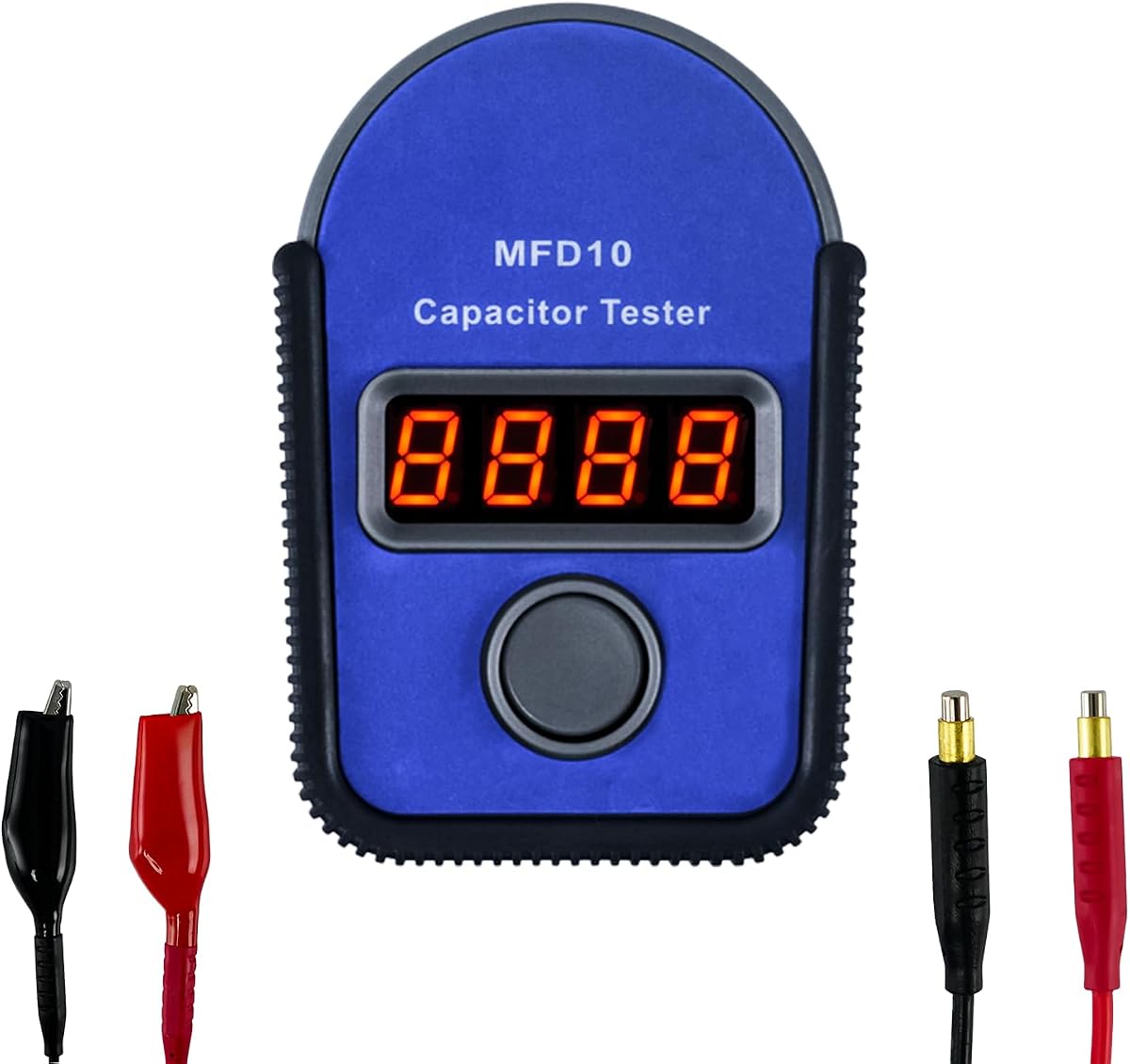
The MFD10 Digital Capacitor Tester is a dedicated capacitance instrument with a supplied rating of 4.9. Its defining feature is a measurement range from 0.001 to 9,999 microfarads, allowing it to handle very small signal capacitors as well as much larger electrolytic units. The listed accuracy is plus or minus 5 percent, a useful specification for comparing a suspect component against its expected value.
We may earn a commission when you buy through this link, at no additional cost to you.
The large LED display is designed for straightforward data checking, with a compact, lightweight body that should be easy to carry between a workbench and field location. Unlike multifunction component analyzers, the instrument keeps its controls and purpose focused on capacitance measurement. That specialization can make it easier to operate for technicians whose main task involves service capacitors, unidentified capacitors, or suspected open and short circuits.
Its limitations are equally clear from the supplied information: no MOSFET, transistor, diode, ESR, or in-circuit measurement capability is listed. It is therefore not a substitute for the DCA55, LCR-T4, or T7 when semiconductor identification is central to the job. Instead, it is a convenient dedicated meter for users who want a readable capacitance result without navigating a general-purpose analyzer.
The MFD10 is a strong recommendation for HVAC servicing, appliance repair, electronics bench work, and anyone who primarily needs to verify capacitance values. Its high supplied rating, broad stated range, clear screen, and portable format make it an appealing focused option, provided the absence of transistor testing fits the intended work.
A range beginning at 0.001 microfarads extends through small ceramic and film values, while the upper end accommodates large electrolytic capacitors. That versatility makes the meter useful across consumer electronics and larger service applications.
The large LED screen places measured values in a format that is easy to read during repeated checks. A specialized meter can be less distracting than a multifunction device when capacitance is the only relevant result.
We may earn a commission when you buy through this link, at no additional cost to you.
The T7 Transistor Tester combines a full-color graphic display with a wide range of electronic test functions. It can measure triodes, diodes, resistors, capacitors, inductors, thyristors, field-effect transistors, regulators, LEDs, and other listed components. Its supplied rating is 4.2, and its main appeal is the combination of broad component coverage with more visual and interactive output than simpler LCD testers.
We may earn a commission when you buy through this link, at no additional cost to you.
The instrument supports automatic diode detection, self-test, automatic calibration, and an automatic shutdown with a configurable timeout. Its infrared capabilities are unusually prominent for a component tester. The displayed infrared waveform and decoded data can help when troubleshooting remote-control systems, while the graphics provide a visual way to examine device behavior that numerical readings alone cannot communicate.
A built-in high-capacity rechargeable lithium-ion battery supports portable use, and battery-voltage detection is included. The package contains the tester, a USB cable, red, yellow, and green leads, three pins, and two capacitance accessories. This makes it more of a portable diagnostic system than a bare meter, although the rechargeable battery introduces a need to monitor its condition and charging routine.
The T7 is best suited to technicians who work across diverse circuits and value visual test information, including transistor testing, passive-component checks, and infrared troubleshooting. Its 4.2 supplied rating is lower than several alternatives, but its full-color display, infrared waveform support, and unusually wide function set justify consideration for users who need a portable all-in-one diagnostic platform.
Full-color screens make curves, waveforms, and component behavior easier to inspect. This visual approach can help users understand a result before moving to a more specialized measurement procedure.
Automatic infrared decoding and waveform display support diagnosis of remote-control faults. Aligning the tester with the IR indicator and transmitting a command provides a way to inspect the received signal directly.
We may earn a commission when you buy through this link, at no additional cost to you.
The second MFD10 entry focuses on practical capacitor diagnostics with a supplied rating of 4.4. Its range extends from 0.001 to 9,999 microfarads and its stated accuracy is 5 percent. The large high-brightness LED display is intended to remain clear in bright or dim surroundings, while the sliding door keeps the magnetic wires, clips, manual, and related accessories organized.
We may earn a commission when you buy through this link, at no additional cost to you.
The included connection methods deserve attention because stable contact directly affects measurement reliability. Magnetic wires and vise-style clips can remain attached to capacitor terminals, allowing the user to press the button and wait for the reading to stabilize. The supplied guidance indicates that stabilization may take up to approximately 10 seconds, which is important to remember before assuming a slow-changing display is faulty.
Practical applications include identifying unlabeled capacitors, checking for open or short circuits, and testing start or run capacitors in HVAC systems, household appliances, and general electronic equipment. The meter operates from three AAA batteries, although they are not included. Its portable body is described as sturdy, lightweight, and resistant to wear, making it suitable for a tool bag or field-inspection kit.
This MFD10 is a good recommendation for service technicians who want a dedicated meter and a complete accessory arrangement in one package. It does not offer the MOSFET or transistor analysis found in broader analyzers, so it is best reserved for workflows centered on capacitance values and basic capacitor fault checks.
The sliding compartment stores cables and clips close to the instrument. This reduces clutter and makes it easier to deploy the tester quickly without searching through a separate tool bag.
A reading can continue changing for several seconds before it settles. Waiting for a stable result avoids treating a transient display as the capacitor's final measured value.
We may earn a commission when you buy through this link, at no additional cost to you.
This 2200-piece electronic component assortment combines a broad collection of parts with an LCR-T4 transistor, resistance, capacitance, diode, triode, and capacitor tester. Its supplied rating is 4.6. Rather than competing as a single-purpose analyzer, it functions as a compact parts library and project resource that also includes the tool needed to identify many of the components.
We may earn a commission when you buy through this link, at no additional cost to you.
The assortment includes resistors, transistors, diodes, Zeners, inductors, integrated circuits, crystal oscillators, printed circuit boards, LEDs, mini switches, potentiometers, trim pots, light-dependent resistors, headers, terminals, capacitors, and other listed parts. The components are stored in an 11 by 7 by 2.5-inch box, which makes them accessible for learning, prototyping, repairs, and classroom exercises.
The included LCR-T4 adds meaningful diagnostic value because users can examine the same parts they use in projects. That combination creates a useful feedback loop: an unknown component can be identified, its characteristics observed, and then incorporated into a circuit. The kit is therefore particularly engaging for students who want to learn by experimenting rather than simply memorizing component categories.
This assortment is best for electronics learners, educators, and hobbyists building many types of small projects. A professional technician with a fully stocked bench may prefer a dedicated analyzer, and the mixture of components may not align perfectly with a particular repair specialty. As a general-purpose starter collection, however, it offers a more complete learning package than a standalone meter.
Including a tester alongside the component collection allows users to connect learning with measurement. Identifying a component before installing it helps build practical component-selection skills.
Passive parts, semiconductors, indicators, controls, connectors, and boards allow the kit to support circuits beyond a single experiment. It is well suited to mixed exercises and iterative prototyping.
We may earn a commission when you buy through this link, at no additional cost to you.
The Supco MFD10 is a portable digital capacitor tester with a supplied rating of 4.7. It is explicitly positioned for HVAC and refrigeration work, particularly when checking start and run capacitors. Its measurement range begins at 0.01 microfarads and extends to 9,999 microfarads, covering many common service capacitors while remaining focused enough for straightforward field diagnosis.
We may earn a commission when you buy through this link, at no additional cost to you.
The bright LED display presents capacitance readings clearly, and the procedure is streamlined: connect the leads and press the button. Continuity testing adds value by helping identify open and short circuits. That combination supports diagnosis of weak, failed, open, or shorted capacitors and can reduce the need to replace components merely because a circuit is not behaving normally.
Portability is a major advantage. The tester runs on three AAA batteries, which are not included, and comes with a soft carry case. It is therefore easy to move from a service vehicle to an attic, appliance compartment, or outdoor condensing unit without using a full-size bench instrument.
The Supco MFD10 is a strong recommendation for HVAC technicians, appliance-repair professionals, and general users who primarily need reliable capacitance and continuity checks. It does not offer the MOSFET or transistor identification required by a broad component analyzer, but it is a more task-specific and convenient option for capacitor-focused maintenance.
A dedicated capacitor meter is especially relevant to start and run capacitor checks in refrigeration systems. The portable format and included case suit technicians who move between service locations.
Open-circuit and short-circuit checks add context to capacitance readings. A resistance reading that appears inconsistent with the expected component condition can make a failed diagnosis easier to confirm.
We may earn a commission when you buy through this link, at no additional cost to you.
The GME Professional In-Circuit ESR Capacitor Tester is built for a specific diagnostic task: evaluating equivalent series resistance in or out of circuit. Its supplied rating is 4.3. Unlike basic capacitance meters, it can assess a capacitor while it remains mounted on a populated board, helping technicians avoid repeated desoldering when narrowing down a power-supply problem.
We may earn a commission when you buy through this link, at no additional cost to you.
The instrument uses microprocessor-generated, 100-kilohertz output with a low stated voltage. The product information emphasizes that this low output will not turn on solid-state devices during testing, which is important when active components remain in the circuit. It automatically discharges the capacitor under test and calibrates itself at power-up, removing the need for manual zeroing.
Its measurement coverage extends from 0.47 to 2,200 microfarads. An audible buzzer announces the ESR range during testing, allowing a technician to scan an entire PCB quickly. The one-handed tweezers have gold-plated tips, and the non-polarity-dependent probe removes the need to confirm lead orientation before every measurement.
This is the leading recommendation for board-level capacitor diagnosis where removing suspected parts is inconvenient. It is not a general MOSFET or transistor analyzer, and its lower range limit excludes some small capacitors, but its controlled in-circuit procedure, automatic calibration, and useful audible guidance are compelling advantages for experienced repair work.
Testing a mounted capacitor can narrow down a faulty section without immediately removing components. That efficiency is particularly useful on dense power boards where desoldering is slow or risky.
The low stated test output is intended to avoid activating solid-state devices in the circuit under test. This makes the instrument more suitable for board-level screening than an aggressive general-purpose test signal.
We may earn a commission when you buy through this link, at no additional cost to you.
The ZT-XT1 combines a transistor tester and digital multimeter in a two-in-one design with one-button smart switching. It supports diode, resistor, capacitor, and inductor measurement while providing a 25,000-count true-RMS measurement capability. These features position it as a compact general instrument for users who want more than basic continuity testing but prefer an automatic interface.
We may earn a commission when you buy through this link, at no additional cost to you.
Automatic recognition of various electronic components reduces the amount of manual configuration required. A 2.4-inch high-definition display gives the instrument a clear visual interface, while the portable, durable housing is intended for use in tool bags, field work, or educational environments. One-button mode switching should also shorten the transition between transistor analysis and conventional meter functions.
One important limitation is that the supplied data provides no customer rating for this product. It also does not give a detailed component range, ESR range, accuracy breakdown, test voltage, or specific MOSFET parameters. Those omissions make it harder to compare the instrument precisely with the more fully specified DCA55, T7, and GME alternatives.
The ZT-XT1 is best considered for technicians or advanced hobbyists who prioritize automatic recognition, high-count true-RMS capability, and a compact two-function design. Buyers should review the current product documentation and specifications before relying on it for specialized in-circuit or high-range capacitor work where exact operating limits matter.
Automatic component recognition reduces setup time when working with mixed or unidentified parts. This makes the two-in-one design attractive for quick inspections rather than only fixed bench routines.
A 25,000-count true-RMS multimeter section adds conventional electrical measurement capability. It turns the device into a more useful everyday instrument beyond transistor and passive-part identification.
We may earn a commission when you buy through this link, at no additional cost to you.
The 4070L is a multifunction meter designed specifically for capacitor, inductance, and resistance testing. Its capacitance range spans 2,000 picofarads to 200 microfarads, inductance extends from 20 millihenries to 20 henries, and resistance covers 20 ohms to 2,000 megaohms. A supplied rating of 4.6 reflects a generally favorable reception for its broad functionality.
We may earn a commission when you buy through this link, at no additional cost to you.
The large LCD includes a backlight for low-light conditions and data hold, which is useful when the user needs to keep a reading visible while moving probes or recording results. The 1999-count display is simpler than the high-count screens found on some newer instruments, but it remains adequate for general component selection and basic troubleshooting.
Additional listed applications include transistor hFE testing, capacitance matching, and measuring capacitance in cables, switches, and printed circuit boards. A foldable stand on the back supports bench placement, and the compact, lightweight body is easy to carry. The instrument is powered by a 9V battery, supporting portable use without a separate power supply.
The 4070L is a practical recommendation for students, home technicians, and electronics hobbyists who need more than a dedicated capacitor meter but do not require advanced semiconductor analysis. It is less suitable for large-run capacitors or specialist ESR work, yet its combination of capacitance, inductance, resistance, hFE, backlight, and data hold makes it a versatile bench companion.
Capacitance, inductance, and resistance measurements cover common needs in component selection and circuit troubleshooting. Adding transistor hFE testing extends the instrument into basic semiconductor evaluation.
Holding a reading makes it easier to compare values or record them without keeping visual attention on the display. The backlight and folding stand also improve use at a crowded workbench.
We may earn a commission when you buy through this link, at no additional cost to you.
Choose the instrument around your dominant repair tasks, the components you encounter, and the diagnostic depth you need. A broad semiconductor analyzer, dedicated capacitor meter, and ESR tester may look similar, but each answers different questions.
Begin by listing the devices you actually test. The DCA55 is oriented toward bipolar transistors, MOSFETs, diodes, protection components, and related semiconductor parameters. The LCR-T4 and T7 add resistors, capacitors, inductors, triodes, SCRs, thyristors, tubes, and other device families, while dedicated MFD10 and 4070L instruments concentrate on capacitance-related work. Broad coverage is convenient, but the most important capabilities are those matching your regular workload.
Capacitance range determines whether a meter can handle the component in front of you. The MFD10 models extend down to 0.001 microfarads and up to 9,999 microfarads, while the Supco version begins at 0.01 microfarad with the same upper figure. The GME ESR tester covers 0.47 to 2,200 microfarads, and the 4070L spans 2,000 picofarads to 200 microfarads. Compare both ends of the range rather than focusing only on the maximum.
Basic capacitance readings do not always reveal a degraded electrolytic capacitor. ESR testing evaluates equivalent series resistance, and the GME model can perform that measurement in or out of circuit. Its low test output, automatic discharge, startup calibration, and audible range guidance are particularly relevant to board-level work. If your repairs frequently involve populated power boards, an in-circuit ESR tester may be more valuable than another basic capacitance meter.
Automatic identification is useful, but deeper parameter measurement can be more diagnostic. The DCA55 reports bipolar-transistor current gain and leakage current and measures MOSFET threshold voltage. The LCR-T4 also covers gate threshold, gate capacitance, current amplification, and base-emitter threshold. Devices that only identify a MOSFET without describing its parameters may suit inventory work but offer less insight when determining whether a device is functioning correctly.
Display quality affects how quickly you can interpret a result. The LCR-T4 uses a green-backlit 128 by 64 LCD that can show data and graphics. The T7 offers a full-color graphic screen and infrared waveform presentation. Dedicated MFD10 units use large LED displays, while the 4070L adds a backlight and data hold. Consider font size, menu navigation, graph clarity, and whether the display remains readable under workshop lighting.
Power requirements affect where and how long you can work. The LCR-T4 accepts a 9V battery or 6.8V to 12V DC input, the Supco MFD10 uses three AAA batteries, the 4070L uses a 9V battery, and the T7 includes a rechargeable lithium-ion battery. Consider battery availability, recharge access, case design, lead storage, and whether external DC power is available when choosing between a portable instrument and a bench-centered analyzer.
Accuracy specifications help determine whether a reading is appropriate for the task. Both MFD10 listings and the Supco MFD10 state 5 percent accuracy, with ranges that differ. A tolerance does not guarantee the same accuracy across the full scale, so range placement and stabilization time remain important. The MFD10 instructions allow up to approximately 10 seconds for readings to stabilize, and the LCR-T4 notes that bulk capacitor detection can take much longer than a typical component scan.
Useful accessories determine how easily a tester becomes part of a repeatable workflow. The T7 includes test leads, colored wires, pins, capacitance accessories, and a USB cable. The range-equipped MFD10 includes magnetic wires and vise clips in a sliding storage compartment. The GME uses one-handed tweezers with gold-plated tips, while the Supco includes a soft case. Choose the connection method that suits the component size and the working environment.
Begin by reviewing the instrument's instructions, identifying the component leads, and checking that the tester is configured for the expected measurement. Disconnect power from the circuit whenever practical, discharge stored energy safely, and avoid connecting the probes across mains voltage or an energized high-energy circuit. If an in-circuit or live-board procedure is required, use only a device explicitly designed for that condition and follow its warnings.
For capacitors, remove or isolate the component when the tester does not support in-circuit measurement. Connect the clips firmly to both terminals, initiate the test, and wait for the reading to stabilize. Large or bulk capacitors may take longer than small ceramic parts. Compare the displayed value with the marked or schematic value while recognizing tolerance, temperature, and component type can affect the result.
For MOSFETs, transistors, diodes, and other semiconductors, use automatic identification where available, confirm that all leads are connected correctly, and review every displayed parameter. Keep test leads away from short circuits, clean contacts before use, and store the device with accessories organized. Remove batteries during long storage if the manual recommends it, recharge the T7 as directed, and arrange periodic calibration or self-test checks according to the manufacturer's instructions.
A transistor tester is designed to identify and evaluate semiconductor devices such as MOSFETs, bipolar transistors, diodes, and thyristors. A capacitor tester focuses on capacitance and may also check continuity, ESR, open circuits, or short circuits. Some multifunction instruments combine both categories, while dedicated tools usually provide deeper measurements within their specialty.
Usually not completely. A multifunction component analyzer can measure resistance, capacitance, inductance, and semiconductor parameters, but a conventional multimeter remains useful for voltage, current, continuity, and general circuit measurements. The ZT-XT1 is the closest option in this list to a two-in-one instrument because it combines a transistor tester with a digital multimeter.
ESR testing is especially useful for finding aged or degraded electrolytic capacitors that may still display a plausible capacitance value. It evaluates equivalent series resistance and can be performed in-circuit with a suitable tester such as the GME model. For components that can be removed safely, a dedicated capacitance meter remains a simpler first-line option.
The tester may need time to charge the capacitor, settle its measurement circuitry, and average or process the result. Larger capacitors generally take longer because they require more charging energy and a longer measurement interval. The MFD10 guidance allows up to approximately 10 seconds, while the LCR-T4 notes that bulk capacitor detection can take around one minute.
Only use a tester explicitly approved for the circuit condition. The GME in-circuit ESR model uses a low test output designed not to activate solid-state devices, but its range and limitations still apply. For other meters, disconnect power, discharge capacitors safely, and isolate the component whenever possible to avoid inaccurate readings or equipment damage.
At minimum, look for automatic identification of N-channel and P-channel devices, correct pin identification, and threshold-voltage measurement. Gate capacitance and protection-diode detection add useful diagnostic detail. The DCA55 and LCR-T4 provide several of these semiconductor-specific measurements, while the broader T7 focuses heavily on graphical presentation and multiple test modes.
Both matter, and neither should compensate for the other. A broad range is useless if the test method cannot resolve the component accurately, while excellent accuracy outside the required range adds little value. Match the range to the intended capacitors and check the stated percentage accuracy, stabilization behavior, and whether ESR or in-circuit testing is required.
Good clips, probes, and secure connections reduce unstable readings. Magnetic wires and vise-style clips help maintain contact on capacitor terminals, while tweezers-style probes make small in-circuit components easier to touch. A case or integrated storage also protects the meter and keeps leads organized, though measurement quality ultimately depends on correct setup and stable contact.
The Velleman DCA55 is the strongest all-around semiconductor analyzer in this group, with automatic pin identification, transistor parameters, and MOSFET threshold measurement. The HiLetgo LCR-T4 delivers the most accessible broad-component package, while the T7 stands out with a full-color interface, infrared waveform support, and an extensive function list. Together, these three cover very different needs within the category.
Prioritize the measurement you perform most often. Choose a dedicated MFD10 or Supco MFD10 for routine capacitance and continuity work, the GME tester for in-circuit ESR diagnosis, and the 4070L for combined capacitance, inductance, resistance, and basic hFE measurements. The component kit is best for learning and prototyping, while the ZT-XT1 merits closer review of its current detailed specifications before specialized use.
Check the manufacturer's latest instructions, range limits, accessories, and availability before purchasing, because specifications and product configurations can change. Current prices also vary between sellers and over time, so compare the complete feature set rather than treating cost alone as the deciding factor.