
Vortex Solo Monocular 10×36
4.6Editor score
Bright 36mm objective lens
Fully multi-coated optical system
Waterproof fogproof construction
This Monocular Pocket Scope guide compares 10 compact optics for magnification, portability, weather resistance, focusing, and outdoor versatility.
A monocular pocket scope offers the convenience of a compact optical tool with enough magnification for birdwatching, wildlife observation, hiking, travel, and scenic viewing. The best model balances image clarity, field of view, focusing controls, eye comfort, and portability rather than relying on magnification alone.
This guide compares ten monocular pocket scopes using the supplied specifications, including magnification, objective size, optical coatings, dimensions, weight, weather resistance, focusing systems, and included accessories. It covers models for beginners, travelers, serious outdoor observers, and buyers who want smartphone compatibility or a tripod-ready design.
Each pick demonstrates how pocket scopes differ in practical terms, from highly compact 8×21 and 8×25 formats to brighter 8×32, 8×42, and 10×36 options. Ratings and product details reflect the available information, while prices can change, so readers should verify current listings and their own needs before purchasing.
4.6Editor score

4.6Editor score

4.2Editor score
The comparison below places all ten scopes by magnification, optical configuration, portability, construction, and practical features, making it easier to identify the model that fits your preferred activities and handling preferences.
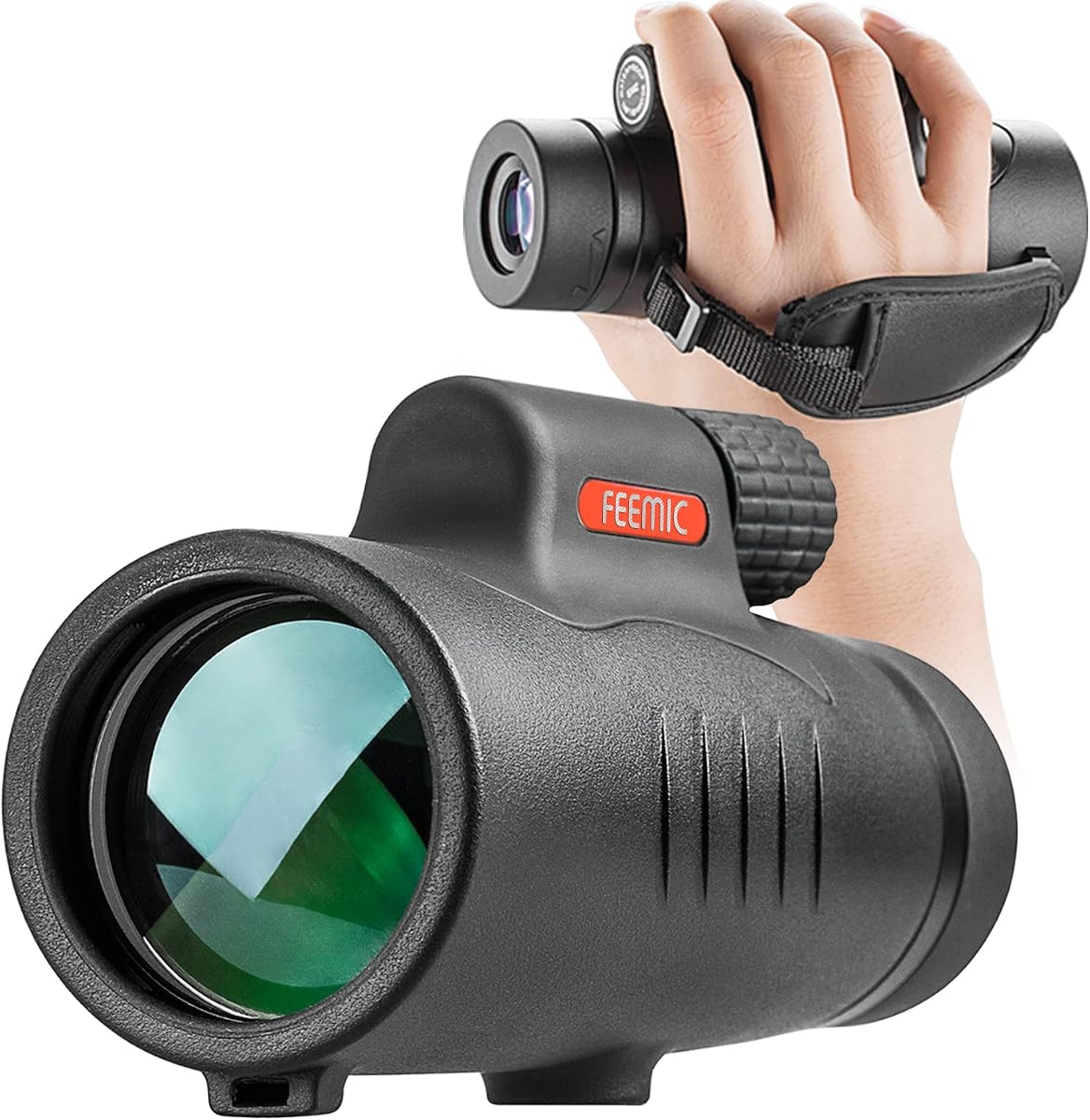


The Olimt 8×32 Monocular Telescope earns a 4.6 rating and stands out as a well-balanced pocket scope for general outdoor use. Its 8x magnification, 32mm objective lens, fully multi-coated extra-low-dispersion glass, and BAK-4 prism combine useful magnification with a relatively broad field of view.
We may earn a commission when you buy through this link, at no additional cost to you.
The optical specification is the model's strongest attraction. Its 396-foot field of view at 1,000 yards gives observers more context than a narrow spotting scope, which is useful when tracking wildlife or scanning landscapes. The large focus wheel also supports quick, straightforward adjustments while the 8-ounce metal body remains suitably portable.
Durability is another meaningful strength. Nitrogen filling, O-ring seals, and an IPX7 rating make this scope better suited to rain, humidity, and variable outdoor conditions than a basic pocket monocular. The principal limitation is that 8x is intentionally moderate rather than high magnification, so distant, tiny subjects may require steadier positioning or additional optics.
This is a strong recommendation for hikers, hunters, travelers, and everyday observers who want a compact scope with convincing optical specifications and serious environmental protection. It is particularly suitable for users who value a wide view, robust construction, and easy one-handed operation rather than maximum zoom.
The 396-foot field of view gives the 8×32 scope a useful balance of magnification and context. That makes it practical for watching animals cross open terrain, locating birds, and comparing features across a wider landscape.
An IPX7 rating, nitrogen-filled interior, and sealed construction support dependable use around rain and humidity. The metal body also adds reassurance for trips where the scope may be packed with outdoor gear.
We may earn a commission when you buy through this link, at no additional cost to you.
This 8×42 monocular has a 4.4 rating and offers a large objective lens in a relatively practical single-hand format. It is aimed at users who want more light-gathering capacity than conventional ultra-compact scopes while retaining a 360-foot field of view.
We may earn a commission when you buy through this link, at no additional cost to you.
Its optical system uses fully multi-coated lens elements and a BAK-4 prism, with the listing describing high light transmittance and a low-light viewing design. The 42mm objective is the key numerical advantage, potentially supporting clearer views in subdued outdoor light than a 21mm or 25mm objective.
The package is also notably practical. An adjustable eyecup accommodates users with or without glasses, a rubber-armored finish improves grip and impact resistance, and the bottom connection accepts a tripod for steadier viewing. Its dimensions are larger than the smallest scopes, so pocketability means jacket or backpack portability rather than a trouser pocket.
It is a sensible pick for birdwatchers, hunters, campers, and travelers who prefer a larger objective and want tripod compatibility. Buyers prioritizing absolute compactness should look elsewhere, but those focused on a versatile field scope will find its feature set unusually complete.
The 42mm objective is considerably more substantial than the 21mm and 25mm lenses used by several compact picks. This makes the model attractive when viewing wildlife or scenery in dimmer outdoor conditions.
The adjustable eyecup can be twisted into different positions, making it easier to find the correct eye relief. This is valuable for users who wear glasses or who need to block stray light around the ocular.
We may earn a commission when you buy through this link, at no additional cost to you.
The Vortex Solo Monocular 10×25 carries a 4.4 rating and combines 10x magnification with a genuinely compact form. Its fully multi-coated lenses are designed to improve light transmission and resolution, making it a practical choice for scanning distant birds, signs, and landscape details.
We may earn a commission when you buy through this link, at no additional cost to you.
The Solo's compactness is supported by a rubber-armored body that supplies a secure grip and added durability. It is also nitrogen purged and O-ring sealed for waterproof and fogproof performance, while the adjustable eyecup improves comfort for people who wear glasses.
Warranty coverage is a meaningful distinction in this category. The listed unlimited, unconditional, lifetime VIP warranty is transferable and covers repair or replacement for damage or defects, although it excludes loss, theft, deliberate damage, and cosmetic damage that does not affect performance.
This 10×25 Solo is best for travelers and everyday outdoor users who prioritize compactness, durable handling, and warranty support. It is less compelling when a large objective or tripod thread is essential, but it remains a well-rounded option for normal daylight observation.
Ten times magnification adds useful reach without turning the Solo into a large field scope. The small optical format can be carried comfortably in a daypack or jacket for travel, birding, and sightseeing.
Nitrogen purging, O-ring seals, and rubber armor address the three common threats encountered outdoors: moisture, internal fogging, and accidental impacts. These features suit a scope frequently moved between vehicles, bags, and outdoor environments.
We may earn a commission when you buy through this link, at no additional cost to you.
The ANTSIR 8×21 has a 4.3 rating and is the most explicitly pocket-oriented scope in this group. At only 9 by 3 centimeters and approximately 63 grams, it is designed for users who want a monocular that can move comfortably from a pocket to a backpack or travel bag.
We may earn a commission when you buy through this link, at no additional cost to you.
Its 8x magnification is easy to understand and operate, while the rotating focus barrel supports quick one-handed adjustments. A fixed eyecup, 13mm eye relief, FMC green-coated glass, and a roof-prism optical structure make it approachable for beginners who want a simple instrument rather than a complex spotting scope.
The trade-off is light-gathering capacity. A 21mm objective is smaller than the 25mm, 32mm, 36mm, and 42mm objectives elsewhere in the list, and the stated light transmission of up to 88% is lower than the 99.9% figure listed for the 8×42 model. The splash-resistant body is also less protected than fully waterproof options.
It is best suited to casual sightseeing, concerts, sporting events, daylight hiking, and travel. Users viewing in dim conditions or seeking more serious wildlife detail should consider a larger-objective scope, while beginners who prioritize size and simplicity will find this model easy to recommend.
At 9 by 3 centimeters, the ANTSIR occupies substantially less space than conventional monoculars. That makes it particularly convenient for travelers who want immediate access to a small viewing tool without dedicating much pack space.
A rotating focus barrel removes the learning curve associated with more complicated controls. The fixed eyecup and generous 13mm eye relief also help keep the viewing experience comfortable and uncomplicated.
We may earn a commission when you buy through this link, at no additional cost to you.
The Vortex Solo Monocular 10×36 earns a 4.6 rating and represents a balanced premium option for serious pocket-scope buyers. Its 10x magnification provides more reach than the 8x models, while the 36mm objective supplies more potential light-gathering capability than the compact 21mm and 25mm alternatives.
We may earn a commission when you buy through this link, at no additional cost to you.
Fully multi-coated lenses support the goal of clear, crisp images with improved light transmission and resolution. The body is fully rubber armored for grip and durability, nitrogen purged and O-ring sealed for weather resistance, and fitted with an adjustable eyecup for viewers with or without glasses.
Compared with the 10×25 Solo, this version is larger because of its 36mm objective, and the supplied information does not identify a tripod thread. That means buyers should consider it a capable pocket or pack-mounted scope rather than a miniature travel accessory. Its transferable lifetime VIP warranty provides substantial long-term support.
This is the premium pick for observers who want stronger magnification, a brighter objective, and rugged construction without moving to a full-size spotting scope. Birdwatchers, wildlife observers, and travelers who will use the scope in variable weather will find the combination especially well matched to their needs.
The 10×36 pairing balances useful distance magnification with a comparatively large objective. It is a more flexible configuration for outdoor observers who need more than a casual sightseeing tool.
The lifetime VIP warranty can cover repair or replacement of a damaged or defective unit. Its transferable nature adds convenience for owners who may pass the monocular to another family member or outdoor companion.
We may earn a commission when you buy through this link, at no additional cost to you.
The Olimt 8×25 Monocular Telescope has a 4.3 rating and delivers a compact optical system designed for portability. It weighs 5.8 ounces and measures 3.81 by 1.22 inches, making it one of the lighter full-size pocket monoculars in the comparison.
We may earn a commission when you buy through this link, at no additional cost to you.
Its fully multi-coated ED lenses and BAK-4 prisms are positioned as a clarity-focused configuration, while the 358-foot field of view supports natural observation. The standout feature is a documented close-focus distance of 0.98 feet, allowing the scope to examine nearby subjects rather than functioning only as a distant-viewing tool.
Other useful details include 16mm eye relief and an IPX7 waterproof rating supported by nitrogen filling and O-ring seals. The 25mm objective keeps the body small but will not gather as much light as the 32mm, 36mm, or 42mm models, so it is less oriented toward very dim conditions.
This is an appealing choice for backpackers, travelers, and casual observers who want a lightweight, waterproof scope with more close-range flexibility. It suits nature walks and sightseeing particularly well, while buyers needing maximum detail at long distance may prefer greater magnification.
The 0.98-foot close focus distance lets the scope examine nearby details. That flexibility separates it from models intended almost exclusively for viewing distant subjects.
At only 5.8 ounces, the scope is easy to carry for long walks. Its nitrogen-filled, O-ring-sealed, IPX7-rated construction still provides meaningful protection for changing outdoor conditions.
We may earn a commission when you buy through this link, at no additional cost to you.
The Nocs Provisions Zoom Tube 8×32 has a 4.6 rating and is one of the most feature-complete monoculars in the comparison. Its combination of a 32mm objective, fully multi-coated optics, central focusing, and a Swiss-designed BAK-4 prism targets users who want capable performance in a travel-oriented format.
We may earn a commission when you buy through this link, at no additional cost to you.
The optical coatings are applied across multiple surfaces with a low-refractive-index layer, supporting brightness, color clarity, and consistency toward the edge of the field. Its 384-foot field of view provides a broad scanning area, while the design can also align with a smartphone for photography or video capture.
The multi-stop twist-up eyecup offers three positions for users with and without glasses. A patented Wave Grip pattern improves security in the palm, and the 9.5-ounce body avoids excessive weight. Its IPX4 rating handles rain, fog, and snow, although that is less comprehensive than an IPX7 rating.
The strongest individual feature is the integrated 1/4-inch, 20-thread tripod adapter. It enables steadier viewing and a wide range of activities, making this a strong recommendation for birdwatchers, backpackers, wildlife viewers, and smartphone photographers who want more than basic pocket optics.
The built-in tripod thread eliminates the need for a separate compatible mounting solution. That is particularly helpful for birdwatching, long-distance observation, and smartphone imaging where camera shake can be frustrating.
The rugged Wave Grip is designed to resist slipping while maintaining comfort. Its textured pattern is useful in damp conditions or when the scope is used with gloves.
We may earn a commission when you buy through this link, at no additional cost to you.
The 80×100 High-Power Monocular has a 4.7 rating, the highest rating in this list, and distinguishes itself with adjustable high magnification and a 100mm objective. It is designed for birdwatching, hunting, wildlife observation, travel, and other activities where distant subjects are the primary target.
We may earn a commission when you buy through this link, at no additional cost to you.
A dual focus wheel system enables controlled adjustment across the magnification range. The included smartphone bracket and tripod make it possible to align a phone with the eyepiece and capture remote views, while the robust rubber exterior provides a secure grip and protection against minor bumps and scratches.
Its size is the primary concern for anyone shopping specifically for a pocket scope. A 100mm objective and 80x maximum magnification indicate a substantially bulkier instrument than the 8×21 or 8×25 models. Also, extreme magnification makes image steadiness harder to maintain, so a tripod becomes particularly valuable.
This scope is best for buyers who prioritize maximum zoom and smartphone integration over pocketability. It is a compelling alternative for stationary wildlife viewing or travel photography, but users who need a compact monocular for hiking should favor one of the smaller 8x configurations.
The adjustable magnification provides a substantially higher ceiling than the fixed 8x and 10x models. This is useful when identifying small birds or inspecting distant wildlife, provided the user can keep the instrument stable.
The quick-positioning phone bracket and included tripod create a straightforward path to remote photography. Users can frame distant subjects through the monocular and record images or video through their phone.
We may earn a commission when you buy through this link, at no additional cost to you.
The Celestron Nature 10×25 Monocular earns a 4.2 rating and delivers a useful budget-oriented combination of compact size and 10x magnification. The 25mm objective gathers more light than an ultra-small 21mm design, giving it greater relevance for wildlife viewing and landscape scanning.
We may earn a commission when you buy through this link, at no additional cost to you.
Multi-coated optics and a BAK-4 prism are included to support contrast, resolution, color, and clarity. Its wide 5.8-degree angular field allows observers to scan open landscapes and track birds in flight without an excessively narrow view.
The rubber-armored polycarbonate housing is designed to withstand bumps and drops, while waterproofing and nitrogen purging help resist rain, snow, humidity, and internal fogging. A twist-up eyecup supports comfortable viewing for both eyeglass wearers and others. The supplied information does not mention a tripod thread.
This is an attractive budget recommendation for hikers, travelers, and beginning birdwatchers who want more magnification than an 8x compact scope without moving to a large objective. Its lower rating and more modest objective keep it behind the strongest picks, but its feature set remains well rounded for everyday outdoor use.
The 5.8-degree angular field is well suited to finding moving birds and taking in open scenery. It gives the 10x magnification enough surrounding context to remain practical rather than excessively narrow.
Nitrogen purging, waterproofing, and rubber armor cover several common outdoor needs. These features make the scope a dependable choice for variable weather and repeated trips.
We may earn a commission when you buy through this link, at no additional cost to you.
The Nocs Zoom Tube 8×32 has a 4.6 rating and is designed around the needs of birdwatchers and backpackers. Its 8x magnification, 32mm objective, and 384-foot field of view form a versatile combination for both scanning distant subjects and maintaining a broad view of the surrounding landscape.
We may earn a commission when you buy through this link, at no additional cost to you.
Fully multi-coated optics and a Swiss-designed BAK-4 prism are intended to produce a bright field with crisp detail and strong color clarity toward the edges. Central focusing provides a straightforward way to bring subjects into clarity, while the 9.5-ounce weight remains manageable for a daypack.
Scratch resistance, water resistance, an impact-resistant housing, and the rugged Wave Grip support regular outdoor use. The three-position twist eyecup accommodates different eye-relief needs, and the integrated tripod thread allows stable viewing. The IPX4 rating is suitable for weather exposure but offers less protection than IPX7 models.
This is a strong recommendation for backpackers and birdwatchers who want a balanced, feature-rich monocular with smartphone and tripod versatility. It may be slightly heavier than the smallest travel scopes, but its optical capability and mounting features justify that trade-off for many outdoor users.
The 9.5-ounce weight and compact format balance optical capability with portability. The scope is small enough for a daypack while remaining substantial enough for comfortable handheld viewing.
Multi-layer anti-reflective coatings are applied to each optical surface. The stated goal is a brighter, crisper image with consistent color clarity across the field of view.
We may earn a commission when you buy through this link, at no additional cost to you.
Choosing a pocket monocular means balancing magnification, objective size, portability, optical quality, and weather resistance. The right scope depends on what you plan to observe, how much light you expect, and whether pocket size or extra capability matters more.
Magnification determines how much a subject appears enlarged, but it also makes the image more sensitive to hand movement and reduces the visible area. Fixed 8x models are often easier to keep steady and provide a naturally broad view, while 10x options help reveal more distant detail. The adjustable scope reaching 80x provides the greatest reach in this group, although its highest power should be used with stable support.
Choose moderate magnification for casual travel and handheld wildlife viewing. Consider higher power when identifying distant birds, subjects at long range, or using a tripod for steady observation.
Objective lens diameter influences potential light-gathering capacity, brightness, physical size, and weight. The list ranges from 21mm on the ANTSIR 8×21 to 42mm on the 8×42 model. Larger objectives generally create a better foundation for viewing in shade, dawn, dusk, or other subdued conditions, but they make the monocular less pocketable.
Match the objective to your environment. A 21mm or 25mm lens is convenient for daylight travel, while 32mm, 36mm, and 42mm designs offer more capacity for wildlife and lower-light scenery.
Fully multi-coated lenses, FMC green coatings, ED glass, BAK-4 prisms, and roof-prism structures appear across the selections. These features are intended to reduce reflection, improve light transmission, clarify contrast, and preserve color. They do not guarantee identical performance, because coating quality, glass selection, prism design, alignment, and optical engineering all influence the final image.
Look for multi-coated optics and a BAK-4 or comparable prism when image clarity is important. Treat these specifications as useful foundations rather than a substitute for handling, focusing, and field-of-view considerations.
A wide field of view makes it easier to locate and track subjects because more of the surroundings remain visible. The Olimt 8×32 lists a 396-foot field at 1,000 yards, while the 8×25 lists 358 feet and the Nocs 8×32 lists 384 feet. A narrower view can sharpen attention on one subject but may make moving targets harder to follow.
Prioritize a broad field for birdwatching, moving wildlife, and scenic scanning. The Celestron 10×25's 5.8-degree angular field offers another perspective on how much context users retain while using higher magnification.
A true pocket scope should be small enough to carry without encouraging you to leave it behind. The ANTSIR 8×21 measures 9 by 3 centimeters and weighs about 63 grams, while the Olimt 8×25 weighs 5.8 ounces. Heavier options may still fit a backpack or jacket pocket, but they are better characterized as travel or field scopes.
Consider how you will carry the monocular. For a dedicated pocket accessory, prioritize dimensions and weight. For hiking, backpacking, and travel where a bag is available, a larger objective or tripod thread may be worth the added size.
Waterproof, fogproof, water-resistant, and splash-resistant labels describe different levels of protection. IPX7 models, such as the Olimt 8×32 and 8×25, are designed to tolerate substantial water exposure, while the Nocs Zoom Tube has an IPX4 rating for weather resistance. Nitrogen purging and sealed O-rings help prevent internal condensation and moisture ingress.
Choose the strongest protection appropriate to your activities and how frequently the scope may encounter rain, snow, humidity, or accidental splashes. Keep protective cases and weather-resistant storage habits in mind regardless of the rating.
Simple controls are valuable for beginners, while dual focus wheels can provide finer adjustments over a broad magnification range. Eyecup design also matters, especially for people who wear glasses. Twist-up or multi-stop eyecups can block stray light and establish different eye relief, while fixed eyecups offer a simpler, more streamlined layout.
Choose a focusing system that feels intuitive and an eyecup that suits your vision. If you plan extended observation, prioritize comfort and precise focus over the smallest possible dimensions.
Tripod compatibility can make a meaningful difference when viewing distant subjects, using high magnification, or photographing with a phone. The 8×42 and Nocs Zoom Tube include or incorporate tripod connection features, while the 80×100 package includes a phone bracket and tripod. Accessories such as hand straps, pouches, cases, and cleaning cloths improve convenience between outings.
Choose a scope with a built-in thread when you expect steady viewing or imaging. For casual carrying, a quality strap and protective pouch may deliver more practical value than a mounting system you rarely use.
Before using a pocket monocular outdoors, read the included instructions and learn how the focus control, eyecup, magnification setting, and any tripod connection operate. Adjust the focus against a nearby subject, then point toward a distant target and make small adjustments. Begin with moderate magnification, move slowly, and allow enough time for the image to settle.
Hold the scope close to the eye without forcing the eyecup against glasses or the face. Keep the focusing wheel free of sand, moisture, and grit, and do not rotate it while the instrument is pointed at a bright light. If using a smartphone adapter, align the camera precisely with the eyecup and use the included tripod for steadier images. Avoid digital zoom because it enlarges pixels rather than adding optical detail.
After each outing, retract the eyecup if applicable, wipe the objective and ocular gently with the supplied microfiber cloth, and allow the scope to acclimate before sealing its case. Store it in a dry place away from prolonged direct sunlight and temperature extremes. Never use household cleaners on coated lenses, and consult the manufacturer before using compressed air or attempting repairs.
An 8x monocular is often the most comfortable general-purpose choice because it provides useful magnification while remaining relatively easy to hold steady. A 10x model can reveal more detail but may make moving subjects harder to track. Adjustable high-power scopes offer greater reach, although a tripod becomes much more useful at their highest settings.
A larger objective generally provides more potential light-gathering capacity, which can help in dim outdoor conditions. It also tends to make the monocular heavier and less pocketable. Smaller objectives are convenient for travel and daylight viewing, while 32mm, 36mm, and 42mm versions are more compelling for wildlife observation and lower-light scenery.
Many models include twist-up or multi-position eyecups designed to accommodate eyeglass wearers. The ANTSIR 8×21 has a fixed eyecup with 13mm eye relief, while the Olimt 8×25 lists 16mm eye relief. You may need to adjust the scope position or eyecup height to find a comfortable view without pressing the lens against your glasses.
A model with a documented waterproof or IPX7 rating is designed for more demanding moisture exposure than a basic splash-resistant scope. Nitrogen purging and O-ring seals also help prevent internal fogging. Even a weather-resistant monocular should be protected from saltwater, soapy water, and harsh chemicals because those can damage coatings and seals.
Common uses include birdwatching, observing wildlife, hiking, camping, travel, scenic viewing, concerts, and sporting events. Some models are also suitable for smartphone photography or video when paired with a compatible bracket. Their usefulness depends on the optical specifications, light conditions, and the steadiness of the user or a tripod.
A tripod is optional for moderate 8x viewing, but it becomes increasingly useful at 10x, during long-distance observation, and with the 80x adjustable model. Higher magnification makes small hand movements more visible. Models with a built-in 1/4-inch, 20-thread connection offer the easiest integration with a compatible tripod.
A 21mm objective is best suited to daylight use and situations where extreme compactness matters most. It can show birds and nearby wildlife, but its light-gathering capacity is lower than that of 32mm, 36mm, or 42mm objectives. Viewers who regularly watch wildlife in shade or near dawn and dusk should favor a larger lens.
Use a clean microfiber lens cloth and gently remove dust without rubbing grit across the coated surface. Avoid tissues, clothing, household sprays, and liquid cleaners that may leave residue or damage the coatings. Keep the eyepiece capped or protected when the scope is not in use, and store it in a dry case away from heat and prolonged sunlight.
The Olimt 8×32 is the strongest all-around choice because it combines fully multi-coated ED optics, a wide 396-foot field, an IPX7-rated metal body, and manageable dimensions. The Vortex Solo 10×36 is the premium selection for buyers seeking stronger magnification and a larger objective, while the Celestron Nature 10×25 provides an approachable budget option.
Prioritize the features that match your environment. Choose a small 8×21 or 8×25 model for effortless carrying, an 8×32 or 10×36 model for a more capable balance of magnification and light gathering, and a high-power scope when remote viewing and smartphone imaging outweigh strict pocketability. Weather sealing, eye comfort, tripod support, and accessory bundles can influence the decision just as much as headline magnification.
Ratings and specifications provide a useful starting point, but current availability and prices can change over time. Review the latest product listing, included accessories, warranty terms, and your own viewing habits before purchasing, then choose the monocular that you will actually carry and use.


