
PalliPartners Compound Microscope
4.3Editor score
100X to 2000X magnification
Dual LED illumination
Twenty-eight included slides
Phone image capture support
Best microscope for soil microbes compared by magnification, lighting, staging, imaging, accessories, and usability for students, teachers, and adult hobbyists.
A microscope for soil microbes must reveal more than isolated particles. It should provide enough resolution to recognize fungal filaments, plant cells, nematodes, protozoa, and other organisms within prepared samples while remaining practical for home, classroom, or field-oriented investigation. Magnification, illumination, stage control, and sample preparation are more important than headline magnification alone.
We compared ten compound and digital microscopes using the supplied specifications, focusing on optical range, objective and eyepiece options, dual lighting, mechanical stages, imaging support, included accessories, and suitability for biological observation. The guide covers educational models, binocular scopes for adults, trinocular systems with camera connections, and a portable digital option for quick sample inspection.
Each pick highlights the microscope's strongest contribution, from ready-to-use school kits to research-oriented imaging systems. Ratings and product details reflect the supplied listings, while availability and pricing can change over time. Before buying, match the microscope's optical capabilities and sample requirements to the organisms and level of detail you expect to observe.
4.3Editor score

4.6Editor score

4.2Editor score
The comparison below organizes all ten microscopes by optical capability, illumination, specimen handling, and documentation features, showing where each model fits in a soil-microbe workflow.
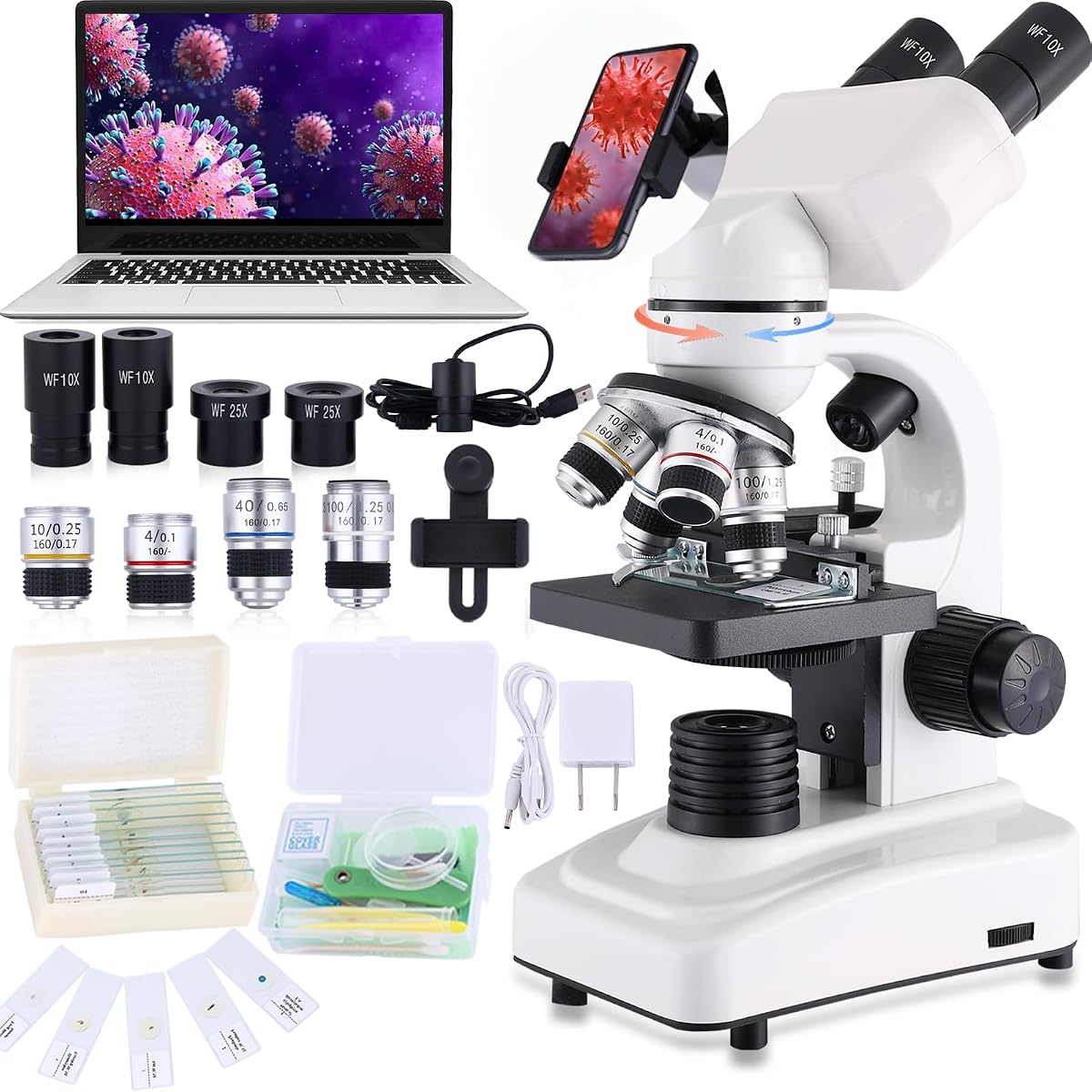


The PalliPartners Compound Microscope for Adults & Students, White earns a 4.3 rating and stands out as the most balanced choice for soil-microbe study. Its 4X, 10X, and 40X objectives, WF25X eyepiece, and 2X magnification lens create a stated 100X-to-2000X range. That versatility allows users to move from a broad view of a soil suspension to a closer examination of fungal strands, plant fragments, algae, and other translucent material.
We may earn a commission when you buy through this link, at no additional cost to you.
Its strongest advantage is the ready-made accessory package. The kit includes 10 prepared slides, 18 blank slides, a universal phone clip adapter, a Bluetooth remote shutter, and a power adapter. For a learner, that means less time spent assembling a basic workflow and more time practicing slide preparation, focus control, and specimen identification. The phone adapter is particularly useful for recording soil samples that contain movement, such as protozoa or small aquatic organisms.
Top and bottom LED illumination provides flexibility for both translucent and opaque material. Bottom light is the more useful setting for cells and organisms in thin soil suspensions, while top light can reveal surface texture, insect fragments, or denser particles. Coaxial coarse and fine focus knobs support controlled sharpening, although the listing does not specify a mechanical stage or image resolution. That makes it better for prepared or liquid mounts than for highly demanding long-term research imaging.
This is the best overall pick for students, homeschoolers, teachers, and adult hobbyists who want a capable microscope without assembling a complex accessory system. Its age guidance and SGS safety certification also suit supervised family and classroom use. For soil work, pair it with clean slides, coverslips, a dropper, and a simple staining or wet-mount process, and regard the phone adapter as a documentation aid rather than a laboratory imaging solution.
The included prepared and blank slides let users practice observation before creating their own soil mounts. The phone clip and remote shutter also make it possible to document motile organisms or compare specimens across multiple sessions.
Independent top and bottom light sources are valuable because soil samples vary in density and opacity. Transparent specimens benefit from transmitted light, while surface details on denser fragments are easier to inspect under reflected-style top illumination.
We may earn a commission when you buy through this link, at no additional cost to you.
This binocular compound microscope has a 4.4 rating and offers a 40X-to-2500X range supported by WF10x and WF25x eyepieces. The wide-angle binocular design is especially helpful for lengthy soil-sample sessions because it presents a larger field and allows both eyes to remain at the eyepieces. That makes it a practical choice for students, teachers, amateur scientists, and adults who expect to examine prepared specimens regularly.
We may earn a commission when you buy through this link, at no additional cost to you.
The large stage with a spiral moving scale is a meaningful upgrade for soil work. A mechanical stage makes it easier to move a wet mount in controlled increments, which is valuable when searching for moving protozoa or tiny organisms dispersed among sediment. Coaxial coarse and fine focus controls are positioned on both sides of the base, allowing the user to keep the same hand near the controls while repositioning the slide.
Its dual LED system provides primary observation and integrated fill illumination. This combination can help users maintain visibility while adjusting a sample, although a soil mount may still need preparation to prevent excessive optical density. A telescoping lens and a mechanism intended to prevent the sample from contacting the objective add practical protection during close observation.
The primary trade-off is that the supplied information does not mention a camera, USB connection, phone adapter, or extensive slide kit. Users who need digital records may need to add an imaging solution separately. Even so, the combination of binocular viewing, a mechanical stage, and a broad magnification range makes this a strong choice for direct visual analysis of prepared soil samples.
The binocular head and wide-field eyepieces are practical for repeated examination of slides. A larger field of view can make it easier to scan particles and locate isolated organisms before moving to higher magnification.
The two-layer stage and moving scale support incremental repositioning of liquid samples. This control is especially useful when tracking motile organisms that would otherwise be difficult to follow with a free-moving slide.
We may earn a commission when you buy through this link, at no additional cost to you.
The PalliPartners Compound Binocular Microscope for Adults, Professionals&Kids has a 4.2 rating and combines a 100X-to-2000X optical range with an unusually extensive collection kit. The microscope includes 4X, 10X, and 40X objectives, a WF25X eyepiece, and a 2X Barlow lens. These are useful configurations for moving from general soil particles to translucent cells and larger microorganisms.
We may earn a commission when you buy through this link, at no additional cost to you.
Its accessories support the entire collection-to-observation process. Four collection bottles allow separate soil or water samples to be gathered, while a hatching box, dissecting needle, ring-cutter, scissors, tweezers, and dropper support handling and preparation. Prepared and blank slides are included, as are a universal phone adapter, Bluetooth shutter, and power adapter. The result is a kit that is easier to use straight away for demonstrations or home investigations.
Dual LED lighting supports transmitted observations of translucent biological material and top-lit inspection of opaque fragments. Coaxial coarse and fine focus controls help users refine an image after finding the approximate focal plane. The binocular format is comfortable for sustained viewing, but the absence of a dedicated third imaging port means users who need continuous digital capture must use the included phone adapter.
This microscope is well suited to people who want to collect specimens rather than merely inspect prepared slides. It may appeal to students completing soil-biodiversity projects, educators building demonstrations, and hobbyists interested in water and sediment organisms. It is less suited to users needing a dedicated camera port or a laboratory-grade infinity optical system, but its comprehensive supporting tools make it a strong all-in-one soil-investigation package.
Collection bottles, dissecting tools, a dropper, and blank slides cover several early stages of a field-to-microscope workflow. This makes the model particularly useful for projects involving multiple collection locations or comparisons between soil and water samples.
The combination of objective lenses, a WF25X eyepiece, and a 2X Barlow lens provides enough range for broad survey work and close inspection. Users still need to select settings according to specimen thickness and transparency.
We may earn a commission when you buy through this link, at no additional cost to you.
The Laboratory Grade Trinocular Microscope has a 4.2 rating and is built for users who want advanced magnification, camera connectivity, and a more structured laboratory setup. Its 195 achromatic objective and infinity optical system are designed to improve resolution and clarity, while the advertised 40X-to-5000X range gives observers considerable flexibility for very small soil organisms.
We may earn a commission when you buy through this link, at no additional cost to you.
The trinocular configuration is a major advantage over binocular designs. Two viewing positions remain available through the eyepieces while a third port can serve an electronic eyepiece or other imaging device. That arrangement supports live observation and simultaneous image capture. The model also includes wide-field eyepieces, 2X magnifiers, LED illumination, dual coaxial focusing, a double-layer mechanical stage, diopter adjustment, and an adjustable interpupillary distance.
Its accessory package supports serious preparation work. The set includes slides, coverslips, tissue sections, Petri dishes, test tubes, droppers, pipettes, brushes, tweezers, insect needles, cleaning materials, a phone holder, and protective packaging. These extras can help users build and maintain temporary mounts, although the inclusion of many tools does not remove the need to learn correct biological technique.
This microscope is best for adult hobbyists, advanced students, educators, and soil researchers who need high magnification or recorded evidence. It may be excessive for simple classroom observations, and high magnification can reveal empty space if the sample is too thick or poorly prepared. For soil microbes, use lower settings to locate organisms, then increase magnification only after achieving a clean, well-lit focal plane.
The infinity optical system and achromatic objective are intended to support clearer, more consistent imaging. These features are particularly relevant when the goal is to distinguish fine structures rather than merely confirm that particles are present.
A trinocular head leaves the operator's eyes on the binocular eyepieces while an electronic eyepiece or camera occupies the third port. This makes it easier to compare live movement with a captured frame or share a field with another person.
We may earn a commission when you buy through this link, at no additional cost to you.
The PalliPartners 40x-2000x Biological Compound Trinocular Microscope has a 4.2 rating and presents a clean, professional approach to soil-sample observation. Its 40X-to-2000X range is appropriate for basic biological inspections, while the trinocular head allows two people to view through the eyepieces while an imaging device is connected to the third port.
We may earn a commission when you buy through this link, at no additional cost to you.
The double-layer stage is designed to keep slides stable and reduce shifting during observation. That stability matters with wet mounts containing moving protozoa or small soil fauna. Dual top and bottom LEDs provide illumination for transparent and nontransparent specimens, and separate coarse and fine focusing knobs let users move quickly to the approximate focal plane before refining clarity.
The primary limitation is that the supplied listing does not identify the objectives, eyepieces, camera resolution, or included camera accessories in detail. While the 2000X ceiling sounds impressive, real-world detail also depends on specimen preparation, illumination, numerical aperture, and sensor quality. The model should therefore be judged as a flexible platform rather than by the headline magnification alone.
This is a strong premium recommendation for home laboratories, classroom programs, and adult researchers who value a dedicated imaging port and stable mechanical stage. It is especially useful when soil organisms must be tracked, compared across samples, or documented. Buyers should confirm their preferred camera is compatible with the third port before purchasing and ensure that slides, pipettes, and basic wet-mount supplies are available.
The third optical path allows a camera or other imaging device to be used without replacing the binocular eyepieces. That makes the scope convenient for teaching, collaboration, and the creation of a repeatable visual record.
The double-layer stage helps hold a slide in position while wet specimens are examined. Stable placement is valuable when the goal is to follow slow movement or keep a specific microbial field centered during an observation session.
We may earn a commission when you buy through this link, at no additional cost to you.
This trinocular microscope carries a 4.4 rating and pairs a 40X-to-5000X stated range with a digital eyepiece, wide-field optics, and a mechanical stage. The 185 achromatic objective and infinity optical system are designed to improve resolution and reduce color-related imaging defects, making this one of the more technically specified options in the list.
We may earn a commission when you buy through this link, at no additional cost to you.
Its imaging package is the defining feature. The included digital eyepiece can be used to acquire views through the third port while users continue observing through the binocular eyepieces. For soil research, this arrangement makes it easier to record a specimen, show it to a class, or compare successive fields without repeatedly repositioning the camera. Wide-field eyepieces and adjustable interpupillary distance improve comfort for different users.
Mechanical sample control and illumination are also well addressed. The double-layer stage, coaxial coarse and fine focus, adjustable diopter, rotating tube, and LED source support precise work. The accessory set includes slides, coverslips, tissue sections, a Petri dish, pipette, tweezers, phone mount, scalpel, test tubes, cleaning supplies, and shock-absorbing packaging.
This microscope is a strong fit for adult educators, advanced students, veterinary or biological observers, and hobbyists who want a camera-centered workflow. The supplied information does not provide the digital eyepiece's exact sensor resolution or the software requirements, so buyers should verify computer compatibility. It is less attractive for a child who only needs to view prepared slides, but more capable for repeated documentation of soil biodiversity.
The included electronic eyepiece removes the need to source a separate camera for basic trinocular documentation. It is a practical way to retain direct visual observation while capturing a field for later review.
Coaxial focus controls, a double-layer stage, and adjustable viewing features make the system suitable for more deliberate examination. These controls help users isolate smaller organisms and reposition thin mounts with less disturbance.
We may earn a commission when you buy through this link, at no additional cost to you.
The Skybasic Wireless Digital Microscope has a 4.2 rating and offers a portable alternative for quick inspections of soil, plants, minerals, insects, and small objects. It supports 50X-to-1000X magnification, eight adjustable LED lights, and image capture at 1920×1080 resolution through a phone. A USB connection also supports compatible Windows and Mac computers.
We may earn a commission when you buy through this link, at no additional cost to you.
The major advantage is portability. Users can carry the microscope to a garden, collect a soil sample, and inspect it without setting up a full compound instrument. The adjustable stand provides steadier positioning, and the app-based capture controls make it easy to record photos or video of visible particles, plant tissue, or larger soil organisms.
Its limitations are important for anyone expecting cellular-level work. The product is described as a fixed-focus magnifying system rather than a traditional compound microscope, and the listing explicitly says it is not suitable for professional serious biologists. The usable focal range is 3 to 60 millimeters, so samples must remain within that distance. There is also no transmitted-light stage for examining freely suspended organisms in a conventional wet mount.
This microscope is best for field scouting, classroom demonstrations, and users who want a lightweight way to inspect relatively large soil organisms or surface textures. It should not be selected for fine microbial morphology, stained slides, or detailed taxonomic work. Keep the lens within the specified focus range, remove the protective film before use, and follow the current app or computer connection instructions.
The lightweight handheld format makes this model useful for examining collected material away from a fixed workspace. It is especially convenient for broad screening of visible organisms and soil-surface details.
Wi-Fi connection to a mobile device supports one-button photo and video capture. This allows students to display a specimen immediately or share a recorded observation without relying on a separate compound microscope.
We may earn a commission when you buy through this link, at no additional cost to you.
The Adult and Student Compound Microscope has a 3.7 rating and is included as an accessible educational option for basic soil-organism observation. Its 4X, 10X, and 40X objectives, WF10X and WF25X eyepieces, and 2X lens produce a stated 40X-to-2000X range. The design targets school laboratories and home education rather than advanced microscopy.
We may earn a commission when you buy through this link, at no additional cost to you.
Two useful features distinguish it within the entry-level group. First, upper and lower LED illumination with adjustable brightness can be adapted to transparent or opaque specimens. Second, the five-color diaphragm filter wheel can improve contrast in a prepared soil suspension by selectively tinting the transmitted light. This is particularly helpful when transparent organisms lack strong visual contrast against sediment.
The accessory kit includes a phone adapter, blank slides, coverslips, tweezers, and prepared slides. That provides the basics for classroom demonstrations and simple home projects. However, the listing does not mention a mechanical stage, camera, USB connection, or a detailed set of high-power objectives. Its 2000X figure is therefore best understood as a range across the included optical components, not a guarantee of laboratory-grade resolution.
This microscope is best for budget-conscious learners who need a dependable compound format, adjustable lighting, and simple imaging support. The lower rating suggests buyers should pay close attention to included components and expected performance. It is more appropriate for broad biology lessons and visible soil organisms than for advanced microbial identification, but it can provide a valuable introduction to wet mounts, focusing, and magnification.
The five-color filter wheel allows an educator to vary transmitted-light color without changing the specimen. This can help students distinguish fine organisms from a visually busy soil suspension.
Slides, coverslips, tweezers, and a phone adapter cover the essentials for simple wet mounts. The included materials reduce the need to purchase separate preparation supplies before beginning a lesson.
We may earn a commission when you buy through this link, at no additional cost to you.
The Research Grade Trinocular Microscope has the highest listed rating in this comparison at 4.6. It combines a stated 40X-to-5000X range, four achromatic objectives, a trinocular head, a 1.3MP camera, USB 2.0 output, and a double-layer mechanical stage. This combination makes it the most complete option for adults who need both direct observation and digital documentation of soil samples.
We may earn a commission when you buy through this link, at no additional cost to you.
Its objective set includes 4X, 10X, 60X, and 100X lenses, providing a useful spread for moving from general survey to detailed inspection. The multiple-lens optical system is described as reducing aberrations and extending a clear imaging range. A variable diaphragm controls the amount of light reaching the sample, while the NA1.25 spotting scope and adjustable LED source support careful brightness control.
The integrated camera is especially important for a modern soil-microbe workflow. It can display a larger field on a Windows or Mac computer or projector, support live streaming, and capture images or recordings. That makes the microscope suitable for classroom sharing, remote consultation, and comparison of samples collected on different dates. The mechanical metal stage provides X- and Y-axis movement, helping users locate and hold specific fields.
This is our Editor's Choice because it addresses the complete needs of an adult researcher: high magnification, thoughtful illumination, mechanical sample control, and integrated imaging. Its limitations are the learning curve and the need to configure computer software or compatible viewing applications. Even so, it offers the most compelling balance for serious soil observation, teaching with live images, and repeatable documentation.
The integrated camera and USB output allow users to move from eyepiece inspection to computer-based review without sourcing a separate imaging system. Live display also enables collaborative teaching and remote consultation.
LED lighting and a variable diaphragm help manage contrast in soil mounts of different densities. Adjusting the light can reveal transparent organisms that become difficult to see under uniformly bright illumination.
We may earn a commission when you buy through this link, at no additional cost to you.
The Microscope for Adults WF10x and WF25x Eyepiece has a 4.1 rating and combines binocular viewing with an electronic eyepiece. Its 4X, 10X, 40X, and 100X achromatic objectives work with WF10X and WF25X eyepieces to provide six stated magnification combinations across a 40X-to-2000X range.
We may earn a commission when you buy through this link, at no additional cost to you.
The dual LED light source supports biological materials and tiny objects, while coaxial and fine focus controls allow a user to move from rough positioning to precise image sharpening. This combination is useful for wet-mounted soil organisms, plant tissue, and small particles. The binocular arrangement reduces the need to alternate between two eyepieces during prolonged observation.
The USB electronic eyepiece adds a basic imaging path for taking photos and videos on a PC. That makes it possible to save evidence of a soil suspension, share a field with a class, or compare a specimen later. However, the supplied information does not state its resolution, and the listing does not identify a mechanical stage. Users who require precise stage movement may prefer one of the trinocular models with an explicit dual-stage design.
This microscope is a sensible middle option for adults and advanced learners who want more objective variety than a basic school kit without moving to the most complex research-oriented system. It is well suited to biological morphology, educational sample work, and general hobby investigation. Its strongest combination is the range of optical settings, dual lighting, comfortable binocular viewing, and built-in electronic documentation.
Four objective lenses make it possible to adjust both resolution and working distance as the observation changes. This variety is useful when moving between larger soil fauna, translucent organisms, and fine cellular detail.
The binocular eyepieces support direct observation, while the USB electronic eyepiece supplies a route to photos and video. Users can keep looking through the scope while checking a captured image on a computer.
We may earn a commission when you buy through this link, at no additional cost to you.
The best microscope for soil microbes depends on the organisms you want to see, the preparation you are willing to perform, and whether direct viewing or digital documentation matters most. These factors help separate a practical school scope from a system suited to detailed biological imaging.
Magnification is useful for comparing subjects, but resolution determines whether fine structures can actually be distinguished. Soil-water mounts may contain organisms only a few micrometers long, so a compound microscope with multiple objective lenses is usually more appropriate than a fixed-focus digital magnifier. The listed 2000X and 5000X ranges represent different combinations of eyepieces, objectives, and auxiliary lenses, but greater magnification also narrows the field and reduces depth of focus.
Choose optics that provide a usable progression rather than relying on one headline number. Lower settings help locate organisms in a busy suspension, while intermediate and high settings reveal structure. Confirm whether the stated maximum comes from an infinity system, a Barlow lens, an electronic eyepiece, or another accessory.
Most translucent soil organisms are easiest to see when illuminated from below. Top illumination is useful for opaque particles, surface textures, and thicker material, so dual LED systems offer greater flexibility than a single-sided light. Adjustable brightness is also important because intense illumination can wash out pale organisms, while insufficient light can conceal fine detail.
Look for independent controls and, ideally, a diaphragm or aperture system for contrast management. Bottom light paired with a simple color filter can make transparent organisms easier for students to recognize, while a mechanical stage helps preserve the field while lighting is adjusted.
A mechanical stage lets you move a slide along X and Y axes while keeping it mounted and stable. This is particularly valuable for tracking motile protozoa, scanning a soil suspension, or returning to a specific field for a higher magnification. A free-moving stage works for simple prepared slides but makes precise navigation more difficult.
Coarse and fine focusing should feel smooth and work together. Coarse focus quickly approaches the specimen, while fine focus resolves the final detail. Wide-field eyepieces and adjustable interpupillary distance can reduce eye strain during long sessions, which is valuable for repeated biodiversity surveys.
A trinocular head has two viewing ports and a third imaging port, allowing direct observation while a camera records the same field. This is valuable for teaching, remote collaboration, and time-lapse-like documentation of living samples. Binocular scopes with a phone adapter can also capture images, but the phone may not offer the same stability or direct computer workflow.
Check the camera's resolution, connection type, operating-system support, and included software. A higher sensor resolution can improve documentation, but magnification alone does not guarantee a sharp result. Sensor quality, illumination, focus, and specimen preparation remain equally important.
Soil organisms are often studied in temporary wet mounts made with slides, coverslips, a dropper or pipette, and clean water. Prepared slides are useful for demonstrations, but blank slides and coverslips allow users to examine their own material. Collection bottles and dissecting tools matter for projects that involve gathering samples from several locations.
Look for Petri dishes, test tubes, brushes, tweezers, and cleaning supplies if you plan to process and maintain specimens. A comprehensive kit can simplify class preparation, although it should not substitute for learning safe handling, sanitation, and correct slide technique.
A portable digital microscope is excellent for field screening, checking visible organisms, and sharing quick observations from a phone. Its fixed-focus design and small working distance make it less suitable for detailed cellular examination or conventional slide work. A compound microscope requires a stable tabletop but provides much greater control over transmitted light, objective selection, and fine detail.
Choose the portable model if your main requirement is quick access to a sample outside a laboratory. Choose a compound scope if your project depends on prepared slides, sustained observation, or close examination of small organisms. For many users, a portable digital model works well as a companion rather than a replacement.
Student microscopes should be approachable, with clear controls and enough accessories to begin immediately. Binocular models with wide-field optics and controls on both sides are more comfortable for adults. Research-oriented trinocular systems add camera ports, mechanical stages, objective selections, and calibration features that can feel excessive for a first microscope.
Consider who will use the instrument and how often. A simple scope with dual lights and standard slides may serve a classroom better than a complex model that is difficult to adjust. Conversely, repeated soil surveys, comparative work, and digital recordkeeping justify investing in more precise controls.
A complete optical system matters more than the presence of many marked components. Check which eyepieces, objectives, Barlow lenses, cameras, and adapters are actually included, and whether each is compatible with the microscope's tube or ports. Eyepiece magnification multiplied by objective magnification explains the direct viewing power, but auxiliary lenses can change the total.
Confirm that any electronic eyepiece or camera works with the user's computer or phone. For shared or classroom use, also consider whether software installation is required, whether a live view is supported, and whether images can be stored directly. These checks prevent an imaging feature from becoming a frustrating final step.
Begin by working in a clean, well-lit area and gathering the sample in a labeled container. Loosen a small amount of soil in clean water, allow larger particles to settle, and transfer the suspended material with a pipette or dropper onto a clean slide. Add a coverslip carefully to avoid trapping large air bubbles. For safer examination of living organisms, avoid using stains until a representative view has been obtained.
Place the slide on the stage, lower the objective, and begin with the lowest useful magnification. Adjust the coarse focus only until the specimen comes into view, then use fine focus for detail. Switch to transmitted light for translucent organisms and top light for opaque fragments. Move the slide with the stage controls, recording images when a field contains organisms worth documenting. Increase magnification gradually and re-center before focusing at a higher setting.
After each session, remove the slide, switch off the illumination, and let the instrument cool before covering or storing it. Clean glass surfaces with lens tissue or a recommended optical cleaning material rather than touching lenses with fingers. Keep the stage clean, return the head to a safe position, and store the microscope away from moisture, dust, direct heat, and unstable surfaces. Digital models additionally require a protective film to be removed before use and current software to be installed for reliable connectivity.
A compound microscope with multiple objective lenses, dual LED lighting, and a mechanical stage is the most flexible choice for prepared soil samples. Models with trinocular heads and integrated cameras are especially useful for repeated observation and digital documentation. The best choice still depends on the size of the organisms and whether living wet mounts or stained slides are being used.
A high maximum magnification can be useful for very small organisms or detailed cellular structures, but it is not automatically better for every sample. High power has a shallow depth of field and requires a thin, clean mount with carefully controlled illumination. Many educational investigations are more effective at lower or intermediate settings because the field of view is larger and organisms are easier to locate.
A digital microscope can work for quick field inspection and observing relatively large organisms or surface textures. The portable models in this guide use a fixed-focus design, however, and do not provide the same optical control or transmitted-light workflow as a compound microscope. Use one for screening, and choose a compound model when cellular detail is important.
Many common soil organisms require magnification in the hundreds, while very small bacteria generally require high-power laboratory imaging beyond what a basic school scope can reliably resolve. A microscope with a broad 100X-to-2000X or 40X-to-5000X range lets users survey a sample first and then zoom in. Effective preparation and illumination matter as much as the stated magnification.
Wet mounts are a practical starting point because living, motile organisms can be observed without permanently fixing the sample. Add a drop of clean water, transfer a small amount of suspended material, and apply a coverslip. For preservation or specialized stains, additional laboratory methods and appropriate safety procedures may be necessary.
Transmitted light passes through thin, translucent specimens and makes their internal outlines visible against the background. This is especially helpful for protozoa, small algae, and delicate organisms in a soil-water suspension. Top light is more useful for opaque fragments and surface texture, so a dual-light microscope handles a wider variety of samples.
A binocular microscope is simpler and often more comfortable for direct observation. A trinocular microscope adds a third port for a camera or electronic eyepiece, allowing images and video to be captured while the user continues looking through the eyepieces. Choose trinocular if documentation, teaching, sharing, or collaborative observation is a regular requirement.
A phone adapter can provide a practical way to capture images with binocular models that lack a dedicated camera port. Results depend on the adapter, phone camera, stable mounting, lighting, and accurate focus. For repeated records, live computer display, or classroom sharing, a model with a native USB camera usually provides a more integrated workflow.
The Research Grade Trinocular Microscope is the strongest all-around option because its four achromatic objectives, mechanical stage, adjustable illumination, and integrated 1.3MP camera support both careful observation and reliable documentation. The PalliPartners Compound Microscope is the best budget-oriented choice for a ready-to-use educational kit, while the PalliPartners Biological Trinocular offers a more polished platform for users who prioritize a third imaging port and stable double-layer stage.
Prioritize optical range, transmitted and top lighting, mechanical sample control, and a workflow you can sustain. A 5000X ceiling may be unnecessary for a classroom demonstration, while a mechanical stage and camera can be essential for repeated surveys. Whichever model you choose, keep prepared slides thin, begin at low magnification, and use the illumination and focus controls to reveal detail rather than relying on magnification alone.
Check the current listing carefully before ordering because included accessories, software, and product availability can change. Confirm camera compatibility, stage type, slide supplies, and whether the included eyepieces and objectives match your intended soil organisms. With the right preparation and the appropriate optical system, any well-chosen microscope can become a valuable tool for exploring the hidden life within a handful of soil.