
ZOWEETEK Original Portable Wired Microphone
4.4Editor score
10-watt voice amplification
12-hour battery life
Flexible wired headworn mic
Our guide compares the best microphones for teachers, covering wireless range, sound quality, battery life, comfort, connectivity, and classroom suitability.
A classroom microphone can transform a difficult-to-hear lesson into a clear, comfortable teaching experience. The right model combines strong voice projection, reliable transmission, comfortable wear, and enough battery life for a full schedule. Important options include wired headsets, compact personal amplifiers, and wireless lavalier systems that let teachers move freely.
We compared all ten products using the specifications and feature information available for each model. The comparison focuses on output, microphone style, wireless or wired operation, room coverage, battery life, audio playback, controls, portability, and suitability for teachers and other presenters. It also considers how each system is likely to fit into classroom routines.
The list shows where each product stands out, from budget-friendly personal voice amplifiers to wireless systems with extended range and convenient mute controls. Ratings reflect the information supplied with the products, while practical details help distinguish a good general option from one better suited to a particular classroom. Prices and availability can change, so check the current listing before purchasing.
4.4Editor score

4.4Editor score

4.4Editor score
The table below compares all ten systems across their core design, power, and classroom features. It highlights the most important differences among wired headsets, personal amplifiers, and wireless lavalier configurations.




The ZOWEETEK Original Portable Wired Microphone is a compact personal voice amplifier with a 4.4 rating. It is designed for educators who want their voice projected clearly without resorting to prolonged yelling. Its strongest combination is generous 10-watt output, flexible wired headworn microphone positioning, and a rechargeable battery that supports up to 12 hours of amplification.
We may earn a commission when you buy through this link, at no additional cost to you.
The stated coverage of about 10,000 square feet makes the system appealing for large classrooms, training spaces, presentations, and outdoor instruction. Teachers can adjust the distance between the microphone and mouth, while the back clip, waistbelt, or neck hanging options provide several ways to wear the lightweight 0.36-pound unit. ABS construction is also described as durable and wear-resistant.
This is not the most flexible option for moving around because the microphone remains connected by a wire. The absence of listed Bluetooth connectivity also makes it less suitable for teachers who want to stream music from a phone while maintaining a completely wireless setup. Even so, its direct voice amplification, extensive media playback, and long battery life make it a compelling basic teaching tool.
Choose this model when reliability, clear amplification, and straightforward operation matter more than cable-free movement. It is particularly well suited to a fixed teaching position, a training room, or any situation where a teacher wants an inexpensive, compact alternative to shouting across a large room.
The 10-watt amplifier is described as loud enough for a large room without distortion. Its adjustable microphone lets the wearer find a comfortable distance from the mouth, while the clip, waistbelt, and neck options make it easier to use the same system in different environments.
TF card and USB flash drive playback support MP3 audio, while the 3.5mm AUX input lets the device function as a wired speaker. A 1800mAh battery adds up to 12 hours of amplification, with up to 10 hours for music playback.
We may earn a commission when you buy through this link, at no additional cost to you.
The ZOWEETEK Portable Rechargeable Mini Voice Amplifier for Teachers shares the strengths of the original ZOWEETEK model while emphasizing a compact wired headset. It has a 4.4 rating, 10-watt maximum output, and a claimed room-coverage figure of about 10,000 square feet. The result is a portable personal amplifier suited to teaching, training, coaching, presentations, and tour guiding.
We may earn a commission when you buy through this link, at no additional cost to you.
Its 1800mAh rechargeable lithium battery supports up to 12 hours of continuous amplification and can be recharged in approximately three to five hours. Teachers who want background audio can use TF card or USB flash drive playback, including single-track repeat, looping, and song switching. The 3.5mm AUX input and the ability to use the mic port as AUX adds further versatility.
The main limitation is the wired microphone. While the adjustable headworn design may remain secure and keeps the mouth relatively close to the mic, it does not provide the freedom of movement associated with a wireless lavalier. Bluetooth is also not listed among the connection options, so phone-based audio would require another route.
This amplifier is a good option for teachers who prefer the familiarity of a headset and want a compact body that can be clipped to a belt or worn around the neck. Its combination of output, battery life, and media playback makes it more versatile than a basic classroom speaker.
The wired headset microphone is adjustable, allowing the user to change the distance between the mic and mouth. That flexibility is useful in classrooms, rehearsals, and presentations where maintaining consistent voice pickup matters.
The rechargeable battery can provide up to 12 hours of amplification, while music playback lasts up to 10 hours. A three-to-five-hour recharge makes it practical to prepare the unit overnight or between demanding days.
We may earn a commission when you buy through this link, at no additional cost to you.
The WinBridge Wireless Voice Amplifier with Clip-On Lapel Mic for Teachers is a well-balanced wireless system with a 4.4 rating. It combines 15-watt amplification, a lightweight 0.64-ounce lavalier microphone, automatic pairing, and dual mute buttons. These qualities make it especially suitable for teachers who move around a classroom and want simple equipment that does not require a manual learning curve.
We may earn a commission when you buy through this link, at no additional cost to you.
The speaker contains a 2600mAh rechargeable battery rated for 12–15 hours of voice amplification, while the microphone has a 300mAh battery that supports more than 10 hours. A dual Type-C cable allows both units to charge together, and automatic power-down is intended to preserve power when the system is not being used. The lightweight mic can be clipped to a collar, held by hand, or carried with the included strap.
Bluetooth playback is supported for background music from a phone or laptop. That makes the system usable for lessons, gym instruction, guided tours, church services, and outdoor events. The trade-off is that it is a two-piece wireless system rather than a small single-unit amplifier, so there is more equipment to organize and charge. The shorter microphone runtime is still sufficient for extended teaching sessions.
This is the strongest all-around recommendation in the roundup for teachers who prioritize freedom of movement, fast setup, useful controls, and classroom-friendly volume. It suits both conventional classrooms and more active teaching environments where a headset could interfere with movement, glasses, or personal comfort.
The 0.64-ounce lapel mic avoids the pressure associated with a conventional headset. Teachers can write, demonstrate, or interact with students while maintaining a hands-free presentation style, and the included strap adds another carrying option.
Both the amplifier and microphone have mute buttons, making it possible to interrupt amplification without powering down the whole system. Automatic pairing and an intuitive control layout also reduce the chance of fumbling with settings during a lesson.
We may earn a commission when you buy through this link, at no additional cost to you.
The B006 15W Voice Amplifier with Bluetooth and Wireless Lavalier Microphone is a 4.4-rated system built around strong output and long-range mobility. Its 2.4GHz connection is stated to work at least 98 feet in open areas, giving it more coverage than many of the compact wireless options in this guide. The clip-on microphone is designed to avoid the pressure of a headset.
We may earn a commission when you buy through this link, at no additional cost to you.
A one-touch mute control is built into the microphone, allowing a teacher to stop voice transmission without walking back to the speaker. The system also supports simultaneous Bluetooth music playback, which is useful when a lesson needs background audio. Fast pairing and low audio delay are listed among the 2.4GHz system's features, helping it feel appropriate for regular classroom use.
The battery configuration is more balanced for mic-heavy movement than for all-day speaker operation. The microphone can run for up to 15 hours, while the speaker is rated for up to seven hours under specific testing conditions. A classroom that uses the system only for lessons and recharges the speaker regularly may find this entirely manageable, but all-day events should account for the shorter figure.
The B006 is a strong premium choice for teachers who need room-filling output, extended wireless reach, and minimal physical restriction. It is well suited to large rooms, training spaces, tours, group presentations, and outdoor activities where dependable mobility across a broad area matters.
The 15-watt speaker provides substantial voice projection, while the 98-foot open-area transmission specification gives the teacher considerable freedom. The range will vary with walls, interference, and room layout, but it is designed for larger working areas than a standard short-range system.
The microphone’s built-in mute button gives the wearer immediate control over voice amplification. This is useful for brief side conversations, interruptions, or moments when the teacher wants students to hear only background audio.
We may earn a commission when you buy through this link, at no additional cost to you.
The 2200mAh Personal Headset Amplifier is a compact rose-colored voice amplifier with a 4.3 rating. Its defining advantage is endurance: the rechargeable battery supports up to 20 hours of amplification and up to 13 hours of music playback. That makes it appealing to teachers with several classes, long activity days, or limited opportunities to recharge equipment.
We may earn a commission when you buy through this link, at no additional cost to you.
The amplifier provides up to 8 watts of output and is described as sufficient for a room of approximately 25–50 people. It measures 3.6 by 2.8 by 1 inches and weighs 0.4 pounds. The adjustable headset includes a flexible gooseneck, while the body can be worn with a headband, hung from the neck, or clipped to a belt or waistband.
TF card and USB flash drive playback are supported, with repeat, loop, and song-switching functions. A 3.5mm jack also allows the unit to work as a wired speaker. Compared with the 15-, 25-, and 35-watt systems in the list, its output is lower, and the wired headset is less suitable for active movement. The product guidance also recommends keeping the mic and speaker separated to avoid noise.
This is a sensible choice for small and medium classrooms, tutoring sessions, training rooms, and presentations where a long uninterrupted battery is the priority. Teachers who regularly work at the front of a room and do not need wireless mobility may find its simpler setup and substantial runtime especially convenient.
Up to 20 hours of amplification means the device can cover multiple activities without a daily recharge. The stated four-to-six-hour charging period is also relevant for teachers who can prepare the unit overnight and carry it through the next day.
The headset, adjustable band, neck tie, and rear clip provide multiple wearing options. That flexibility lets a teacher move the system between a tabletop, waist-mounted, or head-worn setup without buying a separate mount.
We may earn a commission when you buy through this link, at no additional cost to you.
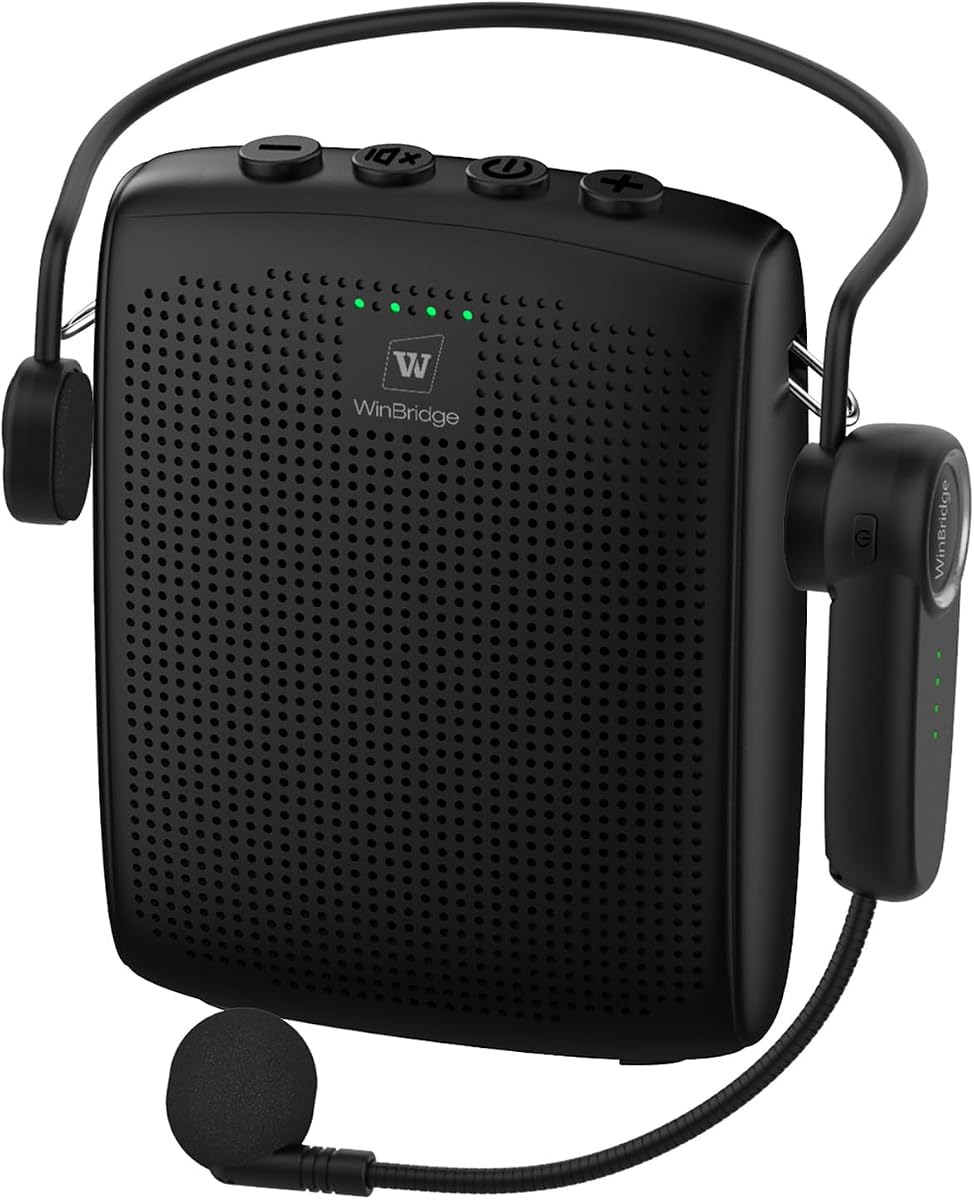
The WinBridge WB002 Bluetooth Voice Amplifier pairs a portable speaker with a wireless headset microphone. It carries a 4.3 rating and offers 15 watts of output, stated to be sufficient for a classroom of around 50 middle-school students. The system is aimed at teachers and presenters who want more volume than a personal amplifier without needing to shout.
We may earn a commission when you buy through this link, at no additional cost to you.
Automatic pairing is a major convenience. The speaker and headset can be turned on and connected without navigating a complicated menu. The speaker has a 2600mAh rechargeable battery that supports up to 12–15 hours, while the microphone supports eight to ten hours. Both can be charged with the included Type-C cable.
Unlike the lavalier products in this guide, this system uses a headset. That can be useful for strong, consistent voice pickup and gives the teacher the option to remove it and use it as a handheld microphone. The trade-off is less visual discretion, and some wearers may prefer a collar-mounted mic. The headset is also described as lightweight, with a back clip and lanyard for the speaker.
The WB002 is a good fit for traditional classrooms, staff meetings, training sessions, and presentations where a headset is acceptable and straightforward wireless operation is a priority. It is particularly attractive for teachers who want the option to hold the microphone in hand as well as wear it over the head.
The speaker and headset automatically pair after being switched on. This keeps setup brief and makes the system approachable for teachers who do not want to manage complicated wireless configuration.
The two-part wireless headset can be worn over the head or separated for handheld use. That versatility is useful when a teacher changes from lecturing to demonstrating or addressing someone away from the normal speaking position.
We may earn a commission when you buy through this link, at no additional cost to you.
The A006 Wireless Lapel System is a 4.4-rated voice amplifier built around a lightweight 0.6-ounce microphone and a 7.05-ounce portable speaker. It provides 15-watt output and up to 15 meters of wireless range, making it well matched to typical classrooms where the speaker remains near the front while the teacher walks among students.
We may earn a commission when you buy through this link, at no additional cost to you.
The speaker battery can run for 12–15 hours, and the microphone can also operate for up to 15 hours, although runtime varies with volume. A dual charging cable lets both units charge together. The wireless mic includes a one-touch mute button, and automatic connection removes the need for technical pairing knowledge during setup.
Bluetooth 5.0 playback and USB flash drive support make it possible to play music or other audio while continuing to amplify the voice. The lavalier format is less intrusive than a headset and avoids the discomfort associated with prolonged ear pressure. Its 49-foot range is shorter than the B006’s claimed open-area distance, so it is better suited to a defined room than a very large event area.
This is a strong option for teachers who need a discreet mic, dependable 15-watt output, and long battery life without needing extended-range transmission. It also works well in yoga studios, tour groups, and public-speaking settings where a compact, cable-free design is valued.
The tiny lavalier microphone can be clipped to clothing without creating the bulky appearance of a headset. A back clip and adjustable strap on the speaker give the teacher several convenient carrying methods.
Bluetooth 5.0 and USB playback allow background media to run through the amplifier while the teacher speaks through the wireless microphone. This is useful for movement breaks, guided activities, and lessons involving audio clips.
We may earn a commission when you buy through this link, at no additional cost to you.
The Skin-Tone Wireless Lavalier System is a compact 10-watt amplifier with a 3.7 rating. Its 20-gram, coin-sized microphone is designed to remain discreet under a collar or tie, while the 49-foot range allows the wearer to move around a classroom or gathering within a defined area. It supports clear voice projection for presentations, lectures, and group events.
We may earn a commission when you buy through this link, at no additional cost to you.
The microphone has a 120mAh rechargeable battery that provides more than seven hours of continuous use. The speaker contains an 1800mAh battery rated for eight to 12 hours of playback. Both units power on and connect automatically, so a teacher does not need to complete a Bluetooth-style pairing sequence for the wireless voice link.
Bluetooth 5.0 is available for streaming audio from compatible phones, tablets, and laptops. The skin-tone color and low visual profile make the system less conspicuous than a black headset, though its 3.7 rating is lower than every other product in the roundup. The smaller mic battery and 10-watt output also place it below several higher-output systems in room-filling power.
This model is most appropriate for teachers who value a nearly invisible microphone and compact carrying arrangement over maximum volume or extended battery life. It can be a good fit for smaller classrooms, meetings, yoga instruction, and workshops where the speaker can remain close to the audience.
The 20-gram lapel microphone has a coin-sized profile and skin-tone finish. That low-visibility design can feel more professional than a large headset, particularly during demonstrations, parent meetings, or recorded teaching activities.
Turning on both units is enough to establish the wireless voice connection. The design avoids complex setup, while the 49-foot range gives the teacher room to move without remaining directly beside the speaker.
We may earn a commission when you buy through this link, at no additional cost to you.
The SHIDU 35W Voice Amplifier is the highest-output product in the guide, with a stated ability to cover a classroom of about 22,604 square feet and 320 people. It has a 4.0 rating and combines a 35-watt speaker with a 2.4GHz wireless lavalier microphone. It is a natural fit for large teaching spaces, outdoor instruction, and events where broad coverage matters.
We may earn a commission when you buy through this link, at no additional cost to you.
The wireless connection is stated to reach up to 40 meters, or 131 feet, which is the longest figure among these products. Bluetooth 5.3 allows music playback while the wireless microphone handles the teacher’s voice. The clip-on microphone is intended to reduce the discomfort associated with wearing a headset and can also be held by hand.
A 3100mAh rechargeable battery supports up to 16.5 hours of continuous use and takes approximately two to four hours to charge. The main practical concern is placement: SHIDU advises keeping the mic and speaker separated, facing away from each other, and avoiding pointing the microphone directly at the speaker. Those precautions help prevent the sharp feedback-like sound that can occur in any amplified system.
The SHIDU is a powerful option for teachers who routinely work in large gyms, auditoriums, outdoor spaces, or busy training venues. Its 4.0 rating is lower than the rest of the field, so buyers should pay close attention to setup guidance and ensure the classroom layout can accommodate the speaker and mic positioning.
The 35-watt output is substantially higher than that of the other systems listed. That makes the SHIDU more suitable when the audience is large or the teaching space has high ambient noise and a speaker needs to project from a distance.
The 2.4GHz system is specified to reach 131 feet, offering room to lead a group outdoors. The microphone and speaker should remain separated and oriented away from each other to reduce interference and avoid the sharp sound caused by close microphone placement.
We may earn a commission when you buy through this link, at no additional cost to you.
The Tearstone Voice Amplifier with Bluetooth and Dual Magnetic Mics is a 4.1-rated upgraded system that includes two magnetic wireless lavalier microphones. It is designed for teachers who want a discreet collar or tie attachment, convenient controls, and a practical way to store and charge the microphone directly on the amplifier.
We may earn a commission when you buy through this link, at no additional cost to you.
The speaker has a 2600mAh rechargeable battery, while the microphones can be stored on the back of the unit, which also serves as a charging dock. The listed total runtime reaches up to 15 hours, with three-to-five hours required to charge the speaker and two-to-four hours for a mic. A battery-level display makes remaining power easier to monitor.
The microphones use 270-degree omnidirectional pickup, while a DSP noise reduction chip and a 76mm horn are intended to reduce distortion, feedback, and whistling. The system also supports Bluetooth connections to phones, tablets, and computers, plus USB playback. The magnetic system is convenient, but the instructions specifically advise removing the clip and reattaching the original magnet correctly before storing a microphone on the amplifier.
This model is well suited to teaching, training, speeches, conferences, tours, and other situations where two presenters may need microphones. It is also a good fit for teachers who want a collar mic rather than a headset, although buyers should follow the magnetic storage instructions carefully to maintain the intended charging connection.
Two wireless lavalier microphones allow the system to serve more than one presenter. That is useful for co-teaching, guided activities, conferences, or training sessions where a second person needs amplification without sharing a wired headset.
The magnetic rear compartment stores the microphone and functions as its charging dock. This reduces the number of loose components to carry, although the clip should be removed and the original magnet reattached as directed before placement.
We may earn a commission when you buy through this link, at no additional cost to you.
The best classroom microphone is the one that projects clearly, remains comfortable through a full lesson, and fits the room and teaching style. Use the following factors to narrow the choice before comparing individual models.
A wired personal amplifier offers consistent transmission and does not require battery power in the microphone, although the cable can restrict movement and may snag during demonstrations. The two ZOWEETEK models and the 2200mAh headset amplifier use wired microphones, making them most convenient when the teacher works in a fixed area. Wireless lavalier and headset systems are better for active instruction, group work, and classrooms where the teacher needs to circulate. They introduce pairing, charging, and signal considerations, but the products in this guide are designed for relatively straightforward automatic connection.
Output should be considered alongside classroom size, student count, ambient noise, and how far the speaker is from listeners. The listed options range from 8 watts to 35 watts, with many wireless systems using 10 or 15 watts. The 8-watt model is described as suitable for approximately 25–50 people, while 15-watt systems are positioned for larger classes and substantial coverage. The 35-watt SHIDU is intended for very large rooms or outdoor spaces. A higher figure does not guarantee better results in every environment, but it offers more potential headroom when a room is difficult to fill.
Wireless range determines how far the teacher can move from the speaker. Several compact systems state a range of 15 meters, or 49 feet, while the B006 lists at least 98 feet in open areas and the SHIDU states up to 131 feet. Actual performance can be affected by walls, furniture, electronic interference, and room layout. Teachers who remain near the front of a conventional classroom may not need maximum range, while outdoor instruction, tours, gym classes, and large training sessions benefit from a system designed to travel farther.
Headset microphones keep the mic close to the mouth and can offer consistent pickup, but some teachers dislike the pressure or visual prominence of a headband. Lavalier microphones clip to a collar or tie, look more discreet, and are easier to wear with glasses or varied clothing. The distance from mouth to microphone can affect clarity and background noise, so the adjustable gooseneck on the personal headset models is worth considering. Teachers should also think about whether they will hold the mic, clip it on, or use a neck or belt mount.
Battery runtime matters most for teachers with back-to-back classes, field activities, or events that extend beyond one period. The listed amplification runtimes range from seven or eight hours on some systems to 12–15 hours on several wireless models and up to 20 hours on the 2200mAh personal amplifier. A microphone that lasts all day but a speaker that needs a midday charge may still work well if the speaker stays in a classroom. Recharge time, included cables, battery indicators, and the ability to charge two units together are also useful points of comparison.
A mute button is especially helpful during interruptions because it lets the teacher stop voice transmission without powering down the amplifier. The WinBridge clip-on system, B006, A006, and Tearstone system offer convenient control features, while automatic pairing reduces setup time. Teachers should consider whether volume and mode controls are easy to identify, whether music can be played while the voice microphone remains active, and whether the system can switch quickly between instruction, media, and private conversation.
Some teachers need only voice amplification, while others want to play music, recorded material, or lesson audio. TF card and USB flash drive support appears on the personal amplifiers, while most wireless systems use Bluetooth for phone, tablet, or computer playback. Simultaneous voice and Bluetooth operation is explicitly listed for the WinBridge clip-on model, B006, and A006. The 3.5mm connections on wired systems can also allow them to operate as conventional speakers. Teachers should verify the exact playback features and compatibility needed for their lessons rather than assuming every wireless system supports file-based playback.
Begin by fully charging the amplifier and microphone according to the included instructions, especially before the first use. Pair the wireless components in an open area, confirm that the mic produces clear audio, and test the volume at a realistic classroom level. Adjust the microphone position before class begins. For a lavalier, clip it securely to a collar or upper chest; for a headset, position the mic consistently near the mouth without making the headband uncomfortable.
Place the speaker where students can hear it but keep it at a reasonable distance from the microphone. Several product descriptions specifically warn that placing the mic too close to, or directly in front of, the speaker can produce sharp or unusual sound. Raise the volume gradually, use the mute control when needed, and avoid speaking over music that is too loud. Secure cables and charging accessories before moving between classes so the equipment does not become a trip or snag hazard.
Store the system dry and away from excessive heat, and keep the charging contacts and magnetic storage area clean. Follow the model-specific guidance for removable clips, magnetic microphones, and charging docks; the Tearstone system specifically requires removal of the attached clip and correct reattachment of the original magnet before docking. Check battery levels between teaching days, recharge before long events, and use the supported charging cable to maintain reliable operation.
A wireless lavalier microphone is usually the most suitable choice for an active teacher. It avoids a dangling cable, clips discreetly to clothing, and allows the wearer to write on a board or assist students without handling the mic. Models with a one-touch mute button and at least 15 hours of microphone runtime are especially useful for long teaching days.
Wireless is better when mobility and a discreet appearance are priorities. A wired headset is simpler in concept, keeps the microphone close to the mouth, and avoids wireless pairing or radio transmission concerns. The best choice depends on the teaching space, movement level, equipment-management habits, and whether students may see the microphone clearly.
The required output depends on room size, student count, and background noise. An 8-watt personal amplifier is described as suitable for around 25–50 people, while many wireless systems offer 10 or 15 watts. Larger auditoriums, gyms, and outdoor groups may benefit from a higher-output system, but placement and room acoustics also affect perceived loudness.
Several models support simultaneous voice amplification and Bluetooth music playback, including the WinBridge clip-on system, B006, and A006. Other personal amplifiers use TF cards, USB flash drives, or AUX connections for audio playback. Check the specific model’s features because file support, Bluetooth behavior, and audio input methods are not identical across all ten products.
Clip a lavalier near the collar or upper chest, and keep the speaker separated from the microphone. Avoid pointing the mic directly at the speaker because close placement can cause sharp feedback-like sounds. Test the system in the actual room before class, including a walk to the back to evaluate range and clarity.
At least a full teaching day is desirable for teachers who cannot recharge between sessions. Listed amplification runtimes range from roughly seven hours to 20 hours, with many wireless systems offering 12–15 hours. Because the speaker and microphone may have different runtimes, check both figures and whether the included cable can charge the units together.
The listed ranges are measured under particular conditions, and the most extended specifications refer to open areas. Walls, furniture, people, and electronic interference can reduce practical range. A system covering 15 meters may be sufficient for one classroom, while a large gym, tour group, or outdoor class benefits from a model offering greater stated transmission distance.
A wireless lavalier is generally the least conspicuous option. The Skin-Tone Wireless Lavalier System emphasizes a coin-sized 20-gram mic, while the WinBridge, B006, A006, and SHIDU systems use compact clip-on designs. Discretion also depends on the clothing color, attachment position, and whether the speaker itself is visible.
The ZOWEETEK Original Portable Wired Microphone is a strong budget choice for teachers who want dependable 10-watt amplification, long battery life, and simple media playback. The WinBridge Wireless Clip-On Lapel System stands out as the most balanced overall option because of its 15-watt output, automatic pairing, light 0.64-ounce mic, mute controls, and long dual-device runtime. The B006 is the premium selection for teachers who need greater wireless reach and a microphone that can run for up to 15 hours.
Prioritize room coverage, microphone comfort, and operating style rather than focusing on a single specification. A teacher who remains at the front may be well served by a compact wired headset, while an active instructor is better served by a wireless lavalier. Consider noise level, student count, the need for background audio, recharge opportunities, and how often the microphone will be worn before making the final decision.
Customer ratings offer a useful starting point, but the feature set and classroom layout should guide the purchase. Review the current product listing, included accessories, compatibility, and warranty information, and confirm that the microphone style feels comfortable. Prices, ratings, and availability can change, so check the latest listing and offers before ordering.