
Megohmmeter, Insulation Resistance Tester, 50V-1000V
4.6Editor score
Five selectable test voltages
Measures up to 100GΩ
PI and DAR analysis
Compare the best Megohmmeter Insulation Resistance Testers for motors, cables, HVAC equipment, and electrical maintenance, with voltage, range, safety, and
Megohmmeter insulation resistance testers reveal whether motors, cables, transformers, appliances, and other electrical equipment retain adequate insulation. A useful instrument combines selectable test voltage, dependable resistance readings, clear safety indicators, and a design suited to the environment where inspections occur.
The products in this guide were compared using their published specifications and feature descriptions. We considered test-voltage options, resistance range, displayed information, measurement functions, safety provisions, portability, battery requirements, and the equipment types each model is intended to inspect.
Each review identifies the strongest reasons to choose a model, along with limitations that may matter to electricians, HVAC technicians, facility maintenance teams, or advanced users. Product configurations and availability can change, so readers should verify current specifications, accessories, and prices before purchasing.
4.6Editor score

4.8Editor score
4.6Editor score
The following comparison places all ten insulation testers by their stated test voltages, resistance ranges, diagnostic features, and intended applications, helping readers identify the right balance of capability, portability, and specialized functionality.


This combined megohmmeter and multimeter earns the Best Budget position by offering a unusually broad set of insulation-testing functions without the complexity associated with a premium laboratory instrument. It carries a 4.6 rating and supports test voltages from 50V through 1000V, making it useful across low-voltage equipment, motors, cables, transformers, and industrial systems.
We may earn a commission when you buy through this link, at no additional cost to you.
The standout capability is its resistance range of up to 100GΩ, combined with polarity index and dielectric absorption ratio calculations. Those diagnostic functions help users evaluate insulation condition over time rather than relying exclusively on a single resistance number. Automatic discharge for capacitive loads improves workflow safety, while the compare function supports more consistent assessment of similar equipment. Additional low-voltage and frequency measurements broaden its usefulness beyond dedicated insulation testing.
The stated CATIII 600V safety rating and EN61010-1 compliance are reassuring for a general-purpose jobsite instrument, although the category designation does not replace sound work practices or a site-specific risk assessment. The package includes test leads, an alligator clip, four AA batteries, and a manual, making it relatively self-contained. The principal drawback is that the listing provides less detail about calibration pedigree and long-term application support than established professional brands.
This is a strong selection for electricians, maintenance technicians, and serious DIY users who need several test voltages, advanced insulation diagnostics, and a very high resistance limit in one instrument. It is also a practical option when a general-purpose megohmmeter is needed without moving to a higher-tier dedicated model. Buyers who prioritize traceable calibration, brand service networks, or documented certification should investigate those details before finalizing their choice.
Five selectable voltages and a 100GΩ ceiling give users room to test small electrical systems as well as motors, generators, and cables. Matching the test voltage to the equipment and the applicable testing procedure is more important than simply selecting the highest available setting.
PI and DAR functions can reveal trends in insulation aging, while automatic discharge helps manage residual energy in capacitive loads. These features make the meter more valuable for preventive maintenance than a basic resistance-only design.
We may earn a commission when you buy through this link, at no additional cost to you.
The Klein Tools ET600 combines a well-rounded insulation tester with conventional electrical measurement functions in a package that received a 4.8 rating, the highest among the ten products here. Its four test voltages—125V, 250V, 500V, and 1000V—cover common inspection requirements, while the 4000MΩ maximum makes it appropriate for many motors, cables, and installed electrical systems.
We may earn a commission when you buy through this link, at no additional cost to you.
Test and lock buttons streamline the two stages of an insulation test. The lock function is valuable when hands-on probe placement and a sustained reading are required, and the voltage warning alarm plus high-voltage icon help operators recognize energized conditions. A backlit display and bar graph improve readability, particularly in dim mechanical rooms and around equipment cabinets.
This instrument also measures up to 1000V AC and DC, resistance, and continuity. True Root Mean Square technology supports more reliable readings on non-sinusoidal loads. Max/min, hold, auto-power-off, and low-battery indicators round out the interface, while the replaceable battery and fuse simplify maintenance. Its insulation range is lower than several competing meters, and the published specification does not mention PI or DAR calculations.
The ET600 is a compelling all-purpose choice for professional electricians, facilities personnel, and technicians who want a single instrument for insulation resistance and everyday electrical diagnostics. It is especially attractive when a simple, readable workflow matters more than storing large numbers of insulation records or calculating absorption ratios. It should be the general-purpose selection for most readers who want an established brand and balanced feature set.
Separate test and lock buttons give operators direct control over the measurement, while the backlit bar graph helps them interpret the result at a glance. The interface appears designed for repeated field use rather than infrequent experimentation.
AC/DC voltage, resistance, continuity, True RMS readings, and insulation testing reduce the need to carry separate instruments. This makes the ET600 particularly useful for technicians responsible for both troubleshooting and preventive inspections.
We may earn a commission when you buy through this link, at no additional cost to you.
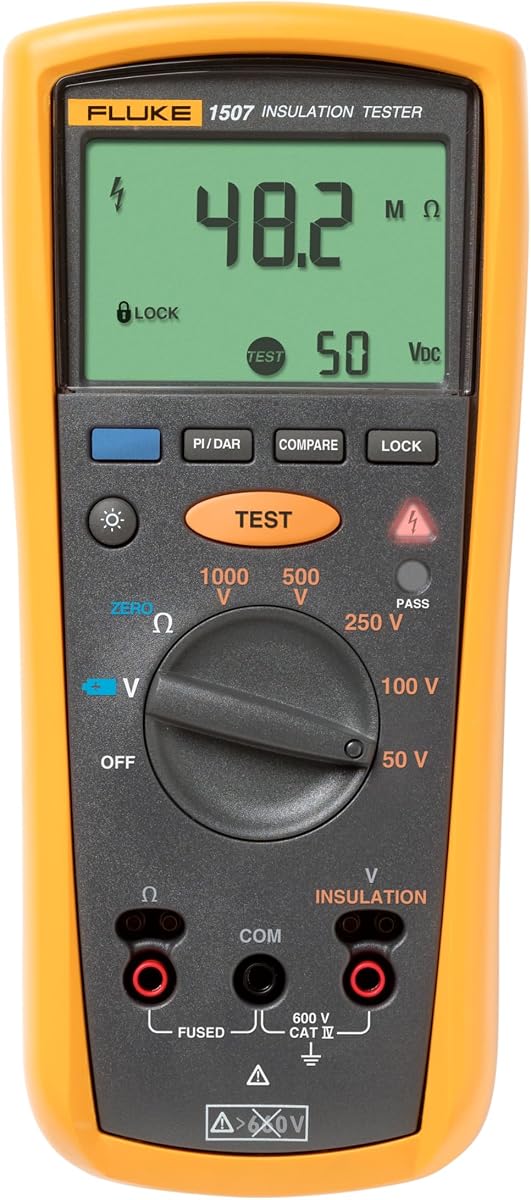
The Fluke 1507 is the premium choice for industrial maintenance, plant electrical work, and quality-controlled inspection programs. Its 4.6 rating reflects a strong user reception, while the most distinguishing feature is the included New NIST-Traceable Calibration Certificate with data, providing documentation that the instrument met the manufacturer’s specifications when shipped.
We may earn a commission when you buy through this link, at no additional cost to you.
It supports 50V, 100V, 250V, 500V, and 1000V test voltages, offering a similar voltage-selection breadth to the leading budget-oriented model. The remote test probe makes repetitive or difficult-to-reach testing more practical by separating probe placement from instrument operation. Live circuit detection prevents an insulation test when voltage greater than 30V is detected, adding a valuable protection layer during real-world diagnostics.
The large backlit display supports clear readings in difficult lighting and established industrial environments. The trade-off is that this level of calibration assurance and specialized construction represents a larger commitment than general-purpose alternatives. The listing also places particular emphasis on advanced industrial and electrical testing rather than presenting the broadest possible collection of secondary meter functions.
The 1507 is best suited to organizations that need documented calibration, dependable low-voltage detection, and a dedicated instrument for demanding insulation work. It is less compelling for a homeowner seeking a simple tester or a technician who mainly wants a combined HVAC multimeter. For professional quality systems, however, the calibration documentation and focused design can justify the premium tier.
The supplied NIST-traceable certificate and associated data create a clear audit trail at acquisition. That is valuable when measurements must satisfy internal quality procedures or support customer and regulatory documentation.
The remote probe simplifies repetitive and hard-to-reach measurements. Live circuit detection further reduces risk by preventing an insulation test when dangerous voltage is present.
We may earn a commission when you buy through this link, at no additional cost to you.
The Supco M500 is a focused, portable insulation tester aimed at technicians who service motors, compressors, and electrical systems. It received a 4.6 rating and offers a straightforward 500V test with a resistance range extending to 1000 megohms. That makes it especially relevant for HVAC diagnostics, including hermetic and inverter compressor assessments.
We may earn a commission when you buy through this link, at no additional cost to you.
Its most user-friendly feature is the combination of a clear LED display and a resistance zone scale. Instead of requiring users to interpret every raw value alone, the instrument presents insulation condition through a visual scale. It supports applications involving appliances, panel boards, relay-control circuits, motors, ground loops, conduit wiring, circuit boards, transformers, pumps, disposals, and damaged wiring.
The handheld, battery-operated format and soft carrying case support field work, and the listing describes the unit as rugged. Batteries are not included, so users should account for that when assembling a kit. Another limitation is the single 500V test output: technicians who require 250V, 100V, 1000V, or lower-voltage testing will need to consider a more versatile instrument.
The M500 is a sensible option for HVAC service professionals whose core need is compressor and motor insulation checks rather than exhaustive electrical measurement. Its straightforward display lowers the learning curve, while the broad motor-oriented use cases give it value beyond residential refrigeration. It is best chosen by users who value specialized simplicity over multimeter integration and selectable test voltages.
The zone scale provides an immediate visual indication of insulation condition. This can speed preliminary diagnosis and make the instrument easier to use when comparing several motors or compressors during a service visit.
The 500V output and 1000MΩ range align well with many motor-winding and compressor checks. The soft case and handheld design help keep the tester practical for mobile HVAC service.
We may earn a commission when you buy through this link, at no additional cost to you.
This M500-compatible insulation tester offers a portable and approachable option for HVAC technicians, electricians, and maintenance personnel. Its 4.5 rating and stated 500VAC insulation test up to 1000 megohms position it as a focused alternative to larger, multifunction instruments. The listing specifically describes compatibility with the Supco M500 format.
We may earn a commission when you buy through this link, at no additional cost to you.
A resistance-range scale gives users direct feedback on whether tested insulation is in good, normal, or at-risk condition. Rather than relying entirely on numeric interpretation, the display areas provide a quicker visual assessment. The enclosure is made from impact-resistant, double-sided ABS intended to withstand accidental impacts, abrasion, and demanding working environments.
The soft portable case adds cushioning during transport, and the simple operation makes the instrument approachable for professional electricians and DIY users. Two 2C batteries are required but not included. Buyers should examine the compatibility claim carefully, especially if they already own a Supco M500 or plan to rely on interchangeable accessories, because the listing does not establish full accessory interchangeability.
This tester is best for users seeking a small, dedicated motor and compressor insulation instrument with straightforward zone-based results. It lacks the wide voltage selection, record storage, and multimeter functions found in higher-feature models. For routine HVAC checks where those conveniences are unnecessary, it can provide a focused and durable tool at a modest purchase commitment.
The handheld body and soft case make storage and transport convenient. Impact-resistant ABS construction is particularly relevant in service vans, mechanical rooms, and other environments where instruments are handled frequently.
Multiple display areas communicate insulation status without demanding constant comparison against a raw resistance scale. This supports faster screening of motors, compressors, and related equipment.
We may earn a commission when you buy through this link, at no additional cost to you.
The M500 Zone-Scale Tester is a compact insulation-resistance option with an unusually explicit description of its visual status thresholds. Its 4.4 rating is the lowest among these products, but the instrument provides useful guidance for HVAC, motor, transformer, panel, and relay-control applications.
We may earn a commission when you buy through this link, at no additional cost to you.
The display uses four visual categories: red for bad insulation below 20MΩ, yellow for caution from 40MΩ through 100MΩ, green for good insulation from 150MΩ through 1000MΩ, and no light for excellent results above 1000MΩ. These thresholds make it easier for users to understand the general condition of the equipment being tested.
Its listed operating range covers 20MΩ to 1000MΩ at a 500VAC test output. The soft carrying case and six-inch embedded test-lead design emphasize portability and reduced setup time. Two 2C batteries are needed and are not included. The specification does not mention a broader resistance measurement function, broader voltage selection, record keeping, or calibration documentation.
This tester is most useful for technicians who want a small, dedicated instrument with clearly defined condition zones rather than a full electrical multimeter. It suits motor winding, compressor, panel, and relay checks, including work in HVAC systems. Buyers needing formal calibration records, multiple test voltages, or storage of measurement histories should select a more advanced model.
The stated red, yellow, green, and unlit categories make the intended reading exceptionally intuitive. This is useful for fast field screening, although final equipment decisions should still follow the applicable test standard.
Embedded six-inch leads and a soft case make the unit simple to deploy and carry. The arrangement is practical for technicians who repeatedly move between service locations.
We may earn a commission when you buy through this link, at no additional cost to you.
The VC60B+ offers selectable 250V, 500V, and 1000V insulation testing in a compact package, with a 4.2 customer rating. Its resistance range extends to 200MΩ, which is narrower than the ranges offered by several higher-ranked products but remains relevant to many motor, cable, and equipment inspections.
We may earn a commission when you buy through this link, at no additional cost to you.
Its most useful workflow feature is the test-button lock. Holding the button is no longer required during long-duration measurements, allowing the operator to maintain stable probe placement. A 1999-count backlit LCD improves visibility, and Data Hold preserves readings outside insulation mode. The meter also measures DC voltage to 1000V, AC voltage to 750V, resistance, and continuity.
Safety communication is unusually prominent. During insulation testing, a red LED illuminates, a high-voltage symbol appears, and the buzzer produces a rhythmic tone. If resistance falls below 5% of the current range or a short circuit occurs, the alarm changes to a continuous sound. The package includes two test leads, two alligator clips, six AA batteries, a detachable neck strap, and a protective cover.
This is a good fit for electricians who regularly test motors and cables and need multiple voltage options without a large feature list. The 200MΩ ceiling and lack of insulation-mode data hold may limit advanced diagnostic work. Nevertheless, the strong warning system, locking control, and complete accessory package make it a capable dedicated insulation tester.
The combined LED, screen symbol, and changing buzzer pattern provide several ways to recognize active test output and abnormal conditions. This layered warning approach is valuable around long cables and capacitive equipment.
The locking test control removes the need to maintain constant finger pressure. It is especially helpful for repeated tests or when probe positioning requires both hands.
We may earn a commission when you buy through this link, at no additional cost to you.
The AIOMEST VC4060B is the strongest integrated electrical tester in this group, combining insulation resistance with a broad True RMS multimeter. Its 4.7 rating places it behind only the Klein ET600 by customer rating. Insulation testing is available at 500V and 1000V, with readings up to 2000MΩ and stated accuracy of plus or minus 4%.
We may earn a commission when you buy through this link, at no additional cost to you.
Beyond insulation work, the meter measures AC and DC voltage, current up to 20A, resistance, continuity, capacitance up to 60mF, inductance up to 60H, frequency, duty cycle, and diode characteristics. A K-type thermocouple supports temperature measurement from -40°C to 1000°C. These additions make it relevant to HVAC systems, motors, pumps, automotive circuits, and control boards.
The large 6000-count backlit display is designed for clarity, and True RMS technology supports measurements on non-linear loads such as motor drives and variable-frequency drives. Safety and convenience features include overload protection, fuses, NCV detection, data hold, relative mode, min/max readings, and auto power-off. The package includes leads, alligator clips, a thermocouple, carrying case, and six AA batteries.
The VC4060B is ideal for technicians who want one instrument to cover insulation, electrical diagnostics, and temperature-related troubleshooting. Its broad functionality can reduce equipment requirements, but the interface may feel more complex than a dedicated megohmmeter. The listing does not mention stored test histories or a calibration certificate, so users with formal traceability needs should verify those points separately.
Capacitance, inductance, current, frequency, duty cycle, and temperature measurements extend well beyond basic insulation screening. The result is a practical all-in-one meter for motor-control and HVAC troubleshooting.
The 6000-count backlit screen provides a detailed view of changing values. True RMS support and NCV detection add useful capability for modern motor drives, power electronics, and service environments.
We may earn a commission when you buy through this link, at no additional cost to you.
This Multimeter Insulation Tester distinguishes itself with selectable output voltages from 250V through 2500V, the widest test-voltage range in this roundup. It received a 4.5 rating and supports insulation resistance measurements from 1MΩ to 200GΩ, combining high measurement capacity with an unusually broad selection of test levels.
We may earn a commission when you buy through this link, at no additional cost to you.
Automatic voltage release is a useful safety-oriented feature, while a high-voltage indication and low-battery warning help operators manage the instrument. The backlit LCD, soft push buttons, and 2000-count maximum display make the unit relatively easy to operate. AC and DC voltage measurements cover 10V to 600V, adding practical electrical troubleshooting capability.
Data hold and storage for up to 100 insulation-resistance values set it apart from simpler meters. Users can browse or delete stored records, making the instrument useful for inspections involving multiple components. Its dustproof and moistureproof construction is advertised for outdoor use, and a zipper storage bag and silicone protective case support transport and handling.
This model is a compelling choice for maintenance teams that need multiple test voltages, very high resistance limits, and stored results. The generic name may make comparison and support less transparent, and no calibration documentation is stated. Nevertheless, for users who routinely document insulation checks across transformers, motors, cables, switches, and appliances, the feature combination is unusually complete.
Five available test levels—250V, 500V, 1000V, 2000V, and 2500V—give users exceptional flexibility. The higher outputs are especially relevant to demanding equipment tests performed under appropriate procedures.
Storage for 100 insulation readings, browse and delete controls, and data hold reduce the need to transcribe every result immediately. This makes the tester useful for repeated preventive-maintenance rounds.
We may earn a commission when you buy through this link, at no additional cost to you.
The UNI-T UT501A offers a straightforward 1000V insulation tester with automatic measurement, AC voltage capability, and a 4.5 customer rating. It is framed as an economical, multifunction option for daily inspection of transformers, electrical machines, cables, switches, appliances, and insulation materials.
We may earn a commission when you buy through this link, at no additional cost to you.
Automatic measurement reduces the number of manual steps, while the LCD backlight improves display visibility. A low-battery indicator, alarm light, and alarm buzzer provide basic operational awareness. The product title also identifies it as a ground-resistance meter, though the supplied description focuses primarily on insulation resistance and AC voltage functions rather than detailing the ground-testing procedure.
The main limitation is that the listing provides limited numerical detail about insulation and ground-resistance ranges. It specifies one insulation test voltage rather than offering the selectable levels found on several competitors. Buyers who need broad resistance limits, multiple test levels, ratio calculations, or recorded results may need a more fully documented instrument.
The UT501A is suitable for routine electrical-equipment inspection and maintenance, particularly for users who value simple operation and audible or visual alerts. It can be a practical addition to a toolkit covering cables, switches, appliances, machines, and transformers. For formal reporting or specialized high-voltage testing, confirm the exact technical specifications and applicable test procedures before relying on it.
Automatic measurement reduces configuration effort, making the instrument approachable for repeated preventive inspections. The backlit display and simple soft-button interface support practical field operation.
An alarm light and buzzer provide immediate status feedback, while the low-battery warning helps prevent interrupted tests. These cues are useful for users who may not be watching the display continuously.
We may earn a commission when you buy through this link, at no additional cost to you.
Choosing an insulation resistance tester requires balancing the equipment being tested, required test voltage, measurement range, safety features, portability, and documentation needs. The following factors help narrow the field before comparing final features and accessories.
Test voltage should match the voltage class of the equipment and the relevant insulation-testing procedure. The selection here includes outputs from 125V to 2500V, with many models offering 500V or 1000V options for common motor and cable work. A higher available voltage is not automatically better, because using an inappropriate level can impose unnecessary stress on insulation or produce misleading comparisons. Low-voltage systems may be assessed at 250V or 500V, while more demanding equipment may be tested at 1000V or above under a defined standard.
Resistance range determines the span of insulation conditions the meter can display clearly. Some models stop at 200MΩ, while others reach 1000MΩ, 2000MΩ, 4000MΩ, 100GΩ, or 200GΩ. A higher range does not automatically produce a better result if its accuracy is unspecified or the display is too coarse, but it does help prevent over-range readings when testing very sound insulation. Consider the highest resistance likely to be encountered and ensure that readings remain informative rather than appearing simply as an over-range indicator.
Basic insulation readings can reveal a fault, while diagnostic ratios such as the polarity index and dielectric absorption ratio provide insight into insulation aging and condition trends. These calculations are most valuable when readings are recorded over time and interpreted alongside temperature and test duration. Data hold, min/max tracking, stored records, and comparison functions can also make preventive-maintenance programs more consistent. Advanced users should determine whether they need raw measurements, calculated ratios, historical storage, or simply a fast pass-or-fail indication.
Insulation testers generate potentially hazardous voltage, so visible and audible warnings are essential. Look for high-voltage indicators, active-test lighting, buzzer patterns, automatic discharge, automatic voltage release, and live-circuit detection. A test-button lock can improve control during long tests, but it should never substitute for confirming that the equipment is isolated. Standards markings such as EN61010-1 and a category rating provide useful context, though users must still select equipment appropriate for the installation and follow site-specific safe-work procedures.
A compact instrument is easier to carry between service calls, while a larger body can provide a bigger display and physical controls. Impact-resistant housings, replaceable leads, protective covers, and carrying cases matter for field durability. Battery format also influences logistics: some models use widely available AA cells, while others require less common C or 2C batteries. Confirm whether batteries and accessories are included, and consider how long a typical inspection day lasts before making a choice based solely on the smallest possible body.
Many insulation testers also measure AC or DC voltage, resistance, and continuity, reducing the need for a separate meter. True RMS capability is valuable when checking nonlinear loads produced by motor drives or power electronics. Some models add capacitance, inductance, frequency, duty cycle, current, diode testing, non-contact voltage detection, and temperature measurement. These extra functions are especially useful for HVAC and motor-service technicians, but they also increase interface complexity. Determine whether the additional measurements correspond to real work requirements rather than simply adding clutter.
Published accuracy specifications are essential when comparing instruments, particularly in the lower resistance ranges where measurement precision matters. Some listings state accuracy, while others provide only the maximum range and test voltage. Formal industrial users should ask about calibration status and traceability. The Fluke 1507 stands apart in this roundup with a stated New NIST-Traceable Calibration Certificate and data. For routine service work, certification may be less critical, but it remains valuable when results must satisfy quality systems, customer requirements, or internal inspection standards.
Digital records can reduce transcription errors and create a more reliable maintenance history. Data hold is helpful for reading a stable value, while internal storage supports comparisons across multiple machines and visits. The Multimeter Insulation Tester in this list stores up to 100 insulation-resistance readings and allows browsing and deletion, while most alternatives emphasize immediate display functions. If your organization requires standardized reports, verify whether the meter exports data, how records are named, and how they connect to a maintenance system before purchasing.
Before testing, identify the equipment, review the applicable insulation-resistance procedure, and select a test voltage appropriate for that system. Check the meter’s battery, inspect the test leads and clips, and verify the instrument’s display and warning functions. Prepare the equipment by disconnecting it from power, removing electronic components that could be damaged by test voltage when required, and discharging or grounding the circuit according to site procedures. Never begin an insulation test on a circuit that has not been properly isolated and verified.
Connect the leads to the specified terminals and run the test for the duration required by the standard or maintenance plan. Keep hands clear of energized conductors and exposed test points, and remain attentive to visual and audible high-voltage warnings. Record the measured resistance, test voltage, duration, and relevant equipment temperature. Do not rely solely on a colored zone when making a maintenance decision; compare results with manufacturer limits, previous readings, and the conditions under which the equipment is operating.
After testing, confirm that the meter has released the test voltage and that any capacitive load has discharged. Use automatic discharge where available, but still allow the specified discharge period and verify the circuit state according to established procedures. Disconnect the probes, return the equipment to its normal configuration, and document any abnormal result. Store the tester in a dry environment, remove batteries during long storage if the manufacturer recommends it, clean the exterior with a dry or lightly damp cloth, and inspect leads and cases for damage.
The appropriate test voltage depends on the motor’s rated voltage and the applicable testing procedure. Low-voltage motors are commonly checked with lower test levels, while higher-voltage equipment may require 500V, 1000V, or another specified level. Always follow the motor manufacturer’s guidance and the relevant standard rather than simply selecting the highest voltage the meter offers.
A high resistance generally indicates sound insulation, but the number must be interpreted in context. Temperature, humidity, test duration, applied voltage, component age, and the equipment’s design all affect readings. Trend data and manufacturer thresholds are generally more informative than a single isolated value.
No. The circuit should be de-energized, isolated, and verified before applying insulation test voltage. Some meters detect live circuits or block testing, but those features are safeguards rather than permission to test energized equipment. Always follow the test lead connections and safe-work procedures specified for the meter.
A standard multimeter measures low resistance, voltage, current, and continuity, while a megohmmeter applies a relatively high test voltage to evaluate insulation resistance. Many modern units combine both functions, but only a model with a specified insulation test output should be used for insulation assessments.
PI and DAR are most useful for preventive maintenance and insulation-aging analysis. They can reveal changes that become clearer when several readings are compared over time. For occasional basic fault checks, a reliable resistance display and appropriate test range may be sufficient, but advanced service teams may prefer the added diagnostics.
Temperature affects the behavior of the insulation material and can influence the measured resistance. Readings taken at different temperatures may not be directly comparable, so consistent temperature conditions and correction methods should be used when monitoring trends. The ambient or winding temperature can be recorded alongside each measurement.
No. The supplied product information differs: several units include AA batteries, while the Supco M500 and compatible M500 listings specify that C or 2C batteries are not included. Check the package contents before ordering and keep a suitable set of batteries with field kits.
Useful accessories include spare test leads, alligator clips, a soft carrying case, and the correct batteries. Some models include a remote or detachable probe, thermocouple, neck strap, or protective cover. Users who often access confined equipment may also consider dedicated probe accessories, provided they are compatible with the manufacturer.
The 50V-1000V combined tester is the most capable budget-oriented selection, offering five test levels, a 100GΩ range, PI and DAR calculations, and automatic discharge. The Klein ET600 is the strongest general-purpose professional choice because it blends four insulation test voltages with a true RMS multimeter, clear warnings, and an easy-to-read backlit interface.
For industrial programs that require documented quality control, the Fluke 1507 leads with its NIST-traceable calibration, remote probe, live-circuit detection, and five test voltages. Below those premium choices, the AIOMEST VC4060B provides the broadest integrated measurement functions, while the Supco M500 and its compatible alternatives focus on straightforward motor and compressor screening.
Before purchasing, verify the test voltage, resistance range, accuracy, included accessories, battery type, safety markings, and calibration documentation against the equipment you regularly inspect. Current product configurations, availability, and prices can change, so checking the latest listing will help ensure that the selected meter fits both the task and the working environment.