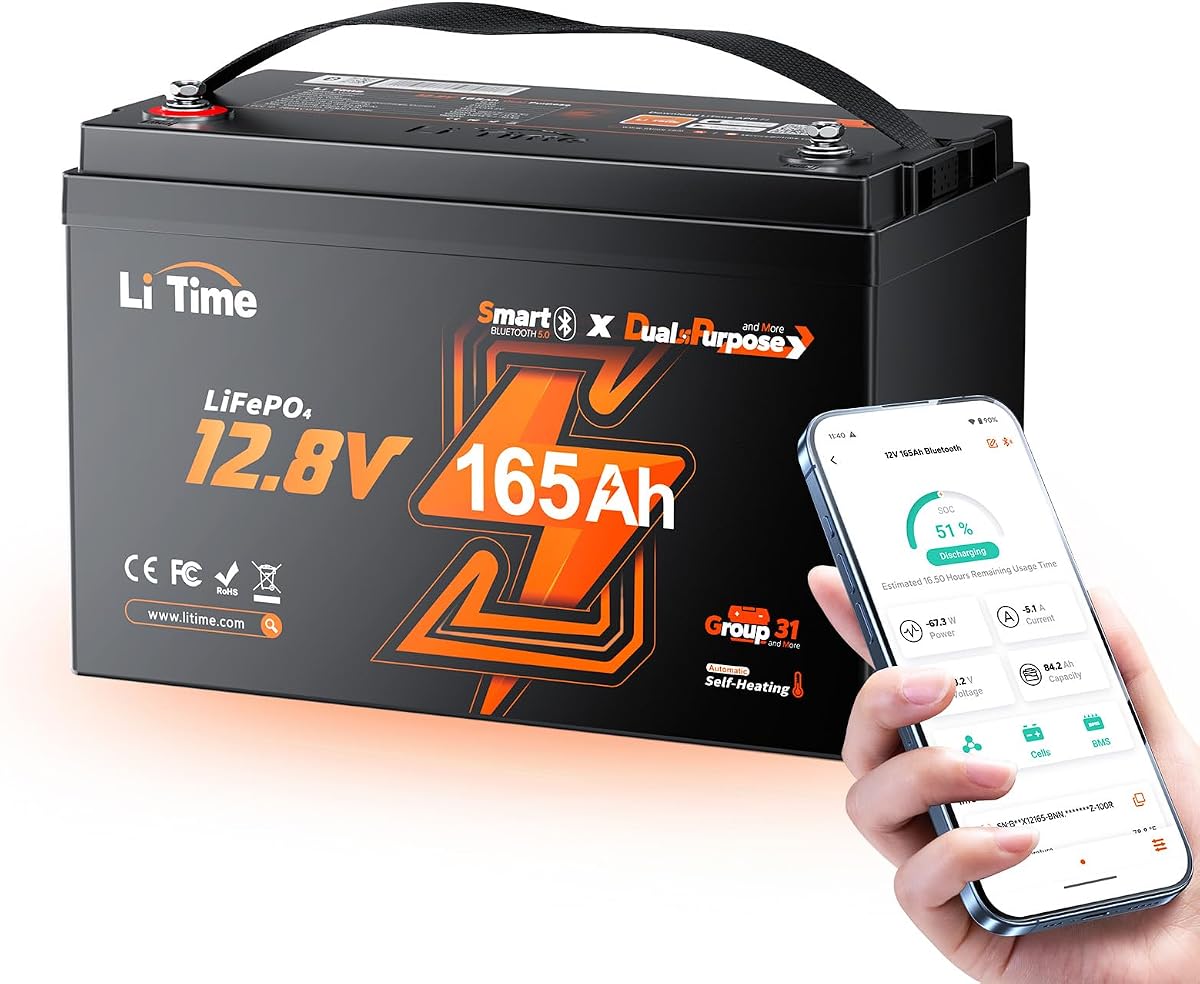
LiTime 12V 165Ah Dual-Purpose Battery
4.5Editor score
Engine cranking and device power
1200 CCA cold-start performance
Automatic emergency reserve cutoff
Built-in low-temperature heating
Compare the best lithium batteries for boats in 2026, including trolling motor options, Bluetooth monitoring, cold-weather protection, capacity, and Group 24
Lithium batteries for boats can deliver dependable power for trolling motors, fish finders, lighting, and onboard electronics while weighing less than flooded, AGM, or SLA alternatives. A good marine lithium battery should combine usable capacity, a robust battery management system, secure Group 24 or Group 31 dimensions, and protection against the moisture, vibration, and temperature changes encountered on the water.
This guide compares ten 12-volt lithium iron phosphate options using the specifications and customer feedback supplied for each product. The evaluation covers deep-cycle performance, low-temperature limits, Bluetooth monitoring, physical dimensions, expansion options, marine protections, warranty coverage, charger compatibility, and whether a model is designed for engine cranking or energy storage alone.
Each review identifies the battery most suitable for a particular boating setup, from lightweight Group 24 installations to expandable trolling motor banks and a dual-purpose starting battery. Ratings and product details reflect the supplied listing information, while prices and promotions can change, so compare current listings, charger requirements, and installation constraints before purchasing.
4.5Editor score

4.7Editor score

4.6Editor score
The table below compares all ten batteries by capacity, physical format, marine features, monitoring, and expansion potential, helping boaters match a battery to their electrical system and available battery compartment.


The SUPER EMPOWER 12V 100Ah LiFePO4 Battery is our top overall choice for boaters seeking a conventional-looking deep-cycle installation with flexible expansion. It carries a 4.6 rating in the supplied data, uses a 12.8V 100Ah configuration, and measures 6.49 by 10.24 by 8.98 inches, allowing it to fit many standard Group 24 battery boxes without modification.
We may earn a commission when you buy through this link, at no additional cost to you.
Its standout feature is the combination of Grade A cells, a 100A battery management system, and a broad set of protections. The BMS addresses overcharging, over-discharging, overcurrent, short circuits, and temperature extremes. Low-temperature controls prevent charging below 32°F and stop discharge at minus 4°F until the battery warms sufficiently, which reduces the risk of damaging a battery during cold-weather storage or use.
The battery supports three practical charging routes: a dedicated 12V lithium charger, lithium-mode solar controllers, and generator charging through a lithium-compatible or DC-DC charger. It can also expand to as many as four batteries in series and four in parallel, producing a 51.2V 400Ah system with 20.48kWh of capacity when configured as listed. Non-lithium chargers are not recommended, so charger compatibility deserves careful attention.
This is a strong recommendation for trolling motor users, anglers with extensive electronics, and offshore cruisers who need house power but not engine starting. The trade-offs are that it is expressly an energy-storage battery, and cold charging requires the appropriate temperature conditions. Install it with a lithium-profile charger, secure the terminals against vibration, and verify cable sizing for the trolling motor and accessory loads.
Matching the listed BCI Group 24 format is a major practical advantage for an upgrade from lead-acid, AGM, or SLA batteries. The stated 21.6-pound weight also makes the unit considerably easier to handle than a comparably sized flooded battery, although physical clearance around the terminals should still be checked.
Supporting 4S4P arrangements gives owners a practical path to more capacity without abandoning the same battery family. The integrated BMS assists with cell balancing and multi-battery operation, though a correctly configured charger and properly rated interconnects remain essential.
We may earn a commission when you buy through this link, at no additional cost to you.
The BUKNUWO 12.8V 100Ah Bluetooth battery is the pick for boaters who want more visibility into battery operation than a basic voltage display can provide. It has a 4.2 rating in the supplied data, offers 1.28kWh of energy, and weighs 22 pounds. Its main attraction is the free iOS and Android application, which connects through Bluetooth 5.0.
We may earn a commission when you buy through this link, at no additional cost to you.
The application displays state of charge, voltage, current, power, temperature, charging or discharging status, and protection status from a stated range of 33 feet. That information is useful when troubleshooting an unexpected load, estimating remaining trolling motor runtime, or determining whether a low-voltage condition is related to the battery rather than the boat's wiring.
A 100A BMS protects against overcharging, over-discharging, short circuits, overheating, and overcurrent. The listed operating ranges allow discharge from minus 4°F to 140°F and optimal charging from 32°F to 113°F. Cycle claims vary with depth of discharge, reaching 15,000 cycles at 60% depth of discharge, 6,000 at 80%, and 4,000 at 100%.
Choose this battery if app-based diagnostics are worth more to you than having the highest customer rating in the roundup. Its ABS casing is described as dustproof, weather-resistant, and lightly waterproof, and it supports up to 4S4P configurations. As with all lithium models, use a compatible charger and periodic charging to avoid damage from prolonged inactivity.
The app turns a sealed battery into a monitored system component, displaying charging status, current, temperature, and protective cutoffs. This is particularly helpful for anglers who need dependable runtime information across a long day on the water.
A stated capacity utilization rate of up to 95% indicates that more of the rated capacity may be accessible than with a typical lead-acid installation. The 1.28kWh figure also makes it easier to compare the battery's nominal energy with the loads on an onboard electrical system.
We may earn a commission when you buy through this link, at no additional cost to you.
The LiTime 12V 100Ah Trolling Motor LiFePO4 Battery is a strong match for anglers who want an energy-storage battery with explicit marine and trolling motor protections. Its 4.7 rating is the second-highest among the reviewed products, and the listing identifies ABYC E-13 compliance alongside safeguards for dust, water, salt spray, overcharging, overheating, and short circuits.
We may earn a commission when you buy through this link, at no additional cost to you.
The most boat-specific feature is the built-in TVS protection for 12V to 36V trolling motors. It is intended to shield the motor from voltage spikes and support steadier output in rough water. The battery weighs 22.16 pounds, which the listing says is 64% lighter than a 12V 100Ah lead-acid battery, reducing the amount of dead weight that must be carried in the boat.
Cold-weather controls stop charging below 32°F and discharge below minus 4°F, helping guard against cold damage. Expansion up to 4P4S creates a 51.2V 400Ah configuration with 20.48kWh of listed capacity, and the battery is rated for more than 4,000 cycles at 100% depth of discharge. It can serve trolling motors, marine electronics, RVs, and energy-storage applications.
This is a compelling choice for a dedicated trolling motor bank, especially when compared with a generic Group 24 lithium battery. It is not intended for starting a boat engine, golf cart, or jack, and its physical Group 31 size may require more space than a Group 24 compartment. Verify dimensions, cable placement, and charger compatibility before installation.
The integrated TVS feature gives this model a more purposeful marine profile than many general-purpose lithium batteries. It is particularly relevant to trolling motors exposed to voltage spikes during acceleration, rough water, and repeated stop-and-start operation.
At a listed 22.16 pounds, the battery is easier to install and removes meaningful weight from a small boat. Faster handling and improved agility matter most in vessels where payload, stability, and the location of the battery compartment are already constrained.
We may earn a commission when you buy through this link, at no additional cost to you.
The DC HOUSE 12V 100Ah Bluetooth LiFePO4 Trolling Motor Lithium Battery combines app-based visibility with a Group 24-like footprint. It holds a 4.5 rating and is designed to fit common installations for RVs, boats, trolling motors, fish finders, solar systems, and other 12V applications without occupying the space of a much larger battery.
We may earn a commission when you buy through this link, at no additional cost to you.
Bluetooth 5.1 links through the DC HOUSE application at a stated range of five to ten meters. The app can display state of charge, voltage, current, cell-specific information, and fault details, while push notifications flag detected abnormalities. This makes the model attractive for troubleshooting electrical systems where a simple voltmeter would not reveal a cell imbalance or unusual operating condition.
Temperature protection cuts charging below 19.4°F and discharge below minus 4°F, with automatic recovery after the battery reaches 32°F. The listing states that the battery uses Grade A cells, has passed UL and UN38.3 testing, and is rated for as many as 15,000 cycles. It supports up to four batteries in series or four in parallel, with eight total, but explicitly rules out 4P4S arrangements.
It is a sensible choice for boaters who want a compact, monitorable battery and a generous stated cycle life. The dimensional exception is important: the battery is described as approximately 0.32 inches taller than the standard Group 24 specification. Measure the compartment and terminal clearance, use a dedicated lithium charger, and confirm the permitted series and parallel arrangement.
The app's cell-specific readings and dedicated fault page can help distinguish a battery problem from a wiring, charger, or accessory-load problem. That makes the monitoring feature more useful than a basic state-of-charge estimate.
The battery can form a larger bank when more energy is required, but its maximum eight-battery configuration differs from many competitors. Buyers should follow the stated series and parallel limits instead of assuming all 4P4S arrangements are permitted.
We may earn a commission when you buy through this link, at no additional cost to you.
The Hey Future 12V 100Ah Bluetooth LiFePO4 Battery is built for boaters replacing a standard Group 24 installation and wanting remote monitoring. It has a 4.4 rating, deep-cycle charging and discharging, and a maintenance-free BMS with protection against overcharging, over-discharging, overcurrent, and overheating.
We may earn a commission when you buy through this link, at no additional cost to you.
Its enclosure is described as dustproof, waterproof, and designed for harsh conditions including sea exposure, rain, humidity, and dust. The listing also emphasizes shock resistance for trolling motor use and says the battery is suitable for boats, yachts, ships, RVs, solar systems, and backup power applications. Bluetooth adds another layer of convenience for checking operating data without a wired meter.
The battery supports up to 4S4P expansion, yielding a listed maximum of 48V and 400Ah. Professional installation is recommended when creating larger banks, and the manufacturer asks users to follow its instructions or contact support. It uses a standard Group 24 design intended to replace lead-acid, AGM, and SLA batteries without complicated rewiring or routine maintenance.
This model is a good candidate for a direct Group 24 upgrade with smartphone monitoring. The key caveat concerns charging: it may not be compatible with some older lead-acid charging systems without an upgrade. Before buying, identify every charger and alternator regulator that may connect to the battery and confirm it has an appropriate lithium charging profile.
A standard Group 24 format can simplify the physical side of a conversion because many existing battery boxes and cable positions are already designed around that footprint. The fit still depends on accurate measurements, terminal orientation, and adequate clearance.
The BMS and enclosure features focus on the moisture, dust, temperature, and vibration challenges that accompany marine use. These protections do not make the battery maintenance-free in every sense; securing it against movement and keeping terminals clean remain good practice.
We may earn a commission when you buy through this link, at no additional cost to you.
The Lithova 12V 100Ah Group 24 is a straightforward choice for boaters who value installation flexibility and established charger compatibility over app-based monitoring. It has a 4.4 rating, weighs 22.57 pounds, and is built to BCI Group 24 dimensions, making it a natural candidate for replacing a lead-acid, AGM, or SLA battery in a compatible compartment.
We may earn a commission when you buy through this link, at no additional cost to you.
Its cycle claims are tailored to different operating depths: more than 4,000 cycles at 100% depth of discharge, 6,000 at 80%, and 15,000 at 60%. The upgraded smart BMS includes cell balancing, overcharge, over-discharge, overcurrent, short-circuit, and cold-weather protections. Unlike several competitors, the battery does not require a Bluetooth connection for operation.
The listing names numerous compatible chargers, including Ionic, Noco Gen Pro, Dual Pro PS/Auto, Minn Kota Precision, Pro Mariner/Pro Tournament Elite, Stealth, Troll Bridge DC, and Power Pole models. This broad list is useful for anglers, but the model still needs a charger with the correct lithium profile. The recommendation is 14.6V charging voltage and a 20A charging current, with roughly five hours for a full charge under the stated conditions.
This battery suits owners who want a familiar Group 24 footprint, large expansion options, and straightforward operation. It can scale from 1.28kWh to a listed 20.48kWh with 16 batteries in a 4P4S configuration. It is not intended for engine startup, and buyers should confirm charger compatibility rather than relying only on the connector.
The long list of supported charger brands is one of this model's strongest practical advantages. It reduces uncertainty when upgrading an existing trolling motor charging setup, although the charger's lithium settings still need to be configured correctly.
Sixteen identical units can be combined in the listed 4P4S arrangement to reach 20.48kWh. That scalability makes the model relevant to larger offshore power systems, although each expansion should follow the manufacturer's wiring and balancing instructions.
We may earn a commission when you buy through this link, at no additional cost to you.
The LiTime 12V 165Ah Dual Purpose Cranking Starting LiFePO4 Battery is the premium pick for boats that want one battery to start an outboard motor and power onboard devices. It has a 4.5 rating, a listed capacity of 2,112Wh, and the ability to deliver 1200 CCA at 14°F and 1300 MCA at 32°F. It is substantially different from the energy-storage-only batteries in this guide.
We may earn a commission when you buy through this link, at no additional cost to you.
Its 2-in-1 design is intended to replace separate starting and house batteries, saving space and simplifying the electrical layout. A 15% emergency reserve automatically interrupts discharge when state of charge approaches that level, preserving power for safe ignition and return. Bluetooth 5.0 monitoring through the LiTime app provides remote status information, discharge control, and real-time alerts.
The automatic heating system activates below 32°F and raises the battery toward 50°F to support charging, while discharge stops at minus 4°F. The listing also states compatibility with many Honda, Suzuki, Evinrude, and Tohatsu outboard motors and cites ABYC E-13-compliant installation. The battery is rated for more than 5,000 cranking cycles and 4,000 deep cycles at 100% depth of discharge.
This is the most specialized choice in the roundup, and it is best suited to compatible outboard boats seeking a combined battery. It is not compatible with LiveScope fish finder chargers, outboard motors lacking voltage regulators, some Mercury Black Max configurations, MerCruiser marine engines, or inboard systems. Confirm the exact motor, regulator, charger, and system compatibility before ordering.
The dual-purpose design can simplify a boat that currently carries separate cranking and deep-cycle batteries. Its 165Ah capacity provides more stored energy than a standard 100Ah model, making it useful for extended runs of electronics, lighting, and household devices.
Automatic heating helps the battery enter a suitable charging temperature in cold weather, while the emergency reserve protects a portion of capacity for starting. The 1200 CCA claim is particularly relevant to cold-start reliability in properly matched outboard systems.
We may earn a commission when you buy through this link, at no additional cost to you.
The MARSENERGY 12V 100Ah LiFePO4 Lithium Battery earns the highest customer rating in this comparison, with a 4.8 score. It weighs 21 pounds and measures 10.16 by 8.46 by 6.54 inches, meeting the listed BCI Group 24 standard. That combination of strong feedback, low weight, and a familiar size makes it a strong general-purpose marine energy-storage option.
We may earn a commission when you buy through this link, at no additional cost to you.
Cycle claims are tiered by depth of discharge: 4,500 cycles at 100%, 8,000 at 80%, and 15,000 at 60%. The battery uses A-grade cells with low-temperature additives and a 100A BMS. It is described as waterproof and robust, while the BMS interrupts power during conditions such as short circuits, overvoltage, and abnormal temperature.
A Group 24 installation should be straightforward for many boats because existing Group 24 battery boxes can often be reused, while larger Group 27 or Group 31 compartments may also accommodate it. The battery also retains a standard Group 24 terminal arrangement, helping simplify replacement over AGM, SLA, or conventional lead-acid installations.
The most important operational caveat is that a battery placed into sleep mode must be activated before use, with the process explained in the manual or through support. Charging is also restricted below 32°F and discharge below minus 4°F. For owners seeking a high-cycle Group 24 battery without Bluetooth complexity, this is a highly rated option.
The battery's cycle ratings adapt to the depth at which it is regularly discharged. Fishing boats that use a moderate portion of capacity may receive a substantially higher stated cycle count than owners who routinely drain the battery to 100% depth of discharge.
At a listed 21 pounds, the MARSENERGY unit is among the lighter options in the guide while retaining a standard Group 24 format. This makes it attractive for smaller boats where every pound affects handling and where battery-box replacement is inconvenient.
We may earn a commission when you buy through this link, at no additional cost to you.
The Power Queen 12V 100Ah Group 31 LiFePO4 Lithium Battery is a solid option for cruisers, pontoon boats, and RVs that have room for a Group 31 installation. It has a 4.6 rating, weighs 24 pounds, and uses a 100A BMS with protection against overcharge, over-discharge, short circuits, and overheating.
We may earn a commission when you buy through this link, at no additional cost to you.
Grade A cells are intended to provide stable voltage and consistent power, while the battery's low weight makes installation and repositioning more manageable. Its Group 31 format offers more room in the battery compartment than a Group 24 design, and the listing identifies trolling motors weighing approximately 30 to 70 pounds as suitable applications.
The battery can be expanded through 4S4P arrangements to a 51.2V 400Ah configuration with 20.48kWh of capacity. That flexibility supports larger RV, marine, or home backup systems, provided the charger, interconnects, and BMS configuration are correctly matched. Low self-discharge is listed at 3%, which helps during periods when the boat is not in active use.
Choose this model for a straightforward Group 31 deep-cycle installation with no need for smartphone telemetry. Its strengths are stable output, protective electronics, and manageable weight. Verify the compartment dimensions, confirm that the charging system supports lithium batteries, and use the correct series and parallel arrangement when building a larger bank.
Grade A cells and a 100A BMS create a solid foundation for electronics, trolling motors, and onboard loads. Consistent voltage is especially useful for fish finders, lighting, pumps, and other systems that benefit from steadier power delivery.
The stated 4S4P support allows the battery family to scale as energy needs grow. An installer should confirm cable ratings, fusing, charger voltage, and cell balancing rather than assuming any similar-looking lithium battery can be added to the bank.
We may earn a commission when you buy through this link, at no additional cost to you.
The Power Queen 12V 100Ah Trolling Motor LiFePO4 Battery is tailored to larger trolling motor setups and marine systems. It carries a 4.4 rating, weighs 22.16 pounds, and is designed for motors up to 120 pounds of thrust. Its built-in TVS surge protector is intended to reduce voltage spikes affecting 12V to 36V motors.
We may earn a commission when you buy through this link, at no additional cost to you.
ABYC E-13 compliance and a triple-protected BMS provide a strong marine feature set, including protection from dust, water, salt spray, overcharging, overheating, and short circuits. The listing also describes low-temperature controls that stop charging below 32°F and discharge below minus 4°F, helping protect the battery when conditions become harsh.
The Group 31 format and light weight are practical for boats with enough space to house the battery while limiting added dead weight. The battery supports 4P4S expansion, creating a listed 51.2V 400Ah and 20.48kWh system, and is rated for more than 4,000 cycles at 100% depth of discharge.
This is a good fit for an angler using a high-thrust trolling motor or maintaining a larger onboard battery bank. The trade-offs are the need for adequate Group 31 clearance and strict attention to cold-weather charging restrictions. It is designed for marine energy use rather than engine starting, so it should not replace a dedicated cranking battery.
The stated support for motors up to 120 pounds of thrust and integrated TVS circuitry make this model more relevant to serious trolling applications than a basic house battery. Motor-controller compatibility and proper cable protection remain necessary for safe operation.
ABYC E-13 compliance and triple BMS protection address the salt, spray, dust, and water exposure associated with marine installations. The low listed weight also helps owners handle the battery during installation and battery changes.
We may earn a commission when you buy through this link, at no additional cost to you.
Selecting a marine lithium battery requires balancing usable capacity, physical fit, charger compatibility, environmental protections, and the specific loads on the boat. These factors are more important than headline cycle counts because a perfectly rated battery is only useful when it safely fits and operates with the rest of the electrical system.
First determine whether the battery is expected to run electronics and a trolling motor or also start an outboard engine. Most 100Ah options in this guide are explicitly energy-storage batteries and should not be used for cranking. The LiTime 165Ah dual-purpose model is the exception, offering starting power, emergency reserve, and onboard-device support for compatible outboard systems.
Choose energy storage for trolling motors and house loads. Choose cranking capability for a compatible outboard. Never substitute a deep-cycle battery for a starting requirement.
A 12V 100Ah battery provides approximately 1.28kWh of nominal energy, while the 165Ah dual-purpose model is listed at 2,112Wh. Compare that stored energy with the combined draw from the trolling motor, fish finders, navigation electronics, lighting, refrigeration, pumps, and inverter loads. Higher capacity does not automatically mean higher output, so verify continuous and surge power requirements as well.
Calculate expected runtime from usable energy and average load. Keep a reserve when possible, especially for electronics safety and return navigation.
Measure the battery compartment before purchasing, including height above the tray, terminal clearance, cable reach, and access to the hold-down bracket. Several Group 24 models claim to fit existing boxes, but one Group 24-like product is described as slightly taller than the standard specification. Group 31 models need more room but may suit larger boats and trolling motor installations.
Match the case dimensions rather than relying on the group label. Confirm polarity, terminal type, and physical clearance before buying.
Most products suspend charging below 32°F, and many stop discharge around minus 4°F. This protection prevents cold damage but can leave a boater with a battery that will not recharge promptly after a cold trip. The dual-purpose LiTime model adds automatic heating to bring the battery toward a more suitable charging temperature. If the boat operates in freezing conditions, account for charging interruptions and carry a recovery plan.
Check both charging and discharge cutoffs. Heating is not a substitute for choosing a charger with a cold-weather strategy.
ABYC E-13 compliance, salt-spray protection, and a built-in TVS device are more relevant to a trolling motor battery than generic claims about waterproofing. A TVS can help shield electronics from voltage spikes, while a robust BMS manages charging, current, and temperature. The LiTime and Power Queen trolling motor models stand out for explicit marine protections, including support for motors with higher thrust ratings.
Prioritize listed marine standards and motor-specific safeguards. Verify that any surge protection is compatible with the motor controller.
A lithium battery generally requires a charger with a lithium charge profile, including the correct absorption voltage and charge current. Some boats also use an alternator or DC-DC charger, and an older lead-acid system may require replacement or adjustment. The Lithova model lists broad charger compatibility, while several other manufacturers specifically recommend dedicated lithium chargers. Review every possible charging path before installation.
Do not connect an unspecified lead-acid charger to a lithium battery. Confirm the charger, alternator regulator, and DC-DC equipment first.
Bluetooth monitoring is useful when the battery is installed out of sight. The BUKNUWO, DC HOUSE, Hey Future, and dual-purpose LiTime models offer app-based telemetry, with individual systems tracking items such as state of charge, voltage, current, temperature, and protection status. This can simplify troubleshooting and help estimate remaining runtime, but it is an optional convenience rather than a substitute for sound electrical design.
Choose monitoring if it improves your diagnostic workflow. Confirm the app, phone compatibility, and stated wireless range.
Most batteries support series and parallel expansion, but the permitted combinations differ. DC HOUSE allows up to eight batteries in total and specifically prohibits 4P4S, while most competitors permit a four-by-four arrangement. Warranty coverage ranges from three years for DC HOUSE to five years for several other brands, with longer stated service-life figures. Review the warranty terms, battery matching requirements, and technical support availability before expanding a bank.
Choose expansion limits that suit your boat now and in the future. Use matched batteries, proper fusing, and manufacturer-approved wiring methods.
Before installation, identify the battery's positive and negative terminals, disconnect the boat's existing power source, and make sure the charger and alternator regulator support lithium chemistry. Hold the battery upright, secure it firmly against vibration, and use cables and lugs sized for both the battery's maximum current and the loads connected to it. Protect exposed terminals from accidental contact with tools and metal objects.
Charge the battery with a compatible lithium-profile charger and observe the stated charging voltage and current recommendations. Most models suspend charging below 32°F, so do not attempt to bypass a cold-temperature cutoff. Check the app or meter for state of charge, voltage, current, temperature, and fault messages when the battery supports monitoring. Periodic charging is also advised for models that are stored for long periods.
During use, keep the battery within its intended depth-of-discharge range when practical and avoid leaving critical electronics without a reserve. Clean salt and moisture from the enclosure and terminals, inspect the hold-down hardware for looseness, and look for swelling, heat, damaged cables, or unusual odor. If the BMS places the battery into sleep mode or a protective state, follow the manufacturer's activation or troubleshooting instructions before reconnecting significant loads.
Yes, if the battery's current rating, capacity, and connector configuration are appropriate for the motor and its controller. A 100Ah LiFePO4 battery is a common deep-cycle choice for trolling motors, but you should still verify charger compatibility and cable size. Boats with very high-thrust motors may need a larger or more specialized bank.
Lithium iron phosphate batteries have a strong safety record when properly installed and charged, and the products here include battery management systems with overcharge, overcurrent, short-circuit, and temperature protections. Marine-rated models add dust, water, and salt-spray protection. Safe operation still depends on secure mounting, clean terminals, suitable wiring, and a compatible charger.
Often yes, provided the lithium battery fits the compartment and the charging system supports lithium chemistry. The physical group size may match, but dimensions, weight, terminal position, and cold-weather behavior still need checking. Older lead-acid chargers and some unregulated charging circuits may require replacement or modification.
Most of these batteries suspend charging below 32°F because charging a cold lithium cell can cause plating or other damage. Some models also stop discharge at very low temperatures. The dual-purpose LiTime includes automatic heating, while other batteries should be allowed to warm naturally in a safe, moderate environment.
It is not essential for basic operation, but it can make troubleshooting easier by showing state of charge, current, temperature, and fault status. Models with Bluetooth are particularly useful in enclosed compartments where a physical meter is inconvenient. A conventional voltmeter and correctly sized charger can still support a non-Bluetooth installation.
Yes, but only in configurations allowed by the manufacturer. Most products support up to 4S4P, while DC HOUSE permits up to eight batteries total and prohibits 4P4S. Series connections increase voltage, parallel connections increase capacity, and mixed arrangements require compatible batteries, proper fusing, correct interconnects, and an appropriately configured charger.
Most 100Ah batteries in this roundup are designed only for energy storage and explicitly exclude cranking. The LiTime 12V 165Ah dual-purpose model is designed for compatible outboard engines and provides 1200 CCA at 14°F. It has specific exclusions, so verify the motor, voltage regulator, charger, and system type before using it as a starting battery.
Store it in a secure, dry location within the manufacturer's temperature range, away from combustible materials, and prevent it from discharging deeply. Periodic charging is recommended for the BUKNUWO model and is sensible practice for maintaining battery condition. Before returning the boat to use, inspect the battery, verify its state of charge, and confirm that the charger is lithium-compatible.
The LiTime 12V 100Ah Trolling Motor Battery stands out as the most compelling all-around marine energy-storage choice because it combines a 4.7 rating, ABYC E-13 compliance, built-in trolling motor surge protection, low-temperature controls, and expandable capacity. The MARSENERGY 12V 100Ah is an excellent high-cycle Group 24 alternative, while the SUPER EMPOWER model provides another well-balanced Group 24 option.
For boaters with a compatible outboard engine, the LiTime 12V 165Ah dual-purpose battery is the standout premium choice because it combines cranking power, house power, cold-weather heating, monitoring, and an emergency reserve. Otherwise, prioritize the correct group size, charger compatibility, required continuous current, marine protections, and expansion rules over cycle claims alone.
Finally, check the current listing and latest product documentation before ordering, because prices, promotions, firmware, warranty terms, and availability can change. Measure the compartment, confirm the charging system, match the battery to the motor and accessory loads, and use a secure, well-ventilated installation that allows the BMS to perform its protective functions.