
Seulliya Lightning to 3.5 mm AUX Cable
4.3Editor score
Apple MFi certified
Built-in DAC chip
15,000-plus bend lifespan
Our expert Lightning Auxiliary Audio Cable guide compares 10 MFi-certified and multi-device options for iPhone, car stereos, speakers, and headphones today.
A Lightning auxiliary audio cable provides a convenient wired connection between compatible Apple devices and car stereos, speakers, headphones, home audio systems, and other equipment with a 3.5 mm audio jack. The right cable depends on connector compatibility, sound quality, length, flexibility, and whether Apple MFi certification matters for your devices.
We compared all ten products using the specifications and feature descriptions provided for each listing. The list covers dedicated Lightning cables, a longer JSAUX option, multipack choices, and a versatile two-in-one design with both Lightning and USB-C connectors, while paying close attention to DAC support, durability claims, and known limitations.
Each review explains what distinguishes its cable from the alternatives and identifies the situations in which it makes the most sense. The top picks represent the strongest choices for value, overall versatility, and premium construction, while product availability, compatibility details, and commercial terms may change over time.
4.3Editor score
4.4Editor score

4.5Editor score
The table below compares connector coverage, cable length, construction, certification, and sound-related features across all ten cables, making it easier to identify the option that best fits your devices and listening setup.


This Seulliya cable combines an Apple MFi-certified Lightning connector with a 3.5 mm plug, making it a practical wired option for compatible iPhones, iPads, and iPod touch devices. Its listed customer rating is 4.3, and the strongest selling points are straightforward setup, a built-in DAC, a flexible 3.3-foot cable, and certification intended to avoid compatibility warning messages.
We may earn a commission when you buy through this link, at no additional cost to you.
The advanced digital-to-analog converter is designed to preserve the audio signal while reducing the chance of unwanted noise, and the high-purity copper conductors support stable transmission. You can connect the cable to a car stereo, home audio system, portable speaker, wired headphones, computer speakers, or another device with a standard 3.5 mm input. Its plug-and-play design requires no driver, adapter, or separate power supply.
Durability is another meaningful strength. The listing states that the soft TPE construction withstands more than 15,000 bends and is designed to resist twisting, knotting, and kinking. The 3.3-foot length is convenient for most car interiors and nearby home speakers, although it may be less useful when the audio device sits farther from the phone. The principal limitation is clear: it does not work with USB-C or Micro-USB ports.
This is the best budget-oriented choice for a buyer who wants dependable MFi certification and useful audio features without moving to a more elaborate design. It is especially suitable for an older or current Lightning-equipped iPhone used in a car. Before buying, confirm that the phone or tablet has a Lightning port and that the destination uses a 3.5 mm auxiliary input rather than a USB-based connection.
The integrated DAC is the feature that sets this cable above a basic passive adapter in the provided specifications. It is intended to decode the phone's digital audio into a stable analog signal for the connected stereo or speaker, while the copper wiring supports consistent sound delivery.
The 3.3-foot TPE cable is short enough to stay organized in a center console while providing enough reach for common dashboard and seat arrangements. Its bend-resistant construction is particularly relevant when the connector is inserted and removed frequently.
We may earn a commission when you buy through this link, at no additional cost to you.
This Seulliya 3.3-foot cable provides a direct Lightning-to-3.5 mm connection with Apple MFi certification and a listed rating of 4.1. It is designed for a broad range of compatible Apple hardware, including numerous iPhone generations, iPod touch models, and several iPad families. The gold-plated contacts are intended to support clean stereo transmission and dependable contact.
We may earn a commission when you buy through this link, at no additional cost to you.
One of its most useful attributes is broad support for both regular and recessed 3.5 mm ports. That matters because some car stereos place their auxiliary input in a recessed dashboard or console area, where a bulky plug can be difficult to connect. The cable can also feed car stereos, home systems, Bluetooth speakers, wired headphones, hi-fi equipment, and computer audio systems without requiring a separate driver.
The soft, resilient jacket is listed as capable of more than 15,000 bends and is designed to resist snagging, creasing, and tangling. The included 3.3-foot length is a familiar middle ground for portable use. Compared with the first Seulliya option, however, this listing emphasizes gold plating and broad jack compatibility rather than a built-in DAC, so buyers prioritizing digital conversion may favor the other model.
This cable is a sensible selection for owners of Lightning iPhones who want MFi certification, compact proportions, and broad compatibility with different audio jacks. It is less suitable for USB-C Android devices, USB-C iPads, and newer Apple hardware without a Lightning port. Confirm the device connector and the type of auxiliary input before ordering.
Compatibility with regular and recessed 3.5 mm sockets makes this cable practical across a wider range of car stereos and portable speakers. That physical fit can matter as much as electrical compatibility when the socket is mounted inside a narrow dashboard opening.
The MFi-certified connector gives the cable a strong compatibility argument for iPhone 7 through iPhone 14 families and compatible iPads. It is particularly useful for owners who want a direct cable rather than an adapter that could add another connection point.
We may earn a commission when you buy through this link, at no additional cost to you.
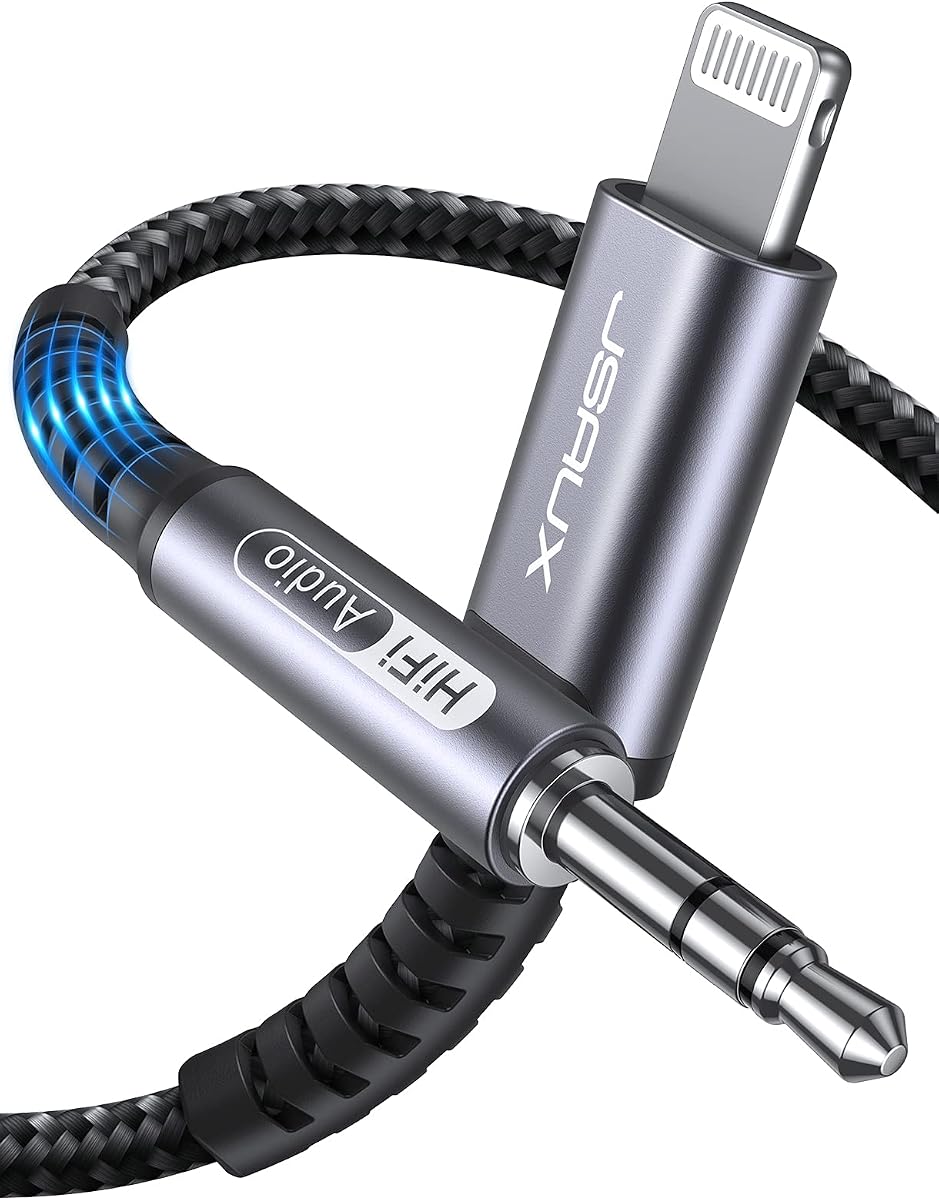
The JSAUX six-foot cable is the strongest all-around option in this group because it combines a generous cable length with MFi certification, a built-in DAC, and a durable braided construction. Its listed rating is 4.4. The extra length distinguishes it from most competing products, making it better suited to reaching a car stereo, a home stereo positioned away from a sofa, or larger audio systems.
We may earn a commission when you buy through this link, at no additional cost to you.
The built-in DAC noise-reduction chip supports audio up to 24-bit/96 kHz according to the supplied product information. The nylon-braided cable and reinforced strain-relief design are stated to withstand more than 15,000 bends, while the aluminum alloy housing adds protection around the connection point. This construction is well suited to a cable that will be routed around dashboards, entertainment centers, and desktop equipment.
Compatibility covers most Lightning-era Apple devices, including iPhone 14 and 13 families, sixth-generation iPod touch, and iPad Mini, Air, and Pro models. The listing specifically excludes AirPods Max and Beats Solo Pro, which use wireless audio designs rather than a conventional 3.5 mm connection. As with the other dedicated Lightning cables, it also cannot serve USB-C-only devices.
Choose this product when cable reach, certification, and audio conversion all matter. It is a particularly good match for drivers who have their phone in a console or passenger seat and need a longer run to the stereo, as well as home listeners whose equipment is not beside them. It remains one of the most complete choices here for Lightning users, and the extra length is the feature most likely to improve daily convenience.
The six-foot length solves many awkward routing problems without requiring a male-to-male extension. It can reach across a larger dashboard, a spacious center console, or a home entertainment cabinet while still retaining direct plug-and-play operation.
The listed support for 24-bit/96 kHz audio distinguishes this cable from many simpler alternatives. Its DAC is intended to reduce noise and maintain a stable signal, which can be beneficial when driving a capable stereo or hi-fi system.
We may earn a commission when you buy through this link, at no additional cost to you.
The Haoano package includes two three-foot Lightning-to-3.5 mm cables, one black and one white, making it a convenient choice for households, offices, or anyone who wants a spare. The listed rating is 4.4, and the set combines MFi certification with a DAC chip, 24K gold-plated contacts, and a soft nylon-braided body rated for more than 15,000 bends.
We may earn a commission when you buy through this link, at no additional cost to you.
Its compatibility list is broad for a Lightning product, covering iPhone 14 through iPhone 7 variants, several iPad generations, and both regular and recessed 3.5 mm audio jacks. The two cables can remain in separate vehicles, rooms, or bags, reducing the need to unplug and move one cable throughout the day. It also works with car stereos, headphones, computer audio, portable speakers, and other standard 3.5 mm inputs.
There are important functional limitations. The product information states that the connection cannot work in both directions, does not support phone calls or music controls, and is not compatible with AirPods Max. Some USB-C-equipped iPads, including the listed 10th-generation iPad and 11-inch fourth-generation iPad Pro, also require a different USB-C-to-3.5 mm cable.
This multipack is most attractive to buyers who value convenience and shared access over remote-control functionality. The extra cable can be particularly helpful in a two-car household or for keeping one at home and another at work. Ensure your device uses Lightning and that you only need music playback through the 3.5 mm connection; otherwise, a model with broader control support may serve better.
The black-and-white set removes the inconvenience of identifying a cable by sight alone. It is easy to assign one cable to a vehicle, office, or travel bag and keep the other as a dedicated home connection.
The absence of call and music-control support is significant for some users. Treat this as an audio-output cable for listening rather than a general-purpose control cable, and check any iPad model against the listed exclusions.
We may earn a commission when you buy through this link, at no additional cost to you.
This two-in-one cable is the most broadly connected product in the guide, combining Lightning and USB-C options with a 3.5 mm auxiliary plug. Its listed rating is 4.4. That design is unusual because it can serve an extensive range of Apple, Samsung, and Google devices without requiring separate cables for each connector standard.
We may earn a commission when you buy through this link, at no additional cost to you.
The supplied compatibility information includes iPhone 17 through many older Lightning models, sixth-generation iPod touch, and several iPad families. It also names Samsung Galaxy S24, S23, and S22 devices and Pixel 8, 7, and 6 models. The four-foot cable provides more reach than the common three-foot design, while the polished metal plug, gold-plated audio conductor, and soft anti-winding jacket are intended to withstand regular use.
The product description highlights state-of-the-art chips, pure copper wiring, and a construction tested for more than 20,000 bends. It plugs directly into headphones, speakers, home audio, or a vehicle stereo without an external power supply. It also includes a 12-month warranty and 24-hour customer-service commitment according to the listing, adding useful support information for a product that spans several device categories.
This is the strongest option for a mixed-device household or a traveler who alternates between an iPhone, a current Android phone, and a compatible iPad. The tradeoff is that the listing does not identify the cable as Apple MFi certified, and even its broad compatibility list cannot guarantee support for every current or future model. Confirm your exact device and connector before purchasing.
The dual Lightning and USB-C design eliminates the need to carry separate auxiliary cables for Apple and Android devices. It is especially convenient for shared vehicles, offices, and travel kits where several people may connect different devices.
A four-foot lead gives more freedom than a three-foot cable when the connected phone is not positioned immediately beside the stereo. It remains compact enough for most cars while reducing tension on the auxiliary plug.
We may earn a commission when you buy through this link, at no additional cost to you.
This three-foot MFi-certified cable is a flexible middle-ground option for connecting Lightning iPhones and iPads to car stereos, home systems, speakers, and compatible wired headphones. Its listed rating is 4.2. The product description emphasizes broad iOS support, including older versions through iOS 16 and later, making it useful for devices that have not been updated recently.
We may earn a commission when you buy through this link, at no additional cost to you.
A built-in DAC is paired with 100 percent copper wire in the supplied specifications, with the goal of stable, high-fidelity stereo output and lower distortion. The 3.5 mm connector uses nickel plating, while the cable uses a textured aluminum head and premium nylon braid. These details suggest a product designed to withstand repeated connector use while remaining flexible enough to store in a console or beside a home system.
The cable works with 3.5 mm headphones from brands such as Beats, Bose, Sony, and Audio-Technica, as well as many car and home stereo inputs. It needs no driver, external power, or separate Lightning adapter. The listing also states that it will not damage the iPhone, although buyers should still insert and remove connectors gently and avoid sharply bending the cable at either plug.
This is a well-rounded option when three feet is sufficient and you want the reassurance of MFi certification without moving to the six-foot JSAUX design. It works especially well for a phone mounted near the stereo or a portable speaker beside a desk. Its main limitations are the shorter reach and lack of USB-C support, so buyers should consider both their connector type and the distance between devices.
The listed 100 percent copper core and integrated DAC are designed to deliver a consistent analog signal with reduced distortion. That combination is useful for car listening, where road vibration and a changing connection can make a less robust cable more noticeable.
Because the 3.5 mm end is designed for conventional wired headphones, the cable can also serve as a simple audio link for compatible models from several established headphone brands. It does not provide the wireless functionality of Bluetooth-only or AirPods Max-style products.
We may earn a commission when you buy through this link, at no additional cost to you.
This two-pack gives buyers two 3.3-foot Lightning-to-3.5 mm cables, one white and one black, with a listed rating of 4.4. The construction combines a certified chip, MFi certification, aluminum housing, and a nylon-braided exterior. Its stated resistance to more than 20,000 bend tests is among the strongest durability figures in this guide.
We may earn a commission when you buy through this link, at no additional cost to you.
The compatibility list includes iPhone 14, 13, 12, 11, X, XS, XR, 8, and 7 families, multiple iPad models, several iPod touch generations, and iPod nano models. The 3.5 mm end can connect to car stereos, speakers, wired headphones, hi-fi equipment, and other devices with a standard auxiliary input. Keeping one cable in each of two locations is easy and avoids repeated unplugging.
The main functional limitation is that the product does not support phone calls or charging. It is therefore an audio-playback accessory rather than a complete phone connection. The listing also describes a certified chip that is intended to support stable contact and lossless transmission, while the aluminum and braid are intended to protect the internal conductors from everyday flexing.
This multipack is a good choice for couples, families, or people who travel between a car and a home setup. It offers a generous bend rating, a moderate length, and MFi certification without requiring a specialized dual-connector design. It is less appropriate for users who expect to handle calls through the wired connection or charge a device, and it remains limited to Lightning-equipped hardware.
The included black and white cords can be deployed separately in two vehicles, rooms, or work locations. This is more convenient than continually removing a single cable and is especially helpful for people who alternate between driving and desk-based listening.
The listed 20,000-plus bend-test figure indicates an emphasis on connector longevity. While real-world results can vary, the stated testing and braided exterior make this a credible pick for frequent insertions, removals, and storage in crowded bags.
We may earn a commission when you buy through this link, at no additional cost to you.
This JSAUX cable combines MFi certification, a 3.3-foot braided body, and a built-in DAC in a compact package. Its listed rating of 4.5 is among the strongest in the guide. The product information highlights Apple original terminals and a smart chip designed to provide a secure connection without the warning message some uncertified accessories can trigger.
We may earn a commission when you buy through this link, at no additional cost to you.
Its DAC noise-reduction chip is stated to support audio up to 24-bit/96 kHz, compared with 16-bit/48 kHz support common among simpler cables. A special strain-relief design is tested for more than 15,000 bends, and the aluminum housing and premium nylon braid add protection. The cable can connect Apple devices to car stereos, home stereos, portable speakers, headphones, hi-fi equipment, and computers with 3.5 mm inputs.
The compatibility list covers many iPhone 14 through 7 variants, sixth-generation iPod touch, and iPad Mini, Air, and Pro families. It also lists exclusions that deserve attention: AirPods Max, Beats Solo Pro, the 2018 12.9-inch iPad Pro, the 11-inch iPad Pro, and the fourth-generation iPad Air are not supported. Those limitations are consistent with connector or audio-interface differences rather than a defect.
This JSAUX model is a refined choice for buyers who want a shorter cable than the six-foot version but still prioritize MFi certification and high-resolution audio claims. It is well suited to portable use, jogging, fitness, travel, and ordinary car listening. Confirm that your exact iPad or other device appears in the compatibility list, especially if you own a newer USB-C model.
The compact three-point-three-foot length is easy to carry in a pocket or small bag, while the high-resolution DAC provides a strong technical specification for compatible audio systems. It offers a practical balance between reach and portability.
The listed strain-relief system focuses stress away from the most vulnerable section of the cable. Combined with the aluminum housing, it is designed to withstand the repeated bending that occurs when a cable is stored tightly or connected in a cramped vehicle console.
We may earn a commission when you buy through this link, at no additional cost to you.
The Syncwire cable earns the highest listed customer rating in the guide at 4.6 and offers a particularly clear approach to MFi verification. Its model number is identified as SW-SC635, allowing buyers to search for the associated information on Apple's MFi page. That transparency adds confidence for a product whose main purpose is reliable connection to Apple hardware.
We may earn a commission when you buy through this link, at no additional cost to you.
The construction uses flexible carbon nylon and an aluminum metal housing. A special strain-relief design is stated to withstand more than 15,000 bends, while the braided jacket is intended to resist winding, knotting, and kinking. The 3.3-foot length is suitable for a car stereo, nearby speaker, or home audio setup without adding excess cable to a bag.
The compatibility list spans iPhone 14 through 7 variants, sixth-generation iPod touch, and iPad Mini, Air, and Pro families. The product is not compatible with AirPods Max or USB-C-interface iPads such as the 2018 12.9-inch iPad Pro and 11-inch iPad Pro. It is designed for a conventional 3.5 mm input and therefore also does not apply to modern USB-C car systems.
This Syncwire model is ideal for buyers who prioritize certification transparency, lightweight construction, and a high customer rating. It is a confident choice for Lightning iPhones used in a vehicle or at home. The exclusions are predictable, but they should be checked carefully if your audio setup involves a USB-C iPad or newer digital-only vehicle interface.
Providing the model number SW-SC635 makes it possible to look up the cable's MFi information independently. This is a useful advantage over relying only on a general certification statement, especially for buyers who want greater confidence in accessory compatibility.
Carbon nylon and aluminum keep the cable light enough for daily carrying while protecting the internal wiring. The listed strain-relief design targets the connector areas, where auxiliary cables commonly develop problems after repeated bending.
We may earn a commission when you buy through this link, at no additional cost to you.
The UGREEN cable stands out for a premium focus on shielding, connector finish, and housing construction. Its listed rating is 4.5, and the product description highlights dual shielding as a method of reducing signal loss and noise. The 3.5 mm connector is nickel plated for corrosion resistance, while the cable itself uses a braided exterior designed to protect the inner conductor.
We may earn a commission when you buy through this link, at no additional cost to you.
Scratch-resistant aluminum housing surrounds the connection point and is also described as helping dissipate heat. Those details are especially relevant for a car cable, where sunlight, temperature changes, and repeated handling can age exposed components. MFi certification provides the primary compatibility assurance for compatible iPhone, iPad, and iPod touch devices.
The cable supports a broad range of uses, including car stereos, home stereos, portable speakers, wired headphones, hi-fi equipment, and computers with a 3.5 mm input. Its compatibility list covers iPhone 14 through 7 variants, iPad 9, several iPad Pro, Air, and mini models, and sixth-generation iPod touch. AirPods Max is explicitly excluded because it is not designed for this wired connection.
This is the premium recommendation for someone who wants a refined cable built around signal protection and robust physical components. It suits a car, a permanent home audio arrangement, or an office where the cable will be handled regularly. It does not advertise the same high-resolution DAC resolution as some rivals, so listeners prioritizing a specific digital specification should compare that feature before deciding.
The dual-signal shielding is intended to limit interference and reduce audible noise, particularly in environments with nearby electronics. Combined with the nickel-plated 3.5 mm connector, it supports stable delivery to car and home audio equipment.
The scratch-resistant aluminum housing protects the connection from the wear associated with repeated insertion and removal. Its heat-dissipation function is another useful detail for a cable expected to remain plugged into a vehicle or home system.
We may earn a commission when you buy through this link, at no additional cost to you.
Choosing a Lightning auxiliary audio cable requires balancing connector compatibility, certification, signal features, length, and construction against how and where you plan to listen.
A Lightning auxiliary cable is designed for devices with a Lightning port, including many iPhone, iPad, and iPod touch models. It will not work with USB-C or Micro-USB devices, even if the physical size of the connector looks similar. Modern iPhones and many current iPads use USB-C, while some newer vehicles also rely on USB-based audio connections rather than a traditional 3.5 mm input.
Check the charging port on your device and the input on the stereo, speaker, or headphones before buying. If you use several connector standards, a two-in-one cable may be more useful than a dedicated Lightning model.
Apple MFi certification indicates that an accessory has completed Apple's certification requirements and should meet its standards for device connectivity. For an iPhone accessory, that can provide greater confidence that the Lightning connector will establish a secure link without an unsupported-accessory warning. Several cables in this guide are explicitly MFi certified.
Certification is especially useful for older Lightning iPhones, but it does not make a USB-C device compatible. Always verify the exact device model and the cable's stated exclusions before ordering.
Cable length determines how much freedom you have when connecting your phone to an audio system. The common three-foot and 3.3-foot sizes work well when the phone and stereo are close together. A four-foot cable offers a little more routing flexibility, while the six-foot JSAUX option is better for larger dashboards, a center console, or home equipment positioned farther away.
Longer cables are not automatically better. Excess cable can become tangled, snag on controls, or create unnecessary strain at the 3.5 mm plug. Select the shortest length that comfortably reaches the intended connection.
Cables that include a DAC can decode digital audio into an analog signal before sending it to the stereo. Some models specify support up to 24-bit/96 kHz, while others simply advertise a built-in converter. These claims can be useful when connecting to a capable stereo, but the cable's basic job remains the delivery of a stable, low-noise signal.
Look for features such as gold-plated contacts, dual shielding, or nickel-plated connectors, but avoid assuming that every technical-sounding feature is audible in every setup. The destination equipment, source device, and ambient electrical conditions all influence the final result.
Auxiliary cables are frequently bent, coiled, pulled from narrow console spaces, and stored in bags. Look for braided exteriors, flexible thermoplastic or nylon materials, reinforced strain relief, and a stated bend-test figure. Products in this guide list tested lifespans ranging from 15,000-plus to 20,000-plus bends, although laboratory figures do not guarantee identical real-world longevity.
Connector housings are another important durability point. Aluminum shells can protect against scratches and help with heat dissipation, while a dedicated strain-relief section can reduce stress where the wire enters the plug. Handle the connectors carefully regardless of their construction.
Not every Lightning-to-3.5 mm cable supports phone calls, track controls, charging, or communication through a headset. Some products transmit audio only, and the data direction may be one-way. These limitations are particularly relevant to buyers planning to use wired earbuds for voice calls rather than simply playing music through a car stereo.
Read the product description carefully and note any excluded devices, including AirPods Max, Beats Solo Pro, or particular iPad generations. A cable can have excellent physical construction and still be unsuitable for a specific setup.
For a car, a braided cable with reinforced strain relief is generally practical, while a longer lead helps when the phone is mounted away from the auxiliary socket. For home audio, a three-foot cable may be sufficient if the equipment is close by. Headphone users should confirm that their headphones use a conventional 3.5 mm plug.
Consider whether a multipack would be useful. Two cables in different colors can be kept in separate vehicles, rooms, or bags. A dual Lightning and USB-C cable is more versatile for mixed-device households but may not provide the same certification as a dedicated MFi model.
Begin by checking that the Lightning end fits your device and the 3.5 mm plug matches the input on your stereo, speaker, or headphones. Turn the car stereo or audio system down before connecting, insert the Lightning connector firmly, and then connect the 3.5 mm plug to the auxiliary input. Select the auxiliary source on the vehicle or audio system, adjust the volume, and begin playback from your device.
Route the cable so it does not cross sharp edges, pedals, seat rails, or other mechanisms that could damage the jacket. Avoid tightly wrapping it around the phone or stereo, and do not pull on the cable when disconnecting it. Hold the connector housing when removing either end, and unplug it from the iPhone before placing the device in a pocket or bag.
Store the cable loosely in a protected compartment when it is not in use. The supplied listings emphasize flexible, braided, or bend-resistant constructions, but avoiding sharp creases remains important. Keep both connectors away from moisture, sand, and debris, and inspect the 3.5 mm plug periodically for visible wear or contamination.
No, a cable with a Lightning device connector cannot connect directly to a USB-C port. Devices that use USB-C require a compatible USB-C-to-3.5 mm cable or a suitable adapter. Always check the charging and audio connector on the exact device model before purchasing.
The standard 3.5 mm plug can connect to a car stereo, home stereo, portable speaker, or compatible wired headphones. The audio destination simply needs a 3.5 mm input and a selectable auxiliary source. Some destinations require a separate setting to activate that input.
No. Some cables provide audio output only and cannot handle phone calls or inline music controls. The Haoano and two-pack options in this guide explicitly list those limitations. If voice calling or remote track control is important, check those functions before buying.
MFi certification indicates that the accessory has completed Apple's certification process and is intended to meet its device requirements. A certified connector can provide greater confidence in secure iPhone compatibility and may avoid accessory warnings associated with some uncertified products. It does not change the physical connector standard or guarantee support for every Apple device.
A longer cable can be helpful when the phone is stored farther from the stereo or mounted low in the console. The six-foot JSAUX option provides more routing flexibility than the common three-foot model. However, excess cable can tangle, so the best length is the shortest one that reaches comfortably without pulling against the plug.
A DAC converts the device's digital audio into an analog signal for the 3.5 mm output, and the listed chips are designed to improve signal stability and reduce noise. Some products specify support up to 24-bit/96 kHz. The audible difference will depend on the source device, stereo, speakers, and listening environment.
The compatibility information for the cables in this guide specifically excludes AirPods Max, and the JSAUX 3.3-foot model also lists Beats Solo Pro as incompatible. These products use wireless audio designs and do not provide the conventional 3.5 mm connection required by these cables.
Coil it loosely rather than wrapping it tightly around a device or connector. Keep it away from sharp surfaces, secure the excess length in a vehicle, and pull the plug housing rather than the wire when disconnecting it. Flexible TPE, nylon braid, and reinforced strain relief can help, but careful storage remains the simplest protection.
The Seulliya 3.3-foot cable is the best budget pick because it combines MFi certification, a built-in DAC, and a flexible, bend-resistant design. The six-foot JSAUX cable is the editor's choice and most versatile dedicated option, while the UGREEN model earns the premium distinction through dual shielding, corrosion-resistant contacts, and a scratch-resistant aluminum housing.
Prioritize the connector type first, followed by MFi certification if you use a Lightning iPhone. Select a length that reaches without leaving excess cable, and treat DAC support, braided construction, and strain relief as useful refinements. Devices with USB-C ports require a different cable, and models such as AirPods Max fall outside the conventional wired-audio use case.
Before completing your purchase, confirm the exact compatibility of your phone or tablet and inspect the input on the stereo, speaker, or headphones. Product details, device support, warranties, and commercial terms can change over time, so review the current listing carefully when you are ready to buy.