
Lenovo Flagship Chromebook
4.2Editor score
Full HD touch display
Lightweight portable design
Chrome OS learning platform
A laptop for middle school students must balance schoolwork, video calls, web research, and entertainment without becoming intimidating to use. The right model offers a comfortable screen, dependable battery life, simple security, enough storage, and a keyboard that works well for essays and long typing sessions.
We compared these ten laptops by examining their processors, memory, storage, displays, operating systems, connectivity, cameras, portability, and suitability for K-12 learning. The list includes Chromebooks centered on web-based schoolwork as well as Windows laptops for students who need traditional desktop applications and more flexibility.
Each pick highlights a different balance of portability, performance, screen quality, and value. Top selections include a touch-focused Lenovo Chromebook, a well-equipped HP Windows laptop, and a versatile HP x360 Chromebook. Product details and availability can change, so verify current specifications and listings before purchasing.
4.2Editor score

4.4Editor score

4.2Editor score
As an Amazon Associate we earn from qualifying purchases.
The table below compares the ten finalists across operating system, memory, storage, display, and portability. These differences help identify which laptops are best suited to browser-based assignments, demanding school software, video calls, and students who want a flexible touchscreen device.





The Lenovo Flagship Chromebook is a 4.2-rated model built around a 14-inch Full HD touchscreen, making it a compelling all-around choice for middle school learning. Its 1920 by 1080 resolution provides noticeably more room for split-screen research, Google Classroom, documents, and video calls than a basic HD panel. IPS technology, wide viewing angles, and an energy-efficient LED backlight also make it practical for shared study spaces and long homework sessions.
We may earn a commission when you buy through this link, at no additional cost to you.
At the center is the octa-core MediaTek Kompanio 520 processor, paired with 4GB of RAM and 64GB of eMMC storage. That combination is aimed at everyday student tasks such as browsing, Google Docs, online lessons, presentations, and streaming. Chrome OS supports thousands of applications, automatic updates, cloud backup, and a straightforward interface that should be easy for a younger student to navigate once a family establishes basic routines.
The main compromises are storage and memory. Four gigabytes of RAM is adequate for school applications and several browser tabs, but fewer simultaneous programs will feel more comfortable than on machines with 8GB or 16GB. Likewise, 64GB is limited for large project files, downloaded videos, and an extensive offline media library. Families should plan to use cloud storage carefully and avoid making the internal drive a dumping ground for large installers or movies.
This Lenovo is a strong recommendation for a student who mainly uses web-based tools, values a sharp touchscreen, and needs something light enough to carry every day. The built-in 720p webcam has a privacy shutter, while USB-A, USB-C, a microSD reader, and a headphone jack cover the essential accessories. For the balance of display quality, portability, and everyday school functionality, it is a particularly well-rounded Chromebook.
The Full HD touchscreen is the centerpiece. It creates a useful two-pane workspace for a lesson on one side and notes on the other, while touch navigation is intuitive for reading, drawing, and interacting with educational applications.
At 2.86 pounds and only 0.73 inches thick, the Lenovo is among the lightest full-size choices here. Its slim design reduces bulk in a backpack, and Chrome OS offers a familiar software model for assignments, web research, and communication.
We may earn a commission when you buy through this link, at no additional cost to you.
The HP Stream 14-Inch combines Windows 11, an Intel N150 processor, and a generous collection of accessories that make it an interesting choice for students who want more than a standard Chromebook. Its 4.2 rating reflects a generally practical balance, and the anti-glare 14-inch display is well suited to classes, homework, and everyday browsing. The lavender finish also gives it a more distinctive appearance than a basic business notebook.
We may earn a commission when you buy through this link, at no additional cost to you.
Its standout feature is the 1.12TB storage bundle, consisting of 128GB UFS storage and a 1TB docking station. The included seven-in-one dock expands connectivity, while a 32GB microSD card, Type-C data cable, three-in-one charging cable, and cleaning cloth round out the package. A one-year Microsoft 365 subscription supplies Word, Excel, PowerPoint, and other office tools, which is particularly helpful when schoolwork requires traditional documents.
The Intel N150 is designed for efficient everyday productivity rather than demanding games or advanced creative work. With 4GB of RAM, the laptop is best treated as a single-task-oriented or lightly multitasked school computer. Its display resolution is only HD, so a higher-resolution panel would be preferable for detailed design work, and the anti-glare finish is helpful even if it does not look as crisp as Full HD.
Families should choose this model when included accessories and storage are especially valuable. The USB-C port, two USB-A ports, HDMI, media card reader, audio jack, Wi-Fi 6, and Bluetooth 5.4 provide a practical connection setup. It is less compelling for a child whose school fully supports Google Workspace, but for Windows-oriented households, it offers a ready-to-use package for research, assignments, and remote learning.
The combination of internal UFS storage and a one-terabyte docking station gives the student room to separate documents, media, and backups. The dock also makes it easier to connect the laptop to a larger display, keyboard, mouse, and other accessories.
Microsoft 365 covers the common needs of a middle school student who must create presentations, spreadsheets, and formatted documents. Windows 11 also provides greater flexibility than Chrome OS when specialized desktop software or an established school computer lab workflow is involved.
We may earn a commission when you buy through this link, at no additional cost to you.
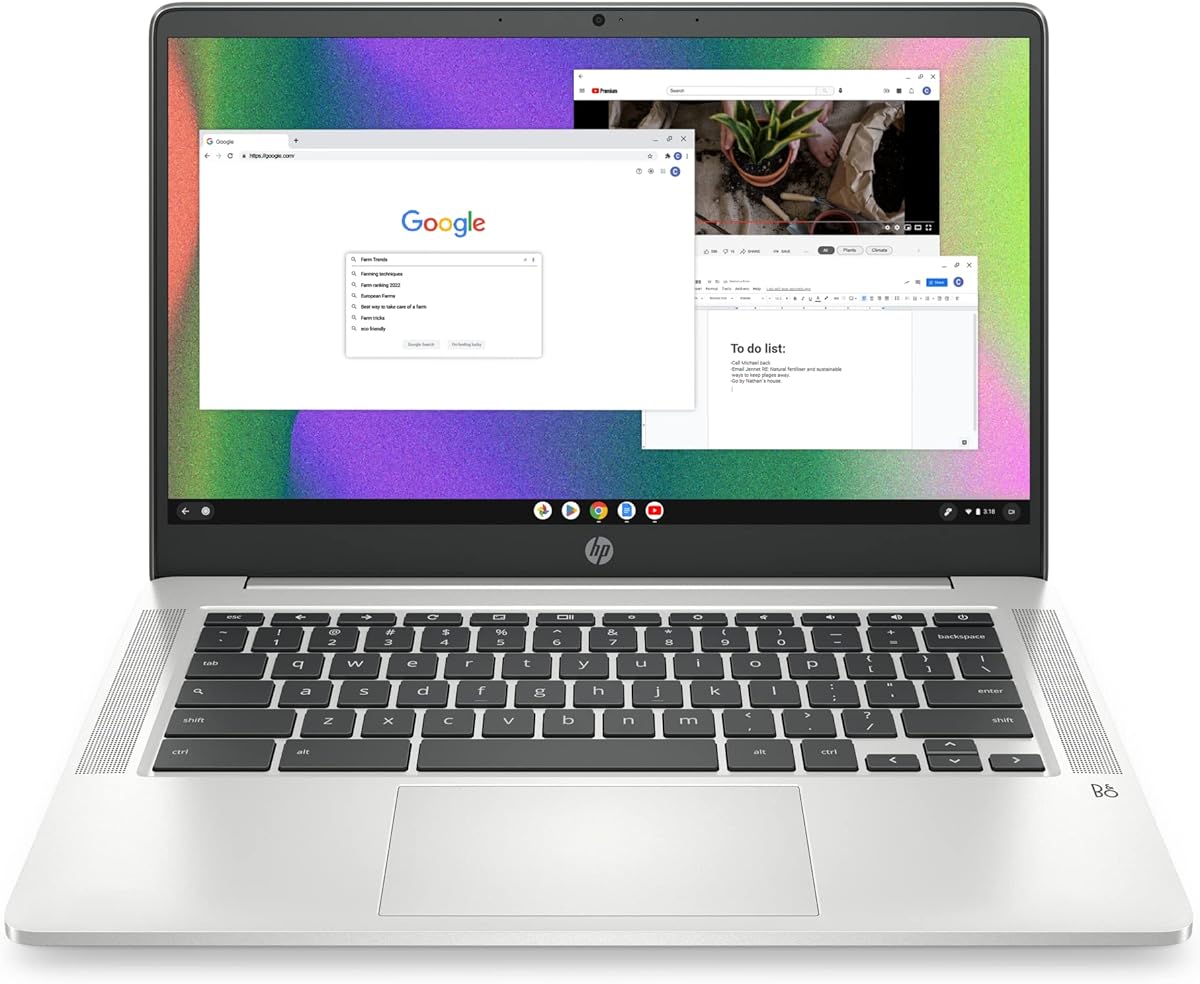
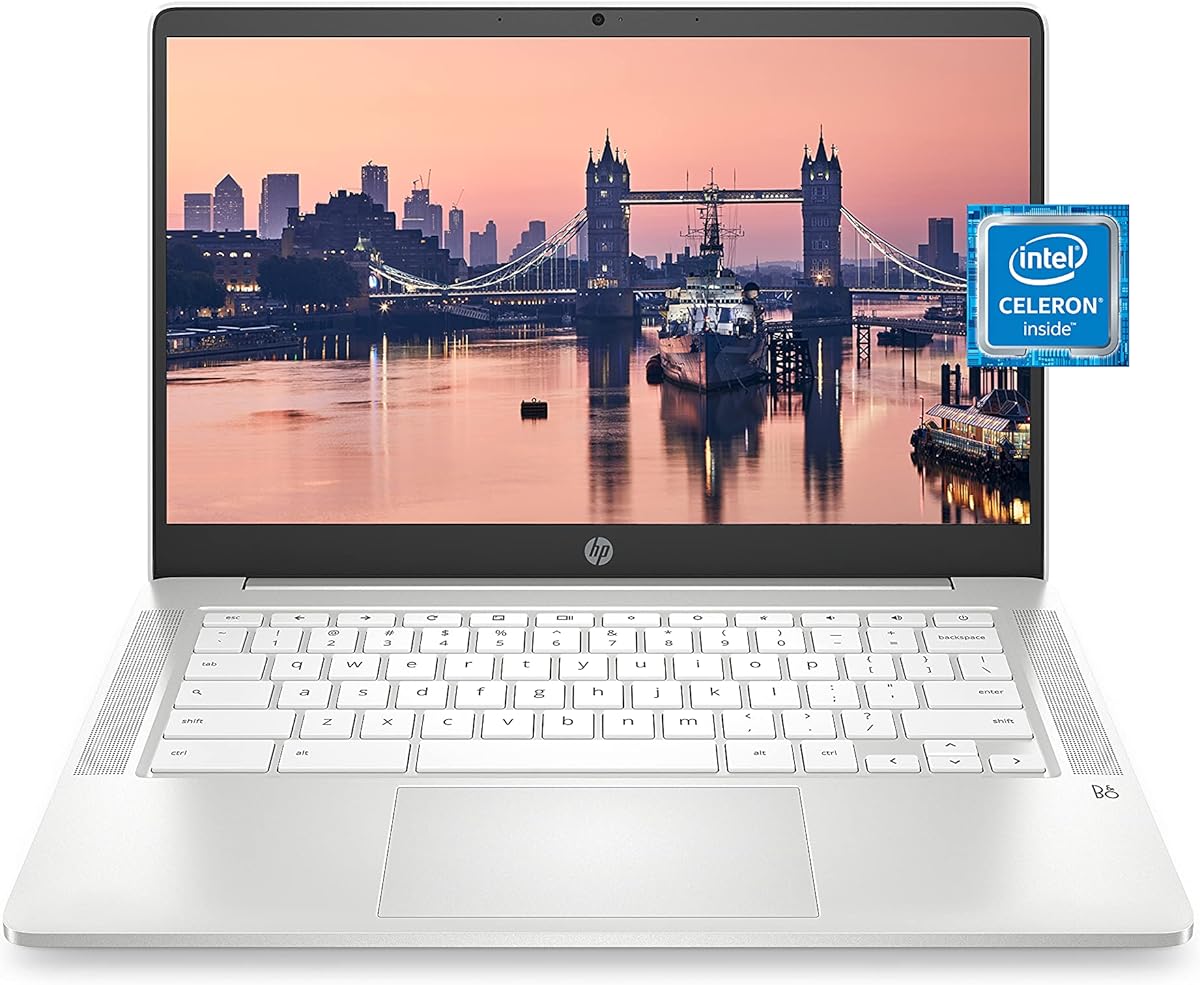
The HP Chromebook 14a-na0226nr is a 4.3-rated Chromebook designed around the practical needs of students who spend long periods away from an outlet. Its most impressive advertised feature is up to 14 hours of battery life, followed by HP Fast Charge, which is stated to take the battery from 0% to 50% in approximately 45 minutes. That combination is useful for a full school day, library visits, and long bus rides.
We may earn a commission when you buy through this link, at no additional cost to you.
The laptop uses a quad-core Intel Celeron N4120 processor, 4GB of RAM, and 64GB of eMMC storage. Those specifications suit Google Classroom, Google Docs, browsing, streaming, and light app use. Intel UHD Graphics 600 is advertised as 4K ready, which helps with video playback and visually engaging educational content, although it is not intended for demanding modern games.
The 14-inch micro-edge HD display is anti-glare, a useful characteristic for fluorescent classroom lighting and shared workspaces. A full-size keyboard, multi-touch touchpad, custom-tuned stereo speakers, 720p webcam, Wi-Fi, and Bluetooth create a complete everyday package. The trade-offs are familiar entry-level Chromebook limitations: 4GB of memory is modest, and 64GB leaves little room for offline files.
This is a sensible option for a student whose school relies on Google Workspace and whose daily routine involves many classes without reliable charging opportunities. It is less suitable for extensive local media libraries, advanced creative applications, or families expecting a full Windows software experience. Within the Chromebook category, however, its long stated runtime and portable form make it especially relevant to middle school life.
The advertised runtime of up to 14 hours provides useful flexibility for students moving through a long school day. Fast Charge also helps when only a short lunch break is available before the next session.
Chrome OS keeps the system focused on the browser, Google applications, and Android apps. Automatic updates, cloud backup, and a straightforward interface reduce setup friction for younger users.
We may earn a commission when you buy through this link, at no additional cost to you.
The HP 14-Inch N150 8GB earns a 4.4 rating and stands out as the most well-rounded Windows option in this guide. It combines an Intel N150 processor with 8GB of RAM, giving a student more headroom for multiple browser tabs, a video call, and a document than a typical 4GB configuration. The included one-year Microsoft 365 subscription adds Word, Excel, and PowerPoint for assignments that require standard office formats.
We may earn a commission when you buy through this link, at no additional cost to you.
Its 128GB UFS storage supports fast access to applications and files, though it is not a large local drive for large media files or multiple full software suites. Windows 11 S mode offers a secure and simplified experience intended primarily for applications from the Microsoft Store. That is appropriate for standard student productivity, but a family expecting specialized desktop software should verify compatibility before purchasing.
Connectivity is one of the model's strongest practical points. USB-C and HDMI make it possible to connect a monitor or other classroom accessories, while Wi-Fi 6 helps maintain a modern wireless connection. A 720p camera supports online lessons and study groups, and the 3.24-pound frame is light enough for daily transport. The advertised battery life of up to 11 hours supports a school day, although real results depend on brightness, video, and network activity.
This laptop is a strong recommendation for a student who wants Windows, more memory than a basic Chromebook, and a device that can handle both browser-based coursework and conventional productivity software. It is not a high-end gaming or creative workstation, and 128GB means careful storage management will be necessary. Even so, its balanced specifications make it an especially sensible general-purpose family computer.
The 8GB of memory is the feature that distinguishes this model from many entry-level alternatives. It provides more flexibility when several online tools remain open, which is common during research assignments, recorded lessons, and group video calls.
Microsoft 365 covers word processing, spreadsheets, and presentations, while Windows 11 supports familiar desktop workflows. USB-C and HDMI also make it easier to create a more permanent desk setup at home.
We may earn a commission when you buy through this link, at no additional cost to you.
The HP Chromebook x360 Plus is the premium choice in this roundup because its 360-degree hinge, high-resolution touchscreen, and four usage modes extend beyond the standard school laptop format. It can operate as a conventional laptop, tent for collaboration, stand for viewing, and tablet for touch interaction. That flexibility is especially valuable for reading, note-taking, demonstrations, and educational applications.
We may earn a commission when you buy through this link, at no additional cost to you.
Its 14-inch WUXGA display has a 1920 by 1200 resolution, narrow borders, 300-nit brightness, and an anti-glare coating. Compared with a standard HD panel, the extra resolution provides more usable detail and a more polished reading experience. The Intel N150 processor, 4GB LPDDR5 memory, and 128GB UFS storage are appropriate for browsing, document editing, video streaming, and light multitasking.
Connectivity includes USB-C, USB-A, a combination audio jack, Wi-Fi 6, and Bluetooth 5.4. The FHD camera uses temporal noise reduction for video calls. Chrome OS provides access to Google applications, cloud backup, and Google Assistant, and the listed automatic update expiration date extends to November 2026, which is useful information for a family planning several years of use.
The 4GB memory means it is best for focused work rather than dozens of simultaneous tasks, and 64GB alternatives remain even more constrained for offline media. The convertible form can also be bulkier than a conventional laptop when folded into tablet mode. Even with those trade-offs, the x360 Plus offers the most adaptable and premium design for a student who values touch interaction and wants one device to handle several learning styles.
Laptop mode supports typing-heavy assignments, tent mode is useful for shared viewing, stand mode supports video, and tablet mode makes touch-focused tasks more natural. The hinge has also passed MIL-STD 810H testing according to the listed product information.
The WUXGA panel provides more resolution and workspace than a typical HD laptop. Its anti-glare coating is advantageous in bright rooms, while touch input can make reading and interactive educational applications feel more direct.
We may earn a commission when you buy through this link, at no additional cost to you.
The HP New Student Laptop focuses on the practical basics of a school computer: a portable form, an anti-glare screen, Microsoft 365, and ample cloud storage. It carries a 4.2 rating and uses Windows 11 S mode, giving students a familiar environment for documents, browsing, communication, and school applications. The royal blue finish adds visual character without affecting the core function.
We may earn a commission when you buy through this link, at no additional cost to you.
The product information highlights 1TB of OneDrive cloud storage, which is valuable for keeping assignments and school files synchronized across devices. The Intel N4102 processor is intended for efficient browsing, online classes, office tasks, and streaming rather than demanding software. An HD 1366 by 768 micro-edge display with 220-nit brightness and anti-glare treatment is adequate for documents and lessons, though it is less crisp than the Full HD and WUXGA alternatives in this list.
The 720p True Vision camera, temporal noise reduction, dual-array microphones, full-size keyboard, and multi-touch HP Imagepad support online learning and regular computer use. Connectivity includes USB-C, two USB-A ports, HDMI 1.4b, and an audio jack, while Wi-Fi 6 and Bluetooth 5.4 provide modern wireless support.
This model makes sense for a household that wants Windows, cloud-focused file management, and a computer advertised for up to 12 hours of battery life. At 3.24 pounds, it is easy to carry, and the claimed 11.5 hours of video playback or 7.5 hours of wireless streaming can help during long school days. The N4102 chip and HD screen are the main compromises, making it better for standard coursework than advanced creative applications.
One terabyte of OneDrive space reduces the need to keep every project on the laptop itself. Students can work across compatible devices and keep school files synchronized, provided their school accounts and assignments support cloud workflows.
The camera, microphones, stereo support, Wi-Fi 6, and long advertised battery target the practical demands of remote learning. A full-size keyboard also provides a more familiar typing experience for longer written assignments.
We may earn a commission when you buy through this link, at no additional cost to you.
The HP 14-Inch Student 16GB differentiates itself with an unusually generous amount of memory for an entry-level student laptop. Its 4.3 rating reflects a capable configuration for browsing, online classes, document editing, video streaming, and light multitasking. The Intel N150 handles the processor side, while 16GB of DDR4 RAM provides considerable headroom for keeping multiple applications and browser tabs active.
We may earn a commission when you buy through this link, at no additional cost to you.
Storage totals 384GB through a combination of 128GB UFS and 256GB expansion. That is more practical than the 32GB or 64GB configurations found on some Chromebooks, giving the student room for downloaded projects, photographs, presentations, and videos. The 14-inch micro-edge anti-glare display measures 1366 by 768, which is comfortable for general study but trails the higher-resolution Lenovo, Acer, and x360 models.
Windows 11 Home in S mode, Copilot AI, and a one-year Microsoft 365 subscription support common school tasks. Built-in stereo speakers, Wi-Fi 6, and a 3.24-pound weight round out the everyday feature set. The laptop is marketed for students, seniors, and first-time users, which reflects its simple approach and familiar operating system.
This is an attractive choice for a student who leaves many applications open, handles demanding browser-based research, or wants a computer that can grow with a heavier workload over time. The main caveat is that memory does not expand every limitation: the processor is an efficient N150 rather than a high-performance chip, and the HD display is only 1366 by 768. Even so, the 16GB configuration makes this one of the strongest multitasking picks in the guide.
Sixteen gigabytes of RAM is the headline advantage here. It can keep a video call, browser research, a document, and a presentation open more comfortably than a 4GB machine, reducing the likelihood of performance pressure during group work.
The listed 128GB UFS and 256GB expansion combine for 384GB. That offers a useful middle ground between very small Chromebook storage and much bulkier laptops, especially for school folders, downloaded media, and locally installed applications.
We may earn a commission when you buy through this link, at no additional cost to you.
The HP Chromebook 14a-na0021nr is a straightforward browser-based laptop for a student who primarily needs Google applications, web research, communication, and media. It holds a 4.4 rating, and its simple design makes it approachable for younger learners or anyone seeking a low-complexity secondary computer.
We may earn a commission when you buy through this link, at no additional cost to you.
The Intel Celeron N4000 processor, 4GB of RAM, and 32GB of eMMC storage are suited to lightweight browsing, school websites, music, movies, and online communication. The 32GB drive is the most significant limitation, leaving little room for downloaded files or offline media. Families would need to rely primarily on cloud storage and maintain careful housekeeping if they choose this configuration.
Its 14-inch HD micro-edge anti-glare display measures 1366 by 768 and provides a practical workspace for writing and lessons. The Wide Vision HD camera and integrated dual-array digital microphones support video chats, while Wi-Fi 5 and Bluetooth 5.0 handle wireless accessories. The stated wireless streaming time reaches up to 13 hours and 30 minutes depending on use, making it attractive for students who spend a full day away from a charger.
At 3.24 pounds, the Chromebook is easy to carry, and Chrome OS keeps updates, security, and the application environment relatively simple. It is best suited to schools built around Google Workspace and light use cases, not students who need desktop applications, large local game libraries, or extensive offline storage. For those priorities, it can be a practical and comfortable choice.
Chrome OS centers the experience around the browser, Google apps, and Android applications. That keeps navigation familiar and is useful for younger students who primarily need web research, online assignments, and video communication.
The stated battery endurance and 3.24-pound weight are both meaningful advantages for a full school day. The anti-glare display also helps when the student studies under bright classroom or library lighting.
We may earn a commission when you buy through this link, at no additional cost to you.
The HP Essential 2026 Laptop is a 4.4-rated Windows machine built for straightforward studying, browsing, streaming, and document editing. It uses the Intel N150 processor with up to 3.6GHz turbo boost, 4GB of LPDDR5 memory, and 128GB of UFS storage. A one-year Microsoft 365 Personal subscription provides Word, Excel, PowerPoint, and cloud storage.
We may earn a commission when you buy through this link, at no additional cost to you.
Its strongest differentiator is the port selection. A 10Gbps USB-C port with DisplayPort 1.2, two 5Gbps USB-A ports, HDMI 1.4b, an audio jack, and a multi-format SD card reader provide a well-rounded connection set. That makes it easy to connect a monitor at home, attach a mouse and keyboard, move files from a camera, or participate in a video class.
The 14-inch HD anti-glare screen has 250-nit brightness and 62.5% sRGB coverage, with a 79% screen-to-body ratio. It is adequate for text, lessons, and research, although the resolution and color coverage are not particularly advanced. A True Vision 720p camera with noise reduction, dual-array microphones, and a dedicated Copilot key support communication and everyday assistance.
The 3.24-pound weight and stated battery figures of up to 11 hours for video playback make the laptop portable and practical for school use. Four gigabytes of memory is the key limitation, so students should moderate the number of simultaneous applications. Overall, it is a well-equipped and approachable Windows choice when a complete port selection and included productivity software matter more than a high-resolution display.
DisplayPort over USB-C, HDMI, and multiple USB-A ports make it simple to connect the laptop to a larger monitor and standard peripherals. The SD card reader is also convenient for moving media from a camera or portable device.
Microsoft 365 covers the core productivity applications, while Windows 11 provides a familiar environment for school and home. Copilot is available through a dedicated key, and the camera and microphones support everyday online collaboration.
We may earn a commission when you buy through this link, at no additional cost to you.
The Acer 2026 15.6-inch Chromebook is the only 15.6-inch model in this guide, making it the clear choice when screen workspace matters more than maximum portability. It has a 5.0 rating, the highest listed score in the group, and its 1920 by 1080 display provides a large, sharp canvas for lessons, documents, research, and media.
We may earn a commission when you buy through this link, at no additional cost to you.
The full-size keyboard includes a dedicated numeric keypad, which can be useful for spreadsheet exercises, data entry, and math classes. That makes the Acer resemble a small desktop computer more than an ultraportable notebook. The large display also reduces the need to constantly switch between a lesson and notes, although the wider chassis will be less convenient in a compact school bag or during frequent movement between rooms.
Under the hood, a dual-core Intel Celeron processor, 4GB of RAM, and 64GB of storage target ChromeOS tasks. The system is designed for Google Classroom, Google Docs, browsing, streaming, and other online tools. A 10-hour stated battery supports school use, and Wi-Fi 6 supports modern wireless connectivity. The listed glare-reducing webcam is designed to make video calls more practical in varied lighting.
This Chromebook is a strong fit for a student who works with long documents, spreadsheets, or multiple windows and who prefers a traditional laptop shape with a number pad. The trade-offs are obvious: 4GB is modest, 64GB requires careful file management, and the large display reduces the portability of the lighter 14-inch models. For a home or shared desk, however, it provides an unusually spacious and approachable learning environment.
The 15.6-inch Full HD display provides a noticeably larger workspace than the 14-inch HD models. It is particularly useful for keeping a live lesson, notes, and supporting documents visible at the same time.
The dedicated keypad makes spreadsheet assignments and number entry faster. It also gives the laptop a familiar home-computer feel, which can help younger students work comfortably as they transition from school desktops to personal machines.
We may earn a commission when you buy through this link, at no additional cost to you.
The best laptop for a middle school student is not necessarily the most powerful model available. Priorities should include manageable size, a comfortable display, dependable connectivity, enough memory for school workflows, and an operating system that matches the software and online services used by the school.
Chrome OS is designed around web-based work, Google applications, cloud backups, and Android apps. It is usually simple to manage and well suited to schools using Google Workspace, online assignments, Docs, Slides, and Classroom. Windows 11 provides a broader mix of traditional desktop applications, productivity software, games, and customizable programs, making it the safer choice when a school requires specific software that is not web-based. Before buying, ask the teacher or school technology department which operating system and application suite students are expected to use.
Memory determines how comfortably a student can keep browser tabs, a video call, a document, and a presentation open at the same time. A 4GB configuration is sufficient for light Chromebook use, but 8GB offers a better margin for busy school days and Windows applications. The HP models with 8GB or 16GB are particularly interesting for students who multitask. A larger amount of memory helps responsiveness, but it should be balanced with a capable processor and adequate storage rather than considered in isolation.
Local storage matters for downloaded videos, large project files, applications, and work that must remain available without an internet connection. A 64GB Chromebook is workable when the student works mostly online and maintains organized cloud storage. A 32GB model requires even more discipline and may be better for a lightly used secondary computer. Models with 128GB or more give a family more flexibility, particularly for Windows software and locally stored multimedia. Check whether an included expansion drive, docking station, cloud subscription, or separate storage solution actually matches the student's workflow.
A 14-inch laptop is the most common compromise between screen area and portability. Full HD and WUXGA resolutions make text, images, and web pages look sharper, while HD panels are adequate for basic documents. A 15.6-inch display provides more room for coursework and often includes a number pad, but it is heavier and less convenient to carry. Anti-glare treatment is valuable in bright classrooms and libraries. Touchscreens can make reading, drawing, and interactive lessons more engaging, but they are not necessary for every student.
A school day often lasts longer than a short break between periods, so advertised battery runtime deserves close attention. Up to 10, 11, 12, 13, or 14 hours represents different levels of stated endurance, but actual results vary with screen brightness, video playback, Wi-Fi use, and battery condition. Fast Charge is convenient when a student can top up during lunch. Families should also consider charger size, whether the school provides outlets, and whether a long battery specification still leaves enough capacity for a full day of video lessons.
The lightest option in this guide weighs 2.86 pounds, while several 14-inch models weigh 3.24 pounds. Differences of only a few ounces can become noticeable in a backpack, especially when the student also carries books, a charger, and a water bottle. A slim profile also helps with storage in a school locker. Convertible models add flexibility but may be bulkier when folded. For frequent travel or shared spaces, look for a durable hinge, reliable port placement, and a design that is easy for the child to carry independently.
Online learning requires more than a screen. A 720p webcam, microphones with noise reduction, stereo speakers, and stable Wi-Fi can materially improve the quality of lessons and group calls. Wi-Fi 6 is the newest standard represented in this guide, while older Wi-Fi 5 systems remain adequate for many homes. USB-A, USB-C, HDMI, an audio jack, and a memory-card reader make it easier to connect headphones, a mouse, an external drive, or a larger display. Confirm that the school uses web-based video calling and that the student has a private space and suitable headphones.
Security features should match the student's age, maturity, and school requirements. Chrome OS emphasizes a simple managed online environment, while Windows includes familiar security controls and a wider range of installed software. Whichever system is selected, establish rules for downloads, app permissions, browser access, shared accounts, and communication with strangers. Use school-managed accounts where available, keep operating systems updated, and teach the student how to recognize suspicious links. Parental controls are most effective when combined with clear household expectations rather than relied upon as the only safeguard.
Begin by signing in with the student's school account when the school provides managed access. Install only the required learning applications, apply necessary content restrictions, and organize the desktop into clearly labeled folders for each class. For Chrome OS, check that Google Classroom, Docs, Drive, and other school services work correctly. For Windows, confirm that Microsoft 365 or the school-provided applications open normally and that required security or accessibility features are enabled before the first day of classes.
Teach a simple routine for both charging and file management. Keep the laptop in a protective sleeve, use a labeled charger, and avoid leaving it in vehicles or unattended in crowded areas. Save important work in the appropriate cloud folder and maintain a separate local backup for large projects. Parents should periodically review storage, installed applications, browser history as appropriate, and account settings while respecting the student's growing independence.
For battery care, follow the manufacturer's charging guidance and avoid leaving the computer in extreme heat or cold. Keep vents clear, clean the screen with a soft microfiber cloth, and do not use harsh liquids. Periodic updates are essential, especially for a school device connected to the internet. A restart every few weeks, along with saved work being properly closed, can help maintain smooth performance throughout the school year.
A Chromebook is usually sufficient when schoolwork is completed through Google Workspace, web-based research, and Android or web applications. Its fast startup, automatic updates, and cloud-centered storage simplify everyday use for younger students. Families should verify whether the school requires Microsoft Office, specialized desktop software, or other programs that may be difficult to run in Chrome OS.
Four gigabytes works for basic browsing, Google Docs, and a limited number of open applications. Eight gigabytes is a more comfortable choice for a student who regularly uses video calls, multiple browser tabs, and Microsoft Office. Sixteen gigabytes provides additional headroom, but the processor and storage still need to be capable enough to support the intended workload.
It depends on the student's backpack and daily routine. A 15.6-inch model offers more workspace and often a numeric keypad, but it is bulkier and generally less convenient to transport than a 14-inch model. A student who changes classes frequently or travels on a bus may prefer a smaller design, while one who uses a desk at home and carries the computer less often may benefit from the larger screen.
A touchscreen is helpful for touch-based educational applications, drawing, reading, and convertible designs, but it is not essential for every assignment. Standard laptops with accurate keyboards and comfortable displays can handle writing, research, presentations, and video calls very well. Consider a touchscreen when the student benefits from interactive instruction or wants the flexibility of tablet and laptop modes.
It can be enough for a student who works primarily online and uses cloud storage carefully. The limitation becomes noticeable when downloading large videos, installing many applications, or retaining offline project files. A 128GB or larger drive offers more freedom, so families should consider both the device's storage and whether included cloud space is connected to the account the student will use.
Chrome OS is usually easier to manage and works well for Google-based school platforms. Windows 11 is more versatile and is often necessary for Microsoft Office, specialized learning software, or a school ecosystem built around desktop applications. Asking the teacher or school technology department about required software is the most reliable way to choose.
Use the student's school-managed account when available, require updates, review installed applications, and establish rules for downloads, web access, and communication with strangers. Privacy settings, a separate account for younger children, and scheduled family check-ins can add protection. Security software and parental tools help, but they work best alongside clear family rules and regular conversation.
A protective sleeve, a labeled charger, wired or wireless earbuds, and a basic USB drive or SD card can be useful. A mouse may improve comfort on larger models, while an HDMI or USB-C adapter is helpful if the student connects to a home monitor. The child should also know how to protect the screen, carry the device safely, and request help when an accessory fails.
The Lenovo Flagship Chromebook stands out for its sharp Full HD touchscreen, light 2.86-pound design, and balanced approach to everyday learning. The HP 14-Inch N150 8GB is the most versatile traditional pick, offering Windows, 8GB of memory, Microsoft 365, and a useful mix of ports. The HP Chromebook x360 Plus takes the premium route with a high-resolution touchscreen and four convertible modes.
Above all, prioritize the operating system required by the school, enough memory for simultaneous applications, a screen the child finds comfortable, and a device that can be carried without difficulty. Battery claims, ports, camera quality, and weight should be considered together because no single specification determines the entire experience. A modest computer with the right software and dependable daily handling is usually more valuable than an expensive model with unnecessary power.
Before purchasing, confirm the current listing, included accessories, warranty terms, and exact configuration. Product details and availability can change, so check the seller's current page rather than relying solely on an earlier summary. With the student's school requirements and routines in hand, the most suitable laptop should be clear.