
Titan 84" Skid Steer Land Planer
Removable sift screens
Optional planer comb
Adjustable scarifier teeth
Universal SSQA hookup
A land plane for a tractor can turn uneven ground, compacted drives, rough gravel, and damaged soil into a more workable surface. The right implement depends on your tractor hitch, the amount of material you need to move, the width of your project, and whether you want a simple scraper or a scarifying land plane.
This guide compares ten tractor-compatible grading and land-leveling products based on their stated construction, dimensions, adjustment systems, cutting components, mounting methods, and intended uses. It covers Cat 1 three-point blades, universal hitch scrapers, skid steer land planers, and a replacement plane comb.
The selections show how the same task can be approached with different levels of depth, capacity, and refinement. The top three offer a balanced premium land plane, a versatile skid steer planer, and a practical three-point blade, while individual ratings and product details may change as manufacturers update their listings.
4.6Editor score

5.0Editor score
As an Amazon Associate we earn from qualifying purchases.
This side-by-side comparison highlights the major differences in mounting system, working width, material movement, scarifying capability, and adjustment options across the ten featured tractor land plane and grading products.


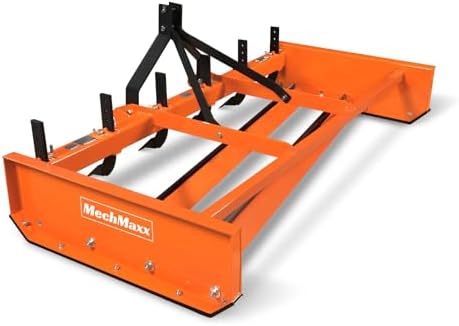
The MechMaxx LP84 combines an 84-inch land-plane format with six adjustable shanks and two reversible blades, giving it a more specialized leveling design than a basic box scraper. Its 4.6 rating reflects a favorable overall buyer impression, while its listed applications include roads, potholes, driveways, farming, landscaping, hunting camps, and small acreages.
We may earn a commission when you buy through this link, at no additional cost to you.
The strongest feature is the combination of wide coverage and adjustable depth. The shanks can be customized for crowning roads, filling potholes, and leveling soil, while the reversible edges help break up and smooth difficult material. High-grade, corrosion-resistant steel and a Cat 1 quick-hitch connection also make it appealing for owners who want a purpose-built implement rather than a general-purpose blade.
The trade-off is size. An 84-inch assembly covers more ground per pass, but it also creates a larger implement that may be less convenient around tight landscaping features. Tractor weight, hitch geometry, and available storage space should be checked before purchase, particularly for owners with a compact utility tractor or limited barn.
Overall, the LP84 is the strongest all-around choice in this group for owners who need substantial width, adjustable scarifying action, and refined grading in one attachment. It is especially well suited to maintaining long gravel roads, rough farm lanes, large driveways, or uneven acreage where a narrower blade could require more passes.
The six independently useful shanks provide a way to tear into uneven or compacted areas and then level the disturbed surface. This makes the implement better suited than a simple blade for ground that needs more than superficial reshaping.
An 84-inch working width can reduce the number of passes required across driveways, farm lanes, and open ground. The trade-off is a larger implement footprint, so operators should plan turning space and travel routes.
We may earn a commission when you buy through this link, at no additional cost to you.
This 52-inch rear grading blade is a practical Cat 1 implement for owners who need to move, shape, and level material rather than perform deep scarifying. Its 4.1 rating indicates a generally favorable reception, and the listing emphasizes adjustable blade positioning, steel construction, and easy attachment to lawn, garden, and small-farm tractors.
We may earn a commission when you buy through this link, at no additional cost to you.
The blade can be adjusted in either direction, which makes it useful for grading, backfilling, clearing brush, and moving sand or gravel. Its frame uses heavy-duty 8-gauge steel with 10-gauge main-frame tubing, while the reversible cutting edge is designed to be replaced when wear becomes significant.
It does not offer the depth of a dedicated land plane with scarifier shanks, so heavily compacted or uneven ground may require preliminary work. Its 52-inch width also means more passes than an 84-inch model on broad roads and fields. These limitations matter only when the job demands aggressive soil breakup rather than routine surface shaping.
This blade is best for tractor owners with a standard Cat 1 hitch who need a versatile rear implement for driveways, arenas, paths, topsoil, and gravel. It is a sensible middle-ground option for landscaping, small acreage, and property maintenance where maneuverability and straightforward attachment matter as much as maximum width.
The ability to angle the blade in either direction makes it easier to pull material toward the operator, push it away, or spread it across a work area. This is useful when the operator changes tasks without leaving the tractor seat.
A reversible and replaceable cutting edge helps extend useful service life while simplifying wear replacement. Owners should inspect the edge regularly, particularly when cutting gravel, stones, or compacted material.
We may earn a commission when you buy through this link, at no additional cost to you.
The MechMaxx SSLP84 is an 84-inch skid steer land plane built around eight adjustable scarifier shanks, bolt-on cutting blades, and a removable sift screen. It targets compacted ground, soil leveling, rock removal, and land clearing, giving operators more aggressive soil preparation than the conventional rear grading blades in this guide.
We may earn a commission when you buy through this link, at no additional cost to you.
Its shanks can penetrate as deep as four inches, allowing the implement to loosen compacted dirt and break up bumps before the surface is graded. Replaceable blades and mesh support straightforward maintenance, while the powder-coated construction is intended to resist corrosion during outdoor use.
The primary limitation is attachment compatibility. This is a skid steer land plane, not a Cat 1 tractor implement, so buyers need a compatible skid steer rather than a conventional tractor. It also has no displayed customer rating, which means there is less visible buyer feedback for balancing the stated specifications.
The SSLP84 is a strong choice for operators who need to restore hard-packed surfaces, prepare soil for seeding, or clear a rough area before finishing. Its eight shanks, screen, and replaceable cutting components make it a more complete processing tool than a simple blade, provided the mounting machine and project scale fit its design.
With a stated maximum rip depth of four inches, the eight shanks can loosen compacted material and reduce high spots. The setting should be adjusted gradually to avoid excessive strain on the skid steer and attachment.
The removable screen can separate rocks and debris from the working material, while replaceable blades help preserve the cutting profile. Routine screen cleaning and blade inspection are important when working in rocky conditions.
We may earn a commission when you buy through this link, at no additional cost to you.
The 52-inch three-point grader is designed for Cat 1 tractors and handles leveling, backfilling, and moving dirt, snow, gravel, and other materials. Its 3.6 rating is the lowest numerical score among the products with visible ratings, so buyers should weigh the straightforward feature set against more strongly rated alternatives.
We may earn a commission when you buy through this link, at no additional cost to you.
Its bottom-pin mounting arrangement is designed to simplify attachment and detachment, especially for smaller tractors. The 52-inch blade adjusts in either direction, providing useful control over material placement, while high-quality steel and a rust-resistant powder-coated finish support durability.
Because it lacks an adjustable scarifier-shank system, it is less suitable for deeply compacted or badly uneven ground than a dedicated land plane. It is better suited to routine grading after the hardest material has already been loosened or when the objective is simply moving and shaping a loose surface.
This grader remains a practical option for owners who want one rear attachment for driveways, lawns, snow, gravel, and general grading. Its compact width, quick mounting design, and adjustable angle make it useful for smaller tractors, provided the operator understands that it is primarily a surface-shaping blade.
The rear blade and bottom-pin design are intended to make connection to a Cat 1 hitch straightforward. This convenience helps owners switch between implements more often during mixed property-maintenance work.
The listed applications include driveways, lawns, snow, gravel, backfilling, and dirt movement. This range makes it a general-purpose rear blade, although it is not intended to replace a deep scarifying land plane.
We may earn a commission when you buy through this link, at no additional cost to you.
The 52-inch rear grading blade combines a 5.0 rating with a well-known Cat 1 box-scraper format, making it the leading budget-oriented selection here. It is aimed at farm, lawn, and garden work, including driveways, arenas, topsoil, gravel, and material movement.
We may earn a commission when you buy through this link, at no additional cost to you.
Its heavy-duty high-strength steel construction, 8-gauge steel frame, and 10-gauge main-frame tube provide a sturdy base. The blade angle can be adjusted in either direction, and the reversible cutting edge is designed for extended use and easier replacement when the working edge wears down.
The integrated three-point hitch is spaced for Cat 1 lawn and garden tractors, allowing relatively direct attachment without the complexity of a hydraulic rear blade. The 52-inch width is less efficient than an 84-inch land plane on large roads, but it is easier to maneuver and may better fit the working space of a smaller tractor.
For owners seeking a capable and popular grading attachment at the lower end of the guide, this is the strongest budget pick. Its five-point rating, serviceable edge, and simple mounting justify the selection, while buyers with severely compacted soil should consider adding a scarifier or choosing a dedicated land plane.
The conventional three-point layout is familiar to many compact-tractor owners, and the integrated mounting design keeps setup relatively simple. It can complement a broader collection of Cat 1 implements used on farms and properties.
The reversible cutting edge supports continued use while reducing the need to purchase an entirely new blade when one edge becomes worn. Replacing and checking the edge remains essential when working in gravel or stony soil.
We may earn a commission when you buy through this link, at no additional cost to you.
The Titan Attachments 84-inch land planer is the most feature-complete premium option in the guide, combining a universal skid steer quick-attach hookup, removable sift screens, a replaceable cutting edge, an optional planer comb, and adjustable scarifier teeth. It is designed for gravel roads, driveways, parking lots, compacted terrain, and larger grading projects.
We may earn a commission when you buy through this link, at no additional cost to you.
The removable screens perform two useful jobs: separating rocks and debris while grading and acting as a carry-all for materials. Meanwhile, the optional comb breaks up clumps before leveling, and adjustable teeth can rip into compacted dirt to a stated depth of four inches.
Its powder-coated steel frame, dual front gussets, and bolt-on cutting edge emphasize durability and serviceability. As with the MechMaxx skid steer model, no numerical customer rating is displayed, so the main evidence comes from the detailed feature set rather than a visible review score.
This land planer is best for owners with a compatible skid steer who want one attachment for rough reclamation, aggregate finishing, and material control. It is a premium choice because the screens, comb, adjustable teeth, and reinforced frame go beyond the basic material-moving capacity of a conventional grader blade.
Removable screens let operators separate stones and debris while grading and can double as a material carrier. This adds flexibility for road work, driveway maintenance, and cleanup after the primary pass.
The optional comb breaks up clumps ahead of the leveling action, while adjustable scarifier teeth reach into compacted ground. Together, these components support a more deliberate workflow than a single-pass scraper.
We may earn a commission when you buy through this link, at no additional cost to you.
The Garvee 52-inch grading blade is distinctive for its stated Cat 0 and Cat 1 compatibility and built-in weight tray. Its 4.0 rating reflects generally positive feedback, while the additional ballasting option gives operators a way to increase downforce on compacted soil and gravel.
We may earn a commission when you buy through this link, at no additional cost to you.
The blade locks at a 30-degree angle to either side, allowing it to handle grading, leveling, ditching, and snow removal with directional control. Thick carbon steel construction is intended to resist bending, cracking, and wear, while 52-inch coverage helps reduce pass count on driveways, pastures, and larger properties.
The ballast system is helpful, but the operator must supply suitable weight such as sandbags, concrete blocks, or steel weights. The listing also says the universal hitch can work with lawn tractors, zero-turn mowers, and ATVs, but hitch geometry and actual machine capacity should be confirmed before purchase.
This blade suits property owners who want more downforce than a light box scraper and broader mounting flexibility than a strict three-point model. It is particularly interesting for tough grading work, although operators needing deep soil breakup should still use a scarifier or land-plane implement.
The integrated tray allows operators to add ballast as conditions require. More weight can help a blade resist drifting or cutting into hard-packed material, but the tractor and hitch must safely support the increased load.
Cat 0 and Cat 1 support, along with the stated universal hitch arrangement, broadens the potential machine base. Compatibility still depends on the vehicle's geometry, weight class, and safe towing or attachment limits.
We may earn a commission when you buy through this link, at no additional cost to you.
This 52-inch tow-behind box scraper offers an alternative to a three-point grading blade for ATV, UTV, and manual-lift arrangements. It carries a 5.0 rating and uses a two-inch inside-diameter connection referenced in the title, making its towing compatibility the defining feature.
We may earn a commission when you buy through this link, at no additional cost to you.
The implement retains the familiar strengths of the rear grading blade format: heavy-duty high-strength steel, a rust-resistant black coating, adjustable blade positioning, and a reversible cutting edge. These characteristics make it suitable for moving and leveling gravel, topsoil, and other loose materials.
Because it is a tow-behind product rather than a three-point rear implement, it will not provide the same lifting, transport, or weight-transfer behavior as a Cat 1 attachment. The tow vehicle, manual lift, pin, and hitch components must all be compatible and rated for the implement's load.
This scraper is a good choice for owners who already use an ATV or UTV with a suitable implement lift and want a broad 52-inch grading surface. Its five-point rating and familiar box-scraper construction make it compelling, provided the tow system is designed for the job.
A manual implement lift can let compact utility vehicles handle grading work without a three-point hitch. The tow connection must be securely pinned and matched to the stated two-inch inside-diameter bore.
The steel frame, adjustable angle, and reversible edge provide the core features expected from a rear grading blade. This makes the implement familiar to operators who already work with similar scrapers.
We may earn a commission when you buy through this link, at no additional cost to you.
The Titan Attachments 72-inch rear blade is a substantial Cat 1 grading tool offering 12 manual angle settings, a reversible heat-treated AR400 cutting edge, and a heavy-duty locking mechanism. Its 3.8 rating is lower than several smaller blades, but the specification set distinguishes it through precise manual positioning and a robust cutting edge.
We may earn a commission when you buy through this link, at no additional cost to you.
Five forward and seven rear positions allow the operator to select how aggressively the blade engages and where material is directed. The implement includes a top link and lower lift pins, works with Category 1 three-point hitches, and does not require hydraulic rear remotes for angle adjustment.
At 326 pounds, with an overall height of 35.3 inches and a 72-by-31-inch footprint, it is a substantial attachment. The 0.25-inch blade thickness and AR400 edge support demanding work, but tractor capacity, rear-hitch geometry, and storage clearance should be reviewed carefully.
This rear blade is ideal for owners who want multiple angle choices without hydraulic controls, particularly for clearing debris, scraping roads, moving snow, and pushing material. Its precision-oriented configuration is more specialized than the simpler 52-inch alternatives, so matching it to a suitably capable tractor is essential.
Twelve settings allow the operator to tailor the blade for different material-handling directions without relying on hydraulic remotes. The locking pin keeps the chosen position stable once the blade is set.
The reversible, bolt-on, heat-treated AR40 edge is designed for extended service in grading and scraping work. Checking fasteners and edge wear regularly helps maintain consistent material control.
We may earn a commission when you buy through this link, at no additional cost to you.
The Titan 84-inch plane comb is a specialized bolt-on attachment for a skid steer land plane rather than a complete tractor implement. It replaces the front cutting edge to loosen compacted material before the leveling section, making it most useful as an upgrade or replacement component for owners with a compatible land-plane frame.
We may earn a commission when you buy through this link, at no additional cost to you.
Its teeth are 0.9375 inches deep and spaced every 2.375 inches, a layout intended to break up clumps and improve the consistency of the finished surface. The bolt-on design allows the comb to be installed without the complexity of replacing an entire land plane.
Compatibility is the essential limitation. The attachment is not intended for use as a standalone rear blade or three-point grader, and its listing does not provide a visible numerical customer rating. Owners should confirm the frame dimensions, mounting pattern, and existing cutting edge before ordering.
For owners seeking a smoother, more textured finish on gravel, dirt, and uneven surfaces, the comb can be a valuable refinement to a compatible land plane. It is best considered a specialized add-on rather than a substitute for a complete land plane for tractor or skid steer use.
The comb teeth loosen compacted material before the main plane pass. That preparation can help produce a more consistent final grade than attempting to pull every clump through a standard cutting edge.
The front-edge installation makes the comb convenient to add or replace. Owners should still match it to the compatible land-plane frame and follow the attachment's mounting instructions.
We may earn a commission when you buy through this link, at no additional cost to you.
Choosing a land plane or grading blade means matching the implement to your tractor, the severity of the surface, and the type of finish you need. Hitch type, working width, depth control, material processing, and storage constraints deserve attention before purchase.
The first filter is the connection between the tractor and implement. Cat 1 three-point attachments require compatible lower hitch pins, lift-arm spacing, and a suitably sized top link, while skid steer land planes need the appropriate universal or SSQA quick-attach carrier. Do not assume that every implement advertised for a tractor will fit every tractor, and verify the machine's hitch category, loader specifications, hydraulic needs, and weight rating before ordering.
Choose the mounting system your tractor actually has and can safely operate. Cat 1 is common among compact and mid-size tractors, but the correct pin dimensions, clearance, and top-link arrangement still matter.
Width determines how much ground an implement can cover per pass. An 84-inch land plane is efficient on long roads, large arenas, and broad acreage, while a 52-inch blade is easier to steer, transport, and store. Wider is not automatically better: turning space, terrain, hitch load, and the size of individual work areas can make a narrower implement more practical.
Match the blade width to your most common project rather than the largest possible job. A wide implement that cannot safely turn or fit in the shed may be less useful than a well-matched 52-inch blade.
A true land plane uses shanks or scarifier teeth to tear into high spots and compacted material before a grading surface restores the shape. Models advertising up to four inches of rip can handle more severe unevenness than a basic blade, but they also create greater loads. Surface graders are better where the soil is already loose and the objective is to move, spread, or shape it.
For severely compacted ground, prioritize adjustable scarifying shanks. For routine driveway and material shaping, a reversible-edged grading blade may be sufficient and easier to control.
Finish quality depends on more than the cutting edge. Sift screens remove rocks and debris, planer combs break up clumps, and reversing edges help maintain an effective cutting profile. These features are valuable when preparing a road for aggregate, smoothing soil, or restoring a damaged lane. If the project involves loose topsoil or simple material distribution, a conventional scraper may provide enough control without additional processing components.
Choose extra screening and comb features only when the material and final result justify them. They add maintenance, weight, and operating complexity that may not improve every project.
Angle adjustment controls how an implement engages and directs material. Two-way adjustment is useful for pulling and pushing material, while models with numerous fixed settings offer more precise placement of dirt, snow, or debris. Manual systems are simpler and avoid dependence on hydraulic remotes, while hydraulic options can be convenient when the tractor and attachment support them.
Look for a secure locking method and clearly defined angle positions. Stable settings are more valuable than a large number of positions if the blade can shift during demanding work.
Land planes and scrapers experience abrasion, impact, and repeated bending loads. High-strength steel frames, corrosion-resistant coatings, and replaceable cutting edges help extend service life. Bolt-on edges are particularly useful because they can be removed and replaced without replacing the entire frame. Owners working in wet or corrosive environments should still clean the implement after use and inspect for rust at joints and wear points.
Prefer durable steel construction with readily replaceable wear components. A stronger frame and replaceable edge generally provide better long-term value than a lighter assembly with limited repair options.
Wide blades, frames, screens, and scarifying teeth all add load. A heavy implement may improve downforce in hard material but can reduce steering response, traction, or stability on uneven ground. Check the tractor's rear lift capacity, loader rating, transport dimensions, and the ballast requirement of the selected attachment. This is especially important for a 72-inch or 84-inch unit.
Keep the implement within the machine's stated capacity and add ballast only as required. A well-balanced tractor is safer and more effective than forcing a mismatched implement to work.
Driveways, arenas, farm lanes, food plots, gardens, and woodland lanes present different grading requirements. Gravel roads may need aggressive scarifying, sifting, and a comb, while a level lawn or topsoil job may require only a reversible blade. A dedicated plane comb is a finishing accessory rather than a complete implement, so it should not be compared with a full land plane as a standalone choice.
Define the desired finish before buying. The best implement is the one whose features match the surface, material, and result you need without adding unnecessary weight or complexity.
Begin by inspecting the tractor, hitch, and implement before every session. Confirm that pins, bolts, quick-attach latches, shank settings, and cutting edges are secure, and verify that the tractor's lifting and operating limits suit the attachment. Clear loose objects from the work area, identify buried rocks, and avoid working where the blade could strike an immovable obstacle.
Set the implement on loose ground before making final adjustments. For a scarifying land plane, begin with shallower shank settings and increase depth gradually while watching the tractor's response. For a grading blade, select the angle that directs material where you want it, then use the lower link, top link, or hydraulic controls to establish a stable cutting depth. Make overlapping passes and change direction only when the tractor is on firm, level ground.
After use, detach the implement according to the manufacturer's instructions and clean mud, gravel, and vegetation from the frame, screen, comb, and cutting edge. Inspect the edge for wear, shanks for bending, and fasteners for looseness. Touch up exposed steel or damaged coating, store the attachment where it can drain and remain supported, and replace worn cutting components before they cause uneven grading.
A land plane generally uses scarifying shanks or teeth to rip up compacted material and high spots before a grading surface restores the grade. A box scraper is simpler and primarily moves, spreads, and levels loose material with a straight blade. A land plane is usually better for severe surface correction, while a box scraper is often sufficient for routine driveway, arena, and material-spreading work.
No. The tractor must have the correct hitch or carrier system, adequate lift and weight capacity, and compatible pin or quick-attach dimensions. Most tractor rear blades in this guide specify Cat 1, one model supports Cat 0 and Cat 1, and the two complete skid steer land planes require a compatible skid steer quick-attach carrier.
An 84-inch implement can cover more ground per pass and may be more efficient on long roads, wide arenas, and large acreage. A 52-inch blade is usually easier to maneuver, store, and control with a smaller tractor. The better choice depends on working space, tractor capacity, terrain, and how much you value coverage versus maneuverability.
A land plane with adjustable scarifying teeth can break into compacted ground, pull up roots or small rocks, and reduce high spots before smoothing the surface. A regular blade is better for moving already-loose material and making directional adjustments. If the ground is hard and uneven, adding a land plane or scarifier stage can produce a more complete correction.
The appropriate amount depends on the tractor, attachment, and soil conditions. A built-in weight tray can increase downforce for hard-packed soil or gravel, but the added load must remain within the tractor's safe operating and hitch limits. Start with the implement's recommended ballast and add only what is needed for control and traction.
A screen is valuable when rocks, debris, or oversized pieces need to be separated from the finished material. A plane comb is useful for breaking clumps before a smooth final grade. These features are most helpful on gravel roads, rough soil, and heavily worked surfaces, but they are optional for simple spreading or light maintenance tasks.
Inspect the implement before use and after encountering rocks, stumps, or unusually hard material. Check bolt security, shank alignment, pins, quick-attach latches, screen condition, and cutting-edge wear. After work, remove accumulated material and store the implement dry to reduce corrosion and make the next inspection easier.
Many of the featured blades are listed for multiple materials, including gravel, soil, snow, dirt, and topsoil. However, a blade optimized for snow removal may not be ideal for deep soil scarifying, and a heavy land plane may be excessive for a small tractor. Match the implement's stated uses and your tractor's capacity to the material you handle most often.
The MechMaxx LP84 stands out as the most balanced overall tractor choice because it combines an 84-inch width, six adjustable shanks, reversible blades, and Cat 1 quick-hitch compatibility. The Titan 84-inch skid steer land planer is the premium selection for operators who want sift screens, a comb, adjustable scarifier teeth, and a complete road-maintenance workflow.
For a lower-cost three-point solution, the 52-inch rear grading blade with its 5.0 rating offers a familiar Cat 1 format, adjustable angle, and a replaceable reversible edge. In every case, prioritize the correct hitch, safe machine capacity, appropriate working width, and the depth of soil correction your project actually requires before considering optional features.
Product availability, ratings, and prices can change, so check the current listing and seller details before buying. Also verify the tractor's specifications and the implement's mounting requirements rather than relying only on the product category, since different blade and land-plane formats serve very different jobs.