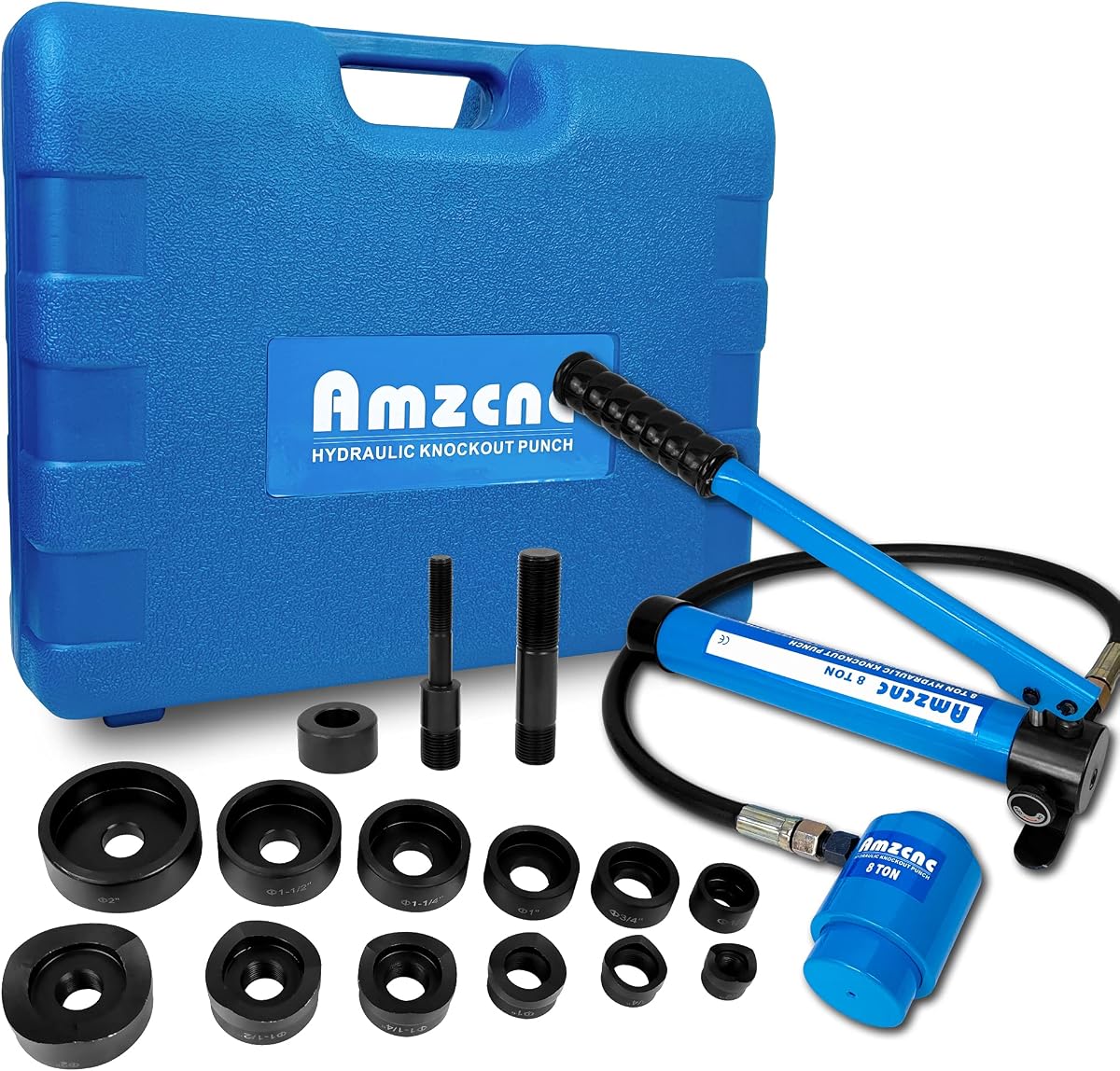
AMZCNC 8 Ton Hydraulic Knockout Punch Kit
4.4Editor score
Eight-ton hydraulic punching capacity
Six half-to-two-inch die sets
Works with Greenlee tooling
Punches seven common materials
A knockout kit for electrical panel work is essential whenever a conduit must pass through a panel, enclosure, or box and the factory knockout cannot be removed cleanly by hand. Good kits balance hole size coverage, cutting capacity, control, durability, and ease of use, with hydraulic and manual designs serving different job-site demands.
We compared all ten products by their stated purpose, knockout sizes, drive system, material capacity, included accessories, portability, and suitability for electrical panel work. The list includes dedicated knockout removers, manual ratchet punch sets, compact hydraulic kits, and professional-grade systems for larger conduit openings.
Each review explains where the kit stands out, what trade-offs may matter, and which trade it fits best. Product ratings reflect the supplied customer feedback, while technical limits come from the listed specifications. Availability and prices can change, so check the current listing before purchasing.
4.4Editor score

4.2Editor score

4.5Editor score
As an Amazon Associate we earn from qualifying purchases.
The comparison covers dedicated knockout removers, manual ratchet systems, compact hydraulic punch sets, and professional hydraulic platforms, with particular attention to conduit size, drive type, material capacity, included components, and workspace flexibility.


The VEVOR 15 T Hydraulic Knockout Punch Kit is the broadest conventional punch set in this group, combining a 15-ton hydraulic mechanism with ten punches and dies covering conduit fitting sizes from 1/2 inch through 4 inches. Its 4.2 rating reflects a useful balance of capability and value, while the adjustable ram and carrying case make it more adaptable than a simple fixed driver.
We may earn a commission when you buy through this link, at no additional cost to you.
The complete package includes a hydraulic punch, 10 punches and dies, a step drill bit, two draw studs, a piston shaft, a spacer, sealing rings, and a carrying case. Maximum punching thickness is stated as 0.1 inch for soft carbon steel and 0.08 inch for stainless steel. The 40 Cr steel and 45# steel construction, laser alignment marks, and slug-splitting dies support accurate placement and cleaner removals.
Hydraulic pressure is the main advantage when repeatedly driving large punches, especially in thick sheet metal. An on-and-off knob provides quick pressure release, the anti-skid handle improves grip, and the flexible ram angle can help where a straight ram is inconvenient. The trade-off is that this is a larger system with more components than a manual set, and its stated stainless-steel capacity is less than the carbon-steel figure.
This is the strongest all-around choice for electricians and installers who need a broad size range, repeated punching capacity, and one-person hydraulic operation. It is especially relevant when a project includes large conduit openings or several panels. Verify material thickness and the required conduit size before buying, and follow local electrical and safety requirements.
The ten-die selection gives this kit more range than the common 1/2-to-2-inch packages. That makes it useful when one trade team handles conduit runs of several diameters rather than repeatedly changing tools for separate jobs.
A 15-ton mechanism is intended to reduce the labor involved in driving the punch. The adjustable ram angle and pressure-release control also make it easier to work around confined panel locations.
We may earn a commission when you buy through this link, at no additional cost to you.
The Jonard Tools WBK-100 Panel Buddy is a focused solution for removing existing knockouts from electrical panels embedded in drywall. It handles both front and rear knockouts and carries a 4.5 rating. Unlike a full punch-and-die set, its purpose is to release a knockout without cutting a new opening in the surrounding wall.
We may earn a commission when you buy through this link, at no additional cost to you.
The tool works by pushing against the knockout to loosen and remove it. Its straightforward action avoids the need for a drill, hydraulic pump, or other powered equipment. It can be used on electrical, security, alarm, and datacom panels, giving it value beyond a single panel style. The main benefit is preserving finished drywall around the box.
The limitation is scope. A knockout remover does not provide punches, dies, or draw studs for creating fresh conduit holes, so it is not a substitute for a conventional knockout punch kit. It also cannot safely be used near live circuits, and the product information specifically warns against that use. Operators must de-energize and verify the panel before touching any knockout.
Choose this kit when the task is specifically removing an existing panel knockout and the surrounding wall is already finished. It is a simple, portable, budget-conscious answer for repair and remodel work. For new conduit openings, look to one of the manual or hydraulic punch sets reviewed later.
Because the tool releases the knockout directly, it can avoid the larger wall opening that an improvised cutting method may create. That is particularly helpful during repair work in occupied or finished spaces.
The push-to-loosen design requires no electrical power and fewer accessories than a punch set. It is a practical option when the only goal is removing an existing knockout.
We may earn a commission when you buy through this link, at no additional cost to you.
The AMZCNC 8 Ton Hydraulic Knockout Punch Kit delivers the core hydraulic-punch format with a 4.4 rating. It covers six conduit sizes from 1/2 inch to 2 inch and combines an eight-ton mechanism with a drill bit and driving bolt setup intended to produce clean, uniform holes.
We may earn a commission when you buy through this link, at no additional cost to you.
A major practical strength is its compatibility with GREENLEE and other domestic punch tooling using 3/4-inch-16 threads. The kit can punch steel, stainless steel, brass, copper, soft aluminum alloys, fiberglass, and plastic. Its stated limits are 1/8 inch for steel and 1/16 inch for stainless steel, so users should compare those figures carefully with panel or enclosure thickness.
The long plastic handle is designed to reduce slipping and transfer force effectively. That makes the system more suitable for demanding hole-making than a small hand punch, although it still requires proper driver and die alignment. Its most obvious limitation is the two-inch maximum conduit size, and users should also confirm the compatibility of their existing accessories before depending on an interchangeable system.
This kit suits electricians who regularly create 1/2-to-2-inch openings and value compatibility with familiar domestic tooling. It is a strong middle option between a manual ratchet set and a larger hydraulic package. Confirm thread standards, material thickness, and the exact die size required for the job.
Support for GREENLEE and other domestic 3/4-inch-16 threaded tooling can be valuable for shops that already own compatible punches and dies. This may make the kit easier to integrate into an established tool inventory.
The six included sizes cover many conduit openings encountered in panel installation. A long handle and drill-driven bolt arrangement help deliver force while preserving control.
We may earn a commission when you buy through this link, at no additional cost to you.
The Rack-A-Tiers Panel Buddy is another dedicated knockout-removal solution, with a 4.3 rating and compatibility across electrical, security, alarm, and datacom panels. Its distinguishing specification is support for both lipped and non-lipped panels, which is useful when the box design is not consistent across a project.
We may earn a commission when you buy through this link, at no additional cost to you.
Rather than driving a hole punch through sheet metal, this tool releases a knockout from a panel. It fills a narrow but important category: removing factory knockouts without treating the wall around the enclosure as if it needs to be cut. The design is compact and purpose-built, which can make it easier to carry than a complete punch-and-die system.
As with other removers, the key limitation is that it cannot create a new conduit opening when no suitable knockout exists. Buyers who need fresh holes should choose a manual or hydraulic punching kit instead. Its advantage over the Jonard tool is primarily the stated lipped-panel compatibility and a product range designed around several enclosure categories.
This is a good pick for remodelers, service technicians, and installers who know the panel is already installed and need its factory knockout removed. Confirm the panel style and surrounding access before purchase. Electrical isolation and verification remain essential before any knockout is disturbed.
Support for lipped and non-lipped panels gives the tool more relevance across different enclosure designs. That matters when a technician encounters a mix of boxes during maintenance or remodel work.
Keeping the task limited to knockout release avoids the need to assemble punches, dies, studs, and a driver. It is a focused alternative for maintenance work where no new hole is required.
We may earn a commission when you buy through this link, at no additional cost to you.
The SLUG-Buster CC-60 stands out with a 4.7 rating, the highest among the listed punch-oriented products. It is a manual ratchet knockout kit containing six punches in 22.5, 28.3, 34.6, 43.2, 49.6, and 61.5 millimeter sizes, along with a wrench, two pull rods, and a connector.
We may earn a commission when you buy through this link, at no additional cost to you.
Its long handle and ergonomic structure are designed to reduce effort and make repeated operation more comfortable. The complete package is housed in a durable red plastic case, making the relatively compact manual system easy to organize between jobs. It is listed for mild steel, aluminum, fiberglass, and plastic, giving users several common material options.
Manual ratcheting requires more physical input than a hydraulic kit, and large or thick workpieces can be demanding. The six punch sizes also cap the range at the listed 61.5 millimeter size, so it is not intended for the 2-1/2-to-4-inch openings addressed by some Milwaukee systems. The tradeoff is simplicity: there is no pump, motor, or separate power source to manage.
This kit is best for electricians who want clean, round holes without carrying a hydraulic system. It is also attractive for smaller installation tasks, maintenance, and field repairs. Operators should match the punch to the material, maintain square alignment, and use the proper pulling accessories included in the case.
The manual ratchet format eliminates hoses, pumps, and powered tools. That simplicity can be valuable for service vehicles and jobs where only a few openings need to be made.
Six metric punch dimensions cover a useful range of openings, while the dedicated case keeps the pieces together. The rating indicates strong customer reception without requiring an oversized hydraulic system.
We may earn a commission when you buy through this link, at no additional cost to you.
The VEVOR 10 Ton Hydraulic Knockout Punch Kit combines a 4.4 rating with a compact hydraulic format and six dies from 1/2 inch through 2 inch. The kit includes a hydraulic punch, punches and dies, a step drill bit, case, draw studs, piston shaft, spacer, sealing rings, and manual.
We may earn a commission when you buy through this link, at no additional cost to you.
Its 10-ton mechanism is intended to provide controlled force while reducing the labor associated with wrench-driven punching. The deep-draw dies use an optimized angle to require less cutting force, while laser-engraved alignment marks aid positioning. An on-and-off knob releases pressure after a punch, and the anti-skid handle is intended to improve control.
The material limits deserve attention. Soft carbon steel is rated up to 0.1 inch, but stainless steel is limited to 0.04 inch, or 20 gauge. The set can still address stainless, iron, aluminum, plastic, and fiberglass within appropriate limits. Users should not assume a punch's nominal size guarantees suitability for a particularly thick or hard workpiece.
This kit is a practical choice for contractors who want hydraulic assistance and a complete 1/2-to-2-inch set without moving to a larger professional platform. It is more specialized than the broad 1/2-to-4-inch VEVOR model. Confirm the panel material, thickness, and required opening before selecting it.
The pump, driver, and accessories fit into a dedicated carrying case, making the system more manageable than a full professional hydraulic platform. It suits mobile work where power equipment would add complexity.
Engraved alignment marks and a quick-release knob make the setup easier to inspect. These features help maintain consistent punch placement and avoid leaving pressure in the ram after each operation.
We may earn a commission when you buy through this link, at no additional cost to you.
The Manual Knockout Hole Punch Kit is a straightforward ratchet-driven set for 1/2-to-2-inch conduit openings. It has a 4.3 rating and uses 5140 steel punches, studs, and ratchet wrenches that are stated to be heat-treated to HRC48 hardness, giving it a clear emphasis on component durability.
We may earn a commission when you buy through this link, at no additional cost to you.
The kit contains six punches, two pull rods, and a wrench in a plastic case. The long handle and ergonomic structure are designed to maximize leverage and reduce user effort. Listed applications include steel, stainless steel, brass, copper, soft aluminum alloys, fiberglass, and plastic, with maximum thicknesses of 1/8 inch for steel and 1/16 inch for stainless steel.
The manual system is less effortless than a hydraulic model, particularly when the material approaches its stated limit. It also offers no size coverage beyond 2 inches. Its advantages are portability, straightforward operation, and a relatively compact footprint, making it a realistic choice for electricians who do not need powered assistance on every punch.
This kit is well suited to installers, maintenance technicians, and DIY users working with common conduit sizes in sheet metal, electrical boxes, and similar enclosures. Keep the dies clean, use the correct pull rod, and work squarely to avoid damaging the panel edge. It provides a useful balance of durability and simplicity.
The stated HRC48 hardness indicates an emphasis on durable working parts. That makes the kit appealing for repeated service work where tool deformation and wear are important concerns.
The six listed sizes align with common electrical conduit dimensions. A long handle and included pull rods support controlled manual punching without a powered system.
We may earn a commission when you buy through this link, at no additional cost to you.
The Greenlee 7906SB is a professional hydraulic knockout system built around the Quick Draw 90 driver. Its 4.5 rating and specialized design make it a premium option for contractors who repeatedly work in panels and other tight electrical spaces. The kit covers 1/2-to-2-inch conduit sizes with matching Slug-Buster punches and dies.
We may earn a commission when you buy through this link, at no additional cost to you.
The compact, lightweight approach is designed for one-person operation. Its right-angle hydraulic punch driver head rotates more than 180 degrees, a meaningful advantage when the ram cannot approach the work from a straight line. The dog-point draw-stud tip is intended to eliminate cross-threading, and hex-key access allows studs to be removed from the tool more easily.
Capacity extends to 10-gauge mild steel and 12-gauge stainless steel, with listed use across aluminum, brass, copper, fiberglass, and plastics. The included KCC-QD2 case has markings for part identification, and both 7/16-inch and 3/4-inch short hydraulic draw studs are supplied. These details show attention to the repeated setup and transport demands of professional work.
This kit is best for electricians, mechanical contractors, and specialty fabricators who need a dependable professional driver and frequent access in confined areas. Its limitation is size: it does not cover openings larger than 2 inches, and its premium positioning may be unnecessary for occasional work. Choose it for workflow quality and maneuverability rather than maximum range.
The rotating right-angle head can change the ram orientation by more than 180 degrees. This gives the operator more options when a panel is boxed in, mounted high, or otherwise difficult to approach directly.
The dog-point tip and hex-key access are intended to make stud handling more predictable. A marked case reduces the time required to find the correct die, punch, or draw stud on a busy job site.
We may earn a commission when you buy through this link, at no additional cost to you.
The Milwaukee 49-16-2695 M18 Exact set offers a distinctive alternative to the many half-to-two-inch kits in this roundup. It is designed for 2-1/2-to-4-inch knockouts, carries the highest supplied rating at 5.0, and uses the M18 cordless platform. That range makes it a natural fit for larger conduit work.
We may earn a commission when you buy through this link, at no additional cost to you.
The product information emphasizes ease of use and handling, while its cordless design avoids the need to position a hydraulic pump near the work. For a panel installed in a tight mechanical room or elevated location, a compact battery-powered tool can offer valuable flexibility. It also fits contractors who already standardize their equipment around the M18 platform.
Its principal limitation is specialization. The set focuses on larger openings, so it does not replace a conventional half-to-two-inch kit for a full range of common sizes. The supplied information does not provide detailed material-thickness figures or a complete component list, so buyers should review the current listing to confirm those specifications for their panel and conduit.
This is a compelling choice for installers who specifically need large knockouts and value a cordless workflow. The 5.0 rating is encouraging, but product fit matters more than the rating alone. Confirm the required diameter, panel material, accessories, battery availability, and compatibility with the rest of the intended workflow before buying.
The 2-1/2-to-4-inch range fills a gap left by conventional compact kits. It is aimed at trades that regularly work with larger conduit sizes rather than a broad range of small openings.
Battery-powered operation can simplify setup around installed panels and confined equipment areas. It also offers workflow consistency for users who already maintain M18 batteries and chargers.
We may earn a commission when you buy through this link, at no additional cost to you.
The Milwaukee M18 Force Logic 6T Knocko is a high-force, cordless knockout tool built for professional users who want power without a separate hydraulic pump. Its 4.3 rating and six-ton class place it in the serious end of this list, while the M18 platform can simplify battery and charger logistics for established crews.
We may earn a commission when you buy through this link, at no additional cost to you.
The supplied listing is concise, confirming the M18 Force Logic 6T identity, a 6T output class, and shipment with relevant accessories. It does not provide a detailed size range, material-thickness chart, or component inventory, so this review avoids inferring specifications that are not listed. Those details should be confirmed on the current product page before purchase.
The cordless format is the central advantage. It allows one-person operation without positioning hoses or maintaining a separate power source near the panel. The six-ton force rating suggests it is intended for more demanding knockout work than a lightweight manual remover. Its trade-offs are the dependency on the M18 battery ecosystem and less immediately available sizing information in the supplied product data.
This tool is best for professional electrical, mechanical, or fabrication work where cordless high-force punching is valuable and the required dies and accessories are confirmed. It is less suitable for buyers who need a broad, clearly specified punch-and-die collection from one purchase. Review the live listing for compatibility, dimensions, and kit contents before ordering.
A six-ton cordless design can reduce setup around crowded panels. It removes the need to position a hydraulic pump and manage connections at the point of work.
The M18 platform and included relevant accessories support a professional mobile workflow. Users should confirm the exact accessories and battery requirements before incorporating the tool into a standard kit.
We may earn a commission when you buy through this link, at no additional cost to you.
The right knockout kit depends on whether you only need to release a factory knockout or must create a new opening, plus the required diameter, panel material, thickness, available space, and preferred drive system. These factors narrow the choice faster and reduce the risk of buying an incomplete or unsuitable set.
A panel knockout remover is a specialized device for loosening and releasing an existing knockout from the front or rear of an installed enclosure. It is especially useful when drywall is already in place and you do not want to cut the wall. A complete punch kit is needed when the panel has no usable knockout or the opening must be larger than the factory options. The Jonard and Rack-A-Tiers products in this guide belong to the removal category, while the other systems include punches and dies for creating holes.
Choose a remover for repairs and remodel tasks focused on opening an existing panel. Choose a punch set for new construction, larger openings, or situations requiring a specific conduit diameter.
Most compact kits in this roundup cover 1/2, 3/4, 1, 1-1/4, 1-1/2, and 2 inch conduit sizes. The VEVOR 15 T expands through 4 inches, while the Milwaukee M18 Exact set focuses on 2-1/2-to-4-inch openings. The SLUG-Buster provides its six sizes in millimeters, so check the measurement table rather than assuming every listed die matches a standard inch designation.
List the actual conduit diameter and compare it with the included die sizes before buying. Buying a broad set is convenient, but a kit that directly covers the required range is more useful.
Manual ratchet systems are portable, straightforward, and avoid a pump, battery, or hydraulic maintenance. They are effective for a limited number of openings but require more physical effort. Hydraulic kits provide much greater force and are better suited to repeated work, larger punches, or thicker material. Cordless options add mobility but introduce battery and platform considerations.
Choose manual for occasional work and portability. Choose hydraulic for repeated punching. Compare cordless tools when access is difficult or the crew already uses that battery platform.
The relevant metal determines the force and tooling required for a clean opening. Listed limits vary considerably: the AMZCNC set states 1/8 inch steel capacity, VEVOR's 15 T set states 0.1 inch for soft carbon steel, and Greenlee specifies up to 10-gauge mild steel. Stainless ratings are often lower, so a tool suitable for one material may not be suitable for another.
Identify both the panel material and its actual thickness before purchasing. Stay within the lower applicable limit, and note that aluminum, brass, fiberglass, and plastic have different cutting characteristics.
A knockout can be difficult to reach after the panel is mounted. The Greenlee system uses a right-angle head that rotates more than 180 degrees, while the VEVOR systems mention adjustable ram angles and suitability for narrow places. Removers can be valuable when the panel is embedded in drywall because they avoid creating a large wall opening around the enclosure.
Consider the direction of approach, available hand clearance, and location of nearby equipment. A compact or angled driver may matter more than capacity when the punch site is tightly enclosed.
A useful kit should include the driver or pump, appropriate punches and dies, draw or pull studs, a wrench, and storage for every piece. Several products add a step drill bit, piston shaft, spacer, sealing rings, or a manual. The Greenlee case uses markings for part identification, while the SLUG-Buster and manual kits use compact plastic cases. Missing accessories can make an otherwise capable system inconvenient or expensive to complete.
Compare the complete contents rather than judging by the main tool alone. Organized storage is especially valuable for field technicians who need to find the correct die quickly.
Tool compatibility can be a decisive advantage for established shops. The AMZCNC hydraulic kit states compatibility with GREENLEE and other domestic tooling using 3/4-inch-16 threads, allowing some existing punches and dies to be used. Other sets may use proprietary or less clearly documented interfaces, making replacement parts and combined workflows less convenient.
Check thread standards, driver types, punch interfaces, and die dimensions before integrating a kit with existing equipment. Compatibility claims should be matched to the exact accessory you already own.
Portability extends beyond physical weight. Manual systems need only a case of relatively small parts, hydraulic systems must be kept sealed and organized, and cordless tools depend on charged batteries. The Greenlee kit emphasizes compact one-person operation, while the VEVOR sets highlight carrying cases and flexible ram positioning. Consider vehicle space, stair access, ladder use, and how often the kit must travel.
Select the system that matches the actual work environment. A more powerful tool is not automatically better if it is difficult to transport, position, or operate where the panel is installed.
Before using a knockout tool, de-energize the electrical panel, identify the circuit, and verify absence of voltage with appropriate test equipment. Remove covers only as directed by the panel manufacturer, protect nearby surfaces, and wear suitable eye protection. Never work on a live knockout or use a removal tool near energized components.
For a hydraulic punch kit, install the correctly sized die on the output side, align the punch with the die, and attach the specified draw or pull stud securely. Confirm the ram is fully retracted before operating the pump. Keep the driver square to the panel, brace the enclosure, run the ram smoothly, and release pressure before separating the slug or removed knockout.
After the job, wipe away metal debris, wipe the tool clean, and return punches, dies, studs, and accessories to their marked storage positions. Inspect edges for chips, cracks, or deformation, and check seals and connections on hydraulic systems for leakage. Store manual tools dry, protect hydraulic kits from impact and temperature extremes, and follow the manufacturer's instructions for battery-powered models.
A knockout kit is used to remove a factory knockout or create a new round opening for conduit and other fittings. Dedicated removers release existing knockouts, while punch-and-die sets combine a punch, die, and driver to form new holes. The appropriate type depends on whether the panel already has the required knockout and whether the opening must be a particular size.
Some knockouts can be removed with a screwdriver or similar tool, but the process may twist the enclosure or damage the surrounding finish. A dedicated panel knockout remover is designed to release the knockout more directly and is especially useful near finished drywall. The panel must always be de-energized and verified before any knockout is disturbed.
A hydraulic punch is generally better for repeated work, thick material, and larger driving forces because it reduces manual effort. A manual ratchet is simpler, lighter, and easier to transport for occasional jobs. The best choice depends more on workload, material thickness, panel location, and required hole size than on either drive type alone.
Choose a punch size that matches the actual conduit or fitting diameter rather than relying on a rough visual estimate. Most common kits cover 1/2 through 2 inch conduit, while larger systems cover 2-1/2 through 4 inch openings. Some listed punch dimensions use millimeters, so consult the measurement guide and compare them with the intended fitting.
Some kits can punch stainless steel within a stated thickness limit, but stainless capacity is commonly lower than mild-steel capacity. Do not assume that a punch suitable for carbon steel can safely handle the same stainless thickness. Check the manufacturer's rating and the actual panel specification before applying the tool.
A dedicated remover can release front or rear knockouts without the need to cut holes in surrounding drywall, provided the panel and knockout remain accessible. Access can still be limited by trim, cabinets, or equipment. A full punch set may require room behind the panel for a draw stud, driver, or hydraulic hose.
Misalignment, a mismatched punch and die, excessive panel movement, a dirty or damaged die, and material that exceeds the tool's capacity can all cause poor results. Confirm that the correct die is installed, that the panel is firmly supported, and that the punch and die are clean and undamaged. Stop if the tool begins to bind rather than applying additional uncontrolled force.
Keep the tool free of metal shavings, clean the dies after use, and inspect the pump, ram, seals, and connections for damage or leakage. Store the components in the provided case and follow the manufacturer's instructions for fluid service if the system uses hydraulic oil. A cordless model should be stored according to its battery manufacturer's safety guidance.
The AMZCNC 8 Ton kit offers an attractive balance of hydraulic capability, six common die sizes, and compatibility with established domestic tooling. The VEVOR 15 T system is the broadest conventional choice here, while the Greenlee 7906SB stands out for its professional driver, tight-space maneuverability, and organized accessory system.
Prioritize the task before the features: use a dedicated remover for an existing knockout, a manual ratchet for occasional portable work, a hydraulic system for repeated or demanding punching, and a large-diameter cordless set for openings beyond 2 inches. Confirm the exact diameter, material, thickness, available clearance, and accessory compatibility before purchasing.
Ratings and specifications provide a useful starting point, but current product availability and prices can change. Review the latest listing, manufacturer instructions, warranty information, and included parts at the time of purchase, and always de-energize the electrical panel before operating any knockout tool.
