
YUNZII QL108 Typewriter Style Mechanical Gaming Keyboard
4.5Editor score
Full 104-key layout
Hot-swappable 3-pin switches
Five-pin switch compatibility
Dynamic RGB lighting
Metal frame construction
Explore the best keyboards that sound like a typewriter, comparing switches, connectivity, layouts, lighting, build quality, and typing comfort.
A keyboard that sounds like a typewriter can make ordinary writing sessions feel deliberate, rhythmic, and satisfying. The best models pair round vintage-style keycaps with tactile or clicky mechanical switches, while adding modern conveniences such as wireless connectivity, programmable controls, and adjustable lighting.
This guide compares ten typewriter-inspired keyboards based on their switch behavior, acoustic character, layout, construction, connectivity, lighting, ergonomics, and feature set. It covers wired and wireless models for writers, office users, gamers, and enthusiasts, with options ranging from compact 75-percent designs to full-size boards with number pads.
Each review highlights the strongest reason to consider a particular model, along with practical limitations. The top selections range from a versatile enthusiast keyboard to a feature-rich full-size option and a premium multi-device model. Product listings and availability can change, so confirm the latest specifications and configuration before ordering.
4.5Editor score

4.4Editor score

4.2Editor score
The comparison below highlights the major differences in layout, connectivity, switch design, lighting, and control options. These factors help separate straightforward wired keyboards from highly programmable enthusiast models and practical wireless combinations.



The Retro Typewriter Wireless Mechanical Gaming Keyboard combines an 83-key layout, round retro keycaps, clicky blue switches, and a wood-accented design. With a 4.3 rating, it stands out as a balanced option for writers who want the unmistakable snap of mechanical blue switches without giving up modern wireless convenience. Its closest appeal lies in the combination of authentic typewriter character and practical everyday controls.
We may earn a commission when you buy through this link, at no additional cost to you.
Sound is the defining feature here. Blue switches provide crisp actuation and noticeable tactile feedback, creating the lively, percussive rhythm associated with traditional typewriters. The keyboard also supports hot-swappable switches and keycaps, so enthusiasts can move toward linear or tactile alternatives when a shared office calls for less noise. A stainless-steel lever changes the white backlight, while separate knobs handle brightness and volume, placing useful adjustments directly on the desk.
Connectivity is another strength. USB-C and Bluetooth allow the keyboard to pair with up to three devices, including a tablet, laptop, or phone. Compatibility with Windows, macOS, and Android makes it useful for a mixed-device workspace. The compact 83-key format omits the number pad, which improves desk space but will frustrate users who regularly enter large amounts of numerical data. The wooden styling also makes the board feel more at home as a permanent desktop centerpiece than a travel accessory.
This is a strong recommendation for writers, students, and keyboard enthusiasts who prioritize a lively clicky sound, distinctive styling, and flexible wireless switching. It may be less suitable for accountants, spreadsheet-heavy users, or anyone who needs a numeric keypad. Even so, its hot-swap design, tactile controls, and compact footprint make it one of the most complete choices for recreating a typewriter-inspired mechanical experience.
The blue switches supply both audible clicks and a distinct tactile bump, giving every keystroke a clear point of actuation. That feedback helps explain the keyboard's appeal for long-form writing and nostalgic mechanical setups, while hot-swappable sockets provide an easy route to a quieter setup when needed.
Two dedicated knobs simplify brightness and volume changes, while the lever-operated lighting offers 14 white backlight modes. USB-C and Bluetooth support across three devices makes the keyboard convenient for anyone moving between a computer, tablet, and phone without reconnecting a wired cable each time.
We may earn a commission when you buy through this link, at no additional cost to you.
The YUNZII QL75 is a 75-percent retro mechanical keyboard with round keycaps, a wood-style enclosure, integrated device stand, and a 4.4 rating. It is designed for enthusiasts who care about both the sound and behavior of their switches. Unlike simple aesthetic keyboards, the QL75 gives buyers extensive control over layout, lighting, device switching, and everyday ergonomics.
We may earn a commission when you buy through this link, at no additional cost to you.
Its hot-swappable PCB accepts common 3-pin and 5-pin mechanical switches. That means users can begin with the included pre-lubed switches and then tailor the acoustic result by choosing tactile or linear alternatives. The gradually ascending key rows are a meaningful ergonomic detail, creating a more typewriter-like profile while reducing the need to reach for a wrist rest. The round keycaps and wood finish deliver the nostalgic appearance, but the feature set is decidedly modern.
QMK and VIA support is the QL75's major advantage for experienced users. Remapping keys, creating shortcuts, and adjusting layers can be handled through supported customization software rather than relying only on limited onboard commands. Tri-mode connectivity includes USB-C, Bluetooth, and 2.4GHz wireless, with the ability to switch among as many as five devices. The integrated stand can hold a phone, tablet, or pad while preserving the keyboard's compact footprint.
The QL75 is best for keyboard enthusiasts, programmers, and writers who enjoy tuning a setup. It is less suitable for someone seeking a simple plug-and-play peripheral or a full-size board with a number pad. The broader ecosystem also requires a short learning period, but for users who value customization, the QL75 delivers an unusually complete typewriter-inspired package.
The hot-swappable design makes the keyboard a flexible starting point for anyone refining a preferred sound. Pre-lubed switches provide a smoother initial experience, while compatible tactile and linear options let users compare quieter, sharper, or heavier-sounding alternatives without replacing the entire board.
QMK and VIA support expands the QL75 beyond appearance and sound. Users can tailor layers, shortcuts, and lighting behavior to their workflow, which is especially valuable for programmers and anyone who wants a keyboard to adapt to different applications.
We may earn a commission when you buy through this link, at no additional cost to you.
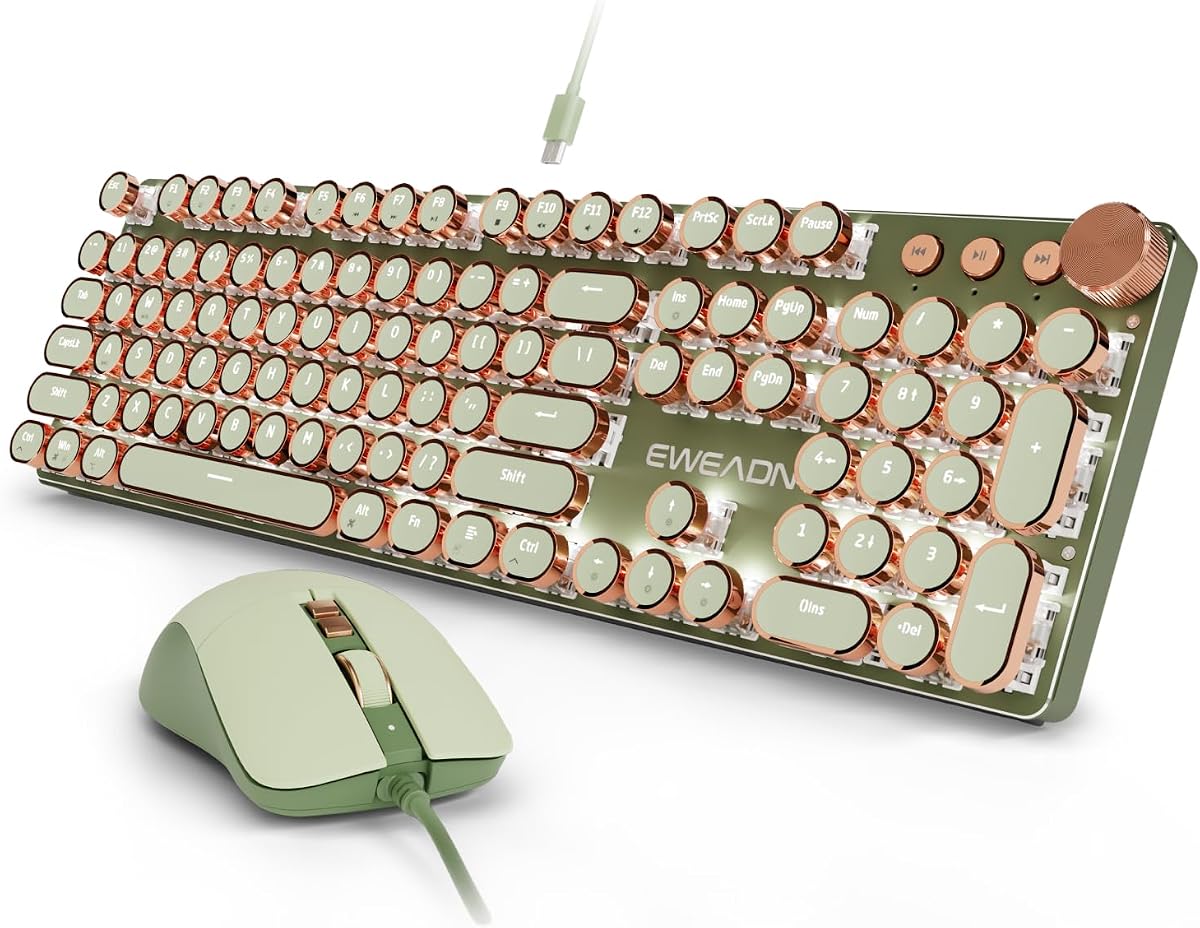
The Wired Typewriter Keyboard and Mouse Combo is a green, typewriter-inspired set that focuses on softer mechanical feedback rather than aggressive clicking. It carries a 4.4 rating and includes a keyboard, ergonomic wired mouse, illuminated keys, and a multimedia knob. It is an appealing choice for shared offices and home setups where the visual character of a typewriter keyboard is desired without the disruption of loud blue switches.
We may earn a commission when you buy through this link, at no additional cost to you.
The keyboard uses smooth linear pink switches, which produce a gentle pop with less harsh clacking than many clicky mechanical options. A scientific key spacing is intended to support accuracy and comfort, while the dynamic lighting adds atmosphere without dominating the green body and chrome round keycaps. The metal rotary knob handles volume or muting, and preset lighting modes can be selected directly without software.
The included mouse is designed for extended use, with a contoured shape and adjustable DPI from 1200 to 2400. It uses an independent wired connection, so it can be placed and used separately from the keyboard. That makes the package more versatile than a permanently joined keyboard-and-mouse set, although the matching aesthetic is strongest when both pieces share the same desk.
This combo is ideal for a writer, student, or office worker who wants typewriter styling with a gentler sound. It also appeals to anyone starting a desktop setup and wanting a mouse in the same package. Users with modern USB-C-only laptops may need an adapter, and advanced keyboard enthusiasts may eventually prefer a hot-swappable model. As a ready-to-use decorative set, however, it offers convincing style and approachable ergonomics.
Pink linear switches preserve the satisfying mechanical bottom-out while reducing the sharp click associated with blue switches. The result suits users who still want a mechanical rhythm but prefer a calmer soundtrack during calls, shared workspaces, or evening writing.
Pairing the keyboard with a contoured, adjustable-DPI mouse reduces the need to source several accessories for a new workspace. Independent mouse cabling, plug-and-play operation, and system shortcuts make the set approachable for everyday office tasks.
We may earn a commission when you buy through this link, at no additional cost to you.
The YUNZII QL108 is a full-size typewriter-style mechanical keyboard that combines 104 keys, a metal shell, round electroplated keycaps, and dynamic RGB lighting. Its 4.5 rating makes it one of the strongest all-around choices in the group, particularly for users who need a number pad but still want unmistakable retro styling and the option to tune their switch sound.
We may earn a commission when you buy through this link, at no additional cost to you.
The hot-swappable PCB accepts both 3-pin and 5-pin switches, and the keyboard arrives with pre-lubed onyx gray switches. These provide a smooth, creamy feel while retaining a satisfying click. Users can change the acoustic and tactile character without desoldering anything, making the QL108 a practical entry point for mechanical keyboard customization. The south-facing RGB system adds color that shines through the rounded legends without erasing the typewriter-inspired appearance.
Construction is another advantage. The metal frame provides stability and gives the keyboard a more substantial feel than an all-plastic board. South-facing lighting, a wired Type-C connection, and an adjustable footrest round out a focused design. The keyboard supports Windows, macOS, Android, and iOS, while online customization for Windows and Mac allows users to reprogram keys and create macros.
The QL108 is a strong recommendation for office-focused users, gamers, and mechanical keyboard newcomers who want full-size functionality. It suits anyone who prefers a stable wired connection and appreciates a tactile sound without giving up switch customization. Its lack of wireless modes means it is less convenient for a clutter-free multi-device desk, but the trade-off supports its stable performance and enthusiast-oriented feature set.
The dedicated number pad makes the QL108 useful for accounting, spreadsheets, data entry, and games that require rapid numerical input. Round keycaps and electroplated details preserve the retro theme, so practical full-size functionality does not come at the cost of visual personality.
The metal panel and adjustable footrest help keep the board stable during vigorous typing. With hot-swap sockets and broad switch support, users can experiment with quieter or more pronounced switch options while retaining a sturdy platform.
We may earn a commission when you buy through this link, at no additional cost to you.
The Typewriter Style Mechanical Gaming Keyboard White LED Backlit is a full-size keyboard with a steampunk-inspired appearance, 104 keys, and smooth white linear switches. Its 3.9 rating is the lowest among the selections, but the design remains relevant for users who want a clean typewriter look, straightforward wired operation, and a calmer sound than a traditional clicky mechanical switch.
We may earn a commission when you buy through this link, at no additional cost to you.
White linear switches deliver smooth actuation and moderate resistance without a tactile bump. That makes the keyboard a sensible choice for users who want a mechanical rhythm but do not need the pronounced click of a blue switch. The double-shot keycaps support even illumination, and 19 lighting effects include both static and dynamic modes. Brightness, speed, and preset game lighting are all adjustable through onboard key combinations.
Practical details are handled well. A detachable USB-A cable reduces strain at the connector and can be replaced if damaged. The tactile volume knob and three dedicated multimedia keys make common adjustments straightforward. An aluminum alloy panel and adjustable tilt feet create a stable platform, while full-key N-key rollover helps register simultaneous inputs during rapid typing or gaming.
This model is best for a gamer or office user who values a complete layout, straightforward controls, and a less aggressive sound. It is less attractive to typists who require a strong tactile event, and its rating suggests some buyers may have found aspects less compelling. Even so, the detachable cable, NKRO support, and adjustable construction make it a functional alternative to more complex enthusiast keyboards.
The white linear switches provide a smooth up-and-down action without the sharp click or pronounced bump of blue switches. This can make the keyboard more comfortable in shared environments while preserving the satisfying mechanical bottom-out.
A detachable cable, tactile volume control, dedicated media keys, and adjustable feet are useful refinements that do not require software. The 104-key layout also keeps numerical controls close at hand, while NKRO supports reliable multi-key input.
We may earn a commission when you buy through this link, at no additional cost to you.
The Wireless Typewriter Style Mechanical Keyboard with White Backlit, Pink has the highest rating in the group at 4.7. It combines a compact form, tactile blue switches, 18 white lighting modes, and tri-mode connectivity in a distinctly pink metal-panel design. The result is especially appealing for writers and creators who want a lively typewriter-like sound and a striking desktop centerpiece.
We may earn a commission when you buy through this link, at no additional cost to you.
The blue switches provide crisp tactile feedback and a satisfying acoustic signature. Their resistance makes each keystroke deliberate, which can feel engaging during extended writing sessions. White illumination spreads across the metal faceplate and concave round keycaps, while 18 lighting modes allow the appearance to shift without sacrificing the restrained monochrome glow. The curved layout is designed to support fingertip positioning during long sessions.
Connectivity is comprehensive. Bluetooth, 2.4GHz wireless, and USB-C wired modes support switching among as many as five devices, including a Mac, PC, tablet, or smartphone. A 5000mAh rechargeable battery is designed to reduce charging interruptions, and USB-C recharging keeps the process simple. This makes the keyboard a convenient centerpiece for a multi-device workspace that still needs an audible mechanical edge.
The keyboard is best for writers, students, and creative professionals who enjoy clicky tactile feedback and distinctive retro styling. It may not be the first choice for someone in a shared office, where blue switches can be conspicuous. The absence of a number pad also limits its value for data-heavy workflows, and its switch configuration appears fixed. Even so, the rating, battery capacity, multi-device support, and attractive design make it a particularly strong compact recommendation.
Tactile blue switches create a pronounced typing rhythm without relying on an especially heavy or linear feel. Concave round keycaps and the curved layout complement the switch feedback, making the keyboard visually elegant and physically focused on fingertip placement.
Tri-mode connectivity and support for five paired devices reduce the friction of moving between computers, tablets, and phones. The large rechargeable battery further supports an uncluttered wireless setup without making frequent cable changes necessary.
We may earn a commission when you buy through this link, at no additional cost to you.
The Wireless Keyboard and Mouse, Backlit Typewriter with Magnetic Wrist Rest is a practical all-in-one set for home offices, studios, and classrooms. It combines a round-keycap keyboard, RGB-lit six-button mouse, 2.4GHz wireless receiver, and a detachable magnetic wrist rest. Its 4.4 rating reflects a package that emphasizes comfort and convenience as much as nostalgic appearance.
We may earn a commission when you buy through this link, at no additional cost to you.
The wrist rest is one of the most useful additions. Soft sponge padding and a skin-friendly outer surface support the wrists during extended typing, and the magnetic attachment makes it easy to remove when changing desk configurations or switching to a more traditional typing posture. The built-in phone holder is another practical touch, keeping notifications visible without requiring a separate stand.
Both keyboard and mouse are rechargeable through USB-C and use auto-sleep and physical power controls to conserve energy. A single USB receiver connects the pair, with a stated wireless range of up to 33 feet. The keyboard offers seven backlight colors, while the mouse has 11 lighting modes and three DPI settings. Dual-system layouts support Mac and Windows, and broader compatibility extends to Linux and Chrome OS.
This set is a good match for someone building a complete workstation without researching several accessories separately. It is also well suited to shared gifts, teaching spaces, and offices where a clean wireless desk is important. Those seeking a pronounced mechanical blue-switch sound may find the switch details less satisfying than the dedicated mechanical models, but the focus here is a complete, comfortable, and visually coordinated setup.
The magnetic wrist rest adds a level of support that many compact keyboards omit. Because it detaches easily, users can keep it in place for long writing sessions and remove it when a centered or raised typing position feels better.
The included receiver links both keyboard and mouse, reducing the number of USB adapters occupying a port. Rechargeable construction, auto-sleep behavior, and separate power switches make the set straightforward to maintain as a daily wireless workstation.
We may earn a commission when you buy through this link, at no additional cost to you.
The Typewriter Wired Mechanical Gaming Keyboard is a straightforward RGB mechanical board with steampunk round keycaps and blue switches. It has a 4.3 rating and offers the clear rhythmic clacking, tactile feedback, and durable metal construction expected from a typewriter-inspired gaming keyboard. It is especially relevant to players who want responsive input, a recognizable aesthetic, and color-rich lighting.
We may earn a commission when you buy through this link, at no additional cost to you.
The blue switches are the board's defining element. They provide an audible click and tactile bump, making each action distinct without relying on visual feedback. A stepped key layout, dedicated multimedia keys, and adjustable feet support comfortable positioning, while the aluminum alloy panel gives the keyboard a stable base. Full N-key rollover helps ensure that rapid or simultaneous inputs register reliably during gameplay.
RGB lighting adds a modern counterpoint to the steampunk design. Multiple color modes, adjustable brightness, and controllable speed allow the keyboard to move between a subtle desk accent and a more animated gaming setup. The wired interface avoids battery management and wireless interference, making it straightforward to connect and use. Compatibility with both Windows and Mac broadens its everyday appeal beyond gaming.
This keyboard is recommended for gamers and typists who enjoy clicky blue switches and want full-size performance without programming complexity. It is less suitable for a minimalist multi-device desk because the wired connection cannot be switched among devices. Users who require remapping, macros, or extensive lighting effects should look toward a more programmable model. For straightforward RGB and a bold mechanical sound, however, it remains a capable choice.
Blue switches make the point of every press distinct through a tactile bump and audible click. That clarity can be useful during fast typing and gaming, although it also makes the board more noticeable in shared or quiet environments.
The aluminum alloy panel and adjustable feet help maintain a consistent typing angle and reduce movement. South-facing RGB illumination adds saturated color and dynamic modes, allowing the retro keycaps to function as both functional keys and decorative elements.
We may earn a commission when you buy through this link, at no additional cost to you.
The FINEDAY Keyboard 2.0 Plus is a 104-key retro mechanical keyboard that draws heavily from historical typewriter design. With a 4.2 rating, it stands apart through its lever-style left key, dual aluminum control wheels, integrated device storage, and support for as many as five devices. It is a premium choice for writers who want historical design translated into a modern wireless productivity tool.
We may earn a commission when you buy through this link, at no additional cost to you.
The aluminum left lever functions as an Enter key, while a separate left wheel adjusts white LED brightness and a right wheel controls connected-device volume. These physical controls are more tactile and immediately accessible than software menus, reinforcing the keyboard's machine-like character. A 9.22-degree cradling angle and integrated stand are designed to improve long-session comfort and keep a phone, tablet, or other device nearby.
Blue switches deliver the advertised clickty, tactile “clickety-clackety” experience associated with traditional typing. The 5000mAh built-in battery is intended to support long periods of wireless use. Connectivity is notably flexible: three devices can be connected through Bluetooth, one through the 2.4GHz receiver, and one through USB, allowing all five to be used simultaneously.
The Keyboard 2.0 Plus is best for writers, editors, and enthusiasts who prioritize authentic visual design, tactile controls, and broad device support. It is less appropriate for users seeking a compact layout or extensive documented macro controls. Its full-size footprint also occupies more desk space than a 75-percent board, but for a permanent writing station, the historical details and flexible connectivity can be especially rewarding.
The lever-style Enter key, aluminum wheels, and angled typing profile recreate familiar elements of a mechanical typewriter. Instead of being purely ornamental, those details provide direct control over Enter, brightness, volume, and typing angle.
Supporting three Bluetooth connections, one 2.4GHz connection, and one USB connection gives the keyboard exceptional cross-device flexibility. The integrated stand further reinforces its role as the central control point for writing across a computer, tablet, or phone.
We may earn a commission when you buy through this link, at no additional cost to you.
The Redragon K710 is a full-size wireless mechanical keyboard that combines round typewriter-style keycaps, blue switches, a metal panel, and extensive RGB control. Its 4.5 rating reflects a balanced gaming and productivity design, particularly for users who want the clicky feel of blue switches without giving up wireless switching or programmable shortcuts.
We may earn a commission when you buy through this link, at no additional cost to you.
Blue switches provide medium resistance, audible clicks, and tactile feedback, producing the responsive mechanical character expected from a gaming keyboard. The vintage steampunk keycaps give the board a distinctive typewriter appearance, but its underlying design is modern. USB-C wired, Bluetooth 3.0 and 5.0, and 2.4GHz wireless modes cover nearly every common connection preference, with onboard shortcuts used to select them.
The lighting system offers up to 16 presets, seven solid colors, adjustable brightness, and flowing speed. Software can expand that customization further by allowing individual keys to use different colors. Macros and custom keybindings are also supported through dedicated software, which can be downloaded for the K710W model from Redragon's official software page. The metal panel and 104-key anti-ghosting layout provide stability and reliable multi-key input.
The K710 is an excellent choice for gamers, programmers, and keyboard enthusiasts who want full-size convenience, wireless freedom, and extensive personalization. It is less convenient for users who want an entirely software-free experience because the deepest customization requires a separate driver installation. It also demands more desk space than a compact model. Even so, the combination of typewriter styling, blue-switch response, and deep programmability makes it one of the most versatile entries here.
Beyond physical lighting controls, software allows custom keybindings, macros, and individual key colors. This makes the K710 useful for users who want one keyboard to handle gaming shortcuts, productivity commands, and a distinctive desk aesthetic.
Bluetooth, 2.4GHz, and wired Type-C modes provide flexibility without removing the stable connection of a full-size gaming board. The metal panel contributes stability, while anti-ghosting support helps sustain accurate input during rapid and simultaneous presses.
We may earn a commission when you buy through this link, at no additional cost to you.
A satisfying typewriter-like experience depends on more than appearance. Switch type, layout, connectivity, construction, controls, and intended environment should all be considered before choosing a keyboard.
Blue switches deliver the clearest click, heaviest tactile event, and most recognizable mechanical typewriter rhythm. They suit writers who actively seek a crisp percussive sound, though they can be distracting in shared offices. White linear switches provide a smoother, quieter action without a tactile bump, while pink linear switches soften the acoustic profile further. Tactile switches add a noticeable bump without the sharpest click and can feel more controlled.
In short, choose blue switches for maximum click and feedback, or white and pink linear switches for a quieter sound. Consider the room and people around you before selecting the loudest option.
Compact boards with 75 or 83 keys maximize usable desk space and work well for writing, travel, and uncluttered setups. Full-size 104-key models include a number pad, dedicated navigation cluster, and multimedia controls, which are more useful for spreadsheets, accounting, data entry, and gaming. Integrated stands can support a tablet or phone, but they may raise the viewing angle in a way some users do not prefer.
Choose a compact layout when every centimeter matters and a full-size model when numerical entry or separate navigation keys are priorities. Check the actual key count and included functions before ordering.
Wired keyboards provide a stable connection with no charging routine and are often appropriate for a fixed gaming or office station. Wireless models reduce cable clutter and can move between a laptop, tablet, and phone. Tri-mode boards support wired, Bluetooth, and 2.4GHz connections, while some can maintain several paired devices. Battery capacity, charging port, auto-sleep behavior, and range are important considerations for frequently mobile setups.
Choose wired operation for the simplest fixed desk, or tri-mode connectivity when you regularly switch devices. For wireless use, confirm that the keyboard supports the connection method and operating systems you actually own.
Hot-swappable sockets let users change compatible 3-pin or 5-pin switches without soldering, making it easier to refine sound and feel. QMK, VIA, and web-based configuration tools add deeper control over remapping, macros, and lighting. Build quality also matters: metal frames and panels generally feel more stable than lightweight plastic cases, while double-shot keycaps resist character wear better than inexpensive surface-printed alternatives.
Prioritize hot swapping and durable construction if you enjoy experimenting with switches. Look for QMK or VIA support when programming and remapping are important, and note whether switch PCB support includes both 3-pin and 5-pin components.
A typewriter impression comes from a combination of click, bottom-out sound, spacing, and physical movement, not simply round keycaps. Blue switches provide the most explicit click, while pre-lubed switches can reduce harshness without eliminating character. A stepped or ascending row layout can improve the historical profile and may reduce wrist extension, while a solid case and stable feet can prevent distracting vibration.
Prioritize tactile blue switches and a stepped layout for the strongest typewriter effect. If realism must be balanced with quiet operation, choose smooth linear switches and add a case or wrist support that limits vibration.
Dedicated volume and brightness knobs make common adjustments faster than software menus. Rotary knobs can be especially convenient for muted calls, media playback, and changing lighting during the day. Backlighting options range from restrained white illumination to dynamic RGB effects. Enthusiasts may value per-key color control and custom modes, while users who mainly need legibility may prefer even white backlighting with simple brightness controls.
Choose a model with clear physical controls and simple lighting if convenience is the priority. Select programmable RGB and software control only when the added visual and functional complexity will be used regularly.
Typewriter-inspired keyboards can feel unusual because of raised rows, round keycaps, and pronounced switches. Curved or gradually ascending layouts may reduce strain, while a detachable wrist rest can help during long sessions. The included mouse matters for complete setups, and adjustable DPI, independent cables, and multi-device pairing can improve workflow more than extra decorative lighting. Desktop space should also be considered before choosing a full-size model.
Look for a raised but comfortable row profile and a wrist rest if you type for long periods. Choose a compact board for limited space, and consider a keyboard-and-mouse set if you are building an entire workstation.
Begin by installing the correct keycap and switch pullers if the keyboard is hot-swappable. Power it on, connect through the desired wired, Bluetooth, or 2.4GHz mode, and pair it with the computer before configuring shortcuts or lighting. Update any required manufacturer software, choose a typing angle that keeps the wrists neutral, and test several switch options with a short writing sample rather than judging them only by the first keystroke.
To tune the acoustic profile, start with the included switches and then experiment with lighter tactile, linear, or clicky alternatives. O-rings and foam can alter pitch and resonance, but they are not required to improve every keyboard. Keep switch and keycap pullers nearby, remove power before changing hot-swappable components, and avoid pulling directly from the keycap body. If using a wrist rest, position it so it supports the palms rather than creating a raised ridge under the wrists.
For long-term care, disconnect the cable before cleaning, use a soft brush or compressed air to remove debris, and wipe keycaps with a lightly damp cloth. Avoid pouring liquid into the switches and let the board dry fully before reconnecting it. Charge wireless models on a stable surface, follow the manufacturer's battery guidance, and use the included receiver or the specified pairing procedure. Periodically check that keycaps are seated evenly and that the connection remains stable.
Blue switches are usually the closest match because they combine a pronounced audible click with a strong tactile bump. The result resembles the sharp, rhythmic action of many vintage typewriters. Pink or white linear switches can provide a gentler mechanical sound, while tactile switches provide feedback with a somewhat softer acoustic profile.
Keycap shape can influence the perceived sound and feel, but switch selection is the more important factor. Round keycaps may alter how the fingertip contacts the switch and how the sound travels through the board. Their primary advantage, however, is the vintage appearance and distinct tactile interaction.
They can be, but blue switches are usually more audible than linear or tactile alternatives. A user who values crisp feedback may still prefer a quieter mechanical setup in a busy office. Sound-dampening foam, a case, softer switches, and a wired keyboard can help reduce perceived noise.
A 75-percent layout is more compact and usually omits the number pad and some navigation keys, freeing valuable desk space. A full-size 104-key model includes a number pad and dedicated navigation controls, making it better for numerical work and gaming. The compact option is generally better for minimal writing desks, while the full-size model is more versatile across productivity tasks.
Yes. Hot-swappable keyboards allow compatible mechanical switches to be removed and replaced without soldering, making it easy to compare clicky, tactile, and linear sound profiles. Check whether the board supports 3-pin, 5-pin, or both, and use proper switch and keycap pullers to avoid damaging the components.
They can be, but connection stability and battery management deserve attention. Models offering both 2.4GHz and wired modes provide useful flexibility because the receiver is generally designed for responsive input. Keep the device charged, use the keyboard within the stated range, and use a wired connection when uninterrupted performance is essential.
QMK and VIA support is useful for remapping and custom layers, while broader keyboard software may provide macros, lighting effects, and per-key color control. These features are valuable for programmers and gaming-focused users but may be unnecessary for conventional writing. Consider the learning curve and whether the keyboard provides useful onboard controls without software.
The most effective change is usually replacing blue switches with quieter tactile or linear models. A case with internal damping, switch foam, and stable feet can also reduce vibration and hollow resonance. Silencing switches without changing them may soften the sound, but it generally cannot produce the same acoustic result as a different switch family.
The YUNZII QL75 is the most compelling all-round recommendation for enthusiasts because it combines hot-swappable switches, tri-mode connectivity, programmable controls, RGB lighting, and an integrated stand. The YUNZII QL108 stands out as a practical full-size option, while the FINEDAY Keyboard 2.0 Plus offers the richest historical design and multi-device flexibility. Together, they cover the strongest combinations of customization, function, and nostalgic appearance.
Your priorities should determine the rest of the shortlist. Choose blue switches for the loudest, most tactile typewriter character; linear switches for a smoother and quieter sound; and a compact layout for a minimal writing desk. Full-size models are preferable when numerical entry, gaming controls, or dedicated navigation keys matter. Wireless connectivity is worth paying attention to when switching between several devices is part of the daily routine.
Finally, verify the current listing details before buying, especially connection modes, switch compatibility, included accessories, and operating-system support. Product configurations can change, and individual needs may favor one keyboard's layout or controls over another's. Use the reviews and comparison table to identify the sound, features, and footprint that best match your desk.