
SSUPD Xhuttle Black
4.7Editor score
Vertical or horizontal placement
Three ARGB reverse fans
Dual-chamber panoramic design
Inverted PC cases combine striking display angles with flexible layouts; this guide compares 10 options for cooling, compatibility, airflow, and features.
Inverted PC cases place the motherboard and expansion slots near the top of a conventional tower, creating a display-focused layout that can make a finished build feel more like a centerpiece than a desktop enclosure. The best models combine that dramatic orientation with effective cooling, tidy cable routing, and room for modern graphics cards, radiators, and power supplies.
The cases in this guide were compared using the supplied specifications, with particular attention to orientation flexibility, fan and radiator support, component clearances, motherboard compatibility, included cooling hardware, and the visibility of the interior. The list covers dedicated inverted designs as well as cases that can be positioned in alternative ways for a similar presentation effect.
Each review explains who benefits most from that particular chassis and where its compromises lie. Product ratings reflect the supplied customer feedback, while availability, component bundles, and prices can change. Buyers should confirm current case dimensions, motherboard layout, hardware clearance, and included accessories before purchasing.
4.7Editor score

4.8Editor score
4.7Editor score
The comparison below highlights the most important differences among the 10 cases, including mounting orientation, motherboard support, cooling capacity, and display design. It is designed to help builders identify the most suitable chassis before checking live retailer listings and current hardware dimensions.




The be quiet! Light Base 900 DX Black is the clearest dedicated answer in this group for builders seeking a genuine inverted layout. It carries a 4.8 rating and distinguishes itself through removable feet, large front and side viewing panels, and an optional horizontal position. That combination makes it unusually practical for users who want an inverted presentation without giving up the option to reconfigure the chassis as the build evolves.
We may earn a commission when you buy through this link, at no additional cost to you.
Its interior is unusually spacious. The case supports up to 10 fans, two 420mm radiators, and an additional 360mm side radiator, while the two-chamber layout separates drives and cables from the main hardware chamber. Removable fan and radiator holders in the lid and base simplify installation, and the supplied specification also allows an E-ATX motherboard and high-end graphics cards. Two ARGB and PWM hubs provide 12 total connection ports across the upper and lower areas.
The main drawback is that no cooling fans come preinstalled. Buyers therefore need to budget separately for a complete cooling arrangement, whether using air cooling or an all-in-one liquid cooler. The case also has a substantial footprint and a design that may be visually dominant in a smaller workspace. Neither issue diminishes its core appeal, but both deserve consideration for compact-room and value-focused builders.
This is the recommendation for someone who explicitly wants to invert a PC without treating inversion as a one-way assembly decision. It suits builders with large components, elaborate liquid-cooling plans, and a preference for a dramatic display enclosure. For most buyers searching this category, its combination of orientation flexibility, thermal capacity, and polished presentation makes it the strongest overall choice.
Removable feet allow the chassis to be inverted in seconds, while the alternate horizontal position makes it easier to service components or change the appearance of a finished system. That flexibility is more useful than a permanently inverted design because the case can adapt to different rooms, display angles, and working habits.
Support for up to 10 fans and three radiators makes the Light Base 900 DX suitable for high-performance systems. The removable upper and lower brackets should simplify radiator installation, while the isolated wiring chamber helps preserve the open visual effect that motivated the inverted design in the first place.
We may earn a commission when you buy through this link, at no additional cost to you.
The SSUPD Xhuttle Black combines a vertical GPU display with a flexible vertical-or-horizontal orientation, making it a polished option for an inverted-style presentation. Its 4.7 rating reflects a well-rounded package that includes three 120mm ARGB reverse fans, an RGB strip, and an ARGB controller rather than relying on a bare chassis.
We may earn a commission when you buy through this link, at no additional cost to you.
The dual-chamber design is central to its appeal. It separates cable management from the main hardware area, while panoramic tempered glass reveals both the interior and vertically mounted graphics card. The supplied compatibility details cover ATX and hidden-connector motherboards, graphics cards up to 370mm, power supplies up to 190mm, and CPU coolers up to 170mm. Cooling capacity extends to 10 120mm fans and two 360mm radiators.
There are some clear limits. A 370mm graphics-card ceiling is shorter than the allowances offered by several other cases in this guide, and the 170mm CPU-cooler limit could rule out some large tower coolers. Compatibility with hidden-connector motherboards is valuable, but it should not be confused with support for every proprietary rear-connector design; buyers should verify their exact motherboard model.
The Xhuttle is best for builders who want a dramatic, illuminated showcase with fewer separate purchases. The included reverse fans, lighting controller, panoramic glass, and vertical GPU mount create a nearly ready-to-build presentation package. It is particularly suitable for ATX systems with modest-to-medium-length graphics cards, and it is our feature-rich pick for inverted PC cases.
The upright graphics-card mounting position exposes the GPU face and its lighting to the room. Combined with the panoramic glass and reverse-blade fans, it creates a layered display in which the case itself becomes a central part of the gaming setup rather than merely surrounding the components.
Three ARGB fans, a built-in RGB strip, and a controller provide a coordinated starting point. Buyers can connect the lighting to compatible motherboard software and add more fans through the case's broader cooling capacity without beginning with an entirely empty enclosure.
We may earn a commission when you buy through this link, at no additional cost to you.
The HYTE Y50 RGB Taro Milk is an expressive mid-tower that emphasizes a coordinated pastel appearance, panoramic visibility, and a generous fan bundle. It earns a 4.7 rating and is a compelling option for builders seeking an eye-catching display case, although it is not presented as a chassis that physically inverts onto its side.
We may earn a commission when you buy through this link, at no additional cost to you.
Its defining visual element is the three-piece panoramic glass design. The included lighting package consists of one 120mm FE12RS ARGB fan and one 360mm FE12RTR reverse-blade unibody ARGB fan, giving the interior multiple illuminated surfaces from the outset. The dual-chamber structure is compatible with ASUS BTF, Gigabyte Stealth, and MSI Project Zero motherboards, reducing visible cable clutter when the exact board supports rear connections.
Its limitation is directly relevant to this particular guide. The supplied information does not describe removable feet, inverted rotation, or a formal vertical mounting position, so it should not be chosen purely because the keyword sounds like a close match. The hardware support also calls for checking current fitment details, especially radiator placement and GPU clearance, before committing to a specific configuration.
The Y50 is best for a colorful builder who values the display effect of an inverted-style showcase but does not require a case that changes orientation. Its included fans and distinctive finish reduce setup work and make it a strong fit for systems with rear-connector motherboards. In this roundup, it represents an attractive alternative to a mechanically inverted chassis.
The Taro Milk finish and three-piece glass give the Y50 a distinctive identity without sacrificing motherboard or graphics-card compatibility. Full-size expansion slots and a dual-chamber layout help it function as a conventional high-visibility ATX enclosure rather than a display-only novelty.
The supplied 120mm and 360mm ARGB fans create a strong initial lighting effect. Their standard ARGB and PWM connectors make the package approachable for builders who want synchronized illumination without immediately planning a full fan replacement.
We may earn a commission when you buy through this link, at no additional cost to you.
The CORSAIR 3500X is a refined dual-chamber showcase case for builders who want a broad view of the internals and a clean visual result. Its 4.7 rating and extensive compatibility make it one of the most practical conventional designs in the group, even though its supplied specifications do not describe physical inversion.
We may earn a commission when you buy through this link, at no additional cost to you.
Wraparound panoramic tempered glass provides the centerpiece, while removable front and side panels make assembly and later maintenance easier. The chassis supports motherboards from Mini-ITX through E-ATX, accommodates up to 10 120mm fans, and accepts a 360mm radiator in the roof and another 360mm radiator at the side, with a 280mm position also mentioned. ASUS BTF and MSI Project Zero compatibility keeps rear-facing cables out of view on supported systems.
No fans are included, so a new build will need a cooling solution selected separately. The case is also designed around a conventional upright tower layout, so buyers who expect a case to rotate physically onto its side should look elsewhere. Its dual-chamber arrangement and broad glass coverage can still create a presentation similar to an inverted display build when paired with a suitable setup.
The 3500X is recommended for builders who prioritize a refined panoramic view, flexible cooling, and a tidy interior more than a novelty orientation. It is especially appealing for users of supported hidden-connector motherboards, because that feature reinforces the clean look promised by the glass. It serves as a strong alternative within the broader category of display-oriented PC cases.
The wraparound glass is balanced by dedicated side, roof, and PSU fan positions, with room for as many as 10 120mm fans. This allows builders to preserve a large viewing area without giving up the mounting flexibility needed for air cooling or multiple radiators.
Both the front and side tempered-glass panels are removable. That makes it easier to reach connectors during installation, clean accumulated dust, and check cable routing without awkwardly working around a fixed panel.
We may earn a commission when you buy through this link, at no additional cost to you.
The JONSBO TK-3 Black is built around an unusual one-piece curved-glass side panel that provides a 270-degree view of the hardware. Its 4.6 rating reflects a case with strong visual ambition and generous component allowances, though the supplied information does not identify it as a mechanically inverted enclosure.
We may earn a commission when you buy through this link, at no additional cost to you.
Cooling capacity is one of its main strengths. The listed layout provides 10 fan positions and supports a 360mm AIO at the top, bottom, or motherboard side. It accommodates ATX power supplies up to 220mm, CPU coolers up to 165mm, and graphics cards up to 420mm. Back-connect motherboards are supported, and the front panel includes USB 3.2 Gen 2 Type-C, two USB 3.0 ports, and a seven-slot expansion arrangement.
The curved panel requires care during installation, and the product notes specifically warn not to remove the explosion-proof protective film. The enclosure also ships without cooling fans or a radiator, adding work and cost to a new build. Its dimensions of 288 by 438 by 415mm make it larger than a compact chassis, and the dramatic glass can dominate a smaller desk.
The TK-3 is best for a builder who wants a sweeping display of the internals and has enough room for a large case. It offers a strong sense of visual presence and accommodates substantial hardware, but it should be selected for its curved-glass design and cooling flexibility rather than for literal inversion. For those priorities, it is a distinctive and capable showcase enclosure.
The column-free curved-glass design exposes a broad portion of the build and places the components at the visual center of the room. It is especially effective when paired with coordinated RGB lighting and a deliberately arranged interior.
Dual 360mm AIO support and ten fan positions give builders considerable freedom in arranging airflow. The 420mm GPU limit and support for 220mm ATX power supplies also make the chassis appropriate for many contemporary performance components.
We may earn a commission when you buy through this link, at no additional cost to you.
The JONSBO X400 Gray is a large, visually unconventional ATX enclosure with a skeletal framework, double-glazed display area, and an emphasis on component capacity. It receives a 4.5 rating and can deliver the impression of a suspended or inverted showcase, although the supplied data does not specify a conventional inverted rotation mode.
We may earn a commission when you buy through this link, at no additional cost to you.
Its dimensions and allowances are extensive. The chassis measures 460.2 by 310.3 by 476.5mm and offers 13 optional fan positions, top and side 360mm AIO support, graphics-card clearance up to 427mm, CPU-cooler clearance up to 176mm, and power-supply support up to 180mm. The patented motherboard auxiliary airflow system can use a rear 120mm fan to direct air into the motherboard compartment, while tool-free top, side, and bottom access simplifies maintenance.
Vertical GPU installation is supported, but it requires a separate conversion bracket and PCI Express extension cable. That additional requirement makes the feature less convenient than a chassis with a native vertical mount. The size may also complicate placement under a desk or in a compact entertainment unit, and the listed power-supply limit should be checked against larger modern units.
The X400 is best for builders with a large desk or dedicated display area who value futuristic styling and generous hardware support over compactness. It is a compelling option for an inverted-style presentation because the open framework and dual glass surfaces place the hardware at the center of the design. It is less suitable for buyers who want a straightforward installation with no conversion accessories.
The 427mm GPU allowance, 176mm CPU-cooler height, and numerous fan positions accommodate a broad range of performance hardware. That makes the X400 useful for builders who want to avoid choosing the case before finalizing the largest component in the system.
The top cover, side panel, and bottom plate use tool-free snap-on and snap-off arrangements. This improves the experience of installing components, checking connections, and cleaning filters compared with a chassis that requires tools for routine access.
We may earn a commission when you buy through this link, at no additional cost to you.
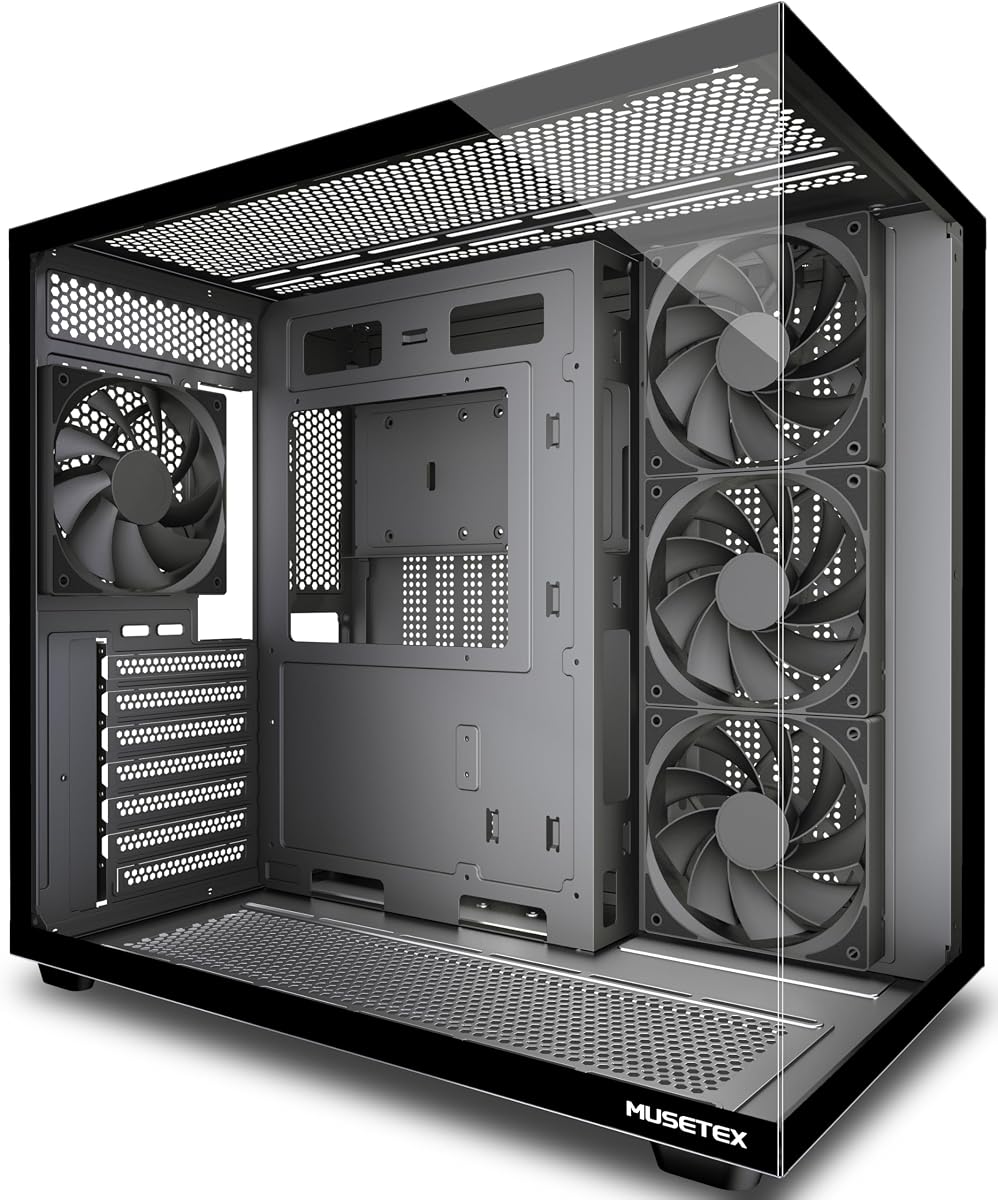
The MUSETEX Y6 Four-Fan version is a value-oriented showcase case that includes a full set of four non-LED fans. It carries a 4.7 rating and prioritizes a 270-degree dual-tempered-glass view, a tidy dual-chamber layout, and useful cooling provisions without adding ARGB lighting to the purchase.
We may earn a commission when you buy through this link, at no additional cost to you.
Three reverse fans sit at the side and one forward fan occupies the rear. The case supports ATX, Micro-ATX, and Mini-ITX motherboards, graphics cards up to 410mm, CPU coolers up to 160mm, power supplies up to 230mm, and a top-mounted 360mm liquid cooler. An independently ventilated power-supply compartment and magnetic filters at the top and bottom add practical thermal and maintenance features.
The absence of lighting will be a decisive factor for some builders, as the internal presentation relies more on component colors and the glass itself. The case is also not described as mechanically invertible, so it is best understood as a visually similar display-oriented alternative. The 160mm CPU-cooler limit is also worth checking against a tall air cooler, and the supplied specification does not provide every possible radiator position.
This Y6 version is the best budget choice for a builder who wants a panoramic case with basic airflow already installed. It is particularly useful for first-time builders who would otherwise need to choose an entire fan set at the outset. It suits restrained, neutral setups where illumination is not essential and a clean glass presentation matters more than synchronized lighting.
A full set of four fans provides usable airflow from the first assembly. Their placement follows a sensible side-intake and rear-exhaust arrangement, allowing builders to test the completed system before deciding whether additional cooling is required.
The dual tempered-glass panels provide a broad view of the hardware, while the independent power-supply ventilation channel helps prevent the enclosed PSU area from becoming a separate heat pocket. Magnetic top and bottom filters make periodic dust removal more convenient.
We may earn a commission when you buy through this link, at no additional cost to you.
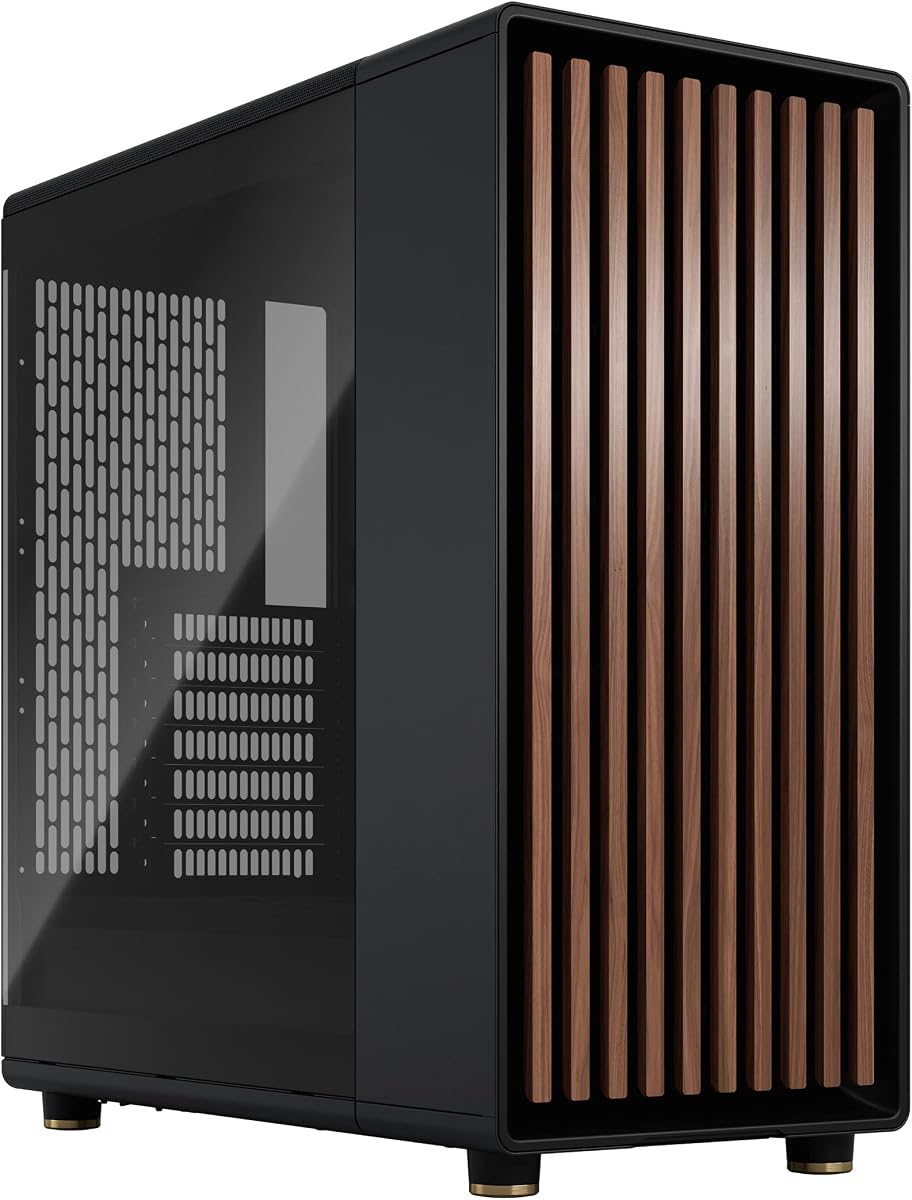
The Fractal Design North is the most natural-looking case in the guide, combining a charcoal exterior, genuine walnut or oak front accents, and a tempered-glass side panel. Its 4.7 rating reflects a well-regarded design that emphasizes airflow and distinctive materials rather than a literal inverted orientation.
We may earn a commission when you buy through this link, at no additional cost to you.
The open front and integrated mesh encourage natural ventilation, while two Aspect PWM 140mm fans are included from the factory. The case supports ATX, micro-ATX, and ITX motherboards, with graphics cards up to 355mm, or up to 300mm when a 360mm front radiator is fitted. Seven bridgeless expansion slots, two combined 3.5-inch and 2.5-inch drive mounts, and two dedicated 2.5-inch positions provide useful configuration options.
Buyers should be aware that the front radiator reduces available graphics-card length, and the case is not documented as invertible. Its main appeal is its distinctive wood aesthetic, which may not suit a build centered on aggressive gaming imagery. A buyer searching specifically for an inverted chassis should prioritize one of the cases that explicitly supports rotation or vertical presentation.
The North is best for a sophisticated build in a home office, living room, or studio where natural materials complement the hardware. The included large fans, removable panels, and ventilated front make it practical as well as decorative. It is our pick for users who want a display-focused case with a calmer, furniture-like appearance.
Real wood front bars soften the appearance of an otherwise technical enclosure and help the North blend into a living space. The combination of dark metal, mesh, and tempered glass still communicates its performance focus without relying on bright RGB elements.
Two included 140mm Aspect PWM fans provide meaningful airflow out of the box. The open front and mesh integration also allow air to enter around the fans, helping the case maintain a natural cooling path while preserving its distinctive exterior.
We may earn a commission when you buy through this link, at no additional cost to you.
The MUSETEX Y6 ARGB is the lighting-heavy version of the Y6, arriving with seven Infinity Mirror PWM ARGB fans. Its 4.4 rating is the lowest in the group, but the case still offers a strong specification for builders who want a bright, coordinated display and are comfortable managing RGB software.
We may earn a commission when you buy through this link, at no additional cost to you.
The fan bundle includes three reverse fans at the side, three reverse fans at the bottom, and one forward fan at the rear. The Infinity Mirror design is intended to create continuous bands of light with smooth color transitions, while motherboard software can control lighting patterns and fan speeds. The underlying chassis supports ATX, Micro-ATX, and Mini-ITX boards, GPUs up to 410mm, CPU coolers up to 160mm, power supplies up to 230mm, and a top-mounted 360mm liquid cooler.
Seven lit fans create a striking result, but they can also dominate the visual presentation and make cable or software management more complicated than the non-lit Y6. The lower supplied rating should not be read as a definitive verdict, yet it provides less margin for subjective satisfaction than the other highly rated options. As with the rest of the Y6 range, the supplied information does not describe a physical inversion mechanism.
The ARGB Y6 is best for a builder whose primary goal is a colorful, highly visible gaming system with a large number of preinstalled fans. It is less suitable for a restrained or minimalist build and for anyone who wants a true inverted case rather than a conventional tower with panoramic glass. Within that visual brief, however, the seven-fan package is unusually complete.
Reverse fans at the side and bottom turn their illuminated faces toward the viewer, while the rear fan completes the airflow path. The result is a bright, multi-layered display that complements collectibles, illuminated components, and coordinated motherboard lighting.
Compatible motherboard software can adjust fan behavior and lighting modes. Buyers should verify that their chosen board and software version support the required ARGB and PWM connections, and they should avoid changing several settings at once before confirming stability.
We may earn a commission when you buy through this link, at no additional cost to you.
The NZXT H5 Flow is a compact ATX mid-tower that offers a smaller alternative to the expansive display cases dominating this guide. It has a 4.6 rating and prioritizes effective airflow, clean cable management, and a straightforward parts list over literal inversion or extensive bundled lighting.
We may earn a commission when you buy through this link, at no additional cost to you.
The chassis comes with two 120mm Quiet Airflow fans, one at the front and one at the rear. Fine mesh across the top, front, and side panels supports airflow while acting as a dust filter. Cooling options include a 360mm radiator at the front and a 240mm radiator at the top. A perforated PSU shroud admits air through its side and bottom, helping the power supply area receive additional cooling.
This case does not support a physical inverted position according to the supplied information, so its relevance comes from the broader appeal of a compact, well-ventilated glass-sided build. The 240mm top-radiator limit is modest compared with many mid-towers, and buyers with a large air cooler should also verify cooler clearance. The included fans provide a practical baseline but no lighting bundle.
The H5 Flow is best for a builder who wants a smaller, tidier ATX system that does not sacrifice front radiator support. Wide cable channels, hooks, and straps make it approachable for first-time builders, while the preinstalled fans simplify initial assembly. It works well when desk space is more important than creating a literal inverted display.
The case supports a full 360mm radiator at the front, providing a strong liquid-cooling option in a relatively compact chassis. A 240mm top mount is also available for builders who want liquid cooling in two locations or a more balanced top-to-bottom airflow path.
Ultra-fine mesh over the top, front, and side helps admit air while filtering dust. The perforated side and bottom of the PSU shroud create an additional intake route, improving cooling around a component that is otherwise enclosed behind the main chamber.
We may earn a commission when you buy through this link, at no additional cost to you.
Choosing an inverted or display-oriented PC case means balancing physical orientation, component clearance, thermal performance, and visual impact. The following factors cover the details that most often determine whether a chassis works smoothly with a completed build.
An inverted case may rotate onto its side using removable feet, use a vertical GPU mount, or simply offer broad glass panels that create a similar presentation effect. These are not interchangeable. Builders who require the motherboard to sit above the power supply should look for an explicitly invertible chassis and confirm how its feet, panels, and rear connectors behave after rotation. Others may only be searching for a clean showcase case with a prominent viewing window.
Graphics cards are among the most limiting components in display cases. The listed maximum lengths range from 355mm in the Fractal Design North to 427mm in the JONSBO X400, with other cases falling between those figures. Measure the actual card rather than relying on the marketing name, and remember that a front radiator can reduce available GPU space. Vertical mounting may also require a conversion bracket, riser cable, or both.
A large air cooler can interfere with a side panel, radiator, or the motherboard area in a tightly routed chassis. Supplied CPU-cooler limits range from 160mm in the MUSETEX Y6 to 176mm in the JONSBO X400. If the intended cooler falls between the case limit and the cooler's total height, mounting may still fail because of the motherboard socket position, so the case and cooler should be checked together before ordering.
A strong fan specification does not always guarantee balanced airflow. Buyers should map intake and exhaust positions, determine whether the listed radiator sizes can operate simultaneously, and consider whether reverse fans are needed for the desired visual effect. Cases with three-radiator potential, such as the be quiet! Light Base 900 DX, offer broad options, while compact models may offer fewer mounting points. Remember that no-fan models require a separate cooling purchase.
Hidden-connector motherboards move power, USB, and other connections to the rear of the board, producing a cleaner view through the case glass. The CORSAIR 3500X, HYTE Y50 RGB, JONSBO TK-3, and JONSBO X400 list support for such layouts, but the named standards differ. Buyers should check the exact motherboard model and case compatibility list rather than assuming every rear-connector board will fit or work identically.
Inverted and panoramic cases lose much of their visual appeal when power leads and data cables cross the viewing area. A dedicated dual-chamber design can isolate cables behind a solid section, while removable panels and generous routing space make installation easier. Buyers should ask where the main power cables connect after rotation, whether the motherboard cutout remains accessible, and whether the drive cage occupies valuable cooling space.
A complete fan bundle can simplify a first build, but lighting adds software complexity and visual intensity. The be quiet! Light Base 900 DX includes no fans, while the SSUPD Xhuttle, HYTE Y50 RGB, and both MUSETEX Y6 versions include illuminated fans. The Fractal Design North and NZXT H5 Flow include non-illuminated fans, and the CORSAIR 3500X includes none. Choose the bundle that matches your cooling plan and desired presentation.
Cases with curved glass, skeletal frames, and multiple radiators can become physically large even when the motherboard itself is standard ATX. The JONSBO X400 is especially expansive, while the NZXT H5 Flow targets a more compact footprint. Measure desk depth, ceiling clearance, floor space, and distance from walls. Also consider radiator tubing, side-panel service access, and whether an inverted case will need enough room to rotate safely during installation.
Before assembling the PC, read the case manual and identify every removable foot, panel, bracket, and cable-routing point. Install the motherboard, power supply, storage, and cooling hardware in an order that leaves access to tight connectors. If the case rotates into an inverted position, perform the rotation before attaching fragile glass or decorative panels, and support the chassis securely while working around the feet and rear connections.
After the build is complete, connect fans and lighting through the appropriate ARGB and PWM headers, then use the motherboard software to set a stable fan curve. Test temperatures under a realistic workload and confirm that every intake and exhaust fan is operating in the intended direction. Keep radiators, filters, and mesh surfaces clear of dust, and avoid blocking the case when positioning it beneath a desk or inside a cabinet.
For routine care, power the system down and disconnect it before removing any panel. Clean tempered glass with a soft microfiber cloth and a suitable screen-cleaning solution, never an aggressive solvent, and avoid pressing on the panel edges. Periodically inspect dust filters, cable connections, and removable brackets. For curved or one-piece glass, leave any factory protective film in place until installation and handling are complete.
An inverted PC case is designed to be rotated so the motherboard and expansion slots sit above the power supply and other lower components. A vertical GPU case may remain an ordinary upright tower while mounting the graphics card on its side for display. Some products support both approaches, but the exact installation method and airflow behavior differ by model.
Physically turning a case can expose feet, ports, dust filters, and connectors to inconvenient positions, so it is not automatically safe or practical. A purpose-built inverted chassis provides suitable feet, cable routes, panel access, and airflow for its alternate orientation. Check the manufacturer's instructions before rotating any enclosure that was not specifically designed for inverted use.
Not inherently. Temperature depends on the airflow path, cooler size, fan direction, radiator placement, filters, and component load. A well-designed inverted case can cool a powerful system effectively, but the unusual orientation may change intake and exhaust positions. Buyers should still verify radiator support, fan clearance, and unrestricted airflow beneath the case.
No, but they can improve the appearance when the illuminated or plain fan face points toward viewers. Their aerodynamic performance is not automatically better than that of a conventional fan. The more important considerations are static pressure, airflow direction, noise, and compatibility with the case's mounting positions and lighting controls.
A preinstalled fan bundle can simplify assembly and provide a baseline cooling arrangement, making it useful for first-time builders. Experienced builders may prefer to select every fan and radiator together. If the case includes no fans, account for both the number of mounting positions and the need for splitters, PWM headers, and ARGB controllers.
ATX boards are broadly supported by most of the cases in this guide, while some also accept Micro-ATX and Mini-ITX formats. A hidden-connector board can create an especially clean view by moving cables to the rear, but compatibility is model-specific. Confirm the board format, connector layout, CPU socket, and physical dimensions before purchasing.
It depends on the case dimensions, orientation, and available clearance. A compact model such as the NZXT H5 Flow may fit more readily than a large curved-glass or skeletal chassis. Measure the desk clearance, allow room for cables and airflow, and check whether glass panels can be removed safely during installation without scratching the case.
A dual-chamber layout separates the power supply, drives, or cable routing from the main display area. This can reduce visible clutter, improve presentation, and sometimes provide a separate ventilation path for the power supply. It does not automatically guarantee better thermals, so fan placement, radiator fitment, and overall airflow should still be evaluated.
The be quiet! Light Base 900 DX Black stands out as the most complete dedicated inverted case because its removable feet allow quick changes between vertical and horizontal presentations while accommodating extensive cooling hardware. The SSUPD Xhuttle Black is the feature-rich alternative for builders who prioritize a vertical GPU display, included ARGB equipment, and flexible orientation.
Other buyers may find better value or a more suitable aesthetic in the MUSETEX Y6 Four-Fan, HYTE Y50 RGB, JONSBO TK-3, CORSAIR 3500X, Fractal Design North, or NZXT H5 Flow. Before choosing, prioritize true orientation requirements, GPU and CPU-cooler dimensions, radiator placement, motherboard connector style, and the amount of fan hardware already included.
Retail listings and component bundles can change over time, so verify the current specification, included accessories, dimensions, and warranty details before purchasing. Use the selected case's compatibility information to finalize the entire system, and confirm live retailer pricing rather than relying on an earlier snapshot or expectation.