
Air Quality Monitor Indoor 10-in-1
5.0Editor score
Ten-in-one environmental monitoring
Color display with air alerts
Twenty-hour rechargeable runtime
Indoor air can carry particles, gases, humidity, and temperature-related comfort issues that are not visible to the naked eye. A useful indoor air quality monitor turns those changes into readable measurements, helping you identify whether ventilation, cleaning, cooking, or an air purifier may be needed.
We compared ten monitors based on the pollutants and comfort factors they measure, the design of their displays, alarm and notification features, connectivity, power requirements, portability, and intended environments. The list includes compact smart-home sensors, rechargeable portable meters, and a comprehensive radon-capable monitor.
Each review explains the product's strongest benefits, practical limitations, and ideal setting so you can choose based on the measurements you actually need. Product ratings and availability can change, and current prices should always be checked on the linked listing before purchasing.
5.0Editor score
4.0Editor score

4.0Editor score
As an Amazon Associate we earn from qualifying purchases.
The following comparison highlights the principal differences among all ten monitors, including measured pollutants, screen format, power approach, and smart connectivity. Use the table as a quick shortlist, then use the detailed reviews to assess alerts, data history, portability, and placement.



The Amazon Smart Air Quality Monitor combines five useful measurements—PM2.5, volatile organic compounds, carbon monoxide, humidity, and temperature—with one of the most approachable smart-home ecosystems. Its 4.2 rating reflects a solid general-purpose design, although the real appeal is how easily the readings can flow into Alexa, the app, and compatible household routines.
We may earn a commission when you buy through this link, at no additional cost to you.
A color-coded LED communicates the current state without requiring a screen, while the Alexa app provides a more understandable air quality score and detailed information. Phone notifications and Echo announcements can warn you when conditions deteriorate. Routines are especially useful: compatible purifiers, dehumidifiers, and fans can respond automatically when sensors detect a change, reducing the need to check the app constantly.
The main limitation is dependence on the Alexa ecosystem. It must be plugged in, so placement is tied to a suitable outlet, and buyers without compatible smart-home equipment will get less value from its automation features. It also does not provide the same large, granular dashboard or long-term history available from more specialized connected monitors.
This is a strong choice for an Alexa household that wants a simple, wall- or shelf-ready monitor and automatic purifier control. It is less suitable for someone seeking a portable meter, carbon dioxide measurement, radon detection, or detailed multi-pollutant history. For those priorities, one of the more specialized options may be a better fit.
The monitor's most valuable feature is its ability to connect readings to compatible air purifiers, dehumidifiers, fans, and heating controls. This makes it a practical choice for people who already use Alexa and want air-quality responses to happen automatically.
The color-coded LED makes the device useful from across a room, while the app adds context and details. Together, these interfaces provide a quick indication without forcing you to interpret a dense panel of sensor values.
We may earn a commission when you buy through this link, at no additional cost to you.
This 16-in-1 indoor air quality monitor combines a large color screen with quick, continuously refreshed readings. Its 4.9 rating makes it one of the strongest entries in this guide, and its broad mix of particle, gas, temperature, and humidity measurements makes it a flexible option for checking several rooms or mobile locations.
We may earn a commission when you buy through this link, at no additional cost to you.
It measures PM1.0, PM2.5, PM10, TVOC, formaldehyde, temperature, and humidity. A sensor array automatically samples and processes those readings every 1.5 seconds, and the display uses color to make changing air levels easier to interpret. This combination of breadth and quick updates is particularly useful when you want to see how a room responds after cooking, cleaning, opening a window, or running a purifier.
Operation is uncomplicated: one button handles power and Celsius or Fahrenheit switching, while a double tap disables the audio prompt. Portability is aided by a rechargeable battery that supports roughly four to five hours of continuous use and a standard USB-C connection. The trade-off is that this runtime is shorter than several competing portable monitors, and the supplied specifications do not include carbon dioxide.
Choose this model for quick visual checks in a bedroom, office, vehicle, classroom, or other indoor space, especially if a large display matters to you. It is less appropriate as a permanent plugged-in monitor or as a radon detector. Its strongest advantage is the combination of informative color presentation, fast sampling, and broad non-CO2 pollutant coverage in a portable format.
The HD color display is large enough to present multiple readings together and makes air levels understandable without an app. Fast sampling helps connect visible changes with activities such as cooking or ventilation, although a single snapshot should not be treated as a formal exposure assessment.
Its compact body and rechargeable design make it easier to carry from a living area to a vehicle or another room. That portability is valuable for investigating inconsistent readings, although continuous all-day use will require a power connection.
We may earn a commission when you buy through this link, at no additional cost to you.
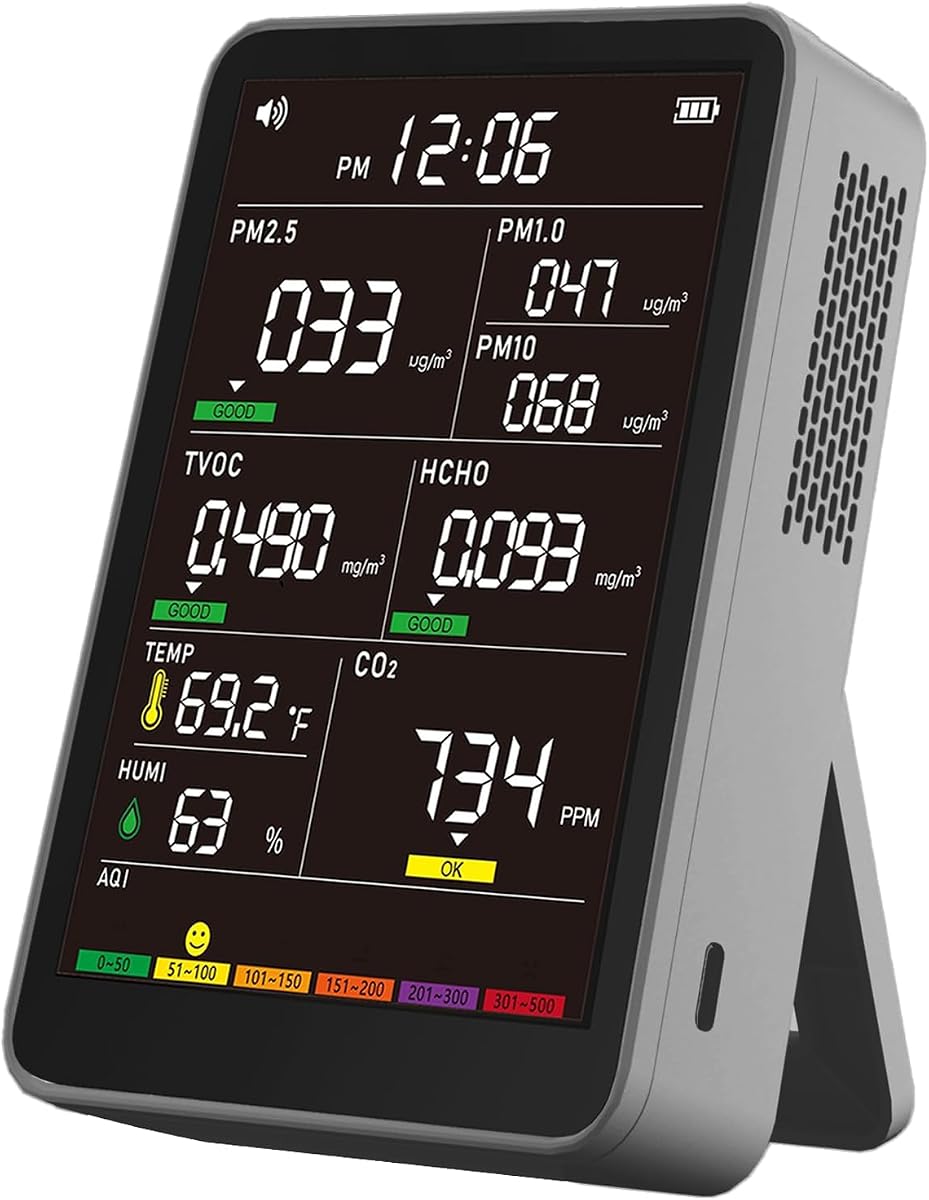
The defining feature of this indoor air quality monitor is its seven-inch LED screen, which can display a comprehensive set of readings without extensive menu navigation. With a 4.2 rating, it offers an appealing balance of visible CO2 measurements, multiple particulate readings, gas detection, and physical comfort measurements.
We may earn a commission when you buy through this link, at no additional cost to you.
Its core data includes CO2, PM2.5, PM1.0, PM10, formaldehyde, TVOC, temperature, humidity, AQI, and time. Seven AQI alert functions are intended to surface changing conditions, and a mute control can silence audible prompts. Three brightness settings help the display remain readable in different lighting while reducing distraction in a bedroom.
The monitor can run for up to eight hours on a charge and recharges through USB-C. That makes it reasonably flexible, although the large enclosure is less travel-friendly than a compact handheld model. The product guidance also warns against touching the external sensors or exposing them to perfume and strong odors, which matters when placing it close to a fragrance diffuser or freshly painted area.
This is a good match for a home office, classroom, living room, or other space where CO2 trends are important and a large, glanceable display is preferred. It is less ideal for discreet monitoring, intensive trend analysis, or use where a compact device is essential. Its primary advantage is bringing CO2 and multiple air readings together on an unusually accessible screen.
Carbon dioxide readings can help reveal when a shared room has accumulated occupancy-related ventilation needs. Pairing that information with particles and VOCs gives a fuller view than a standalone CO2 meter, particularly in offices and busy bedrooms.
Seven inches of screen area makes the device less dependent on phone-based interpretation. Brightness controls and a mute button help it fit into a bedroom or office where continuous visibility and audio could otherwise be disruptive.
We may earn a commission when you buy through this link, at no additional cost to you.
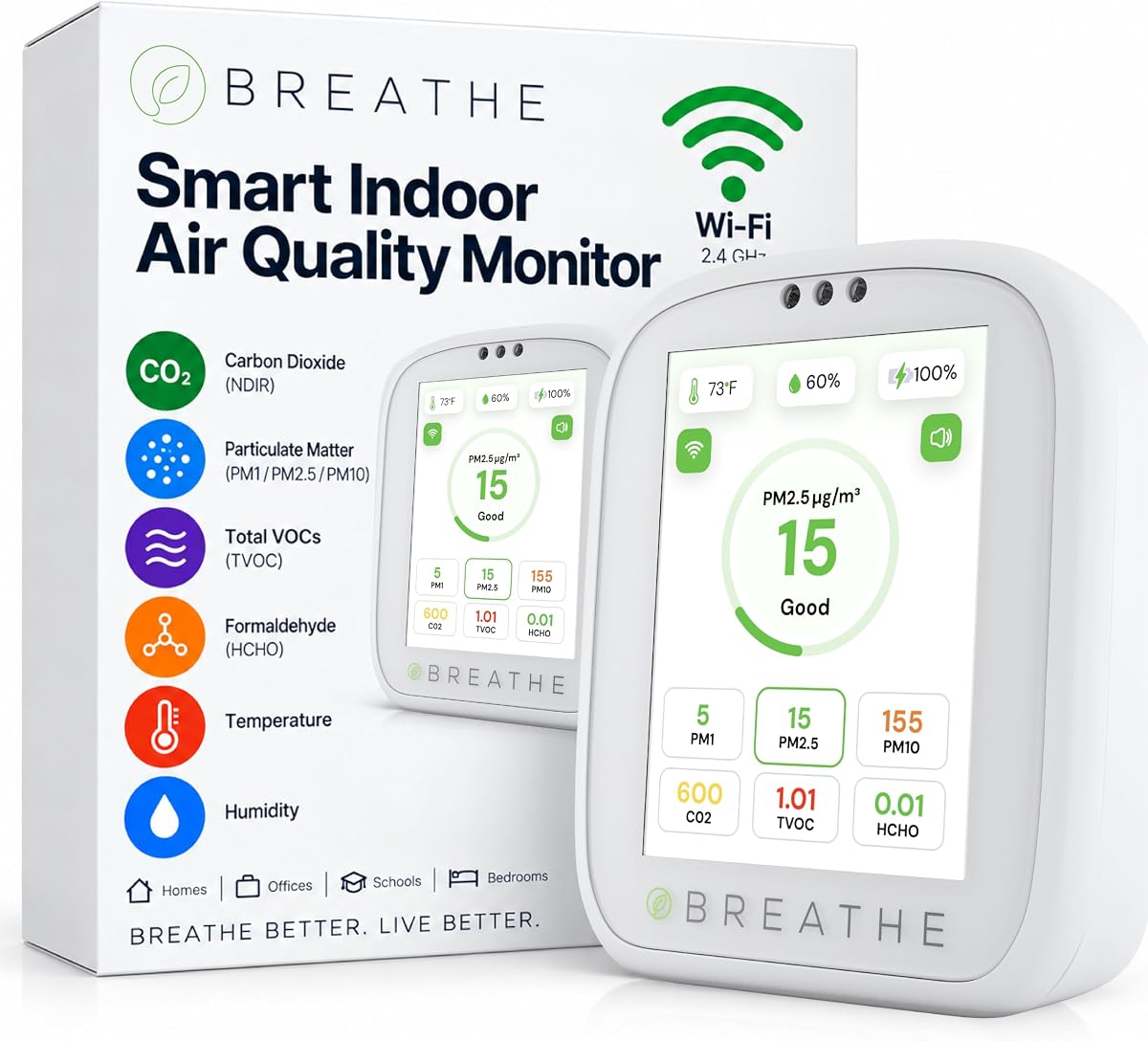
The BREATHE Airmonitor Plus Gen 2 is built for people who want to understand how their indoor environment changes over time rather than simply glance at a current reading. Its 4.0 rating is solid, and its combination of NDIR carbon dioxide sensing, laser particle measurement, dedicated VOC and formaldehyde sensors, and a companion app makes it the most analytical connected option in this roundup.
We may earn a commission when you buy through this link, at no additional cost to you.
It tracks CO2, PM1, PM2.5, PM10, TVOC, formaldehyde, temperature, and humidity in real time. The app provides remote readings, configurable CO2 and PM2.5 alerts, graphs, up to 90 days of stored history, and data export. That history is the key advantage: you can compare cooking, cleaning, occupancy, HVAC behavior, and ventilation patterns instead of reacting to one isolated number.
The rechargeable design supports up to six hours of portable monitoring and can also run while connected to USB-C power. Setup involves pairing through 2.4 GHz Wi-Fi, which is a limitation on networks that use only the 5 GHz band. Quick CO2 calibration and a simple pairing process help reduce setup friction, but the dependency on an app makes it less suitable for users who want a completely standalone display.
This is our top overall-connected choice for homes, offices, classrooms, and bedrooms where historical analysis matters. It offers the strongest balance of sensor breadth, CO2 specificity, app-based interpretation, and exportable data. If a screen-only device, long portable runtime, or standalone operation matters more, a more specialized alternative may be preferable.
Ninety days of stored data makes this monitor useful for identifying recurring problems. Graphs and exports can show whether CO2 rises in a crowded room, whether PM2.5 spikes after cooking, or whether cleaning products coincide with changes in VOC and formaldehyde readings.
NDIR CO2 measurement gives this model a more specialized foundation than a basic comfort monitor. It also tracks three particle sizes, TVOC, and formaldehyde, allowing users to consider gas and particulate causes together rather than relying on a single pollution indicator.
We may earn a commission when you buy through this link, at no additional cost to you.
This 10-in-1 air quality tester stands out as a value-focused portable monitor with a perfect 5.0 rating. It measures CO2, formaldehyde, TVOC, benzene, PM2.5, and PM10, and the supplied information lists an error margin below plus or minus 5 percent. That combination gives it more capability than a basic PM2.5 and humidity screen.
We may earn a commission when you buy through this link, at no additional cost to you.
The high-definition color display presents real-time results and changes color when a measurement exceeds the specified safety threshold. A smart chip and dedicated sensor array support CO2 detection, while electrochemical sensors handle formaldehyde and TVOC. Calibration is described as automatic, reducing the need for frequent manual adjustment, and a one-second press switches the default Celsius display to Fahrenheit.
Its 2,000 mAh rechargeable battery supports up to 20 hours of continuous monitoring, giving it a substantial runtime advantage over the shorter-lived models in this list. The lightweight, compact construction is appropriate for home, car, plant, or pet-area checks. The trade-off is that it offers no app, cloud history, data export, or automation, so it works best as a self-contained information display.
This is the best value option for renters, travelers, and anyone who wants a broad set of portable measurements without a complex setup. It is particularly practical for checking whether conditions differ between rooms or for temporarily monitoring a vehicle. Buyers seeking remote access, long-term graphs, or integration with purifiers should spend more on a connected model.
The monitor begins detection after a simple power-on action, and its one-button design keeps daily interaction uncomplicated. A 20-hour runtime supports extended spot checks without requiring constant access to a charger.
PM2.5, PM10, CO2, formaldehyde, TVOC, and benzene provide more than the usual temperature-and-humidity baseline. The color display and threshold-based screen changes make unusual conditions easier to notice during routine monitoring.
We may earn a commission when you buy through this link, at no additional cost to you.
The GoveeLife Smart Air Quality Monitor focuses on the measurements most commonly used for automated purifier decisions: PM2.5, temperature, and humidity. Its 4.3 rating reflects a dependable, narrowly targeted design, and the ability to coordinate with compatible GoveeHome appliances makes it appealing for an existing Govee ecosystem.
We may earn a commission when you buy through this link, at no additional cost to you.
PM2.5 accuracy is listed as plus or minus 15 micrograms per cubic meter, while temperature and humidity accuracies are given as plus or minus 0.54 degrees Fahrenheit and plus or minus 3 percent relative humidity. Readings refresh every two seconds, and the LED uses four ambient air-quality levels. A top-button press changes between clock and PM2.5 views, while a longer press switches bright and night modes.
Automation is the defining feature. Users can set target air quality and link compatible purifiers, humidifiers, fans, and space heaters so devices turn on or off as conditions change. Remote viewing works through Bluetooth or Wi-Fi, including 13-day graphs and export of data from as far back as two years. However, the monitor measures only three indexes, has no internal battery, and supports a specific list of Govee appliances.
This is an excellent choice for a GoveeHome household focused on PM2.5-driven purifier control. It is less versatile than multi-gas or CO2 monitors, but the combination of rapid updates, simple display, and automatic appliance response is highly practical. It is best installed near a compatible purifier and kept connected to power.
The monitor can serve as the air-quality trigger for listed purifiers, humidifiers, fans, and heaters. This direct link is more focused than a general-purpose platform and can reduce the effort involved in maintaining a preferred air level.
Two-second updates make the display responsive to changes around a purifier. The four-level LED and switchable clock make it convenient to monitor from a normal room, while app graphs provide a longer view of how conditions evolve.
We may earn a commission when you buy through this link, at no additional cost to you.
This five-inch monitor combines a strong 4.9 rating with one of the more complete portable sensor suites in the guide. It displays CO2, PM2.5, PM1.0, PM10, HCHO, TVOC, temperature, humidity, AQI, and time, while seven alert functions draw attention to changes in the measured values.
We may earn a commission when you buy through this link, at no additional cost to you.
The HD LED display offers three brightness levels, making the readings easier to view in daylight, evening, or a dim room. External sensors are positioned to sample surrounding air directly, and a double press switches between Fahrenheit and Celsius. Stated temperature and humidity accuracy ranges are plus or minus 1 to 3 degrees Fahrenheit and plus or minus 2 to 3 percent relative humidity.
Its strongest advantage over smaller portable units is runtime: up to 10 hours on a full charge, with USB-C recharging and an included AC adapter. The limitation is that the product functions as a standalone instrument rather than a connected data platform. There is no described app history, remote access, or export, so trend analysis depends on observing the screen in real time.
This model is a strong fit for bedrooms, offices, vehicles, and temporary checks where a sizeable display and long portable runtime are priorities. It is less suitable for a whole-home analytics project, and the product guidance recommends keeping external sensors away from perfume and strong odors. For connected analysis, the BREATHE Airmonitor Plus offers a more suitable feature set.
The extended battery life supports longer portable monitoring sessions than several similarly featured displays. USB-C charging and the included adapter make replenishment straightforward at home or while traveling.
Putting CO2, three particle sizes, two gas categories, AQI, temperature, and humidity on one screen reduces the need to consult another display. Brightness controls and a mute button help balance visibility with bedroom or office comfort.
We may earn a commission when you buy through this link, at no additional cost to you.
The two-pack version of the Amazon Smart Air Quality Monitor is designed for households that want to monitor more than one room or floor. Each unit tracks PM2.5, VOCs, carbon monoxide, humidity, and temperature, and its 4.2 rating is consistent with the single-unit model's well-received smart-home approach.
We may earn a commission when you buy through this link, at no additional cost to you.
Both monitors can connect to the Alexa app, provide a simplified air quality score, and show their condition through color-coded LEDs. Phone notifications and Echo announcements warn users when air quality drops. The major advantage over the single version is spatial coverage: one monitor can watch a bedroom while another tracks a kitchen, office, or lower level.
Routines can activate or deactivate compatible purifiers, dehumidifiers, and fans when the sensors detect changes. Connecting the temperature and humidity readings to Amazon Smart Thermostat may also support more comfortable room management. The trade-offs are the same as those of the single unit: both devices need power outlets, depend on Alexa, and do not offer the extensive history or export functions of specialist connected monitors.
This pack is best for Alexa users with distinct air-quality concerns in multiple rooms, especially if each area also has a compatible purifier or fan. It is less suitable for portable checks, radon measurement, or detailed historical analysis. The two-unit format adds value only when you can place the monitors in meaningfully different spaces.
Two units make it easier to identify location-specific changes, such as cooking particles in a kitchen versus a stuffier bedroom. The separate color indicators provide quick feedback in each area, while Alexa can announce the relevant status.
Compatible purifiers, dehumidifiers, and fans can be paired with the monitor's readings through routines. This is particularly useful when different rooms require different responses, provided each location has suitable power and automation equipment.
We may earn a commission when you buy through this link, at no additional cost to you.
This portable 16-in-1 monitor shares a broad measurement suite with the other highly rated color-display model, but its 1.5-second sampling interval is the standout specification. Its 4.9 rating indicates strong customer satisfaction, and the device is well suited to users who want immediate visual feedback in temporary spaces.
We may earn a commission when you buy through this link, at no additional cost to you.
The monitor tracks PM1.0, PM2.5, PM10, TVOC, formaldehyde, temperature, and humidity. These seven core indicators are shown on a large HD color screen, with color-coded air-level readings making broad changes easy to spot. A single tap handles power and unit switching, and a double tap disables the audio prompt for quieter use in bedrooms, offices, or vehicles.
The rechargeable design provides approximately four to five hours of continuous sampling and uses a standard Type-C port. A matching cable and AC adapter are included, which simplifies charging at home. As with several other compact options, the battery duration is modest for all-day portable work, and there is no described application for history, remote monitoring, or automated device control.
This model is a good choice for checking a hotel room, car, classroom, or temporary indoor setup where quick feedback matters. It is less appropriate for users who need CO2, radon, permanent installation, or long-term trend review. The combination of a large color display, fast refresh, and uncomplicated controls is its primary appeal.
The 1.5-second interval makes it easy to watch particulate and gas readings react to cooking, ventilation, or cleaning. This is particularly useful for short, comparative checks where the goal is to observe a difference between two conditions.
The adjustable audio prompt lets users reduce sound in bedrooms, offices, and vehicles. A single-button layout also keeps operation approachable for older users or anyone who does not want to navigate a complex menu.
We may earn a commission when you buy through this link, at no additional cost to you.
The Airthings 2960 View Plus is the most comprehensive connected monitor in this guide, with a 4.0 rating and a feature set that extends well beyond PM2.5 and humidity. It measures radon, PM2.5, carbon dioxide, VOCs, humidity, temperature, and air pressure, making it the only option here that directly addresses radon gas.
We may earn a commission when you buy through this link, at no additional cost to you.
Always-on sensors send live information to the Airthings app, where users can review current readings, analyze trends, receive timely notifications, and follow suggested actions. The app also provides local pollen information through Breezometer. Its customizable eInk display presents information without the constant visual activity of a full-color panel, while battery power permits cable-free placement.
The device requires an Airthings account, internet access for the monitor and app, and a compatible Wi-Fi connection. Cloud data storage enables continuous remote tracking, but this ecosystem dependency makes it less convenient as a purely local display. The rechargeable battery also means you must account for charging even though no power cable is required during normal placement.
This is the best premium selection for homeowners who want radon awareness alongside a broad set of connected air measurements. It is also suitable for offices, schools, and other shared spaces where continuous monitoring and historical analysis are valuable. If radon is not a concern and you only need a simple local display, one of the portable or Alexa-connected alternatives will be more economical and less complex.
Radon is invisible and cannot be evaluated with the particle and gas sensors found in most compact indoor monitors. A dedicated electrochemical radon sensor makes this model relevant for long-term household monitoring, particularly in regions where testing is recommended.
Live app readings, trend analysis, and notifications allow the monitor to remain useful when you are away from its display. Cloud-based history creates a longer record than most local-screen models can offer, which is valuable for identifying recurring ventilation problems.
We may earn a commission when you buy through this link, at no additional cost to you.
The right indoor air quality monitor depends on the pollutants and patterns you want to observe, the location where it will operate, and whether you value a local display or connected history. Use these factors to narrow the field before comparing screen size, alarms, and battery life.
Different monitors measure different things. A basic device may cover PM2.5, temperature, and humidity, while more advanced models add CO2, PM1.0, PM10, TVOC, formaldehyde, benzene, or radon. A model with many numbers is not automatically better; the important question is whether its sensor suite addresses the pollutants most relevant to your building and activities.
Match the sensors to the concern. Particles are useful around cooking, dust, or smoke; CO2 is useful in occupied rooms; VOCs and formaldehyde can help track changes associated with cleaning products, furnishings, paints, and adhesives; radon requires a dedicated long-term detector. Choose measurements you can interpret and act upon rather than simply selecting the longest specification list.
A local display matters when you want a quick answer without opening an app. Small LED screens work for PM2.5, temperature, and humidity, while larger color displays can present CO2, multiple particle sizes, gases, AQI, and comfort readings simultaneously. Consider viewing distance, room lighting, and whether the display remains readable from where you usually sit.
Look for color coding, night mode, adjustable brightness, and a simple interface. Large screens can be more informative but may feel conspicuous in a bedroom, while compact displays are less distracting. The best display is the one that makes abnormal conditions noticeable without creating constant visual or audible disturbance.
Connected monitors are superior when you need remote access, alerts, graphs, historical trends, or exported data. They can also trigger purifiers, fans, or dehumidifiers when readings cross selected thresholds. Local-only devices are simpler, often more portable, and do not require an account, server connection, or compatible Wi-Fi network.
Consider how you will use the information. A local display may be enough for a quick bedroom check, while a home or office investigation benefits from a timeline that shows how conditions change throughout the day. If long-term analysis is important, confirm the retention period, export support, alert settings, and required network band before purchasing.
When CO2 matters, look for a model that clearly identifies its measurement method. The BREATHE Airmonitor Plus uses NDIR CO2 measurement, while several portable models include CO2 among their listed readings without providing the same technical detail. NDIR is generally associated with stable, specific CO2 detection, but placement and calibration still affect practical results.
For shared rooms, CO2 can be one of the most useful indicators of ventilation demand. Install the monitor away from direct breathing, open windows, and vents that might distort a local reading. Use the trend rather than a single number to decide whether more ventilation is needed.
Plug-in monitors are reliable for permanent locations and avoid battery-management concerns, but they require access to an outlet and a suitable USB-C connection where applicable. Rechargeable models are better for cars, temporary room checks, travel, and outdoor-adjacent spaces covered by a roof, although their runtime varies widely.
Compare stated battery life with realistic use. A four-to-five-hour runtime suits shorter inspections, while a 20-hour model can cover a full workday of intermittent checks. If you want continuous monitoring, a wired model or a monitor that runs while charging may be more appropriate than choosing a portable device based on its headline battery number.
Alerts should be understandable and configurable. Some monitors change the screen color, some sound a buzzer, and connected products send phone notifications or announce conditions through voice assistants. Multiple buzzer types can be useful, but excessive sound may be unwelcome in a bedroom, classroom, or quiet office.
A mute button and adjustable prompt help address that concern. If you already own an air purifier, check compatibility carefully. The Amazon monitor works with compatible Alexa devices, while the GoveeLife model lists particular H-series purifiers, humidifiers, fans, and heaters. A smart function is only useful when it can integrate with equipment you actually own.
Accuracy depends on airflow, sensor condition, and location. Avoid placing a monitor directly beside a vent, in a dead corner, near strong fragrance, or against a surface that blocks its airflow. Stand the device in the breathing zone or on an open surface representative of the room's occupied conditions.
Many models warn against touching sensors or exposing them to perfume and other strong odors. Dust can also affect readings, so follow the included guidance for cleaning and recalibration. Rechargeable models need periodic charging, while connected models require app updates, account access, and reliable Wi-Fi to remain useful.
A general indoor air quality monitor is not automatically a certified life-safety device. One product in this roundup explicitly states that it is for reference only and is not a smoke alarm or carbon monoxide alarm. Even monitors that detect carbon monoxide or other gases should be evaluated for their certification, placement rules, and intended use.
If the central concern is smoke, fire, or life-threatening carbon monoxide exposure, use a properly certified and correctly installed alarm for that purpose. An air quality monitor can provide broader environmental context, but it should not replace required safety equipment or professional testing in suspected hazardous conditions.
Begin by reading the product instructions, charging the monitor if it uses a battery, and placing it in the area you want to understand. Choose a stable surface with open airflow, away from direct sunlight, heating vents, air-conditioning outlets, cooking steam, perfume, and other strong odors. For a connected model, complete the stated app, account, and Wi-Fi setup before judging the readings.
Allow the sensor to stabilize before taking action. Watch the trends rather than reacting to one isolated change, and note activities that coincide with spikes, such as cooking, cleaning, opening windows, or increased occupancy. Use the readings to guide practical steps such as improving ventilation, running a compatible purifier, adjusting humidity, or repeating a check in a different location.
For upkeep, power the device down before cleaning it and follow the manual's cleaning instructions. Keep the sensing area free of dust and avoid touching exposed sensors. Charge rechargeable units regularly, update connected software when prompted, and check that any selected CO2 or PM2.5 alert thresholds still match the conditions you want to track. Never use a general monitor as a substitute for certified smoke or carbon monoxide alarms.
The most useful measurement depends on the concern. PM2.5 is valuable for fine particles, CO2 helps indicate ventilation demand in occupied rooms, and temperature and humidity explain comfort. VOCs, formaldehyde, or radon become important when you are tracking chemical sources or long-term environmental risks. A multi-measurement device is generally more informative than one focused only on a single comfort metric.
An app is useful when you want remote readings, alerts, historical graphs, data export, or automatic control of compatible purifiers and fans. A local display is sufficient for quick checks and simpler setups. If you plan to investigate recurring problems, an app with stored history is often more useful than repeatedly reading a screen without a record of previous conditions.
Some general monitors include carbon monoxide sensing, but their purpose and certification may differ from dedicated life-safety alarms. The Amazon Smart Air Quality Monitor in this guide detects carbon monoxide as one of five factors, while another product explicitly states that it is not a carbon monoxide alarm. Use certified alarms for required safety protection and treat a general monitor as supplemental environmental information.
Place it in the area you actually want to monitor, on a stable surface with unobstructed airflow and at approximately breathing level. Keep it away from direct vents, open windows, cooking steam, perfume, paint fumes, and other local sources that can distort readings. If comparing rooms, use the same placement height and conditions so the results remain meaningful.
A short check may be enough to compare a room before and after ventilation, cooking, or cleaning. Continuous or multi-day operation is better for identifying recurring patterns, especially when using CO2, particulate, or radon measurements. Remember that some radon changes are gradual, so one brief reading cannot establish a long-term picture.
No. More readings can be valuable, but only if they are relevant, understandable, and supported by a reliable sensor. A focused PM2.5, temperature, and humidity monitor may serve a simple bedroom need better than a crowded display. Compare sensor coverage, update speed, alert quality, and intended use rather than judging only by the number of features.
A single monitor only represents the conditions near its placement. Different rooms can have distinct CO2, particle, VOC, and humidity patterns, so multiple units may be needed for a whole-home assessment. Two-pack options are useful when you want to compare distant rooms or automate compatible appliances in each area.
Generally, no. Consumer monitors are useful for tracking changes and identifying conditions that deserve attention, but they are not a substitute for certified life-safety alarms, professional indoor-air assessments, or laboratory testing in suspected hazardous environments. Use monitor data alongside appropriate safety equipment and qualified advice when a serious concern is suspected.
The best overall-connected choice is the BREATHE Airmonitor Plus Gen 2 because it combines NDIR CO2 sensing, three particle sizes, VOC and formaldehyde measurements, configurable alerts, and 90 days of app history. The Air Quality Monitor Indoor 10-in-1 offers the strongest budget value, while the Airthings 2960 View Plus is the best premium option for connected monitoring that includes radon.
Your priorities should determine the rest of the shortlist. Choose the Amazon monitor for Alexa automation, the GoveeLife H5106 for compatible Govee appliances, and one of the large-screen portable units for immediate visual feedback. Pay special attention to whether your priority is CO2, particles, gases, radon, history, automation, or true portability, rather than assuming the largest feature count offers the best fit.
Ratings, product details, and current prices can change, so check the latest listing and specifications before buying. Confirm room placement, power requirements, app compatibility, and the exact pollutants measured. Most importantly, use a monitor to guide ventilation and source control, while retaining certified smoke and carbon monoxide alarms and professional testing whenever appropriate.