
MONTECH AIR 903 MAX
4.8Editor score
Four 140mm fans included
Dual 360mm radiator support
E-ATX motherboard support
Our Hybrid Airflow PC Case guide compares ten high-airflow chassis for cooling, capacity, cable management, fan support, and build quality.
A hybrid airflow PC case combines a conventional open-air intake path with structural elements that guide, separate, or accelerate air around demanding components. The best examples balance strong ventilation with practical cable routing, accessible fan mounts, and enough room for modern graphics cards, radiators, power supplies, and storage without turning every build into a planning exercise.
This guide compares ten cases based on their documented airflow architecture, included fans, radiator support, chassis capacity, motherboard compatibility, cable-management features, and physical design. The list includes compact ATX mid-towers, larger dual- and triple-chamber models, and full-tower options for builders who prioritize expansion over footprint.
Each review identifies the configuration that best suits a particular type of system, from a straightforward gaming build to a workstation with substantial cooling hardware. Ratings and specifications reflect the supplied product information, while component availability and market conditions can change, so readers should verify current fit, accessories, and pricing before purchasing.
A good hybrid airflow case should cool its hardware without creating an installation headache, look intentional from every angle, and leave room for future upgrades. Airflow paths matter because unrestricted openings alone do not guarantee that cool air reaches the graphics card or that hot exhaust leaves the chassis. Case architecture determines where fans can be installed, how pressure can balance across the enclosure, and whether cables interfere with intake or exhaust routes.
The ten cases in this comparison were evaluated using their stated design features rather than claims of personal testing. Included information covers fan counts and sizes, radiator positions, chamber layouts, motherboard formats, graphics-card clearance, cable-management systems, and special cooling hardware. The guide also distinguishes between cases designed primarily for air cooling and those that combine high airflow with liquid-cooling flexibility.
Each pick demonstrates a different route to effective cooling. Some rely on large front fans and open mesh, others divide the interior into dedicated chambers, and several combine removable panels with highly flexible mounting hardware. The selections show that the right choice depends on hardware size, cooling plan, available desk space, and how much attention you prefer to give to cable routing and assembly.
4.8Editor score

4.7Editor score

4.6Editor score
This side-by-side comparison highlights each chassis layout, cooling capacity, included hardware, and practical expansion features to help you identify the most suitable hybrid airflow case for your build.



The CORSAIR 4000D RS ARGB is a well-balanced high-airflow mid-tower with a 4.7 rating. Its standout combination is a perforated steel front, three pre-installed RS ARGB PWM fans, flexible InfiniRail mounting hardware, and a modular frame that lets builders alter the internal side-panel arrangement. It is especially compelling for a powerful gaming system that needs substantial cooling without adopting a much larger chassis.
We may earn a commission when you buy through this link, at no additional cost to you.
The 3D Y-pattern front panel creates a low-obstruction route for incoming air, while the pre-installed fans immediately provide front-to-rear airflow. InfiniRail supports up to 200mm fans in front positions and 140mm fans in the roof, allowing the cooling layout to evolve as hardware changes. The fans also support daisy-chained four-pin PWM connections and Zero RPM behavior, while their eight LEDs can be controlled through a motherboard's 5V ARGB header.
Its modular design is unusually useful. The side panel beside the motherboard tray can remain in place as a cable cover or be removed to accommodate side-mounted fans for additional cooling. That makes the case adaptable to both tidy and performance-oriented builds. ASUS BTF, MSI Zero, and Gigabyte Stealth support adds another layer of flexibility for builders reducing visible cable clutter.
The trade-off is that the modular system is not as simple as a completely fixed chassis, and users who do not want ARGB may find that the included lighting is more than necessary. Even so, the combination of strong airflow hardware, flexible mounting positions, useful motherboard integration, and clean cable management makes this our top overall recommendation for most builders.
The InfiniRail system lets fans slide into targeted positions, while the removable side panel creates an additional cooling path. This flexibility makes the chassis easier to adapt as graphics cards, processors, or cooling plans evolve.
Wide cable channels and a removable internal cover help keep wiring out of the airflow path. Compatibility with rear-connecting motherboard standards can further simplify the finished appearance.
We may earn a commission when you buy through this link, at no additional cost to you.
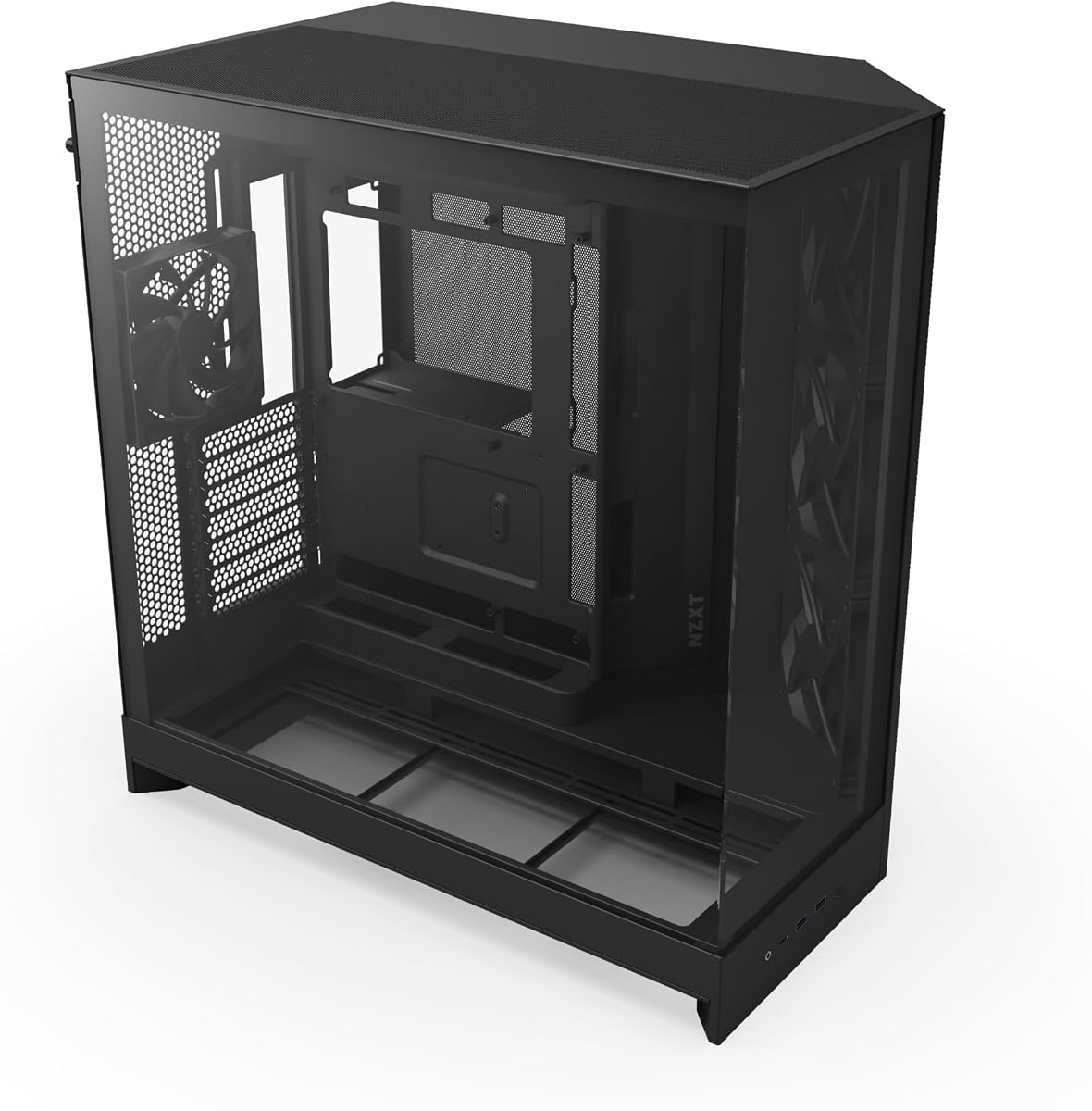
The NZXT H5 Flow is a compact ATX mid-tower aimed at builders who want a clean, airflow-oriented case without moving to a full tower. It carries a 4.6 rating and pairs ultra-fine top, front, and side mesh with a perforated PSU shroud. Two 120mm fans come pre-installed, one at the front and one at the rear, providing a functional baseline for ordinary air-cooled configurations.
We may earn a commission when you buy through this link, at no additional cost to you.
Its most interesting thermal feature is the perforated PSU shroud, whose side and bottom surfaces can draw air from two 120mm fans, though those fans are not included. This arrangement can improve cooling around the graphics card while making use of a region that is often treated purely as a structural or cable-management area. The main chamber also supports a 360mm front radiator and a 240mm top radiator.
The compact dimensions do not prevent broad cooling choices, but they do make careful fan placement especially important. Ultra-fine mesh panels filter dust while permitting airflow, and the front, top, and side surfaces provide several possible intake routes. Cable management is handled through wide channels, hooks, and straps, allowing the wires to remain behind the tray or within designated paths.
Those wanting the strongest possible out-of-the-box cooling will need to add fans, and the included 120mm pair may not satisfy a high-end system by itself. For a smaller ATX build, however, the H5 Flow offers a persuasive mix of mesh ventilation, radiator support, and organized routing. It is a particularly sensible choice when desk space is limited but full-tower proportions would be excessive.
Side and bottom perforations allow optional 120mm fans to pull air into the graphics-card region. That dedicated intake can be useful when the main front airflow needs help reaching a thick or unusually positioned card.
The ability to fit a 360mm radiator at the front and a 240mm radiator above gives builders meaningful liquid-cooling choices in a relatively compact enclosure. Planning the radiator and fan orientation before assembly avoids conflicts.
We may earn a commission when you buy through this link, at no additional cost to you.
The NZXT H6 Flow RGB combines polished appearance with a 4.8 rating, one of the strongest ratings in this comparison. Its dual-chamber structure separates the power supply and storage area from the main hardware chamber, while wraparound glass panels and a compact profile create a clean presentation. Three included 120mm RGB fans make it an attractive option for builders who want coordinated lighting without assembling every fan themselves.
We may earn a commission when you buy through this link, at no additional cost to you.
The three fans are installed at an angle intended to improve out-of-the-box cooling. Airflow-optimized perforations in the top and side panels add intake and exhaust opportunities while helping filter dust. The dual-chamber design contributes to thermal performance by limiting direct mixing between heat sources and the main component area, all while preserving an uncluttered internal presentation.
Its panoramic glass treatment is one of the main reasons to choose it over a more utilitarian mesh case. The wraparound panels provide a broad view of components, and the white finish gives the build a distinctive appearance. The cable-management system uses wide channels and straps rather than relying on a removable cover, which can suit builders who want a straightforward route for wiring.
The white finish requires more attention if fingerprints, dust, or scratches are a concern, and some buyers may prefer a case without visible RGB lighting. Its three included fans also represent a more modest cooling package than the largest-fan configurations nearby. Even so, the combination of dual-chamber organization, angled fans, perforated panels, panoramic glass, and a top-tier rating makes this a particularly refined general-purpose recommendation.
The perforated top and side sections maintain air paths despite the extensive glass treatment. This gives the case a display-oriented appearance while preserving ventilation around the main chamber.
Separating the power supply and storage area reduces visual clutter and helps maintain a more focused component chamber. Integrated channels and straps support a cleaner assembly without relying on a full-length internal cover.
We may earn a commission when you buy through this link, at no additional cost to you.
The HAVN HS 420 is built for builders who want maximum cooling flexibility. Its 4.6 rating understates the scale of the specification set: eleven 140mm fan slots and support for 420mm radiators at the top, right, and bottom. A traditional full-tower ratio provides room for this hardware, while the dual-chamber structure is designed to direct cool air toward a centrally positioned graphics card.
We may earn a commission when you buy through this link, at no additional cost to you.
Custom panel ventilation supports the large fan array, while flexible rubber pads beneath the fan brackets help isolate them from the chassis and reduce resonance. The three-way adjustable GPU bracket accommodates graphics cards of different shapes and sizes. These details show that the case is designed not just to accept large coolers, but to manage their weight, vibration, and interaction with the airflow path.
Cable organization is handled by the SimpliCable system, with grooved guides running from top to bottom and a PWM fan hub for simplified wiring. Heat-formed UniSheet glass uses a small curve radius to preserve a continuous view of the interior. A VESA portable-display mount is included, and the customizable interior can accommodate combinations of storage, cooling hardware, and a display.
The obvious compromise is size and complexity. A full-tower footprint requires considerably more room than a compact mid-tower, and eleven fan positions may be more than many builders will use. The white finish also calls for careful maintenance. For an enthusiast system that will actually use large radiators or extensive 140mm cooling, however, the HS 420 offers one of the most ambitious hybrid layouts in the guide.
Eleven dedicated 140mm positions and three 420mm radiator mounts allow the cooling path to be planned around the entire system. The fan hub can reduce the complexity of connecting numerous PWM devices.
The adjustable three-way GPU bracket supports cards of different dimensions while maintaining a tidy appearance. Rubber isolation pads beneath fan brackets also help limit chassis resonance.
We may earn a commission when you buy through this link, at no additional cost to you.
The Antec Flux Pro is a large full-tower that combines a 4.7 rating with extensive cooling capacity. It supports up to 12 fans and arrives with six, including three 140mm Tranquil PWM fans at the front, two reverse P12R PWM fans on the power-supply shroud, and another 140mm Tranquil PWM fan at the rear. That substantial package gives a new system a strong start.
We may earn a commission when you buy through this link, at no additional cost to you.
A multi-directional vent design helps air move through the tall chassis, while removable cooling brackets at the top, front, and power-supply shroud provide flexibility as the build develops. The case can support a 420mm radiator and a 360mm radiator simultaneously, which makes it appropriate for systems using substantial CPU and GPU cooling. The reverse shroud fans can also direct air toward the graphics card.
Other useful features include an innovative 90-degree power-supply mount and a CPU/GPU dual temperature display. The chassis combines metal, glass, and wood to create varied textures rather than relying on a uniform material treatment. E-ATX support and the roomy full-tower format make this appealing for builders with a large motherboard, multiple drives, or extensive cable-management needs.
Its greatest drawback is physical size. A full-tower is not appropriate for a compact desk setup, and buyers should confirm that the case can be positioned and serviced in the intended space. The mix of metal, glass, and wood may also be less cohesive for buyers who prefer a uniform industrial appearance. For a large, expandable build, though, the included fans and cooling positions are compelling.
The supplied fans cover the front, rear, and power-supply shroud, providing airflow in several directions immediately. Builders can expand the installation toward the documented twelve-fan maximum as their cooling needs grow.
Removable brackets and simultaneous 420mm and 360mm radiator support allow a substantial liquid-cooling layout. The ninety-degree power-supply mount can also create room for a tidier internal arrangement.
We may earn a commission when you buy through this link, at no additional cost to you.
The Cooler Master HAF II 500 takes a deliberately different approach to airflow by using exceptionally large fans. It has a 4.8 rating and pairs two 220mm front intake fans with a 180mm rear exhaust fan. The Mighty40 cooling system is supported by large front and rear ventilation openings designed to reduce airflow resistance and improve throughput.
We may earn a commission when you buy through this link, at no additional cost to you.
The MasterRail mounting system accepts multiple fan and radiator sizes at the front and top, so the case is not limited to its unusually large bundled fans. Split-level cable management creates dedicated routing space and room for the oversized rear exhaust configuration. This is a practical layout for air-cooled enthusiasts who want to move high volumes of air without immediately introducing a large liquid-cooling loop.
The dual-mode GPU holder can clamp a single card for stability or support two cards up to 3.6 slots thick each. That makes the case relevant to legacy or specialist multi-GPU configurations. A flexible storage cage accepts 3.5-inch and 2.5-inch drives in positions determined partly by power-supply length, adding further flexibility for unusual component combinations.
The obvious consideration is that 220mm and 180mm fans are not standard sizes, so replacement requires sourcing the correct hardware. Their size can also make side-panel and clearance planning important. Despite that specialization, the HAF II 500 offers a compelling high-airflow strategy for builders who prefer powerful case fans and can accommodate nonstandard dimensions.
Oversized front and rear ventilation openings complement the large bundled fans. The broad openings help preserve useful airflow despite the depth of the chassis and the size of the cooling hardware.
Multiple mounting sizes offer more freedom than a case designed around one fan dimension. Builders can combine large air coolers with additional fans or radiators according to the hardware they actually need.
We may earn a commission when you buy through this link, at no additional cost to you.
The CORSAIR AIR 5400 RS ARGB is the most architecturally ambitious mid-tower in the guide. Its triple-chamber design isolates the CPU, graphics card and motherboard area, and the power supply and storage into separate zones. The result is a 4.6-rated case that focuses airflow on individual components rather than treating the interior as one undifferentiated volume.
We may earn a commission when you buy through this link, at no additional cost to you.
The front CPU chamber can hold a 360mm radiator, keeping the heat generated by that cooling system away from other components. The central chamber provides vertical airflow through the motherboard and graphics card region, while the lower chamber contains the power supply, storage, and cables with its own intake and exhaust locations. This separation can make the internal layout more orderly as well as thermally focused.
Airflow ducts beneath the bottom fan array accelerate incoming air into a narrow channel, increasing velocity without requiring the fans to run faster. The design is intended to improve cooling while keeping noise in check. Its panoramic glass side presents the chambers and components clearly, making the architecture visible as part of the finished build rather than hiding it behind a solid panel.
The advanced internal structure requires more deliberate assembly than a simple open mesh chassis, and buyers should verify the fit of every planned component before beginning. The triple-chamber approach may also be unnecessary for a modest system. For a high-end build that needs dedicated CPU cooling, strong graphics-card airflow, organized storage, and an expansive view, however, this is the most premium-focused recommendation here.
The CPU, graphics and motherboard, and power supply zones each have dedicated airflow responsibilities. Isolation helps prevent one concentrated heat source from warming the entire internal volume.
The bottom intake ducts use a restricted channel to accelerate airflow through the main chamber. This supports cooling performance while offering another way to maintain a quieter fan profile.
We may earn a commission when you buy through this link, at no additional cost to you.
The NZXT H9 Flow is a dual-chamber ATX mid-tower that combines a 4.7 rating with one of the strongest expansion specifications in the comparison. It can hold up to ten fans and supports 420mm radiators at both the top and front-right positions. The main components are separated from the power supply and drives, improving both thermal organization and cable handling.
We may earn a commission when you buy through this link, at no additional cost to you.
Four fans are included: three F140Q case-version fans in the front-right and one F120Q case-version fan at the rear. These use three-pin DC case connectors, and the angled front-right arrangement is intended to support efficient cooling. Perforated steel panels provide another route for air, while the chamber separation prevents storage and power-supply heat from sharing the same volume as the CPU and graphics card.
Wraparound tempered glass presents the interior, and the case has clearance for high-end graphics cards. Extra-wide cable channels, built-in Velcro straps, and tie-down points simplify routing. Compatibility with rear-connecting motherboards such as ASUS BTF and MSI Project Zero allows cables to connect behind the motherboard tray, which can produce a notably cleaner result.
The included three-pin DC fans may be less convenient for users who want PWM control from a motherboard, and the H9 Flow is larger than a compact ATX model. Even so, its generous radiator positions, ten-fan capacity, and strong cable-management provisions make it a versatile option for a build expected to expand.
Top and front-right 420mm mounts support large radiators, while ten total fan positions leave room for additional intake or exhaust. The angled front-right fans are arranged to work efficiently with that layout.
Wide channels, Velcro straps, and dedicated tie-down points keep wiring controlled. Rear-connecting motherboard support provides an additional route to hide cables behind the tray and maintain an uncluttered glass-panel view.
We may earn a commission when you buy through this link, at no additional cost to you.
The CORSAIR AIR 5400 LX RGB shares the advanced triple-chamber concept of the 5400 RS while presenting an RGB-focused exterior. It has a 4.7 rating and separates the CPU, motherboard and graphics card, and power supply and storage into three distinct areas. This arrangement gives each major category of hardware a more purposeful airflow environment.
We may earn a commission when you buy through this link, at no additional cost to you.
A dedicated front chamber accommodates a 360mm radiator for CPU cooling, helping prevent that heat from entering the central component space. The central chamber supplies massive vertical airflow for the motherboard and graphics card, while the lower section has its own intake and exhaust for the power supply, storage, and cables. The result is a chassis designed around distinct thermal zones rather than a single broad intake path.
The bottom fan assembly feeds air through a duct that narrows the flow and increases velocity. According to the product information, this can improve cooling power without requiring higher fan speeds, which is particularly relevant for builders trying to balance temperatures and acoustic output. The panoramic side panel allows the RGB styling and chamber structure to remain visible from outside the case.
As with the RS version, the main drawback is the complexity of the interior. The separated chambers require careful planning of cables, storage, and cooling equipment, and a simpler system may not justify such an advanced layout. For builders who want component-specific cooling and a dramatic panoramic presentation, the LX RGB offers a strong alternative to conventional mid-towers.
Each chamber isolates a different group of heat-producing or heat-sensitive components. Dedicated airflow for the CPU, graphics card, and power-supply areas gives the case a more systematic cooling structure.
The panoramic panel and RGB treatment make the internal architecture part of the visual design. Functional airflow ducts and chamber separation are therefore integrated into a case intended to be displayed as well as used.
We may earn a commission when you buy through this link, at no additional cost to you.
The MONTECH AIR 903 MAX delivers an unusually complete airflow package and carries a 4.8 rating. It includes three 140mm HP140 ARGB PWM fans at the front and one 140mm PWM fan at the rear. A ventilated mesh front panel feeds those fans, making it a strong starting point for a high-airflow gaming build without requiring a large additional fan purchase.
We may earn a commission when you buy through this link, at no additional cost to you.
The 478 by 230 by 493mm chassis accommodates demanding components, including graphics cards up to 400mm long. It supports E-ATX, ATX, Micro-ATX, and Mini-ITX motherboards, giving builders flexibility across CPU generations. Radiators up to 360mm can be installed at the front or top, allowing either a substantial liquid-cooling system or a high-count air-cooling arrangement.
The front I/O includes one USB Type-C port, two USB 3.0 ports, microphone and audio jacks, plus power, reset, and LED buttons. Internal routing space is designed to keep the interior organized. The front fans provide ARGB lighting, while the rear fan focuses on practical airflow, producing a balanced visual and cooling arrangement without overloading the case with lighting.
The case lacks the elaborate materials, panoramic glass, and sculpted detail found in more premium models, and its mesh-focused appearance is deliberately functional. Even so, four 140mm fans, two 360mm radiator positions, E-ATX support, and 400mm graphics-card clearance form an impressive foundation. It is our best value pick for builders who prioritize cooling capability and hardware flexibility over decorative complexity.
Three front ARGB fans and one rear fan create an immediate push-pull airflow arrangement. The ventilated front panel is designed to provide the cool intake needed to support that configuration.
E-ATX support, long graphics-card clearance, and two 360mm radiator mounts allow the build to grow beyond its included air-cooling setup. The front I/O also provides practical modern connectivity.
We may earn a commission when you buy through this link, at no additional cost to you.
The right hybrid airflow case balances open ventilation with an organized internal layout, dependable mounting hardware, and enough capacity for the components you already own or plan to add. These factors are more useful than fan count alone when determining which chassis will serve a build well.
An open front mesh is only the starting point for airflow. Look for a clear intake path through the front and side, a dedicated route to the graphics card, and an unobstructed path for warm air to leave near the CPU and rear exhaust. Dual-chamber cases can separate the power supply and storage from hotter components, while triple-chamber models go further by assigning the CPU, central hardware, and lower hardware to distinct areas. Ducts can also focus or accelerate air rather than simply allowing it to spread through a large interior.
Begin with the motherboard format and the dimensions of the graphics card, cooler, power supply, and storage. A compact ATX mid-tower can work well for mainstream components, but E-ATX boards, thick liquid coolers, multiple drives, and very long graphics cards may need a roomy mid-tower or full tower. The MONTECH AIR 903 MAX supports E-ATX and graphics cards up to 400mm, while larger cases such as the Antec Flux Pro and HAVN HS 420 provide even more room and cooling flexibility.
Included fans determine how much cooling performance is available on the first day. The AIR 903 MAX provides four 140mm fans, the 4000D RS ARGB supplies three 120mm ARGB PWM fans, and the H6 Flow RGB includes three RGB units. Larger fans can move substantial air at lower speeds, but they require compatible mounting positions and adequate clearance. Also check whether the included connectors are three-pin DC or four-pin PWM, since that affects motherboard and fan-controller compatibility.
Radiator support should be judged by both size and location. A 360mm mount offers more surface area than a 240mm option, but a top-mounted radiator can compete with tall CPU coolers, while a front radiator may require more length in the chassis. Some cases support two large radiators simultaneously, as with the H9 Flow, HAVN HS 420, and Antec Flux Pro. Confirm that the stated radiator capacity can be used at the same time and check the maximum fan thickness if adding a pump or reservoir.
Good cable management keeps wiring away from fans, reduces dust collection, and makes future maintenance easier. Removable covers, wide channels, Velcro straps, tie-down points, and rear-connecting motherboard support all help create a cleaner interior. The CORSAIR 4000D RS ARGB offers a useful compromise because its internal side panel can be removed when additional side cooling is desired. In a case with dedicated storage and power-supply chambers, confirm that the cables still have a logical route between the motherboard tray and those areas.
More airflow does not automatically mean a quieter system. Large fans operating at lower speeds, large ventilation openings, and efficient ducting can provide strong cooling with reduced noise. The HAF II 500 uses two 220mm intake fans and a 180mm rear exhaust fan, while the AIR 5400 models use ducts to increase airflow velocity without increasing fan speed. PWM control, Zero RPM support, and user-adjustable fan curves are also valuable for keeping noise low during light workloads.
A case that looks excellent but is difficult to assemble can be frustrating in the long term. Consider whether the side panel, fan brackets, PSU shroud, and storage cage are removable, and whether the glass panels expose the parts you want to see. The H6 Flow RGB and AIR 5400 models emphasize panoramic presentation, while the 4000D RS ARGB and AIR 903 MAX favor practical, ventilation-led appearances. White finishes can coordinate beautifully but generally demand more care than dark finishes.
The best case is one that can grow with the system. Removable fan rails, adjustable GPU supports, flexible storage cages, and multiple radiator mounts make later changes easier. A case that already includes a strong fan package also gives you flexibility if you later add a radiator. Conversely, a compact or specialized design may be ideal today but restrictive after a graphics-card or CPU-cooler upgrade. Review the maximum fan count, motherboard formats, GPU length, storage options, and liquid-cooling support before committing.
Begin by planning the airflow direction before installing components. Position front or bottom fans as cool-air intake, rear or top fans as exhaust, and compare the planned fan and radiator positions with the graphics card, CPU cooler, power supply, and drive locations. Install components and cables in stages, keeping the main intake unobstructed and ensuring that cables do not pass through moving fan blades or interfere with radiator mounting points.
After the system is assembled, use the motherboard software or fan controller to establish a sensible fan curve. Give intake and exhaust fans a balanced configuration, then adjust speeds while monitoring component temperatures and system noise. Three-pin DC and four-pin PWM fans may require different connections or control methods, so follow the supplied connector information. If the case includes ARGB lighting, connect it only to a compatible 5V addressable RGB header and avoid connecting incompatible voltage standards.
Keep the mesh panels, fan frames, radiator surfaces, and filters clean. Schedule gentle cleaning every few months, more often in dusty environments, and power the system down before opening the case. Use compressed air carefully around fan hubs and check that every grille is secure. Periodic cleaning helps maintain airflow and prevents accumulated dust from increasing temperatures or creating noise.
A hybrid airflow PC case combines open ventilation with guided or compartmentalized airflow. It may use a mesh front, open side intake, dedicated fan positions, ducting, or separate chambers to move cool air toward particular components. The goal is to improve the path of air rather than relying only on the number of fans installed.
A triple-chamber design can offer more focused cooling because the CPU, central components, and power supply or storage have separate airflow responsibilities. A dual-chamber case provides many of the same organizational benefits with a simpler layout. The better choice depends on your hardware, cooling plan, and preference for a more structured interior.
It depends on the build and the case. The AIR 903 MAX, 4000D RS ARGB, and H6 Flow RGB include three or more fans, while some models rely more heavily on optional additions. The H5 Flow includes two 120mm fans but leaves additional PSU-shroud fans to the builder. Plan the total intake and exhaust configuration before deciding what else is needed.
No. A larger case can accommodate more fans and radiators, but airflow still depends on grille openness, component placement, and the paths between intake and exhaust. A well-designed compact case may cool a suitable system effectively, while a large case with obstructed paths or mismatched fan placement may not deliver the expected advantage.
Most models in this guide support liquid cooling, but radiator positions and sizes vary. The H5 Flow, H6 Flow RGB, 4000D RS ARGB, and AIR 903 MAX support a 360mm radiator in a key position. The H9 Flow and HAVN HS 420 offer larger 420mm options, while the HAF II 500 emphasizes large fan sizes. Always check radiator thickness, fan clearance, and CPU-cooler compatibility.
Three-pin case fans generally use DC control, while four-pin PWM fans support more granular speed regulation. The H9 Flow specifically lists its included F140Q and F120Q case-version fans as three-pin DC models. Other cases include PWM or ARGB PWM fans. The correct connection depends on the fan and controller or motherboard header.
Switch off and unplug the system, remove the side panel, and use compressed air or a soft brush to remove dust from fan frames, grilles, radiators, and filters. Hold fan blades so they do not spin from the airflow, and avoid pulling dust into the power supply. Clean the exterior and intake mesh regularly, especially in dusty environments.
Glass panels do not inherently prevent good cooling, provided the intake and exhaust openings remain effective. Cases such as the H6 Flow RGB, H9 Flow, and AIR 5400 models combine panoramic glass with perforated panels, dedicated fan positions, or chamber-based airflow. The more important consideration is whether the glass area corresponds to a closed section of the chassis or an active air path.
The MONTECH AIR 903 MAX is the strongest value choice, combining four 140mm fans, dual 360mm radiator positions, E-ATX support, and generous graphics-card clearance. The CORSAIR 4000D RS ARGB is the most versatile overall recommendation because of its flexible InfiniRail mounts, useful modular side panel, strong stock fan package, and compatibility with modern rear-connecting motherboard layouts. For a premium design, the CORSAIR AIR 5400 RS ARGB uses isolated chambers and directed airflow to manage the CPU, graphics card, motherboard, power supply, and storage more independently.
Prioritize the complete airflow path over any single specification. Confirm motherboard format, graphics-card length, CPU-cooler height, radiator locations, fan connector types, and power-supply clearance before purchasing. If cable management is important, look for dedicated routes and removable covers. If appearance leads the decision, the panoramic H6 Flow RGB and AIR 5400 models offer a more display-focused result, while the 4000D RS ARGB and AIR 903 MAX favor practical, ventilation-led styling.
Component compatibility and market conditions can change, and included accessories or layouts may vary by market. Review the current manufacturer information and product listing before ordering, especially when combining a large radiator, a tall air cooler, specialized motherboard, or unusually long graphics card. With careful planning, one of these hybrid airflow cases can provide an effective and organized foundation for a high-performance PC.