
Seagate IronWolf 12TB
4.5Editor score
12TB NAS-optimized capacity
Up to 256MB drive cache
IronWolf health monitoring
High End NAS Drives are engineered for demanding storage environments where sustained throughput, RAID compatibility, vibration resistance, and dependable 24/7 operation matter. They suit multi-user file servers, media libraries, professional archives, and large-capacity private clouds, but enterprise features and interface requirements must match the enclosure.
The guide compares ten NAS-focused and enterprise-grade hard drives across capacity, recording technology, speed, cache, workload class, health monitoring, recovery support, and enclosure compatibility. It covers SATA and SAS options, standard IronWolf and IronWolf Pro families, refurbished enterprise models, and drives from Seagate, Western Digital, and Synology.
Each pick highlights a different practical path: economical high-capacity storage, a refined all-round NAS choice, or premium performance for intensive arrays. Ratings and specifications reflect the supplied product information, while availability and pricing change over time, so readers should verify current details and NAS support before purchasing.
4.5Editor score

4.7Editor score

4.6Editor score
As an Amazon Associate we earn from qualifying purchases.
This side-by-side comparison focuses on the traits that separate serious NAS drives from general-purpose desktop hard drives, including interface type, recording method, sustained performance, workload support, health management, and recovery coverage.


The Seagate IronWolf 12TB combines high usable capacity with the operating characteristics of a dedicated NAS drive rather than a repurposed desktop disk. Its 4.5 rating reflects a favorable balance of storage density, consistent 7200 RPM performance, and NAS-focused reliability features. The drive is particularly attractive for an eight-bay enclosure serving several users, a home media archive, or a shared project workspace.
We may earn a commission when you buy through this link, at no additional cost to you.
Its headline strengths begin with 12TB of capacity and up to 256MB of cache, giving the platform room for large media collections and frequent file access. The 6Gb/s data transfer rate provides ample interface headroom for ordinary SATA NAS configurations. Seagate describes the drive as optimized for RAID and multi-user environments, while its integrated IronWolf Health Management system helps administrators monitor operating health. The stated 1 million-hour MTBF supports its positioning for continuous service, and the supplied information notes reduced wear, noise, and vibration compared with conventional drives.
The principal limitation is scale. Although 12TB is ample for many private clouds, the regular IronWolf model is described as ideal for NAS environments of up to eight bays, while the Pro family extends to 24 bays and carries a heavier workload profile. Buyers should also note that the supplied transfer-speed description is unusually framed as 240 gigabytes per second, which should not be interpreted as a real-world benchmark. Even so, the 6Gb/s interface remains suitable for typical NAS traffic.
This is a strong recommendation for buyers who want large capacity, dedicated NAS features, and established support without moving into the more specialized Pro or enterprise categories. It is especially well suited to mixed storage arrays that need RAID optimization and integrated health reporting. Confirm that the enclosure supports the drive, keep a healthy replacement available, and treat any multi-bay expansion with appropriate backup procedures.
A 12TB capacity reduces the number of disks needed for a given storage goal, which can lower power use and simplify a compact enclosure. The useful result is more room for backups, media, projects, and application data without requiring a large chassis.
IronWolf Health Management gives administrators a clearer view of drive condition, while the included three-year Rescue Data Recovery Service provides an additional recovery resource. These services support maintenance planning but do not replace regular backups.
We may earn a commission when you buy through this link, at no additional cost to you.
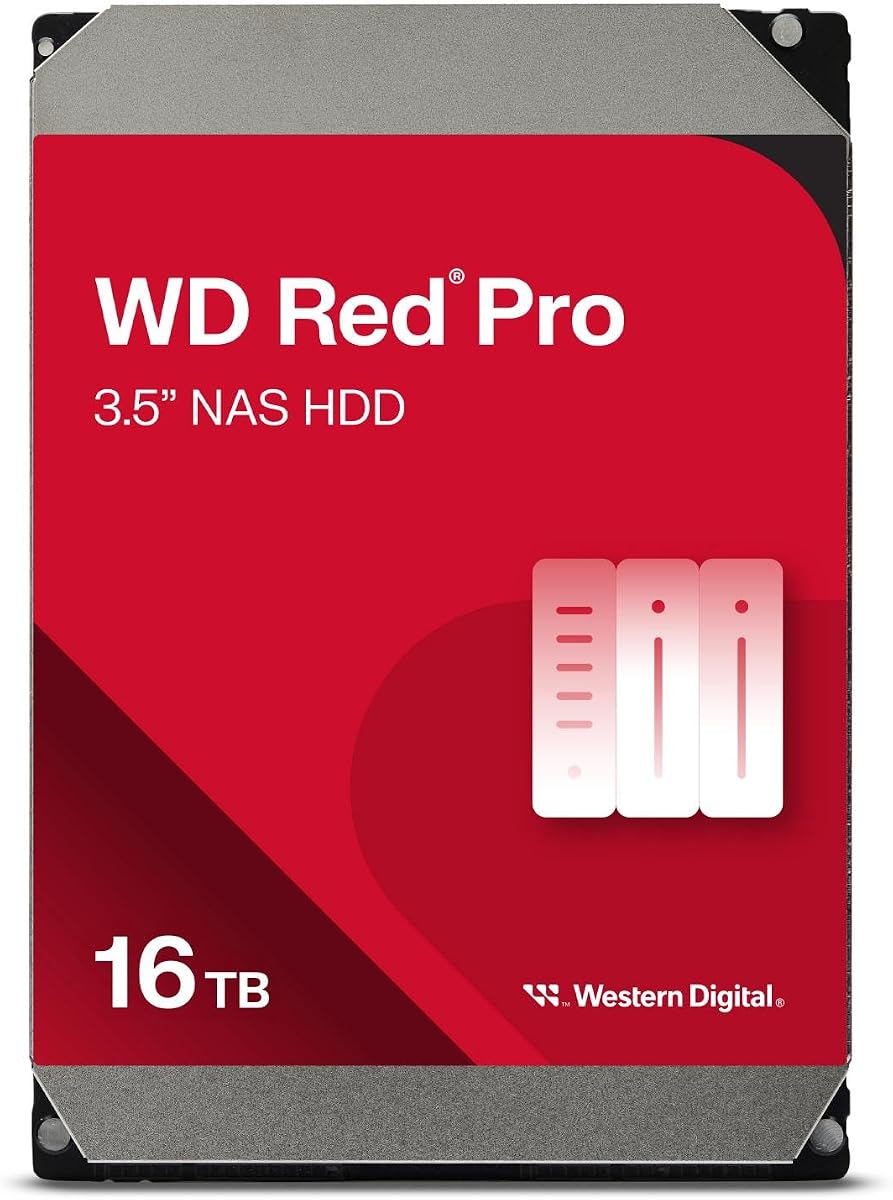
The Western Digital 16TB WD Red Pro is built for RAID-oriented NAS systems that need substantial capacity and a drive capable of handling intensive, continuous activity. Its 3.9 rating places it behind several IronWolf choices, but specifications reveal a compelling option for demanding multi-bay installations: 16TB of storage, CMR recording, a 512MB cache, and a stated workload rating of 550TB per year.
We may earn a commission when you buy through this link, at no additional cost to you.
The drive operates at 7200 RPM over SATA 6Gb/s, giving it the mechanical speed and bandwidth profile expected of a high-end mechanical NAS drive. Western Digital specifically positions the Red Pro line for high-intensity 24×7 multi-user environments, and the product information states that it is RAID optimized for NAS systems with unlimited bay counts. Its 512MB cache is especially notable when compared with the 256MB cache offered by several competitors in this guide.
Compatibility is an important strength because Western Digital works with a wide range of NAS system vendors and conducts extensive testing. The stated 550TB annualized workload rate is significantly more demanding than a conventional desktop drive, making this a better fit for active teams, continuous backups, surveillance-adjacent storage, or shared creative workloads. The rating is not a fixed throughput guarantee, however; actual workload rate varies with temperature, hardware, software, and array configuration.
The WD Red Pro 16TB is most appropriate for administrators who prioritize capacity, sustained workload support, and large cache over having the highest customer rating. It may also appeal to buyers seeking an established alternative to the heavily represented Seagate lineup. Before buying, check the NAS vendor's compatibility list and confirm the enclosure's drive support and cooling arrangement. The lower rating warrants attention, but it does not erase the strong workload and capacity advantages.
The stated 550TB yearly workload rating supports use in active environments where data moves continuously. It helps distinguish the Red Pro from drives designed mainly for archival storage or lighter personal NAS duties.
The 512MB cache can be useful when a NAS serves file requests, backup jobs, and media access at the same time. It supplements, rather than replaces, the need for adequate memory and a properly configured storage pool.
We may earn a commission when you buy through this link, at no additional cost to you.
The Seagate IronWolf Pro 12TB is designed for larger, multi-user NAS server environments that require more than the standard IronWolf's stated bay range. It carries a 4.5 rating, combines 12TB of capacity with up to 250MB/s performance, and is specifically positioned for systems of up to 24 bays. That makes it a credible middle ground between mainstream NAS drives and more specialized enterprise hardware.
We may earn a commission when you buy through this link, at no additional cost to you.
Its 7200 RPM spindle speed, 256MB cache, and SATA 6Gb/s interface create a well-balanced mechanical storage platform. Seagate highlights AgileArray firmware, reduced vibration and noise, and improved RAID performance. The integrated IronWolf Health Management system provides prevention, intervention, and recovery guidance, while the stated 1.2 million-hour MTBF reflects the Pro line's emphasis on long-term dependability.
A major differentiator is the five-year limited warranty, which exceeds the three-year coverage listed for the standard IronWolf 12TB. The drive also includes three years of Rescue Data Recovery Services. Buyers should not interpret those services as a substitute for backups, especially in a large array, but they can complement a careful maintenance and recovery plan. The stated capacity available to users may vary with the operating environment, which is normal for all file systems.
This IronWolf Pro model is a strong recommendation for creative teams, small businesses, and advanced home users running high-access arrays. It balances generous capacity with faster sustained performance and extended support without requiring an enterprise SAS platform. Confirm that the chosen NAS officially lists the model, provide suitable airflow, and use a staggered expansion plan. Buyers needing a SAS interface or an even higher density can consider those alternatives, but this drive is a versatile high-end SATA choice.
With stated support for as many as 24 bays, the IronWolf Pro 12TB targets installations where drive interaction, vibration management, and sustained access are more significant than in a small two- or four-bay enclosure.
The five-year limited warranty gives administrators a longer planning horizon than the standard IronWolf offering. Included recovery services add useful support when unexpected physical damage occurs, although regular backups remain essential.
We may earn a commission when you buy through this link, at no additional cost to you.
The Seagate IronWolf 10TB stands out as the most balanced selection in this guide. Its 4.7 rating is the highest among the listed drives, and its specification set is well matched to the needs of a serious multi-user NAS: 10TB of CMR capacity, 7200 RPM, 256MB cache, and sustained transfers of up to 210MB/s.
We may earn a commission when you buy through this link, at no additional cost to you.
The supplied information emphasizes 24×7 NAS operation, AgileArray firmware, dual-plane balancing, and error recovery. Those features are intended to support RAID arrays where vibration and sustained workloads can affect reliability. Rotational vibration sensors further improve awareness of movement around neighboring drives. A stated workload rating of 180TB per year places it firmly in the serious NAS category rather than the desktop or casual-storage tier.
Reliability is supported by a stated one million-hour MTBF, 600,000 load/unload cycles, and integrated IronWolf Health Management. The product information also states that the drive includes a three-year Rescue Data Recovery Service with an industry-leading 95 percent recovery success rate. That service is a valuable supplement to backups, but it should never be the only reason to skip them.
For buyers seeking a balanced high-end NAS drive rather than the maximum available capacity, this is the recommendation to prioritize. It works especially well for mixed creative files, shared family media, active backups, and small-business workflows. The main tradeoff is straightforward: 10TB is less than the 12TB, 16TB, 18TB, and 24TB alternatives, and its annual workload rating is below the Western Digital WD Red Pro. Within the standard IronWolf family, however, the feature balance and rating make it especially persuasive.
Conventional magnetic recording avoids the write-penalty behavior associated with some alternative recording methods, making CMR a sensible foundation for predictable RAID operation. The 256MB cache complements this design during everyday multi-user access.
IronWolf Health Management and rotational vibration sensors help surface conditions that may deserve attention in a multi-bay system. These features support proactive maintenance, while routine SMART checks and verified backups complete the care routine.
We may earn a commission when you buy through this link, at no additional cost to you.
The Seagate IronWolf Pro 10TB is a compelling choice for buyers who want the Pro family's workload positioning and five-year warranty without moving to a 12TB or greater configuration. Its 4.5 rating and up-to-214MB/s transfer specification place it among the stronger conventional NAS drives in the group.
We may earn a commission when you buy through this link, at no additional cost to you.
This model uses CMR and combines a 7200 RPM spindle with a 256MB cache and SATA 6Gb/s interface. It is intended for up to 24-bay, multi-user NAS servers, with AgileArray firmware supporting RAID behavior. Seagate also emphasizes reduced wear, low noise and vibration, improved file-sharing performance, lower power consumption, and added protection during power loss.
Its stated 1.2 million-hour MTBF and IronWolf Health Management system strengthen its reliability proposition. The five-year limited warranty and three years of Rescue Data Recovery Services add long-term administrative value. Capacity can vary according to the operating environment, so users should plan capacity based on the space visible in their operating system rather than assuming every byte is immediately available.
The best fit is a high-activity NAS where long warranty coverage and multi-bay support matter more than maximizing capacity per drive. A 12TB or 16TB IronWolf Pro may be more economical when a fixed number of bays must hold more data, while a 10TB model can make expansion easier. Buyers should compare their required usable capacity, RAID rebuild time, NAS compatibility list, and current drive cost before deciding.
The extended warranty is especially useful in professional environments where drives remain in service for many years. It reduces the likelihood of a warranty-driven replacement being tied to the shorter coverage offered by standard NAS models.
Seagate's listed focus on data protection during power loss complements the RAID-aware firmware. Actual protection still depends on a suitable power supply, correct array configuration, and tested recovery procedures.
We may earn a commission when you buy through this link, at no additional cost to you.
The Synology HAS5300 12TB is distinct from the SATA-heavy majority of this guide because it uses a 12Gb/s SAS interface. That makes it relevant to buyers operating compatible Synology platforms or other SAS-capable enclosures. The supplied data contains no customer rating, so this recommendation rests on its stated interface, capacity, cache, and intended efficiency rather than a numerical score.
We may earn a commission when you buy through this link, at no additional cost to you.
Its 256MB cache buffer and high-speed SAS connection offer a strong foundation for storage systems handling concurrent requests. The drive can hold millions of images, extensive video, or a very large music collection according to the supplied description, although real usable capacity varies with formatting and operating-system overhead. The standard 3.5-inch form factor supports straightforward integration into compatible bays.
The central issue is compatibility. SAS is not interchangeable with SATA, and a drive using this interface cannot simply be inserted into a consumer enclosure with a SATA data connection. Buyers must verify the specific Synology model, backplane, controller, and expansion unit before purchasing. This is a specialized recommendation rather than a universal one, but in a properly matched environment the interface's bandwidth and enterprise positioning can be advantageous.
Choose the HAS5300 12TB when your existing infrastructure uses SAS and you prefer a drive closely associated with the Synology ecosystem. It is less appropriate for a standard SATA NAS, even if the capacity seems attractive. Confirm model-level support, use the correct cabling, and compare the total cost of a SAS platform against a modern SATA array before making a larger investment.
The 12Gb/s SAS interface provides a distinctive upgrade path for systems designed around enterprise-style storage connectivity. Its benefits apply only when the enclosure, controller, and cabling support the same interface.
A 12TB drive is well suited to image, music, and video archives where capacity is more valuable than a very small form factor. As with every mechanical drive, the final usable space depends on the file system and NAS volume configuration.
We may earn a commission when you buy through this link, at no additional cost to you.
The Seagate IronWolf Pro 16TB is the strongest premium conventional NAS recommendation in this guide. It combines a 4.6 rating, 16TB of capacity, 7200 RPM operation, all-CMR recording, and a stated 2.5 million-hour MTBF. The result is a high-density drive aimed at multi-bay systems that cannot compromise on either endurance or storage consolidation.
We may earn a commission when you buy through this link, at no additional cost to you.
Seagate highlights AgileArray firmware, dual-plane balancing, and time-limited error recovery as core RAID-oriented features. All-CMR technology supports consistent performance, while built-in rotational vibration sensors help the drive tolerate the movement common in densely populated arrays. IronWolf Health Management adds prevention, intervention, and recovery recommendations, giving administrators a more active view of system health.
The product listing includes a five-year limited warranty and three years of complimentary Rescue Data Recovery Services with registration. It also describes an industry-leading 95 percent recovery rate for supported cases. These services can be valuable in a professional deployment, but they are not a substitute for immutable, off-site, or otherwise independent backups. A high-capacity mechanical drive can fail without warning even when its health telemetry looks normal.
This model is recommended for prolific studios, distributed teams, large media archives, and NAS systems where reducing drive count is important. Sixteen terabytes helps limit the number of disks exposed to vibration and power draw, and the endurance figures suit 24×7 use. The tradeoff is the effect of larger drives on RAID rebuild duration and the higher acquisition cost of premium capacity. Check enclosure limits and ensure the NAS supports the exact model before ordering.
Using 16TB disks can reduce the number of drives needed for a target capacity, which is valuable where drive bays are limited. The benefit is strongest when the enclosure is designed for sustained heat and vibration management.
A stated 2.5 million-hour MTBF, all-CMR construction, vibration sensors, and a five-year warranty create a compelling reliability package. These figures support the premium positioning, though they cannot guarantee that any individual drive will remain failure-free.
We may earn a commission when you buy through this link, at no additional cost to you.
The Seagate IronWolf Pro 16TB ST16000NE000 delivers the same broad capacity tier as the newer IronWolf Pro option, but with a different performance and reliability profile. Its 3.7 rating is the lowest among the numerically rated products, so the drive is best considered when its features align closely with an existing installation and the buyer has compared alternatives carefully.
We may earn a commission when you buy through this link, at no additional cost to you.
Its strengths are clear. The 16TB disk uses conventional magnetic recording, operates at 7200 RPM, and connects through SATA 6Gb/s. AgileArray firmware adds dual-plane balancing and time-limited error recovery, while rotational vibration sensors support operation in multi-bay arrays. IronWolf Health Management offers prevention, intervention, and recovery recommendations, giving administrators the same familiar monitoring framework found across the IronWolf range.
The stated MTBF of 1.2 million hours supports continuous operation, and the 24×7 design suits shared file access, backups, and media workflows. As a 16TB model, it can consolidate several lower-capacity disks into a more space-efficient array while preserving large individual volumes. That efficiency must be balanced against the time required to rebuild a large drive after a failure.
This model makes sense for an existing compatible NAS that specifically supports it, particularly where the alternative is adding more disks to a crowded enclosure. The lower rating and older endurance figure give careful buyers a reason to compare it with newer 16TB choices. Check current firmware behavior, enclosure support, and warranty terms before purchasing, and keep a current backup independent of the RAID array.
IronWolf Health Management provides a consistent way to review drive condition and receive operational recommendations. Administrators should pair those insights with routine SMART monitoring and a documented replacement procedure.
The inclusion of rotational vibration sensors helps the drive respond to movement caused by nearby spinning disks. This is valuable in larger arrays where vibration management influences sustained RAID performance.
We may earn a commission when you buy through this link, at no additional cost to you.
The Western Digital Ultrastar DC HC580 24TB is the maximum-capacity option here and stands apart through its enterprise lineage. Its 4.6 rating, 24TB capacity, 7200 RPM speed, 512MB cache, and 2.5 million-hour MTBF make it compelling for very large private clouds, data centers, and bulk storage systems.
We may earn a commission when you buy through this link, at no additional cost to you.
The supplied information describes a drive engineered for hyperscale environments, major data centers, big-data applications, cloud storage, and massive scale-out deployments. Conventional magnetic recording supports consistent performance, while the 512e sector format and SATA 6Gb/s interface support mainstream enterprise storage. A 512MB cache provides a generous buffer for demanding workloads and sequential transfers.
The major qualification is that this is an enterprise drive rather than a NAS-specific model. It lacks the supplied product data's direct references to NAS health management, rotational vibration sensors, and multi-bay workload ratings. It may work correctly in some SATA NAS enclosures, but buyers should confirm size, firmware, power requirements, acoustics, and vendor support. The renewed designation also calls for careful attention to condition, seller information, and the available return process.
This drive is recommended for experienced administrators who need the highest density in the guide and can validate compatibility themselves. It is a less obvious choice for a compact home NAS because acoustic output, heat, enclosure support, and replacement logistics may be less convenient. For large systems, however, the ability to store more data in fewer drives can simplify expansion. Confirm the exact model suffix and support status before deploying it in a critical array.
Twenty-four terabytes per drive can substantially reduce the physical disk count needed for a large archive or backup repository. Fewer drives can mean lower enclosure overhead and fewer individual failure points, provided cooling and vibration controls are appropriate.
A renewed drive can be economical for secondary storage, but buyers should review its condition, remaining coverage, seller reputation, and return terms. It is prudent to introduce a renewed enterprise disk gradually and monitor it closely.
We may earn a commission when you buy through this link, at no additional cost to you.
The Seagate IronWolf Pro 18TB offers a high-density NAS option with a 4.3 rating and 18TB of storage. Because this is a renewed model, its manufacturer-recertified status and condition should be evaluated alongside the attractive capacity. It is best suited to buyers who understand the risks and rewards of purchasing a previously used enterprise drive.
We may earn a commission when you buy through this link, at no additional cost to you.
The drive uses all-CMR technology for consistent 24×7 performance and a SATA 6Gb/s interface within a standard 3.5-inch form factor. AgileArray firmware brings dual-plane balancing, time-limited error recovery, and rotational vibration sensors, all relevant to multi-bay RAID systems. The product information says it is rated for as many as 24 drives per array, making it relevant to larger installations.
IronWolf Health Management adds prevention, intervention, and recovery recommendations to help maintain system health. For a renewed unit, those monitoring tools are particularly valuable because they complement careful deployment and early-life testing. Users should still verify all SMART attributes, review the drive's history, introduce it gradually, and maintain backups that are not confined to the same NAS.
This model is recommended for experienced buyers who want more capacity per bay than a conventional 12TB or 16TB drive and can manage a renewed product. It may be useful for bulk archives, media repositories, or secondary storage where access demand is lower than for a critical application database. Check the NAS compatibility list and the return policy, and avoid placing the drive in a device where an immediate replacement is not available if the device does not support hot-swapping.
The 18TB capacity offers more room than mainstream 10TB and 12TB options while remaining below the 24TB enterprise model. That middle position can be useful when bay density matters but maximum per-drive capacity is not essential.
Manufacturer recertification and NAS-aware health tools provide a useful starting point for renewed hardware. Buyers should still run the NAS's native drive test, review diagnostic logs, and watch early performance and SMART trends.
We may earn a commission when you buy through this link, at no additional cost to you.
Choosing a high-end NAS drive requires matching the drive to the enclosure, RAID strategy, workload, and available bay space. Capacity alone is only the beginning; interface, recording technology, endurance, vibration handling, and support can determine whether the installation performs reliably.
In short, verify the interface and model number before ordering. Compatibility errors can make an otherwise capable drive unusable.
Choose the smallest capacity that comfortably meets current and near-term needs. Larger drives make sense when density, bay limits, or power and cooling constraints justify the longer rebuild time.
For predictable multi-bay performance, favor an explicitly identified CMR model. It reduces uncertainty when rebuilding arrays or sustaining mixed workloads.
Match the drive class to the intensity of daily use. A higher-endurance NAS drive is worthwhile for continuous business or team workloads, not simply because it has a larger cache.
For larger arrays, vibration-aware firmware and sensors are meaningful advantages. A properly engineered enclosure matters just as much as the individual drive.
Treat health tools and recovery services as useful safety nets. Maintain independent backups and a tested replacement plan because no monitoring feature can prevent every failure.
Compare warranty length, recovery terms, and return provisions alongside performance. For renewed products, verify the specific seller's coverage rather than assuming it matches a new drive.
Plan airflow and noise before filling the enclosure. Secure mounting, adequate cooling, and regular acoustic checks protect both performance and drive longevity.
Before installation, confirm the exact drive model, interface, capacity, and enclosure support. Create or verify a complete backup of essential data, and follow the NAS manufacturer's procedure for adding or replacing a disk. Disconnect power before changing hardware, use anti-static precautions, and secure each drive in its tray or sled. When building a new array, the operating system will need to initialize or format the drives according to the selected RAID level, so avoid interrupting the process.
After installation, review the NAS dashboard for drive health, temperature, firmware, filesystem, and storage-pool status. Run the manufacturer's diagnostic test when practical and confirm that the storage volume, shared folders, permissions, and backup jobs work as expected. For an array, verify that the expected number of disks is present and that the pool reports the intended redundancy. Schedule regular SMART checks, keep firmware and NAS software current, and investigate new warnings rather than dismissing them.
Maintain the NAS with deliberate replacement planning. Keep an unused compatible drive on hand, document the array layout, and test the restore process periodically. Monitor capacity so the file system does not become critically full, and avoid deleting important recovery points from the same array that serves as the backup source. When replacing a failed drive, follow the documented sequence for identifying the failed disk, rebuilding the pool, and restoring redundancy. For renewed or secondary-purpose drives, monitor early-life behavior especially closely.
For a continuously operating NAS, a NAS-specific drive is usually better because it is designed around sustained multi-bay workloads, vibration awareness, and RAID-related firmware. A desktop drive may work, especially in a simple enclosure, but it may not include the same health management, workload tolerance, or multi-bay support. The most important factor is matching the drive to the NAS vendor's compatibility list and intended use.
A 12TB to 18TB drive is a practical range for many large media libraries, while a 24TB enterprise option can reduce the number of bays needed. The right choice depends on how much usable space you need, how many bays are available, and how long you want RAID rebuilds to take. Remember that formatted usable capacity is lower than the nominal capacity, and keep an independent backup for irreplaceable media.
Only when the enclosure or backplane explicitly provides SATA compatibility through the appropriate adapters, controllers, and cabling. A SAS interface is not automatically compatible with a SATA drive, even though both may use similar-looking connectors in some setups. Check the NAS and expansion-unit documentation, and use the exact interface and model combinations listed as supported.
CMR is generally favored for RAID because it provides predictable write behavior and avoids the performance penalties that can affect SMR drives during sustained workloads and rebuilds. Several drives in this guide are explicitly identified as CMR models. Still, the full technical specification and enclosure support list should be checked because product families can include different recording technologies across capacities.
Renewed drives can be reasonable for secondary storage, bulk archives, or experienced users who understand the risk and have a solid backup and replacement plan. The renewed 18TB IronWolf Pro and 24TB Ultrastar are particularly attractive for capacity, but their prior use should be reflected in careful health checks and conservative deployment. For an irreplaceable dataset, prioritize new drives and independent backups rather than relying on recovery services alone.
The 256MB and 512MB caches in this guide help buffer incoming and outgoing data, but sustained file throughput is influenced by the entire system. RAID configuration, drive population, network speed, controller performance, workloads, and file patterns can matter as much as raw sequential speed. Focus on compatible performance specifications and sustained transfer behavior rather than assuming a larger cache alone will make every task faster.
No. Rescue services can help with certain physical or logical drive failures when the product's terms are met, but they do not protect against accidental deletion, ransomware, filesystem damage, or every form of corruption. Keep versioned or immutable backups on a separate system or medium, test restores periodically, and follow the registration and return requirements for the included service.
The right count depends on the enclosure, RAID level, performance target, redundancy needs, and storage capacity. Populating every bay can improve performance or storage efficiency in some configurations, but it also increases heat, vibration, power draw, and the number of drives exposed to failure. Use the NAS vendor's recommended population guidance, plan for failure headroom, and avoid expanding an array with drives that are not supported for that purpose.
The Seagate IronWolf 12TB stands out as the best overall value, combining 12TB of capacity, NAS-specific RAID features, health monitoring, and a three-year warranty. The IronWolf 10TB is the editor's choice because of its 4.7 rating, balanced 210MB/s performance, CMR consistency, and strong multi-user feature set, while the 16TB IronWolf Pro is the premium selection for buyers who want greater density and a higher stated endurance rating.
The right choice for a specific system may differ from the overall winner. The WD Red Pro 16TB brings a 512MB cache and a heavy 550TB yearly workload rating, the HAS5300 is appropriate only for compatible SAS infrastructure, and the renewed enterprise and NAS models can provide exceptional capacity for buyers willing to manage the additional considerations. Prioritize interface compatibility, workload class, CMR where appropriate, multi-bay vibration support, cooling, and a recovery plan before concentrating on capacity alone.
Finally, check current product details, NAS compatibility, warranty terms, and pricing immediately before purchasing. Drive prices and availability can change, as can the precise contents of a retailer listing or renewed inventory. Use current NAS documentation to confirm the model number and interface, and make sure your backup plan protects data even when a RAID array and its recovery services appear healthy.

