SEQURE M10-25Q FPV GPS Module
4.8Editor score
QMC5883L magnetic compass
Six satellite-system modes
Solder-free connection option
Compare GPS modules for drones by M10 GNSS support, compass features, update rates, protocols, flight-controller compatibility, and installation needs.
GPS modules give drones the satellite positioning information needed for accurate navigation, return-to-home functions, waypoint missions, and improved recovery after a control-link failure. A capable module should lock quickly, track multiple satellite systems, communicate with the flight controller, and fit without adding unnecessary bulk or interference.
This guide compares ten GPS and GNSS modules designed for FPV drones, fixed-wing aircraft, robotics, and compatible flight-controller platforms. The evaluation considers positioning protocols, constellation support, compass integration, refresh rate, dimensions, weight, power requirements, mounting options, and the level of setup each module demands.
Each pick highlights a different practical advantage, from compact multi-GNSS hardware for racing builds to flash-equipped receivers for autonomous platforms. Ratings reflect the supplied customer feedback, while technical details come from the listed product information. Product availability and pricing can change, so confirm current specifications before purchasing.
4.8Editor score

5.0Editor score

The table below compares the ten modules by receiver generation, navigation support, refresh rate, compass integration, and practical compatibility. It is designed to make protocol, constellation, and installation differences easy to identify before choosing a receiver for a particular aircraft.

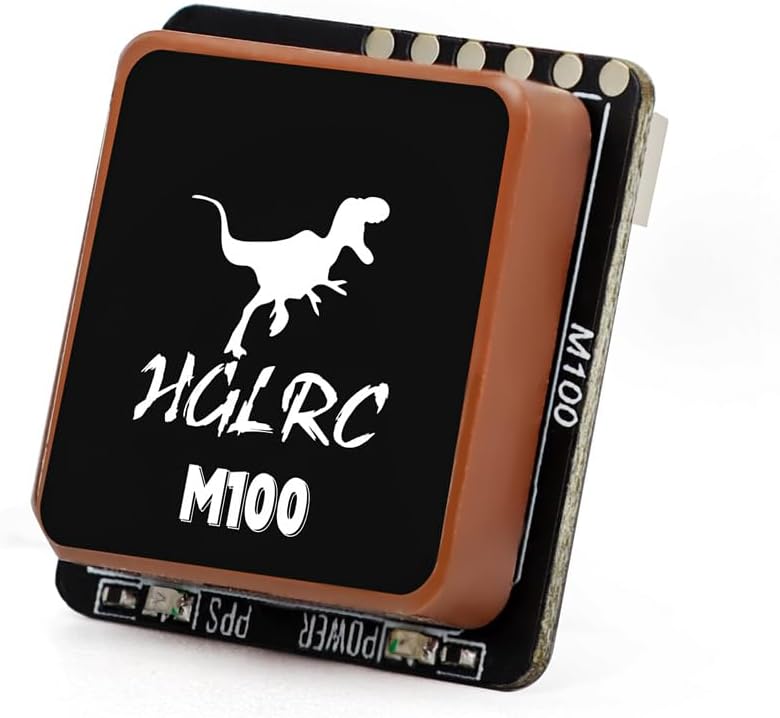



The HGLRC M100 Pro is a compact GPS and compass module aimed at FPV and fixed-wing UAV builders that want current-generation positioning hardware without moving to a larger autonomous-flight receiver. It carries a 4.6 customer rating and stands out through its 10th-generation chip, expanded 120-channel receiver, and integrated QMC5883L compass.
We may earn a commission when you buy through this link, at no additional cost to you.
The combination of GPS reception and magnetic sensing is useful for builds that require heading information alongside a position fix. A 120-channel receiver can potentially observe more satellite signals than a smaller-channel implementation, while the ceramic antenna and external PCB approach described for the related HGLRC design suggests attention to signal capture and component placement. Compatibility should still be confirmed against the flight controller and intended navigation features.
The main drawback is that the supplied listing focuses on headline features rather than providing a detailed protocol matrix, voltage range, connector arrangement, or exact dimensions. That means builders cannot rely on the product description alone to establish every installation detail. Firmware compatibility, baud rate, protocol, and compass calibration should all be checked before committing to the module.
This is a sensible pick for an FPV fixed-wing builder who wants an updated receiver and onboard compass in a small package. It is particularly attractive for pilots adding return-to-home or position-based navigation to an aircraft that previously lacked reliable satellite positioning. Verify connector type and protocol settings, then confirm that the antenna has an unobstructed view of the sky.
The expanded 120-channel receiver is the module's most prominent specification. Working with a larger channel set can help the receiver evaluate satellite signals efficiently, although actual lock time still depends on signal conditions, antenna orientation, and the surrounding environment.
The QMC5883L compass adds heading data without requiring a separate magnetometer board. This simplifies the build, although pilots should still separate the GPS antenna from sources of magnetic interference and perform calibration in the final airframe.
We may earn a commission when you buy through this link, at no additional cost to you.
The HGLRC M100-5883 is designed around a 21mm square footprint and a weight of just 7.73 grams, making it a natural candidate for compact FPV fixed-wing aircraft. Its 4.5 rating reflects generally favorable customer feedback, while the updated 10th-generation chip, QMC5883L compass, and support for GPS, Galileo, and BeiDou distinguish it from a basic receiver.
We may earn a commission when you buy through this link, at no additional cost to you.
Multi-constellation support is particularly helpful when a flight takes place near buildings, wooded areas, or other locations where a single satellite system may provide fewer usable signals. The listed ceramic antenna and external expansion PCB are intended to improve reception, while the integrated compass can provide directional data for assisted navigation and return-to-home behavior.
Its tiny dimensions reduce the impact on flight performance, but the same miniaturization can make installation less forgiving. A poor antenna position, excessive carbon-fiber or metal interference, or a compass mounted too close to high-current electronics may reduce performance. The listing also does not state the output refresh rate or input-voltage range, so exact setup requirements should be confirmed with the manufacturer or seller.
Choose this module when every gram and millimeter matters but heading and multi-GNSS support remain important. It is especially relevant to small fixed-wing aircraft where a larger GPS assembly would interfere with the airframe. Confirm the flight-controller protocol, connector, voltage requirements, and antenna clearance before installation.
Supporting GPS, Galileo, and BeiDou gives the receiver more potential satellite sources than a single-system design. The extra options can improve availability in challenging locations, though each constellation must be supported and configured in the flight software.
At 7.73 grams and 21mm square, the module is easy to accommodate on a small FPV airframe. Keeping the GPS antenna away from the ESC and radio-frequency components remains important, as a compact receiver cannot compensate for a poorly chosen location.
We may earn a commission when you buy through this link, at no additional cost to you.
The HGLRC Mini M100 targets FPV racing drones from 2 to 7 inches and carries a 4.6 rating. Rather than focusing on an integrated magnetic compass, its strongest selling points are broad aircraft-size compatibility, a ceramic antenna, flexible 3.3-5 volt input, and onboard power and PPS indicators that make operating status easy to inspect.
We may earn a commission when you buy through this link, at no additional cost to you.
The broad voltage range can simplify integration with different flight-controller power systems, while the status LEDs help a pilot confirm that the receiver is powered and receiving time or position information. Its small form factor is appropriate for racing builds where every component must fit without compromising aerodynamics or creating a snag point.
Unlike several other modules in this guide, the Mini M100 is not described as including a compass. Builds that need heading information for assisted flight or return-to-home may therefore need another magnetometer arrangement, depending on the flight controller. The listing also omits exact output protocols and refresh rate, which are important details when matching the receiver to Betaflight, INAV, or another controller.
The Mini M100 is best for a pilot adding satellite positioning to a small or mid-size racing drone and wanting simple power-status feedback. Its broad voltage support and stated drone-size range are practical advantages. Before installation, check the connector, UART settings, protocol, and whether the aircraft's navigation configuration requires a separate compass.
Separate power and PPS indicators give ground crews a simple way to determine whether the module is energized and receiving timing information. They are particularly handy when a craft will not arm because the flight controller is not detecting the receiver.
The stated 3.3-5 volt DC input range makes the module more accommodating across different receiver boards and flight-controller environments. The builder must still verify polarity and signal levels before connecting it.
We may earn a commission when you buy through this link, at no additional cost to you.
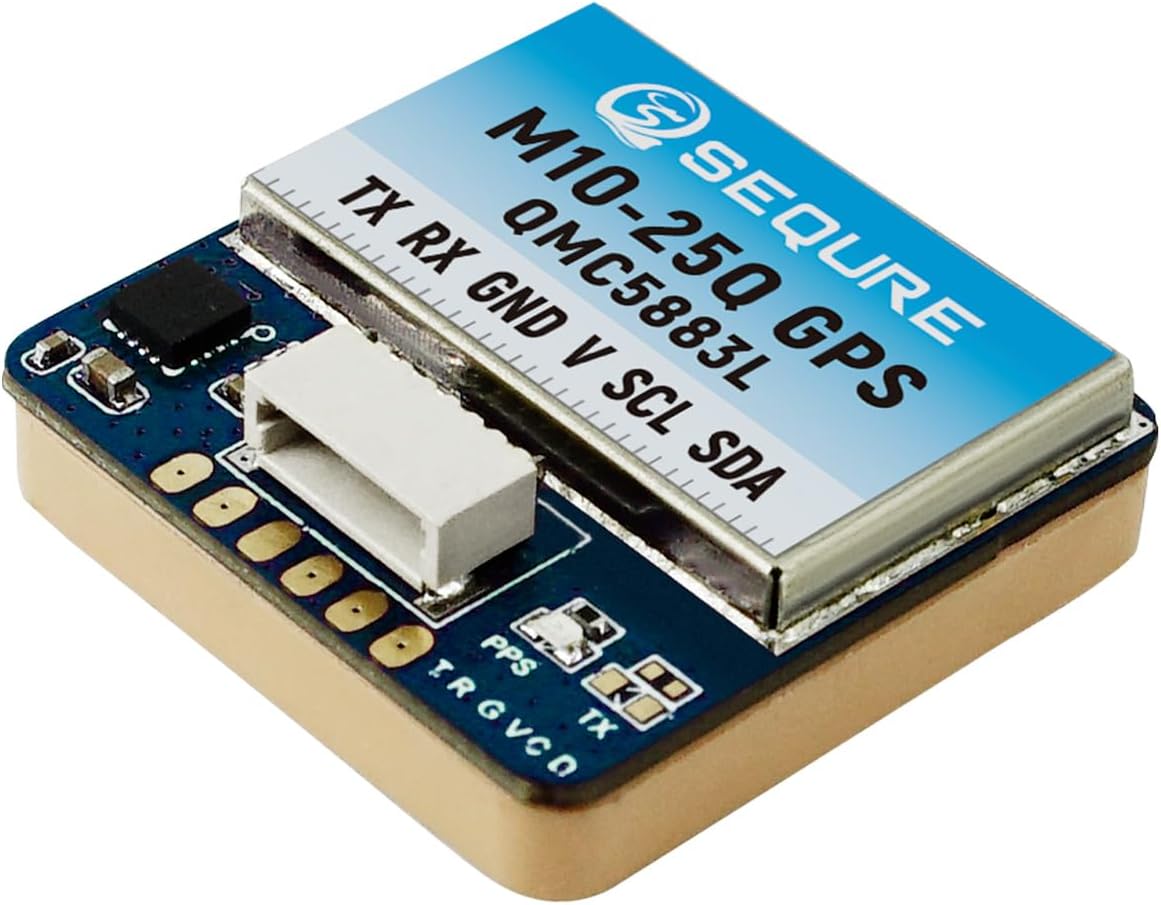
The SEQURE M10-25Q is a strong all-around FPV navigation module, earning a 4.8 rating in the supplied data. It combines a 10th-generation receiver, 10Hz output, a QMC5883L compass, and broad multi-constellation support in a compact package intended for 5-inch-and-larger UAVs.
We may earn a commission when you buy through this link, at no additional cost to you.
Support for GPS, GLONASS, BeiDou, Galileo, SBAS, and QZSS gives builders meaningful configuration flexibility. Different constellations can improve the number of visible satellites in challenging environments, while the ceramic antenna and expanded PCB are intended to support stable reception. The 10Hz output is well suited to aircraft that demand responsive position updates for navigation and return-to-home functions.
Installation is unusually flexible because the module offers both plug-and-play and solderable connection methods. That can save time in a completed build, though the correct protocol, baud rate, and navigation settings still have to be selected. Because the listed use case centers on 5-inch-and-larger aircraft, pilots with smaller racing drones may need to check the physical layout and weight budget more carefully.
This module is a compelling choice for an FPV pilot who wants a modern receiver, integrated compass, and selectable satellite systems without adding several separate parts. It also has the strongest customer rating among the picks with a numeric score, making it an informed budget-oriented recommendation. Confirm connector orientation and configure the module in an open area before relying on it for a first flight.
Supporting six navigation and augmentation systems lets the pilot match the receiver to regional availability and the flight controller's configuration. Enabling all available constellations can improve satellite visibility, but each setting should be supported and correctly interpreted by the chosen firmware.
The plug-and-play option reduces soldering work, while the alternate solder connection gives builders flexibility for permanent installations. A quick physical check still matters because incorrect connector orientation or an incompatible protocol can prevent a position fix.
We may earn a commission when you buy through this link, at no additional cost to you.
The JeeFly M8N targets pilots and builders working with Pixhawk, PX4, F4, or F7 flight controllers. Unlike the more compact racing-oriented modules, it is presented as a complete autonomous-flight receiver with a 72-channel Ublox M8N, 10Hz updates, a built-in compass, an antenna mount, a 270mm cable, and clearly labeled status indicators.
We may earn a commission when you buy through this link, at no additional cost to you.
Its multi-GNSS reception can use GPS, GLONASS, BeiDou, and QZSS simultaneously, with the listing noting tracking of more than 26 satellites. The stated accuracy is 0.5 meters, improving to 30 centimeters under ideal conditions. Those figures depend on a clear signal environment and proper antenna placement, so they should be treated as best-case performance rather than guaranteed flight results.
The main compatibility restriction is important: the module is not for APM, and some Pixhawk models may require a firmware update. Those with older stacks should verify hardware revision and supported receivers before installation. The 270mm cable is helpful for positioning the antenna on a larger airframe, but it must be routed without sharp bends or proximity to noisy electronics.
Choose the M8N when autonomous routes, return-to-home, and professional flight-controller workflows matter more than minimizing size. The included mount and cable make installation more complete than a bare mini receiver, while the 10Hz rate supports responsive navigation. Verify firmware support and compass placement, then test satellite acquisition in the intended operating area.
The combination of 72-channel reception, four major satellite systems, and 10Hz updates is aimed at aircraft that need dependable position updates during autonomous maneuvers. This makes it more relevant to Pixhawk-class builds than to lightweight freestyle racers.
The included 270mm cable and antenna mounting base help position the receiver away from processors and high-current wiring. Good antenna placement remains essential for both acquisition speed and the consistency of position and heading information.
We may earn a commission when you buy through this link, at no additional cost to you.
The Readytosky M10 is a purpose-built GPS and external compass solution for the Pixhawk 2.4.8 flight controller. It has a 4.2 rating and emphasizes low power, high precision, persistent configuration, and the ability to place the compass outside the aircraft's central electronics area.
We may earn a commission when you buy through this link, at no additional cost to you.
The most useful feature is the onboard flash, which preserves configuration changes when power is removed. That matters on platforms where the receiver settings may need to survive a power cycle or maintenance session. The stated ideal positioning accuracy of 1.5 meters CEP is suitable for many waypoint, loiter, and return-to-home applications when the antenna has a clear view of the sky.
Compatibility is restrictive by design. The listing explicitly states that the GPS works only with the Pixhawk flight controller and cannot be used with other controllers. This removes uncertainty for a Pixhawk 2.4.8 owner but makes the module unsuitable for a builder comparing platforms or planning to change controllers later.
The Readytosky M10 is best for established Pixhawk 2.4.8 systems that benefit from an external compass and persistent receiver settings. Pilots should confirm the exact flight-controller revision, connector, baud configuration, and antenna-cable arrangement before installation. For a more versatile GNSS choice, select a module that supports several flight-control ecosystems.
Onboard flash allows modified settings to remain in memory after shutdown. This reduces repeated configuration work and is especially useful in a fixed-wing aircraft or a drone that is regularly powered down between test flights.
The separate compass and holder can be positioned farther from motors, ESCs, and power wiring. Even so, the final installation still requires compass calibration and a check for interference from the completed aircraft.
We may earn a commission when you buy through this link, at no additional cost to you.
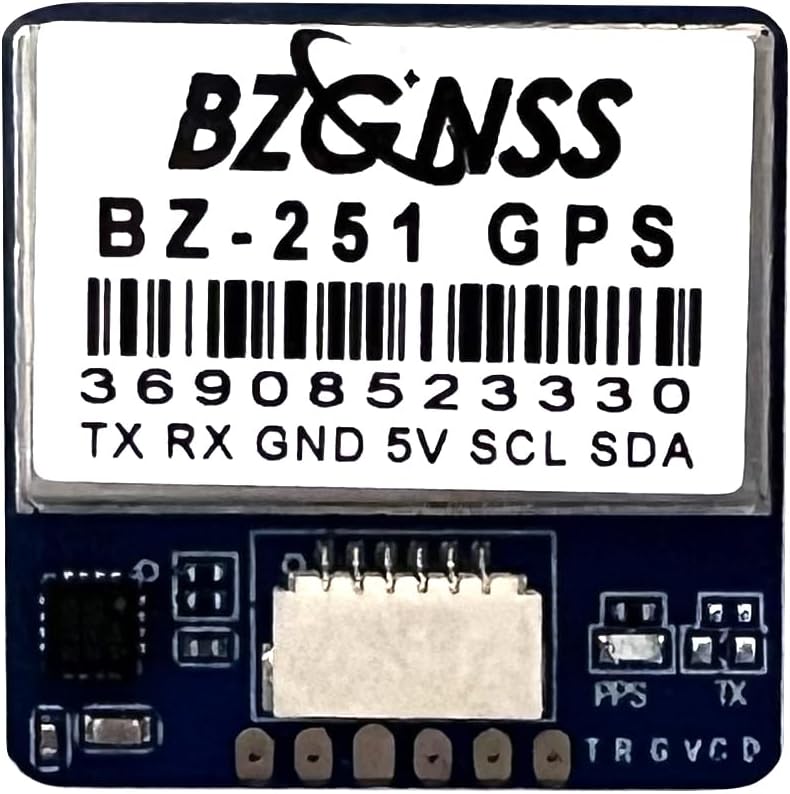
The BZGNSS BZ-251 stands out as a navigation-and-rescue module for FPV drones, fixed-wing aircraft, and other RC platforms using F4 or F7 flight controllers. It has a 5.0 rating in the supplied data, making it the highest-rated numeric entry, and its core focus is dependable positioning for failsafe return-to-home functions.
We may earn a commission when you buy through this link, at no additional cost to you.
The module uses the u-blox M10 chipset to acquire satellites and maintain positioning in challenging signal conditions. It supports both NMEA and UBX protocols, giving builders more flexibility when matching the receiver to a flight controller's navigation settings. A refresh rate of up to 10Hz provides responsive location data, while the listed 1.5-meter 2D accuracy is appropriate for return-to-home and broad positioning tasks.
Its ceramic antenna uses an oil-spraying process intended to resist scratches and oxidation, which is a thoughtful durability measure for modules exposed to handling, vibration, and changing humidity. The main limitation is that the listing does not explicitly mention an integrated compass. A craft requiring a full assisted-navigation solution may need a separate magnetometer or a module with onboard compass support.
This is an excellent general choice for pilots who need reliable failsafe behavior and want protocol flexibility without committing to a large autonomous-flight receiver. Confirm the available UART, select the correct protocol and refresh rate, and verify whether your flight controller requires additional heading hardware. For fixed-wing and long-range builds, the M10 receiver is a particularly compelling feature set.
Accurate location data becomes most valuable when a pilot loses video control or the aircraft flies beyond direct control range. A receiver designed around fast acquisition and stable positioning supports the flight controller's failsafe logic, although the feature must also be configured correctly.
NMEA and UBX support lets the module fit a wider range of flight-controller configurations. The correct mode matters: using a protocol the receiver or flight stack does not support can prevent position data from appearing even when the hardware is working.
We may earn a commission when you buy through this link, at no additional cost to you.
The BZGNSS BZ-251 FPV GPS is a compact M10 receiver designed for RC FPV racers, fixed-wing aircraft, and long-range flight. It has a 4.4 rating and supports both NMEA and UBX protocols, making it a practical option for F405 and F722 flight controllers that need reliable satellite positioning.
We may earn a commission when you buy through this link, at no additional cost to you.
Its durable ceramic antenna is supported by an external PCB layout intended to improve signal reception, and the module advertises rapid satellite acquisition for less waiting before takeoff. BDS satellite support adds another source of potential positioning signals, while the compact, lightweight construction makes the receiver practical for small FPV airframes.
A built-in battery is an unusual and useful feature because it can preserve the receiver's configuration or assist with maintaining satellite information during brief power interruptions. The listing does not state a specific output refresh rate, and pilots should determine the current configuration in the flight software rather than assume the maximum supported by the chipset.
Choose this BZ-251 when a lightweight GPS is needed for a racing or fixed-wing build and NMEA/UBX flexibility is important. Its built-in battery and BDS support help separate it from simpler receivers. Confirm connector type, wiring order, protocol selection, and whether your chosen navigation mode requires a compass.
The integrated battery can help maintain receiver state when the main supply is momentarily interrupted. This is particularly useful in aircraft where a brief power fluctuation might otherwise cause the navigation system to restart and wait for a fresh satellite fix.
The support for both NMEA and UBX lets pilots use the receiver with different firmware expectations. Select the protocol required by the flight controller and confirm the baud rate before arming, especially on platforms that default to a different navigation mode.
We may earn a commission when you buy through this link, at no additional cost to you.
The AERO SELFIE FK-C1 M9 is built for weight-conscious FPV aircraft where every millimeter of space matters. It measures 20mm by 20mm by 8mm, weighs 7 grams, and combines an M9 positioning chipset with an IST8310 magnetic compass. The receiver supports GPS, GLONASS, Galileo, and BeiDou and can track up to 32 satellites.
We may earn a commission when you buy through this link, at no additional cost to you.
Its multi-constellation capability is valuable in settings such as urban canyons and forests, where different satellite systems may remain visible as the aircraft moves. The integrated compass supplies heading information for directional control and waypoint navigation, reducing the need for an additional magnetic sensor. Low power use is also important for battery-powered aircraft, with the listing specifying approximately 80mA consumption.
The module operates from -20°C to 80°C, covering a wide range of ordinary flying environments. Its blue LED blinks at 1Hz when a three-dimensional GNSS fix is acquired, giving ground crews a clear readiness indicator. One limitation is that this module uses the ninth-generation M9 chipset rather than the newer M10 generation found in several competing options.
Choose the FK-C1 for a small FPV or drone build that needs multi-GNSS positioning and an onboard compass in an exceptionally small package. Confirm flight-controller protocol, connector, voltage, and compass calibration. The lack of a numerical customer rating means technical fit and platform compatibility should carry more weight in the decision than review history.
Combining a multi-GNSS receiver and compass in a 20mm footprint saves space on crowded FPV frames. The integrated compass still needs to be mounted away from magnetic interference, so installation planning is as important as the small dimensions.
The blue LED blinks at 1Hz when the receiver has a three-dimensional position, allowing a pilot to check readiness without accessing flight-controller menus. A solid or different light state can help identify a search in progress.
We may earn a commission when you buy through this link, at no additional cost to you.
The FK-D1 is a 10th-generation GNSS module intended for drones and robotics, with support for INAV, Betaflight, ArduPilot, and PX4. It combines a 10Hz update rate, tracking of up to 32 satellites, and a built-in QMC5883L compass. Its 12-gram weight and 25 by 25 by 4mm antenna make it more substantial than the smallest racing modules without becoming oversized.
We may earn a commission when you buy through this link, at no additional cost to you.
The high-gain ceramic antenna is designed to support reception in challenging locations such as urban areas and dense natural cover. Built-in flash preserves user settings after power cycles, reducing the need to repeat configuration whenever the aircraft is shut down. Broad flight-controller support also makes the module useful for pilots who move between ArduPilot, PX4, INAV, and Betaflight-based platforms.
A UART interface requires correct wiring, baud rate, and protocol settings. The module also needs a clear sky view and careful compass placement away from motors, magnets, and high-current wiring. No numerical customer rating is supplied, so buyers should judge it primarily on confirmed platform compatibility and the features needed for their specific project.
The FK-D1 is a strong choice for a mixed drone or robotics platform that uses more than one flight-control ecosystem or needs persistent receiver configuration. It also suits builders wanting current-generation M10 performance with an integrated compass. Verify the connector pinout, navigation protocol, antenna orientation, and compass calibration before the first powered flight.
Built-in flash retains user settings through power cycles, which is useful for aircraft and robots that are moved between workbenches and operating locations. It also makes ongoing troubleshooting less repetitive because the same configuration can be restored consistently.
Compatibility with INAV, Betaflight, ArduPilot, and PX4 broadens the module's appeal for builders who work across platforms. Firmware and receiver configuration still need to match the selected stack, so compatibility should be validated before final installation.
We may earn a commission when you buy through this link, at no additional cost to you.
A useful drone GPS module must fit the aircraft, communicate with its flight controller, and provide navigation data under the conditions in which it will fly. The following factors help separate a simple positioning receiver from a complete navigation solution.
Receiver generation can influence acquisition speed, tracking capacity, update performance, and the satellite systems supported by the hardware. Several options in this guide use the 10th-generation M10 chipset, while others use the 72-channel Ublox M8N or a compact M9 design. Newer generations are not automatically correct for every aircraft, but they may offer a more capable platform for current flight controllers and demanding navigation tasks. Consider the number of channels, advertised accuracy, maximum update rate, and supported constellations as a set rather than focusing on the generation label alone.
GPS is only one part of modern satellite positioning. GLONASS, Galileo, BeiDou, QZSS, and SBAS can add visible satellites and improve availability in cities, forests, and other partially obstructed locations. A module supporting several constellations usually gives the receiver more opportunities to obtain a fix, but the flight controller must also support and correctly interpret them. Constellation availability can vary by region, so pilots should check the systems commonly visible at their normal flying locations.
An integrated magnetic compass provides heading information that can support assisted navigation, return-to-home, and waypoint features. Modules with QMC5883L or IST8310 sensors combine position and heading in one package, reducing component count. However, a compass near motors, carbon fiber, magnets, or high-current electronics may produce unreliable readings. Even an integrated compass requires proper calibration in the completed airframe, so it should be mounted and tested after all major components are installed.
A GPS module cannot be evaluated independently of the flight controller. Some products support both NMEA and UBX, while others are intended for a specific protocol or controller family. Pixhawk, PX4, INAV, Betaflight, and ArduPilot users should check baud rate, UART assignment, navigation mode, and connector pinout before installation. Some flight stacks also limit which receivers or compass types they recognize, and occasional firmware updates may be required.
A 10Hz module can send position updates ten times per second, which is useful for responsive navigation and return-to-home logic. Not every aircraft needs that rate, and a higher figure alone does not guarantee better real-world accuracy. The flight controller must be configured to use the available update rate, and the antenna should maintain a stable satellite view. For racing or basic position reporting, a lower update rate may be sufficient if it reduces complexity or power use.
Compact receivers are essential on racing drones, where every gram affects the aircraft, and on small fixed-wing models where space is limited. The FK-C1 at 20mm square and 7 grams is among the smallest options, while modules with larger antennas and cables may suit fixed-wing or autonomous aircraft better. Beyond the module body, account for the connector, cable, antenna clearance, and mounting hardware. A slightly larger receiver in a well-ventilated position can be a better choice than a tiny module surrounded by carbon fiber and wiring.
Power requirements vary across the list, with the Mini M100 accepting 3.3-5 volt DC input and the FK-C1 consuming approximately 80mA. Confirm voltage, current, and connector polarity before applying power. A ceramic antenna is common in compact modules, but its performance still depends on orientation and an unobstructed view of the sky. Temperature ratings matter for aircraft flown in varied climates, while durable antenna coatings can help protect the module from repeated handling and oxidation.
Persistent flash can save baud rate, protocol, and constellation settings across power cycles, reducing setup time and preventing accidental loss of configuration. Plug-and-play connectors are also convenient, although they do not eliminate the need to select the right UART and protocol. Fixed-wing and autonomous aircraft benefit from a receiver with a mounting base and longer cable, while racing pilots may prefer the smallest possible board. In every case, the completed installation should be tested for satellite acquisition, heading accuracy, and interference.
Begin by identifying the flight controller, its available GPS or compass UART, and the required navigation protocol. Read the receiver's pinout and voltage requirements before connecting it, and ensure the flight software is configured for the module's communication format and refresh rate. For a board with a compass, mount the receiver or external antenna in an open location and keep it away from motors, ESCs, magnets, dense wiring, and carbon-fiber structures that may block satellite signals.
Power the aircraft on the ground with the propellers removed or safely disabled, then inspect the receiver's status lights and flight-controller diagnostics. Move the aircraft into an open area and allow enough time to acquire the required satellite fix. Check position accuracy, heading behavior, and the return-to-home data before flying. Any compass-equipped module should be calibrated in the final aircraft configuration, and a short hover or static test can reveal obvious interference or movement of the reported position.
For ongoing care, protect the ceramic antenna from impacts, abrasion, conductive residue, and excessive bending of the cable. Keep the connector seated but do not force it, and inspect the wiring after rough flights. If positioning becomes erratic, check for a changed metal or magnetic component, recalibrate the compass, confirm the antenna remains exposed, and review the flight-controller logs. Firmware or protocol changes should be completed with the aircraft on the ground and followed by another acquisition and failsafe test.
No. A receiver must use a protocol and connector supported by the flight controller, and some stacks recognize only specific receiver or compass models. The Readytosky M10 is specifically limited to Pixhawk, while other modules in the guide support broader combinations such as INAV, Betaflight, ArduPilot, PX4, F4, or F7. Always check the protocol, baud rate, pinout, and firmware requirements before installation.
GPS is one satellite-navigation system, while multi-GNSS receivers can also use systems such as GLONASS, Galileo, BeiDou, and QZSS. Using several constellations can provide more visible satellites and improve signal availability in urban or wooded environments. The improvement depends on local satellite visibility, antenna quality, and correct configuration in the flight controller.
It depends on the aircraft and flight software. Position data allows the controller to know where the aircraft is, while heading data helps determine its orientation and movement direction. Some assisted-flight and return-to-home workflows work best with both position and compass information. Integrated-compass modules simplify wiring, but the compass still requires careful placement and calibration.
A 10Hz receiver can report position data up to ten times per second. This provides responsive updates for navigation and failsafe functions, but it does not automatically mean the location is ten times more accurate. The flight controller must support the requested rate, and actual precision still depends on the satellite signal, antenna placement, and environment.
It is possible, but the antenna should have as clear a view of the sky as possible. Carbon fiber and other structural or electronic components can weaken satellite reception. A small module positioned near an opening, or an external antenna on a longer cable, is often more reliable. A compass additionally needs separation from motors, magnets, high-current wiring, and other sources of magnetic interference.
Testing reveals incorrect baud rates, wrong protocols, poor antenna placement, compass interference, or a faulty power connection before those issues become flight risks. Place the aircraft in an open area, confirm a stable position fix, verify heading behavior, and exercise the configured return-to-home procedure. This is especially important after changing the flight controller, firmware, navigation mode, or airframe layout.
The choice should follow your flight controller and navigation requirements rather than the generation number alone. M10 modules provide current-generation positioning, the M8N option targets multi-GNSS autonomous platforms, and the compact M9 design is useful where size is the deciding factor. Confirm protocol, antenna behavior, compass requirements, refresh rate, and available mounting space before selecting a receiver.
Its direct effect is usually less noticeable during manual flight than during assisted navigation, mission work, or failsafe recovery. A GPS module supplies useful position and heading data, but features such as return-to-home, waypoints, and rescue behavior depend on the flight controller, firmware, antenna placement, and correct configuration. Even with a good receiver, pilots should understand how their aircraft responds when a failsafe is triggered.
The BZGNSS BZ-251 stands out as the strongest all-around recommendation for pilots who value NMEA and UBX flexibility, M10 positioning, and failsafe-ready navigation. The SEQURE M10-25Q is a compelling budget-oriented choice with a 4.8 rating, integrated compass, and broad constellation support, while the JeeFly M8N is the most advanced option for Pixhawk, PX4, and autonomous-flight workflows.
For smaller racing aircraft, the HGLRC Mini M100 and AERO SELFIE FK-C1 emphasize low weight and compact dimensions. The HGLRC M100 Pro and M100-5883 offer integrated compasses for FPV and fixed-wing builds, while the Readytosky M10 is most appropriate when a known Pixhawk 2.4.8 platform and persistent onboard flash are priorities. Whichever receiver you choose, protocol compatibility, antenna placement, compass calibration, and the final flight-controller configuration are more important than a small difference in a headline specification.
Before purchasing, verify the current product listing, flight-controller support, connector arrangement, power requirements, and satellite-system options. Customer ratings and available product information can evolve, and market conditions change. Use this guide to narrow the field, then confirm that the selected module matches your aircraft, firmware, navigation goals, and installation constraints before buying.