
Nest Wifi Router and 2 Points
4.2Editor score
Whole-home mesh networking
Up to 5,400 square feet
Two smart-speaker points
Automatic network management
Discover the best Google Fiber WiFi Extenders and Boosters for 2026, with expert comparisons of coverage, Wi-Fi speed, compatibility, features, and setup.
A strong internet connection is only useful when every room can reach it consistently. Google Fiber WiFi Extenders and Boosters can improve coverage across large homes, stubborn dead zones, upstairs rooms, workshops, and other areas where the main network signal becomes unreliable.
We compared the featured products by examining their bands, stated coverage, device capacity, wired connectivity, operating modes, security features, and setup options. The list includes Google Nest mesh systems, TP-Link Wi-Fi 6 extenders, and more compact dual-band repeaters suitable for filling specific gaps.
Each review identifies the product's strongest use case and its practical limitations, including the repeated transmission loss associated with wireless repeaters. Ratings and specifications may change, product availability also varies, and current prices should always be checked before making a purchase.
4.2Editor score

4.1Editor score

4.2Editor score
The comparison covers wireless standards, stated coverage areas, maximum device counts, wired connections, and notable functions such as mesh support, access-point mode, WPS setup, and smart-speaker integration.



The TP-Link RE315 is a conventional dual-band Wi-Fi extender with a 4.2 rating and a feature set that makes it an especially balanced choice for extending coverage around a home served by Google Fiber. Its stated 1.2 Gbps total bandwidth combines an 867 Mbps 5 GHz band with a 300 Mbps 2.4 GHz band, giving modern devices a useful balance of speed and range.
We may earn a commission when you buy through this link, at no additional cost to you.
Its standout qualities include Adaptive Path Selection, automatic movement toward the strongest signal, and EasyMesh compatibility. Two adjustable external antennas help direct coverage toward the areas that need it, while the Fast Ethernet port allows a nearby computer, game console, or smart television to receive a stable wired connection. Setup is handled through the TP-Link Tether app, including a signal indicator that helps identify a better placement.
The main trade-off is inherent to wireless extension. The extender receives the existing Wi-Fi signal and retransmits it, so a wireless client connected through the RE315 may experience reduced speed compared with a direct connection to the main router. It also cannot combine with TP-Link Deco mesh systems, and its coverage figure should be treated as a general maximum rather than a guarantee for every floor plan.
This is a strong recommendation for most shoppers who want to cover a medium-sized dead zone without replacing their main network. It is especially suitable for a bedroom, upstairs landing, detached office, or other area where an Ethernet cable can be used for one important device. Buyers seeking a complete whole-home mesh upgrade may prefer the Nest Wifi system, while those seeking newer Wi-Fi 6 hardware may favor the TP-Link AX3000 extender.
The RE315 is designed to improve signal in locations where the main Google Fiber router is weak or obstructed by walls. Adaptive Path Selection helps the unit favor a stronger connection as conditions change, while adjustable antennas provide some control over the direction of the extended signal.
The Fast Ethernet port adds flexibility beyond basic repeater use. It can serve as a wired connection for one device or support an access-point arrangement, making the extender useful in home offices and rooms where low-latency wired access is valuable.
We may earn a commission when you buy through this link, at no additional cost to you.
This AX3000 Wi-Fi 6 extender combines a 4.0 rating with a broad set of capabilities for shoppers seeking more from a single coverage device. Its stated maximum speeds are 3,000 Mbps on the 5 GHz band and 650 Mbps on 2.4 GHz, with four adjustable antennas intended to strengthen and direct reception.
We may earn a commission when you buy through this link, at no additional cost to you.
The device supports repeater and access-point modes, WEP, WPA, and WPA2 security, and simultaneous connections for more than 100 devices. Its three-sided heat-dissipation design is also notable for a compact networking accessory because heat management can support steadier operation over time. The supplied information presents straightforward setup instructions and professional technical support as additional buying points.
A large 19,000-square-foot coverage claim needs perspective. That number does not guarantee full-speed service in a 19,000-square-foot building, especially across multiple floors or through masonry. Wireless repeaters also lose throughput because the extender must receive and then transmit the signal, and the product information does not describe a dedicated mesh ecosystem or automatic roaming system.
The extender is a good fit for a large home with many connected devices, provided buyers place it thoughtfully and understand that its best results come from a strong upstream signal. It may also work in an access-point arrangement when a wired connection is available. For a smaller, more clearly defined dead zone, the TP-Link RE315 offers a simpler, more established alternative.
The AX3000 designation indicates a modern dual-band standard intended to handle contemporary phones, laptops, televisions, and smart-home equipment. Its stated device capacity is particularly relevant in homes where numerous products connect to the network simultaneously.
Four adjustable antennas provide more directional control than a fixed compact repeater. Buyers can orient them toward weak rooms and use repeater mode for wireless expansion or access-point mode when a wired internet source is available.
We may earn a commission when you buy through this link, at no additional cost to you.
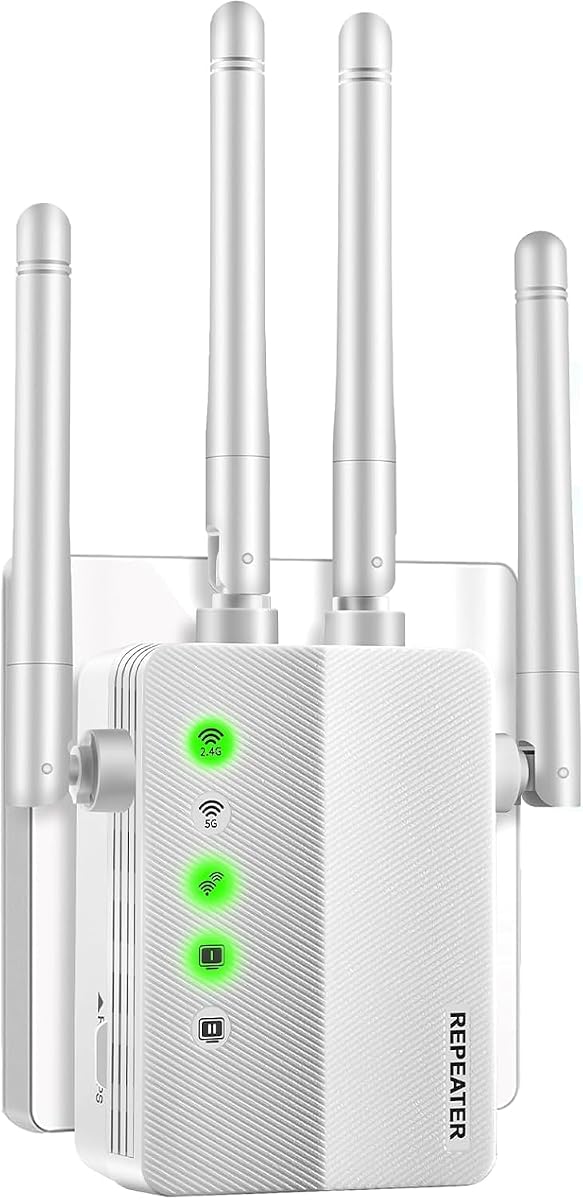
The 2026 New WiFi Extender is a dual-band unit with a stated 1,200 Mbps transmission rate and a 5.0 rating. It uses 2.4 GHz and 5 GHz bands, four antennas, and a claimed capacity of more than 115 connected devices, making it relevant to busy homes and offices with numerous smart-home products.
We may earn a commission when you buy through this link, at no additional cost to you.
Its versatility comes from three operating options: Wi-Fi repeater mode, access-point mode, and an Ethernet connection. These allow the unit to expand an existing network, create a wireless access point from a wired connection, or provide a wired link for compatible equipment. The product data also highlights WPA and WPA2 protocols for network security and describes broad coverage up to 19,999 square feet.
Its biggest uncertainty comes from limited brand and performance detail compared with the established TP-Link and Google products in this guide. A square-foot maximum is heavily influenced by layout, wall materials, interference, and the speed of the upstream connection. The stated 1200 Mbps figure also describes wireless capability rather than guaranteed throughput, and traditional wireless repetition can reduce the speed delivered to a client.
This model is most appropriate for a buyer who wants a multi-mode device, many antennas, and a high stated connection limit at a comparatively accessible tier. It may be especially useful in an office or larger residence where numerous devices need coverage. Buyers who prioritize established app management and detailed placement guidance may find the TP-Link RE315 or AX3000 easier to evaluate and manage.
Repeater mode, access-point mode, and Ethernet support make the device adaptable to different network arrangements. A wired source can reduce the signal loss associated with receiving and retransmitting Wi-Fi wirelessly.
The stated ability to support more than 115 devices is useful for smart homes, offices, and streaming-heavy households. Actual performance still depends on client capabilities, traffic demand, and the quality of the incoming connection.
We may earn a commission when you buy through this link, at no additional cost to you.
Google Nest Wifi is a two-unit mesh system designed to cover as much as 4,400 square feet, and its 4.4 rating reflects a strong balance of coverage and management features. One unit connects to the internet provider's modem, while the second extends the wireless network into another part of the home.
We may earn a commission when you buy through this link, at no additional cost to you.
Unlike a basic repeater that creates another network name, the Nest units work together as a scalable system. Google says the network can handle up to 200 connected devices and stream multiple 4K videos simultaneously, although real-world results depend on the internet plan, placement, and client devices. The app automates network management, provides guest-network and parental-control tools, and includes Ethernet ports on each router.
The trade-offs are cost and the need to place both units thoughtfully. Mesh improves the experience compared with a poorly positioned single repeater, but a point in a central hallway or near the main router still performs better than one hidden in a dead zone. The supplied information also does not identify the exact Wi-Fi generation for this system, so buyers seeking a stated Wi-Fi 6 specification may prefer a product that explicitly lists one.
This two-pack is an excellent choice for a Google Fiber household that wants one managed network across multiple rooms. It is particularly useful for families that value automatic updates, simple app controls, and the ability to add more Nest Wifi routers or points later. For a single weak room or an extension-only setup, a less elaborate dual-band extender may be more proportionate.
The two Nest Wifi units coordinate as a mesh system, allowing connected devices to move between coverage areas without requiring users to switch between separate extender networks. That unified approach is the principal benefit over many conventional range extenders.
The app handles setup, network management, guest access, and parental controls. Automatic updates help keep features and security current, while device-prioritization tools can direct available bandwidth toward important clients.
We may earn a commission when you buy through this link, at no additional cost to you.
This three-pack includes one Nest Wifi router and two Nest Wifi points, forming a managed mesh system with coverage stated at up to 5,400 square feet. Its 4.2 rating reflects a capable and flexible system, especially for larger homes or layouts with several dead zones that need dedicated nodes.
We may earn a commission when you buy through this link, at no additional cost to you.
The two points do more than extend the network: each also functions as a smart speaker with Google Assistant. That integration can add value in a kitchen, bedroom, or living area where a voice-assisted speaker is useful. The system provides automatic network management, app-based setup, guest-network tools, parental controls, device prioritization, and compatibility with Google Wifi.
The product information lists capacity of up to 100 connected devices for each router and point, while also stating that the system can stream multiple 4K videos at a time. Those are maximum claims, so congestion, building layout, and the underlying Google Fiber service can affect the experience. The two Ethernet ports mentioned for each router make this configuration more useful than a basic repeater set, but the supplied details do not establish the port count for the points.
This is the right choice for a homeowner who wants extensive mesh coverage and appreciates the Google Assistant ecosystem. It is also a natural fit for a household already using compatible Google devices. Shoppers who only need to strengthen one remote room should avoid overspending on a three-node system and consider the TP-Link RE315 or another compact dual-band extender.
Each point acts as a mesh node and a Google Assistant speaker, combining network expansion with a useful household controller. Voice-based music, connected-device control, and network management require an internet connection.
The stated 5,400-square-foot coverage makes the three-pack more suitable than the two-pack for large layouts. Additional Nest hardware can be added when necessary, and automatic coordination helps keep roaming behavior consistent.
We may earn a commission when you buy through this link, at no additional cost to you.
The TP-Link AX3000 Wi-Fi 6 range extender is a modern option for a Google Fiber home with newer phones, laptops, and other Wi-Fi 6 clients. It has a 4.1 rating and offers up to 2,404 Mbps on the 5 GHz band and 574 Mbps on 2.4 GHz for a combined stated bandwidth of about 3 Gbps.
We may earn a commission when you buy through this link, at no additional cost to you.
Two high-gain directional antennas use beamforming to improve signal strength, reliability, and range. The product is rated to cover up to 2,400 square feet and support as many as 64 devices. A Gigabit Ethernet port can provide a wired connection, while access-point mode can turn that wired connection into a Wi-Fi hotspot. EasyMesh compatibility allows it to join an EasyMesh-compatible router as part of a broader network.
The important limitation is that this remains a wireless extender. TP-Link warns that actual speeds can be 50% or less than direct connections because the extender must communicate with the main router and then with the client. Walls, distance, and interference also affect results, and the device is not compatible with TP-Link Deco mesh systems.
The AX3000 is recommended for buyers who want an explicit Wi-Fi 6 upgrade and a Gigabit wired option. It works especially well for a modern home office, upstairs media area, or other medium-sized zone with a strong available upstream signal. It is less appropriate for someone seeking a complete network redesign, in which case the Nest Wifi system provides more integrated management.
Wi-Fi 6 support is the defining feature of this extender, making it better aligned with compatible modern devices than older AC-series models. The benefit is most relevant when both the main router and client equipment support the newer standard.
Directional antennas and beamforming focus coverage toward a target area. The Gigabit Ethernet port also allows one device to benefit from a wired link, avoiding the additional wireless transmission penalty for that particular connection.
We may earn a commission when you buy through this link, at no additional cost to you.
This compact 2.4 GHz Wi-Fi signal booster offers a 4.9 rating, one of the strongest user-response figures among the products reviewed. Its stated 300 Mbps transmission rate is modest compared with dual-band models, but that figure may be sufficient for a targeted dead zone serving browsers, printers, surveillance equipment, and basic smart-home devices.
We may earn a commission when you buy through this link, at no additional cost to you.
The device supports one-touch WPS setup or browser-based configuration from a smartphone, tablet, or computer. Its wall-plug design needs little space, and its compatibility with 802.11 N/B/G networks and common routers, modems, smartphones, tablets, laptops, and smart TVs makes it a straightforward addition to an existing network.
Its three modes are a meaningful advantage. It can operate as a range extender, access point, or router, while the Ethernet port can turn a wired connection into wireless service. The limitation is the single 2.4 GHz band: modern high-bandwidth applications and newer clients generally benefit from a 5 GHz or dual-band extender, and the large stated square-foot figure does not remove the usual placement and signal-quality limitations.
This booster is best for a small weak-signal area where simplicity, compactness, and quick setup matter more than maximum throughput. It may be useful in a basement, guest room, garage, or travel setting. Homeowners with streaming-heavy dead zones should choose a dual-band unit, while users needing a coordinated whole-home network should consider Nest Wifi.
WPS setup allows a quick connection to a compatible router without a complicated configuration process. Browser-based setup provides an alternative, while the compact wall-plug format keeps the device discreet.
Access-point and router modes extend the device beyond a simple repeater. The Ethernet connection can also provide a useful alternative for locations where a wired source is available.
We may earn a commission when you buy through this link, at no additional cost to you.
The TP-Link RE500X combines Wi-Fi 6 with a stated total bandwidth of 1.5 Gbps, including up to 1,201 Mbps on 5 GHz and 300 Mbps on 2.4 GHz. Its 4.2 rating makes it a balanced upgrade for a Google Fiber household that wants modern wireless capabilities in a relatively compact extender.
We may earn a commission when you buy through this link, at no additional cost to you.
High-gain antennas help push the extended signal into weak areas, and a Gigabit Ethernet port offers a wired alternative for a nearby device. The RE500X can pair with a OneMesh-compatible router, range extender, or wireless powerline adapter to present a single network name. Setup and management are handled through the TP-Link Tether app, including a signal indicator for placement.
One important detail is that the product does not support the 6 GHz band. It operates on 2.4 GHz and 5 GHz, even though the supplied description inconsistently refers to it as a Wi-Fi 7 range extender elsewhere. It is also not compatible with Deco systems. As with all wireless extenders, actual throughput may be 50% or less than a direct connection.
This model is a good recommendation for a shopper who wants Wi-Fi 6, OneMesh support, and a compact design without moving to a complete mesh system. It works particularly well when a medium-strength connection is available near the desired extension area and one nearby device can be connected by Ethernet. Buyers seeking higher stated throughput and a larger stated coverage area may prefer the TP-Link AX3000.
Pairing with compatible OneMesh equipment can create a unified network, reducing the need to manually switch between the main router and an extended network. This is a more integrated result than a generic repeater that creates separate Wi-Fi names.
The RE500X brings Wi-Fi 6 and a Gigabit wired port to a compact enclosure. Its two-band design supports current mainstream clients while remaining simpler to place than a larger, multi-antenna unit.
We may earn a commission when you buy through this link, at no additional cost to you.
The 1200Mbps dual-band Wi-Fi extender has a 4.8 rating and offers a practical balance of capacity, features, and compactness. It provides up to 300 Mbps on 2.4 GHz and 867 Mbps on 5 GHz, with a stated coverage area of up to 3,000 square feet for as many as 20 connected devices.
We may earn a commission when you buy through this link, at no additional cost to you.
Its wall-plug design makes it suitable for homes, offices, and hotels without requiring shelf space for a larger adapter. A one-click WPS setup process pairs the extender and router, while repeater and access-point modes support different network layouts. The Ethernet port can also turn a wired internet connection into Wi-Fi or act as a wireless adapter for a device such as a game console, Blu-ray player, or smart television.
The 20-device ceiling is lower than the 32-, 64-, 100-, and 115-device figures stated by several alternatives. That may be perfectly adequate for a small household, but busy smart homes should account for the number of connected appliances, updates, and active streams. Like every wireless repeater, the device also introduces a second transmission, and the 3,000-square-foot maximum will vary with walls and layout.
This is a strong recommendation for someone who wants a discreet, straightforward dual-band booster for a modest dead zone. It is also a sensible travel or secondary-home option because of its compact design. If the requirement is a large connected-device network or a centrally managed mesh experience, a higher-capacity model will be more appropriate.
The wall-plug format leaves outlets unobstructed and makes the extender easy to position near a weak area. Separate 2.4 and 5 GHz bands let compatible clients choose between longer range and higher throughput.
The Ethernet port gives the device a useful role as an access point or wireless adapter. A wired source can reduce repetition-related loss and create a stable local connection for compatible entertainment equipment.
We may earn a commission when you buy through this link, at no additional cost to you.
The TP-Link RE550 combines a 4.3 rating with three adjustable external antennas and a stated 1,900 Mbps total bandwidth. It offers up to 1,300 Mbps on 5 GHz and 600 Mbps on 2.4 GHz, making it a capable dual-band option for extending a Google Fiber connection to a substantial weak area.
We may earn a commission when you buy through this link, at no additional cost to you.
The adjustable antennas give users directional control over coverage, which can be useful in homes with rooms branching from a hallway or in offices with defined work areas. A Gigabit Ethernet port provides a reliable wired option, and access-point mode can create a Wi-Fi hotspot from that wired connection. Smart Adaptive Roaming helps clients move toward a stronger signal, while EasyMesh compatibility allows use with compatible routers.
The RE550 is based on Wi-Fi 5 rather than the newer Wi-Fi 6 standard found in several competing products. That is not a major disadvantage for many existing networks, but it makes the unit less forward-looking for buyers whose primary router and all important clients use Wi-Fi 6. Its external antennas also make it larger than a compact wall-plug extender. Actual wireless speeds can be substantially lower than direct router connections because of retransmission.
This extender is best for a buyer who wants more antenna adjustment than a compact model offers and does not need Wi-Fi 6. It is particularly useful in a home office, upstairs landing, workshop, or other zone where a strong upstream connection is available. For a modern whole-home upgrade, the AX3000 or Nest Wifi system provides a more advanced foundation.
Three adjustable antennas allow the extended signal to be aimed toward a particular room or floor. This control can be more useful than a fixed antenna when the dead zone sits at an angle from the main router.
The Gigabit Ethernet port supports a direct connection for one device, while access-point mode can integrate the unit with a wired network. EasyMesh compatibility provides an option for a more unified system when the rest of the equipment supports it.
We may earn a commission when you buy through this link, at no additional cost to you.
The right coverage device depends on the size of the gap, the capabilities of the existing router, building construction, device count, and whether a wired connection can be used.
A single extender is usually appropriate when one or two rooms have weak signal and the rest of the home is well covered. A mesh system is more suitable for extensive dead zones, multiple floors, and large homes because several coordinated nodes distribute coverage. Google Nest Wifi also offers automatic management and device prioritization, while TP-Link extenders can join compatible EasyMesh or OneMesh equipment.
Wi-Fi 6 extenders are most useful when the main router and important clients also support Wi-Fi 6. Older dual-band Wi-Fi 5 products can still be highly effective for extending existing equipment, while a single 2.4 GHz booster favors range and basic device support over speed. The 5 GHz band handles faster modern traffic, and 2.4 GHz offers better reach through some obstacles.
Stated square-foot coverage is only a maximum under favorable conditions. Walls, floors, metal appliances, electrical interference, and the placement of the main router can make a smaller area perform much better than a larger one. An extender should generally sit where it still receives a strong signal from the main network while remaining close enough to serve the target room.
An Ethernet port can connect one nearby device for stable, low-latency access or provide a wired source for access-point mode. Wired backhaul can also avoid some of the speed loss inherent in wireless-to-wireless repetition. Buyers should check whether the port supports Gigabit Ethernet, since the included products range from a basic Fast Ethernet connection to Gigabit Ethernet.
The stated device count offers a rough guide, but real performance depends on client standards and bandwidth demand. A household with many smart-home sensors may need less throughput than one streaming 4K video, gaming, and downloading at the same time. Products in this guide state limits ranging from 20 devices to more than 115, while Nest configurations are described as handling up to 200 connected devices.
Repeater mode is useful for expanding an existing wireless network, while access-point mode creates Wi-Fi from a wired connection. Several products also offer a router mode. WPA and WPA2 support is common across the group and is preferable to obsolete WEP-only configurations. For a new network, use a current security protocol and a strong administrator password.
App-based management can simplify setup, firmware updates, and placement. Smart Adaptive Roaming, Adaptive Path Selection, and mesh coordination can make movement between the main router and extension areas feel more consistent. A basic WPS button offers a quick initial connection, while Google Nest provides a more complete managed interface with guest networks, parental controls, and automatic updates.
Begin by identifying the dead zone and selecting an outlet or shelf approximately halfway between the main Google Fiber router and that area. The extender should receive a strong signal there; placing it too close to the main router or inside an obstructed area can leave the target room underserved. For mesh systems, distribute nodes through separate usable areas and avoid hiding them inside cabinets.
Follow the manufacturer's app or browser-based setup process, connect the extender to the existing network, and update its firmware if an update is available. Use WPS only when both devices support it, and assign a unique administrator password. If the setup includes an Ethernet port, test access-point mode with a wired connection, especially when the goal is to avoid repeated wireless transmission.
After installation, test important rooms with the devices and applications you use most. Check both signal strength and real-world responsiveness, then adjust the placement or antenna direction if necessary. Keep the unit ventilated, avoid stacking it with heat-producing equipment, and periodically check the manufacturer's app for firmware and security updates.
An extender primarily improves coverage rather than the internet speed available from Google Fiber. It can make video calls, streaming, and downloads feel faster in a dead zone because the client receives a more reliable signal. However, a wireless extender normally receives the signal and retransmits it, which reduces throughput compared with a direct connection to the main router.
A mesh system is usually better for broad coverage across several rooms, multiple floors, or a large home. It coordinates multiple units and generally provides smoother movement between coverage areas. A single extender is more economical when the problem is limited to one room or a defined section of the property.
Place it between the main router and the weak area, where it can still receive a strong signal from the router. A hallway, central room, or near an interior wall may work better than a location beside the main router. Use the manufacturer's signal indicator or app to refine the position.
Yes, if the selected extender includes an Ethernet port. Several products in this guide provide Gigabit Ethernet, while the TP-Link RE315 has a Fast Ethernet port. The wired device can use this connection directly, and some extenders can also create a Wi-Fi access point from a wired internet source.
It depends on the rest of the network. A Wi-Fi 6 extender is most valuable when the main router and important clients support Wi-Fi 6. If the existing network is Wi-Fi 5, a good dual-band extender can still provide reliable expansion, while a single-band 2.4 GHz model may be sufficient for basic devices.
The Nest Wifi router in these sets connects to the internet provider's modem to create the home Wi-Fi network. The included points extend that network. It can be used with most internet service providers according to the supplied product information, although installation and service arrangements should be confirmed with the provider.
Most wireless extenders communicate with the main router and then transmit again to the client, which creates an additional wireless hop. Walls, interference, and distance can add further loss. A wired access-point connection can improve a nearby device, while a mesh system or better placement can help reduce the effect across the home.
The correct number depends on the floor plan, wall construction, and position of the main router. One well-placed extender may solve a single dead zone, while a larger home may need several mesh nodes. Avoid placing nodes in poor signal locations simply to follow a square-foot estimate, because each node needs a dependable link to the rest of the network.
The TP-Link AX3000 Wi-Fi 6 extender is the leading choice for modern homes that want flexible coverage, Gigabit Ethernet, and a balance of dual-band performance. The Nest Wifi Router and 2 Points stand out for extensive managed mesh coverage and smart-speaker integration, while the TP-Link RE315 offers a balanced, economical way to eliminate a specific dead zone.
When choosing, prioritize the size and location of the coverage problem, compatibility with the main network, and the availability of a wired connection. A modern mesh system is appropriate for comprehensive coverage, a Wi-Fi 6 extender suits newer equipment, and a compact dual-band model is often enough for one troublesome room. Placement can be as important as the stated specification.
Ratings, firmware, compatibility details, and product availability can change, and current prices should be checked before purchasing. Review the latest manufacturer documentation, confirm the extender's operating mode, and verify that the main router supports any mesh or OneMesh function required for the intended setup.