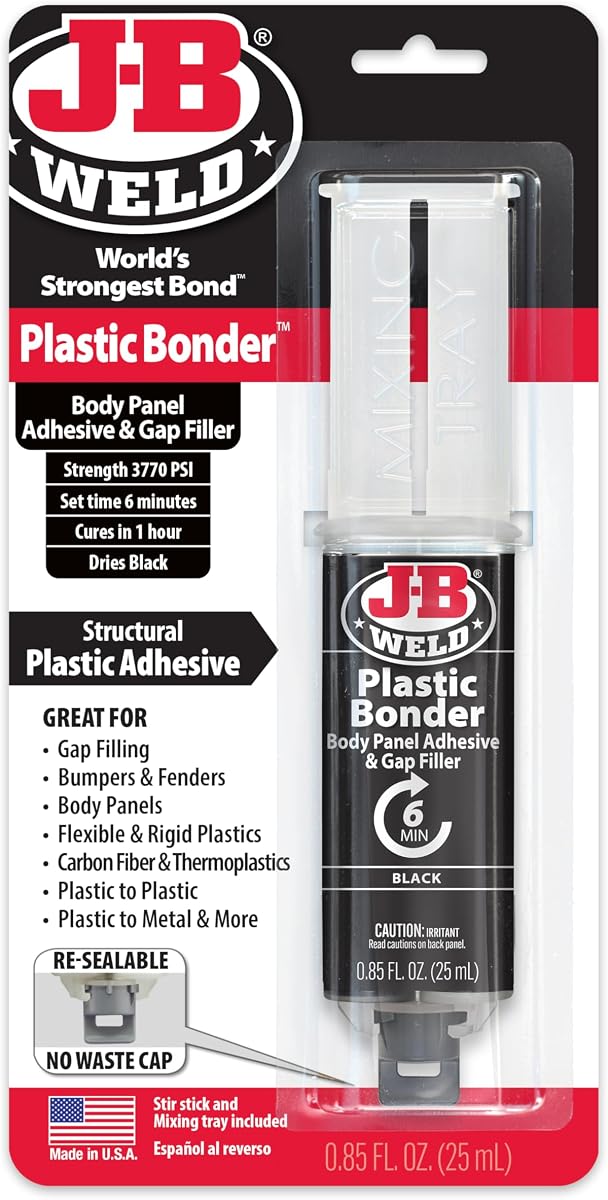
J-B Weld 50139 Plastic Bonder
4.6Editor score
Two-part urethane system
Sets in 15 minutes
Black gap-filling finish
Our Glue for Plastic guide compares ten strong adhesives for toys, models, household repairs, PVC, acrylic, and more to help you choose the right formula.
Glue for plastic is not a one-size-fits-all category. The right adhesive depends on the plastic type, the importance of the repair, the need for precision, and whether the finished item will face heat, water, impact, or heavy loads. A strong instant glue may suit one project while a two-part urethane system handles another far better.
We compared ten products using their stated bonding materials, application methods, curing times, finish, packaging, and suitability for detailed or demanding repairs. The list includes general-purpose cyanoacrylates, gel formulas, construction adhesives, and two-part plastic bonding systems for projects ranging from toys to automotive trim.
Each pick highlights a different practical advantage, from no-drip control to a brush applicator or a permanent structural bond. Ratings and specifications reflect the supplied product information, while product availability and prices can change, so check the current listing before making a final purchase.
4.6Editor score

4.6Editor score

4.6Editor score
This side-by-side comparison shows the adhesive type, setting behavior, key material compatibility, and most useful application feature for each product, making it easier to narrow the field before buying.


The Super Glue All-Purpose Liquid 1.75 oz is an instant cyanoacrylate adhesive built for household repairs, crafts, and more demanding DIY work. Its 4.6 rating reflects a broadly favorable user history, while the product's strongest selling point is the combination of a 50g supply and rapid handling strength. The crystal-clear finish is also important for visible repairs where an obvious glue line would detract from the result.
We may earn a commission when you buy through this link, at no additional cost to you.
This adhesive is described as reaching maximum handling durability in seconds, making it a practical choice when a repaired item needs to be handled quickly. The airtight precision tip and anti-clogging safety cap help maintain consistent dispensing and reduce the chance of a dried-out nozzle. Its larger supply also makes it more practical for repeated repairs, intricate craft assembly, or a workshop that is likely to use a substantial amount of adhesive.
The main trade-off is its liquid consistency. Cyanoacrylate can flow into seams and may be more difficult to control than a gel or brush-applied formula. It is also not positioned as a gap-filling structural adhesive, so it may not be the best choice for separated, warped, or visibly damaged plastic components. Careful dispensing, compatible surfaces, and reasonable handling during the initial set are still important.
Buy this liquid super glue when speed, supply size, and a discreet finish are your main priorities. It is a strong generalist for non-structural household and craft repairs, provided you apply a small amount and allow the joined pieces to remain undisturbed while the bond develops.
The seconds-fast handling strength makes this adhesive useful for quick household fixes where waiting for a long cure would be inconvenient. Secure the pieces immediately after application, then allow the bond to mature for a durable final cure.
The 50g supply is designed for users who want more than a tiny single-use tube. It suits craft work, household maintenance, and recurring small repairs while the anti-clogging tip helps protect the bottle between uses.
We may earn a commission when you buy through this link, at no additional cost to you.
The J-B Weld 50139 Plastic Bonder is a two-part urethane adhesive for strong, lasting repairs to plastic and several other materials. It earns a 4.6 rating and stands out for a reported 3770 PSI tensile strength, a 15-minute set time, and the ability to work as both an adhesive and gap filler. The black finish also makes it more appropriate than a clear glue for visible body-panel work where a discreet repair is not essential.
We may earn a commission when you buy through this link, at no additional cost to you.
One of its strongest advantages is the simple 1:1 mixing ratio. The syringe format makes the two components easier to dispense accurately, while the included mixing process produces a permanent, hard-cured bond. It is listed for thermoset and carbon fiber composites, thermoplastics, coated metals, concrete, PVC, and other surfaces, giving it broader utility than a product advertised only for general plastic bonding.
The additional steps are the principal trade-off. Mixing and application require more attention than a ready-to-use super glue, and a black adhesive may not blend into light-colored plastics. It can also be sanded after 30 minutes according to the supplied information, which is useful for body panels and cosmetic work but requires a controlled finishing process. Users should still verify compatibility with their specific plastic before committing to a full repair.
This is the pick for a failed bumper, a structural plastic component, a dented panel, or a joint that needs a permanent structural bond. It is less convenient for a tiny instant repair, but for demanding work, its strength, gap-filling ability, and broad material compatibility justify the extra preparation.
A reported 3770 PSI tensile strength makes this a more structural option than ordinary instant adhesives. It is better suited to components that need to carry meaningful loads after curing than to simple decorative touch-ups.
The product does more than join close-fitting surfaces. Its gap-filling characteristics make it relevant to dents, imperfect joints, and body-panel repairs where a thin, brittle glue line would not provide enough support.
We may earn a commission when you buy through this link, at no additional cost to you.
Gorilla Super Glue Gel XL is a clear, no-run gel adhesive designed for precision repairs, including vertical applications where a liquid super glue would tend to run. It carries a 4.6 rating and offers a more controlled application experience. The thicker consistency is especially useful for detailed craft work, model assembly, and visible repairs where placement accuracy matters.
We may earn a commission when you buy through this link, at no additional cost to you.
Its Impact Tough technology is intended to improve strength and resistance to bumps, while the cyanoacrylate formula bonds in 10 to 45 seconds and reaches full cure in 24 hours. The metal pin anti-clog cap creates an airtight seal that helps the bottle remain usable between applications. Its all-purpose formulation is also listed for glass, plastic, wood, metal, ceramic, rubber, leather, paper, and other common materials.
As a gel, it is not a substitute for a gap-filling structural adhesive on badly damaged components. Nor should users assume that every hard plastic will respond identically; plastics differ greatly in surface composition and resistance to solvents and stress. The clear, residue-free finish is a major strength, but a successful bond still depends on clean, dry surfaces and a thin application.
Choose this gel when you need pinpoint control without moving to a slower, heavier adhesive. It is especially well suited to toys, models, decorative objects, and household items that benefit from a fast set and discreet appearance. Its combination of control, speed, and versatility makes it a strong all-around recommendation.
The thicker no-run formula helps adhesive stay near the application point, particularly on vertical surfaces. This control makes the gel easier to use on intricate parts than a free-running liquid formula.
Impact Tough technology is designed to make the cured bond better able to tolerate bumps and knocks. The combination of a quick set and continued strengthening over 24 hours supports both immediate handling and durable everyday use.
We may earn a commission when you buy through this link, at no additional cost to you.
The four-pack of 3g Gorilla Super Glue tubes has a 4.7 rating, the highest among the products compared. Each sealed tube is aimed at small, precise repairs such as jewelry, nail touch-ups, delicate crafts, and items that need to be carried in a travel kit. The compact format is a practical alternative to carrying a full-size bottle with a larger nozzle.
We may earn a commission when you buy through this link, at no additional cost to you.
Every tube includes a metal pin anti-clog cap intended to create an airtight seal. This is particularly useful in a multipack because one tube can be dedicated to a workshop, one to a repair kit, and the others to travel or special projects. The Impact Tough cyanoacrylate formula sets in 10 to 45 seconds and is described as suitable for a wide range of materials, including plastic, glass, wood, metal, ceramic, rubber, leather, and paper.
The 3g size is both the benefit and the limitation. It works well for a single small repair, but it is less convenient for a large assembly or a project requiring many applications. As a liquid adhesive, it also needs careful placement to avoid unwanted runs. The tubes do not create a structural gap filler, and their clear finish is more appropriate where visual discretion matters.
This is an excellent pick for small repairs, hobby work, and anyone who wants to divide a liquid super glue among several portable tasks. Its 4.7 rating, separate sealed tubes, and clear fast-setting formula make it especially convenient for precision work that does not require a larger supply.
Separate tubes reduce the inconvenience of carrying one large bottle everywhere. They can be divided among a toolbox, travel bag, craft kit, or household emergency kit while retaining sealed, anti-clog storage.
For tiny components and quick touch-ups, a 10-45 second set time provides practical results without the handling burden of a large adhesive container. The small size also reduces waste when only a few drops are needed.
We may earn a commission when you buy through this link, at no additional cost to you.
Gorilla Max Strength Construction Adhesive is a clear, heavy-duty adhesive for substantial household projects rather than tiny instant touch-ups. Its 4.6 rating reflects strong customer satisfaction, while its defining features are waterproof performance, indoor and outdoor suitability, gap filling, and a finish that can be painted to suit the project.
We may earn a commission when you buy through this link, at no additional cost to you.
The product is described as the brand's strongest formula and as twice as strong as Gorilla Heavy Duty Construction Adhesive Ultimate. That positioning makes it relevant when a plastic component is part of a larger structure or must withstand conditions beyond a simple indoor craft repair. Its gap-filling function also expands its usefulness for imperfect joints that a thin cyanoacrylate would struggle to reinforce.
The tradeoff is curing and handling. This is not positioned as a second-strength instant adhesive, so it may require more time and support than a gel or liquid super glue. Construction adhesive can also be more difficult to apply invisibly because its body is designed to bridge gaps. Users should account for application pressure, surface preparation, and the need to allow the joint to cure before stressing it.
Choose this adhesive for a larger plastic repair, a project that may encounter water, or a joint that benefits from gap filling and paintability. It is best for experienced DIY users who want more substantial construction performance rather than the fastest possible cure.
Waterproof performance makes this adhesive relevant for outdoor repairs and household projects where moisture may be present. Its all-purpose positioning also allows it to handle different project materials without relying on a narrowly specialized formulation.
The clear adhesive is designed to remain visually discreet, and its paintable finish offers another way to integrate a repaired part into the surrounding project. That is useful when the joint needs to blend into a finished surface.
We may earn a commission when you buy through this link, at no additional cost to you.
Super Glue All-Purpose Gel 1.76 oz combines the speed of an instant adhesive with the control normally associated with a thicker gel. It has a 4.6 rating and shares several practical advantages with liquid super glue, including seconds-fast handling strength, a 50g professional supply, an anti-clogging safety cap, and a clear finish intended to leave little visible residue.
We may earn a commission when you buy through this link, at no additional cost to you.
The gel consistency is the defining difference in application behavior. It is better suited to intricate crafts, decorative items, and visible components where liquid adhesive could migrate from the intended bond line. It also makes the product more practical for vertical applications, although the surface still needs to be held in position during the initial set.
Like other cyanoacrylate adhesives, it is not intended to replace a gap-filling structural system. A 50g bottle may look generous, but the amount used per repair can still be substantial, so careful dispensing is important. Its general-purpose description indicates broad household and industrial use, yet specific plastics and finishes should be checked for compatibility before beginning an important repair.
This is a compelling pick for users who need a larger instant-adhesive supply but prefer gel-like control. It works particularly well for detailed household items, decorative projects, and visible repairs where a clear but non-running application is valuable.
The 50g bottle provides substantial working material for repeat projects, while the gel formula helps limit unwanted migration. Together they suit a user who needs both convenience and better placement control.
The clear finish is intended for visible areas and intricate crafts where a pronounced glue line would be distracting. It provides a quick set without the appearance of a heavy construction adhesive.
We may earn a commission when you buy through this link, at no additional cost to you.
J-B Weld 50133 Plastic Bonder is a quick-setting, two-part urethane adhesive designed for strong and lasting plastic repairs. It has a 4.6 rating, a reported 3770 PSI tensile strength, and a 15-minute set time followed by a 30-hour cure. Those figures make it especially relevant to structural work where a fast initial set is helpful but the joint will not be fully strengthened right away.
We may earn a commission when you buy through this link, at no additional cost to you.
The syringe delivery system supports the product's simple 1:1 mixing ratio, and the re-sealable cap is designed to reduce drying and leaking between uses. Its applications include thermoset and carbon fiber composites, thermoplastics, coated metals, plastic and PVC, concrete, ceramic and tile, fiberglass, and aluminum. The tan color also makes the cured material easier to identify on projects where appearance is not the primary concern.
The main limitation is the distinction between set time and cure time. Although the adhesive holds in 15 minutes, the full 30-hour cure is the appropriate point for evaluating final strength. Users should not confuse initial handling strength with complete structural performance. The tan finish may also be conspicuous on white, gray, or naturally colored plastic, and precise mixing is necessary for consistent results.
This product is a strong choice for DIY structural repairs, dents, bumper work, and durable bonds involving plastic alongside composite, metal, tile, or concrete. It is less convenient for spontaneous household touch-ups, but it rewards a careful repair process with a permanent, versatile bond.
The two-part urethane system is built for strong, lasting results rather than only a quick cosmetic fix. A 3770 PSI tensile rating and full cure make it better aligned with components expected to carry a meaningful load.
The syringe format makes the 1:1 ratio easier to manage, while the re-sealable cap helps protect the remaining material. This makes the adhesive more practical for carefully planned projects than for casual on-the-spot use.
We may earn a commission when you buy through this link, at no additional cost to you.
WoldoClean Super Glue for Plastic is a 50g fast-setting cyanoacrylate adhesive focused on PVC, acrylic, and other common plastics. Its 4.4 rating is the lowest in this comparison, but the product information presents a broad and practical compatibility list. It is intended for model kits, miniatures, RC parts, building bricks, toys, automotive trim, eyeglass frames, garden furniture, and 3D-printed items.
We may earn a commission when you buy through this link, at no additional cost to you.
The thin formula sets in seconds and can also join plastic to metal, wood, ceramic, glass, stone, and concrete. Once cured, the bond is described as waterproof and heat resistant. A precise nozzle supports controlled placement, and the recommended method is one thin drop followed by 30 seconds of pressing, making the application process straightforward for small components and hobby work.
Its thin consistency is the principal concern. It may spread or migrate more readily than a gel, which can make accurate placement essential. The stated heat and water resistance applies after curing, and those properties should not be interpreted as permission to expose the fresh bond to harsh conditions immediately. As with all cyanoacrylates, using a small amount is generally more effective than flooding a joint.
Choose this product for a broad range of plastic crafting and repair tasks, particularly when you work with PVC, acrylic, ABS, vinyl, or 3D-printed parts. It offers the broadest explicit material list in the group, although the lower rating and thin application mean careful handling remains important.
The listed material compatibility extends beyond common plastics to rubber, nylon, polystyrene, wood, glass, ceramic, metal, stone, and concrete. That makes it useful for mixed-material miniatures, models, and household craft assemblies.
The recommended method is straightforward: apply one thin drop, press the parts together for 30 seconds, and close the anti-clog cap. The precision nozzle helps keep the adhesive where it is needed.
We may earn a commission when you buy through this link, at no additional cost to you.
GH1200 2-in-1 Super Glue is built around a dual-application design: a fine-bristle brush for controlled placement and an anti-clog nozzle for dispensing more adhesive over larger areas. It has a 4.6 rating and is particularly relevant to plastic repairs where controlled coverage can prevent overspray, excess glue, or a messy working area.
We may earn a commission when you buy through this link, at no additional cost to you.
The 3000 CPS cyanoacrylate formula is described as smooth-flowing and capable of use multiple times without the stiffness and clogging problems associated with some liquid super glues. The product sets in 10 to 40 seconds and requires 24 hours to mature fully. According to the supplied information, it creates a permanent, weather-resistant bond and can be used on plastic, rubber, metal, and ceramics.
Brush applicators require more care than simple twist or nozzle caps. The bristles can spread adhesive beyond the intended area if too much is loaded, and the product should be closed after use to protect both applicators. The nozzle remains useful when a repair needs more coverage than a brush can provide, but users should still apply a controlled amount rather than flooding the joint.
This is a strong pick for detailed repairs, larger visible areas, and users who want more control than a standard liquid bottle. It is particularly useful for plastic and rubber household items, toys, and decorative objects where neat application matters and the adhesive must cure quickly.
The fine brush is useful for touching a precise area, while the nozzle can cover a broader joint. This flexibility makes the product adaptable without changing between separate adhesive containers.
The smooth-flowing formula and anti-clog nozzle are intended to reduce dried-out applicators. Closing the container after each use helps preserve usability for later repairs.
We may earn a commission when you buy through this link, at no additional cost to you.
GH1200 Super Glue for Plastic is a clear, fast-setting adhesive developed for detailed plastic work. It has a 4.5 rating and combines a built-in fine brush with a precision anti-clog nozzle. The product information specifically highlights ABS and PVC plastic, miniatures, toys, AMT models, and 3D figures, making it a natural fit for scale models and small hobby components.
We may earn a commission when you buy through this link, at no additional cost to you.
Its brush is designed for controlled acrylic and plastic application without the mess associated with squeezing liquid glue directly onto a part. The nozzle offers a second method for dispensing more glue or covering a larger area. The adhesive sets in 10 to 45 seconds, while a 24-hour cure is recommended for better final results. Its clear finish is intended to keep repaired surfaces visually clean.
The product information includes an important limitation: it will not work on hard plastics such as plastic bags and some containers. This makes a small compatibility test especially important for unfamiliar items. The phrase that it will last for years should also be understood within the listed conditions and after full curing, not as a guarantee for every plastic, load, and environment.
Choose this adhesive for precise model assembly, decorative miniatures, toys, and other manageable plastic projects. It is a good fit when appearance and placement control are as important as quick setting, but it is not the right choice for flexible or particularly hard plastics.
The fine brush helps place adhesive directly on a small joint, reducing the chance of coating nearby detail. It is especially useful when a model needs a neat repair or when a part must remain visible.
The 10-45 second set allows assembly to continue quickly, while the recommended 24-hour cure gives the joint more time to mature. Avoid stressing a fresh repair until that period has passed.
We may earn a commission when you buy through this link, at no additional cost to you.
The most useful adhesive is the one that matches the plastic, joint quality, required strength, and application method. Consider those factors before comparing formulas, because the word plastic covers materials with very different chemical compositions and surface characteristics.
Start by identifying the material as closely as possible. Common plastics include ABS, PVC, acrylic, polystyrene, polycarbonate, nylon, and vinyl, but manufacturers may use recycled blends or proprietary formulations that are difficult to distinguish visually. The listed compatibility of an adhesive is a useful starting point, not a guarantee that every grade of plastic will behave the same way. Some surfaces are smooth and easy to bond, while others are heavily textured, coated, or chemically resistant.
Choose an adhesive that explicitly names your plastic when possible. WoldoClean lists broad compatibility with PVC, ABS, acrylic, plexiglass, vinyl, rubber, nylon, and polystyrene, while the GH1200 plastic-focused formula calls out ABS and PVC. If the plastic is unknown or the repair is important, test the adhesive on a hidden or sacrificial area before assembling the full item.
A toy hinge, decorative model, and cracked bumper support very different loads. Instant cyanoacrylates are useful for small, non-structural items that need to be handled quickly. Two-part systems such as J-B Weld Plastic Bonder are more appropriate when the joint must carry a meaningful load, bridge a larger gap, or endure repeated stress. Gap-filling performance is especially relevant when the two surfaces do not meet in a straight, tight line.
Match the adhesive class to the consequence of failure. Use a gel or liquid super glue for quick touch-ups, and consider a two-part urethane or heavy-duty construction adhesive for larger or more demanding assemblies. Do not assume that a faster set means a stronger permanent bond; initial handling strength and full cure are different measurements.
Close-fitting parts can be handled effectively by thin liquid adhesives, controlled gels, and brush-applied cyanoacrylates. A gap changes the situation because a thin adhesive may bridge the opening superficially while leaving the center weak. Gap-filling products are formulated to occupy space and support imperfect joints, making them better candidates for separated sections, dents, or distorted components.
Inspect the joint before selecting a formula. If the pieces pull away from each other or must be forced together, choose a product explicitly described as a gap filler. For precise work on a small opening, a thicker gel or brush formula may provide better placement than a free-flowing liquid.
Application control matters most on visible surfaces, vertical assemblies, intricate models, and repair areas where excess adhesive is difficult to remove. Gel formulas resist running, fine brushes permit targeted placement, and precision nozzles help keep liquid adhesives confined to a small area. The Gorilla Gel XL and the two GH1200 products are especially relevant when control is the deciding factor.
Choose the applicator that matches the job rather than automatically choosing the strongest adhesive. A brush is useful for spreading or positioning a small amount, a nozzle is convenient for narrow joints, and a gel is easier to keep stationary. In every case, use only enough adhesive to wet the bond line, because excess product can create a visible or mechanically weak blob.
Set time determines when a repair can be handled, while cure time indicates how long the adhesive needs to reach fuller strength. Several instant products reach handling strength in 10 to 45 seconds, but some require 24 hours to mature. J-B Weld Plastic Bonder sets in 15 minutes, yet one version specifies a 30-hour full cure. Construction adhesive may need longer still before it should be placed under load.
Plan around the full cure when possible. Fast-setting products are convenient, but clamping, positioning, or testing a joint too early can weaken the repair. If a project must be completed quickly, choose an adhesive whose handling window matches the available work time and avoid adding unnecessary stress until the bond has matured.
A repair that will live in a bathroom, garden, vehicle, or outdoor location may need better moisture and temperature tolerance than a dry indoor model. WoldoClean describes its cured bond as waterproof and heat resistant, and Gorilla Max Strength Construction Adhesive is waterproof for indoor and outdoor projects. These statements are more relevant to durable projects than to a single decorative repair.
Consider where the finished item will be used and how much heat it may encounter. Also allow the adhesive to cure fully before exposing it to water or elevated temperatures. For critical outdoor or automotive work, verify the manufacturer's instructions and test a sample joint whenever possible.
A clear adhesive is usually preferable for visible components, jewelry, decorative objects, and transparent plastic. Both J-B Weld Plastic Bonder options are available in noticeable colors: black for the 50139 model and tan for the 50133 model. That distinction can affect whether a repair blends into the original surface. Gorilla Max Strength Construction Adhesive is clear and paintable, giving it more options for cosmetic integration.
Decide whether the bond should disappear, remain visible, or be sanded and refinished. A clear formula does not guarantee an invisible joint if the plastic is opaque or textured, and a colored adhesive can make a repair easier to see. Test appearance on an inconspicuous area and consider whether sanding, painting, or scraping could damage the plastic.
Cyanoacrylate adhesives are sensitive to contamination, moisture, and dried residue, so the package is more than a convenience. Anti-clog caps, precision nozzles, resealable syringe caps, and separate tubes can improve repeat usability. The Gorilla four-tube pack is useful for portability, while the larger 50g bottles suit frequent workshop or craft use. The J-B Weld syringe protects mixed or unmixed components more effectively than an open container.
Select packaging that matches how often you will use the adhesive and where you will keep it. Close every container immediately after application, and avoid leaving a brush or nozzle exposed. For a planned collection of small repairs, individually sealed tubes may reduce waste and simplify organization.
Begin with clean, dry plastic surfaces. Remove loose dirt, oil, fingerprints, and any weak material around the break, because a glue line can fail when it is attached to contamination instead of the substrate. Light abrasion may help create a more secure bonding surface, but avoid heavy sanding on thin parts. Follow the product instructions, assemble a test joint when compatibility is uncertain, and make sure the fit is correct before adhesive is applied.
Apply the smallest effective amount. For cyanoacrylate formulas, place a thin drop or use the brush to coat only the bond area, then bring the pieces together and hold them in position for the stated set time. For a two-part J-B Weld system, measure the two components at the specified 1:1 ratio, mix them thoroughly, and use the product before its working time expires. Wipe away excess adhesive before it cures if doing so will not damage the plastic.
Allow the repair to cure without movement or load. Although several products set in seconds, the supplied information often calls for 24 hours of maturation, while J-B Weld Plastic Bonder requires a longer full cure. Store adhesives tightly closed, keep the brush or nozzle clean, and use the anti-clog or resealable caps as intended. Do not test a newly repaired item by pulling on the joint; give it time to develop full strength.
The strongest choice depends on the plastic and the repair. Two-part urethane adhesives such as J-B Weld Plastic Bonder are intended for permanent structural work and gap filling, while impact-resistant cyanoacrylates are useful for smaller repairs. Verify material compatibility and allow the selected product to reach its full cure before applying significant stress.
No. Cyanoacrylate products can perform differently across ABS, PVC, acrylic, polyethylene, polypropylene, polystyrene, vinyl, and specialty plastics. The GH1200 plastic-focused product specifically notes that it does not work on hard plastics such as plastic bags and some containers. Always test an unfamiliar plastic in a hidden area first.
Liquid glue is convenient for small, close-fitting repairs and can spread into narrow seams. Gel glue is better for vertical surfaces, visible projects, and areas where precise placement matters. Choose a gel when controlled application is more important than filling a wide or uneven gap.
Wait until the product has reached its stated full cure whenever possible. Many instant adhesives can be handled in 10 to 45 seconds but are described as needing 24 hours to mature. J-B Weld Plastic Bonder sets in 15 minutes but can require 30 hours for full cure, so set time should not be treated as final strength.
Some products offer cured waterproof performance, including WoldoClean Super Glue for Plastic and Gorilla Max Strength Construction Adhesive. Even so, allow the repair to cure fully before exposing it to moisture, and confirm that the adhesive is compatible with the particular plastic and intended load.
A brush or no-run gel generally provides the most control on miniature models. Apply a minimal amount to a clean joint, position the part immediately, and hold it still for the stated set time. GH1200 products and Gorilla Super Glue Gel XL are particularly relevant because their application systems are designed to reduce running and improve placement.
It depends on the formulation. J-B Weld Plastic Bonder and Gorilla Max Strength Construction Adhesive are explicitly described as gap-filling products, making them more appropriate than thin super glues for separated or imperfect joints. A thin cyanoacrylate may bridge a small opening but often cannot replace a gap filler on a distorted component.
Close the container immediately after use and keep the cap or nozzle clean. Products with anti-clog caps, such as the Gorilla formulas, offer an additional safeguard, while resealable packaging protects multi-component systems. Do not leave a brush exposed or attempt to clear a hardened nozzle with a sharp object that could damage the plastic.
The leading choices serve different needs. Gorilla Super Glue Gel XL offers controlled, clear, fast-setting repairs, J-B Weld 50139 Plastic Bonder provides a permanent two-part bond with gap-filling capability, and Gorilla Max Strength Construction Adhesive suits heavier, waterproof, paintable household projects. Gorilla's four-tube pack is ideal for small portable fixes, while the GH1200 products add brush control for detailed work.
Prioritize the material compatibility, load, gap size, and final appearance before focusing on the fastest set time. A structural repair may need a two-part urethane system, a visible model may benefit from a brush or gel, and a high-volume workshop may favor a larger bottle with an anti-clog tip. If compatibility is uncertain, a small hidden test is far better than committing the only copy of an important item.
Finally, check the current product listing, package details, and availability before ordering, since prices and seller information can change. Use the supplied ratings as a general buying signal rather than a guarantee, follow the manufacturer's directions, and give the repair the full cure time it needs.