
TRENDnet TPE-119GI
4.5Editor score
Up to 95W POE++ output
Automatic power sensing
Sturdy metal enclosure
Wall-mountable design
Our guide compares the best Gigabit POE injector adapters by power output, standards, range, portability, compatibility, and installation ease.
A Gigabit POE injector adapter combines electrical power and network data on one Ethernet cable, making it useful for cameras, access points, VoIP phones, and other devices located where no convenient power outlet exists. The right adapter should match your device’s power standard, provide Gigabit data throughput, and support a cable run of up to 100 meters.
We compared ten injectors using the specifications supplied for each product, focusing on supported POE classes, available wattage, port speed, transmission distance, mounting options, safety features, and practical compatibility. The list includes standard 802.3af and 802.3at models, a passive 24-volt option, and higher-powered 802.3bt injectors for demanding installations.
Each review explains where the injector stands out, what limitations buyers should consider, and which network setups it suits best. Ratings and specifications can change over time, and market conditions affect availability and pricing, so readers should verify the current listing and confirm their endpoint requirements before ordering.
4.5Editor score

4.6Editor score
4.4Editor score
The comparison below places all ten adapters side by side, highlighting differences in power delivery, standards, cabling distance, physical design, and the kinds of devices each model is designed to support.


The Omada PoE160S is a well-balanced Gigabit POE injector for buyers who need dependable power and data delivery without replacing an existing non-POE switch. It carries a 4.6 rating and supports up to 30 watts through IEEE 802.3at while remaining backward compatible with 802.3af devices. Its combination of Gigabit ports, automatic detection, and a 100-meter reach makes it broadly useful for cameras, wireless access points, and other POE endpoints.
We may earn a commission when you buy through this link, at no additional cost to you.
The injector's strongest feature is its practical versatility. A Gigabit Ethernet input receives the network connection from a router or switch, while the Gigabit POE output sends both data and power through one cable. Automatic detection can deliver the appropriate level of power to compatible 802.3at and 802.3af equipment. That makes it easier to connect the injector directly to a non-POE network port without installing a larger POE switch.
The primary limitation is that the model tops out at 30 watts, so it cannot satisfy devices requiring the much greater power available from 802.3bt POE++ equipment. It also needs a local AC source, although the bundled integrated supply avoids a separate external power brick. For ordinary IP cameras, standard access points, and many VoIP phones, that trade-off is unlikely to be a problem.
This is our choice for the broadest all-around installation because it supports the most common POE and POE+ devices while retaining Gigabit throughput and a generous cable distance. Buyers should choose it when their endpoint needs no more than 30 watts, their source port is non-POE, and they want straightforward installation without software or complex configuration.
The PoE160S combines network data and electrical power on a single Ethernet run. This is especially helpful in offices, warehouses, retail spaces, and outdoor-adjacent areas where adding a separate power line would be inconvenient or impractical.
Automatic detection and backward compatibility simplify mixed installations. The injector can serve 30-watt 802.3at devices while also accommodating lower-power 802.3af equipment, provided the endpoint's requirements are within the supported output.
We may earn a commission when you buy through this link, at no additional cost to you.
This generic Gigabit POE+ injector is a straightforward choice for extending power and network connectivity to a compatible endpoint. Its 4.6 rating reflects a generally positive buyer response, while the published specifications cover the core needs of most small and medium network installations. It supports 802.3at and 802.3af equipment, provides Gigabit data ports, and can operate over runs as long as 100 meters.
We may earn a commission when you buy through this link, at no additional cost to you.
Its integrated power supply makes installation uncomplicated. Users connect the non-POE network source to the Gigabit input, connect the POE device to the POE+ output, and power the injector from an available outlet. Automatic sensing determines the power offered to a compatible endpoint, while a green power light and a red load indicator provide basic operational feedback.
Buyers need to understand the product's stated limitation: it supports POE devices and POE cameras but does not support cameras that use separate data and power connections. The attached equipment's power demand must also remain at or below 30 watts. These are not shortcomings for conventional POE endpoints, but they matter when planning a mixed legacy installation.
This adapter is best for users who want a compact, cost-conscious way to add POE to a non-POE Gigabit port without purchasing a larger POE switch. It is especially appropriate for IP cameras, access points, and VoIP phones that follow the stated 802.3af or 802.3at requirements.
The adapter is designed for immediate use without software installation or configuration. Its straightforward port arrangement makes it approachable for small business owners, installers, and homeowners adding a single remote endpoint.
A green light shows that power is on, while the described red load light appears during output. These indicators help installers verify operation without repeatedly disconnecting the Ethernet cable.
We may earn a commission when you buy through this link, at no additional cost to you.
The TRENDnet TPE-115GI is a polished standard POE+ injector with a 4.7 rating, making it one of the strongest-rated products in this group. It provides one Gigabit Ethernet input and one Gigabit POE+ output, an integrated power supply, and up to 30 watts of output. The result is a capable one-device solution for installations that need more confidence in physical construction and mounting flexibility.
We may earn a commission when you buy through this link, at no additional cost to you.
The auto-sensing system supports 802.3at POE+ devices and remains compatible with 802.3af endpoints. A connection distance of 100 meters gives installers room to position cameras or access points away from a non-POE network source. Full-duplex Gigabit operation also makes this model suitable for endpoints that need more throughput than a fast Ethernet injector can provide.
Its wall-mountable design is a meaningful advantage in permanent installations. A unit can be secured where it will not be moved, keeping the Ethernet run orderly and reducing accidental disconnections. The listed NDAA and TAA compliance is also relevant for eligible United States and Canadian government projects, although the product data explicitly limits that claim geographically.
The TPE-115GI is a strong recommendation for installers who want a conventional 30-watt injector with robust mounting options, clear status LEDs, and a high customer rating. It is not the right option for POE++ devices needing more than 30 watts, but it is well suited to 802.3at cameras, access points, and phones.
A wall-mountable enclosure suits closets, utility areas, and other fixed locations. Securing the injector can simplify cable management and reduce wear caused by accidental movement.
The stated NDAA and TAA compliance can make this model easier to specify for eligible government networking projects in the United States and Canada. Buyers should still verify procurement requirements against current policies.
We may earn a commission when you buy through this link, at no additional cost to you.
The Omada POE2412G is a lower-power alternative for network devices that do not require 30 watts. Its 4.4 rating and concise feature set center on 12-watt output, 24-volt passive POE, Gigabit data support, and automatic power selection. It is a particularly relevant option for installations involving compatible lower-power access points, phones, or other endpoints.
We may earn a commission when you buy through this link, at no additional cost to you.
Auto-determination of power requirements is the model's most useful feature. Rather than requiring extensive manual setup, the injector identifies what the connected device needs. Its wall-mountable design adds flexibility, allowing it to be positioned near the endpoint or kept out of the way in a utility area.
The critical limitation is output capacity. A device rated for 30 watts cannot be powered properly by this 12-watt injector. In addition, 24-volt passive POE compatibility requires closer attention to the endpoint's electrical expectations than standard IEEE POE modes. The shared Ethernet cable must also meet the 100-meter channel guidance for a dependable full-length run.
Choose the POE2412G when the target device is known to need 12 watts or less and its POE implementation is compatible with 24 volts. For users who need a broad range of 802.3at equipment or higher-powered access points, a 30-watt model is the safer purchase.
A 12-watt budget is suitable for many conventional network endpoints but not all modern equipment. Checking the endpoint's listed POE class or input requirement prevents an underpowered installation.
Passive POE can provide a useful bridge to compatible devices, but voltage and polarity must match. Buyers should confirm both details before connecting non-POE or specialized hardware.
We may earn a commission when you buy through this link, at no additional cost to you.
The BV-Tech 30W injector combines standard 802.3at and 802.3af support with a Level VI efficiency rating. It carries a 4.4 rating and is designed for IP cameras, CCTV equipment, IP phones, PTZ cameras, and wireless access points. Its 30-watt output and Gigabit support align it with the needs of many mainstream POE+ installations.
We may earn a commission when you buy through this link, at no additional cost to you.
Automatic detection and protection are valuable for a device that may be installed in a less accessible location. The system can identify non-standard Ethernet terminals and ensure that low-power devices receive only the power they require. That protection reduces the chance of overfeeding an endpoint while simplifying setup.
The injector also receives attention for physical organization. An interlocking feature allows multiple units to be arranged together, and integrated wall-mounting slots provide an alternative installation method. These details are useful in structured installations where several remote endpoints need dedicated injectors.
This model is a sensible choice for buyers who want 30-watt POE+ performance, energy efficiency, and flexible mounting. Verify the 54-volt output against the receiving device, and choose a POE++ injector instead if the endpoint needs substantially more than 30 watts.
Level VI compliance is a notable feature for a permanently installed network accessory. Efficient power conversion can reduce standby waste and makes the unit suitable for organizations attentive to operating overhead.
Automatic detection helps avoid excessive voltage on lower-power terminals. The protection behavior is particularly useful when field technicians may connect different device types over time.
We may earn a commission when you buy through this link, at no additional cost to you.
This Gigabit POE++ injector is aimed at installations that need more power than a conventional 30-watt POE+ unit provides. It carries a 4.6 rating, supports 802.3af, 802.3at, and backward-compatible passive POE devices, and can provide up to 60 watts to 802.3bt POE++ equipment. That broader range makes it suitable for newer, more power-hungry endpoints.
We may earn a commission when you buy through this link, at no additional cost to you.
A full-duplex Gigabit path and a stated 100-meter extension capability preserve the bandwidth needed for high-volume camera footage, access-point traffic, and other demanding network services. The injector can convert an existing non-POE Gigabit port into a POE++ output, allowing a larger project to build on current infrastructure.
Safety is a major part of the design. Automatic detection distinguishes POE and non-POE equipment, supplies appropriate power to compliant endpoints, and powers down non-standard POE equipment according to the product information. An internal AC/DC converter removes the need for an external power brick and keeps the installation compact.
This injector is best for users with a confirmed 802.3bt POE++ device, especially one rated above 30 watts. If the endpoint only requires 802.3at, the additional capability may go unused, but the model still offers a useful bridge for future expansion and mixed POE generations.
The 60-watt ceiling distinguishes this adapter from ordinary POE+ injectors. It can accommodate compatible high-power devices while also supporting the lower 15.4-watt and 30-watt standards.
An integrated AC/DC converter simplifies the physical setup by eliminating a separate power brick. LED power and POE-output indicators make it easier to confirm correct operation.
We may earn a commission when you buy through this link, at no additional cost to you.
The TRENDnet TPE-119GI is the most capable injector in this guide by stated output, providing up to 95 watts to compatible 802.3bt POE++ devices. It also supports 15.4-watt POE and 30-watt POE+ endpoints, making it suitable for a network containing devices from several power classes. Its 4.5 rating reflects a strong but not flawless customer response.
We may earn a commission when you buy through this link, at no additional cost to you.
The interface consists of one Gigabit data input and one Gigabit POE++ output. Auto-sensing technology determines the correct wattage for the attached device, while the published 100-meter connection distance allows meaningful flexibility in cable placement. A Gigabit path ensures the injector does not become the bottleneck for high-bandwidth traffic.
Unlike many compact plastic adapters, this model uses a sturdy metal enclosure. That makes it a better visual and physical fit for permanent installations, while the wall-mount design provides an organized way to secure it near cable routing paths. It also includes stated NDAA and TAA compliance for eligible government projects in the United States and Canada.
Choose the TPE-119GI when a device genuinely requires a 60-watt or 95-watt POE++ budget, or when one injector needs to cover current and future POE classes. For routine 802.3at devices, the extra output capacity is unnecessary, but no other model in the list offers the same stated maximum.
Supporting POE, POE+, and POE++ devices allows administrators to standardize on one injector platform. Automatic sensing selects the appropriate output for the connected endpoint.
The metal enclosure and wall-mount provision offer greater permanence than a loose, lightweight adapter. This is advantageous in equipment rooms and other fixed network locations.
We may earn a commission when you buy through this link, at no additional cost to you.
The 30W 48V POE+ Injector offers a familiar combination of 30-watt POE+ output and Gigabit data transfer. Its 4.5 rating, compact housing, and plug-and-play design make it a practical option for IP cameras, wireless access points, IP phones, network-attached storage, smart televisions, and compatible routers.
We may earn a commission when you buy through this link, at no additional cost to you.
Automatic sensing helps the injector adapt to different endpoint requirements. It supports 802.3at devices at up to 30 watts and remains backward compatible with 802.3af equipment at 15.4 watts. One Ethernet cable can carry both power and data for a stated distance of up to 100 meters, which is useful when a device must be installed away from a nearby outlet.
Its flame-retardant plastic housing and small form factor prioritize a tidy installation, while the black finish makes the adapter visually discreet. The unit does not support the higher power demands of POE++ devices, so the endpoint's requirements must fall within the 30-watt ceiling.
This injector is a strong general-purpose choice for conventional 802.3at installations. Confirm that the receiving equipment accepts 48-volt POE+ and does not require a higher class, then connect it to a local power source and a non-POE Gigabit network port.
The listed compatibility range includes cameras, phones, access points, storage devices, and smart displays. This makes the adapter useful beyond surveillance, provided the endpoint's power and voltage requirements fit.
The small housing is easy to place near equipment or conceal in a suitable enclosure. Flame-retardant construction adds reassurance for permanent networking installations.
We may earn a commission when you buy through this link, at no additional cost to you.
The REOLINK RLA-PI1 is an attractive choice for a camera-focused network, particularly when the endpoints are compatible REOLINK products. It has a 4.7 rating, the joint-highest in this list, and its stated strengths align neatly with PoE IP cameras, video doorbells, floodlight cameras, and compatible REOLINK NVR setups.
We may earn a commission when you buy through this link, at no additional cost to you.
The injector converts a non-POE Gigabit port into a POE+ port and provides either up to 30 watts for a POE+ device or 15.4 watts for a standard POE device. Power and data travel over one Ethernet cable, removing the need for a local outlet at the camera and allowing a stated distance of 100 meters.
Its maximum limitation is the 30-watt class ceiling. It will not serve 802.3bt POE++ hardware, and while the 802.3af/802.3at approach is broadly understandable, the strongest case for this model is its explicit compatibility with REOLINK equipment. Buyers outside that ecosystem should verify all electrical details before purchasing.
For a REOLINK surveillance installation, particularly one extending beyond a convenient outlet, the RLA-PI1 provides a simple and appropriately rated solution. It is also a reasonable general 30-watt injector when its current feature set and construction meet the project requirements.
A single Ethernet cable removes the need to run a separate power line to a remote camera. That makes the injector useful for gates, sheds, exterior walls, and other areas where electrical installation is inconvenient.
The product information specifically highlights compatibility with REOLINK NVR setups and multiple PoE camera categories. This focused support gives camera buyers a clearer buying path than a completely generic adapter.
We may earn a commission when you buy through this link, at no additional cost to you.
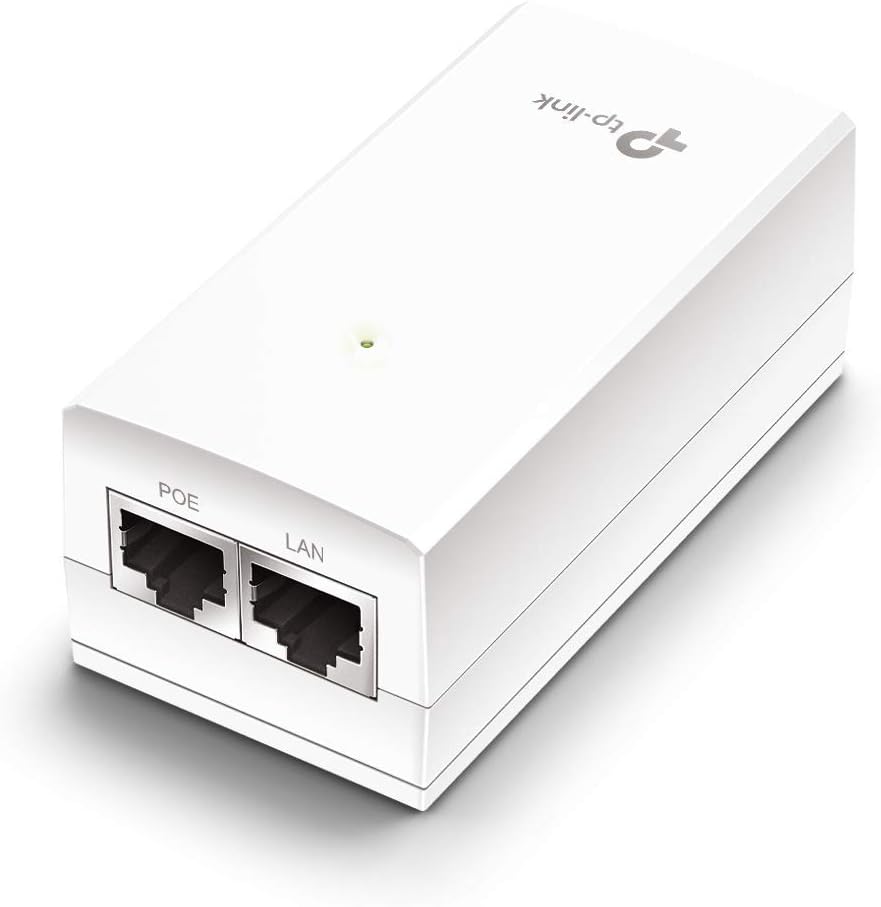
The TP-Link TL-PI30G is a conventional 30-watt Gigabit POE+ injector with a 4.5 rating. It cleanly addresses a common networking problem: adding POE capability to an existing non-POE switch or device without replacing that equipment. The result is a simple way to extend a network to locations that lack convenient power.
We may earn a commission when you buy through this link, at no additional cost to you.
One Gigabit Ethernet input and one Gigabit Ethernet output support full-speed wired connectivity, while the injector delivers power and data over a single cable for a stated maximum of 100 meters. Automatic detection handles 30-watt 802.3at endpoints and remains compatible with 15.4-watt 802.3af devices.
Like other standard POE+ injectors, it cannot power equipment that requires a POE++ budget. It also needs access to an outlet, although placing the injector at the network source allows the only in-wall run to be a standard Ethernet cable. No software installation or configuration is listed as necessary.
The TL-PI30G is a well-rounded recommendation for small offices, homes, and surveillance installations using 802.3at or 802.3af devices. It combines familiar TP-Link networking positioning with sufficient power for most mainstream POE+ endpoints and a reach suitable for remote placements.
The injector's main benefit is infrastructure reuse. A non-POE network port can feed the injector, allowing the attached endpoint to receive both power and data over the outgoing Ethernet cable.
Auto-detect functionality simplifies connection to both 802.3at and 802.3af equipment. It reduces manual power selection while preserving compatibility across common POE device classes.
We may earn a commission when you buy through this link, at no additional cost to you.
The correct injector depends primarily on endpoint power, POE standard, cable distance, and installation environment. Review the device's electrical requirements before considering features, and choose a model whose stated output and standards provide a safe margin.
Begin with the receiving device's stated power requirement. A 12-watt injector may suit a lower-power endpoint, while a 30-watt model covers common 802.3at equipment. Devices requiring 60 or 95 watts need a suitable 802.3bt POE++ injector. The injector's maximum output must be at least as high as the endpoint's demand, and the power budget should not be confused with the data-transfer rate.
IEEE 802.3af generally corresponds to up to 15.4 watts, 802.3at to up to 30 watts, and 802.3bt to higher POE++ power classes. Some injectors also support passive POE, but that does not guarantee compatibility with every device. Review voltage, polarity, detection behavior, and the manufacturer's requirements before using an injector with non-standard equipment.
Both the input and output should support Gigabit Ethernet when the endpoint handles high-resolution video, large file transfers, or other bandwidth-intensive traffic. A Gigabit data path protects throughput, although the actual network speed still depends on the upstream switch, router, cable quality, and connected device.
Most listed models support a maximum distance of 100 meters, or 328 feet, for power and data over a single Ethernet run. Longer distances may require a powered switch, repeater, or another networking strategy. Good-quality Ethernet cabling, correct terminations, and the absence of unnecessary intermediate connections all help preserve reliable performance.
Every injector needs local AC power. A model with an integrated power supply is more compact and portable, while a permanently mounted injector may benefit from a metal enclosure and wall bracket. Think about where the outlet is located, whether it can remain continuously connected, and whether the injector will be exposed to heat, moisture, or accidental impact.
Automatic detection and sensing features can simplify installation and help protect equipment from excessive or incorrect power. Backward compatibility is useful in mixed networks, but the safest approach is to use an injector explicitly compatible with the endpoint's standard. Avoid relying on passive mode for unknown or unusually configured devices.
A compact adapter works well for temporary setups and locations with limited space, while a wall-mountable model suits permanent installations. Metal enclosures may be preferable in equipment rooms, and flame-retardant housing can be reassuring. Indicator LEDs are also useful for confirming power and POE output, especially when the endpoint is remote from the installer.
If the deployment includes a particular camera, NVR, access point, or managed-switch ecosystem, verify any stated brand compatibility. Government buyers may also need NDAA or TAA compliance, but the product information limits some of these claims to the United States and Canada. Procurement requirements and organizational standards should be checked against current documentation.
First, identify the source and endpoint. Connect the Gigabit Ethernet input to a live non-POE switch, router, or network port, and connect the POE output to the supported endpoint. Check the endpoint's power class, voltage, and connector requirements before applying power. Never substitute a passive-POE injector for a device whose installation instructions call for a specific IEEE standard.
Next, place the injector where it can use a suitable outlet without creating a hazardous or exposed arrangement. Connect the AC lead, allow the injector to start, and observe its power and POE indicators. If the endpoint does not power up, reseat the Ethernet connections and verify the source port and device requirements. Do not repeatedly power-cycle the unit if the LED pattern indicates a fault or incompatible endpoint.
For care, keep the injector unobstructed, away from standing water, excessive heat, and combustible materials. Dust can accumulate around vents and connectors, so disconnect power before cleaning. Periodically inspect the Ethernet cable for damaged jackets, loose plugs, and sharp bends. A cable-management plan reduces strain and preserves reliable data and power transmission over long runs.
A Gigabit POE injector adds power to an existing non-POE network connection while carrying Gigabit data over the same Ethernet cable. It is commonly used for IP cameras, wireless access points, VoIP phones, and other POE devices installed where a nearby electrical outlet is unavailable. The unit connects between the network source and the endpoint.
The principal difference is available power. Standard 802.3af POE supports up to 15.4 watts, 802.3at POE+ supports up to 30 watts, and 802.3bt POE++ can provide higher budgets. Always match the injector to the endpoint's required class rather than choosing solely by cable speed or port naming.
An injector serves one connected POE device and does not provide the multiport capacity of a POE switch. It is ideal when only one remote endpoint needs power, because a small adapter can be less wasteful and simpler to deploy. Multiple endpoints usually make a suitable POE switch or another centralized power solution more practical.
The listed injectors generally support up to 100 meters, or 328 feet, over a single Ethernet cable. The full distance depends on correct cabling, installation quality, and compatible devices. Longer runs may require networking extenders, a repeater, or a powered switch rather than a direct injector connection.
A standard quality Ethernet cable is normally used because POE carries power and data on the same conductors. However, the cable should support the intended Gigabit bandwidth and comply with appropriate Ethernet wiring standards. Very long, poorly terminated, or damaged cables can cause connectivity problems or prevent reliable power delivery.
No. Passive POE lacks some of the negotiation and protection features found in IEEE-compliant injection, and the required voltage and polarity must match the endpoint. A device designed for 802.3af or 802.3at may not work correctly with a passive adapter. Check the device documentation and use the compatible standard whenever possible.
The input port receives network data and connects toward the switch or router. The POE output port sends data to the endpoint while adding the electrical power supplied by the injector. Connecting the source and endpoint to the wrong roles prevents normal operation, so the labels and directions should be checked before installation.
These products are single-port injectors, so each powered endpoint requires its own injection point. If several devices need power, choose a multiport POE switch or a smaller POE switch with adequate per-port and total power budgets. A single injector should not be split through an unpowered or unsupported passive distribution arrangement.
The Omada PoE160S is the strongest general recommendation because it combines a 30-watt budget, Gigabit ports, automatic detection, and 100-meter reach in a straightforward package. TRENDnet's TPE-119GI is the premium choice for demanding 802.3bt devices, while the Omada POE2412G is a focused budget solution for compatible lower-power equipment.
Prioritize the endpoint's required POE class, voltage, and power demand before considering convenience features. Confirm that the injector has Gigabit input and output, supports the necessary cable distance, and is appropriate for passive or IEEE-standard operation. Physical design, mounting, indicators, and procurement compliance become important after the core electrical requirements are satisfied.
Ratings, specifications, availability, and market conditions can change, so readers should check the current product listing and user feedback before purchasing. Confirm the current requirements of the device being powered, use suitable Ethernet cabling, and select the smallest injector class that safely covers the installation.