
Garden Netting Pest Barrier
4.6Editor score
Compact four-by-ten-foot size
UV-stabilized HDPE construction
Lightweight 40-mesh barrier
Explore the best garden netting for raised beds, comparing mesh sizes, coverage, materials, fit, installation methods, and protection features.
Garden netting for raised beds creates a practical barrier against birds, insects, rabbits, and other hungry visitors while allowing sunlight, air, and water to reach crops. A worthwhile cover should balance a sufficiently fine mesh with enough coverage for the bed, plants, and seasonal growth. For example, a 4-foot-wide bed requires more material than a narrow planter and may benefit from a fitted cover with an adjustable closure.
The products in this guide were compared using the information supplied by their listings, focusing on dimensions, mesh construction, material, permitted light and airflow, installation options, and intended uses. The list covers flexible netting that can be cut and draped over beds or hoops, a fitted design for a specific raised-bed size, and a larger-mesh alternative primarily suited to larger animal barriers. It also distinguishes fine insect protection from broader wildlife deterrence.
Each review explains which type of raised-bed gardener is most likely to benefit from a particular option. Ratings reflect the supplied customer feedback, while practical trade-offs help distinguish a compact budget choice from a larger roll or a tailored premium cover. Product availability and prices can change over time, so check the current listing before purchasing and confirm the measured bed dimensions first.
4.6Editor score

4.5Editor score

4.2Editor score
The comparison below highlights the dimensions, mesh approach, material, and practical advantage of each option, helping you match a cover to the size and pest pressure of your raised beds.



The Alphatool two-pack provides two 10-by-6.5-foot sheets of ultra-fine garden netting, offering a flexible way to protect raised beds, greenhouse areas, and individual plants. Its supplied rating is 4.5, and the strongest qualities are its adaptability, visibility, and ability to allow water, air, and light through the dense white mesh. The netting can also be trimmed to fit irregular bed layouts.
We may earn a commission when you buy through this link, at no additional cost to you.
Each panel is broad enough to serve as a low tunnel over a compact bed or as a cover for a larger group of plants. The PE material is described as sturdy, durable, and reusable when properly preserved. Because the mesh is see-through, a gardener can inspect plant growth without removing the cover, and watering can take place directly through it. A cut-to-size design also makes the two panels useful for separate beds rather than forcing them into one standard shape.
The principal compromise is that the package contains netting only, not the poles or hoops needed to create a rigid enclosure. A loose sheet can catch wind or leave small openings unless its edges are carefully anchored with soil, stones, staples, or clips. The ultra-fine opening may also be more than a gardener needs when birds and larger animals, rather than tiny insects, are the only concern. Even so, the flexible sizing makes the pack broadly useful.
This is a strong general recommendation for gardeners who want an adaptable cover without a complex frame. It works especially well for small or medium raised beds, seedlings, leafy vegetables, and flowers that need protection without a solid row cover. Choose it when fine mesh, low weight, and straightforward installation matter more than having poles included in the package.
The cuttable panels can conform to a single bed, split into two covers, or combined around multiple plants. This makes the pack practical when bed dimensions do not match standard accessories.
The mesh permits light, air, and water to pass through, so routine irrigation and liquid feeding can occur without repeatedly removing and refastening the barrier.
We may earn a commission when you buy through this link, at no additional cost to you.
The KLEWEE 10-by-50-foot roll is designed for gardeners who need substantial coverage and a fine physical barrier. Its supplied rating is 4.5. The listing highlights an 0.8-by-0.8-millimeter mesh with 80 mesh per inch, creating a close barrier against birds and small garden animals while retaining enough transparency to observe plant health.
We may earn a commission when you buy through this link, at no additional cost to you.
The generous length allows one material to cover a large crop, create a tunnel, or be divided among several raised beds. It is suitable for vegetables, flowers, berries, fruit trees, and other crops, including tomatoes, broccoli, cauliflower, pumpkins, blueberries, figs, and cherries. The lightweight stabilized PE material can be placed directly over plants, and the listing says it can be reused for longer-term protection when handled carefully.
A roll this large can be more than a compact urban gardener needs, and proper installation remains important. The net should be secured with stones, soil, or stakes so that it does not lift in wind or leave a route for animals. The fine mesh is more specialized than a broad 3/4-inch fence net, so buyers seeking only a barrier against larger animals may find a coarser and quicker-to-install option more suitable.
Overall, this is an attractive choice for extensive raised-bed projects, multiple beds, and gardeners who want one roll to cut into many shapes. It combines fine exclusion with low weight and good visibility. Choose it when coverage area is a priority and you are comfortable anchoring the material around plants.
The 50-foot length provides enough material for several raised beds, individual plant covers, or a larger enclosure. It is a practical way to standardize protection across a substantial garden.
At 0.8 millimeters, the openings are substantially finer than those of conventional fencing mesh, making this roll more appropriate for small pests and bird exclusion.
We may earn a commission when you buy through this link, at no additional cost to you.
The RIFNY set includes two 10-by-33-foot netting pieces in a single package, giving raised-bed gardeners a generous amount of fine material. Its supplied rating is 4.4. The oblong mesh is described as 0.04 inches, while the overall product emphasizes a combination of insect, animal, ultraviolet, and frost protection without blocking the movement of air, water, and light.
We may earn a commission when you buy through this link, at no additional cost to you.
Two pieces can be used over separate beds, joined to create a larger tunnel, or cut into custom covers. Installation is straightforward: the mesh can be placed over the crop, weighted at the edges with stones or soil, or attached with garden stakes, steel staples, and clips. Its transparency allows close monitoring without disturbing the cover, and liquid feed or water can be applied through the openings.
A clarification in the product information is worth noting: this is one package containing two 10-by-33-foot nets, not two separate retail packages. Buyers should also consider that the very fine construction can be more delicate than heavier fencing mesh. The listing recommends folding and storing the material away from sunlight and humidity when it is not being used.
This option is well suited to gardeners managing several raised beds who want more coverage than a small roll provides but do not need a rigid enclosure. It is especially relevant for vegetables, flowers, tomatoes, peaches, cherries, and grapes. Choose it for adaptable fine-mesh coverage and straightforward ground-level installation.
Because air, rain, and liquid feed can pass through, the netting can remain in place during watering and routine plant maintenance, reducing disturbance to covered crops.
Gardeners can use stones, soil, stakes, staples, or clips. The variety of methods makes it easier to secure the netting on different bed edges and soil conditions.
We may earn a commission when you buy through this link, at no additional cost to you.
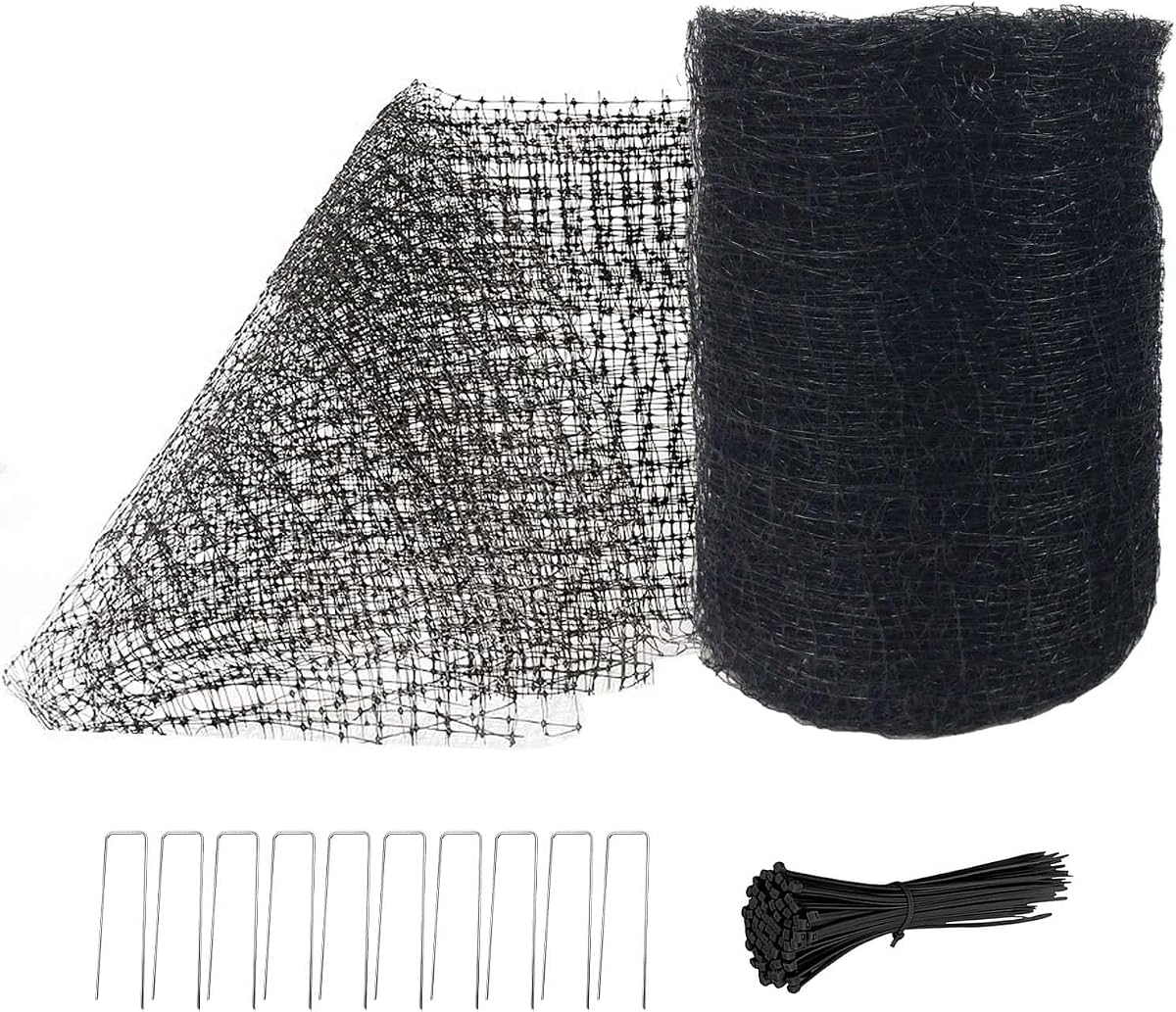
The 4-by-10-foot Garden Netting Pest Barrier is a compact option for small raised beds, garden hoops, and individual crops. It carries the highest supplied customer rating in this group at 4.6. Its 40-mesh HDPE construction is described as UV resistant, strong, and light enough to place safely over vegetation without removing it for watering.
We may earn a commission when you buy through this link, at no additional cost to you.
The net is intended to discourage pests including cicadas, carrot fly, aphids, and various animals. Air, water, and light enter easily, allowing the cover to remain functional during normal care. Because the material can be cut into different sizes, a gardener can tailor it around a smaller bed, a row of seedlings, or a cage rather than using an oversized sheet.
Its most obvious limitation is coverage. A four-by-10-foot panel is the smallest listed product and may not span a common four-by-eight-foot bed without leaving gaps or being stretched. Joining multiple sheets is possible, but it adds work and creates additional edges that need securement. The tighter selvedge is designed to resist unraveling, although physical durability still depends on handling and anchoring.
This is a sensible budget pick for a small bed, one section of a larger garden, or a gardener who wants a compact barrier rather than a large roll. Its strong rating, UV-stabilized material, and three-year warranty make it an attractive entry-level option. Buy it when its listed dimensions closely match the area you need to cover.
The compact sheet is easier to position, cut, and store than a large roll. That makes it convenient for protecting a single bed section or a group of young plants.
UV-stabilized HDPE and a tight selvedge support continued outdoor use. The listed three-year warranty also provides reassurance beyond the basic description of the material.
We may earn a commission when you buy through this link, at no additional cost to you.
SnugNiture offers a 10-by-33-foot sheet of ultra-fine netting with a supplied rating of 4.3. Its 0.1-by-0.1-millimeter square mesh is intended to protect vegetables, fruits, and flowers from small intruders. The PE mesh is described as waterproof, sunproof, resistant to deformation, and suitable for long-term outdoor use.
We may earn a commission when you buy through this link, at no additional cost to you.
The product weighs approximately 1.23 pounds, according to the supplied listing, so it can be laid directly over plants without creating a heavy burden. Water, sunlight, and air pass through the square openings, reducing the need to remove the cover during irrigation. It can be trimmed to any size, then laid flat with enough slack for growth and secured using soil, stones, or nails.
The long sheet is versatile but not fitted to a particular bed, so obtaining a wrinkle-free, gap-free cover depends on correct placement and anchoring. The instructions specifically advise leaving enough slack as plants develop, which helps prevent the mesh from resting too tightly on tender growth. It is also marketed for use around doors, windows, ponds, or swimming pools, giving it value beyond the garden.
This is a good match for gardeners who want a lightweight, long roll of very fine mesh and may also need it for household or pond applications. It is less convenient for someone seeking a structured enclosure or a cover known to fit a bed exactly. Choose it for flexible coverage and easy handling.
The low weight allows the mesh to rest over plants without heavily pressing them down. Leaving slack as growth develops helps preserve space around leaves and stems.
The listing includes screen and pond applications, so this net may serve as a multipurpose household and outdoor barrier when garden coverage is not required.
We may earn a commission when you buy through this link, at no additional cost to you.
The 10-by-33-foot Ultra Fine Pest Barrier is a flexible option designed for vegetables, fruits, flowers, and crops. Its supplied rating is 4.3. The oblong opening construction is listed at approximately 0.8 by 1 millimeter, creating a fine physical barrier while allowing the movement of air, moisture, and light.
We may earn a commission when you buy through this link, at no additional cost to you.
The product can be placed directly over plants and secured with stones, soil, or stakes. It may also be cut to fit particular beds, trees, or shrubs, including peaches, cherries, grapes, and tomatoes. Because watering and liquid feeding can be performed through the mesh, a gardener can maintain consistent coverage without removing the barrier for every care task.
The listing describes the material as stabilized PE that is durable and reusable for long-term use. Nevertheless, a fine net benefits from careful handling, and secure anchoring remains essential. Wind can lift lightweight material, while a small gap along the bed edge may provide an entry route. The cover also does not include a frame, so hoops or another support must be added if a tunnel shape is desired.
This net is a straightforward choice for a large bed or group of crops where fine protection and ease of cutting are priorities. It balances coverage size with the ability to work directly over plants. Consider it when you want a reusable, translucent barrier without needing a tailored enclosure.
Air and moisture pass through the fine oblong openings, allowing irrigation and feeding while the cover remains secured around the crop.
The net can be cut for smaller raised beds or draped over trees and shrubs. Ground-level anchoring keeps the setup approachable for temporary seasonal protection.
We may earn a commission when you buy through this link, at no additional cost to you.
AlpineReach provides a 10-by-34-foot roll of 0.8-millimeter ultra-fine mesh intended for raised beds, hoops, frames, and greenhouse use. Its supplied rating is 4.2. The product description emphasizes lightweight HDPE construction, reusable performance, and a structure that lets light, air, and water pass through the covering.
We may earn a commission when you buy through this link, at no additional cost to you.
The net can be draped directly over a bed or shaped over hoops and frames, giving a gardener more installation options than a fitted enclosure. It is designed for vegetables, fruit, herbs, seedlings, and delicate new growth. Water can be applied directly through the material, and the fine mesh provides close coverage while remaining manageable in the garden.
As with other loose netting, the quality of the installation depends on how evenly the material is spread and secured. The AlpineReach listing does not mention included hoops, stakes, or fastening accessories, so those may need to be sourced separately. The 10-by-34-foot dimensions also require a second measurement of the bed and available coverage area before cutting.
This is a versatile option for gardeners who may move between low covers and hoop tunnels or who want one material for several raised-bed applications. It is particularly appropriate for protecting seedlings and tender crops while maintaining ventilation and watering access. Choose it for flexible HDPE coverage and a clearly stated fine-mesh size.
The same sheet can accommodate different growing arrangements, making it useful for gardeners who transition between direct covers and supported tunnels.
The 0.8-millimeter mesh allows essential light and air to pass through, helping plants remain covered while still receiving natural growing conditions.
We may earn a commission when you buy through this link, at no additional cost to you.
This fitted two-pack is designed specifically for 8-by-4-foot rectangular raised beds with a listed height of one foot. Its supplied rating is 4.2, but it offers the most purpose-built installation in the group. The tailored dimensions aim to provide full coverage without excess mesh, creating a tidier enclosure than a loose sheet.
We may earn a commission when you buy through this link, at no additional cost to you.
An integrated heavy-duty drawstring is the standout feature. The cover slips over the bed and the string tightens at the base, helping it remain in place during wind. The mesh is described as tearproof, weather resistant, and reusable. It remains breathable and allows sunlight, air, and moisture to reach the plants while blocking birds and larger garden intruders such as squirrels, chipmunks, and rabbits.
The main limitation is specificity. This cover is intended for a particular 8-by-4-foot rectangular bed and a one-foot height, so it will not accommodate a square bed, a wider bed, or a taller frame without modification. The drawing still offers the benefit of a more secure perimeter than a draped net, but users should verify all three bed measurements before ordering.
This is the best choice for gardeners with matching raised beds who prioritize a neat, secure fit and want to avoid anchoring loose edges. The two-pack can cover two compatible beds, while the drawstring simplifies seasonal installation. Choose it when the dimensions align exactly and convenience matters as much as fine-mesh protection.
The integrated drawstring tightens around the base of the bed, reducing gaps and helping the cover resist displacement better than an unsecured draped sheet.
Because the cover is made for a specific bed size, there is less measuring, cutting, and trimming. Verify the bed length, width, and height before purchase.
We may earn a commission when you buy through this link, at no additional cost to you.
The Feitore 7-by-100-foot roll is built for larger-animal and perimeter protection rather than extremely fine insect exclusion. It has a supplied rating of 4.3, a 3/4-inch square mesh, and a black polypropylene construction. The listing says the material is lightweight yet heavy duty, resistant to tearing, rust, and rot, and reusable for longer periods.
We may earn a commission when you buy through this link, at no additional cost to you.
The long roll can surround a substantial group of raised beds, enclose shrubs and fruit trees, or form a broad barrier against deer, dogs, birds, and other animals. Reinforced edges help the material remain intact when it is tensioned. Ten installation nails and 50 cable ties are included, providing basic fastening options, while the product can also be cut to custom lengths with scissors.
Stakes or posts are not included, so a rigid fence installation requires additional supports. The 3/4-inch openings are much larger than those of ultra-fine garden netting; this makes installation easier but means it is not the right barrier for tiny insects. Its suitability for insects, pond and pool use, or other specialized applications should be judged against the opening size and intended purpose.
This is the appropriate choice for gardeners whose primary concern is keeping larger animals away from crops, particularly when a long perimeter barrier is needed. It can also protect tomatoes, strawberries, blueberries, figs, and cherries. Choose it for animal deterrence and flexible installation rather than for the most insect-resistant fine mesh.
The 100-foot length is suited to enclosing multiple beds or larger garden areas. The included nails and cable ties help begin the installation, although proper posts or stakes are still necessary.
Polypropylene construction and reinforced edges target larger garden intruders. It is a more substantial barrier choice than fine netting intended only for insects and small birds.
We may earn a commission when you buy through this link, at no additional cost to you.
The Jevrench 4-by-25-foot row cover combines a narrow width with a useful length for raised beds and plant rows. Its supplied rating is 4.4. The ultra-fine mesh is listed at approximately 0.8 by 1 millimeter, and the transparent PE material is described as twice as thick as ordinary garden netting, with good elasticity and toughness.
We may earn a commission when you buy through this link, at no additional cost to you.
The cover allows sunlight, rain, and air to pass through, so it can remain in place during watering and across different growing seasons. It can be cut into different sizes for various beds and plants. The listing says that, with proper maintenance, it can last three to five years, making careful storage and setup important parts of obtaining that potential lifespan.
The four-foot width may be perfectly suited to a single narrow bed, but it can be too short for a broad raised bed without joining pieces. As a loose panel, it also needs securement around the edges so animals cannot push underneath and wind does not lift it. The benefit is that it remains less bulky and more manageable than many large rolls.
This is a good middle ground for gardeners with a narrow raised bed or a long row of plants who want a fine, reusable cover. It is less suitable for a broad bed requiring a full-width span, but it can be cut and combined as needed. Choose it for manageable fine-mesh protection and long-term seasonal use.
The tough, elastic PE construction is intended to withstand handling and sunlight over multiple seasons. Folding it away from moisture and direct storage conditions helps preserve its condition.
The 25-foot length suits a long single row, while the cuttable material can be divided into smaller covers for separate crops and containers.
We may earn a commission when you buy through this link, at no additional cost to you.
The right choice depends on bed dimensions, the pests causing damage, and how much setup effort you want to manage. Use these factors to balance coverage, mesh tightness, durability, and installation convenience.
Measure the length, width, and height of each raised bed, then account for plants that will grow above the soil. Flexible netting can be cut and draped, but it still needs enough material to reach the ground around the perimeter. A fitted model only makes sense when the bed matches its stated dimensions, while a narrow panel may work for a single row but not an entire wide bed.
Ultra-fine netting is appropriate when small insects, birds, and small animals are the concern. Coarse three-quarter-inch mesh creates a larger barrier against deer, rabbits, dogs, and similar animals but will not exclude many insects. Inspect the actual mesh opening, consider the pests present, and avoid assuming that a broadly labeled garden net will stop every unwanted visitor.
A useful cover should admit light, air, and water while maintaining a physical barrier. Transparent or see-through material makes it easier to inspect plant health without lifting the net. Permeability also allows irrigation and liquid feeding through the mesh, simplifying care and reducing the chance that a forgotten cover traps excess moisture against foliage.
Loose sheets are versatile and inexpensive, but every edge must be secured with soil, stones, staples, clips, or stakes. Hoop and frame systems create a useful tunnel shape but require separately purchased supports. Fitted covers with drawstrings are convenient when their dimensions are an exact match, because the closure can reduce gaps and resist wind without extensive trimming.
HDPE and PE are common in the listed products, but construction details still matter. Look for UV stabilization, reinforced selvedges, tight weaving, and a material described as tear-resistant or reusable. A net that remains exposed to sunlight, rain, and wind should also be light enough to handle without tearing and sturdy enough at the edges where tension and repeated fastening occur.
Netting that can be folded and reused across seasons offers more flexibility than a disposable cover. Before storing a fine mesh, remove excess soil and plant debris, clean it gently, dry it fully, and keep it away from prolonged sunlight and humidity. A fitted cover should also be emptied and dried before folding so retained moisture does not create mildew or damage the mesh.
Do not pull netting tightly over a crop. Leave enough slack for leaves, fruit, and stems to develop without contacting the mesh, particularly for fast-growing or tall plants. Fine netting can trap leaves if it is stretched, while a tunnel over hoops gives more vertical space. Check the crop regularly and adjust or raise the cover as growth changes.
A large roll may be more economical for several beds because it can be divided into different covers. By contrast, a compact panel is easier to handle for one small bed. Two-piece sets offer a middle ground, while fitted two-packs simplify installation for matching beds. Compare total coverage, not just the size of a single panel, and think about how you will store any unused material.
Begin by cleaning the bed and supporting nearby plants before installing the net. Measure the bed, inspect the mesh for damaged areas, and trim the material to the required shape. Cut away from any finished reinforced edge where possible, because the selvedge is intended to remain intact. If using hoops or a frame, position the support first and make sure it will hold the cover without pressing against the crops.
Drape the netting over the plants or frame with enough slack for continued growth. Anchor each edge using stones, soil, staples, clips, or stakes, paying particular attention to corners and gaps beneath the cover. For a fitted drawstring model, place the cover over the bed and pull the string tightly around the base. Check the entire perimeter after wind or watering, since a loosened edge can quickly undo a careful installation.
Water through the mesh when possible and inspect plants regularly without removing the cover. Clean off debris when the net is no longer needed, let it dry completely, and fold it loosely for storage away from sunlight and humidity. Avoid unnecessary pulling and snagging, repair small tears promptly, and replace netting that becomes brittle, distorted, or too damaged to retain a secure barrier.
The best option depends on the bed dimensions and the pests involved. Fine PE or HDPE mesh is versatile for insects, birds, and small animals, while a fitted drawstring cover is convenient for a matching 8-by-4-foot bed. A coarser barrier is more appropriate when deer, rabbits, or dogs are the main concern.
It is best not to pull netting tightly against growing plants. Leave enough slack for leaves, stems, and fruit to develop without contacting the mesh. A hoop-supported tunnel provides more vertical room, while a loose cover should be adjusted upward as the crop grows.
Yes, all of the listed fine-mesh products are described as allowing water to pass through. This makes it possible to irrigate or apply liquid feed without removing the cover. Water the soil directly and check that runoff is not collecting heavily against the netting or bed edge.
Anchor the edges firmly with stones, soil, staples, clips, or stakes, paying extra attention to corners and the side facing prevailing wind. A fitted model uses a drawstring around the bed base, while a loose cover can be tightened by burying the edge beneath soil or mulch. Recheck anchors after a strong gust.
Ultra-fine mesh with openings around 0.8 millimeters is substantially more restrictive than three-quarter-inch fencing mesh. However, no mesh specification alone guarantees exclusion of every insect. Match the material to the target pests and keep the cover taut, correctly sized, and free of gaps.
Several listed products are explicitly described as reusable, provided they are handled and stored correctly. Remove debris, clean and dry the net, then fold it away from direct sunlight and humidity. Replace it if sunlight makes the mesh brittle or if repeated use has caused tears or distorted edges.
No. Loose netting can be draped directly over crops and secured along the ground if the plants are low enough and the mesh is not stretched. Hoops are useful for taller plants, row covers, and improved airflow, but they are additional accessories rather than a requirement for every installation.
A 10-foot-wide sheet can cover the width of an 8-by-4-foot bed with material available at the sides. A 4-foot-wide sheet may only cover part of the bed or need to be joined. A fitted cover made for 8-by-4-foot beds is simpler if its height also matches the bed.
The Alphatool two-pack stands out as the most flexible general recommendation because it combines fine mesh, two usable panels, and easy cutting for a variety of bed layouts. The 4-by-10-foot Garden Netting Pest Barrier is a compact budget option for smaller covered areas, while the fitted two-pack offers the most convenient premium choice when the raised bed matches its eight-by-four-foot dimensions.
Prioritize the pest first and the bed dimensions second. Fine mesh is best for insects, birds, and smaller animals; a coarser three-quarter-inch barrier is more practical for larger animals. Within the fine-mesh group, compare the total area, ability to admit light and water, anchoring method, and storage needs. A modest cover that fits securely is often more useful than a large sheet that is difficult to tension.
Finally, check the latest listing information, customer rating, dimensions, included accessories, and current price before ordering. Mesh specifications and packaging can change, so confirm that the product still matches the dimensions and installation style described in this guide. Prices and availability are subject to change.