
SYNCO XTALK XPRO2
4.5Editor score
Two-person focused configuration
MasterFree 2.0 resilience
500m line-of-sight range
Explore the best full duplex wireless headset options, comparing range, team capacity, audio, batteries, monitoring, and key features for professional
A full duplex wireless headset lets team members speak and listen simultaneously, making it far more natural than push-to-talk equipment. The strongest systems combine reliable group networking, noise control, comfortable long-session construction, useful monitoring, and enough battery life to cover demanding workdays in film, broadcasting, events, and other production environments.
The products in this guide were compared using the supplied specifications, focusing on team size, communication range, audio features, operating modes, battery endurance, monitoring connections, microphone design, and practical setup requirements. The list covers two-person kits as well as expandable systems for larger crews, with both single-ear and dual-ear designs represented.
Each review explains who benefits most from a particular model, where it stands out, and which compromises may matter. Ratings reflect the information provided for each listing, while availability and pricing can change, so readers should confirm the current configuration, accessories, and latest specifications before purchasing.
4.5Editor score
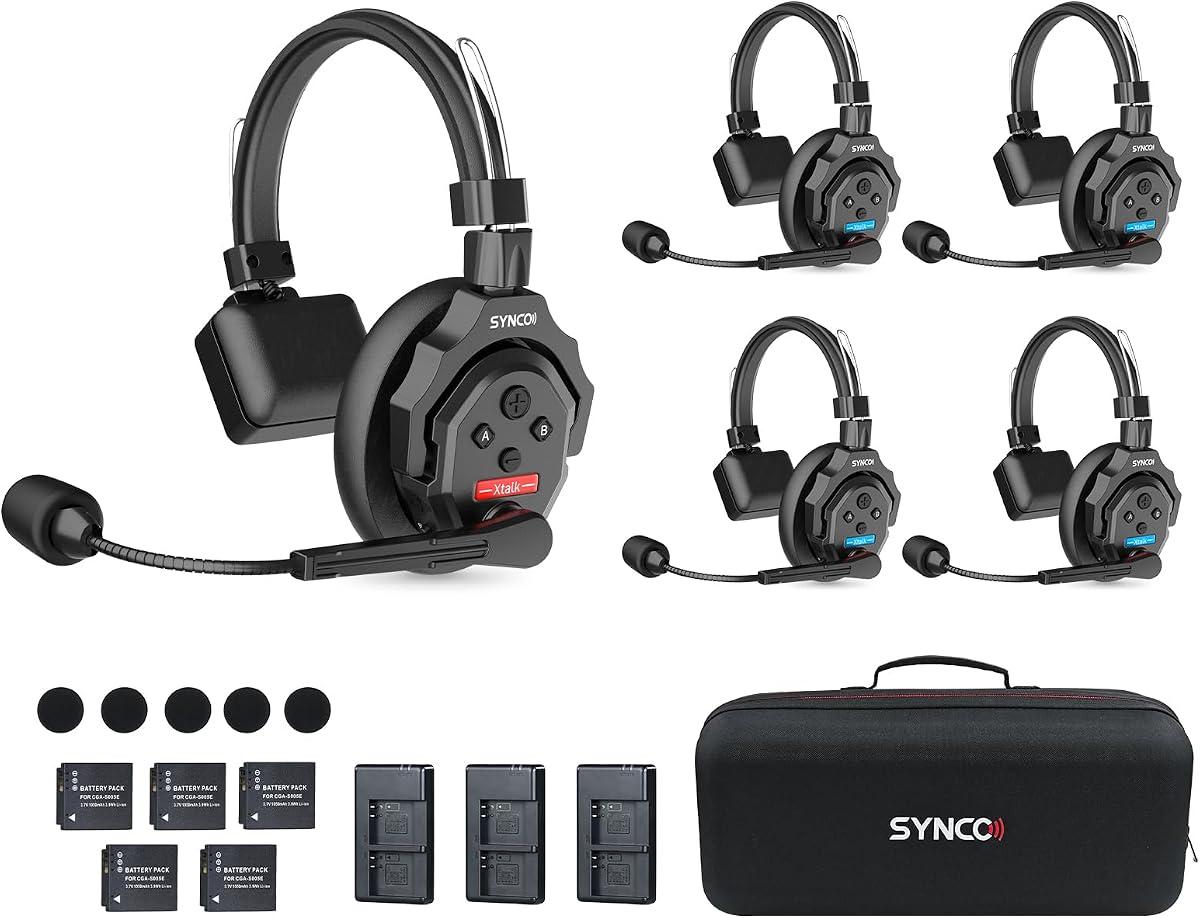
4.5Editor score

4.1Editor score
This side-by-side comparison highlights the major differences among ten full duplex wireless intercom systems, including user capacity, operating range, audio controls, battery strategy, and monitoring support.


The SYNCO XTALK X5 is a well-rounded five-person intercom system with a 4.5 rating, and its strongest attraction is decentralized group control. Instead of tying the entire network to one fixed master, the system can designate any remote as master and can support two independent groups. That flexibility makes it especially useful for crews whose roles or locations change during a production.
We may earn a commission when you buy through this link, at no additional cost to you.
Its communication package covers the needs of active teams. Up to five people can talk at once over a 2.4GHz connection with a stated line-of-sight range of 350 meters. Advanced acoustic echo cancellation spanning 150Hz to 7kHz is intended to reduce echoes, reverberation, and background noise, while the 3.5mm monitoring port allows communication to continue while crew members monitor a camera, recorder, or another audio device.
Battery support is another practical strength. The replaceable battery design offers up to 24 hours of operation, and each battery takes approximately 2.5 hours to recharge. Type-C power support adds flexibility during extended work. The trade-offs are that the decentralized setup may require occasional configuration according to the manual, and the stated range depends on line-of-sight conditions rather than unrestricted distance.
This is our best overall recommendation for small-to-medium production teams that need flexible grouping, simultaneous conversation, and professional monitoring. It suits filmmakers, directors, live-event crews, church production teams, and performers who value a system that can adapt if a master unit is lost or becomes unavailable.
Allowing any remote to become the master reduces dependence on one headset and can help a team recover quickly from an equipment failure. The ability to form two separate groups also supports divided production teams working in different locations.
The 3.5mm input supports real-time monitoring from cameras and recorders while the intercom remains active. This is particularly valuable for directors, supervisors, camera operators, and sound personnel who need one audio source and team communication together.
We may earn a commission when you buy through this link, at no additional cost to you.
The SYNCO XTALK XPRO2 is a focused two-person full duplex system rated 4.5 by users. It is our best budget-oriented top pick because it combines a compact two-person configuration with resilience features normally associated with larger professional networks, including automatic reconnection when the master unit disconnects.
We may earn a commission when you buy through this link, at no additional cost to you.
MasterFree 2.0 is the defining feature. Rather than making the whole system fail when the master drops out, the algorithm is designed to keep the network stable and reconnect automatically without repeated manual pairing. Two external high-gain antennas support a stated 500-meter line-of-sight range, while Boost Mode is available to strengthen the signal in dynamic environments.
The system also offers replaceable rechargeable batteries with more than 24 hours of use, a two-slot charging station, 3.5mm live monitoring, and 2.0 acoustic echo cancellation from 150Hz to 7kHz. Its dominant mode can mute all remotes with one button, and each headset weighs 194 grams with smooth leather and upgraded over-ear cushions.
Choose the XPRO2 when a director and operator, driver and navigator, or another two-person pairing needs dependable hands-free communication without a larger multi-user package. It may not be the simplest choice for a five-person crew, but for a focused duo it offers an unusually complete feature set at a comparatively accessible configuration.
MasterFree 2.0 removes much of the concern associated with a fixed master headset. Automatic reconnection and a one-button dominant control make the system easier to manage during fast-moving production work.
Lightweight ABS construction, smooth leather, and upgraded over-ear cushions are intended to reduce fatigue. The replaceable batteries and compact charging station also help support all-day schedules.
We may earn a commission when you buy through this link, at no additional cost to you.
The GODOX Skytalk Air 5S is a five-user 2.4GHz full duplex system with a 4.1 rating. Its premium case for this roundup comes from the integrated battery ecosystem, flexible role selection, sealed ear-cups, and a comprehensive charging case rather than from a more conventional headset-and-dock arrangement.
We may earn a commission when you buy through this link, at no additional cost to you.
The network supports five users in one call and can divide into two separate groups. As with the strongest decentralized systems, no remote is permanently locked into the master role, allowing another unit to take over if a designated headset is lost, damaged, or depleted. Intelligent environmental noise cancellation and sealed ear-cups support clearer voices in busy locations, while the 150Hz to 7kHz response preserves useful vocal detail.
A built-in FPC antenna, external antenna, and automatic frequency hopping strengthen stability across larger shooting areas, with a claimed 500-meter range. The microphones support full-duplex, mute, and push-to-talk operation, giving teams different ways to manage conversational flow. Its 760mAh battery and energy-saving design provide a stated 20-hour runtime.
The principal downside is its 4.1 rating, which is lower than the ratings attached to several alternatives. The charging and battery-storage case can also be bulkier than a simple headset setup. Even so, it is a compelling premium pick for teams that value field organization, user flexibility, and a battery system designed to travel with the crew.
The supplied case functions as both a charger and battery housing. It can charge as many as eight batteries simultaneously, and a full eight-battery recharge takes approximately five hours.
Users can rotate the boom upward to mute, rotate it downward to talk, or hold the control for push-to-talk behavior. Multiple modes make it easier to match the headset to different stages and communication disciplines.
We may earn a commission when you buy through this link, at no additional cost to you.
The SYNCO XTalk X2 is a two-piece 2.4GHz intercom system with a 4.4 rating. It is a straightforward choice for two-person teams that want decentralized control, long-distance operation, and real-time monitoring without a larger headset bundle.
We may earn a commission when you buy through this link, at no additional cost to you.
The supplied specifications describe a 350-meter line-of-sight range for the system and up to 700 meters when both remotes communicate through a master. MasterFree technology intelligently designates a master and can form groups of two to five people, although the product is sold here as a two-piece set. AEC covering 150Hz to 7kHz targets echoes, reverberation, and unwanted ambient sound.
Its rechargeable batteries support more than 20 hours of operation, and the two-slot charging station simplifies recharging. SmartFlow allows users to communicate with a team while monitoring cameras or recorders through the 3.5mm connection, including the ability to use a wired headset alongside the system.
This model makes sense for a director-assistant pairing, small camera team, or independent creator who mainly needs two headsets. Its two-piece format is less attractive for users who expect several people to join immediately, but the decentralized network and strong monitoring support make it a capable compact option.
The stated range differs depending on whether one or two remotes are connected to a master. Buyers should therefore match the system to their actual crew layout rather than relying on the largest possible number alone.
SmartFlow combines intercom communication with live monitoring from connected production equipment. That versatility can reduce the need to switch between separate monitoring arrangements during a shoot.
We may earn a commission when you buy through this link, at no additional cost to you.
The EARTEC UL2S is a two-person single-ear intercom with a 4.5 rating. It is particularly attractive for teams that need natural conversation without giving up awareness of the surrounding environment, because the wearer keeps one ear open while monitoring the production location.
We may earn a commission when you buy through this link, at no additional cost to you.
Its 1.9GHz DECT 6.0 operation is designed to avoid competition from Wi-Fi, Bluetooth, and two-way radio frequencies. The system offers up to 1,000 feet of line-of-sight range, requires no base station, and does not need an FCC license. Each headset contains its own electronics and rechargeable lithium battery, and the system pairs in seconds without programming or software.
The pivoting noise-cancelling microphone can be worn on either side and automatically mutes when raised. That makes the headset easy to move between users and useful when a crew member occasionally needs to hear the environment directly. The limitation is the stated six-hour talk time, which may be short for a full event or extended production day.
This is a strong recommendation for two-person film and television teams, boat crews, drone teams, sideline coaches, RV operators, warehouse teams, and others who value simplicity and one-ear awareness. It is also field-programmable and expandable to five users, offering a path beyond the included two-person arrangement.
The single-ear layout leaves one ear open to ambient sound. That can help operators hear vehicles, cues, equipment, or nearby crew members while still receiving continuous intercom audio.
Because no base station, programming, or software is required, the UL2S is easy to deploy for spontaneous jobs, remote locations, and small teams that need a dependable two-person system.
We may earn a commission when you buy through this link, at no additional cost to you.
The COMICA Seekcom S1 has a 4.7 rating, the highest listed rating in this group, and combines five-person full duplex communication with unusually detailed monitoring. It is a strong choice for technical production teams that want more visibility into headset status and more connection options than a basic intercom provides.
We may earn a commission when you buy through this link, at no additional cost to you.
CalMix AI and traditional environmental noise cancellation can be switched according to the working environment. A dual-antenna design adjusts its working band to reduce interference, while the stated line-of-sight range reaches 1,640 feet, or 500 meters, in open areas. The 24kHz/16-bit audio specification and 150Hz to 7kHz response emphasize clear speech reproduction.
The OLED display shows signal strength, battery level, volume, and the active noise-reduction mode, reducing the need to infer status from external indicators. TALK, PTT, and MUTE modes accommodate different working styles, while one-key broadcast, one-to-one talk, and recorder mode add operational flexibility. A 3.5mm input, cascade extension, and USB-C digital audio support broaden compatibility.
Its 12-hour battery life is shorter than that of several competitors, but the broad feature set and five-person base capacity make up for that compromise. It is best suited to filmmakers, sound teams, conference operators, broadcasters, and multi-camera crews that value information, flexibility, and expandable team communication.
The OLED interface provides immediate visibility into signal, battery, volume, and noise mode. For busy production environments, this can reduce troubleshooting delays and help users maintain consistent settings.
Recorder mode and one-click ducking suit sound recordists, while USB-C digital audio supports computer communication and firmware updates. These options make the headset more adaptable than a basic production intercom.
We may earn a commission when you buy through this link, at no additional cost to you.
The SYNCO XTALK XMAX5 is a dual-ear system for five people with a 4.4 rating. It stands out for people who prefer fuller sound isolation, a more enclosed wearing design, and the ability to move between intercom communication and phone or music control.
We may earn a commission when you buy through this link, at no additional cost to you.
Well-fitted ear cups are intended to provide clear calls in busy or adverse environments. The system pairs with a phone and supports separate intercom and call/music modes, with the call mode adding noise cancellation and spatial audio. Intercom and call or music modes cannot operate simultaneously, so users must switch between functions.
The communication side includes MasterFree selection, allowing any headset to become master, and group chats for two to 13 people according to the supplied description. Boost Mode and external antennas support a claimed 500-meter range and improved interference resistance. AI noise cancellation uses a chip and dual-microphone algorithm to adjust to ambient noise.
Replaceable batteries deliver up to 24 hours, the two-slot station supports efficient charging, and a 3.5mm jack enables real-time monitoring. This is a compelling option for directors, camera teams, event crews, and users who want a dual-ear headset with phone integration and robust production monitoring.
The enclosed two-ear design offers stronger environmental isolation than a single-ear system. Phone pairing and call mode add value for users who need the same headset for production calls and everyday communication.
MasterFree removes a permanently designated master, while dominant mode can silence connected remotes with one control. These features support faster direction and cleaner production conversations.
We may earn a commission when you buy through this link, at no additional cost to you.
The EARTEC UL422 is a four-person system with a 4.6 rating, and its defining advantage is a complete package containing both single-ear and dual-ear headsets. It gives small crews the freedom to assign each person the wearing style that best suits their role.
We may earn a commission when you buy through this link, at no additional cost to you.
The bundle includes one ULSM single-ear main headset, one dual-ear remote, two additional dual-ear remotes, four rechargeable lithium batteries, a ten-bay multiport charger, and a softside carrying case. The system operates on 1.9GHz to reduce interference with other wireless equipment and allows four users to communicate simultaneously.
Line-of-sight range reaches 1,000 feet, and each headset offers up to six hours of talk time. Noise-cancelling microphones mute automatically when pivoted upward, and the boom can be worn on either side. The system can expand to five users, though the included arrangement centers on four.
Choose the UL422 when a compact film unit, stage team, event crew, or technical team needs more than two people but does not need a large enterprise system. Its accessory completeness, mixed headset styles, and carrying case make it particularly organized for mobile work, provided the six-hour runtime is adequate.
Mixing a single-ear main headset with dual-ear remotes lets users balance environmental awareness and sound isolation. Directors who need to hear the room can use one ear, while crew members wanting stronger isolation can wear both.
The multiport charging dock and softside carrying case support transport and charging across multiple users. A complete four-person package also reduces the need to source matching accessories separately.
We may earn a commission when you buy through this link, at no additional cost to you.
The Saramonic WiTalk-WT2D is a two-person 1.9GHz full duplex system with a 4.2 rating. Its most compelling advantage is scalability: although it starts with two users, it can expand to as many as 17 people using additional WiTalk headsets, a hub base station, and link cables.
We may earn a commission when you buy through this link, at no additional cost to you.
The supplied range is up to 1,312 feet, or 400 meters, under line-of-sight conditions. Its lightweight dual-ear headsets use leatherette earpads and rotating earcups, with a gooseneck microphone lever or button muting and individual volume control. A 65dB signal-to-noise ratio and voice-focused frequency response support clear communication.
Battery life differs by role. Remote headsets are rated for 18 hours, while the master headset is rated for 12 hours when used with one remote. Quick-change batteries, included USB-C charging cables, and USB-C powering help reduce interruptions during longer workdays.
The included lockable, impact-resistant, and watertight hard case is a notable extra for event and film crews. It makes the WT2D a good starting point for a two-person unit that may grow, although reaching its maximum capacity requires buying a hub and additional components.
The two-person configuration provides a simple entry point, while the broader WiTalk ecosystem can accommodate much larger groups. This is useful for productions whose crew size is likely to grow between projects.
The custom hard case is lockable and designed to resist impact and water. It helps protect the headsets and accessories when moving between locations, backstage areas, vehicles, and job sites.
We may earn a commission when you buy through this link, at no additional cost to you.
The Hollyland Solidcom C1 Pro is a four-person double-ear system offering hands-free full duplex communication with a stated 1,100-foot line-of-sight range. It is designed for teams working in challenging environments where both clear speech and low headset weight are important.
We may earn a commission when you buy through this link, at no additional cost to you.
Its dual-microphone environmental noise cancellation reportedly reduces ambient noise by 20dB. The listed audio specifications include a 150Hz to 7kHz response, a 16K sample rate, greater than 70dB signal-to-noise ratio, and less than 1% distortion. Communication uses the 1.9GHz band and is described as encrypted for private conversation.
The PTT control supports long-press-to-talk and release-to-mute behavior, while the microphone boom can also be rotated to change talk and mute states. Each headset weighs six ounces and includes two batteries. That redundancy is valuable for long workdays because it permits field replacement with less downtime.
The main limitation is the absence of a numerical customer rating in the supplied data, making it harder to compare user feedback. For church production, drone teams, filmmakers, boat operators, and sports events, its light construction, 1.9GHz range, and noise control make it a worthwhile four-person option.
At six ounces per headset, the Solidcom C1 Pro emphasizes reduced fatigue. Thicker microphone cushions, ergonomic over-ear pads, and a compact double-ear design support extended use.
Users can long-press the PTT control for walkie-talkie-style behavior or move the boom arm to switch between talk and mute. This lets different crew members choose whichever control is more intuitive.
We may earn a commission when you buy through this link, at no additional cost to you.
The right full duplex wireless headset depends on crew size, working environment, wearing style, communication range, and production workflow. Comparing these factors before buying helps prevent an expensive mismatch between the system and the way a team actually communicates.
Start with the number of people who need to speak and listen at the same time. Two-person systems are convenient for directors working with one operator, drivers, navigators, and small camera pairs. Systems supporting five users or more are better for film crews, stage teams, church production, conferences, and event operations. Pay attention to whether a listed capacity is the number of included headsets or the maximum number of users the platform can support.
Also consider role management. A fixed-master design can be simple for a disciplined team, while a decentralized system lets another headset take control if a master fails. Systems that support two separate groups are useful when different departments must communicate without hearing every conversation.
Published maximum range is only meaningful when the working conditions resemble those used in testing. A stated line-of-sight figure applies to an unobstructed path, while buildings, crowds, vehicles, walls, and rapidly moving teams can reduce reliability. Larger venues should prioritize external antennas, frequency hopping, dual-antenna designs, and strong anti-interference claims.
For outdoor filming, large sports events, and sprawling production sites, a range above 500 meters may be valuable. For smaller sets, vehicle teams, or indoor shoots, a shorter range may be sufficient if the system also has a stable connection and noise-reduction features suited to the environment.
Full duplex describes the conversation method, not automatically the audio quality. Look for noise cancellation, environmental noise control, acoustic echo cancellation, and a frequency response centered on speech intelligibility. Systems offering both AI-based and traditional environmental noise control provide more flexibility when moving from a controlled studio to a loud location.
The microphone design also matters. A noise-cancelling or dual-microphone boom can improve clarity, while automatic mute when the boom is raised helps prevent accidental open-mic conversations. Headset users should test whether voice remains natural in their normal working environment rather than focusing only on maximum technical specifications.
Compare battery endurance against the length of a typical workday rather than selecting on the largest published number. Six hours may be enough for a short event but insufficient for a full shoot day. Systems offering 12, 18, 20, or 24 hours provide more margin, particularly when monitoring and higher output levels increase power use.
Replaceable batteries are worth prioritizing for long sessions. A charging case or multiport dock makes battery management easier, but it should be considered alongside headset weight and transport space. Confirm whether batteries, docks, cables, and spare power supplies are included in the particular package being purchased.
Real-time monitoring lets a director or camera operator hear a camera, recorder, or other source while remaining connected to the crew. A 3.5mm connection is common for production monitoring, while USB-C digital audio can support computer communication, firmware updates, or digital workflows. Recorder mode and one-click ducking may be particularly useful to sound recordists.
Avoid purchasing a headset that cannot meet the crew's broader audio requirements. A product may have excellent intercom performance but lack the input, output, or monitoring behavior needed to combine production sound with team talk. Review connectors and supported operating modes before finalizing the purchase.
Single-ear headsets are often preferred by directors, camera operators, and performers who need to hear the surrounding environment naturally. Dual-ear headsets provide greater isolation and a more enclosed listening experience, which can help users focus in loud settings. Headset weight, cushion softness, boom adjustability, and left-or-right microphone placement all affect long-session comfort.
Look for lightweight materials and a boom that can be pivoted or muted easily. A headset that becomes tiring or shifts under a hat or headset may be less useful despite excellent radio performance. Since comfort is subjective, consider whether the package includes different ear configurations or can be exchanged within the manufacturer's return policy.
Full duplex is valuable when continuous listening is important, but different jobs benefit from additional control. Push-to-talk can reduce interruptions on a busy set, while mute and dominant modes let a director silence the group or focus on one speaker. Boom-arm control is often faster when wearing gloves or working at a distance.
Screen-based systems can provide visible signal, battery, and volume information, while simpler models may rely on LEDs. Consider whether the controls are understandable under pressure and whether software or an app is required for routine functions such as pairing, role changes, firmware updates, or monitoring.
Mobile crews need more than technical performance; they need a practical way to charge, store, and transport the system. Look for carrying cases, multiport chargers, battery indicators, and USB-C charging. A case that doubles as a charger can simplify logistics, although its bulk should be checked against available transport space.
Expansion potential matters when a team may grow. Some two-person products can expand through a hub, remotes, and cables, while others are sold only as a fixed kit. Confirm the maximum supported user count, which additional components are required, and whether expansion preserves the same range and operating features.
Before the first production, charge every headset and battery completely, then pair the units according to the manufacturer's instructions. Confirm the designated master, test the working range at the intended location, and make sure each microphone boom is oriented correctly. A short rehearsal with real crew members is more useful than testing the headsets in an empty room.
During use, establish clear call, mute, and push-to-talk procedures before work begins. Keep the boom close to the mouth, raise it or use mute when not speaking, and avoid covering the headset antenna. Use the real-time monitoring connection when a director needs to hear camera or recorder output, and recheck the signal if the crew moves through obstructions.
After work, disconnect batteries if the manufacturer recommends it, inspect microphones and cushions for damage, and clean the headset with a soft dry or slightly damp cloth. Keep charging contacts clear and store the system in its case away from heat, moisture, and direct sunlight. Replace batteries promptly when runtime becomes inconsistent.
A full duplex intercom lets users speak and listen at the same time, creating a more natural group conversation. Push-to-talk requires holding a control to transmit. Many systems described as full duplex also offer PTT, mute, and dominant modes for situations where continuous open conversation is not desirable.
Capacity depends on the specific system. Several products in this guide are configured for two or four people, while others support five users and can be expanded. A listed maximum may require extra headsets, a hub, or wired cascade accessories, so buyers should verify both the included package and the platform's true expansion limit.
No. Maximum range usually assumes clear line of sight and may decline around walls, crowds, vehicles, or other obstructions. Signal architecture, antenna placement, noise control, team size, and the specific production environment can matter more than a single range figure, particularly in areas with many competing wireless devices.
Single-ear headsets preserve awareness of the surrounding environment and are often favored by directors, camera operators, and performers. Dual-ear headsets provide stronger isolation and are useful in loud locations or for users who want to focus entirely on monitoring. The best choice depends on the role, comfort preference, and working environment.
Many models support real-time monitoring through a 3.5mm connection, allowing team communication to continue while a user hears another source. The COMICA Seekcom S1 also lists USB-C digital audio, recorder mode, and ducking features. Buyers should verify connector type and compatibility with their specific camera or sound equipment.
That depends on the network design. The SYNCO XTALK X5, XPRO2, and XTalk X2 use MasterFree technology, while the GODOX system allows any remote to assume the master role. These features are designed to keep communication available when a designated master becomes unavailable, although users should still test the recovery procedure before an important event.
Start with fully charged batteries, carry replacements for long shoots, and use a multiport charger or charging case where available. Some listed systems provide around six hours of talk time, while others reach 12, 18, 20, or 24 hours. Actual runtime can vary with output level, monitoring use, and environmental conditions, so critical teams should keep a backup plan.
The SYNCO XTALK X5 and GODOX Skytalk Air 5S explicitly support two separate groups. Other systems focus on one main call and offer expansion through additional components. If different departments need isolated conversations, confirm group-control support before purchasing rather than assuming every multi-user network can operate independently.
The SYNCO XTALK X5 is the strongest all-around choice for teams of up to five, combining decentralized master selection, two-group capability, 3.5mm monitoring, and long battery life. The SYNCO XTALK XPRO2 is the most focused recommendation for two people, while the GODOX Skytalk Air 5S stands out through its integrated battery case and flexible networking.
Before buying, prioritize the number of simultaneous users, actual working range, noise-reduction method, and whether monitoring is required. Battery life and wearing style deserve equal attention because a technically capable headset is only useful if the crew can wear it comfortably and keep it powered throughout the job.
Current pricing, package contents, and availability can change, and sellers may offer different headset configurations for the same product family. Check the current listing, included accessories, expansion requirements, warranty information, and compatibility details before placing an order.